Chuck Schuldiner wrote Symbolic around an eight-track recorder he had bought for his Florida home, and the machine changed Death for good. For the first time he could stack guitar harmony on guitar harmony, and some of the melodies that make the album soar were tunes he knew his own throat could never sing. "Some of the melodies guitar-wise are vocal melodies I would have had, if there was a melodic singer in the band," he admitted in 1997.
Nearly everything else about the record was improvised. Death paid for it themselves, got their producer because the usual one was booked, and hired a guitarist and a bassist only weeks before the tapes rolled. Roadrunner then barely pushed it in America, where it sold just under 50,000 copies in its first 12 years. Gene Hoglan says fans hated it. Today it sits at No. 97 on Paste's list of the 300 greatest albums of all time, across every genre.
Album Facts: Symbolic by Death (1995)
| Field | Detail |
|---|---|
| Artist | Death |
| Album | Symbolic |
| Release Date | 21 March 1995 |
| Label | Roadrunner Records |
| Producer(s) | Jim Morris, with Chuck Schuldiner as co-producer |
| Studio(s) | Morrisound Recording, Tampa, Florida |
| Genre / Subgenre | Progressive, melodic and technical death metal |
| Track Count | 9 |
| Total Runtime | 50:36 |
| Billboard 200 Peak | Did not chart |
| UK Chart Peaks | No. 30 on the Official Rock & Metal Albums Chart (1995); No. 66 on the Official Albums Sales Chart (2025) |
| Other Notable Chart Peaks | Netherlands 68 (1995); Germany 35, Finland 37, Austria 64 (2025 reissue) |
| Certifications | None found |
| Estimated Sales | Just under 50,000 in the US by January 2008 (Nielsen SoundScan) |
| Key Singles | None released |
Cultural Context
Death metal looked like yesterday's news by 1995. Pitchfork's Sam Sodomsky later wrote that Symbolic "came and went, dwarfed by post-grunge and the oncoming wave of nu-metal, overshadowed by bigger sellers on Death's new label, Roadrunner, like Machine Head and Sepultura."
Schuldiner wasn't about to follow anybody. He told the band's fan newsletter that "wimp-out", "compromise" and "grunge" were "things that I oppose as a fan and as a musician", and he told Guitar World that modern death metal was "just too limited and safe". He was listening to old Kiss and Iron Maiden, plus the new Dream Theater and Mercyful Fate records, Awake and Time.
Melodic death metal was barely a thing yet. As Hoglan remembers it, "There wasn't a lot of melodic death metal going on at the time. CARCASS was just starting to lean towards that with the 'Heartwork' record." WhatCulture's Matt Mills puts Symbolic "on the cusp of melodic death metal's explosion thanks to names like Dark Tranquillity and At the Gates."
Death Before Symbolic
Florida's Death had been Schuldiner's band from the start ("When I started Death in 1983, I did not plan to be the singer; it just worked out that way," he said), and it never kept a lineup for long. Individual Thought Patterns (1993) paired him with ex-Dark Angel drummer Gene Hoglan and bassist Steve DiGiorgio, with King Diamond's Andy LaRocque guesting on guitar. Its video for "The Philosopher" was ripped apart on Beavis and Butt-Head, though Schuldiner later said, "I definitely don't regret it being on there."
The label situation was grimmer. Death had spent eight years on Relativity, and by 1994 Schuldiner felt the company had given up on metal altogether. "We were the last of any metal or hard rock bands that they had, so for the last album they totally did nothing for," he told Terrorizer. "When we were starting to work on Symbolic, we were still on Relativity, and I remember thinking that it was gonna kill me to give this record to them because I knew they didn't care," he told Guitar World.
The escape route was Roadrunner, already Death's European distributor. Symbolic was technically an option owed to Relativity, which did a deal with Roadrunner to release it, and Roadrunner signed the band for one album only. Self-managed, Death paid for the recording themselves. "For Symbolic, we had to finance it ourselves," Schuldiner said.
Pre-production and the Eight-Track
Two months after the last tour, with Schuldiner deep in writing, DiGiorgio quit. "We really tried to make him stay but he didn't want to," Schuldiner said. LaRocque couldn't commit either. Schuldiner wrote the songs with Hoglan "even before Kelly and Bobby joined the band", the pair "sitting at my house taping the songs on an 8-track recorder."
For a man who had worked out the overdubs for Individual Thought Patterns on "two portable box radios", the new machine was a revelation.
"With the eight-track I could lay down a chord progression, then lay a melody on top of it, then another on top of that. And if it sucked, I could erase it."
Chuck Schuldiner, Guitar World, April 1995
The process left a paper trail that eventually got released. In January 1994 Schuldiner cut a four-track demo of the title track, then called "Symbolic Acts", playing guitar and bass, singing and programming the drums himself. In March 1994 he recorded instrumental demos of "Symbolic Acts", "Zero Tolerance", "Crystal Mountain" and "Misanthrope" with Hoglan programming the drums and DiGiorgio, not yet gone, on bass. Hoglan wrote every drum part himself. "I write the riffs and then give the tapes to Gene and tell him to go with it," Schuldiner explained.
Finding replacements took longer. Schuldiner said he auditioned "hundreds" of guitarists before calling Bobby Koelble, an ex-Azrael player he had met at 16 through a mutual friend at high school and had failed to track down during the previous album. Koelble, a jazz-fusion fan, lived about five minutes away. Friends in the Orlando band Pain Principle supplied the number for bassist Kelly Conlon. Both arrived roughly a month before the sessions, Conlon only three weeks before, so Koelble's input was limited to "some final arrangement".
Creating Symbolic at Morrisound
Scott Burns had recorded Death's previous four albums, but when it came to booking studio time he had "prior obligations". Schuldiner turned to Jim Morris, who co-owned Morrisound Recording in Tampa with his brother Tom and had a background in traditional heavy metal. "My first choice was absolutely Jim, who I definitely wanted to work with for some time now," Schuldiner said. The sessions ran for six weeks.
The brief was a natural, uncompressed sound. "We didn't want it to sound compressed, big drums, real guitars, everything just back to the basics, a real record," Schuldiner told Terrorizer. Compared with the "muddy" guitars of Individual Thought Patterns, he said the new ones were "straighter, sharper." Morris, Schuldiner said, "made the sound immense and spacious."
"In Symbolic, I just wanted to plug in my guitar and play. I didn't want to fool around with the squishing and squashing it with technology."
Chuck Schuldiner, Sentinel Steel, Spring 1997
Pitchfork's Sodomsky notes that the sessions were "longer and more elaborate than any of their previous albums." In the 2016 documentary Death by Metal, Morris recalled trying to find more melody in music that was already full of it: "How do you put more melody into his music? Well, you can't do it with the guitars, he's already really, really melodic." When Schuldiner tried a cleaner vocal, Morris says his reaction was "Oh my god, you can sing." The two talked briefly about a version of the album with traditional singing, but none of it was recorded.
Instead, Schuldiner took more care than ever over his usual rasp, which now sat noticeably higher. He said he had set out to give his vocals proper attention, "to be on par with the music". According to Pitchfork, he used to tell the band, "All the music is done, now I have to ruin it with my vocals."
Behind the kit, Hoglan was at full stretch. "By the time of Symbolic, I was doing a lot of hand stuff as well," he told Modern Drummer, naming Deen Castronovo as a favourite at the time. He has jokingly said he played "lead drums" on the record, and summed up his approach at the time as "My hands are jazz, but my feet are metal."
Personnel and Credits
| Role | Player | Notes |
|---|---|---|
| Core band | ||
| Guitars, vocals | Chuck Schuldiner | Sole songwriter; also co-producer |
| Guitars | Bobby Koelble | His only Death album |
| Bass | Kelly Conlon | His only Death album; joined three weeks before recording |
| Drums | Gene Hoglan | Wrote his own parts; second and last Death album |
| Demo players (2008 bonus tracks) | ||
| Bass | Steve DiGiorgio | March 1994 instrumental demos only |
| Drum programming | Gene Hoglan | March 1994 demos |
| Production and engineering | ||
| Producer, engineer | Jim Morris | Morrisound co-owner; first album with Death |
| Mastering | George Marino | Also remastered the 2008 reissue |
| Artwork | ||
| Cover art, photography | René Miville | Also painted Human and Individual Thought Patterns |
| Design | Patricia Mooney | |
The lineup was a one-off. Conlon was gone before the year was out, and Koelble never recorded with Death again. Hoglan, meanwhile, was let off the leash. "I'm glad that Gene is with me and that on Symbolic he got so much freedom for his instrument, which he deserved a long time ago," Schuldiner said.
The Songs on Symbolic
| # | Title | Writer(s) | Length | Single? | Notes |
|---|---|---|---|---|---|
| 1 | Symbolic | Chuck Schuldiner | 6:32 | No | Working title "Symbolic Acts"; Chuck's favourite track |
| 2 | Zero Tolerance | Chuck Schuldiner | 4:48 | No | Aimed at journalists who "write lies" |
| 3 | Empty Words | Chuck Schuldiner | 6:22 | No | Opening "keyboard" is actually a guitar effect |
| 4 | Sacred Serenity | Chuck Schuldiner | 4:27 | No | About animals, especially his dogs and cats |
| 5 | 1,000 Eyes | Chuck Schuldiner | 4:28 | No | Inspired by a TV documentary on surveillance cameras |
| 6 | Without Judgement | Chuck Schuldiner | 5:28 | No | About public opinion and rumour |
| 7 | Crystal Mountain | Chuck Schuldiner | 5:07 | No | Acoustic outro inspired by Kiss |
| 8 | Misanthrope | Chuck Schuldiner | 5:03 | No | Aliens watching humanity wreck the planet |
| 9 | Perennial Quest | Chuck Schuldiner | 8:21 | No | Longest track; the search for happiness |
Symbolic. Schuldiner called the title track "my most favourite" and said it was "about how an innocent child watches the world, how it is watched by an adult man", a look back at growing up with Kiss records and a mother who bought him his first guitar. He chose the word because it "seemed to me strong enough to title the whole album." Pitchfork singles out the riff "that arrives 45 seconds into the opening title track", and Blabbermouth remembered "a room full of air-drummers mimicking Hoglan's twittering ride cymbals in the thrashy part" in 1995.
Zero Tolerance. The target was the press. Schuldiner said the song was about "people from some magazines who write lies, fabricating and twisting facts", and later added that it was aimed at "a pair of people" in particular. Blabbermouth praised "the crushing doom of the chorus".
"Actually, that's a guitar effect. I told our producer, Jim Morris, that people were gonna think it was a keyboard."
Chuck Schuldiner on "Empty Words", Guitar World, April 1995
Empty Words. No synthesizers appear anywhere on Symbolic. The intro is a clean guitar run through an effect that, in Schuldiner's words, "takes the main root of that chord and stretches it" across four chord progressions. Lyrically it is about broken promises.
1,000 Eyes. A TV documentary predicting cameras "in each street, each house, each flat, each bathroom" gave Schuldiner the idea. Pitchfork notes that its line about "a newfound age of advanced observeillance" now "sounds a little like life online in the 21st century."
Crystal Mountain. The title sounds like fantasy, but Schuldiner said it was about "the troubles we had with our former neighbours in Florida", religious fanatics who were always first to church on Sunday. The acoustic outro was worked out on the eight-track once the song was almost done, inspired by the background acoustics on Kiss's Rock and Roll Over. MusicRadar's Jonathan Horsley hears the influence of European metal bands Sortilège and H-Bomb.
Misanthrope and Perennial Quest. "Misanthrope" imagines "a microgroup of Extra-Terrestrials" watching humans pollute and kill. The eight-minute closer "Perennial Quest" is, in Schuldiner's words, about the search for happiness, and like "Crystal Mountain" it fades out on classical guitar. Paste says it "quakes in its own melody like a pop song stripped for parts, doused in gallons of acid and marinated in arsenic."
Album Artwork
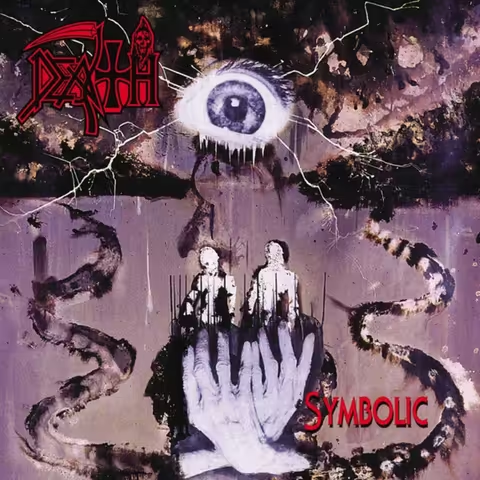
The cover is a painting by René Miville, who had also done Human and Individual Thought Patterns. It shows a cracked, bruised-purple wall split by white fault lines. A huge eye stares out from the top, icicles hanging from its lower lid. Below it, two pale figures stand behind thin vertical bars above an enormous open hand, while dark serpentine trails curl down either side and "Symbolic" sits in red at bottom right.
Top left is the red Death logo with a hooded reaper above the "H". This was the last album to carry that version: the reaper was removed when the logo was streamlined before The Sound of Perseverance. In January 2020 Loudwire reported that Miville's original painting had sold on eBay for $10,100 after 63 bids.
Release and Reception
Roadrunner released Symbolic on 21 March 1995. Schuldiner did about 70 interviews in a week from a New York hotel and initially praised the label, but the goodwill didn't last. There were no singles and no videos. "No videos. We couldn't get the video support," he said in 1997. When Roadrunner lumped the album into a blanket advert alongside its other death metal releases, Pitchfork reports, Schuldiner made an angry phone call.
"It was the most important record in my life at the time. I put a lot of personal stuff in that record."
Chuck Schuldiner, Sentinel Steel, Spring 1997
He was blunter still: "Symbolic, in my opinion, was shit on." It got no further than No. 68 in the Netherlands and No. 30 on the UK rock chart, and in America it sold just under 50,000 copies in its first 12 years.
Not every critic was convinced. Select gave it three stars and noted "lashings of gristly, growling vocals and head-in-the-groin thrashing". AllMusic's Stephen Thomas Erlewine also gave three stars, writing that "some of the riffs are beginning to sound a little tired." Germany's Rock Hard gave it 10/10, and Martin Popoff called it "the band's most impressive and crossover-ish to date." Hoglan remembers the fans' verdict more clearly:
"It was hated. Hated. Hated. Absolutely hated. One hundred percent hated. The only people who didn't hate it were some of the journalists who reviewed it, but the fans hated it."
Gene Hoglan, The Garza Podcast, via Blabbermouth, 2025
Later critics have been much kinder. Blabbermouth gave the 2008 reissue 10/10, Record Collector's Joel McIver called it "as close to flawless as metal gets", and Pitchfork's 2022 Sunday Review scored it 9.1, calling it "the most melodic and refined album of their career". Metal Rules ranked it the seventh greatest extreme metal album, Consequence ranked it No. 9 among its 75 best metal albums, and Paste's No. 97 places it among the best records of any genre.
Touring Symbolic
The new lineup took the album to Europe on the Full of Hate Easter festivals, from the Paradiso in Amsterdam on 13 April 1995 to Katowice ten days later. Soon afterwards Conlon was out. "Gene and Bobby and I decided to expel him from the band," Schuldiner said, taking the blame for hiring him too fast. Brian Benson of Pain Principle took over for the rest of the year.
- Metal To The Masses tour: dates from Rimouski, Canada, on 21 June 1995 to Worcester, England, on 21 October.
- A seven-week North American run with Nevermore.
- Japan in September 1995, the band's first visit, including two nights at Club Citta in Kawasaki.
- A European tour with Benediction that reached the Czech Republic and Portugal for the first time.
Japan fulfilled a childhood dream. Schuldiner had wanted to go ever since seeing pictures of Kiss there, and the last Club Citta show was videotaped. In Portugal, fans thrashing around the tour bus sent one of them "head first" into the windscreen. Luckily, only the window was hurt.
Thirty years later, Death To All, with Hoglan, Koelble, DiGiorgio and singer-guitarist Max Phelps, booked the "Symbolic Healing" tour of North America for 4 to 30 November 2025, with Gorguts and Phobophilic. "30th anniversary of Symbolic, so we're playing it in full," Hoglan told the Dallas Observer.
Reissues and the 1994 Demos
Roadrunner reissued a George Marino remaster on 1 April 2008 with new liner notes by Don Kaye and five demos: the January 1994 "Symbolic Acts" with vocals and the four March 1994 instrumentals with DiGiorgio. Blabbermouth found them non-essential but said "the difference between a drum track programmed by Hoglan and one done by Chuck" was enlightening.
When Relapse announced its reissue programme for Death's catalogue in 2010, Symbolic was left out because Roadrunner still held the rights. Roadrunner's own 30th-anniversary LP, released on 9 May 2025, put it back in the charts: No. 35 in Germany, No. 12 in Hungary and No. 66 on the UK Album Sales chart.
The Legacy of Symbolic by Death
Schuldiner meant Symbolic to be the last Death album. "I thought SYMBOLIC was a great record to leave people with to prepare them for the next journey, 'Control Denied'!" he told the band's newsletter in 1995, and by April 1996 Death was on hiatus. Nuclear Blast wanted another Death record first, so The Sound of Perseverance followed in 1998, cut at Morrisound. Schuldiner described it as "violent like Human, technical like ITP and has the feeling of Symbolic." Control Denied's The Fragile Art of Existence arrived in 1999. Schuldiner died of a brain tumour on 13 December 2001, aged 34.
Asked in 1997 for his favourite Death album, he said: "I would say Symbolic, hands down." Blabbermouth argued that the album helped spawn "a new generation of metallers open to the concept that brutality and melody could work together", and that "if heavy metal was a college course," it would be on the reading list on day one. Pitchfork calls it "an evergreen gateway to the genre" and says Schuldiner remains a figurehead for bands such as Horrendous and Blood Incantation.
Hoglan thinks Death helped create three genres: brutal death metal, technical metal and melodic death metal. He credits Individual Thought Patterns and Symbolic for the last of those. The songs keep turning up in other hands: California's Hemotoxin recorded "Crystal Mountain" in 2021 after playing it live for more than a decade.
Things You Might Not Know About Symbolic
| Fact | Detail |
|---|---|
| Chuck's backup plan | In 1995 Schuldiner told Guitar World that if Death's "light of inspiration" ever started to die down, he would open a restaurant. |
| The dream singer | The same year he named Ronnie James Dio as his first choice to sing his more melodic material, in a project outside Death. |
| The cheaper painting | The seller of the Symbolic original had earlier sold the original Human cover painting for $5,250, about half the price. |
| A band called Symbolic | For the December 2021 Florida tribute shows marking 20 years since Chuck's death, Koelble and Conlon were billed together in a band named Symbolic. |
| Lockdown Zero Tolerance | In August 2020 Hoglan, DiGiorgio, Koelble and Max Phelps released a quarantine performance of "Zero Tolerance". |
| The Dutch run | The album entered the Dutch chart at No. 87 on 15 April 1995 and lasted six weeks. |
| Catalogue number | The original Roadrunner CD was RR 8957-2, and the vinyl pressing RR 8957-1. |
| Gorguts' confession | Luc Lemay, whose Gorguts were booked to support the 2025 tour, said: "Chuck was my idol, my inspiration." |
Listen to the Riffology Podcast
If the story of Symbolic has you reaching for the eight-track, the Riffology podcast digs into the stories behind rock and metal's great records. It is available on all major podcast platforms.
Comments