
By the time Ugly Kid Joe walked into a studio to make their debut album in early 1992, their six-track EP had already gone double platinum, sold over a million copies in the United States alone, and forced Mercury Records to demand a full-length follow-up at a sprint. The band's rhythm guitarist quit mid-session. Their lead singer kept flying home from Ozzy Osbourne's tour to finish overdubs. They were short of songs, so they recorded a Harry Chapin folk standard as "filler" and watched it become their biggest single. And then they got Rob Halford to come in and scream like the devil on a track called Goddamn Devil. America's Least Wanted, released on 8 September 1992, is the sound of a band that had no business being this successful trying very hard not to fall over while it happened.
This is the full story of the album that took a one-EP joke from a Californian student town and put it on the same stages as Ozzy, Def Leppard and Bon Jovi, complete with the censored cover, the SNL cameo, and the Northern Ireland anti-terrorism advert that nobody saw coming.
Album Facts
| Field | Detail |
|---|---|
| Artist | Ugly Kid Joe |
| Album | America's Least Wanted |
| Release Date | 8 September 1992 |
| Label | Mercury Records (Stardog imprint) |
| Producers | Mark Dodson, Michael Dodson, Ryan Dorn and Ugly Kid Joe |
| Studio | Devonshire Studios, North Hollywood, California (1991-1992) |
| Genre | Hard rock, funk metal, alternative metal |
| Track Count | 13 |
| Total Runtime | 59:08 |
| Billboard 200 Peak | No. 27 |
| UK Albums Chart Peak | No. 11 |
| Other Notable Chart Peaks | Austria No. 4, Australia No. 7, Norway No. 8, Germany No. 10, New Zealand No. 13, Switzerland No. 16 |
| Certifications | US 2x Platinum, Australia 2x Platinum, Canada Platinum, Switzerland Gold, Austria Gold |
| Estimated Sales | Over 2 million in the US alone; the band's best-selling album |
| Key Singles | "Neighbor", "So Damn Cool", "Cats in the Cradle" (US No. 6), "Everything About You" (re-promoted), "Busy Bee", "Goddamn Devil" |
From Isla Vista to an EP That Broke Records
Whitfield Crane and Klaus Eichstadt were childhood friends from Palo Alto, California, who got into music together as teenagers and eventually drifted south. By 1989 they had landed in Isla Vista, the noisy student suburb crammed up against the University of California, Santa Barbara, where house parties and student bars provided the kind of low-stakes audience a new band needs. Crane had a band there already; Eichstadt joined, and a string of false starts began. The group ran through the names Overdrive and the gloriously unmarketable Suburban White Alcoholic Trash before settling on the one that stuck.
The name Ugly Kid Joe was a sneer at a specific target. They were booked to open a single show in Santa Barbara for Pretty Boy Floyd, a Sunset Strip glam-metal outfit whose look and posturing the Isla Vista lads found ridiculous. If those bands were pretty, the joke went, this one would be the opposite. Pretty Boy Floyd pulled out and the show was cancelled, but the band kept the name. By 1991, after several lineup changes, they had locked in the five-piece who would record their breakthrough: Crane on lead vocals, Eichstadt on lead guitar, Roger Lahr on rhythm guitar, Cordell Crockett on bass and Mark Davis on drums.
That lineup signed to Mercury Records in 1991 and released a six-track EP in October of the same year. As Ugly as They Wanna Be was supposed to be a calling card. Instead, it detonated. The single "Everything About You" climbed to number three in the UK and number nine on the Billboard Hot 100, was hoovered up by the makers of Wayne's World for an early-1992 sync, and ended up shifting more than a million copies in the United States alone. The EP went on to be certified double platinum by the RIAA, a feat no EP had achieved before.
The band's problem now was that they had a hit, a hungry label, and not enough songs.
"We didn't have enough songs to fill the record, and Mercury/Polygram was so driven to release something. We sat there and told the label, 'Yeah, yeah. We have the songs, no worries.' And we really didn't have enough songs to fill a proper LP."
Whitfield Crane, Survival of the Fittest: Heavy Metal in the 1990s (2015)
The 1992 Landscape
The moment the band walked into the studio could not have been less hospitable to a goofy California hard-rock band. By the autumn of 1992, Nirvana's Nevermind had been at the top of the Billboard 200, Pearl Jam's Ten was an unstoppable slow burn, and Alice in Chains were about to release Dirt. Major labels were quietly burying any act whose hair was higher than its songbook. At the same time, the old guard had not yet conceded the ground: Def Leppard's Adrenalize was a multi-platinum monster, Bon Jovi were lining up Keep the Faith, and funk metal was having its own moment thanks to Faith No More's Angel Dust and the Red Hot Chili Peppers riding BloodSugarSexMagik.
Ugly Kid Joe fitted nowhere and everywhere at once. They were too funny for hardline metalheads, too riff-driven for the alternative crowd, and too irreverent for the earnest grunge faithful. AllMusic eventually filed them as a "fun-loving hard rock/funk/alt-metal group" with a "knack for crafting infectious pop-metal", which captures the genre confusion neatly. Their saving grace was that they did not seem to care which scene they were annoying.
Making the Album: The Dodsons, a Quitting Guitarist and an Ozzy Deadline
Recording began in late 1991 and continued into the first half of 1992, principally at Devonshire Studios in North Hollywood, the room where Mercury booked them in to capture lightning a second time. The production credits read like a small consortium: the band themselves, Mark Dodson, Michael Dodson and Ryan Dorn all share producer billing on the sleeve, with Randy Long engineering and mixing, Greg Calbi mastering and Jay Baumgardner remixing key tracks for radio. Mark Dodson was the marquee name in the room. He had cut his teeth engineering for Judas Priest, including on Ram It Down and Painkiller, and brought a metal sensibility that gave the album more bite than the songs alone would suggest.
The sessions did not go smoothly. Rhythm guitarist Roger Lahr left the band partway through, citing musical differences. He was replaced in April 1992 by Dave Fortman, formerly of the band Sugartooth, who re-cut Lahr's parts on most of the album and went on to become a major rock producer in his own right (his later credits include Evanescence, Mudvayne and Slipknot). Lahr is still credited as co-writer on "Come Tomorrow" and thanked in the liner notes.
The clock was the other antagonist. The band were chasing a coveted opening slot on Ozzy Osbourne's No More Tears tour, and the gig depended on having an album out. They sped the sessions up to make the date. Crane ended up flying back to Los Angeles from various tour stops more than once to finish vocal edits, the kind of guerilla schedule that explains why the record sounds, in places, like it was assembled at speed.
- Recorded in chunks across late 1991 and the first half of 1992.
- Principal studio: Devonshire Studios, North Hollywood.
- Mark Dodson's Judas Priest pedigree gave the record its metal edge.
- Rhythm guitarist Roger Lahr quit mid-album; Dave Fortman re-cut his parts.
- Recording was rushed to make the Ozzy No More Tears tour deadline.
The Rob Halford Connection
The album's most surreal credit is the appearance of Judas Priest's Rob Halford on backing vocals for "Goddamn Devil". The link was Mark Dodson. The producer had worked with Priest and was able to call in the favour, and Halford, evidently amused, came in to add the kind of demonic howl no one else in the room could approximate. He shares the track with another unlikely guest: Saturday Night Live cast member Julia Sweeney, who appears as her famously androgynous character Pat, contributing spoken-word interludes on both "Goddamn Devil" and the re-recorded version of "Everything About You". The Pat link came directly out of the song's Wayne's World sync earlier in the year. Jane's Addiction percussionist Stephen Perkins also dropped in to add percussion across several tracks, while pianist Carrie Hamilton (Carol Burnett's daughter) plays on "Everything About You", and guitarist Dean Pleasants of Suicidal Tendencies adds rhythm parts to "Same Side". For a band whose two principals were friends from Palo Alto, the guest list is wildly cosmopolitan.
Personnel and Credits
| Role | Player | Notes |
|---|---|---|
| Core band | ||
| Lead vocals | Whitfield Crane | |
| Lead guitar | Klaus Eichstadt | Lead vocals on "Mr. Recordman"; backing vocals |
| Rhythm guitar | Dave Fortman | Joined April 1992; re-cut most rhythm parts. Backing vocals |
| Rhythm guitar | Roger Lahr | Left mid-sessions; co-wrote "Come Tomorrow" |
| Bass | Cordell Crockett | Backing vocals |
| Drums | Mark Davis | Only Ugly Kid Joe album with Davis; left after the tour |
| Guest and session musicians | ||
| Backing vocals | Rob Halford | "Goddamn Devil" |
| Spoken words | Julia Sweeney | In character as Pat on "Goddamn Devil" and "Everything About You" |
| Piano | Carrie Hamilton | "Everything About You" |
| Percussion | Stephen Perkins | Multiple tracks; Jane's Addiction |
| Rhythm guitar | Dean Pleasants | "Same Side"; Suicidal Tendencies |
| Backing vocals | Jennifer Barry | Multiple tracks |
| Production and engineering | ||
| Producers | Mark Dodson, Michael Dodson, Ryan Dorn, Ugly Kid Joe | Mark Dodson also engineered |
| Engineer / mixer | Randy Long | |
| Remixing | Jay Baumgardner | |
| Mastering | Greg Calbi | |
| Artwork | ||
| Photography | Michael Levine | |
| Mascot artwork | Moish Brennan | High-school friend of Whitfield Crane |
One detail worth flagging: every song on the album is credited collectively to Crane, Crockett, Davis, Eichstadt and Fortman, even though the actual writers (often just one or two band members, with Lahr or outside contributors on a couple) are listed song-by-song. That collective-credit arrangement was generous on paper and would seed exactly the kinds of tensions over publishing money that often pull bands apart later.
The Songs
| # | Title | Writer(s) | Length | Single? | Notes |
|---|---|---|---|---|---|
| 1 | Neighbor | Crane, Eichstadt | 4:45 | Yes | Video featured on Beavis and Butt-Head |
| 2 | Goddamn Devil | Eichstadt | 4:55 | Yes (1993) | Rob Halford on backing vocals; Julia Sweeney as Pat |
| 3 | Come Tomorrow | Crane, Crockett, Eichstadt, Lahr | 4:55 | Only credit for outgoing guitarist Roger Lahr | |
| 4 | Panhandlin' Prince | Crane, Eichstadt | 5:42 | ||
| 5 | Busy Bee | Fortman | 4:10 | Yes (1993) | Dave Fortman's first writing credit on the album |
| 6 | Don't Go | Crane, Eric Phillips | 4:33 | Co-write with ex-member Eric Phillips | |
| 7 | So Damn Cool | Crane, Eichstadt | 4:26 | Yes | Third US single |
| 8 | Same Side | Crane, Crockett, Eichstadt | 4:51 | Dean Pleasants on rhythm guitar | |
| 9 | Cats in the Cradle | H. Chapin, S. Chapin | 4:02 | Yes (1993) | Cover of the 1974 Harry Chapin original |
| 10 | I'll Keep Tryin' | Eichstadt, Alan Reed | 4:59 | ||
| 11 | Everything About You | Crane, Eichstadt | 4:20 | Re-promoted | Re-cut from the 1991 EP with Sweeney's Pat intro |
| 12 | Madman ('92 Remix) | Eichstadt | 3:37 | Yes (1992) | New vocal track over the EP recording |
| 13 | Mr. Recordman | Eichstadt | 4:06 | Klaus Eichstadt on lead vocals |
"Neighbor" opens the record with one of the album's best riffs and a lyric aimed squarely at the housemate from hell. It was the album's first proper single in August 1992 and remains a fan favourite, partly thanks to the video's adoption by Beavis and Butt-Head in their episode "Scratch 'n' Win". The clip features cameos from the band's circle and a guest appearance from Julia Sweeney as Pat, the SNL connection rolling on.
"Goddamn Devil" is the album's heaviest moment and the one that benefits most obviously from the Mark Dodson production. Halford's backing vocals push the chorus into proper metal territory while Sweeney's spoken interjections undercut the menace with the kind of self-aware humour that defined the band. "Panhandlin' Prince" is a sneering, funk-inflected rocker that owes as much to the Red Hot Chili Peppers as to anything in metal, while Dave Fortman's first writing contribution, "Busy Bee", is the album's most pop-leaning rocker and would later be plucked off as a 1993 single.
The mid-album stretch from "So Damn Cool" through "Same Side" leans hardest on the band's funk-metal instincts, with Crockett's bass and Davis's drums working tighter than the band's reputation for goofery might suggest. Klaus Eichstadt takes a rare lead vocal on the closer, "Mr. Recordman", a wry kiss-off to the band's own A&R reality that Entertainment Weekly singled out as "the most pathetic love song to a record company ever written", which the band almost certainly took as a compliment.
The Cats in the Cradle Accident
The album's biggest hit was not supposed to be a hit. By the band's own account it was not even supposed to be on the record. Short of finished songs and under deadline pressure, Whitfield Crane suggested they record Harry Chapin's 1974 folk standard as filler. They cut it, moved on, and forgot about it. Then a radio station in Texas started spinning it and it climbed straight to number one in that market. Mercury saw the data, fast-tracked it as a single in early 1993, and commissioned a stylised black-and-white video from director Matt Mahurin.
"There was a radio station in Texas that started playing it, it went number one immediately. And then we made a video with Matt Mahurin, and we got the Ozzy/Motorhead tour. We got to travel around the world. I never thought I'd leave California."
Whitfield Crane, Survival of the Fittest: Heavy Metal in the 1990s (2015)
"Cats in the Cradle" (the band dropped Chapin's apostrophe, technically implying more than one cat in the cradle) peaked at number six on the Billboard Hot 100, became their highest-charting US single, hit number three on the Mainstream Rock chart, and went all the way to number one on Australia's ARIA singles chart. In the UK it reached number seven; it also hit the top five in Ireland, Norway, Iceland, New Zealand, Sweden and Switzerland. Globally it covered ground Chapin's original had never reached. Critics were divided; the Los Angeles Times called turning Chapin into a power ballad "a bad idea to begin with", while the Toledo Blade praised the band for "adding power to the sing-song chorus, and a crashing finale that removes its coffeehouse patina". Either way, an accident pulled together in days became Ugly Kid Joe's calling card.
"They do an excellent job, adding power to the sing-song chorus, and a crashing finale that removes its coffeehouse patina."
Tom Ford, Toledo Blade, October 1992
Singles and Music Videos
The single campaign for America's Least Wanted sprawled across nearly two years and seven separate releases, an old-school promotional onslaught of the kind labels stopped doing once the album-as-product model began to fray.
| Single | Released | Notable Chart Positions | Notes |
|---|---|---|---|
| Everything About You | 19 March 1992 (originally on EP) | US Hot 100 No. 9; UK No. 3 | Synced into Wayne's World; re-pressed on the album with Pat intro |
| Madman ('92 Remix) | 1992 | Remix of the EP track with new lead vocal | |
| Neighbor | August 1992 | US Mainstream Rock charting | Beavis and Butt-Head feature |
| So Damn Cool | October 1992 | Third single from the album | |
| Cats in the Cradle | 25 March 1993 | US Hot 100 No. 6; UK No. 7; ARIA No. 1 | Matt Mahurin video; RIAA Gold |
| Busy Bee | June 1993 | US Mainstream Rock charting | Fortman composition |
| Goddamn Devil | 1993 | Final single; Halford guest |
The Cover That Got Banned
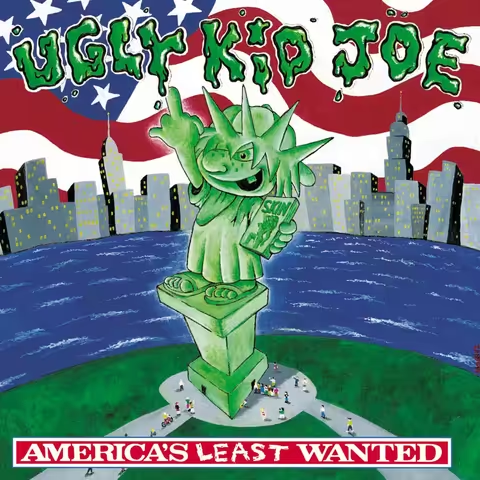
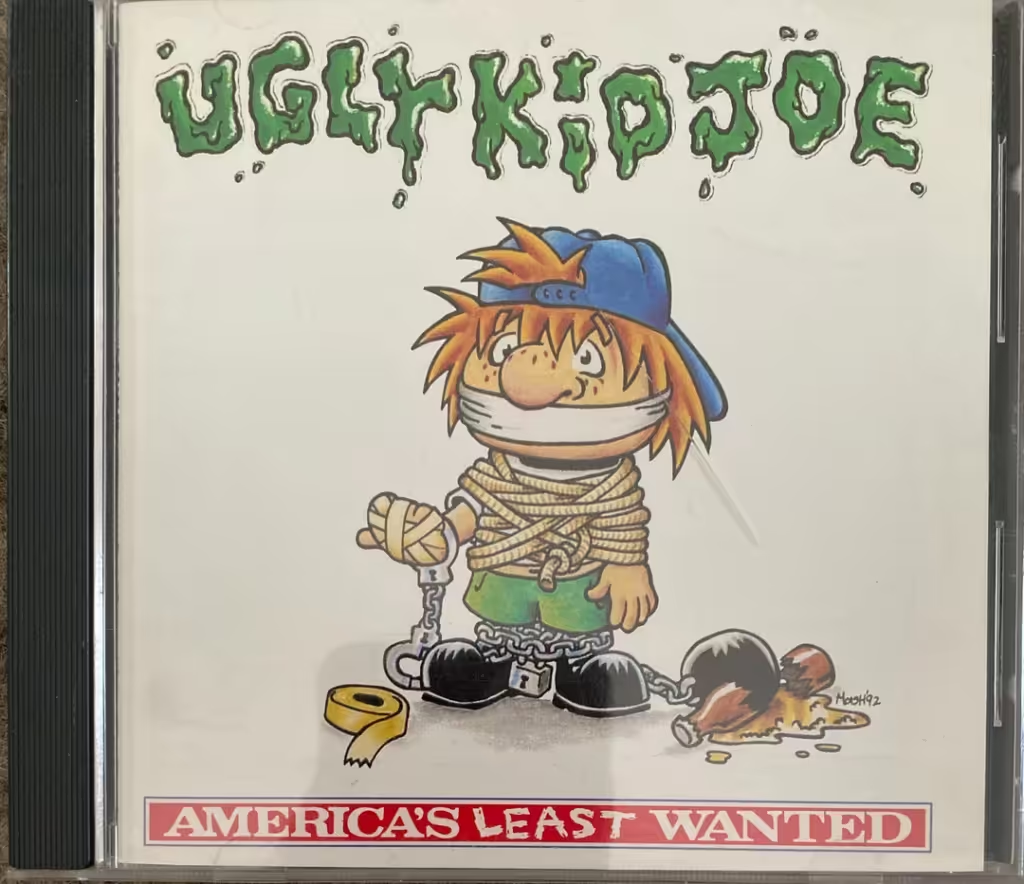
The album's original artwork is one of the era's great provocations. The band's mascot, a backwards-cap-wearing scowling kid drawn by Whitfield Crane's high-school friend Moish Brennan, was posed as the Statue of Liberty, raising a middle finger in place of the torch and clutching a pornographic magazine where the statue's tabula ansata should be. Several large American retail chains refused to stock it. Mercury duly commissioned a censored cover for those markets, using the original back-cover image, which depicts the same mascot gagged, handcuffed (with one hand wrapped in duct tape), tied with rope and shackled with a ball and chain. As pieces of merchandise go, both are extremely on-brand.
Release and Reception
Released on 8 September 1992, the album sold more than 600,000 copies on its first run and debuted high on the Billboard 200, peaking at number 27. In Europe it was an even bigger story: it reached number 11 in the UK, number 4 in Austria, number 10 in Germany and the top 20 in Switzerland and Sweden, and in Australia it climbed to number 7 on the ARIA chart. Eventual certifications tell the rest: 2x Platinum in the US, 2x Platinum in Australia, Platinum in Canada, with Gold in Switzerland and Austria.
Critics were less kind. AllMusic's Stephen Thomas Erlewine was the album's most enthusiastic mainstream voice, awarding three-and-a-half stars and describing the music as a "mixture of fizzy, fuzzy riffs, sing-song melodies, and calculated obnoxiousness" that "isn't that offensive". Entertainment Weekly's Deborah Frost handed out a C− and dismissed the record as "a weak attempt to pad Ugly out to LP length with Lynyrd Skynyrd licks, Mister Rogers jokes, a scarily straight Harry Chapin cover, and 'Mr. Recordman', the most pathetic love song to a record company ever written". The Los Angeles Times's Steve Hochman was even harsher, calling the band "generic MTV-rad-party dudes in baggies and Ts" and savaging "Goddamn Devil" for having "neither the irony nor the evil needed to revive that tired topic, despite a guest appearance by Judas Priest's knowing Rob Halford".
"America's Least Wanted delivers a set of similar rockers and a handful of power ballads, including a revamped version of Harry Chapin's 'Cat's in the Cradle'. The mixture of fizzy, fuzzy riffs, sing-song melodies, and calculated obnoxiousness isn't that offensive."
Stephen Thomas Erlewine, AllMusic
The split between critics and audience was wide and, for the band, irrelevant. The records were moving. The tour was booked. And they were about to spend the better part of two years on the road behind the album.
Touring and Live
The opening slot on Ozzy Osbourne's No More Tears tour was the prize the studio sprint had been about, and Ugly Kid Joe duly took it through late 1992 and into 1993. With Motorhead joining the bill on some legs, this was the kind of education a young hard-rock band could not buy: nightly arenas, the Osbourne machine in full flow, and the chance to convert curious metal audiences who had bought the EP for "Everything About You" into actual fans.
From there the band stepped up again, opening for Def Leppard on the European leg of the Adrenalize tour, a run that sold out in six weeks. They played the 1992 MTV Video Music Awards, sold out three weeks of shows in Australia and Japan, and presented the Favorite Heavy Metal/Hard Rock Band award to Metallica at the American Music Awards in January 1993. They were also nominated themselves in the Favorite Heavy Metal/Hard Rock New Artist category, losing to Pearl Jam, the kind of statistic that captures 1993 in a single sentence.
In TV, Film and Media
The album's footprint outside music was unusually large for an early-1990s hard-rock debut. The "Neighbor" video was adopted by Beavis and Butt-Head, the surest sign of pop-cultural arrival in 1992. The album cover appeared as a bedroom poster in the Seinfeld episode "The Bubble Boy". And in one of the strangest afterlives of any rock single, the "Cats in the Cradle" cover was used in a 1993 anti-terrorism public information film in Northern Ireland, the Chapin lyric of generational repetition deployed to argue that the children of paramilitaries would walk the same path as their fathers unless somebody changed direction.
- "Neighbor" featured on Beavis and Butt-Head episode "Scratch 'n' Win".
- Album cover appears in Seinfeld episode "The Bubble Boy".
- "Cats in the Cradle" used in a 1993 Northern Ireland anti-terrorism advert.
- "Everything About You" was synced into Wayne's World and re-surfaced in Encino Man.
What Happened Next
The lineup that recorded the album did not survive the touring cycle intact. Drummer Mark Davis stepped away after the campaign, and Bob Fernandez briefly took over before former Souls at Zero drummer Shannon Larkin (later of Godsmack) took the chair properly. With Larkin in place, the band recorded the grittier Menace to Sobriety in northern Santa Barbara in 1995. Menace was praised by Kerrang!, who positioned it as an album-of-the-year contender, and the band toured it with Bon Jovi and Van Halen, pointedly refusing to play "Everything About You" to make a point. American sales never recovered, however, and after the divisive 1996 album Motel California on their own Evilution label, Ugly Kid Joe broke up in 1997.
They reunited in 2010 and have remained a going concern: the EP Stairway to Hell arrived in 2012, followed by the crowdfunded Uglier Than They Used ta Be in 2015 and Rad Wings of Destiny in 2022. Dave Fortman became one of modern rock's most in-demand producers. Shannon Larkin remains in Godsmack. And the band that started as a joke at glam metal's expense outlived almost everyone they were originally taking the mickey out of.
Legacy and Influence
Three decades on, America's Least Wanted sits in an awkward and rather charming corner of nineties rock history. It was double platinum without ever being cool, beloved by anyone who owned it and dismissed by every magazine that had to review it. Rolling Stone later included Ugly Kid Joe in its list of the 20 greatest "two-hit wonders" of all time, an accolade that feels generous to one of the hits and stingy to the album, which had at least five tracks that found radio in 1992 and 1993. The band's run also helped widen the gates for everything from Wheatus to Bowling for Soup to Bloodhound Gang: bands that combined hard-rock crunch with sneering humour and refused to pick a tribe.
For a record made in a panic, with a quitting guitarist, a missing songbook, a folk cover thrown in as filler and the Metal God popping in to scream on a song called Goddamn Devil, America's Least Wanted has lasted remarkably well. The 25th-anniversary touring cycle in 2017 and 2018 saw the band play the album in full to crowds who had grown up with it, a final piece of evidence that the joke from Isla Vista landed harder than even Mercury had hoped.
Things You Might Not Know
| Fact | Detail |
|---|---|
| The first names | The band was briefly called Overdrive, then Suburban White Alcoholic Trash, before settling on Ugly Kid Joe. |
| The Pretty Boy snub | The Ugly Kid Joe name was invented as a parody of LA glam band Pretty Boy Floyd, originally for a single Santa Barbara show that Pretty Boy Floyd then cancelled. |
| An EP first | The 1991 EP As Ugly as They Wanna Be is generally cited as the first EP ever certified double platinum by the RIAA, having sold over two million copies in the US. |
| Halford's favour | Rob Halford appeared on "Goddamn Devil" because producer Mark Dodson had previously engineered Judas Priest albums including Painkiller. |
| An SNL cameo | The androgynous Pat character on "Goddamn Devil" and the album version of "Everything About You" is Julia Sweeney reprising her Saturday Night Live role. |
| Carol Burnett connection | The piano on "Everything About You" is played by Carrie Hamilton, the daughter of comedian Carol Burnett. |
| Jane's Addiction percussion | Stephen Perkins of Jane's Addiction plays percussion on multiple tracks across the album. |
| The Texas test | "Cats in the Cradle" was almost left off the album entirely and only became a single after a Texas radio station started playing the album cut and watched it go to number one in the market. |
| An apostrophe missing | Ugly Kid Joe pointedly dropped the apostrophe from the title, releasing their version as "Cats in the Cradle", technically implying more than one cat in the cradle. |
| The Fortman afterlife | Rhythm guitarist Dave Fortman, who replaced Roger Lahr during sessions, went on to produce major albums for Evanescence, Mudvayne, Slipknot and Otep. |
| The Northern Ireland advert | "Cats in the Cradle" was used in a 1993 Northern Ireland anti-terrorism public information film about paramilitary fathers and their sons. |
| Bubble Boy poster | The album's cover artwork appears as a bedroom poster in the famously surreal Seinfeld episode "The Bubble Boy". |
| A Metallica handover | Ugly Kid Joe presented the Favorite Heavy Metal/Hard Rock Band award to Metallica at the 1993 American Music Awards, the same night they lost the new-artist category to Pearl Jam. |
Join the Conversation
The full story of America's Least Wanted, from the cancelled Pretty Boy Floyd opening slot to Rob Halford on backing vocals to a folk-cover accident that ended up on the Billboard top ten, is exactly the kind of tale the Riffology podcast loves to unpick. If you have ever wondered why a band this irreverent ever shared a stage with Ozzy Osbourne, or whether "Cats in the Cradle" is genuinely better than the Harry Chapin original (it depends on how you feel about a crashing finale, frankly), we go deep on all of it. The Riffology podcast is available on Apple Podcasts, Spotify and every other major platform, and we would love to hear which deep cut you reckon the critics missed.
Comments