A year after he buried his mother, Pat Monahan woke up with four words stuck in his head and no idea what to do with them: "back in the atmosphere." The band he fronted, Train, was sitting on a problem that four words from a dream had no business solving. Their debut had produced exactly one hit, the radio was already filing them under nostalgia, and Columbia Records wanted another single yesterday. The song those four words turned into, Drops of Jupiter (Tell Me), was recorded in a hurry as a late addition, became the title track of their second album, and won two Grammy Awards before most of America could have named a second Train song. This is the complete story of how a grief-stricken dream about a dead mother became one of the biggest rock records of the early 2000s.
Released on 27 March 2001, Drops of Jupiter is the album that rescued Train from the one-hit-wonder bin and turned a scrappy San Francisco bar band into a fixture of adult radio for the rest of the decade. It is also a record critics never quite knew what to do with, a roots-rock album wrapped around a string-drenched power ballad about soy lattes, Tae Bo and deep-fried chicken that somehow added up to something millions of people have never been able to shake. The story behind it runs from pay phones in forgotten tour towns to Capitol Studios in Hollywood, and it is far stranger than the radio ever let on.
Album Facts
| Field | Detail |
|---|---|
| Artist | Train |
| Album | Drops of Jupiter |
| Release Date | 27 March 2001 |
| Label | Columbia Records / Aware Records |
| Producer | Brendan O'Brien |
| Studios | Southern Tracks Recording, Atlanta (main); Capitol Studios, Hollywood (strings for "Drops of Jupiter"); Ocean Way Nashville (strings for "Something More") |
| Genre / Subgenre | Pop rock / Roots rock / Adult alternative |
| Track Count | 11 (standard edition) |
| Total Runtime | 48:33 |
| Billboard 200 Peak | No. 6 |
| UK Albums Chart Peak | No. 8 |
| Other Notable Chart Peaks | Australia No. 3, Netherlands No. 3, Scotland No. 3, Norway No. 9, UK Rock & Metal Albums No. 1 |
| Certifications | US 3x Platinum, Australia 4x Platinum, Canada 2x Platinum, UK Gold |
| Estimated Sales | Over 3 million in the US; Train's best-selling album |
| Key Singles | "Drops of Jupiter (Tell Me)" (US No. 5), "Something More", "She's on Fire" |
The Pay-Phone Years: Train Before 2001
Train is, at heart, the story of a few people who kept showing up after the music industry had politely told them not to bother. Pat Monahan grew up in Erie, Pennsylvania, fronting a Led Zeppelin covers band called Rogues Gallery, the kind of outfit that plays weddings and the back room of a bar and dreams of something bigger. In late 1993, restless and out of options at home, he packed up and moved to California, landing in San Francisco. There he met Rob Hotchkiss, a Berklee College of Music graduate who had been the singer in a Los Angeles band called the Apostles and was now working the coffee-house circuit.
The two of them started as a duo, trading lead vocals, with Hotchkiss on guitar and harmonica and Monahan banging out rhythm on a modified conga rigged to a kick-drum pedal. It was lo-fi and homemade, but it had a sound. Wanting to fill it out, they pulled in two more of Hotchkiss's former Apostles bandmates, lead guitarist and mandolin player Jimmy Stafford and bassist Charlie Colin, plus drummer Scott Underwood. By 1994 the five-piece lineup was set, and San Francisco had quietly adopted a new bar band.
Getting signed was the hard part. Columbia Records passed on Train in 1996, a rejection that would look fairly silly within five years. Undeterred, the band pressed their own self-titled debut and toured it relentlessly, opening for Barenaked Ladies, Hootie & the Blowfish, Counting Crows and Blues Traveler. In 1997 they caught the ear of Aware Records, a tastemaker indie with a knack for breaking exactly this kind of act, and through a deal that ran via Columbia and Sony the self-titled record got a proper national release in February 1998.
It worked, just about. The reissued debut climbed to number 76 on the Billboard 200 and eventually went platinum, carried by "Meet Virginia", a likeable roots-rock single that reached number 20 on the Hot 100 in late 1999 and clung to the chart for 27 weeks. But "Meet Virginia" was looking like the whole story. As 2000 rolled around with no follow-up hit in sight, Train were drifting toward the most dangerous category in pop, the band with one song everyone knows and no second act. Columbia president Donnie Ienner wanted more, and the clock was ticking loudly.
"Loss of the most important person in my life was heavy on my mind, and the thought of, what if no one ever really leaves? What if she's here but different. The idea was, she's back here in the atmosphere."
Pat Monahan, VH1 Behind the Music
The Dream and the Deadline
Behind the commercial pressure sat a private catastrophe. Throughout the touring for the first album, Monahan's mother was dying of lung cancer, the legacy of a lifetime of heavy smoking. This was before mobile phones were universal, so he spent that tour feeding coins into pay phones in town after town, snatching conversations with her from the road. She died in December 1998. The band, meanwhile, was being told to produce a hit.
Monahan went back to his childhood home in Pennsylvania to grieve, and it was there, roughly a year after the funeral, that he woke one morning with the phrase "back in the atmosphere" ringing in his head. What followed was not a tidy piece of craft but a stab at making sense of loss. The conceit, he later explained, was the idea that nobody who matters ever truly disappears, that his mother had simply gone somewhere else and might still be looking in on him. In his telling she became a cosmic traveller, swimming through the planets and bending them to her will.
"My mother, she was able to swim through planets and turn them into whatever she wanted. They didn't have to be what we know them to be. So she actually had Jupiter in her hair, when she was talking to me."
Pat Monahan, BuzzFeed
That image gave the song its strange, indelible title. Around it Monahan hung a swirl of everyday specifics, soy lattes and Tae Bo and Mozart and fried chicken, that lifted the lyric out of greeting-card grief and into something odder and more human. Listeners have spent two decades arguing about whether the song is about a dead mother or a lover finding herself, and Monahan has happily let both readings stand. The line "one without a permanent scar", incidentally, is autobiographical: he carries a scar on his chin from a car accident.
He cut a demo and, about a week later, played it for Donnie Ienner. The Columbia president did not hesitate. He told Monahan it was his "Grammy song", and he was right twice over. Ienner pushed the band to record the track quickly so it could anchor the album and serve as the title cut. The song that nearly did not exist became the entire centre of gravity for the record.
Making the Album in Atlanta
The man Columbia paired with Train was a significant upgrade in pedigree. Brendan O'Brien was, by 2001, one of the most trusted rock producers in America, with Pearl Jam, Stone Temple Pilots, Rage Against the Machine, Bob Dylan and Bruce Springsteen on his résumé. The story goes that O'Brien first took an interest in Train after hearing their cover of Led Zeppelin's "Ramble On" on the radio, a fitting hook given Monahan's Zeppelin-tribute roots. He did not just produce and mix the record; he sat in on keyboards across several tracks, making him very much a sixth voice in the room.
The sessions ran from January to March 2001 at Southern Tracks Recording in Atlanta, Georgia, O'Brien's home turf, with Nick DiDia, another Pearl Jam regular, handling the recording. Where the self-titled debut had been a modest, self-produced affair cut for around 25,000 dollars, this was a different scale of operation: a marquee producer, a real budget, and a clear mandate to make something that radio could not ignore. The result keeps one foot in the band's loose, organic roots-rock and the other in widescreen, string-laden balladry.
- Recorded in a tight nine-to-ten week window at the start of 2001.
- Produced and mixed by Brendan O'Brien, who also played keyboards.
- Engineered by Nick DiDia, with strings tracked separately in Hollywood and Nashville.
- Mastered by Bob Ludwig, one of the most decorated mastering engineers in the business.
The making of the title track is where the album's ambition shows clearest. To realise the strings, Train reached for Paul Buckmaster, the British arranger behind some of the most famous orchestral pop of the 1970s, including Elton John's "Tiny Dancer" and "Levon" and work with David Bowie, Miles Davis and the Rolling Stones. The band reportedly hired Buckmaster specifically to evoke the sweep of his arrangement for Elton John's "Burn Down the Mission". On piano they brought in Chuck Leavell, the keyboard player who has anchored the Allman Brothers Band and the Rolling Stones for decades. The strings for "Drops of Jupiter" were recorded at Capitol Studios in Hollywood; those for "Something More", arranged by David Campbell (Beck's father and a session legend in his own right), were tracked at Ocean Way in Nashville.
Personnel and Credits
| Role | Player | Notes |
|---|---|---|
| Core band | ||
| Lead vocals | Pat Monahan | Also trumpet, saxophone, vibraphone, percussion |
| Guitar | Jimmy Stafford | Lead guitar, mandolin, backing vocals |
| Guitar / bass | Rob Hotchkiss | Guitar, bass, harmonica, backing vocals |
| Bass / guitar | Charlie Colin | Bass, guitar, backing vocals (died 2024) |
| Drums | Scott Underwood | Drums, keyboards, programming, percussion |
| Guest and session musicians | ||
| Piano | Chuck Leavell | Piano on "Drops of Jupiter" |
| Strings | Paul Buckmaster | Arranged and conducted strings on "Drops of Jupiter" |
| Strings | David Campbell | String arrangement on "Something More" |
| Cello / contractor | Suzie Katayama | Cello and orchestral contracting on "Drops of Jupiter" |
| Orchestra | Markman, Wilson, Smith; Gorodetzky, Wilkinson, Mason | Principal players on the two string sessions |
| Backing vocals | Fleming McWilliams | Backing vocals on "Mississippi" |
| Production and engineering | ||
| Producer / mixer | Brendan O'Brien | Also keyboards |
| Recording engineer | Nick DiDia | |
| Orchestral engineer | Steve Churchyard | Strings on "Drops of Jupiter" |
| Mastering | Bob Ludwig | Gateway Mastering, Portland, Maine |
| Artwork | ||
| Art direction | Joel Zimmerman | |
| Illustration | Tony Hernandez | |
| Photography | Ralf Strathmann | |
One detail in the credits would echo for years. Every song on Drops of Jupiter is credited to Train as a collective rather than to individual writers. It is an egalitarian, all-for-one arrangement on paper, but in practice it papered over a growing imbalance: Monahan was increasingly the driving creative force, and the question of who really wrote what would help pull the original lineup apart within a couple of years.
The Songs
For all that the title track dominates the album's reputation, Drops of Jupiter is a deliberately front-loaded, radio-minded record that opens with its most immediate rocker and saves its emotional peak for track three. The tracklist below is the standard eleven-song edition.
| # | Title | Writer(s) | Length | Single? | Notes |
|---|---|---|---|---|---|
| 1 | She's on Fire | Train | 3:49 | Yes | Third single; later film syncs |
| 2 | I Wish You Would | Train | 4:25 | ||
| 3 | Drops of Jupiter | Train | 4:21 | Yes | Lead single; two Grammys |
| 4 | It's About You | Train | 4:27 | ||
| 5 | Hopeless | Train | 4:31 | ||
| 6 | Respect | Train | 3:25 | ||
| 7 | Let It Roll | Train | 5:00 | Slide-guitar critics' favourite | |
| 8 | Something More | Train | 4:33 | Yes | Second single; David Campbell strings |
| 9 | Whipping Boy | Train | 4:26 | ||
| 10 | Getaway | Train | 4:26 | ||
| 11 | Mississippi | Train | 5:00 | Horns and acoustics; Fleming McWilliams vocals |
"She's on Fire" opens the album with a bright, chiming jangle, a smart bit of sequencing that establishes the band's roots-rock credentials before the orchestra arrives. But the record really turns on track three. "Drops of Jupiter (Tell Me)" builds from a single piano figure into a soaring, string-swept chorus, Monahan's voice cracking just enough to sell the grief underneath the cosmic imagery. It is the rare radio ballad that gets bigger and stranger as it goes, and the Buckmaster strings give it a grandeur most of the band's peers could not have afforded or imagined.
Elsewhere the album leans into the band's looser, bluesier instincts. "Let It Roll", with its mournful slide guitar and easy swing, was singled out by more than one critic as evidence Train had more in the tank than the hit suggested. "Mississippi" closes the record on a dreamy mix of acoustic guitars and horns, with Fleming McWilliams adding backing vocals. "Something More" is the album's other big orchestral moment, a David Campbell string chart giving it a lushness to rival the title track, while "Hopeless" and "Whipping Boy" keep the mid-album moving with the kind of sturdy, hook-forward writing that defined adult radio at the turn of the millennium.
Singles and Music Videos
The campaign was built entirely around the title track, and rightly so. "Drops of Jupiter (Tell Me)" went to hot adult contemporary and rock radio at the end of January 2001, hit contemporary hit radio a month later, and then simply refused to leave. It peaked at number five on the Billboard Hot 100 and reached the top ten in eight other countries. On the Adult Contemporary chart it pulled off something genuinely freakish, climbing into the top ten in its 49th week, the slowest ascent to the top ten by any act in the chart's history, and hanging around for 54 weeks in total.
| Single | Released | US Hot 100 | Notable |
|---|---|---|---|
| Drops of Jupiter (Tell Me) | 29 January 2001 | No. 5 | UK No. 10, ARIA No. 5; RIAA Diamond; two Grammys |
| Something More | October 2001 | Adult Top 40 success; David Campbell strings | |
| She's on Fire | 18 February 2002 | Featured in The Animal and Rugrats Go Wild |
There were two videos for the lead single. The first showed the band performing in front of a giant "TRAIN" banner, intercut with a woman acting out the lyrics. The second, far more famous, was directed by Nigel Dick and filmed at the cathedral-like Union Station in Los Angeles, with the band performing alongside a string ensemble as onlookers gathered to watch. An early edit even contained a runaway-girl storyline that was cut during editing, leaving the cleaner, more elegant performance piece that became an MTV and VH1 staple.
"Something More" followed in October 2001 and did solid business on the Adult Top 40, its David Campbell string arrangement deliberately echoing the formula that had worked so well on the title track. The third single, "She's on Fire", arrived in February 2002 to a more modest reception, though it found a second life in film, turning up in the 2001 Rob Schneider comedy The Animal and the 2003 animated feature Rugrats Go Wild.
B-sides and Outtakes
The single campaigns threw off a useful clutch of non-album tracks, several of which fans rate as highly as some of the deep cuts on the record itself. The various international editions of the "Drops of Jupiter" single rounded out their tracklists with "It's Love", "This Is Not Your Life" and "Sharks", while a stripped-back acoustic reading of Led Zeppelin's "Ramble On", the very cover that supposedly first caught Brendan O'Brien's ear, surfaced as a B-side and a nod to the band's origins.
- "It's Love" and "This Is Not Your Life" appeared across the UK and European single editions.
- "Sharks" turned up on the Australian CD single.
- "Ramble On" (acoustic), the Led Zeppelin cover, links the album straight back to Monahan's Rogues Gallery days.
- "Sweet Rain" later resurfaced as a bonus track on expanded editions.
Artwork and Packaging
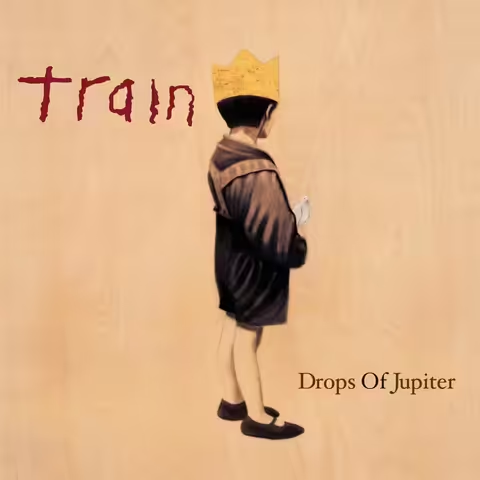
The album's cover leans into the title's celestial imagery, an illustrated, dreamlike design rather than the standard band-on-a-wall photograph that dominated rock sleeves at the time. Joel Zimmerman handled the art direction, with illustrations by Tony Hernandez and photography by Ralf Strathmann. The soft, slightly storybook quality of the artwork matched the song's mix of cosmic wonder and private grief better than any literal image could have, and it gave the record an identity on the shelf that suited its left-of-centre place in the 2001 marketplace.
Release and Reception
Commercially, Drops of Jupiter did exactly what Columbia had prayed for. It debuted at number six on the Billboard 200, gave Train their first top-ten album in both the US and the UK, where it reached number eight, and went on to triple-platinum certification in America, quadruple platinum in Australia and double platinum in Canada. It remains, comfortably, the band's best-selling record.
The critics were a tougher crowd. Reviews were decidedly mixed, and the album holds a middling Metacritic score of 60. AllMusic's Mark Morgenstein damned it with faint praise, calling Train "a classic-rock wannabe band in the mould of Counting Crows, although that's not always a bad thing". Entertainment Weekly handed out a C+, and Robert Christgau in The Village Voice was harsher still. Yet there were defenders. Rolling Stone's Aidin Vaziri heard real craft in the deep cuts, praising the "intoxicating" acoustic textures of "Mississippi" and the "perfect meeting of blustery earnestness and unapologetic commerciality" on "Let It Roll".
"There is nothing cutting edge about Train's sophomore effort. Train is a classic-rock wannabe band in the mould of Counting Crows, although that's not always a bad thing."
Mark Morgenstein, AllMusic, 2001
The split was telling. Critics largely heard a competent, slightly anonymous adult-rock band reaching for grandeur it had not quite earned; listeners heard a song that articulated grief, longing and the strange persistence of the people we lose, and they voted with their wallets and their radio dials for the better part of two years. Both groups were, in their way, correct.
The Grammys
Donnie Ienner's "Grammy song" prophecy came good at the 2002 ceremony. "Drops of Jupiter (Tell Me)" was nominated for five awards, including the two biggest, Record of the Year and Song of the Year, as well as Best Rock Performance by a Duo or Group. It won two: Best Rock Song, the songwriter's award, and Best Instrumental Arrangement Accompanying Vocalist(s), which went to Paul Buckmaster for those unmistakable strings. Train performed an expanded version of the song at the ceremony, complete with a cello prelude and full orchestra, and when Monahan collected the award he thanked his mother. The dream had come full circle.
Touring and Live
Train spent 2001 and 2002 on the road behind the record on the Drops of Jupiter Tour, graduating from clubs and support slots to genuine headline status on the back of the hit. The high-water mark of the campaign was captured on home video: a sold-out hometown show at The Warfield in San Francisco on 26 May 2001 was filmed and released as the live DVD Midnight Moon, gathering the best of the first two albums in one set. A live recording of the title track from that night also surfaced on later expanded editions, a document of the band at the exact moment everything finally broke their way.
In TV, Film and Media
Few songs of its era have burrowed as deep into popular culture as the title track. Beyond its film placements, it became a karaoke and talent-show standard, re-entering the UK chart in 2012 after contestant Phil Poole performed it on The Voice UK. Taylor Swift covered it on her Speak Now World Tour, introducing it to a new generation. It even, bizarrely, made the news in 2009 when reports tied a Christmas Day domestic dispute involving actor Charlie Sheen to the song, prompting a typically gracious public response from Monahan.
- "She's on Fire" featured in The Animal (2001) and Rugrats Go Wild (2003).
- "Drops of Jupiter" became a recurring presence on talent shows including The Voice UK.
- Taylor Swift covered the title track live on her Speak Now World Tour.
- Train later named a wine, Drops of Jupiter California Red, after the song, with proceeds supporting Family House in San Francisco.
The Band That Came After
Success did not hold the original lineup together for long. By 2003, around the release of the follow-up My Private Nation, Rob Hotchkiss left, reportedly resenting being pushed aside as a songwriter under the collective-credit model. That same year bassist Charlie Colin was forced out amid struggles with substance abuse; Monahan later recalled calling an emergency meeting and telling the band, bluntly, "you can have your bass player, or you can have your singer." Colin was replaced by Johnny Colt of the Black Crowes. Drummer Scott Underwood eventually departed in 2014, leaving Monahan as the sole constant.
The band soldiered on and, remarkably, scaled an even bigger commercial peak in 2009 with "Hey, Soul Sister", a worldwide smash that became the best-selling single in Columbia Records history. But Drops of Jupiter remains the pivot, the record that converted a one-hit wonder into a career. Charlie Colin's death in 2024 was a sombre reminder of how much that original five-piece had achieved together in a short, intense window.
"Every era gets the lighters-up, power-ballad, arena-rock anthem it deserves, and for the early 2000s, Train delivered with Drops of Jupiter."
Rolling Stone, The 250 Greatest Songs of the 21st Century So Far, 2025
Legacy and Influence
More than two decades on, Drops of Jupiter occupies a peculiar and durable place in pop history. The title track has been certified Diamond by the RIAA for sales and streams exceeding ten million, climbed back onto charts on multiple occasions, and was named by Rolling Stone in 2025 as one of the 250 greatest songs of the 21st century so far, the magazine framing it as the defining lighters-up anthem of its moment. A 20th-anniversary edition arrived in March 2021, gathering bonus tracks and live material for a song and album that had long since outgrown their mixed reviews.
The deeper legacy is what the record proved. It showed that a grief-stricken, idiosyncratic ballad, built on real loss and surrounded by genuine orchestral craft, could become a mass-market hit without sanding off the things that made it strange. Train would chase that lightning for years, sometimes catching it, and a generation of adult-radio acts took notes. For all the critical shrugging, very few albums from 2001 are still as instantly recognisable from a single piano figure as this one.
Things You Might Not Know
| Fact | Detail |
|---|---|
| Columbia's first no | Columbia Records passed on signing Train in 1996, then released the band's debut and Drops of Jupiter a few years later. |
| A dream lyric | The opening line "back in the atmosphere" came to Pat Monahan in a dream roughly a year after his mother's death from lung cancer. |
| The pay-phone tour | Before mobile phones were common, Monahan kept in touch with his dying mother by feeding coins into pay phones town by town on the first album's tour. |
| The Grammy prophecy | Columbia president Donnie Ienner heard the demo and immediately called it Monahan's "Grammy song"; it won two. |
| A Stone's piano | The piano on the title track was played by Chuck Leavell, longtime keyboardist for the Rolling Stones and the Allman Brothers Band. |
| The Elton John connection | Arranger Paul Buckmaster was reportedly hired to recreate the feel of his strings on Elton John's "Burn Down the Mission". |
| The Zeppelin hook | Producer Brendan O'Brien is said to have first noticed Train when he heard their cover of Led Zeppelin's "Ramble On" on the radio. |
| The permanent scar | The lyric "one without a permanent scar" refers to a real scar on Monahan's chin from a car accident. |
| The slowest climb | On the Adult Contemporary chart the single reached the top ten in its 49th week, the slowest ascent to the top ten by any act in that chart's history. |
| Beck's father | The strings on "Something More" were arranged by David Campbell, the father of musician Beck. |
| A wine of its own | Train later released a Drops of Jupiter California Red wine, with proceeds going to a San Francisco charity for families of children with cancer. |
| Swift's cover | Taylor Swift covered the title track live on her Speak Now World Tour, decades after its release. |
Join the Conversation
The full story of Drops of Jupiter, from the pay phones and the dream to the Grammys and the strings, is exactly the kind of tale the Riffology podcast loves to pull apart. If you have ever wondered how a song about a dead mother became a soy-latte radio smash, or where a roots-rock bar band found the nerve to hire Elton John's string arranger, we go deep on all of it. You will find the Riffology podcast on Apple Podcasts, Spotify and every other major platform, and we would love to hear which Train deep cut you think the critics missed.
Comments