Brody Dalle finished writing Coral Fang while her marriage to Rancid's Tim Armstrong was collapsing, took the songs from Hellcat to a Warner Bros. imprint that had once signed Madonna and the Ramones, and handed them to a Liverpudlian producer best known for the most beloved Pixies record. The Distillers' third album was supposed to be a street-punk band's clean reset. It came out as something stranger: a major-label rock record cut by four people who still played like a basement crew, written by a 24-year-old being chased through music magazines for who she was sleeping with rather than what she had just made.
Released on 14 October 2003, Coral Fang took The Distillers from the Hellcat circuit to MTV2 rotation in a single album cycle. It peaked at 97 on the Billboard 200, hit 46 on the UK Albums Chart, sold enough copies to earn a BPI Silver disc, and turned "Drain the Blood" into a song that strangers shouted back at the band. It is also the last Distillers studio album, frozen in time by a hiatus that began in 2006 and a reunion that, as of 2026, has yet to produce a follow-up.
Album facts
| Field | Detail |
|---|---|
| Artist | The Distillers |
| Album | Coral Fang |
| Release date | 14 October 2003 |
| Label | Sire / Hellcat, distributed by Warner Bros. |
| Producer | Gil Norton |
| Executive producer | Tom Whalley |
| Studio | The Site, San Rafael, California |
| Recorded | Spring 2003 |
| Engineers | Bradley Cook, John Dunne |
| Mixed by | Andy Wallace |
| Mastered by | Howie Weinberg |
| Genre | Punk rock, alternative rock |
| Track count | 11 |
| Total runtime | 44:52 |
| US Billboard 200 peak | 97 |
| UK Albums Chart peak | 46 |
| Certifications | BPI Silver |
| Singles | Drain the Blood, The Hunger, Beat Your Heart Out |
The Distillers before the major label
By the spring of 2003, The Distillers had been a working band for five years and had cycled through almost a full lineup. The group Brody Dalle co-founded in Los Angeles in late 1998 with bassist Kim Chi had begun as a Hellcat Records signing, the Epitaph-distributed punk imprint co-run by Tim Armstrong of [Rancid](/posts/rancid-rancid/). Their self-titled debut, released in April 2000, was a street-punk record cut quickly and cheaply.
Two years and one personnel reshuffle later, the band returned with Sing Sing Death House, recorded with the second-line-up of Dalle, original drummer Matt Young, guitarist Rose "Casper" Mazzola and a freshly recruited Ryan Sinn on bass. That 2002 album sharpened the songwriting and cracked the US Independent Albums chart at 29. It also gave them their first crossover moment in "City of Angels", a Mike Ness-style love song to Los Angeles that reached number 38 on the UK Independent Singles chart.
What it did not give them was stability. By the time Sinn arrived, Young and Mazzola were already on the way out. Mazzola left during the touring for Sing Sing Death House; Young followed in 2002. Tony Bevilacqua, then playing lead guitar in The Nerve Agents, was pulled in on lead guitar and credited on the next record as "Tony Bradley". Andy Granelli, who had filled in for an injured drummer at a 2001 show, took the kit full-time. By summer 2002 the four-piece who would record Coral Fang was, finally, in the same room.
Leaving Hellcat for Sire
The move from Hellcat to Sire was the biggest commercial decision of the band's career and, predictably, the one that drew the most blowback from the punk press. Hellcat was Tim Armstrong's label, run through Epitaph, and Dalle had been signed to it since she was 19 and still married to him. By the time Coral Fang was being shopped, the marriage was over and so, increasingly, was the working relationship.
Sire, founded by Seymour Stein in 1966, was a Warner-distributed imprint with a long track record of catching bands the majors had written off as too weird. Madonna, the Ramones, Talking Heads, The Smiths and Depeche Mode had all gone through it. By 2003, Sire was being run as a boutique brand within the Warner system, with Tom Whalley overseeing executive duties as the wider label's chairman. The split arrangement on Coral Fang, credited to both Sire and Hellcat on the spine, was a face-saving compromise: a major-label release that still nominally honoured the band's roots.
The deal also paid for a producer Hellcat would never have funded. With Sire's chequebook open, the band could finally afford the kind of room and the kind of name that turned an indie record into a Warner record. They picked an English producer who, on paper, was the wrong fit for a Los Angeles street-punk band.
Why Gil Norton
Gil Norton had spent the late 1980s and 1990s making records that did not sound like punk records. He produced Echo and the Bunnymen's Ocean Rain in 1984, then defined his career with [Doolittle](/posts/a-deep-dive-into-doolittle-by-pixies/), the 1989 Pixies album that taught a generation what loud-quiet-loud could mean. He went on to produce [Foo Fighters](/posts/the-making-of-foo-fighters-by-foo-fighters/)' The Colour and the Shape in 1997, [Recovering the Satellites](/posts/the-making-of-recovering-the-satellites-by-counting-crows/) for Counting Crows in 1996, and Dashboard Confessional's major-label crossover A Mark, a Mission, a Brand, a Scar in the same year as Coral Fang.
What Norton was famous for was structure. He arrived at sessions with a copy of the demos pre-marked, suggested cuts and bridges, drilled bands on arrangements before tape rolled, and chased vocal takes harder than anyone else in his price bracket. He was not the obvious hire for a band whose previous album had been a hardcore record. He was the obvious hire if the brief was to make a punk record that worked on alternative radio.
The band has said little publicly about how he was chosen, but the result is audible across the album. Drum sounds are tight and tuned. Guitars are double-tracked rather than smeared. Choruses arrive on the beat you would expect a chorus to arrive on. Coral Fang is not slick in the late-1990s pop-punk sense, but it is finished in a way no previous Distillers record had been.
Pre-production and songwriting
Dalle wrote every song on Coral Fang alone, as she had on the previous two Distillers albums. The publishing credits on the sleeve list her as sole composer of all eleven tracks. Several of the songs were written in the period immediately around her separation from Tim Armstrong, whose annulment paperwork was filed in late 2002 and finalised in 2003. Others date back further, to demos made during the long touring cycle for Sing Sing Death House.
Pre-production with Norton tightened them. The producer's working method, by his own admission in earlier interviews about the Pixies and Foo Fighters sessions, was to take demos apart in rehearsal rooms before any studio time was booked. Bridges were shortened. Choruses were lengthened. A song like "The Hunger", which runs 5:28 on the final record, was almost certainly worked into its slow-burn structure during this phase rather than in the studio. The same goes for "Death Sex", the noisy 12:17 closer that even sympathetic critics treated as a stranded experiment.
Bevilacqua's arrival changed the songs too. The band's previous records had been Dalle-and-a-second-guitarist affairs in which the rhythm and lead parts were not always cleanly separated. With Bevilacqua locked into lead guitar and Dalle holding down rhythm, the parts could finally be layered with intent. The interplay between them, particularly on "The Gallow Is God" and "Hall of Mirrors", is the most musically grown-up thing the band ever committed to tape.
The Site in San Rafael
Recording took place at The Site, a residential studio built into the hills above San Rafael in Marin County, California, north of San Francisco. The Site had been opened in the 1980s by producer Stanley Johnston and was known by 2003 for two things: a Neve console, and a remote location that effectively locked the band into the work. There were no late-night clubs to disappear into, no domestic distractions, and no easy way for label executives to drop in.
For a band who had spent five years writing and touring in Los Angeles, the geographical and psychological distance mattered. Sessions ran through the spring of 2003. Bradley Cook and John Dunne engineered, with Norton overseeing. The day-to-day rhythm of a residential studio, in which the band sleeps on site and works in long contiguous blocks, suits a producer like Norton who likes to chase a single song from start to finish rather than ping between tracks.
What remains striking about the record, given the setup, is how raw the band still sounds. Granelli's drums hit hard. Sinn's bass is mixed forward enough to carry the breakdown in "Drain the Blood". Dalle's vocals, in particular, are tracked dry: the producer did not bury her in reverb in the way another hand might have. Whatever Norton tightened in pre-production, he did not sand off in the room.
Andy Wallace and Howie Weinberg
The mix was handed to Andy Wallace, whose credit list by 2003 read like an alternative-rock canon: Nevermind, Jar of Flies, Slayer's Reign in Blood, Jeff Buckley's Grace, [Rage Against the Machine](/posts/the-making-of-rage-against-the-machine-by-rage-against-the-machine/)'s debut. Wallace was, and remains, the engineer that majors call when they want a record to translate to both rock radio and a teenager's bedroom speakers. He compresses guitars hard, pushes vocals to the front, and tends to favour a low end that resolves on small monitors.
You can hear his signature on Coral Fang immediately. The chorus of "Beat Your Heart Out" punches in a way that Wallace mixes punch. "Drain the Blood" has the sort of glued, in-the-red wallop that became his trademark on Slayer and Faith No More records. The album is the first time The Distillers ever sounded like a band you could play next to a 1990s alternative hit without the gain structure giving them away.
Mastering went to Howie Weinberg at Masterdisk in New York, another industry standard for rock records of the era. Weinberg had mastered most of Wallace's headline mixes, and the pair were so frequently paired that some artists assumed they came as a set. Together they made Coral Fang loud enough for the playlist clock at modern rock radio while keeping enough dynamics for the slower songs to actually breathe.
Personnel and credits
| Role | Player | Notes |
|---|---|---|
| The Distillers | ||
| Lead vocals, rhythm guitar | Brody Dalle | Sole songwriter on all 11 tracks |
| Lead guitar, backing vocals | Tony Bradley (Tony Bevilacqua) | Joined from The Nerve Agents in time for the sessions |
| Bass, backing vocals | Ryan Sinn | Recruited in 2000; later joined Angels and Airwaves |
| Drums | Andy Granelli | Originally a fill-in player who took the kit full-time in 2000 |
| Production | ||
| Producer | Gil Norton | Pixies, Foo Fighters, Counting Crows |
| Executive producer | Tom Whalley | Then chairman of Warner Bros. Records |
| Engineers | Bradley Cook, John Dunne | Tracking at The Site |
| Mixing | Andy Wallace | Mixed Nevermind, Reign in Blood, Grace |
| Mastering | Howie Weinberg | Masterdisk, New York |
| Technicians | Dan Druff, Mike Fazano | Guitar and drum techs on the sessions |
| Artwork | ||
| Original artwork and layout | Tim Presley | Later of White Fence and Drinks; LA-based painter and musician |
| Design | Richard Scane Goodheart | Sleeve typography and layout assist |
| Photography | James R. Minchin III | Band portraits used in the booklet |
The cover art controversy
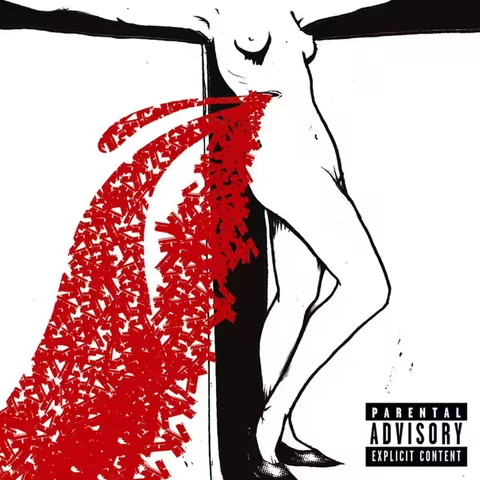
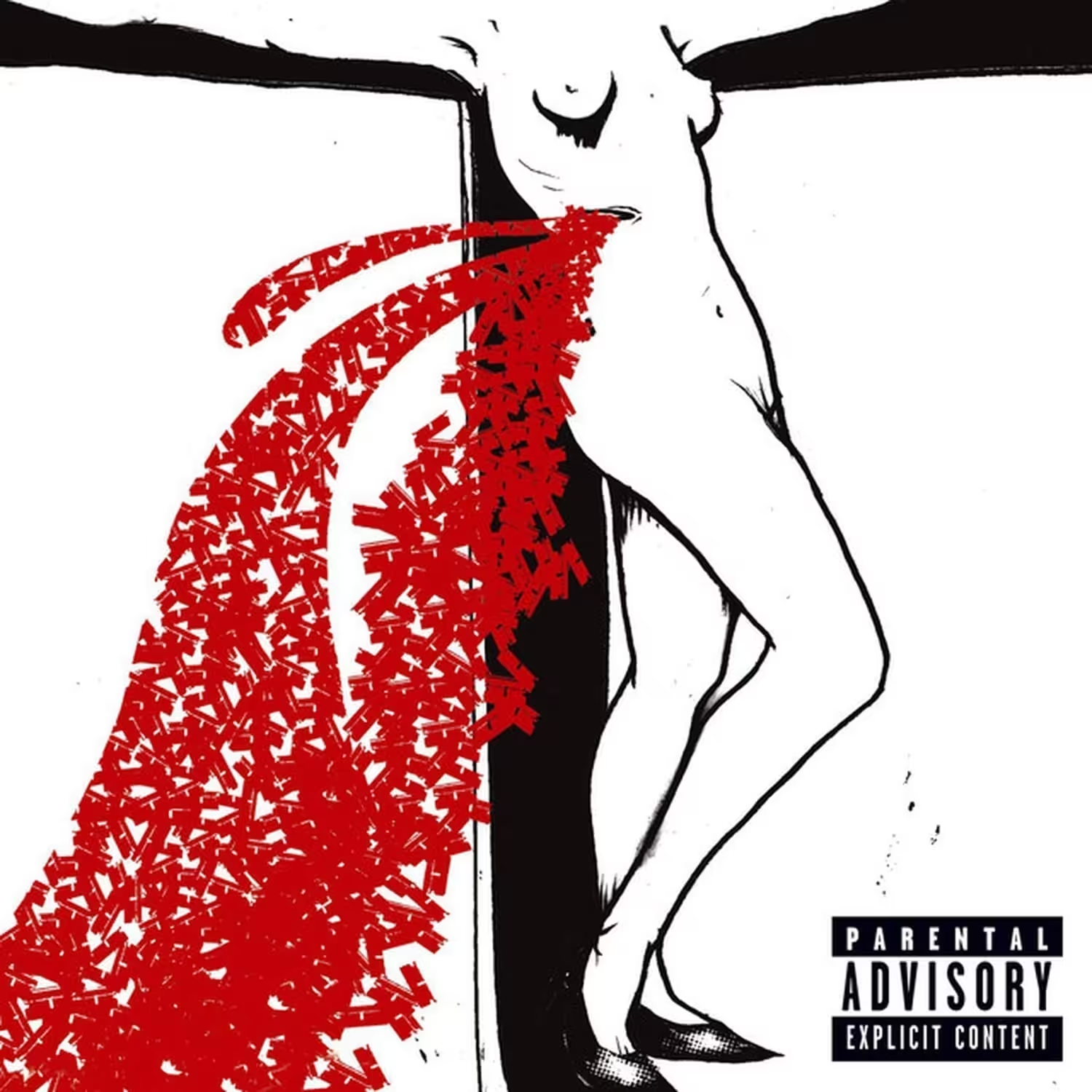
The painting on the front of Coral Fang is by Tim Presley, then a young Los Angeles artist who would later make his name fronting White Fence and partnering with Cate Le Bon in Drinks. Presley's piece is woodcut-style, a robed multi-armed female figure surrounded by bleeding and pregnant female bodies, several of which have razor blades for heads. It looks more like a 1970s underground comic than a 2003 major-label sleeve.
It also looked, to Walmart and Target buyers, like trouble. The chains refused to stock the original cover. Warner's solution was a separate sleeve, jokingly labelled the "SAFE COVER" in capitals on the front, that replaced Presley's painting with a watercolour of cartoon woodland animals. AllMusic's review at the time noted, drily, that the safe sleeve still hid "a few subversive-looking raccoons, weasels, and skunks skulking in the foreground". The music on both versions is identical.
The two-cover compromise was already an old major-label trick by 2003. What made the Coral Fang example unusual was that the band chose to lean into it, treating the safe sleeve as part of the joke rather than as a defeat. The original Presley painting remains the version reproduced almost everywhere outside US big-box retail, and is the one most fans know as the album's image.
The tracklist
| # | Title | Writer | Length | Single? | Notes |
|---|---|---|---|---|---|
| 1 | Drain the Blood | Brody Dalle | 3:08 | Yes | Lead single; US Alternative Airplay 28 |
| 2 | Dismantle Me | Brody Dalle | 2:26 | No | Featured in the video game MTX Mototrax |
| 3 | Die on a Rope | Brody Dalle | 2:39 | No | Later soundtracked the Daredevil episode Kinbaku |
| 4 | The Gallow Is God | Brody Dalle | 4:35 | No | AllMusic likened it to In Utero-era Nirvana |
| 5 | Coral Fang | Brody Dalle | 2:09 | No | Title track; one of the shortest songs on the record |
| 6 | The Hunger | Brody Dalle | 5:28 | Yes | Second single, March 2004 |
| 7 | Hall of Mirrors | Brody Dalle | 3:50 | No | Used in True Crime: Streets of LA the following year |
| 8 | Beat Your Heart Out | Brody Dalle | 2:48 | Yes | Third single, July 2004; in Spider-Man 2 game |
| 9 | Love Is Paranoid | Brody Dalle | 2:07 | No | Shortest song on the album |
| 10 | For Tonight You're Only Here to Know | Brody Dalle | 3:18 | No | A bruised mid-tempo ballad |
| 11 | Death Sex | Brody Dalle | 12:17 | No | Noise outro that runs three times the length of any other track |
All songs are written by Brody Dalle. Total runtime is 44:52.
Drain the Blood, the lead single
"Drain the Blood" was issued as the lead single on 30 September 2003, two weeks ahead of the album. It is the most Norton-shaped song on the record: a sub-three-minute pop-punk single with a hook that lands on the title every chorus. Heather Phares, reviewing for AllMusic, singled out its opening couplet, "I never met a pearl like you, who could shimmer and rot the same time through", as one of the best lyrics on the album.
It worked on radio. The single reached number 28 on the US Billboard Alternative Airplay chart, peaked at 51 on the UK Singles Chart and 8 on the UK Rock and Metal Singles chart, and earned the band their only Kerrang! Award nomination, in the Best Single category at the 2004 ceremony. It is also the song that most consistently makes The Distillers' setlists in their reunion years.
The Hunger and the slow-burn turn
If "Drain the Blood" was the radio bet, "The Hunger" was the song that argued the band could do something else. At 5:28 it is the longest song on the album that is not the closing noise piece. It opens with a clean, almost spaghetti-western guitar figure, builds through a long verse on Dalle's lower register, and breaks into a wide major-key chorus that AllMusic's reviewer called "among the best songs the Distillers have ever written".
It was released as the second single on 29 March 2004 and reached 48 on the UK Singles Chart. It did not chart in the US, but its video, directed for MTV2 rotation, became the band's most-played clip in Europe and remains their second-most-viewed video on YouTube. The Distillers' own channel uploaded it years later; the video has since racked up nearly three million views.
Beat Your Heart Out and the radio-pop hook
The third single, "Beat Your Heart Out", issued on 7 July 2004, made AllMusic suggest that Dalle was capable of pop songs sharp enough to "make Avril Lavigne watch her back". The song is the most major-key thing on the album, a sub-three-minute love song with a chorus designed for arena karaoke and a bridge that exists mainly to give the listener something to sing along to in the second pass.
It did not chart highly on radio, peaking only at 74 on the UK Singles Chart, but it did the heavy lifting for the album in other ways. The song was placed in Tony Hawk's Underground 2, ATV Offroad Fury 3 and the video-game adaptation of Spider-Man 2, where the band's name and the album title appear graffitied on a wall as an Easter egg. For a certain generation, "Beat Your Heart Out" is the Distillers song they first heard, and they heard it through a game controller.
The Gallow Is God and the In Utero shadow
The deepest song on the record is "The Gallow Is God", a four-and-a-half-minute mid-album centrepiece. AllMusic's review described it as "a heavy, lurching, In Utero-esque catharsis that makes up for its lack of originality with its quality", and the comparison is fair. The drop-D guitar tuning, the vocal that starts off whispered and ends shouted, and the long fade into feedback all sit very close to Steve Albini's Nirvana production.
Dalle did not run from the comparison. The Nirvana inheritance is something the band wore openly throughout the record, and it is part of why Coral Fang connects so cleanly with mid-1990s alternative rock listeners who never had much time for street punk. The album sounds, more than once, like the kind of record Kurt Cobain might have wanted to make if he had lived long enough to work with a producer who could chase a chorus.
Death Sex and the closing chaos
The album ends with "Death Sex", a 12:17 track that takes up roughly a quarter of the total runtime. The song proper occupies the first three minutes. The remaining nine are noise: feedback, looped percussion, screams and what sounds like a guitar being dragged across the studio floor. Even Norton, a producer who had handled long-form experiments before, could not corral it into a conventional shape, and it is not clear he tried.
Critics divided over it. AllMusic called the noise outro "out of place" and "a misguided attempt to inject the album with some more punk sensibility". Pitchfork's Eric Carr was harsher, accusing the album of a "classically retarded, album-ending storm of outro chaos" while still scoring the record 8.0 overall. For fans, "Death Sex" is the moment the major-label record remembers it is a punk-band record, and for sceptics it is the moment a tightly produced 35 minutes loses its nerve. Both readings are honest.
Release and chart performance
Coral Fang shipped on 14 October 2003 with the parental-advisory Tim Presley sleeve in indie shops, the Safe Cover in big-box retail, and three singles already lined up for the cycle. It entered the US Billboard 200 at its peak of 97 and held a chart position long enough to earn the band their first US chart entry. The UK was kinder. Coral Fang hit 46 on the Official Albums Chart on 19 October 2003 and stayed in the Top 75 for several weeks. The BPI later certified the album Silver for sales above 60,000 copies in the UK.
It is worth measuring those numbers against the company the album was keeping. October 2003 also gave the rock world Speakerboxxx/The Love Below by OutKast, Room on Fire by The Strokes, and [Nimrod](/posts/the-making-of-nimrod-by-green-day/)-era Green Day, who were already in the studio with Rob Cavallo cutting the songs that would become American Idiot. A 97 peak in that environment, for a punk band on Sire with no MTV programming around it, was not a failure.
Critical reception
The notices were better than the chart numbers suggest. Pitchfork ran Eric Carr's review on 6 January 2004 and scored the album 8.0/10, calling Dalle "an impassioned, powerful frontwoman, the legitimate heart of her band, and probably the most dominating female presence-at-large in rock right now". NME gave it four stars. Rolling Stone, in a review by Jenny Eliscu, gave it four stars too. AllMusic landed at three and a half. Robert Christgau awarded a three-star honourable mention, his shorthand for "I rate this without quite recommending it".
Year-end lists picked the album up. Kerrang! placed it at number 7 on their best albums of 2003. Blender ranked it 27 on their 50 Greatest CDs of 2003. Q magazine placed it at 20 on their Recordings of the Year. Metacritic, aggregating English-language press, settled at 71/100, which by the magazine's own standards counts as generally favourable rather than a critical event.
Two reviewer threads ran through most of the coverage. The first was a reflex Courtney Love comparison. AllMusic's Heather Phares argued it was "more than a little apt" and that Coral Fang delivered "the kind of vicarious, drama-queen punk rock thrills that haven't been around since [Live Through This](/posts/the-making-of-live-through-this-by-hole/)". The second was the Norton question. Several reviewers worried the producer had over-polished the record, leaving songs like "Dismantle Me" sounding "emptier than they actually are". Whether you read that as a flaw or as the price of the album reaching outside the Hellcat audience depends largely on what you wanted The Distillers to be.
The press storm around Brody Dalle
None of the above was the story the music press actually wanted to tell. The story it wanted to tell was that Brody Dalle had left Tim Armstrong, was now seeing Josh Homme of [Queens of the Stone Age](/posts/the-making-of-songs-for-the-deaf-by-queens-of-the-stone-age/), and was therefore, by tabloid arithmetic, a villain. The annulment paperwork had been filed in late 2002 and finalised in 2003. Dalle began appearing publicly with Homme around the same window. The first Distillers album of her post-Armstrong career arrived in the middle of the gossip column response.
Read in retrospect, much of the coverage was openly hostile in a way contemporary music journalism would not, by today's standards, attempt. Dalle was 24, had been signed to her ex-husband's record label as a teenager, and was being chased through interviews about her relationship while trying to promote a record she had written almost entirely on her own. She has spoken in subsequent years about the toll that period took on her mental health and on the band. Without that context, much of the surrounding press feels like a separate story stapled onto the album review.
That the record holds up at all in the face of that distraction is part of why it remains as well-loved as it does. Stripped of the gossip, Coral Fang is the work of someone making a serious case for herself as a songwriter, with a band tight enough to sell it.
Touring, music videos and TV
The band toured Coral Fang through late 2003 and most of 2004, including joint US dates supporting [No Doubt](/posts/the-making-of-tragic-kingdom-by-no-doubt/) and Garbage. They appeared at the 2004 Leeds Festival, played the Vans Warped Tour, and ran a headline UK club tour into the spring of 2004. Photographs of Dalle from the Leeds set, in particular, became some of the defining live images of the album cycle.
The video for "Drain the Blood" got into MTV2 and Fuse rotation. "The Hunger" and "Beat Your Heart Out" followed. The band did the round of late-night TV that was customary for a Warner rock release: rehearsal-room performances rather than chat, dressed in the same gear they had toured in. None of the appearances changed the chart fortunes of the singles much, but they made the album impossible to miss for anyone watching rock television at the end of 2003.
In film, TV and video games
Coral Fang placed unusually well in video games for an album its size. "Beat Your Heart Out" appeared in Tony Hawk's Underground 2 in 2004, in ATV Offroad Fury 3 in the same year, and in Activision's tie-in game for the Spider-Man 2 film, where the band's name and the album title were graffitied onto an in-game wall as an Easter egg. "Drain the Blood" became downloadable content for Rock Band and was placed in Gran Turismo 4. "Dismantle Me" appeared in MTX Mototrax. "Hall of Mirrors" and the older "City of Angels" both surfaced in True Crime: Streets of LA the following year.
Television placements were rarer but pointed. The Daredevil Netflix series used "Die on a Rope" in the season-two episode "Kinbaku", in a car-stereo scene shared between Matt Murdock and Elektra. "City of Angels" turned up in an episode of Sleeper Cell. A 2003 episode of Gilmore Girls had Jess take Rory to a Distillers concert as a date-night surprise, which is in its own way the most middlebrow possible compliment.
After Coral Fang: Spinnerette and the hiatus
The band did not survive long after the cycle ended. Andy Granelli left in early 2005 to play with Darker My Love. Ryan Sinn followed by the summer, eventually surfacing as the bassist in Tom DeLonge's Angels and Airwaves project. By late 2005 The Distillers were Dalle and Bevilacqua only, denying break-up rumours but unable to commit to a new record. In early 2006 Dalle gave birth to her first child, Camille, with Josh Homme. Later that year, she and Bevilacqua formally folded the band and announced a new project, Spinnerette, with Alain Johannes and Jack Irons.
Spinnerette released a self-titled album in 2009 and an EP, Ghetto Love, the same year. The band toured intermittently before going quiet. Dalle's first solo album, Diploid Love, followed in 2014, written and recorded around the birth of her second and third children with Homme. She continued to feature on records by other artists, including a long-running guest-vocal relationship with the Queens of the Stone Age extended family.
The 2018 reunion and the long silence
In January 2018 a teaser video appeared on a freshly opened Distillers Twitter account. Dalle, Bevilacqua, Granelli and Sinn confirmed a reunion. The first show in over 13 years took place at The Casbah in San Diego in late April. A standalone double A-side single, "Man vs. Magnet" and "Blood in Gutters", appeared in September on Rise Records, the band's third label home.
In April 2019 the band announced they would enter the studio with English producer Nick Launay, the engineer who had worked extensively with Nick Cave and the Bad Seeds and with PJ Harvey, to record their fourth studio album. The pandemic intervened. In July 2021 the group released Live in Lockdown, nine tracks recorded during a 2020 livestream, but no studio follow-up to Coral Fang materialised. The band withdrew at short notice from the When We Were Young festival in 2024 with no public explanation. As of May 2026, they have not performed live since January 2020. Whatever exists of the Launay sessions has not been heard.
Legacy and influence
Twenty-three years on, Coral Fang reads as one of the last major-label records of its kind: a punk-rooted album from a female-fronted band put through a name producer at a destination studio, marketed through MTV2 rotation and physical singles. The infrastructure that made it possible was, in 2003, already in decline. By the end of the decade the rock departments at the majors had been gutted and the kind of mid-tier punk crossover the album represented had migrated to streaming.
The album's longer afterlife has been generational. A wave of women fronting heavy bands in the 2010s and 2020s, from the touring lineups of Pretty Reckless and Cherry Glazerr to the harder end of contemporary emo, have name-checked Dalle as a permission slip. The reunion shows in 2018 and 2019 sold out within minutes in cities the band had never headlined the first time around. Coral Fang is consistently the album most cited by fans turning up to those shows.
It is also, almost by accident, the band's defining statement. With no fourth Distillers album yet released, Coral Fang remains the high-water mark and the closing argument. If the Launay sessions never see daylight, it will stay that way. For a record routinely overshadowed at release by its own gossip, that is its own kind of victory.
Things you might not know
| Fact | Detail |
|---|---|
| The Norton hire | Gil Norton had never produced a hardcore punk record before Coral Fang. His CV up to that point was built on Pixies, Echo and the Bunnymen, Foo Fighters, Counting Crows and Dashboard Confessional. |
| Two surnames | Tony "Bradley" on the Coral Fang sleeve is the same person credited on later releases and Wikipedia as Tony Bevilacqua. The stage name was used only briefly around the major-label period. |
| The Safe Cover joke | Walmart and Target refused to stock the Tim Presley painting, so Warner issued a second sleeve marked "SAFE COVER" in capitals on the front, featuring a watercolour of cartoon woodland animals. |
| The art-school painter | Sleeve artist Tim Presley went on to front White Fence, release acclaimed solo records and form Drinks with Cate Le Bon. Coral Fang remains one of his most reproduced images. |
| Twelve-minute closer | Death Sex runs 12:17, longer than any three of the other tracks combined. The actual song lasts roughly three minutes; the remaining nine are pure noise and feedback. |
| Andy Wallace at the desk | Mix engineer Andy Wallace had already mixed Nevermind, Reign in Blood, Jeff Buckley's Grace and the Rage Against the Machine debut before he got to Coral Fang. |
| An Easter egg in Spider-Man 2 | The video game adaptation of the 2004 Spider-Man 2 film hides the words "The Distillers" and "Coral Fang" as graffiti on an in-game wall, on top of using Beat Your Heart Out on the soundtrack. |
| The Gilmore Girls cameo | A February 2003 Gilmore Girls episode has Jess surprise Rory with last-minute tickets to a Distillers concert, eight months before Coral Fang was released. |
| Drain the Blood almost won a Kerrang! | The lead single was a nominee for the Kerrang! Award for Best Single in 2004, the band's only major awards-show nomination of their career. |
| The Daredevil placement | Die on a Rope was used in the season-two Daredevil episode Kinbaku, playing on a car stereo in a scene shared between Matt Murdock and Elektra. |
| Three labels in one cycle | Coral Fang is credited to both Sire and Hellcat on the spine, was distributed by Warner Bros., and the band have since released material on Rise Records. They have, technically, recorded for four label brands. |
| No fourth album, yet | The Distillers entered the studio with Nick Launay in April 2019 to record their first album in 16 years. As of May 2026, no studio follow-up to Coral Fang has been released. |
Riffology podcast
If this kind of deep dive is your thing, the Riffology podcast tackles a different album every episode in the same spirit: sessions, scenes, the songs, and the bits the press got wrong at the time. New episodes land regularly on Apple Podcasts, Spotify, Pocket Casts and all the usual feeds.
Comments