Doolittle is the sound of a band fighting to stay weird while a British producer made them sound expensive. The Pixies had just spent two years as the most thrilling racket in the American underground, and the obvious move was to make another corrosive noise record with Steve Albini. Instead they handed their fifteen songs about sliced eyeballs, suicidal businessmen and Old Testament slaughter to Gil Norton, a tidy Liverpudlian pop craftsman, and spent the sessions pushing back against every clean edge he tried to give them.
What came out, on 17 April 1989, was a 38-minute record that should not have worked: too pretty for punks, too violent for pop radio, sung by a man who seemed to vomit his vocals rather than carry a tune. It limped to number 98 on the Billboard 200 and slipped quietly to number eight in Britain. And then, over the next decade, it rewired rock music from underneath, until the loudest band in the world was telling magazines they had simply been trying to rip it off.
Album Facts
Before the story, the spec sheet. Doolittle was cheap, fast and short, and almost nothing about its commercial performance on release hinted at the shadow it would cast.
| Field | Detail |
|---|---|
| Artist | Pixies |
| Album | Doolittle |
| Release Date | 17 April 1989 (UK), 18 April 1989 (US) |
| Label | 4AD (worldwide), Elektra (US), PolyGram (Canada) |
| Producer | Gil Norton |
| Studios | Downtown Recorders, Boston (tracking); Carriage House, Stamford, Connecticut (mixing) |
| Genre / Subgenre | Alternative rock, noise pop, surf-punk |
| Track Count | 15 |
| Total Runtime | 38 minutes 38 seconds |
| Billboard 200 Peak | No. 98 |
| UK Albums Chart Peak | No. 8 |
| Other Notable Chart Peaks | Top 10 in the Netherlands; charted across Europe and Australasia |
| Certifications | RIAA Gold (1995), RIAA Platinum (2018); BPI Platinum (UK) |
| Estimated Sales | Over 834,000 in the US by 2015; comfortably past a million worldwide |
| Key Singles | Monkey Gone to Heaven; Here Comes Your Man |
Cultural Context: America in 1989
Mainstream rock in 1989 belonged to hairspray and stadiums. Bon Jovi, Aerosmith, Guns N' Roses and Motley Crue ruled MTV and the Billboard album chart, and the year's biggest sellers were polished, expensive and built for arenas. Beneath all of it ran a separate circuit that barely touched the charts: the American college-rock and hardcore underground, a network of independent labels, fanzines, student radio stations and sweaty clubs that had spent the decade nurturing bands the major labels would not touch.
The Pixies came out of that world. Before them came Black Flag, the Minutemen, Husker Du and the Replacements, bands the loudest critics adored and almost nobody bought. They had mapped a chaotic, punkish path through the underground, and none of them had made any money doing it. The Pixies were cut from the same cloth, but Doolittle arrived at the exact moment that the underground was about to break the surface. Within two years Nirvana would take the Pixies' quiet-loud trick to number one and drag the whole alternative scene into the mainstream with it.
The record landed into a specific gap: too odd for metal radio, too tuneful to be dismissed as noise, and arriving just as a generation of listeners was tiring of the gloss. It competed for shelf space that spring with a very different idea of what rock could be.
- The Cure's Disintegration, vast and gothic, released the following month
- The Stone Roses' self-titled debut, igniting the British indie scene the same season
- Nine Inch Nails' Pretty Hate Machine, lurking later that year
- Soundgarden's Louder Than Love, the first stirrings of Seattle on a major label
The Pixies Before Doolittle
Charles Thompson IV, who would rename himself Black Francis, met guitarist Joey Santiago when the two shared digs at the University of Massachusetts Amherst around 1984. Thompson dropped out after a six-month exchange trip to Puerto Rico studying Spanish, a stay that would later seed several of his strangest lyrics, and the pair moved to Boston, took warehouse jobs and started writing songs. Thompson formed the band in January 1986, and roughly two weeks later they placed an advert seeking a bassist who liked both Peter, Paul and Mary and Husker Du.
Only one person answered: Kim Deal, who drove up from her home and arrived without a bass guitar, having never played one. She got the job anyway. Deal suggested her sister Kelley as drummer, but it was Deal's then-husband who pointed them toward David Lovering, a trained electronics technician Deal had met at her own wedding reception. Santiago picked the name "Pixies" out of a dictionary, liking the definition, "mischievous little elves". The classic four-piece was complete.
Money from Thompson's father funded three days of recording at Fort Apache Studios, where house engineer and Throwing Muses associate Gary Smith captured a seventeen-track demo that became known as the Purple Tape. Manager Ken Goes passed it to Ivo Watts-Russell at the London label 4AD. Watts-Russell was unconvinced at first, finding the band "too normal" and a "little bit too rock and roll", and was reportedly talked into signing them by his girlfriend. Eight Purple Tape songs became the 1987 mini-album Come On Pilgrim, the band's first release.
Then came Surfer Rosa in 1988, recorded in a fortnight with Steve Albini, a brutal, dry, room-heavy record that the British weeklies Melody Maker and Sounds both voted album of the year. The Pixies were suddenly the most exciting band in the British music press and a growing cult in America, with a US distribution deal through Elektra in place. The stage was set for a follow-up, and the band walked into it carrying both momentum and a quiet, deepening friction between its two singers.
Pre-production and Demos
Most of the songs that became Doolittle already existed in some form. Several dated back years, including a sweet, jangling tune Thompson had written as a teenager that the band had recorded as far back as 1987 and then repeatedly refused to release. The Pixies demoed the new material at Eden Sound in Boston, and the working title for the whole project was the single, provocative word "Whore", lifted from a line in Mr. Grieves.
The crucial difference this time was the producer. With more money in 4AD's coffers and the Elektra deal behind them, the label again floated Albini, but the band wanted something else. Watts-Russell suggested Gil Norton, an actual British record producer rather than a self-described engineer, and the band found him surprisingly easy to accept.
"Steve Albini had been presented to us by the record company. But he had all these bohemian ideals. He called himself an engineer. At the time, people of that ilk equated production with selling out and being mainstream. So when they suggested Gil Norton, someone who was British and an actual record producer, we were pretty agreeable."
Black Francis, Classic Rock, 2018
Norton's first instinct was to lengthen the arrangements. Many of the songs were tiny, well under two minutes, and he wanted to give them room. Thompson resisted, and the way he resisted has become one of the album's favourite stories: he went out, bought a Buddy Holly record, and played Norton a track barely longer than a minute to prove a point.
"I said: 'Gil, there you go. It doesn't get any more classic than this rock and roll right here. Look how short these arrangements are.' He decided not to fight me on that point. Then I was happy to let him lead everything else. The sound he got was more cold and icy rather than fat and messy. To my ears it was more exotic. We were without vision, and I think Gil made things a little crisper, more statuesque."
Black Francis, Classic Rock, 2018
That compromise set the tone for the whole project. The band would keep the songs short and strange, and Norton would make them sound deliberate, almost architectural, where Surfer Rosa had sounded like a recording of a riot.
Creating the Album
Principal recording ran from late October into November 1988 at Downtown Recorders in Boston, with mixing carried out afterwards at Carriage House Studios in Stamford, Connecticut, finishing in mid-December. The budget was around 40,000 US dollars, roughly four times the cost of Surfer Rosa, and to the Pixies that felt like real money. It was still a fraction of what major-label acts were spending down the hall in the late 1980s.
Norton's method was forensic. He demoed the band hard, drilled the arrangements, and recorded with a clarity that threw every odd interval and abrupt stop into sharp relief. He brought in a polish the band had never had, double-tracking vocals, separating the instruments, finding hooks inside the distortion. The Pixies, conditioned by Albini's live-in-a-room aesthetic, did not always trust it. The most famous flashpoint was Santiago's quiet war over guitar reverb.
"I was a little concerned about there being too much reverb on the guitars. One day Gil came in and I'd covered my Marshall cabinets with blankets, just to make sure the point was taken."
Joey Santiago, Classic Rock, 2018
The other tension in the room was human rather than technical. The creative gap between Thompson, who wrote almost everything, and Deal, who wanted more of her own songs and her own voice on the records, had begun to widen. Thompson has always been careful not to overstate it, insisting it was a truth rather than a thundercloud, but it was real, and it colours the album's history even if it rarely shows on the tape. Deal sings lead on only one track, the surf instrumental-turned-song Silver, co-written with Thompson, and her presence elsewhere is mostly the eerie, soaring harmony that became one of the Pixies' signatures.
A handful of production choices defined the finished record:
- Loud-quiet-loud dynamics pushed to the front, with whispered verses detonating into distorted choruses
- Vocals double-tracked and pushed forward, giving Thompson's screams a strange clarity
- Deal's harmonies recorded high and clean against Thompson's rasp
- A real string quartet booked for a single song, a first for the band
- Mixing handed in part to engineer Steve Haigler, sharpening the separation Norton wanted
Personnel and Credits
The core of Doolittle is the four-piece, but the one moment the band reached outside itself, the string section on Monkey Gone to Heaven, is also the moment the album sounds most like a statement rather than a garage record.
| Role | Player | Notes |
|---|---|---|
| Core band | ||
| Vocals, rhythm guitar | Black Francis (Charles Thompson IV) | Wrote all songs except Silver, co-written with Deal |
| Lead guitar | Joey Santiago | Angular, bent-note leads that define the record's sound |
| Bass, vocals | Kim Deal | Signature harmonies; lead vocal on Silver |
| Drums | David Lovering | Lead vocal on La La Love You |
| Guest and session musicians | ||
| Violins | Karen Karlsrud, Corine Metter | String quartet on Monkey Gone to Heaven |
| Cellos | Arthur Fiacco, Ann Rorich | String quartet on Monkey Gone to Heaven |
| Production and engineering | ||
| Producer, engineer | Gil Norton | Chosen by 4AD over Steve Albini |
| Mixing | Steve Haigler, Gil Norton | Mixed at Carriage House, Connecticut |
| Assistant engineers | Al Clay, John Lupner | Worked the Boston and Connecticut sessions |
| Artwork | ||
| Design | Vaughan Oliver (v23) | 4AD's in-house designer |
| Photography | Simon Larbalestier | The haloed monkey and the album's surreal imagery |
| Typography | Chris Bigg | Hand-lettered lyric fragments |
The supporting cast is small but tells a story. Booking a string quartet was a deliberate reach for grandeur on a record otherwise made of guitars and shouting, and it is no accident that the song they play on became the album's calling card. The artwork team of Oliver, Larbalestier and Bigg, meanwhile, gave the Pixies a visual identity as distinctive as their sound, an asset the band would lean on for the rest of their career.
The Songs
Fifteen tracks in thirty-eight minutes, only three of them longer than three minutes. Doolittle moves at the pace of a band that does not believe in second verses it does not need. Here is the full sequence before the standouts.
| # | Title | Writer(s) | Length | Single? | Notes |
|---|---|---|---|---|---|
| 1 | Debaser | Black Francis | 2:52 | Inspired by Bunuel's Un Chien Andalou | |
| 2 | Tame | Black Francis | 1:55 | Pure loud-quiet-loud blueprint | |
| 3 | Wave of Mutilation | Black Francis | 2:04 | Businessmen driving into the sea | |
| 4 | I Bleed | Black Francis | 2:34 | Deal's harmony at its eeriest | |
| 5 | Here Comes Your Man | Black Francis | 3:21 | Yes | Written when Thompson was a teenager |
| 6 | Dead | Black Francis | 2:21 | David and Bathsheba | |
| 7 | Monkey Gone to Heaven | Black Francis | 2:56 | Yes | String quartet; ecological dread |
| 8 | Mr. Grieves | Black Francis | 2:05 | Source of the working title Whore | |
| 9 | Crackity Jones | Black Francis | 1:24 | About a Puerto Rico roommate | |
| 10 | La La Love You | Black Francis | 2:43 | Lovering's lead vocal | |
| 11 | No. 13 Baby | Black Francis | 3:51 | The album's longest track | |
| 12 | There Goes My Gun | Black Francis | 1:49 | Sub-two-minute blast | |
| 13 | Hey | Black Francis | 3:31 | Slow-burning, sexual, bluesy | |
| 14 | Silver | Black Francis, Kim Deal | 2:25 | Deal's lead vocal; slide guitar | |
| 15 | Gouge Away | Black Francis | 2:45 | Samson and Delilah |
It opens with a manifesto. Debaser is Thompson's imaginary soundtrack to Un Chien Andalou, the 1929 surrealist short by Luis Bunuel and Salvador Dali in which a razor slices an eyeball, and the song's gleeful chant of "slicing up eyeballs" set against Deal's rolling bassline is the most joyous violence in the catalogue. Thompson has been open that surrealism, and David Lynch in particular, was the engine of his writing.
"I got into avant-garde movies and surrealism as an escape from reality. There's nothing surrealistic about everyday life. To me, surrealism is totally artificial. Lynch's Eraserhead was a particularly potent inspiration."
Black Francis, The New York Times, 1989
Tame is the loud-quiet-loud dynamic at its most naked: a panted, menacing verse that erupts into a screamed chorus, the exact mechanism Nirvana would later borrow wholesale. Wave of Mutilation imagines Japanese businessmen, ruined and ashamed, driving their cars into the Pacific, set incongruously to one of the album's brightest tunes. Monkey Gone to Heaven, the album's emotional centre and first single, threads ecological dread and a numerological riddle, "if man is five, the devil is six, then God is seven", over that lone string quartet.
The deepest cuts carry the best stories. Crackity Jones, a 84-second sprint sung partly in Spanish, came from Thompson's exchange-student days.
"My allocated room-mate never showed up. Then suddenly he was there one day, like a scene from a film. He was standing in the doorway, completely silent, holding his hand out. There was blood on his fingers. Then in Spanish he said to me: 'I cut myself.' It just got weirder from there. The guy had some mental health issues. Crackity Jones is about him."
Black Francis, Classic Rock, 2018
The album's odd comic heart is La La Love You, a deadpan parody of a love song sung not by Thompson but by drummer David Lovering, whose hammed-up croon and finger-clicks were powered by a quantity of vodka he has cheerfully owned up to. He has said it took a lot of drinks to get over the nerves, that he was clapping like a fool in the booth, and that the good time is audible on the final take. It is the one moment of pure silliness on a record otherwise full of blood and the Old Testament, and it works precisely because of the contrast.
The closer, Gouge Away, retells the story of Samson and Delilah over a coiled bassline, ending the album where so much of it lives, in the violent imagery of the Bible filtered through a surrealist's eye. Thompson once told Melody Maker he was obsessed with those Old Testament characters and could not fully explain why they kept surfacing.
B-sides, Outtakes and Lost Songs
The Pixies worked fast and left less on the cutting-room floor than most bands, but the Doolittle era still threw off a clutch of non-album tracks that became fan favourites. The singles carried genuinely strong B-sides rather than filler, and the band's voracious BBC session habit produced alternate versions that circulated for years.
- Into the White, a swirling Deal-sung B-side that became a live set-closer and a fan obsession
- Wave of Mutilation (UK Surf), a slowed, dreamy reworking that arguably eclipses the album version
- Manta Ray and Weird at My School, sharp non-album cuts from the singles
- A cover of Neil Young's Winterlong, the band's nod to a clear influence
The 2014 reissue Doolittle 25 finally rounded up the demos, B-sides and Peel Sessions that documented how these tight little songs had grown from rougher seeds, giving the catalogue its first proper archival treatment.
Album Artwork and Packaging
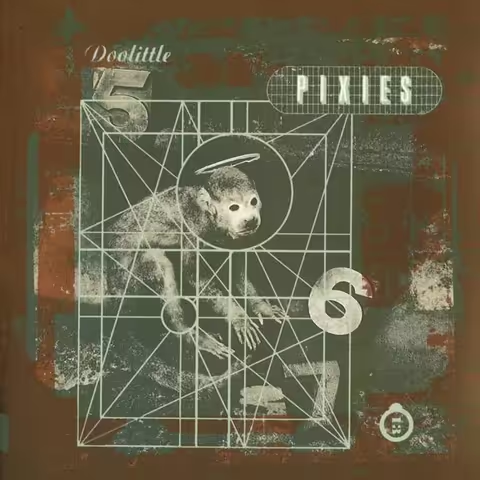
The sleeve is as celebrated as the songs. Designer Vaughan Oliver, working under his v23 banner as 4AD's house visionary, and photographer Simon Larbalestier built the artwork around fragments of Thompson's lyrics rather than any single concept, pairing surreal, slightly unsettling images with hand-set type by Chris Bigg. The cover image, a monkey crowned with a golden halo, floating beside the numbers five, six and seven, lifts the numerology straight out of Monkey Gone to Heaven.
The original "Whore" title was abandoned at least partly because of that cover. Thompson reasoned that a haloed monkey labelled with the word "whore" would invite exactly the kind of heavy-handed interpretation the band wanted to avoid, and he changed the title to the gentler, more enigmatic Doolittle, taken from a line in Mr. Grieves. The result is one of the most recognisable sleeves of its era, a piece of design so strong it has become inseparable from the music.
Release and Reception
The British press, already in love with the band, received Doolittle as a triumph. NME's Edwin Pouncey awarded it a perfect ten, writing that the songs had the power to make a listener literally jump out of their skin with excitement. Sounds and Melody Maker were similarly rapturous. In America the reception was warmer than the chart positions suggest, with the influential Village Voice critic Robert Christgau capturing the album's contradictory joy.
"They're in love and they don't know why, with rock and roll, with the irrational, with engines and Spanish."
Robert Christgau, The Village Voice, 1989
Commercially, the record performed modestly on release and brilliantly over time. It reached number eight in the UK and only number 98 on the Billboard 200, selling a steady hundred thousand or so American copies in its first six months, a figure that felt enormous to a band who had been holding down day jobs a year earlier. Decades of catalogue sales and a generation of converts did the rest.
| Territory | Chart Peak | Certification |
|---|---|---|
| United Kingdom | No. 8 | BPI Platinum |
| United States | No. 98 (Billboard 200) | RIAA Gold 1995, Platinum 2018 |
| Netherlands | Top 10 | |
| Australia | Charted |
In the years since, Doolittle has become a permanent fixture of greatest-albums lists, routinely placed among the finest records of the 1980s and of alternative rock as a whole by Rolling Stone, NME, Pitchfork and others. The retrospective consensus is far warmer than its release-week chart run, a classic case of an album the public caught up with.
Singles and Music Videos
Two singles came from Doolittle, and the second one became the band's defining commercial moment almost against their will.
| Single | Release Date | Chart Notes |
|---|---|---|
| Monkey Gone to Heaven | 27 March 1989 | The band's first proper crossover; reached the US Modern Rock chart |
| Here Comes Your Man | 19 June 1989 | No. 3 US Modern Rock, No. 54 UK; the band's biggest hit |
Here Comes Your Man was the song the Pixies almost buried. Thompson had written its sweet chord progression as a teenager, liking the word "boxcar" he had picked up from an early R.E.M. record, and the band had recorded and rejected it more than once because it was, by their standards, embarrassingly catchy. Come On Pilgrim producer Gary Smith and 4AD's Watts-Russell had both flinched at it.
"There was some reluctance to do Here Comes Your Man because it was too pop; there was something too straight about it."
Gary Smith, recalled in American Songwriter, 2024
Norton rescued it by treating three different demos as raw material, editing the best bits of each into a single version, then asking Thompson for one more verse. Thompson supplied the now-famous detail: the song's wandering hobos die in a California earthquake, "peeing their pants", an image he linked to the eerie stillness that precedes a real quake. The promotional video, in which Thompson and Deal pointedly hold their mouths open rather than mime the words, became a minor MTV hit, the closest the band came to mainstream television.
Their discomfort with their own pop song became legend. The Pixies refused to perform it live for long stretches, and Santiago has told the story of turning down a coveted slot on Arsenio Hall's chat show over it.
"Arsenio Hall asked if we wanted to play on the show, and we weren't playing Here Comes Your Man at the time. We told them we would love to go on, only if we did the song Tame. And they said, 'No, thank you.'"
Joey Santiago, American Songwriter, 2024
Touring and Live
The Pixies toured Doolittle relentlessly through 1989 and into 1990 on the bluntly named Fuck or Fight tour, and the schedule pushed the band's internal tensions to breaking point. The friction between Thompson and Deal, kept mostly off the record, was harder to hide on a tour bus. Accounts describe Thompson hurling a guitar across the stage in Stuttgart in Deal's direction, and Deal coming close to being sacked after a stand-off in Frankfurt. By the end of the cycle the two were barely speaking, and the band slipped into the hiatus that would eventually become a breakup.
The touring threw off the colour that fills any Pixies biography. The most enjoyable comes from early 1990, when Thompson realised the band had finally arrived in the strangest possible setting: pulled over by border police in Texas at three in the morning, in a giant yellow Cadillac with out-of-state plates, a little marijuana hidden in a guitar in the trunk, and two pinatas marked "Mexico" in the boot.
"Finally the leader said: 'Hey, haven't I seen you on MTV?' I said: 'Yes you have, officer. I'm in a band called the Pixies.' Then suddenly out come the Polaroid cameras for me to pose for them, with me literally holding a shotgun. They were shaking hands like I was a big star. Then they let me go on my way."
Black Francis, Classic Rock, 2018
The album's live afterlife eventually outshone its original tour. After the Pixies reunited in 2004, they marked the record's twentieth anniversary in 2009 with a dedicated Doolittle tour, performing the album in full, in sequence, alongside its B-sides, a victory lap that ran into 2010 and 2011 and reintroduced the record to a generation that had grown up on the bands it inspired.
In TV, Film and Media
The Pixies' best-known sync moment, Where Is My Mind soundtracking the collapsing skyline at the end of Fight Club, belongs to Surfer Rosa rather than Doolittle, a distinction worth keeping straight. But Doolittle's own songs have had a long screen life of their own. The dreamy Wave of Mutilation (UK Surf) appeared on the soundtrack to the 1990 film Pump Up the Volume, helping carry the band to a wider American audience, and tracks from the album have since turned up across film, television and video games as shorthand for a particular kind of art-damaged cool. Debaser in particular has become a go-to needle-drop whenever a director wants to signal outsider energy.
The Sellout Question
Doolittle never attracted the censorship battles or lawsuits that dogged some of its contemporaries, and its violence was too surreal to alarm the moral campaigners of the day. Its only real controversy was internal and aesthetic: the nagging fear, in a scene where anti-commercial meant authentic, that hiring a "proper" producer and writing a song as catchy as Here Comes Your Man amounted to selling out.
The band wore that anxiety openly, refusing to mime, refusing to play their hit, refusing the Arsenio Hall slot. It is the great irony of the record: a group terrified of looking too pop made the album that taught the next decade how to smuggle pop hooks inside noise. Thompson, looking back, has always resisted the tidy narratives critics tried to hang on the band.
"People would look at the dead monkey on the album cover and decide we were environmentalists. Everyone was searching for some kind of story. There is a story, but it's not a particularly nice one. It's not a People magazine story. It's more real than that."
Black Francis, Classic Rock, 2018
Covers, Samples and Tributes
Doolittle's songs have proved durable cover material across genres. Debaser, Gouge Away, Wave of Mutilation and Hey have all been reinterpreted by acts ranging from indie bands to electronic producers, and the album is a fixture of the alt-rock tribute circuit. Its influence runs deeper than direct covers, though: the loud-quiet-loud structure became so foundational that countless 1990s bands were, in effect, covering the album's blueprint without ever recording one of its songs. The clearest tribute the record ever received was not a cover at all, but the admission from rock's biggest star that he had set out to copy it.
Reissues, Remasters and Anniversaries
The album has been treated with growing reverence over time. The headline release was Doolittle 25 in 2014, a 25th-anniversary set gathering the album with its B-sides, demos and BBC Peel Sessions across three discs, the first time the era's archival material had been collected properly. A high-resolution Pure Audio Blu-ray edition followed in 2016 for audiophiles, and the catalogue has since been given a Dolby Atmos spatial-audio mix, the kind of immersive reissue treatment usually reserved for canonical classics. Each new format has reaffirmed the same point: a cheap, fast record from 1989 now sits firmly in the rock canon.
Legacy and Influence
The single most-quoted fact about Doolittle is also the most telling. When Kurt Cobain explained how he wrote the song that defined the 1990s, he pointed straight at the Pixies.
"I was basically trying to rip off the Pixies. I have to admit it. When I heard the Pixies for the first time, I connected with that band so heavily I should have been in that band. We used their sense of dynamics, being soft and quiet and then loud and hard."
Kurt Cobain, Rolling Stone, 1994
That endorsement opened the floodgates. Radiohead's Thom Yorke has called the Pixies the greatest band ever. David Bowie named them among the most important American bands of all time. PJ Harvey spoke of being in awe of I Bleed and Tame, and a generation of British and American acts, from Weezer to Slowdive to the entire grunge movement, carried the album's DNA. Gary Smith, who recorded the band's first demos, framed their influence with the line usually reserved for the Velvet Underground.
"Not a lot of people bought their albums, but everyone who did started a band. I think that is largely true about the Pixies as well."
Gary Smith, 1997
For the band itself, the story curdled before it triumphed. The tensions that simmered through Doolittle hardened across the next two albums, and Thompson dissolved the Pixies in 1993, famously informing his bandmates by fax. Deal threw herself into the Breeders; Thompson went solo as Frank Black. The reunion in 2004 turned them into one of the most successful touring acts of the era, playing to crowds many times larger than anything they drew in 1989, proof that the record's reputation had long since outgrown its sales. Doolittle is now widely regarded as their masterpiece, the moment the chaos of Surfer Rosa was refined into something that could change the world without losing its strangeness.
Things You Might Not Know
| Fact | Detail |
|---|---|
| The working title | The album was almost called Whore, a word taken from the lyric of Mr. Grieves, before Black Francis dropped it over the haloed-monkey cover art. |
| A teenage song | Here Comes Your Man was written when Charles Thompson was around 14 or 15 years old, and the band recorded and rejected it several times before it finally made the album. |
| The Buddy Holly stand-off | When Gil Norton wanted to lengthen the songs, Thompson bought a Buddy Holly record and played him a track barely a minute long to win the argument about keeping them short. |
| Blankets on the amps | Joey Santiago protested against Norton's reverb by draping blankets over his Marshall cabinets so the producer could not miss the point. |
| Vodka and a drummer | Drummer David Lovering sang lead on La La Love You and got through the nerves on a quantity of vodka he says you can hear in the performance. |
| A sliced eyeball | Debaser is a tribute to Luis Bunuel and Salvador Dali's 1929 surrealist film Un Chien Andalou, in which a razor slices an eye. |
| The string quartet | Monkey Gone to Heaven features a real four-piece string section, the only time outside musicians appear on the record. |
| Spanish on the record | Crackity Jones, sung partly in Spanish, is about a troubled roommate Thompson was assigned during a student exchange in Puerto Rico. |
| Four times the budget | At around 40,000 US dollars, Doolittle cost roughly four times as much as Surfer Rosa, and still felt cheap by major-label standards. |
| The Arsenio refusal | The band turned down a slot on Arsenio Hall's show because the producers wanted Here Comes Your Man and the Pixies would only play the abrasive Tame. |
| Late certification | Despite peaking at number 98, the album was not certified platinum in America until 2018, nearly thirty years after release. |
| Cobain's confession | Kurt Cobain admitted to Rolling Stone that Smells Like Teen Spirit was him "basically trying to rip off the Pixies". |
The Riffology Podcast on Doolittle
There is far more to Doolittle than any single article can hold, from the surreal corners of Black Francis's lyrics to the quiet war between a band and its producer over how clean a noise record should sound. The Riffology podcast pulls the whole story apart track by track, digging into the sessions, the singles and the strange, lasting power of an album that taught the 1990s how to be loud. You can listen to the full episode on Spotify, Apple Podcasts and every other major platform, and if you have not yet fallen down the Pixies rabbit hole, this is the place to start.
Comments