Sixteen Stone is the album an American record company rejected for having no singles on it, then watched go six times platinum after a radio station played one of those non-singles by accident. Bush, four Londoners who had spent years failing to matter in their own country, made a debut so steeped in Nirvana and the Pixies that British critics never quite forgave them and American radio could not get enough.
That contradiction sits underneath everything that follows. Cut in a fortnight in January 1994 for a boutique label that promptly lost its distribution deal, then shelved, written off and very nearly never released, Sixteen Stone became one of the defining commercial rock records of the post-grunge era. It spun off five hit singles and sold more than six million copies in the United States alone, while its makers were dismissed at home as chancers riding a Seattle wave they had no right to surf. This is the story of how that happened.
Album Facts
Before the story, the headline numbers. The figures below are drawn from the album's chart history, certification records and session credits, with a couple of long-standing discrepancies flagged where sources disagree.
| Field | Detail |
|---|---|
| Artist | Bush |
| Album | Sixteen Stone (debut studio album) |
| Release Date | Late 1994 in the US (Trauma around 1 November, Interscope's wide release 6 December); 8 May 1995 in the UK |
| Label | Trauma Records, distributed by Interscope |
| Producers | Clive Langer and Alan Winstanley, with Bush |
| Studios | Westside Studios, London (Studio One); mixed at Cactus Studio, Hollywood |
| Genre / Subgenre | Post-grunge, grunge, hard rock |
| Track Count | 12 |
| Total Runtime | About 53 minutes (the sleeve lists 52:38, the track times total 52:53) |
| Billboard 200 Peak | No. 4 |
| UK Albums Chart Peak | No. 42 (No. 6 on the UK Rock & Metal chart) |
| Other Notable Chart Peaks | No. 2 New Zealand, No. 4 Canada, No. 5 Australia, No. 20 Netherlands |
| Certifications | 6x Platinum US, 8x Platinum Canada, 2x Platinum Australia, 2x Platinum New Zealand, Silver UK |
| Estimated Sales | More than 6 million in the US by 2010 |
| Key Singles | Everything Zen, Little Things, Comedown, Glycerine, Machinehead |
What 1994 Sounded Like
Nineteen ninety-four was the year alternative rock finished eating the mainstream, and the year its founding myth cracked. Kurt Cobain died in April, five months after Nirvana taped the MTV Unplugged in New York session that would become his epitaph. Soundgarden's Superunknown entered the Billboard chart at number one the same spring. Pearl Jam went to war with Ticketmaster and released the abrasive Vitalogy. Hole put out Live Through This one week after Cobain's death, and Stone Temple Pilots, themselves long accused of being grunge impostors, refined their sound on Purple.
Into that crowded, grief-struck marketplace walked a London band who sounded American, looked like models and had a frontman the British press could not stand. The timing was either perfect or suicidal, depending on which side of the Atlantic you stood. In Britain, the energy was already swinging the other way, towards the wit and swagger of Britpop, with Oasis releasing Definitely Maybe and Blur and Pulp sharpening their kitchen-sink pop. Bush belonged to neither camp. They were too heavy and too American for the Britpop crowd, and too obviously English, too clearly latecomers, for the grunge purists.
Here is some of what Sixteen Stone was competing against, and being measured against, in the months around its release:
- Nirvana, MTV Unplugged in New York, the era's haunted farewell
- Soundgarden, Superunknown, grunge at its most ambitious
- Pearl Jam, Vitalogy, the genre's biggest band turning difficult
- Hole, Live Through This, released into the worst possible week
- Stone Temple Pilots, Purple, the other band fighting the copycat charge
- Green Day, Dookie, and The Offspring, Smash, pop-punk going supernova
That Bush not only survived in this company but outsold most of it, at least in raw American units, is the first surprise of the story. The second is how close the record came to never reaching a shop at all.
From Future Primitive to Bush
Gavin Rossdale was not an overnight discovery. Born in west London in 1965, he had spent the late 1980s fronting a band called Midnight that went precisely nowhere, complete with a record deal that evaporated and years of the kind of failure that hardens a person. He met guitarist Nigel Pulsford, a Welshman and a veteran of the band King Blank, in November 1991 at a Bryan Adams and Baby Animals show at Wembley. The two bonded not over stadium rock but over the music they actually loved: Big Black, the Fall, the Pixies, the Velvet Underground. That record collection, more than any Seattle blueprint, is the DNA of Sixteen Stone.
With bassist Dave Parsons and, from the middle of 1993, drummer Robin Goodridge, the band first called themselves Future Primitive. Under that name they released an early version of the song "Bomb" as a single on Rossdale's own Mad Dog Winston label, and recorded the album that would become Sixteen Stone. The name did not last. The reasons given have always varied, which is itself part of the colour. The producers who made the record remember it bluntly.
"Someone at the record company found out there was a software company called Future Primitive, so they had to change the name. They came up with the name Bush, which they said came from Shepherd's Bush, which is where we recorded the album."
Alan Winstanley, Mix, 2024
To which Clive Langer added, with a laugh, "It has other connotations as well." Other accounts hold that the band's camp simply felt a shorter name would sit better on the spine of a CD. Whatever the trigger, the four-piece became Bush, a nod to the scruffy west London district they came up in, and the old Future Primitive name was buried, surfacing now only as a collector's footnote.
The band Rossdale built was deliberately a vehicle for one writer. From the very start, and for every album since, he was the sole credited songwriter, a fact that shaped how the group recorded, toured and weathered the years of abuse that followed. Sixteen tracks of his frustration, longing and stubbornness were about to be aimed at an industry that had spent the better part of a decade ignoring him.
Pre-production and Demos
Most of Sixteen Stone was written in cheap rooms by a man who assumed nobody would ever hear it. "Comedown," which would become one of the album's biggest hits, was the very first song Rossdale ever wrote entirely by himself, a relic of his pre-Bush wilderness years. "Glycerine," the song he still rates above everything else he has done, was written in the basement bedroom of his home on Montagu Square in central London, alone with a guitar, a distortion pedal and a tape recorder on the dresser. It came so fast and so whole that he was convinced he had accidentally stolen it from somebody else.
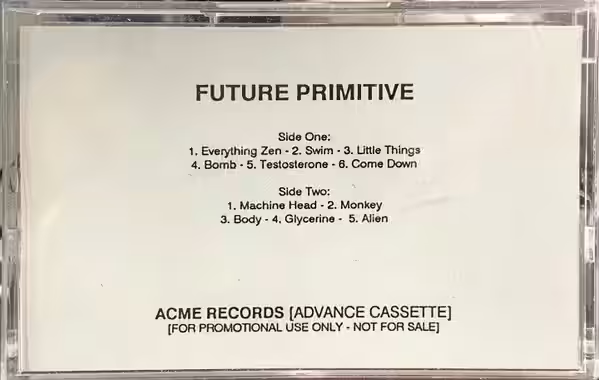
The demos and early shape of the record circulated under the Future Primitive name, including a promotional advance cassette that today is a prized scrap of pre-fame history. Its running order is not quite the album fans came to know: the sequencing is shuffled, the closing run is different, and the track titles are spaced out in the loose phonetic style of the band's earliest pressings.
When Rossdale first played "Glycerine" to the band, in a rough rehearsal room in Harlesden, west London, they barely looked up. He has told the story with some relish: he finished playing what he suspected might be the best song of his life, and the others kept chatting. It is the kind of detail that says a great deal about how little anyone, including the band, sensed what was coming.
Making Sixteen Stone
Bush recorded Sixteen Stone in January 1994 at Westside Studios in London, working in Studio One on a Neve VR console. The most important decision had already been made before a note was tracked: who would produce it. Rossdale, a worshipper of raw American records, initially wanted Steve Albini, the engineer behind Nirvana's In Utero. Albini went unused on the debut, though Rossdale got his wish two years later when Albini engineered Razorblade Suitcase. For Sixteen Stone, the band did something stranger and shrewder. Worried they sounded too American, and braced for the copycat accusations that would indeed arrive, they hired two Englishmen.
"It became apparent that we had a definite American bent to our sound, which is why we choose [Langer and Winstanley] to produce our first album, in the hope that they would make us sound more British."
Nigel Pulsford, BBC Cymru Wales, 2009
Clive Langer and Alan Winstanley were unlikely choices for a grunge record. Their reputation rested on Madness, on Elvis Costello, on the kind of sharp English pop that could not be further from feedback and flannel. Langer had co-written "Shipbuilding" with Costello. Winstanley, by his own account, went out and bought Pixies and PJ Harvey records to prepare for the sessions, listening to Nirvana to understand the world the band wanted to inhabit. Langer spent more time in rehearsals shaping the material; Winstanley, the engineer, did the heavy lifting during tracking. Their working method was the opposite of grunge mythology's chaos.
"The arrangements were very simple. We just recorded it. It wasn't like making a Madness record or a They Might Be Giants record, or even an Elvis Costello record. There weren't that many overdubs. We were purposely keeping it simple."
Clive Langer, Mix, 2024
That simplicity hid a few hard-won breakthroughs. Working on Rossdale's guitar sound, the team tracked most parts through a Marshall 100 amplifier before trying a single pass through a smaller Marshall 50. The 50 sounded so much better that they re-cut every guitar on the record through it in a day, and abandoned double-tracking in the process. As Langer put it, they decided to "forget about the double-tracking, just getting down to basics." Rossdale's vocals ran through a Neumann U87 and an Empirical Labs Distressor, a compressor only launched that year, which Winstanley rented for the sessions and liked so much he immediately bought two for the studio. The guitars stayed dry. The whole record has the sound of a band caught with the lights on, which is exactly what makes it punch.
The kit that shaped the record was modest by the standards of a major-label rock album:
- A Neve VR console in Studio One at Westside Studios, London
- Marshall 50 and 100 valve amplifiers, with the smaller 50 winning out
- A Neumann U87 on Rossdale's vocals
- An Empirical Labs Distressor, rented brand new, for vocal compression
- Sennheiser 421 and Shure SM57 microphones on the deliberately dry guitars
The sessions had a shadow over them. The album is dedicated to two men who died around the time it was made: Nigel Pulsford's father and Rossdale's stepfather. That grief would surface most plainly in the album's quietest, biggest song.
Personnel and Credits
For an album so associated with one man's voice, Sixteen Stone has more hands on it than its lean sound suggests. The most consequential guest contribution is Nigel Pulsford's string arrangement for "Glycerine," written after his father's death and performed by two seasoned session players. The harmonica on the record, the backing voices, the cello and viola: all of it is real, none of it is loud.
| Role | Player | Notes |
|---|---|---|
| Core band | ||
| Lead vocals, rhythm guitar | Gavin Rossdale | Sole songwriter on all 12 tracks |
| Lead guitar, backing vocals | Nigel Pulsford | Wrote the string arrangement for "Glycerine" |
| Bass | Dave Parsons | |
| Drums | Robin Goodridge | Joined in mid-1993; cited Bonham, Billy Cobham and Keith Moon |
| Guest and session musicians | ||
| Cello | Caroline Dale | On "Glycerine" |
| Violin, viola | Gavyn Wright | On "Glycerine"; arrangement double-tracked |
| Harmonica | Vincas Bundza | |
| Backing vocals | Jasmine Lewis, Alessandro Vittorio Tateo, Winston | |
| Production and engineering | ||
| Producers | Clive Langer, Alan Winstanley, Bush | Langer shaped rehearsals; Winstanley engineered tracking |
| Mixing | David J. Holman, Paul Palmer | Mixed at Cactus Studio, Hollywood; Langer and Winstanley also mixed |
| Assistant engineer | Danton Supple | |
| Mastering | Robert Vosgien | |
| Artwork | ||
| Design and packaging | David Carson | The era-defining deconstructed-type designer |
| Photography | Paul Cohen, Mark Lebon | Cohen credited with the cover photo |
| Paintings | Gillian Spitchuk | |
The Songs
Twelve tracks, every word and note credited to Gavin Rossdale, running from a 45-second punk blast to a six-and-a-half-minute closer. The album front-loads its hooks and saves its most fragile moment, "Glycerine," for late in the running order, a sequencing gamble that paid off when the ballad became the record's signature.
| # | Title | Writer | Length | Single? | Notes |
|---|---|---|---|---|---|
| 1 | Everything Zen | Gavin Rossdale | 4:38 | Yes | The KROQ accident that started everything |
| 2 | Swim | Gavin Rossdale | 4:56 | No | Later issued as a live B-side |
| 3 | Bomb | Gavin Rossdale | 3:23 | No | First aired as a Future Primitive single |
| 4 | Little Things | Gavin Rossdale | 4:24 | Yes | The most overtly Nirvana-like cut |
| 5 | Comedown | Gavin Rossdale | 5:27 | Yes | The first song Rossdale ever wrote alone |
| 6 | Body | Gavin Rossdale | 5:43 | No | Riff often likened to Soundgarden's "Rusty Cage" |
| 7 | Machinehead | Gavin Rossdale | 4:16 | Yes | Later featured in the film Fear |
| 8 | Testosterone | Gavin Rossdale | 4:20 | No | A take-down of machismo |
| 9 | Monkey | Gavin Rossdale | 4:01 | No | Sardonic swipe at rock stardom |
| 10 | Glycerine | Gavin Rossdale | 4:27 | Yes | Voice, guitar and strings, no drums |
| 11 | Alien | Gavin Rossdale | 6:34 | No | Missing from early back-cover printings |
| 12 | X-Girlfriend | Gavin Rossdale | 0:45 | No | A Ramones-indebted punk sign-off |
"Everything Zen" opens the record with a swagger that has nothing to do with introspection. Its lyrics are pure surrealist collage, "Mickey Mouse has grown up a cow" being the line most people remember, and one couplet in particular has been picked over for thirty years. Rossdale has explained where "there's no sex in your violence" came from, and the answer is not Seattle.
"One band that really inspired me at the time, and always, forever, was Jane's Addiction. I had seen a show of theirs, and they have that line 'sex is violent.' I thought about that line, and it always struck me as a powerful lyric."
Gavin Rossdale, Songfacts, 2017
"Little Things" is the song that hung the Nirvana albatross around the band's neck, and Rossdale has never seriously denied the resemblance. Its theme, he has said, is "trying to be strong in the face of adversity," paranoia about the future channelled into a chorus built to detonate on radio. It was also the song chosen for one of the album's most-played videos, preserved here.
"Comedown" carries a different weight, being the oldest song here and the most personal. Its descending bassline owes something to Massive Attack, of all people, and its slow-burn structure made it a number one on American alternative radio. "Body" rides a churning riff that listeners have long compared to Soundgarden's "Rusty Cage," and "Bomb," written about the IRA campaigns that scarred Rossdale's north London childhood, is angrier than its three minutes let on. "Machinehead," with its instantly recognisable intro, would become a film-soundtrack staple. And then there is "Glycerine," which is barely a Bush song at all in any conventional sense.
"Glycerine" is a ballad with a distorted guitar, no acoustic, almost no drums, and a string arrangement that should not work and is the whole point. The decision to leave the rhythm section out was half accident, half grief. Pulsford had written the strings after losing his father, and the band realised that adding power drums would smother them.
"Nigel delivered really beautiful strings. His father had just passed away, and he wrote some very, very beautiful strings, and that also informed the decision, 'Don't put drums in there now, don't hide those strings.' It's funny how all these different, unusual circumstances happened to bring about what is effectively a ballad with a distorted guitar. For me, it's the most successful song that I've ever written."
Gavin Rossdale, Mix, 2024
Winstanley's masterstroke was to mix the song as though the drums were about to enter at any moment, building a tension that never resolves into the expected big chorus. Rossdale suspects the drums may even have been recorded and simply muted. Whatever the truth, the result is a song that sounds perpetually on the edge of becoming something louder, and never does. It is the album's emotional centre, hidden two tracks from the end.
B-sides, Outtakes and Lost Songs
Because Sixteen Stone began life as a different record under a different band name, its archival edges are unusually rich. The earliest artefact is the Future Primitive material: the "Bomb" single that predates the album, and the advance cassette pictured above, whose shuffled running order shows the album mid-assembly. Langer remembers the strange limbo that followed the sessions, when the record sat unreleased and seemingly abandoned.
"We made the record as Future Primitive, and then they had problems with their record company, and we didn't hear anything about it. We thought it was a lost album, and it didn't come out until a year later. We didn't have any expectations. It took off really quickly when it finally came out."
Clive Langer, Mix, 2024
Later pressings of the album fleshed out the story. Some editions added an alternative version of "Comedown," stripped back to Rossdale's voice and guitar, slowed down, drenched in extra effects and decorated with violins but no drums, an interesting cousin to the "Glycerine" approach. Other reissues bundled a second disc of live recordings, with concert versions of "Swim," "Alien," "Bomb" and "Little Things" turning up as bonus cuts. The international CD singles that followed the album were a common home for these live takes, the sort of B-side material that rewards the obsessive and that streaming has largely buried.
Artwork and Packaging
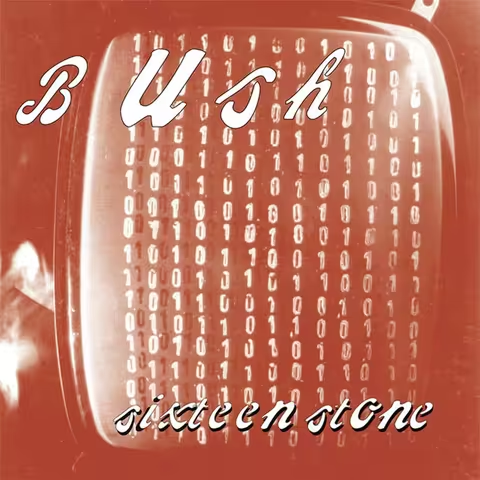
The cover is the work of David Carson, the American graphic designer whose deconstructed, rule-breaking typography defined the look of 1990s alternative culture through magazines like Ray Gun. His sleeve for Sixteen Stone is a rust-red duotone of a curved cathode-ray screen overrun with columns of binary code, the band name and album title looping across it in a soft cursive script that seems to belong to a different decade entirely. It is busy, warm and slightly unsettling, a long way from the stark photography that fronted most grunge records.
The packaging also carried a couple of genuine errors that have delighted collectors ever since. On early pressings, "Alien" is missing from the back-cover track listing, leaving a conspicuous blank where the eleventh title should be, even though the song's lyrics are printed inside and it plays on the disc. "Monkey," similarly, went absent from the inside cover on some copies. Both made it onto the album itself, but the printed sleeves told a slightly different story, the kind of small chaos that fits a record nobody at the label expected to ship.
The Rescue and the Reception
The release saga of Sixteen Stone is the best story Bush have, and it is true. The band signed in 1993 to Trauma Records, a small label run by Rob Kahane, whose distribution flowed through Disney's Hollywood Records. They finished the album in early 1994 and handed it in. Then everything fell apart in slow motion.
- Disney executive Frank G. Wells, Kahane's key supporter, died in a helicopter crash in April 1994.
- With Wells gone, Hollywood Records deemed the album unacceptable, telling the band it had "no singles" and "no album tracks."
- Bush effectively lost their American distribution months before release, and the members went back to day jobs in London.
- Kahane sent an advance copy to a friend at the Los Angeles radio station KROQ.
- KROQ began spinning "Everything Zen" and "Little Things" before the label had even formally serviced the songs.
- With radio demand building, Interscope, run by Jimmy Iovine and Ted Field, picked up the record and released it in late 1994.
Rossdale has been candid about how hopeless it all felt from the inside. There was no master plan, no sense of destiny, just a man who had failed for years and assumed he would carry on failing.
"You have to remember that every single thing we did on that record was against the backdrop of abject failure and a complete zero success. All I had was, this is your legacy before you go back and paint houses for the rest of your life. Just feel good that you've made a record and you weren't such a loser."
Gavin Rossdale, Ultimate Classic Rock, 2024
The critics, when they came, were split along predictable lines, and the fault line ran straight through the Nirvana question. American outlets were warmer. AllMusic handed the album four and a half stars while conceding it sounded a great deal like Nirvana and Pearl Jam. Britain's Q magazine placed it neatly in its lane, praising "a carefully honed post-grunge sound that fits perfectly alongside American counterparts like Stone Temple Pilots or Live." Robert Christgau, less charmed, called it a "not altogether unmusical howl of male pain" that glorified despair, and The Guardian gave it two stars.
The harshest verdict became the most famous. Rolling Stone ran a 1996 feature that branded the band "Nirvanawannabes," and the writer Matt Diehl described Bush as "the most successful and shameless mimics of Nirvana's music." The critic Chuck Klosterman would later land the cruellest line of all, writing that Bush "would become the grunge Warrant," a band that signalled the beginning of the end of the genre's credibility. None of it dented the sales. Sixteen Stone climbed to number four on the Billboard 200, having crept in at number 187 in late January 1995, and simply refused to leave.
Singles and Music Videos
Five singles came off Sixteen Stone across 1995 and 1996, and remarkably, all of them landed. Part of the band's early legend is that their first seven singles, stretching into the second album, every one reached the top ten of the US Modern Rock chart, a run of consistency most of their critics never managed to explain away.
| Single | Released | Peak positions | Notes |
|---|---|---|---|
| Everything Zen | April 1995 | US Modern Rock Top 10 | The song KROQ broke before the label serviced it |
| Little Things | July 1995 | US Modern Rock Top 10 | The most overtly Nirvana-like single |
| Comedown | August 1995 | No. 1 US Modern Rock, No. 30 Hot 100 | The first song Rossdale wrote alone |
| Glycerine | Late 1995 | No. 1 US Modern Rock, No. 28 Hot 100 | Voice, guitar and strings, no drums |
| Machinehead | April 1996 | No. 43 Hot 100 | Featured in the 1996 thriller Fear |
The videos turned Rossdale into a poster on a million bedroom walls, a development that did the band no favours with the rock press but everything for their sales. "Glycerine," performed in the rain, leaned into his looks shamelessly and won the Viewer's Choice award at the 1996 MTV Video Music Awards. "Machinehead" did double duty as a film tie-in, appearing in the 1996 Mark Wahlberg thriller Fear and going on to win Best Song from a Movie at the 1997 MTV Movie Awards. For a record the label had declared singleless, it generated an awful lot of hits.
Touring and Live
Bush's response to success was to disappear into vans and clubs and not come out for years. There was no grand strategy, only relentless work, which Rossdale has framed as the thing that finally cured the sting of a decade of rejection.
"We just didn't stop touring for a couple of years. For two or three years, we just played and played in all of the clubs, over and over. What was so cool about having a hit song and playing the clubs is that every night, you got a chance to prove that you could do it."
Gavin Rossdale, Ultimate Classic Rock, 2024
The touring built the audience that the British press kept insisting did not really exist. By the time the band came off the road, Sixteen Stone had sold into the millions, and Bush had become, improbably, one of the biggest rock acts in America, while remaining near-invisible at home. The pattern set here, constant touring and a deep, loyal American fanbase, would define the rest of their career, and explains why a band the UK never embraced is still filling large venues across the United States three decades on.
In TV, Film and Media
The clearest screen moment for the album is "Machinehead," whose placement in Fear in 1996 turned an album track into an award-winning film song and pushed it onto the Hot 100. Beyond that single sync, the album's afterlife in media has been quieter and more diffuse: its singles became rock-radio perennials, the kind of songs that score television montages of the 1990s by sheer association, and "Glycerine" in particular has lived a long second life as an acoustic cover, the song a certain kind of guitarist reaches for to prove that a few chords and a held breath can level a room.
Rossdale himself drifted into screen work in the years after, taking acting roles that kept his face in circulation long after the band's commercial peak had passed. None of that, though, matches the simple ubiquity of these songs on American airwaves, where they have never really gone away.
The Nirvana Question and the Name in Canada
Two controversies shadow this record, one aesthetic and one legal. The aesthetic one never fully went away. The charge that Bush were Nirvana copyists, crystallised in that "Nirvanawannabes" headline, followed the band for years and coloured every British review they ever got. The most quoted summary of the case against them belongs to the writer Kyle Anderson, and it is sharp enough to sting precisely because it is partly fair.
"The twelve songs on Sixteen Stone sound exactly like what grunge is supposed to sound like, while the whole point of grunge was that it didn't really sound like anything, including itself."
Kyle Anderson, Accidental Revolution
Rossdale's defence, offered across many interviews, was never that the influences were not there, but that they were honestly come by and not the ones critics assumed. He pointed less to Nirvana than to the Pixies, to Jane's Addiction, to the English post-punk and noise records he had loved as a teenager. The band, he argued, were not chasing a trend, they were finally allowed to make the music they had always wanted to make, at the exact moment the world happened to want it too.
The legal controversy was simpler and stranger. In Canada, the name Bush was already spoken for. A 1970s Canadian band called Bush, led by guitarist Domenic Troiano, held the rights, so the album was released north of the border under the name BushX. The dispute dragged on until a 1997 settlement, in which the band were allowed to drop the X in exchange for donating 20,000 dollars each to the Starlight Foundation and the Canadian Music Therapy Trust Fund. Both Sixteen Stone and its successor were subsequently reissued in Canada without the X, and one of the odder footnotes in 1990s rock was quietly closed.
Covers, Samples and Tributes
The album's biggest gift to the wider songbook is "Glycerine," which has become something close to a standard for the acoustic-guitar-and-a-stool brigade. Its simple chord shape and emotional directness make it a perennial choice for buskers, open-mic nights and televised talent shows, where it tends to be reached for as shorthand for sincerity. The song's status as a much-covered staple, decades after release, is itself a quiet rebuttal to the idea that there was nothing underneath the band but borrowed Seattle noise.
Documented full-scale covers and samples from the rest of the record are thinner on the ground, which fits a band whose influence was felt less in tribute than in template. The clearest mark Sixteen Stone left on other artists is structural rather than note-for-note, and that belongs in the story of its legacy.
Reissues, Remasters and Anniversaries
For its twentieth anniversary, Sixteen Stone was given a remaster, released on 14 October 2014. Tellingly, it was a remaster and not a remix. Rossdale tried the latter and recoiled, in a way that says a lot about how completely the original sound had fused with the songs in listeners' minds.
"I did attempt to remix, but you just can't do that. You can't mess with stuff. Those mixes, every single level of those songs is just ingrained in my DNA, as it's probably in anybody's DNA who knows it. It just sounds really weird when you mess with it."
Gavin Rossdale, on the 2014 remaster
The album has since been folded into the band's wider catalogue housekeeping. Its singles anchor the 2023 compilation Loaded: The Greatest Hits 1994-2023, and a 2024 remixes EP, cheekily titled Loads of Remixes, handed the old songs to a new generation of producers, with Rossdale himself reworking "Machinehead." For a record made by a band who thought they were destined to paint houses, Sixteen Stone has proved a remarkably durable piece of property.
Legacy and Influence
Whatever the critics decided, Sixteen Stone won the only argument the marketplace recognises. Six times platinum in the United States and past six million copies, it remains one of the best-selling rock debuts of its decade, and it helped turn post-grunge, a term often spat rather than spoken, into the dominant commercial rock sound of the late 1990s and early 2000s. The bands who followed in that lane, the ones who filled rock radio after the original grunge wave receded, owe a measurable debt to the path Bush cleared, even when they would never admit it.
For Bush themselves, the album was a launchpad they spent years trying to live up to. Razorblade Suitcase, recorded with Steve Albini in 1996, debuted at number one in the US and gave them another long-running radio hit in "Swallowed." The Science of Things embraced electronics and produced "The Chemicals Between Us." The band broke up in 2002, reunited in 2010 with Rossdale and Goodridge at the core, and have kept making records into the 2020s, by which point Rossdale was the last original member standing. None of those later albums, for all their merits, ever escaped the gravity of the debut.
Rossdale's own summary of what he was doing in 1994 is the truest thing anyone has said about this record. He was not chasing the charts; he was making a noise nobody in his own country wanted, and finding out, to his genuine surprise, that on the other side of an ocean it sounded exactly like the future.
"I was in London playing rock music when people didn't like rock music. There was clearly no commercial endeavor. I liked more sweat and mess and feedback. I had more rage than that. I let go of all commercial concepts and began Bush."
Gavin Rossdale, Mix, 2024
Things You Might Not Know
| Fact | Detail |
|---|---|
| They were Future Primitive | Bush recorded the album under the name Future Primitive and released the early version of "Bomb" under that moniker before changing it. |
| A software-company clash | One reason given for the name change was that a software company already called Future Primitive existed, forcing the band to find something new. |
| Rejected for "no singles" | The original distributor, Hollywood Records, declared the album had "no singles" and "no album tracks" and effectively dropped it before release. |
| A death changed everything | The death of Disney executive Frank G. Wells in an April 1994 helicopter crash removed the label ally who had backed the band, triggering the collapse of their deal. |
| Radio rescued it by accident | The album only escaped limbo because a friend of label boss Rob Kahane at KROQ started playing "Everything Zen" before it had even been officially serviced. |
| Glycerine has no real drums | The band's signature ballad was kept drumless so it would not bury Nigel Pulsford's string arrangement, written after his father's death. |
| A brand-new compressor | Engineer Alan Winstanley compressed Rossdale's vocals with an Empirical Labs Distressor, then so new he had to rent one, before buying two for the studio. |
| "Alien" went missing | Early pressings left "Alien" off the printed back-cover track list entirely, even though the song appears on the disc and its lyrics are printed inside. |
| Banned name in Canada | A 1970s Canadian band owned the name, so the album came out there as BushX until a 1997 charity settlement let them drop the X. |
| Albini came later | Rossdale wanted Steve Albini for the debut and did not get him, but landed him to engineer the follow-up, Razorblade Suitcase. |
| Two dedications | The album is dedicated to two men who died around its making: Nigel Pulsford's father and Gavin Rossdale's stepfather. |
| The title stays a mystery | Sixteen stone is a British weight of 224 pounds, but the band have never given a definitive explanation, leaving fans to trade unverified theories. |
The Riffology Podcast
The full, messy, improbable tale of Sixteen Stone, the lost deal, the radio fluke, the Nirvana wars and the six million copies, gets the long-form treatment on the Riffology podcast, where the hosts dig into the songs, the sessions and the stories behind one of the strangest success stories of the 1990s. If this deep dive has sent you back to the record with fresh ears, the episode is the natural next step. The Riffology podcast is available on all major platforms, so settle in, turn it up, and hear how a band everyone wrote off ended up rewriting rock radio.
Comments