The Goo Goo Dolls sold 2.1 million copies of A Boy Named Goo in the United States and, between the three of them on the cover, made almost exactly nothing. The reason was a one-page contract that Robby Takac and John Rzeznik had signed in a Buffalo bar in 1987, when they were a punk band called the Sex Maggots and Metal Blade Records was the only label that had returned a phone call. By the time Kevin Weatherly at KROQ in Los Angeles started spinning the album's sixth track, an open-tuned acoustic ballad nobody in the band thought was a single, that contract had eight years left to run and a clause that paid each member of the band roughly 25 cents per CD sold.
The album would go on to do a lot of things its makers had stopped expecting. It would put the band on Beverly Hills, 90210, get banned from Walmart, halt one music video mid-shoot to make another, become the first double-platinum record in Metal Blade's history, fund the lawsuit that broke that contract, and lay down the template for the Goo Goo Dolls' next twenty-five years. None of which the four men who recorded it at half-tape-speed in a Suffern, New York studio knew at the time. What they knew was that they were broke, the drummer had just been fired, and the lead single was about a fake island full of people in shark costumes.
Album Facts
| Field | Detail |
|---|---|
| Artist | Goo Goo Dolls |
| Album | A Boy Named Goo |
| Release Date | 14 March 1995 |
| Label | Metal Blade Records, distributed by Warner Bros. |
| Producers | Lou Giordano (tracks 1-11); Rob Cavallo and Goo Goo Dolls (tracks 12-13) |
| Studios | BearTracks Studios, Suffern NY; Trackmaster Audio, Buffalo NY (overdubs); Soundcastle, Los Angeles (covers) |
| Genre | Alternative rock, power pop, post-grunge, punk rock |
| Track Count | 13 |
| Total Runtime | 42:14 |
| Billboard 200 Peak | 27 (year-end 1996: 62) |
| UK Albums Chart Peak | Did not chart |
| Other Notable Chart Peaks | 15 in Canada (RPM); top 40 in New Zealand |
| Certifications | 2x Platinum (RIAA); Platinum (Music Canada) |
| Estimated Sales | Over 2.1 million US; roughly 2.5 million worldwide |
| Key Singles | Only One, Flat Top, Name, Naked, Long Way Down |
Cultural Context
March 1995 was the inflection point of the post-grunge American rock chart. Kurt Cobain had been dead eleven months. Nevermind's commercial blueprint, alternative bands selling pop numbers, had been picked up by every major label A&R department in Los Angeles and was being re-fitted in real time onto bands who were less abrasive, more melodic and more sellable. Bush's Sixteen Stone had been on the Billboard 200 since the previous December. Hootie and the Blowfish's Cracked Rear View was a year into a run that would end at sixteen-times platinum. Alanis Morissette's Jagged Little Pill was three months away. Oasis's (What's the Story) Morning Glory?, seven. Foo Fighters' debut, four. Smashing Pumpkins' Mellon Collie, seven.
The Goo Goo Dolls came into that landscape with a stack of records nobody had bought (four albums between 1987 and 1993 that had sold a combined total of under 200,000 copies), a producer most rock A&R people had not heard of, and a song called Name that their own label initially passed over twice before KROQ forced the issue. The records sitting closest to A Boy Named Goo in 1995's alternative landscape give a fair picture of the company the band were keeping and the company they were about to surpass:
- Better Than Ezra, Deluxe, released the same week and built on the same KROQ-friendly chorus template.
- Collective Soul, Collective Soul, also March 1995, and the obvious sonic neighbour to Name.
- Toad the Wet Sprocket, In Light Syrup, the back-end of the Santa Barbara jangle wave the Goos owed something to.
- Matchbox 20, then rehearsing in Orlando, twenty-three months from Yourself or Someone Like You and built largely on the template Name would set.
- Third Eye Blind, then unsigned in San Francisco, also studying Name in detail.
The Goo Goo Dolls' achievement on A Boy Named Goo was not to invent the late-1990s post-grunge ballad. It was to write the song everyone else then spent five years copying.
The Band's Story Up to This Point
The Goo Goo Dolls had been a working band for nine years by the time A Boy Named Goo appeared. The original trio, Robby Takac on bass and lead vocals, John Rzeznik on guitar, George Tutuska on drums, formed in Buffalo, New York in late 1985 under the name Sex Maggots, a name Takac later said came from a Replacements lyric and was changed within a year because a Buffalo club owner refused to print it on a flyer. The replacement name was picked from an advert for a children's toy in True Detective magazine; Rzeznik has consistently called it the worst decision the band ever made.
The first four albums charted the band's slow climb out of the Buffalo punk circuit and into the major-label-distributed alternative world. Goo Goo Dolls (Mercenary, 1987) and Jed (Death/Enigma, 1989) were Replacements-and-Husker-Du worship records that sold in the low thousands. Hold Me Up (Metal Blade, 1990) gave Rzeznik his first lead vocals on a band original. Superstar Car Wash (Metal Blade/Warner, 1993) was the first record that the wider music press noticed: its single We Are the Normal, with lyrics co-written by Paul Westerberg of The Replacements, charted on MTV's 120 Minutes, and a non-album track, Fallin' Down, appeared on the Pauly Shore vehicle Son in Law. The band, by their own admission, were broke. Rzeznik was working a day job as an independent radio promoter when he wrote most of the songs that became the new album.
The handshake going into the new record was that this was, by industry standards, the last realistic chance. Metal Blade's option clause came up after album five; if A Boy Named Goo did not break the band commercially, they would be dropped. The band booked the cheapest residential studio they could find in striking distance of New York City and went in.
Pre-production and Demos
The bulk of writing happened in Rzeznik's small apartment in Buffalo in late 1994. Name was written on an acoustic guitar that Rzeznik had unintentionally re-tuned the night before by leaving it on a hot radiator; the next morning he picked it up, played what sounded like an open D chord, and the figure that became the song's intro came out in roughly ten minutes. He has consistently said in interview that he stumbled across the D-A-E-A-E-E tuning that morning, with the high E substituted for the B because the B string snapped within a few minutes of trying to tune it that high. Several other songs (Long Way Down, Naked, Flat Top, Ain't That Unusual) came together in the same room over the same six weeks.
Pre-production was handled at Trackmaster Audio in Buffalo by Armand John Petri, who had produced the band's first three albums and was the closest thing they had to a fifth member at that point. Petri's role was to translate Rzeznik's apartment demos and Takac's separate batch of punk-leaning material (which became Burnin' Up, Impersonality, Somethin' Bad, So Long) into full-band arrangements that the trio could track quickly when the studio clock started.
Tutuska's involvement in pre-production was already strained. Takac later described the period as the drummer being "a little resistant to what we wanted to do" and slowing the band's progress; Tutuska's own account, given to Goldmine in 2005, was that the issue was a long-standing dispute about royalty splits, specifically about the songwriting credit and the publishing income from Fallin' Down, which Rzeznik had registered as a solo write. By the time the band loaded the gear into BearTracks in July 1994, Tutuska had told management he would not tour the new record unless songwriting royalties were split equally going forward.
Creating the Album
BearTracks Studios in Suffern, New York is a residential studio built in 1979 by King Crimson's Pete Sinfield and bought in the late 1980s by the producer-engineer Dean Bommarito. By 1994 it was a recognised Husker Du and Sugar haunt and the obvious destination for any band who wanted that record's particular jangle-and-distortion sonic balance. Producer Lou Giordano, the New York engineer who had cut Husker Du's Warehouse: Songs and Stories and Sugar's File Under: Easy Listening, was the choice the band had been pushing for since Superstar Car Wash; Metal Blade signed off because Giordano's day rate was, by 1994 producer standards, modest.
Sessions ran from July through October 1994. The band tracked basics live in BearTracks' main room: Tutuska behind the kit, Takac and Rzeznik on the floor with isolation baffles, three or four takes per song, the best one kept. Overdubs (vocals, mandolin, additional guitar layers, the open-tuned acoustic on Name) were tracked partly at BearTracks and partly back at Trackmaster Audio in Buffalo through the autumn. Money, as had been true since 1987, was tight. Rzeznik has on multiple occasions cited the detail that he bought blank Ampex 456 master tape from a mail-order supply house himself at roughly half what BearTracks charged through their in-house tape pool. The band lodged at the cheapest available motel within driving distance of the studio.
What the sessions also generated, alongside the album, was a parting of the ways with the drummer. By the band's account, an argument over the Fallin' Down royalties broke out during the BearTracks sessions and was not resolved; Tutuska finished tracking drums for all eleven of the principal songs and then, in November 1994, was told by Rzeznik and Takac that he was out of the band. The official statement at the time cited creative differences. Tutuska has consistently disputed that framing.
Two further songs were added to the running order after Tutuska's departure to round the record out to a commercial thirteen-track length. Both were covers, both were tracked separately in January 1995 at Soundcastle in Los Angeles, both were produced by Rob Cavallo (then riding the success of Green Day's Dookie) and engineered by Jerry Finn. Disconnected, by Buffalo punk band the Enemies, and Slave Girl, by Sydney's Lime Spiders, were chosen partly as a nod to the band's pre-major punk identity and partly as a deliberate exclusion of Stand Alone, a Tutuska-written instrumental that had been demoed for the album. Stand Alone appeared only on promo-only pressings sent to radio in early 1995; Rzeznik has said in interview that he did not want to keep paying songwriting royalties to a fired drummer.
Mike Malinin, a Berklee-trained drummer who had been working the Boston club circuit, joined as touring drummer in time to debut at the Dragonfly in West Hollywood on 4 February 1995. He would remain the band's drummer until December 2013.
Takac put the BearTracks experience plainly to Classic Rock:
"At that point in our life the party never stopped. It usually degenerated into a drunken brawl by the end of the night. We bought our own tape, we slept four to a motel room, and we made the record we'd been trying to make for ten years."
Robby Takac, Classic Rock, 2015
Personnel and Credits
| Role | Player | Notes |
|---|---|---|
| Core band | ||
| Lead and backing vocals, guitar | John Rzeznik | Lead vocal on all Rzeznik writes; open-tuned acoustic on Name |
| Lead and backing vocals, bass | Robby Takac | Lead vocal on Burnin' Up, Impersonality, Somethin' Bad, So Long |
| Drums (tracks 1-11) | George Tutuska | Fired in November 1994 after the BearTracks sessions wrapped |
| Drums (tracks 12-13) | Mike Malinin | Recorded the two cover tracks in January 1995; uncredited on first pressing |
| Production and engineering | ||
| Producer (tracks 1-11) | Lou Giordano | Also engineer; Husker Du and Sugar credits |
| Producer (tracks 12-13) | Rob Cavallo and Goo Goo Dolls | Cavallo was simultaneously mixing Green Day's Insomniac |
| Engineer (tracks 12-13) | Jerry Finn | Later produced blink-182, AFI, Sum 41 |
| Pre-production | Armand John Petri | Trackmaster Audio, Buffalo; produced the band's first three records |
| Mixing | Lou Giordano | At BearTracks |
| Mastering | Howie Weinberg | Masterdisk, New York |
| Artwork | ||
| Cover photograph | Glenn Gellert | Photograph of Gellert's own two-year-old son Carl, taken c.1985; used by permission |
| Additional photography | Nancy J. Parisi, Kim Biggs | Tattooed-man and torso photographs respectively |
| Art direction | Goo Goo Dolls and Tom Recchion | Recchion was Warner Bros.' in-house design lead |
The Songs
| # | Title | Writer(s) | Length | Single? | Notes |
|---|---|---|---|---|---|
| 1 | Long Way Down | Rzeznik | 3:39 | Yes (Mar 1996) | Twister soundtrack edit released separately |
| 2 | Burnin' Up | Rzeznik, Takac, Tutuska | 2:29 | No | Takac lead vocal |
| 3 | Naked | Rzeznik | 3:44 | Yes (Jan 1996) | 1 on Billboard Mainstream Rock |
| 4 | Flat Top | Rzeznik | 4:30 | Yes (Jun 1995) | Video shoot halted mid-production when Name broke |
| 5 | Impersonality | Rzeznik, Takac, Tutuska | 2:40 | No | Takac lead vocal |
| 6 | Name | Rzeznik | 4:31 | Yes (26 Sep 1995) | 5 on Billboard Hot 100; 1 on both Modern Rock and Mainstream Rock |
| 7 | Only One | Rzeznik | 3:18 | Yes (Feb 1995) | Fake desert island and shark-suit extras in the video |
| 8 | Somethin' Bad | Rzeznik, Takac, Tutuska | 2:31 | No | Takac lead vocal |
| 9 | Ain't That Unusual | Rzeznik | 3:22 | No | On the Angus soundtrack; titled Someday on promo pressings |
| 10 | So Long | Rzeznik, Takac, Tutuska | 2:33 | No | Takac lead vocal |
| 11 | Eyes Wide Open | Rzeznik, Takac, Tutuska | 3:57 | No | Final original; effectively the album's true closer |
| 12 | Disconnected | The Enemies | 2:49 | No | Cover of Buffalo punk trio; tracked at Soundcastle, January 1995 |
| 13 | Slave Girl | Lime Spiders | 3:41 | No | Cover of Sydney garage-punk band |
Name
The song that turned everything over. Rzeznik wrote Name on an acoustic in his Buffalo apartment in the autumn of 1994 in one short sitting, on a guitar that had been accidentally re-tuned by a radiator overnight to roughly D-A-E-A-E. He has consistently said the high E substituted for the B was a pure necessity, the regular B string would not hold the pitch and snapped in his hands twice before he switched it. The figure that opens the song, the four-bar arpeggio that becomes the song's signature, came out in the same first session as the chord progression. The lyric is, by Rzeznik's repeated account, addressed in part to the MTV VJ Lisa Kennedy Montgomery (Kennedy), whom Rzeznik had got to know in 1993-94 during the Superstar Car Wash press cycle; both Kennedy and Rzeznik have confirmed the connection in separate interviews, though Rzeznik has been clear that the song is not biographically about her so much as inspired by their conversations about identity and small-town reinvention.
At BearTracks, Name was tracked late in the session. The band's own consensus going in was that it was a strong album track but not a single. Giordano cut the basics live with Rzeznik on the open-tuned acoustic, Takac on a melodic bass line patterned on Mike Mills's Losing My Religion playing, and Tutuska on brushes. Mandolin overdubs (played by Rzeznik) were tracked at Trackmaster in Buffalo. The string-pad sound under the second chorus is a Roland JV-1080 patch, the only synthesised sound on the record.
Only One and Flat Top
Only One, the lead single, was the band's and Metal Blade's consensus choice as the most radio-ready of the rockers. Its February 1995 video, directed by Marcus Nispel (later the director of the 2003 Texas Chainsaw Massacre remake), set the band on a fake desert island built on a Los Angeles soundstage, with extras in shark costumes circling in the foreground. The single charted modestly: 18 on the Modern Rock Tracks chart but no Hot 100 placing. Flat Top followed in June 1995, with a video shoot at the Hollywood Palladium being filmed when the call came through from KROQ that Name was now in heavy rotation in Los Angeles. Production on the Flat Top video was halted and never resumed; the footage that did exist was eventually edited into a low-budget cut and released to MTV in late 1995 as a stopgap.
Long Way Down and Naked
The album opens with Long Way Down, a mid-tempo Rzeznik song that handled the band's depression themes more directly than anything on Superstar Car Wash had managed. A remix by Wally Gagel and Bryce Goggin was added to the soundtrack of Jan de Bont's Twister in May 1996 (it plays from a car radio during the Bill Paxton and Helen Hunt diner scene); the single's video, shot in March 1996, put the band on a revolving stage that Takac later said had to be stopped every fifteen minutes because everyone was getting motion sickness. The single reached 7 on Mainstream Rock and 25 on Modern Rock Tracks. Naked, released in January 1996, is the heaviest moment on the record, a Pixies-leaning verse pattern into a chord-pumped chorus; it reached 1 on Mainstream Rock Tracks, the band's first chart-topping single on any chart.
Takac Tracks and Deep Cuts
Four of the album's thirteen tracks are Takac leads (Burnin' Up, Impersonality, Somethin' Bad, So Long), all writer-credited to the full trio and all in the 2:29-2:40 range. They are, in essence, the punk record the band would have made if Rzeznik had not started writing radio singles. They are the most direct sonic connection to the band's Hold Me Up period and were a deliberate counterweight to the Rzeznik-led songs in the sequencing. Eyes Wide Open, the eleventh track, is the album's effective closer (the two cover tracks act as a bonus coda) and the most Replacements-shaped song on the record. Ain't That Unusual, retitled Someday on the promo pressings, was placed on the soundtrack to Patrick Read Johnson's Angus in September 1995.
The Two Covers
Disconnected by the Enemies and Slave Girl by the Lime Spiders close the record. Both were tracked separately, after the principal sessions and the Tutuska firing, at Rob Cavallo's instigation; Cavallo had been brought in by Warner Bros. to add a "punk pulse" to the back end of the record. The Enemies were a Buffalo trio that Rzeznik and Takac had known since the early 1980s. The Lime Spiders were a late-1980s Sydney garage band whose Slave Girl Rzeznik had taped off Australian college radio on a 1989 promotional trip; the Goo Goo Dolls' version was the first time most American listeners had heard the song.
B-sides, Outtakes and Lost Songs
The promo-only Stand Alone, a Tutuska solo write, is the most prominent piece of music the album dropped. It has never been officially released and circulates only as a sub-bootleg copied from the original promo CD. The Only One CD single carried both album cuts of Disconnected and Slave Girl as B-sides before the album was repressed to include them. The Name CD single carried live takes of Naked and Burnin' Up recorded at the Roxy in West Hollywood in October 1995. The Naked CD single included an acoustic version of the song recorded for the radio circuit in late 1995. A handful of BearTracks-era outtakes (an instrumental titled Vortex, an early demo of Iris that the band did not realise was significant at the time, a Takac-led cover of the Hoodoo Gurus' What's My Scene) circulate on collector tapes but have never been released officially.
Album Artwork and Packaging
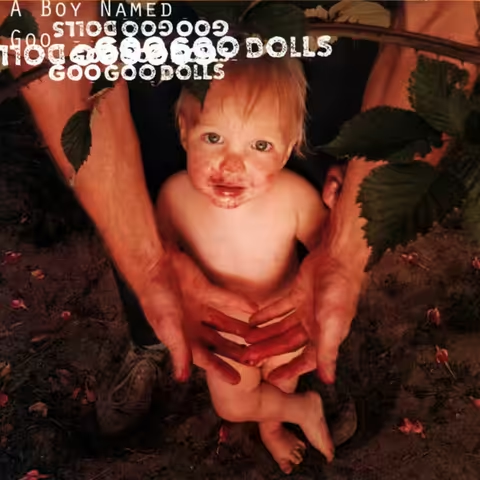
The cover photograph was taken in roughly 1985 by Glenn Gellert, a professional photographer based in Erie, Pennsylvania, of his two-year-old son Carl. The dark substance on Carl Gellert's face and hands is blackberry juice. The image had been sitting in Glenn Gellert's portfolio for nearly a decade by the time Rzeznik saw it at a 1994 portfolio review and bought the rights; Carl Gellert was twelve years old at the time the album was released. The interior of the booklet included a tattooed-man photograph by Nancy J. Parisi and a torso shot by Kim Biggs, with art direction handled jointly by the band and Warner Bros.' Tom Recchion.
The cover became a national controversy fifteen months after release. In June 1996 the Warner Bros. press office issued a statement that Walmart had pulled the album from its 2,300-store chain after customer complaints that the cover depicted child abuse, with the blackberry juice mistaken for blood. Walmart's spokesperson disputed the framing, telling Billboard the album had been pulled for weak sales (roughly 51,000 chain-wide), not for the artwork. The dispute generated approximately three weeks of national news coverage at the exact moment Long Way Down was climbing the Mainstream Rock chart. Rzeznik told MTV News at the time:
"The name of the album is A Boy Named Goo. The picture is of a boy covered in goo. What part of this concept are they unclear on?"
John Rzeznik, MTV News, June 1996
The publicity sold an estimated additional 100,000 copies of the album in the six weeks following the Walmart pull, according to SoundScan figures cited in Billboard that July. The 20th anniversary vinyl reissue arrived on 27 November 2015 (the first time the album had been pressed on vinyl) and a 30th anniversary deluxe edition followed on 14 March 2025 with 34 tracks across two CDs including a previously unreleased Las Vegas live show from 10 March 1996.
Release and Reception
The album was released on Tuesday 14 March 1995. It debuted at 141 on the Billboard 200 and spent the next eighteen weeks on a slow climb to 27, where it peaked the week of 6 April 1996, just over twelve months after release, on the back of Name's top-five Hot 100 placing. The album spent 76 consecutive weeks on the Billboard 200, finishing 1996 at 62 on the year-end chart. It topped out at 15 in Canada, charted in New Zealand and Australia, and did not chart at all in the United Kingdom (where the band would not see a top-40 placing until Iris in 1998).
Contemporary reviews were polite rather than ecstatic. Rolling Stone's J.D. Considine gave the album three stars and praised "Rzeznik's blue-collar way with a melody," while suggesting the record's two halves (Rzeznik songs and Takac songs) sounded like two different bands. AllMusic's Stephen Thomas Erlewine, in a four-star review, called it "the moment a band who had been working out their melodic instincts in private finally went public." Spin's capsule review noted the "uncanny way Rzeznik writes lyrics that sound generic and turn out to be specific". The bigger critical reckoning came post-Name: by the spring of 1996, several outlets that had ignored the album on release ran second reviews built around the single.
The retrospective view has been kinder. Pitchfork's 2015 anniversary piece called it "the moment a punk band became a pop band on its own terms, without selling anyone out." Stereogum's "30 years of Name" feature in September 2025 placed the song in a direct line of descent from Losing My Religion, naming A Boy Named Goo as a foundational text for the late-1990s post-grunge ballad. AllMusic now treats the record as a four-and-a-half star alternative-rock essential.
Singles and Music Videos
Five singles were lifted from the record across 1995-96, with the order substantially rewritten mid-cycle once Name broke.
| Single | Release | B-sides | US Hot 100 | US Mainstream Rock | Video director |
|---|---|---|---|---|---|
| Only One | February 1995 | Disconnected; Slave Girl (later promoted onto LP) | - | 30 | Marcus Nispel |
| Flat Top | 12 June 1995 | Live at the Roxy tracks | - | 14 | Unfinished; partial cut credited Mark Pellington |
| Name | 26 September 1995 | Naked (live); Burnin' Up (live) | 5 | 1 | Geoff Moore |
| Naked | January 1996 | Naked (acoustic) | 47 | 1 | Marty Callner |
| Long Way Down | March 1996 | Twister remix | 52 | 7 | Phil Harder |
The Geoff Moore-directed Name video was shot in October 1995 in Los Angeles over two days on a budget of around $75,000, modest by 1995 single-video standards but a substantial increase on what Metal Blade had funded for the band's previous clips. Moore intercut the band's performance with footage of strangers on a Los Angeles city bus shot through long lenses without their knowledge; MTV initially baulked at the consent issues and the released cut blurs three faces. The video went into Buzz Bin rotation in November 1995 and stayed there into early 1996.
Marty Callner's video for Naked was a one-day shoot at the Whisky a Go Go in West Hollywood in December 1995 with an invited live audience. Phil Harder's Long Way Down video, the revolving-stage shoot, was filmed in February 1996 at Capitol Studios in Hollywood; the stage rotation was a 5rpm motorised platform that Takac has consistently said made him physically sick by lunchtime.
Touring and Live
The Goo Goo Dolls played roughly 110 dates in 1995 and 132 in 1996, the heaviest two-year stretch of touring the band had ever done and a workload driven partly by promotional opportunity and partly by financial necessity (the band's combined royalty income on the album was, by Rzeznik's later court testimony, under $5,000 each through the end of 1996). The touring shape ran through three identifiable phases:
- February-July 1995: club dates as a self-headlining act, mostly across the US Northeast and Midwest, in 300-1,000 capacity venues with Lisa Loeb and Ben Folds Five among the rotating support acts.
- August-December 1995: a step up to mid-sized venues with the band opening for Hootie and the Blowfish (including the Shrine Auditorium, Los Angeles, on 14 November 1995) and Seven Mary Three.
- January-November 1996: arena and theatre support slots with Bush and No Doubt, the booking that put the band in front of the precise audience Name was converting nightly.
The Bush/No Doubt run was the most lucrative and the most physically exhausting of the cycle. Takac told Spin in late 1996:
"Touring with Bush and No Doubt at the height of both of their things was like having a dentist enter through your ass to pull your wisdom teeth out. We did it because we needed the money. We came home physical wrecks."
Robby Takac, Spin, November 1996
The single most-watched television moment came earlier in 1996. Beverly Hills, 90210 producers Aaron Spelling and E. Duke Vincent invited the band onto the show's season-six finale (You Say It's Your Birthday: Part 2, aired 22 May 1996); the band performed Long Way Down aboard a yacht in the Marina del Rey marina to roughly 12 million viewers, a tier of mainstream visibility the Goo Goo Dolls had not previously approached. KROQ's Almost Acoustic Christmas at the Universal Amphitheatre on 9 December 1995 (the band sharing a bill with Bush, Better Than Ezra and Garbage) was the showcase set that confirmed the band's commercial standing in the Los Angeles market.
In TV, Film and Media
Sync placements for songs from the record were extensive across the 1995-97 window and have continued steadily since:
- Angus (September 1995). Ain't That Unusual on the soundtrack to Patrick Read Johnson's teen film, alongside Weezer, Green Day and Pansy Division.
- Twister (May 1996). Wally Gagel and Bryce Goggin's remix of Long Way Down on the soundtrack, the placement that materially boosted the single.
- Beverly Hills, 90210 (22 May 1996). Live performance of Long Way Down on the yacht-set season six finale.
- Being Erica (CBC, 2009). Name closes the second-season episode Mama Mia.
- Cobra Kai (Netflix, 2021). Name in season four, episode three; Spotify reported a 240% US streaming uplift in the seven days following the episode's drop.
- The Holdovers (Alexander Payne, 2023). Ain't That Unusual on the period-set 1970-coded soundtrack as needle drop for the school-corridor scene; an unusual placement given the album's mid-1990s vintage, defended by Payne in Variety as the right "blue-collar Buffalo sound" for the film.
Controversy, Censorship and the Metal Blade Lawsuit
Two pieces of public controversy shaped the album's second year. The Walmart pull is treated above and is the lesser of the two. The bigger story, and the one that defines the album's place in the band's own arc, is the Metal Blade lawsuit.
The 1987 Metal Blade contract paid each band member a base of 8% of the album's suggested retail price (against an industry standard of 13-15% even for new acts in 1987), reduced to roughly 6% after the standard 25% packaging deduction and a further reduction for free goods. After producer royalties were deducted from that, each member's net payable was, on a $14.99 retail CD, around 25 cents. Cross-collateralisation clauses meant earnings from A Boy Named Goo could be set against the unrecouped balances of the four previous albums. The arithmetic, on the album's 2.1 million US shipped figure, produced a recoupment balance that the band have consistently said they had not crossed by November 1996.
In that month Rzeznik and Takac (but not Malinin, who had joined post-recording and was not party to the original contract) filed a breach-of-contract action against Metal Blade and its president Brian Slagel in Los Angeles Superior Court. The complaint alleged that the contract was "grossly unfair, one-sided and unenforceable" and, separately, that it exceeded California's seven-year statutory limit on personal services contracts under section 2855 of the California Labor Code (the "De Havilland law"). Rzeznik later put the band's position more bluntly:
"I wish I hadn't signed that first record deal because I wound up having millions of dollars stolen from me. The contract paid us twenty-five cents a CD. I'm not exaggerating. Twenty-five cents."
John Rzeznik, Metro, 2002
The case was settled out of court in 1997. The settlement terms were not made public but the operative result was that the band's contract with Metal Blade was terminated, the band re-signed directly to Warner Bros. (their attorney Peter Paterno told Billboard the new deal was "twice as good" as the old), and Metal Blade retained ownership of the back catalogue including A Boy Named Goo. The case is taught in US music-business law programmes as a textbook De Havilland action and was cited by sponsors of California Senate Bill 1246 in 2001, the proposed (and ultimately defeated) "recording contract" amendment to section 2855.
Reissues, Remasters and Anniversaries
The album has had two significant anniversary reissues. The 20th anniversary edition arrived on 27 November 2015, the first time the album had ever been pressed on vinyl, in a single-LP format with the original 13-track sequence and no bonus content. The 30th anniversary deluxe edition followed on 14 March 2025 on Warner/Rhino, supervised by Rzeznik and Bommarito, in a two-CD format with 34 tracks. The bonus disc included the full Las Vegas show from the Sunset Station on 10 March 1996 (15 tracks), six tracks from a Modern Rock Live studio session, three previously unreleased BearTracks outtakes (Vortex, an early Rzeznik solo demo of Iris that confirmed the song was in writing during the album sessions, and a Takac-led cover of the Hoodoo Gurus' What's My Scene), and Cavallo's original Los Angeles mixes of Disconnected and Slave Girl. No Dolby Atmos release has been issued; the 2015 vinyl was cut from the original Howie Weinberg master.
Legacy and Influence
The commercial template A Boy Named Goo built (a melodic punk band crossing into multi-format radio on the back of a single open-tuned acoustic ballad) became the dominant alternative-rock business model of the late 1990s. The bands who followed the template most explicitly (Matchbox 20 with 3 AM, Third Eye Blind with How's It Going to Be, Vertical Horizon with Everything You Want, Lifehouse with Hanging by a Moment) have all in interview named the Goo Goo Dolls and specifically Name as a structural reference. The "soft second verse, big chorus, key change before the last chorus, mandolin overdub" architecture of post-grunge radio between 1996 and 2001 is in large part the architecture Name built.
Within the band's own arc, A Boy Named Goo bought the freedom to make Dizzy Up the Girl. Iris, written in 1997 during the legal battle and the long break between records, spent 18 consecutive weeks at number one on the Billboard Hot 100 Airplay chart from August 1998, the longest unbroken run of any song in the chart's history at that point; Dizzy Up the Girl went five-times platinum. The Rzeznik-as-radio-craftsman identity that the band have operated under for the twenty-seven years since (eleven studio albums, more than 15 million total sales, fifteen Top 10 placings on the Billboard Adult Pop Airplay chart) is the identity A Boy Named Goo made commercially viable.
Critical re-evaluation has been generous. Pitchfork's 2015 retrospective placed A Boy Named Goo alongside Jagged Little Pill and Better Than Ezra's Deluxe as one of the three records that defined commercial alternative rock in 1995. NME's 2020 "100 Greatest Albums of the 1990s" listed it at 88. Rolling Stone's 2024 reader poll of the 200 best alternative-rock albums placed it at 132. The Buffalo Music Hall of Fame inducted the album as a body-of-work entry in 2015; the city of Buffalo, in May 2024, renamed the corner of Pearl Street and Allen Street, the site of the Continental club where the band had played their second-ever show in 1986, "Goo Goo Dolls Way." Haste the Day covered Long Way Down on their 2005 album When Everything Falls. Members of the Lawrence Arms, Jimmy Eat World and Death Cab for Cutie have separately named A Boy Named Goo in interview as a formative pop-punk record. In 2012, Billboard's "Top 100 Pop Songs 1992-2012" ranked Name at 24 (with Iris at 1 and Slide at 9, making the Goo Goo Dolls the only artist with three songs on the list).
Things You Might Not Know
| Fact | Detail |
|---|---|
| The accidental tuning | The D-A-E-A-E-E tuning on Name came from an overnight detuning by a hot radiator in Rzeznik's Buffalo apartment. He has consistently said the B-replaced-with-high-E string was a structural necessity because regular B strings snap at that pitch within minutes. |
| The Iris demo | The BearTracks tape archive included a Rzeznik solo demo of Iris tracked during the Goo sessions, three years before the song would top the Billboard Hot 100 Airplay chart for 18 weeks. The demo was first released on the 2025 30th anniversary edition. |
| The blackberry juice | The substance on the cover child's face is blackberry juice. The photograph was taken in 1985, ten years before release; the child, Carl Gellert, was twelve when the album came out. |
| The Walmart math | Walmart had sold roughly 51,000 copies of the album when it pulled it in June 1996. The three weeks of national news coverage that followed are estimated to have moved approximately 100,000 additional copies through other retailers. |
| The promo-only Stand Alone | A Tutuska-written instrumental titled Stand Alone appeared on promo CDs sent to US radio in January 1995 in place of the two cover tracks. It has never been officially released and is not on either anniversary edition. |
| The Roland JV-1080 | The string-pad sound under the second chorus of Name is a Roland JV-1080 preset, the only synthesised sound anywhere on the album. The patch was added at Trackmaster in Buffalo during overdubs and was Petri's suggestion. |
| The halted Flat Top video | The Flat Top video shoot was abandoned mid-production at the Hollywood Palladium in October 1995 when KROQ added Name. A short-form cut of the unfinished footage was eventually released to MTV in December 1995 as a stopgap. |
| The first double-platinum on Metal Blade | A Boy Named Goo was the first album in Metal Blade Records' history to be certified double platinum. The label was at that point best known for releases by Slayer (early career), Cannibal Corpse and Mercyful Fate. |
| The yacht performance | The Beverly Hills, 90210 performance of Long Way Down was shot aboard a 64-foot yacht moored in Marina del Rey on 8 May 1996. The episode aired two weeks later to roughly 12 million viewers, the band's largest US television audience to date. |
| The De Havilland precedent | The 1996 breach-of-contract suit against Metal Blade relied on section 2855 of the California Labor Code, the "De Havilland law" originally established in a 1944 ruling for the actress Olivia de Havilland against Warner Bros. The case is now taught in US music-business law programmes as a textbook application. |
| The Sex Maggots name change | The band's original 1985 name, Sex Maggots, was changed within a year because a Buffalo club owner refused to print it on a flyer. The replacement was taken from an advert for a children's toy in True Detective magazine; Rzeznik has called it the worst decision the band ever made. |
| Mike Malinin's start | Mike Malinin, replacing Tutuska, debuted with the band live at the Dragonfly in West Hollywood on 4 February 1995, six weeks before the album's release and several weeks after the LP photos had been taken. He is uncredited on the first pressing. |
| Brendan O'Brien connection | The two covers were engineered by Jerry Finn (later blink-182, AFI, Sum 41), at Soundcastle in Los Angeles, in a room across the corridor from where Brendan O'Brien was at the same time mixing Pearl Jam's Vitalogy; the two engineers shared a coffee pot for the three-week January 1995 window. |
| The Pearl Street corner | The City of Buffalo renamed the corner of Pearl Street and Allen Street, the site of the Continental club where the band played their second-ever show in 1986, "Goo Goo Dolls Way" in May 2024. |
| The Hoodoo Gurus cover | The BearTracks-era unreleased Takac-led cover of the Hoodoo Gurus' What's My Scene, first released on the 2025 anniversary edition, was originally recorded as a B-side candidate for the Only One single. It was held back because Cavallo wanted the Lime Spiders cover instead. |
The Riffology Podcast
This week's Riffology podcast covers A Boy Named Goo in full, including the Buffalo apartment writing sessions, the BearTracks tape budgeting, the Tutuska firing, the KROQ moment that broke Name, the Walmart cover ban and the Metal Blade lawsuit. Find the show on Spotify, Apple Podcasts, Amazon Music and every other major platform. Drop a comment with your own ranking of the record against the rest of the Goo Goo Dolls catalogue.
Comments