The basic recording of (What''s the Story) Morning Glory? took fifteen days at Rockfield Studios in Wales, with a producer who had been an engineer eighteen months earlier and a band whose new drummer had been in the line-up for a fortnight. Inside a year of those sessions Oasis would play to 250,000 people across two nights at Knebworth, sell three-quarters of a million UK copies a month, force Cool Britannia onto the cover of Vanity Fair and reshape the British album chart for a generation. It is the second-album-as-civic-event: a record made cheaply by five people in a Monmouthshire farmhouse that ended up the best-selling British album of the 1990s and, at nineteen UK Platinum discs, the most-certified British album in history until Adele''s 21 sixteen years later.
Creation Records put it out on 2 October 1995. By the end of release week, central London HMV stores were shifting it at two copies a minute, and the album had set a new British first-week record of 345,000 sales. By early 1996 it was selling 200,000 copies a week in the United States, climbing to number four on the Billboard 200 on the back of "Wonderwall" and "Champagne Supernova" being played to death on American modern rock radio. To date it has shipped more than 22 million copies worldwide and remains, after eight Oasis studio albums and a 2025 reunion, the record by which the band, the producer and the era are measured.
Album Facts
| Field | Detail |
|---|---|
| Artist | Oasis |
| Album | (What''s the Story) Morning Glory? |
| Release Date | 2 October 1995 |
| Label | Creation Records (UK); Epic Records (US) |
| Producer(s) | Owen Morris; Noel Gallagher (co-prod.) |
| Studio(s) | Rockfield Studios, Monmouthshire, Wales (February to June 1995); mastered by Barry Grint at Abbey Road, London |
| Genre / Subgenre | Rock, Britpop |
| Track Count | 12 (including two short "Swamp Song" interludes) |
| Total Runtime | 50:06 |
| Billboard 200 Peak | No. 4 (1996); 4x Platinum (RIAA) |
| UK Albums Chart Peak | No. 1 (10 weeks at the top across two runs; 7 months in the Top 3) |
| Other Notable Chart Peaks | Australia No. 1; New Zealand No. 1; Canada No. 1; Ireland No. 1; Iceland No. 1; Norway No. 1; Spain No. 1; Sweden No. 1; Switzerland No. 1; Germany No. 3; France No. 8; Japan No. 8 |
| Certifications | UK: 19x Platinum (BPI, 5.7 million); US: 4x Platinum (RIAA); Australia: 8x Platinum; Canada: 8x Platinum; Europe: 6x Platinum (IFPI) |
| Estimated Sales | More than 22 million worldwide |
| Key Singles | "Some Might Say" (UK No. 1); "Roll with It" (No. 2); "Wonderwall" (No. 2); "Don''t Look Back in Anger" (No. 1); "Champagne Supernova" (US single, No. 1 Modern Rock) |
Cultural Context: Britpop, the Battle and Cool Britannia
By the spring of 1995, Britpop had ceased to be a magazine label and become a political weather system. Tony Blair had been Leader of the Opposition for nine months. Damien Hirst had won the Turner Prize. Brett Anderson was on the cover of Select with a Union Jack behind him. Blur''s Parklife had been the album of 1994; Pulp''s Different Class would land in late October 1995 and end the year on every critic''s list. The British music press had not had this much oxygen since 1977 and were inhaling deeply.
Oasis had walked into 1995 as the rougher, harder, more obviously working-class wing of the movement, off the back of Definitely Maybe (1994), which had become the fastest-selling debut album in British chart history. They were on Creation, the indie label Alan McGee had run out of a basement since 1983, but distributed through Sony, which was about to discover what 22 million units felt like. Across the Atlantic, Nirvana had been gone for a year, Pearl Jam had retreated from the press, and the American alternative rock chart had nothing in it that sounded like the Stone Roses crossed with John Lennon.
The two months around release were also when Britpop turned into front-page news. On 14 August 1995, Creation pushed "Roll with It" out as the album''s second single six weeks before the LP, a deliberate move to seed radio. Food Records moved Blur''s "Country House" back a week so the two singles would land on the same day. The NME billed it as the "British Heavyweight Championship". Television news bulletins ran package after package about the working-class North versus the middle-class South. Blur won the chart battle by 54,000 copies. Two months later Oasis won the war by 22 million.
The Band''s Story Up to This Point
Oasis had formed in Manchester in 1991, as a Bonehead-led three-piece called The Rain joined first by Liam Gallagher on vocals and then, fatefully, by his older brother Noel on lead guitar and a folder of finished songs. They signed to Creation in May 1993 after Alan McGee saw them play an unbilled support slot at King Tut''s Wah Wah Hut in Glasgow. Definitely Maybe followed in August 1994 with Mark Coyle and Owen Morris engineering, debuted at UK number one, sold 150,000 copies in three days and finished the year as the fastest-selling debut in British chart history.
The line-up at the start of the Morning Glory sessions was Liam Gallagher (vocals), Noel Gallagher (lead guitar, songwriting), Paul "Bonehead" Arthurs (rhythm guitar, keyboards), Paul "Guigsy" McGuigan (bass) and Tony McCarroll (drums). Tensions with McCarroll had been escalating throughout the Definitely Maybe tour; Noel later said McCarroll was "not a good enough drummer" for the more orchestrated direction the second album was taking. The band recorded "Some Might Say" with McCarroll in October 1994 and released it as a stand-alone single in April 1995 (it became their first UK number one, on the day of his sacking). His replacement, Alan White, was the 22-year-old younger brother of Paul Weller''s drummer Steve White; he was auditioned in April 1995 and was at Rockfield within a fortnight, recording his first Oasis album. He did not appear in the band photographs for the first wave of Morning Glory press.
Behind the desk, Owen Morris had worked with Johnny Marr, the Bee Gees and New Order''s Bernard Sumner for Electronic, and had engineered the bulk of Definitely Maybe after Mark Coyle stepped back. He had been promoted to producer for the second album on the recommendation of Marcus Russell, the band''s manager; he was 28 and had never co-produced an album of his own.
Pre-production, Demos and Sounds in the Grass
Noel had written most of the album by Christmas 1994. The songs that would become "Wonderwall", "Champagne Supernova", "Don''t Look Back in Anger" and "Cast No Shadow" all existed as four-track home demos before the band moved into Rockfield. Two of them, "Champagne Supernova" and "Don''t Look Back in Anger", had been included as solo Noel demos on the Christmas 1994 acoustic tour, a small set of US dates Noel played alone with an acoustic guitar to break the songs in. "Wonderwall" had been written for and originally about Noel''s then-girlfriend Meg Mathews, although in later interviews Noel rejected that reading in favour of a more general one.
The album''s name came from a phone call. Melissa Lim, an American friend of the band who hosted them in San Francisco on early US trips, had a habit of answering the phone with "(What''s the story?) Morning glory!". The phrase is itself lifted from "The Telephone Hour" in the 1963 film Bye Bye Birdie. Noel kept it. The title was finalised before the sessions began and dictated the typographic style for everything that followed.
- One song that nearly made the album, "The Masterplan", was instead given to the B-side of "Wonderwall" in October 1995. Noel later said dropping it was his single biggest songwriting regret.
- Two songs originally written for Morning Glory, "Acquiesce" and "Talk Tonight", went out as the double A-side of "Some Might Say" in April 1995. Liam refused to sing "Talk Tonight"; Noel sang both lead vocal and backing on it.
- "Step Out", a song heavily indebted to Stevie Wonder''s "Uptight (Everything''s Alright)", was pulled from the album shortly before mastering after legal threats from Wonder''s publishers. Wonder, Henry Cosby and Sylvia Moy ended up with co-writing credits; the song was later released as a B-side on "Don''t Look Back in Anger".
Creating the Album: Fifteen Days at Rockfield, Owen Morris and the Brickwall
The Oasis camp moved into Rockfield Studios in Monmouthshire, Wales, in the second week of May 1995. Rockfield, owned by Kingsley Ward and built into a working farm a mile outside Monmouth, had hosted Queen''s "Bohemian Rhapsody" sessions in 1975 and the bulk of Stone Roses'' Second Coming in 1994. The Manics had been there a month earlier cutting parts of what would become Everything Must Go. Oasis took both studios, the Coachhouse and the Quadrangle, along with the residential cottage that comes with them.
Owen Morris''s account in his 1996 sleevenote and later 2010 essay "The Rise and Fall of Me Recording Oasis" puts the basic tracking at fifteen days, "at the rate of one song a day". The recording process was almost entirely live: Liam tracking his vocals in single takes through a Neumann U67, the four-piece rhythm section playing together in the Quadrangle live room, with overdubs (Mellotron, EBow, additional guitars, the Kurzweil string patches Morris used on "Wonderwall" and "Don''t Look Back in Anger" in lieu of a real string section) added in the afternoons.
"The sessions were the best, easiest, least fraught, most happily creative time I''ve ever had in a recording studio. I believe people can feel and hear when music is dishonest and motivated by the wrong reasons. Morning Glory, for all its imperfection and flaws, is dripping with love and happiness."
Owen Morris, oasis-recordinginfo.co.uk, 2010
The most-quoted anecdote of the sessions concerns "Some Might Say". Recorded back in October 1994 with Tony McCarroll on drums (Alan White was nine months from joining the band), the take had been earmarked for the album. Late one night at Rockfield, drunk, Noel and Morris listened back to the demo and decided the released version was too fast. Noel woke the rest of the band and re-cut the entire backing track in one take at a slower tempo. They woke up the next morning and realised the new take was, in fact, faster than the demo, with a noticeable speed-up in the first three bars of the first chorus. They kept it anyway, because Liam''s vocal was the best he had done. Morris ended up mixing the song three times, deploying delay, slap-back echo and discreet automation to camouflage the tempo lurch.
Paul Weller, by then back in vogue as Britpop''s godfather, drove down for a weekend. He played lead guitar on the two short instrumental tracks titled "The Swamp Song" (originally just "The Jam", until they realised who was on guitar) and added lead guitar, backing vocals and a tin whistle to the closing "Champagne Supernova". Liam was reportedly so star-struck he stayed out of the live room while Weller was tracking. The harmonica that bookends "The Swamp Song" instrumentals across the album is also Weller.
The album''s loudness is its other defining production choice. Morris had pioneered an extreme "brickwall" mastering technique on Definitely Maybe, using heavy compression and limiting to push the average level of the CD master far higher than was then standard. On Morning Glory he went further still, mastering with Barry Grint at Abbey Road and squashing the album to a level that journalists then and since have credited with starting the so-called "loudness war" in mainstream pop CD mastering.
"If there''s a jump-the-shark moment as far as CD mastering goes then it''s probably Oasis."
Nick Southall, Stylus Magazine, 2006
Noel wrote the album''s final song on the train back to Rockfield on the last weekend of recording. "Cast No Shadow" was dedicated to Noel''s friend Richard Ashcroft, then in the middle of the temporary first break-up of The Verve; the lyric is a portrait of a songwriter "bound with all the weight of all the words he tried to say". Ashcroft would return the compliment three years later with "A Northern Soul"''s "History".
Personnel & Credits
| Role | Player | Notes |
|---|---|---|
| Core band | ||
| Lead vocals; tambourine | Liam Gallagher | Vocals on tracks 1–3, 5, 7–10, 12; absent from "Don''t Look Back in Anger" |
| Lead guitar, acoustic guitar, backing vocals, lead vocals on "Don''t Look Back in Anger"; Mellotron, piano, EBow, bass on tracks 3, 6, 8, 9, 11; production | Noel Gallagher | Wrote all twelve tracks (with Gary Glitter and Mike Leander co-credited on "Hello" for the lift from "Hello, Hello, I''m Back Again") |
| Rhythm guitar (all tracks except "Wonderwall"), Mellotron, piano, Hammond organ on "Don''t Look Back in Anger" | Paul "Bonehead" Arthurs | The Hammond on "Don''t Look Back in Anger" is the most prominent keyboard on the record |
| Bass on tracks 1, 2, 4, 5, 7, 10, 12 | Paul "Guigsy" McGuigan | Walked out for three weeks in September 1995 citing nervous exhaustion; replaced by Scott McLeod of The Ya-Yas for the early US tour |
| Drums and percussion on all tracks except "Some Might Say" | Alan "Whitey" White | 22 years old; younger brother of Paul Weller''s drummer Steve White; joined April 1995 and recorded eleven of the album''s twelve tracks within a fortnight of joining |
| Guest & session musicians (credited) | ||
| Drums on "Some Might Say" | Tony McCarroll | Original drummer; recorded "Some Might Say" in October 1994 before being sacked in April 1995 |
| Lead guitar (tracks 6 and 11, both "Swamp Song" interludes; also track 12), backing vocals (track 12), harmonica (tracks 6 and 11), tin whistle (track 12) | Paul Weller | "The Swamp Song" was originally titled "The Jam" until Weller showed up to play on it |
| Kurzweil string patches on "Wonderwall" and "Don''t Look Back in Anger"; Mellotron on "Champagne Supernova" | Owen Morris | The "strings" on Wonderwall are a Kurzweil K2000 preset, not a real string section |
| Keyboards on "Morning Glory" | Brian Cannon | Sleeve designer; played the synth pad on the title track as a favour |
| Production & engineering | ||
| Producer; engineer; mixer | Owen Morris | Engineered Definitely Maybe; first full producer credit; later worked on Be Here Now (1997) |
| Co-producer | Noel Gallagher | Hands-on across every session; selected the takes |
| Mastering | Barry Grint | Abbey Road Studios, London; cut the original "brickwall" master |
| SACD remaster (2002) | Vlado Meller | Sony Music Studios, New York |
| SACD multichannel mix (2002) | Neil Dorfsman | 5.1 remix from the original multitracks |
| Artwork | ||
| Photography | Michael Spencer Jones | Shot the cover on Berwick Street in Soho on the morning of 23 May 1995 |
| Artwork, design | Brian Cannon (Microdot) | Cover cost £25,000 to shoot and design; Noel has since said he never approved the cover and was told he had |
| Assistant design | Mathew Sankey | |
The Songs
The original twelve-track running order is the most famous album sequence in 1990s British pop: two short Paul Weller instrumentals are pressed into service as palate-cleansers, the album''s biggest hits are scattered front and back rather than clustered, and the closing two-track of "Morning Glory" into "Champagne Supernova" runs almost thirteen minutes by itself.
| # | Title | Writer(s) | Length | Single? | Notes |
|---|---|---|---|---|---|
| 1 | "Hello" | N. Gallagher, Gary Glitter, Mike Leander | 3:21 | No | The middle eight is "Hello, Hello, I''m Back Again", added at Glitter''s insistence after legal threats |
| 2 | "Roll with It" | N. Gallagher | 3:59 | Yes | UK No. 2 (kept off the top by Blur''s "Country House"); the song that triggered the Battle of Britpop |
| 3 | "Wonderwall" | N. Gallagher | 4:18 | Yes | UK No. 2; 30 consecutive weeks on the UK chart; US No. 8; "strings" are a Kurzweil K2000 patch played by Owen Morris |
| 4 | "Don''t Look Back in Anger" | N. Gallagher | 4:48 | Yes | UK No. 1 (Feb 1996); first Oasis single with a Noel lead vocal; opening piano is a paraphrase of John Lennon''s "Imagine" |
| 5 | "Hey Now!" | N. Gallagher | 5:41 | No | Album-only track; the longest non-singles track on the record |
| 6 | Untitled / "The Swamp Song (Excerpt 1)" | N. Gallagher | 0:44 | No | Originally called "The Jam" until Paul Weller showed up to play lead guitar and harmonica |
| 7 | "Some Might Say" | N. Gallagher | 5:29 | Yes | UK No. 1 (April 1995; the band''s first UK chart-topper); only album track to feature Tony McCarroll on drums |
| 8 | "Cast No Shadow" | N. Gallagher | 4:51 | No | Written for Richard Ashcroft of The Verve; finalised on the train back to Rockfield in the last week of sessions |
| 9 | "She''s Electric" | N. Gallagher | 3:40 | No | Critically the most contested song on the album; widely compared to The Beatles'' "With a Little Help from My Friends" and "When I''m Sixty-Four" |
| 10 | "Morning Glory" | N. Gallagher | 5:03 | Dutch single only (Sept 1995) | Title track; the helicopter sample at the start and end is from the film Apocalypse Now |
| 11 | Untitled / "The Swamp Song (Excerpt 2)" | N. Gallagher | 0:39 | No | Second Weller instrumental fragment; bridges the title track into the album''s climax |
| 12 | "Champagne Supernova" | N. Gallagher | 7:27 | Yes (US/Canada only, May 1996) | Album closer; Paul Weller on lead guitar, backing vocals and tin whistle; the line "Where were you while we were getting high?" became a Cool Britannia catchphrase |
"Hello" opens the album with a Bonehead acoustic strum borrowed from George Harrison''s "Wah-Wah" and ends with the middle eight of Gary Glitter''s 1973 single "Hello, Hello, I''m Back Again". Glitter and his co-writer Mike Leander spotted the lift after release and were given a co-writing credit; whatever one feels now about that royalty stream, the song''s opening line ("I don''t feel as if I know you, you take up all my time") remains the closest the album comes to a thesis statement.
"Roll with It" was the obvious sing-along single, picked for the Battle of Britpop in August 1995 and beaten to number one by Blur''s "Country House" by 54,000 copies. Noel later all but disowned it ("it''s a shit song"), which is itself a Britpop weather report. "Wonderwall", three songs in, is the album''s gravitational centre: 30 consecutive weeks on the UK chart, the highest US chart placing of any Oasis single at number eight on the Hot 100, ten weeks at number one on the Billboard Modern Rock Tracks chart, and to date the most-played song on UK radio in the 21st century.
"Don''t Look Back in Anger" is the only song on the record on which Noel sings lead. The opening piano is an undisguised paraphrase of John Lennon''s "Imagine"; Noel has gleefully acknowledged it. The verse line "And so Sally can wait" is reportedly drawn from a chant Noel heard at a Burnage gig the previous summer; the song was first played live (with Liam, unusually, singing it) at the band''s 1995 Glastonbury Pyramid Stage slot. Released as a single in February 1996, it gave Oasis their second UK number one and has since become something close to a national hymn, sung en masse in Manchester''s Albert Square after the 2017 Arena bombing.
The two "Swamp Song" interludes are Weller-on-Weller miniatures. The first sets up "Some Might Say" (the album''s lead UK number one, recorded a year earlier with Tony McCarroll on drums and the one place on the record where the sacked drummer survives). The second bridges the title track and "Champagne Supernova". "Cast No Shadow", written for Richard Ashcroft and finished on the train back to Rockfield in the last week of recording, is the most overtly Verve-influenced moment, all minor-key acoustic strum and falsetto harmonies.
"She''s Electric" is the song most critics use to flag the album''s weaknesses. The original arrangement quoted Stevie Wonder''s "Uptight (Everything''s Alright)" so heavily that the line was removed before release after legal threats; the Beatles parallels (Allan F. Moore has written at length about the structural debt to "When I''m Sixty-Four") are baked in. It is also the song that has aged most awkwardly in the YouTube comments era, and the one a 2018 Oasis lyric video repositioned as "psychedelic".
The closing pair is the album''s emotional architecture. "Morning Glory" itself bookends Coppola''s helicopters from Apocalypse Now with Noel''s most aggressive lyric on the record ("All your dreams are made when you''re chained to your mirror with your razor blade"). "Champagne Supernova" closes the album in seven and a half minutes that have outlived every contemporary reviewer who called the album a disappointment. Weller plays the lead guitar break, sings the backing vocals on the long fade ("How many special people change? How many lives are living strange?") and contributes the tin whistle that hangs in the air at the end. The line "Where were you while we were getting high?" became the lyric of an era; Noel has admitted, half-laughing, that he has no idea what most of the song is actually about.
B-sides, Outtakes and Lost Songs
The B-sides campaign around Morning Glory was the most ambitious of the decade and produced a separate album''s worth of songs, eventually collected on 1998''s The Masterplan. The lead-off "Some Might Say" single (April 1995) carried "Talk Tonight" (a Noel solo lead-vocal track about a near-suicide in San Francisco the previous September) and "Acquiesce" (a song so important to the band''s catalogue that Noel and Liam shared lead vocals on it, the only such Oasis track), plus "Headshrinker". The "Roll with It" single carried "It''s Better People" and "Rockin'' Chair". The "Wonderwall" single carried "Round Are Way", "The Swamp Song" in a longer form, and the song Noel has repeatedly named as the one he most regrets leaving off the album, "The Masterplan". The "Don''t Look Back in Anger" single carried "Step Out" (after Stevie Wonder''s lawyers settled), "Underneath the Sky" and a roaring cover of Slade''s "Cum on Feel the Noize".
Two songs were genuinely lost. A Stephen Hague-style mix of "Morning Glory" exists in a Brendan Lynch remix that was first issued on the 2014 reissue; a Sound on Sound interview-era acoustic version of "Wonderwall" was eventually released on the 30th anniversary box. The Tokyo soundcheck demos of "Bonehead''s Bank Holiday", "Hey Now!" and "Some Might Say", recorded at Club Quattro on 14 September 1994 (with Tony McCarroll still drumming, and before "Bonehead''s Bank Holiday" had been dropped from the album), all surfaced on the 2014 box.
Album Artwork and Packaging
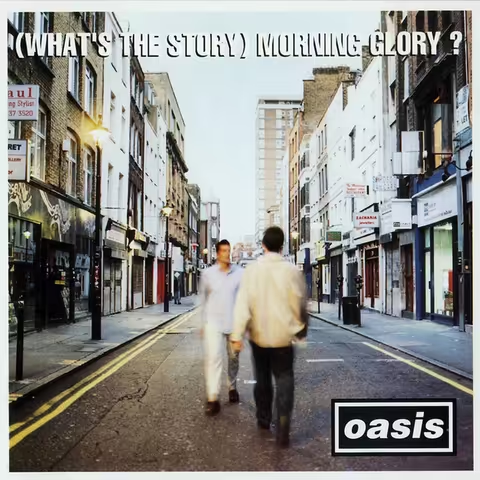
The sleeve is one of the most-copied photographs in 1990s British pop. Sleeve designer Brian Cannon (Microdot) and photographer Michael Spencer Jones shot it on Berwick Street in Soho on the morning of 23 May 1995, while the band were in Rockfield. The two passing figures in the foreground are London DJ Sean Rowley (facing camera) and Cannon himself (with his back to the camera); the man in the background on the left-hand pavement, holding the album''s master tape up to his face, is the album''s producer Owen Morris. The street was chosen because it was at the time the densest cluster of independent record shops in central London (Selectadisc, Sister Ray, Reckless, Cheapo Cheapo).
The cover cost £25,000 to produce, an extraordinary figure for an album sleeve in 1995. Noel Gallagher has subsequently claimed in the Hipgnosis documentary Squaring the Circle that he never approved the cover and was told he had; he has called it the laziest, most thoughtless decision he made on the record. The motion-blurred Berwick Street view, the Helvetica title, the absence of band photography and the tape-as-face Easter egg have nevertheless become unmistakable shorthand for the entire Britpop era.
Release and Reception
Creation released (What''s the Story) Morning Glory? on 2 October 1995. The Daily Express reported the next morning that central London HMV stores were shifting it at two copies a minute. End-of-week sales of 345,000 made it the second-fastest-selling album in UK chart history at the time, behind only Michael Jackson''s Bad. After an initial number-one debut, it hovered in the top three until mid-January 1996, returned to number one for six weeks, dropped back, and returned again for three more weeks in March. It did not leave the UK top three for seven months.
The contemporary reviews were, famously, mixed. The mainstream British music press was lukewarm: NME gave it 7/10, Q''s David Cavanagh dismissed the lyrics ("they scan; they fill a hole; end of story"), Melody Maker''s David Stubbs called the album "laboured and lazy", The Independent''s Andy Gill called "Roll with It" "drab and chummy" and "She''s Electric" "laddism of a tiresomely generic kind". In the United States, Rolling Stone''s Jon Wiederhorn was the early outlier, calling it "a bold leap forward". Spin''s Chuck Eddy heard "generic classic rock". Entertainment Weekly''s Mike Flaherty gave it A−. Select placed it second on its end-of-year list of 1995.
"You just cannot slag this record. It''s gonna speak to real, working-class lads in a way that a Suede or Radiohead could only dream of doing."
Alan McGee, Creation Records, June 1995
The retrospective reviews were where the album took up residence in the canon. AllMusic''s Stephen Thomas Erlewine eventually awarded it five stars; Pitchfork''s 2014 reissue review gave it 8.9/10; the 2020 Rolling Stone 500 Greatest Albums list placed it at 157. At the 2010 Brit Awards a public vote named it Best British Album of the previous 30 years, beating every Beatles solo record, every Stones album of the era and Adele''s then-incoming 21. The album won Best British Album at the 1996 Brits. By 2024 it had been certified 19x Platinum by the BPI on shipments of 5.7 million UK copies, the highest UK certification ever awarded to a single album until Adele''s 21 in 2011.
Singles and Music Videos
| Single | Released | UK Peak | Other Notable Peaks | B-sides / Notes |
|---|---|---|---|---|
| "Some Might Say" | 24 April 1995 | 1 | Ireland 1; Scotland 1 | "Talk Tonight", "Acquiesce", "Headshrinker"; only Oasis single with Tony McCarroll on drums; released day of his sacking |
| "Roll with It" | 14 August 1995 | 2 | Ireland 2 | "It''s Better People", "Rockin'' Chair", "Live Forever" (live at Glastonbury 1995); lost the Battle of Britpop to Blur''s "Country House" by 54,000 copies |
| "Morning Glory" | 18 September 1995 (Netherlands only) | Not charted (UK) | Netherlands single only | Promo / Dutch-territory release ahead of the album |
| "Wonderwall" | 30 October 1995 | 2 | Australia 1; New Zealand 1; US 8; US Modern Rock 1 (10 weeks) | "Round Are Way", "The Swamp Song", "The Masterplan"; video directed by Nigel Dick; 30 consecutive weeks on UK chart |
| "Don''t Look Back in Anger" | 19 February 1996 | 1 | Ireland 1; Scotland 1; Australia 8; New Zealand 6 | "Step Out", "Underneath the Sky", "Cum on Feel the Noize" (Slade cover); the first Oasis single with a Noel lead vocal |
| "Champagne Supernova" | 13 May 1996 (US / Canada) | Not released | Canada 5; US Modern Rock 1 (5 weeks); US Adult Alternative 1 | Not released as a UK single (radio played it constantly anyway); video directed by Nigel Dick at Pinewood |
The "Wonderwall" video, directed by Nigel Dick at Bray Studios, has the band miming on a glittering circular soundstage with Liam in a parka, Noel in a brown leather jacket and Bonehead behind a Hammond. It is the only Oasis video in which Scott McLeod, the McGuigan stand-in, appears (he had quit the band by the time the video aired and the band were touring the US as a four-piece). The "Don''t Look Back in Anger" video, also Dick, was shot at Stocks House in Hertfordshire and features Patrick Macnee, the former Steed in The Avengers. The "Roll with It" video was shot on a wet British beach (Weston-super-Mare, August 1995) and is now famous for the camera operator''s thumb appearing in the bottom corner of a take they used anyway.
Touring and Live: 103 Shows, Two Walkouts, Knebworth
The (What''s the Story) Morning Glory? Tour was 103 shows long and ran from 22 June 1995 to 4 December 1996. It opened at the 1,400-capacity Bath Pavilion as a Glastonbury warm-up and the live debut of Alan White; it closed eighteen months later at the 11,800-capacity Mayo Civic Centre in Rochester, Minnesota. In between it included some of the most famous gigs in UK rock history.
- Earls Court, London, 4–5 November 1995: at the time the largest indoor concerts in Europe, after Guigsy''s return from his three-week walkout, Scott McLeod having quit halfway through an American promo tour.
- Maine Road, Manchester, 27–28 April 1996: the band''s own football team''s ground, capacity 39,000 a night, filmed for the ...There and Then VHS / DVD.
- Balloch Castle Country Park, Loch Lomond, 3–4 August 1996: open-air, 80,000 a night, in the rain.
- Knebworth Park, Hertfordshire, 10–11 August 1996: 125,000 people each night; more than 2.5 million ticket applications were received, around 4 per cent of the entire UK population. It is still the largest demand for a British concert in history. Footage was shot by Dick Carruthers and released in 2021 as the cinema film Oasis Knebworth 1996.
The tour had two near-fatal disruptions. Guigsy walked out for three weeks in September 1995 after a verbal pile-on from Liam in a Paris hotel; the band brought in Scott McLeod of Manchester band The Ya-Yas, who appeared in the "Wonderwall" video and then left the band halfway through an American promo tour, claiming he could not cope with the lifestyle. Oasis played a Late Show with David Letterman appearance and three further US dates as a four-piece before McGuigan agreed to return for Earls Court. Then in September 1996, midway through a US tour, Noel walked out and flew home; the rest of the Australian, New Zealand and US autumn dates had to be cancelled.
In TV, Film and Media
"Wonderwall" has been one of the most synced songs in television and film history since 1995. It opens The Royle Family''s pilot episode (1998), soundtracks the final scene of Richard Ayoade''s Submarine (2010, in Ryan Adams''s cover version) and has appeared in The Office, Brooklyn Nine-Nine, the 2018 A Star Is Born remake and Ted Lasso. "Don''t Look Back in Anger" was the song the crowd in Manchester''s Albert Square broke into spontaneously during a vigil after the 2017 Manchester Arena bombing; it is now treated by Manchester City supporters as a stadium anthem. "Champagne Supernova" closes Cameron Crowe''s Vanilla Sky (2001) and was the song the British Olympic team walked out to in the closing ceremony of the London 2012 Games. "Morning Glory" the song was used in the trailer for the 2010 film Morning Glory starring Harrison Ford and Rachel McAdams.
Controversy, Censorship and Lawsuits
The album generated more legal action than any British rock album of the decade. "Hello" added Gary Glitter and Mike Leander to the writing credits after Leander spotted the lift from "Hello, Hello, I''m Back Again". Stevie Wonder''s publishers threatened to sue over "Step Out"''s heavy quotation of "Uptight"; Wonder, Henry Cosby and Sylvia Moy were given a writing credit and the song was pulled from the album shortly before release, moved to the "Don''t Look Back in Anger" B-side. The piano figure on "Don''t Look Back in Anger" is openly modelled on Lennon''s "Imagine"; Noel was already a Beatles publisher member through Sony/ATV and the credit stayed clean. The cover photograph caused no lawsuits but Soho council later complained about the volume of fans gathering on Berwick Street to take their own version of the picture.
The closest the band came to a public-relations meltdown around the album was Noel''s September 1995 quote to The Observer about Blur''s Damon Albarn and Alex James: "I hope the pair of them would catch AIDS and die because I fucking hate them two." Noel publicly retracted the statement within days, but the quote followed him for years. Graham Coxon told The Guardian in 2005 that he bore no malice, partly because "at least they were outright about it. They weren''t pretending to like us and then slagging us off, which is what we''d been used to."
Covers, Samples and Tributes
"Wonderwall" alone has been covered by Ryan Adams (2003, on Love is Hell; Noel later said he preferred it to his own version), the Mike Flowers Pops (an easy-listening pastiche cover that charted at UK number two in December 1995, four spots above Oasis), Cat Power, Paul Anka (on his 2005 swing-covers album), Lana Del Rey, Boyce Avenue, Christopher Walken (memorably, as a spoken-word recital on US comedy show 20 to 1), Brad Mehldau (the jazz pianist''s instrumental on Largo), Sara Bareilles and effectively every musician on YouTube. Coldplay have covered "Don''t Look Back in Anger" multiple times in encores. "Champagne Supernova" has been covered live by Foo Fighters, Matt Bellamy of Muse, and Liam Gallagher himself with the Black Keys at the 2022 Eden Sessions. Robbie Williams''s "Let Me Entertain You" lifts the chord structure of "Champagne Supernova" and Williams has acknowledged the debt.
Hundreds of songs since 1996 have been described as Morning Glory-derived; the most direct beneficiaries are Coldplay, Travis, Stereophonics, Embrace, Starsailor and the entire late-90s wave of British anthemic rock the British music press christened "dadrock" in 2000. Noel Gallagher has cheerfully accepted the credit for almost all of it.
Reissues, Remasters and Anniversaries
The original 1995 CD has been reissued five times. A four-disc Singles Box Set in November 1996 collected the four UK singles and their B-sides (plus a disc of interviews) and charted at number 24 in the UK in its own right. A 2002 SACD multichannel remaster, mixed by Neil Dorfsman and mastered by Vlado Meller, was the first Oasis album to be released in 5.1 surround. A 2014 "Chasing the Sun" 3-disc deluxe edition (29 September 2014) added the B-sides disc, five demos, the Brendan Lynch mix of "Champagne Supernova", and live tracks from Earls Court, Knebworth and Maine Road. A 30th anniversary edition followed on 3 October 2025, adding a one-disc bonus of five unplugged recordings produced by Noel Gallagher and Callum Marinho from the original masters: "Cast No Shadow", "Morning Glory", "Wonderwall", "Acquiesce" and "Champagne Supernova".
The 2009 limited-edition picture-disc vinyl pressing of the original LP is now a collector''s item; the 2014 super-deluxe boxed set is rumoured to contain a sixth disc never released commercially. Oasis themselves played the album in full only once: at the Knebworth shows in August 1996, in re-sequenced live order.
Legacy and Influence
Morning Glory is the album on which Oasis became the most famous band on the planet and the album most British rock bands of the next decade quietly tried to make. Be Here Now (1997) sold 423,000 copies in its first day in the UK and was treated at the time as a triumph; within twelve months it had become the most-returned album in HMV history and the cautionary tale of cocaine-era British rock. Every subsequent Oasis album, from Standing on the Shoulder of Giants (2000) to Dig Out Your Soul (2008), was reviewed against Morning Glory; none ever caught it. The Gallaghers split the band acrimoniously after a backstage fight at Rock en Seine in Paris on 28 August 2009; they did not speak for fifteen years. In August 2024 they announced an Oasis Live ''25 reunion tour playing the largest stadiums in the UK and Ireland in the summer of 2026, with Morning Glory material dominating the announced set.
The retrospective lists have been emphatic. Rolling Stone''s 2020 redraft of the 500 Greatest Albums of All Time placed it at number 157; Spin''s "300 Best Albums 1985–2014" had it at 79; the public vote at the 2010 Brit Awards named it the greatest British album of the previous 30 years, ahead of The Joshua Tree, OK Computer and every Beatles solo record. It is featured in Robert Dimery''s 1001 Albums You Must Hear Before You Die. The BPI''s 19x Platinum certification, awarded in stages between 1995 and 2023, was the highest ever given to a single album in the UK until Adele''s 21 finally overtook it in 2018.
And then there is "Wonderwall". In 2018 the Performing Right Society named it the most-played song on UK radio of the 21st century. It has crossed into wedding receptions, school discos and every busker''s repertoire on every high street in Britain. The song is, more than three decades later, the single most identifiable musical artefact of 1990s British pop, the closest thing British rock has to "Hey Jude". It is a song about almost nothing, sung by a band whose drummer had been in the line-up for two weeks, recorded on a Kurzweil string preset by a producer who was making his first album, mixed so loud it allegedly started the loudness war. It has sold and sold and sold. The album it sits in the middle of has done the same.
Things You Might Not Know
| Fact | Detail |
|---|---|
| Fifteen days | Owen Morris''s account puts the basic recording of the album at fifteen days at Rockfield, working at a pace of "one song a day". |
| The album title | Came from Noel''s American friend Melissa Lim, whose habit of answering the phone with "(What''s the story?) Morning glory!" itself derived from "The Telephone Hour" in the 1963 film Bye Bye Birdie. |
| The Berwick Street cover | Was shot on the morning of 23 May 1995 while the band were in Wales recording the album, by photographer Michael Spencer Jones and designer Brian Cannon. The walking figures are DJ Sean Rowley (facing camera) and Cannon (with his back to camera). |
| The producer in the background | Owen Morris himself appears in the cover''s background on the left pavement, holding the album''s master tape up in front of his face. |
| The cover cost £25,000 | An extraordinary sleeve budget for 1995; Noel has since claimed he never approved it and was told he had. |
| The new drummer | Alan White was 22 when he joined the band in April 1995 and recorded 11 of the album''s 12 tracks within a fortnight; he is the younger brother of Paul Weller''s drummer Steve White. |
| The sacked drummer | Tony McCarroll only survives on the album on "Some Might Say", recorded in October 1994. The single was released on 24 April 1995, the same day McCarroll was sacked from the band. |
| The "Some Might Say" tempo | Was meant to be slower than the demo; recut in one drunken late-night take that Owen Morris had to mix three times to disguise a tempo lurch in the first chorus. |
| Paul Weller | Played lead guitar on the two "Swamp Song" instrumentals (originally titled "The Jam") and added lead guitar, backing vocals and tin whistle to "Champagne Supernova". |
| "Wonderwall"''s strings | Are not a string section. They are a Kurzweil K2000 preset played by producer Owen Morris during the overdubs. |
| The "Don''t Look Back in Anger" piano | Is an undisguised paraphrase of John Lennon''s "Imagine", a debt Noel has cheerfully acknowledged in interviews. |
| The Stevie Wonder lawsuit | "Step Out" was pulled from the album shortly before mastering after Stevie Wonder''s publishers threatened legal action over its similarity to "Uptight (Everything''s Alright)"; the song became a "Don''t Look Back in Anger" B-side with Wonder, Cosby and Moy as co-writers. |
| Gary Glitter''s royalty | "Hello" credits Glitter and Mike Leander as co-writers because the middle eight quotes "Hello, Hello, I''m Back Again" verbatim; the credit was added after Leander spotted the lift. |
| "The Masterplan" | Was relegated to a B-side of "Wonderwall" rather than included on the album; Noel has called it the worst songwriting decision he ever made. |
| "Acquiesce" | Is the only Oasis song on which Noel and Liam share lead vocals; Liam takes the verses, Noel takes the chorus. It was a B-side of "Some Might Say", not on the album. |
| The Knebworth demand | 2.5 million ticket applications were received for the August 1996 Knebworth shows. At the time around 4 per cent of the UK population had applied for a ticket; it remains the largest demand for a British concert in history. |
| The Mike Flowers Pops version | Reached UK number two in December 1995, four spots above Oasis''s own "Wonderwall" single in the same chart week. |
| The loudness war | Music journalist Nick Southall has named Morning Glory the "jump-the-shark moment" of CD mastering, citing Owen Morris''s aggressive brickwall compression as the start of the modern loudness war in mainstream rock. |
"Whilst Definitely Maybe is about dreaming of being a pop star in a band, What''s the Story is about actually being a pop star in a band."
Noel Gallagher, Rolling Stone, 1995
"With Morning Glory, Noel began to take seriously the notion of being the voice of a generation."
Steve Sutherland, former NME editor, Seven Ages of Rock, BBC, 2007
Riffology Podcast
(What''s the Story) Morning Glory? is paired with Definitely Maybe on an extended Riffology podcast episode, available wherever you get your podcasts. The hosts dig into the 15-day Rockfield sessions, the Tony McCarroll question, the Battle of Britpop, the brickwall master, the Berwick Street sleeve and the Knebworth two-night stand. The embed is at the top of this article.
Comments