
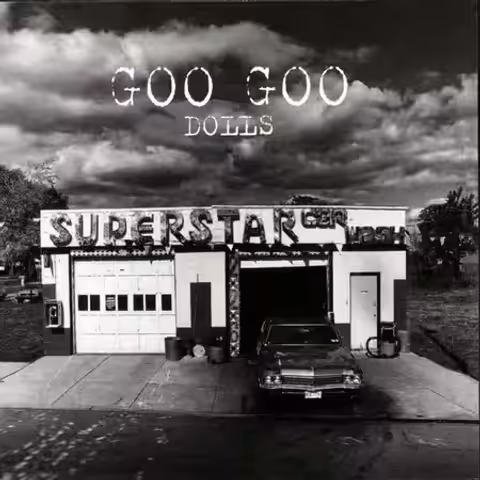
By the autumn of 1992 The Goo Goo Dolls had been a band for seven years, released three albums on small labels, opened for Soul Asylum, Bad Religion and Motorhead, and slept on more floors than they cared to count. Superstar Car Wash is the record where John Rzeznik stopped pretending he was a punk-rock screamer and started writing songs that sounded like the ones he actually loved: Paul Westerberg songs, Bob Mould songs, songs with hooks and hurt in roughly equal measure.
It is also the only album in the Goo Goo Dolls catalogue with a credit reading "Rzeznik, Takac, Tutuska, Paul Westerberg", the result of a fan letter, a cassette in the post and a folded-up sheet of lyrics that came back from Minneapolis a few weeks later. The album sold modestly, peaked at number 35 on the Heatseekers chart, and is the one Rzeznik still hands people who say they only know "Iris". He has spent thirty years insisting it is the best record they ever made.
| Field | Detail |
|---|---|
| Artist | The Goo Goo Dolls |
| Album | Superstar Car Wash |
| Release Date | 23 February 1993 |
| Label | Warner Bros. Records (with Metal Blade Records) |
| Producer | Gavin MacKillop |
| Studios | Metalworks (Mississauga, Ontario); Trackmaster Recording (Buffalo, NY); Master Control (Burbank, CA) |
| Genre | Alternative rock, power pop, punk rock |
| Track Count | 14 |
| Total Runtime | 44:25 |
| Billboard 200 Peak | Did not chart |
| Billboard Heatseekers Peak | 35 |
| UK Albums Chart Peak | Did not chart |
| Certifications | None at original release |
| Key Singles | "We Are the Normal", "Fallin' Down", "Cuz You're Gone", "Lucky Star" |
Buffalo and the road to 1993
Buffalo, New York in the late 1980s was a city in slow industrial collapse. The steel mills had closed, the lake-effect winters were brutal, and the underground scene that grew up in its bars and basements was heavy on volume and short on patience. Rzeznik, Robby Takac and George Tutuska met in that scene as teenagers, Takac and Tutuska had been friends since school, and they had picked up Rzeznik through a tangle of cousins and shared bands. They called themselves the Sex Maggots for about five minutes in 1985, then grabbed the words "Goo Goo Dolls" off a True Detective magazine advert because they had a gig that night and needed a name on the flyer.
The first three records, Goo Goo Dolls (1987), Jed (1989) and Hold Me Up (1990), are loud, fast, and sung mostly by Takac in a voice that sounds like he has just been startled awake. Rzeznik, who had bad stage fright and worse confidence, only stepped up to the microphone when Takac forced him to. The big shift was on Hold Me Up, where he sang lead on five tracks including "There You Are" and "Two Days in February", and where the band first allowed a melody to sit unaccompanied by a power chord. Rzeznik later admitted what every Replacements obsessive in 1990 knew already.
"We were still drawing heavily, heavily from bands like Husker Du and the Replacements. So we were still incredibly derivative at that point."
John Rzeznik, Vice / Noisey, December 2015
By the time Hold Me Up had run its course, two things had happened. Metal Blade Records, the band's home since 1987, had cut a distribution deal with Warner Bros., which meant a bigger budget and major-label reach for the next record. And Rzeznik, by his own account, had decided to stop hiding behind irony and write something he actually meant. The Buffalo News' Anthony Violanti caught the band rehearsing in February 1993 and called the result an "alternative-pop masterpiece" before most of America had heard a note of it.
Westerberg by mail
The Goo Goo Dolls had been opening for The Replacements off and on since the late eighties, and Rzeznik had spent every one of those nights watching Paul Westerberg from the wings. When the band started demoing songs for what would become Superstar Car Wash, Rzeznik wrote a backing track he could not finish, lyrically. He sent it to Westerberg with a letter. Westerberg, by then deep into his post-Replacements solo career, mailed back a complete set of lyrics. The two never met in a studio, never recorded together, and never sat across a piano figuring out a chorus. The whole collaboration happened by post.
The song was "We Are the Normal". Listen to it now and the Westerberg fingerprint is immediate: a bruised, plain-spoken refusal to pretend, set against a tune that almost dares you to call it pop. Rzeznik, asked years later what the co-write meant to him, did not bother understating it.
"To some people, Keith Richards is their hero. I feel that way about Westerberg. Keith Richards got to do his thing with Chuck Berry, and I got to do it with Westerberg. That was amazing to me."
John Rzeznik, Vice / Noisey, December 2015
It is the credit Billboard's reviewers led with when the album landed in early March, calling Westerberg the band's "longtime idol" and noting the co-write almost as the album's headline event. For a band that had spent six years being introduced as openers, having Westerberg's name in the writing credits was the first piece of paper that said: take these people seriously.
The recording sessions
Sessions ran from August to October 1992 and crossed an international border twice. Producer Gavin MacKillop, a Scotsman with credits stretching from The Church to Toad the Wet Sprocket and Shriekback, was brought in to give the record more shape than Armand John Petri had managed on Hold Me Up. The bulk of the basic tracking happened at Metalworks in Mississauga, Ontario, Triumph drummer Gil Moore's high-end facility, the closest big-room studio to Buffalo and a step up from anything the band had touched before. Overdubs and additional sessions happened back at Trackmaster Recording in Buffalo, and final overdubs and mixing moved to Master Control in Burbank, California. Stephen Marcussen mastered at Precision Mastering in Hollywood.
The engineering team was Brad Nelson and Matt Pakucko, both of whom assisted on the tracking, with Pakucko handling mix-down with MacKillop. Mary Ramsey, the violist who would later front 10,000 Maniacs alongside John Lombardo, was brought in to play on "We Are the Normal", giving the song the unmistakable string arrangement that lifts its chorus out of straight-ahead power pop. Multi-instrumentalist Joe Rozler and Petri himself contributed additional instrumentation across the record.
- Three studios across two countries, with sessions tracked August to October 1992.
- Gavin MacKillop producing, with Brad Nelson and Matt Pakucko engineering.
- Mary Ramsey adding viola to "We Are the Normal", a string section in everything but name.
- Stephen Marcussen mastering at Precision Mastering, the same Hollywood facility he used for Tom Petty and Sheryl Crow.
- Working title for the closing track "So Far Away": "Dancing in Your Blood", with different lyrics and sparser arrangement.
The record sounds louder and cleaner than anything the band had cut before. Guitars are stacked rather than smeared, vocals sit forward in the mix, and Tutuska's drums, long the bluntest instrument in the band's arsenal, are recorded with the kind of room sound a Metalworks live room actually allowed. MacKillop's signature was clarity without polish: he kept the band's edges intact while pulling out the melodic spine that had been drowning underneath them on the indie records. Rzeznik later said it bluntly enough.
"This is where the band started to become something. I did some of my tightest and best writing on that album. It's so heavily influenced by Paul Westerberg, Bob Mould, Soul Asylum, every band from Minneapolis. I just thought, wow, I'm really getting good at this."
John Rzeznik, Vice / Noisey, December 2015
Personnel and credits
| Role | Player | Notes |
|---|---|---|
| Core band | ||
| Guitar, lead and backing vocals | John Rzeznik | Sings lead on the singles and most of side one |
| Bass, lead and backing vocals | Robby Takac | Lead vocal on the punkier short tracks |
| Drums, art direction | George Tutuska | Co-writer on most of the band-credited tracks; also took an art-direction credit |
| Guest and session musicians | ||
| Viola | Mary Ramsey | Plays on "We Are the Normal" only |
| Instrumentation | Armand John Petri | Producer of the band's previous album, recalled to add keys and percussion |
| Instrumentation | Joe Rozler | Buffalo multi-instrumentalist; piano and additional textures |
| Production | ||
| Producer, recording, mixing | Gavin MacKillop | Also took the leaf-photography credit on the sleeve, for reasons no one has ever fully explained |
| Assistant engineering | Brad Nelson | |
| Assistant engineering, mixing | Matt Pakucko | |
| Mastering | Stephen Marcussen | Precision Mastering, Hollywood |
| Songwriting | ||
| Co-writer, lyrics | Paul Westerberg | "We Are the Normal" only; collaboration conducted entirely by post |
| Artwork | ||
| Cover and building photography | Merlyn Rosenberg | Photographed the actual Superstar Car Wash on William Street, Buffalo |
| Band photography | Frank Luterec | |
| Design | Deborah Norcross, Leslie Wintner | |
The credits read like a snapshot of where the band actually was in late 1992: still tied to Buffalo (Rosenberg, Luterec, Petri, Rozler, Trackmaster), but reaching into the wider industry on either side of the border (MacKillop, Metalworks, Master Control, Marcussen). The presence of Mary Ramsey is the small detail that gives the record's biggest single its identity, and the fact that producer-of-the-previous-record Petri was invited back as a session player is one of the quieter examples of a band keeping its bridges intact.
The songs
Fourteen tracks in 44 minutes, short songs, mostly under three and a half minutes, structured the way punk records are structured but written and produced as if they intend to be heard. Rzeznik takes the lion's share of the lead vocals; Takac handles the breakneck ones. Tutuska's writing contribution is at the centre of the record's later legal trouble and at the centre of half its band-credited tunes.
| # | Title | Writer(s) | Length | Single? | Notes |
|---|---|---|---|---|---|
| 1 | Fallin' Down | Rzeznik | 3:18 | Yes | Featured in Son in Law; later flashpoint of the Tutuska royalty dispute |
| 2 | Lucky Star | Rzeznik / Takac / Tutuska | 3:06 | Yes | Promo single only |
| 3 | Cuz You're Gone | Rzeznik | 3:31 | Yes | One of Rzeznik's first openly heart-on-sleeve ballads |
| 4 | Don't Worry | Rzeznik / Takac / Tutuska | 2:25 | Takac on lead vocal | |
| 5 | Girl Right Next to Me | Rzeznik | 3:44 | ||
| 6 | Domino | Rzeznik / Takac / Tutuska | 2:37 | ||
| 7 | We Are the Normal | Rzeznik / Takac / Tutuska / Westerberg | 3:38 | Yes | Westerberg lyric; Mary Ramsey viola; lead single |
| 8 | String of Lies | Rzeznik / Takac / Tutuska | 3:08 | ||
| 9 | Another Second Time Around | Rzeznik / Takac / Tutuska | 3:01 | Surfaces in TV sync as late as 2023 | |
| 10 | Stop the World | Rzeznik | 3:32 | ||
| 11 | Already There | Rzeznik / Takac / Tutuska | 2:45 | Singled out by Billboard as a highlight | |
| 12 | On the Lie | Rzeznik | 3:18 | ||
| 13 | Close Your Eyes | Rzeznik / Takac / Tutuska | 2:25 | ||
| 14 | So Far Away | Rzeznik / Takac / Tutuska | 3:57 | Originally cut as "Dancing in Your Blood" |
"Fallin' Down" opens the record on a downstroke and a Rzeznik vocal that is recognisably him. The riff is as close to a Husker Du chord progression as the band ever recorded, sped up and sweetened with a chorus that lands in three rather than four; it would later be picked up almost incidentally for the soundtrack of Pauly Shore's Son in Law. "Cuz You're Gone" is the album's first full ballad, three and a half minutes of unguarded longing, and it is the song most often singled out as the moment Rzeznik figured out he could write that way without flinching. "Lucky Star" pushes the same melody-first instinct into something rangier; the chorus shoves itself forward in a way the band had previously been too embarrassed to allow.
Takac's tracks bunch in the middle. "Don't Worry" and "Domino" run together at less than two and a half minutes apiece, the kind of fast-loud-melodic that Soul Asylum had been trading in for half a decade. "We Are the Normal" arrives at track seven as the album's emotional centre, Rzeznik singing Westerberg's words over Mary Ramsey's viola line, and it is the only song on the record where you can hear the band reaching beyond what they thought they were capable of.
The back half is messier and stronger for it. "Already There" is the song Billboard's reviewers picked out alongside "Fallin' Down" and "Lucky Star" as a choice cut. "On the Lie" is an underrated Rzeznik miniature. "So Far Away" closes the record with the song that started life under a different name and a different lyric, the band re-cut the basic structure of "Dancing in Your Blood" with new words and a fuller arrangement, and it became the album's most patient piece of writing.
Singles and music videos
"We Are the Normal" was the first single, released on 22 April 1993, with a video that Warner pushed onto MTV's 120 Minutes. College and alternative radio took it; mainstream rock did not, and the song's chart fortunes never matched its critical reception. The follow-ups "Fallin' Down", "Cuz You're Gone" and "Lucky Star" each got promo treatment in 1993; "Fallin' Down" picked up a second life on the Son in Law soundtrack later that summer, the kind of accidental sync placement that introduces a song to a million people who would never have bought the parent album.
None of the singles cracked the Billboard Hot 100. The Heatseekers placement of number 35 was the only Billboard chart action the album logged. For a band on the periphery of a major label, with a college-radio constituency and no MTV daytime rotation, it was enough to keep the lights on. It was not enough, by 1995, to keep them out of legal war with Metal Blade.
The cover and the title
The album cover is a photograph of an actual car wash. Superstar Car Wash sat on William Street, just outside downtown Buffalo, and Merlyn Rosenberg shot it for the sleeve at MacKillop's suggestion. The leaf imagery scattered through the layout was photographed by MacKillop himself, the producer's only credit of that kind on any record he ever made. Deborah Norcross and Leslie Wintner handled the design, and Tutuska took an art-direction credit alongside his drumming. The result is a sleeve that looks more like a Replacements record than a Goo Goo Dolls one: blue-collar, plainspoken, deliberately uncool.
That refusal of glamour is the album's whole proposition. The band were Buffalo kids who had spent six years being mistaken for a Twin Cities band, and the title and sleeve announce the local context out loud. Rzeznik later put it as bluntly as anyone could.
"It's not a complex, physical music. And it wasn't supercool. We were never hip, which is fine with me. All the times how we tried and failed to get across in our music, we actually succeeded on Superstar Car Wash."
John Rzeznik, Vice / Noisey, December 2015
Release and reception
The album hit shops on 23 February 1993. Critically, it landed clean. Mike DeGagne at AllMusic gave it four stars out of five and reached for a phrase that has followed the record ever since, calling it the album where the band "let loose and channeled their playful immaturity throughout the attractive impurity". Entertainment Weekly ran a full A grade. Rock Hard's Holger Stratmann gave it eight out of ten. Greg Kot at the Chicago Tribune gave it three and a half out of four.
| Publication | Score | Notable line |
|---|---|---|
| AllMusic (Mike DeGagne) | 4 / 5 | "Playful immaturity throughout the attractive impurity of this album." |
| Entertainment Weekly | A | Full A grade, February 1993 |
| Rock Hard (Holger Stratmann) | 8 / 10 | "They have an arrow in their quiver that might hit the mark this time." |
| Chicago Tribune (Greg Kot) | 3.5 / 4 | March 1993 |
| Buffalo News (Anthony Violanti) | , | "An alternative-pop masterpiece." |
| Billboard (Verna / Morris) | , | Highlighted "We Are the Normal", "Fallin' Down", "Lucky Star" and "Already There" |
"The Goo Goo Dolls have taken their heavy metal, punk and garage rock roots and combined them with a softer pop style. The result is an alternative-pop masterpiece."
Anthony Violanti, Buffalo News, 7 February 1993
What the reviews could not do was move the kind of units the band's contract assumed they would. Sales never went past gold-territory levels at the time of release. The record was a critical springboard, not a commercial one, the Heatseekers placement, the MTV video, the soundtrack appearance and the Westerberg headline were all pieces the band needed to assemble before the next record could break through.
February 1993 in context
The album landed in the strangest fortnight in nineties alternative rock. Nirvana were three weeks away from beginning the sessions in Pachyderm, Minnesota that would produce In Utero. The Smashing Pumpkins were halfway through tracking Siamese Dream at Triclops in Marietta, Georgia, with Butch Vig pulling guitar takes out of Billy Corgan one note at a time. PJ Harvey's Rid of Me arrived in May. The Breeders' Last Splash in August. Pearl Jam's Vs. in October. The wave that the major labels had spent 1992 trying to surf was fully formed by autumn, and a Buffalo trio with a Westerberg co-write and a Heatseekers chart placement was always going to struggle for column inches against Cobain, Corgan and Vedder.
The cultural backdrop was no quieter. The first World Trade Center bombing happened three days after the album's release, on 26 February 1993. Bill Clinton had been in the White House for five weeks. Jurassic Park, Schindler's List, The Fugitive and Groundhog Day were all weeks or months from cinemas. The X-Files would debut on Fox in September. Across all of it, alternative radio was the format with the loudest cultural lift, and the Goo Goo Dolls were among the bands working the format hardest from below the headline tier. Rzeznik's later assessment, that the album succeeded in saying what the previous three had failed to say, lands harder when you remember exactly how much weather it was being released into.
The tour and the live record
The 1993 touring cycle was the closest the band had been to a proper national run. They played college towns, alternative-rock clubs and a handful of bigger rooms supporting other Warner-affiliated acts. A homecoming show at New World Record in Buffalo on 27 February 1993 marked the album's release week. A summer leg followed in support of "We Are the Normal" and "Fallin' Down". The pattern that defined the band for the rest of the decade, relentless, goodwill-hoovering live work in front of audiences that had not yet bought the records, set in here.
The set typically opened with "Fallin' Down" and closed with one of the punkier Hold Me Up tracks. "We Are the Normal" was the moment in the set Rzeznik introduced by name; "Cuz You're Gone" was the one he introduced quietly. By the end of 1993 the band had played more dates in support of Superstar Car Wash than they had for the previous three albums combined.
The Tutuska departure
The album's most consequential afterlife is legal rather than musical. George Tutuska had a co-writing credit on "Fallin' Down", the very song that became the soundtrack to Son in Law and, for a while, the most-heard piece of music the band had ever made. According to Tutuska's later interviews, he had assumed for years that songwriting royalties were being split evenly across the band, as had been the working arrangement since the 1987 debut. He told Rolling Stone in 1999 that when he raised the issue with Rzeznik, Rzeznik admitted he had been collecting "Fallin' Down" royalties on his own for two years.
The argument festered through the writing of A Boy Named Goo. Tutuska refused to commit to the touring cycle unless royalties were split evenly across the band. He was fired during the album's completion and replaced by Mike Malinin. The band's bigger lawsuit, against Metal Blade for non-payment of royalties on the resulting double-platinum record, came soon after. The seeds of both fights are on Superstar Car Wash.
Legacy and influence
The record's reputation has always run ahead of its sales. Rzeznik has called it his fourth-favourite Goo Goo Dolls album in a public ranking but the one he hands to anyone who only knows the post-Iris material. Vice's Cam Lindsay, in the same 2015 conversation, described it as "the more refined and Paul Westerberg-featuring hard rock" record that won critics over before A Boy Named Goo won the radio. The band themselves played the album in full on a 30th-anniversary run of dates in 2023.
- Rzeznik's writing on this album set the template the band's commercial run was built on: melodic anchors, plainspoken lyrics, a rhythm section that hits hard underneath.
- Power-pop and post-grunge bands of the late nineties, Matchbox Twenty, Vertical Horizon, Lifehouse, drew on the same blend of guitar weight and chorus polish.
- The Westerberg co-write remains the most direct creative bridge between The Replacements and the alternative-rock mainstream that displaced them.
- Buffalo's claim to its own band hardened around this record. 4 July 2004 was officially declared "Goo Goo Dolls Day" in the city.
- Songs from the album were re-mixed and re-issued on the 2001 compilation What I Learned About Ego, Opinion, Art & Commerce.
The album's influence is most visible in the path the band took afterwards. A Boy Named Goo two years later, produced by Lou Giordano, Husker Du's old producer, another Minneapolis fingerprint, turned "Name" into a number-one airplay hit and made Metal Blade's first double-platinum record. Dizzy Up the Girl in 1998 carried "Iris" to eighteen weeks at number one on the Hot 100 Airplay chart. None of that happens without the writing breakthrough on Superstar Car Wash.
Things you might not know
| Fact | Detail |
|---|---|
| The car wash is real | Superstar Car Wash was an actual business on William Street, just outside downtown Buffalo. Merlyn Rosenberg photographed the building for the sleeve. |
| Westerberg never set foot in the studio | The "We Are the Normal" co-write happened entirely by post. Rzeznik mailed a backing track to Minneapolis; Westerberg mailed back lyrics. The two never recorded the song together. |
| The producer took a photography credit | Gavin MacKillop is credited on the sleeve for "leaf photography", the only such credit on any record he has ever produced. |
| "So Far Away" started life as a different song | The album's closer was originally cut as "Dancing in Your Blood", with the same chord shape but different lyrics, sparser instrumentation and a slightly different melody. The band re-recorded it from the ground up. |
| Mary Ramsey was a 10,000 Maniacs collaborator | The viola player on "We Are the Normal" was John Lombardo's musical partner in John & Mary, and would replace Natalie Merchant as 10,000 Maniacs' lead singer in 1995. |
| The album triggered a band-ending lawsuit by proxy | The royalty argument over "Fallin' Down" between Rzeznik and Tutuska is the direct cause of Tutuska's firing in 1994 and the band's later lawsuit against Metal Blade. |
| Metalworks belonged to a Triumph drummer | The Mississauga studio where most of the basics were tracked was built and owned by Gil Moore of the Canadian rock trio Triumph. |
| "Fallin' Down" got picked up for a Pauly Shore movie | The track ended up on the Son in Law soundtrack in summer 1993, exposing it to an audience that had never heard the band's name. |
| The first vinyl pressing arrived 24 years late | The album was released only on CD and cassette in 1993. Warner Bros. and Metal Blade did not press it on vinyl until a 2017 Record Store Day reissue. |
| The band's third album producer played on this one | Armand John Petri, who produced Hold Me Up, was hired back as a session musician contributing additional instrumentation rather than as producer. |
Reissues and formats
| Format | Year | Country | Label(s) | Notes |
|---|---|---|---|---|
| CD | 1993 | US | Warner Bros. / Metal Blade | Standard edition |
| CD | 1993 | Europe | Warner Bros. / Metal Blade | European release |
| CD | 1993 | Canada | Warner Bros. / Metal Blade | Canadian release |
| CD | 1993 | US | Warner Bros. / Metal Blade | BMG Direct Club edition |
| Cassette | 1992 | US | Warner Bros. | Promotional cassette, pre-release |
| Cassette | 1993 | US / Canada | Warner Bros. / Metal Blade | Standard cassette release |
| CD | 1996 | Japan | Warner Bros. | Japanese edition with obi strip |
| CD | 1998 | Japan | Warner Bros. / Metal Blade / WEA | Japanese reissue |
| CD | 1999 | Germany | Hollywood Records | European reissue |
| Vinyl LP | 2017 | US | Warner Bros. / Metal Blade | First-ever vinyl pressing, Record Store Day |
Three decades on, Superstar Car Wash reads as the hinge in the Goo Goo Dolls catalogue: the moment a Buffalo punk trio with three indie albums and a Husker Du fixation became a band capable of writing the songs that would, eventually, make them inescapable on adult-alternative radio. It did not sell at the time. It shaped everything that did.
Comments