
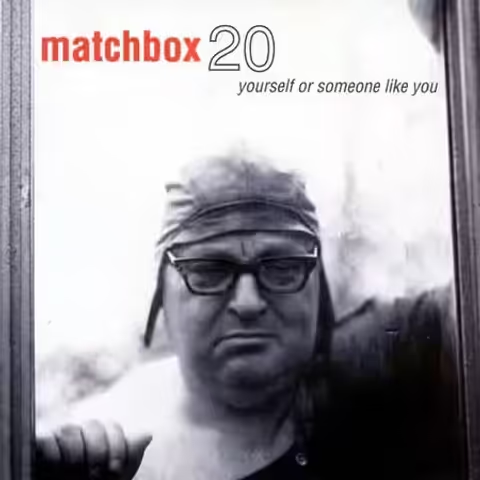
Matchbox 20's debut album sold 610 copies in its first week. Two and a bit years later it had passed Diamond. There is no single neat reason for the gap, but the unhurried version goes like this. Atlantic Records refused to release the singles as physical commercial CDs in the United States because the album was already selling too well to risk cannibalising it, which under pre-1999 Billboard rules made the songs ineligible for the Hot 100 even as they topped Airplay and Modern Rock for months at a time. The institutional consequence was that the singles never quite finished the way most singles do. The cultural consequence was that Yourself or Someone Like You spent 119 consecutive weeks on the Billboard 200, four consecutive singles in the top 10 of the Radio Songs chart, and finished 1998 as the number-one album of the year in Australia.
Rob Thomas later summarised the trajectory as "a really long overnight success", which is the line that ends up in every retrospective. The longer version is that five musicians who had never played a national tour, working with a producer best known for a Collective Soul record from three years earlier, recorded twelve confessional songs about loneliness, depression, domestic violence and the inside of Thomas's own teenage hospital corridors at a studio in Atlanta in May 1996, and then watched a single accidentally pulled out of a hotel-room exercise around the word "rusty" become the song that finally made Ryan Gosling famous in a different way twenty-seven years later. This is the deep dive.
Album Facts
| Field | Detail |
|---|---|
| Artist | Matchbox Twenty (originally styled Matchbox 20) |
| Album | Yourself or Someone Like You |
| Release Date | 1 October 1996 |
| Label | Lava Records, distributed by Atlantic Records (Melisma Productions) |
| Producer | Matt Serletic |
| Studios | Triclops Recording, Atlanta GA (tracking); House of Blues Studios, Memphis (mixing); Precision Mastering, LA (mastering by Stephen Marcussen) |
| Genre | Post-grunge, alternative rock, pop rock |
| Track Count | 12 (standard); 15 (deluxe) |
| Total Runtime | 46:51 (standard); approx. 59 minutes (deluxe) |
| Billboard 200 Peak | 5 (119 weeks on chart) |
| UK Albums Chart Peak | 50 |
| Other Notable Chart Peaks | 1 Australia (ARIA); 3 New Zealand; 11 Canada; 21 Germany; 46 Switzerland; 50 Netherlands |
| Certifications | 12x Platinum / Diamond (RIAA); 10x Platinum (ARIA); 8x Platinum (Canada); 5x Platinum (NZ); Gold (UK) |
| Estimated Sales | Over 15 million worldwide (12 million in the US alone) |
| Key Singles | Long Day, Push, 3AM, Real World, Back 2 Good |
Cultural Context
Autumn 1996 was the moment American rock radio quietly stopped trying to be Seattle. Kurt Cobain had been dead two and a half years. Pearl Jam were two albums into a deliberate retreat from the mainstream. Soundgarden would split within the year. The format vacuum that opened up underneath had been filled progressively through 1994 and 1995 by a softer, more song-craft-focused band of bands (Hootie and the Blowfish, Counting Crows, Live, the Wallflowers, the Goo Goo Dolls) who took the emotional directness of grunge and stripped the abrasion off the front of it. Alanis Morissette's Jagged Little Pill had proven across 1995 that a confessional voice with a pop chorus could shift sixteen million copies. Matchbox 20 walked into that landscape with twelve songs about exactly the same emotional territory, sung by a singer who had until very recently been sleeping on park benches.
The wider 1996 record racks against which Yourself or Someone Like You was competing tell a story of an alternative-rock chart that did not yet know what shape it would take next:
- Smashing Pumpkins, Mellon Collie and the Infinite Sadness, then still on the Billboard 200 from its October 1995 release.
- Foo Fighters' self-titled debut, twelve months old and still spawning singles.
- Beck, Odelay, released June 1996, redefining what "alternative" meant in real time.
- R.E.M., New Adventures in Hi-Fi, the second of the band's experimental mid-decade records.
- Sublime, Sublime, posthumous and still climbing.
- Soundgarden, Down on the Upside, the breakup record.
- Tool, AEnima, the underground heaviness option.
Matchbox 20's trick was to land between every one of those bands and the existing pop chart and to do so without sounding like a compromise to anyone in either camp. AllMusic's contemporary review eventually settled on "a blend of Tom Petty and Pearl Jam" as the cleanest summary; it remains the most useful single shorthand for what Matt Serletic and Rob Thomas built at Triclops.
The Band's Story Up to This Point
The band's origin runs through a long-defunct Orlando bar act called Tabitha's Secret. Founded in roughly 1993 around Rob Thomas on vocals, Brian Yale on bass and Paul Doucette on drums, with rotating guitar contributions from Jay Stanley, Brandon Goldwaite and John Goff, Tabitha's Secret were a fixture of the Orlando club circuit for three years and a recording entity for none of them. They had a strong local following, a packed Tuesday-night residency at the Sapphire Supper Club, and an entirely unreleased album's worth of songs that Thomas had been writing since he was a teenager.
Thomas himself was twenty-four when the band signed. He had been born on 14 February 1972 at Ramstein Air Base in Landstuhl, Germany, to American service parents, raised between Gainesville and Turbeville, South Carolina, and looked after his mother through her cancer treatment when he was twelve and again at fifteen. He dropped out of high school in his senior year at seventeen and spent the following four years sleeping rough across Orlando and the Florida panhandle, a period he has described in interview as the formative writing window for almost everything on the album.
The change of trajectory came from a single A&R repeat-visit. Atlantic's Kim Stephens drove down to an Orlando bar in 1995 to see a different band entirely, watched Tabitha's Secret open, and kept returning every few months for the better part of a year. When the Tabitha's Secret line-up collapsed in early 1995 over the standard internal disagreements, Stephens approached Thomas directly. Thomas brought Doucette and Yale across into the new band; the three then went looking for two guitarists and found Kyle Cook (Atlanta Institute of Music graduate) and Adam Gaynor (Criteria Recording Studios, Miami, where he had been working as an engineer). Doucette named the new band from two words he had clocked on a softball jersey at the restaurant where he was waiting tables: "Matchbox" and "20".
The five-piece signed a seven-album deal with Atlantic in mid-1995. Stephens has consistently said in interview that the conversation took roughly ten minutes; the band's lawyer Howard Comart, hired the week of the signing, spent three months negotiating the small print. By the end of 1995 the band were rehearsing in a storage shed in Orlando six nights a week.
Pre-production and Demos
Thomas wrote the bulk of the album across late 1995 and the first quarter of 1996, with several of the songs (3AM most prominently, but also early forms of Hang and Shame) carried over from the Tabitha's Secret repertoire. He has consistently cited R.E.M., U2, Live, Bush and Counting Crows as the contemporary listening, with Tom Petty and Willie Nelson as the unspoken structural references underneath. The Nashville storytelling instinct is what gives songs like 3AM and Back 2 Good their narrative directness; Thomas later said he was the only Southerner in the band and the first reviewers who caught the country undercurrent surprised him.
The most decisive piece of pre-production was a single rented storage unit on the eastern edge of Orlando, where the five-piece set up gear for a continuous month of rehearsal in February and March 1996. Thomas put it plainly to The A.V. Club:
"We as a band went into a storage shed and brought our gear in there. For a month we just played it over and over and over, so that when we went in the studio we were ready and prepared, because it was a whole different world for us."
Rob Thomas, The A.V. Club, 2013
The shed-month was the single biggest reason the Triclops sessions were short. The band arrived in Atlanta with the arrangements locked, the keys set, the dynamic shifts charted and Doucette's drum parts already rehearsed against a click. Six weeks of studio time was enough to track twelve songs because nothing about the arrangements needed re-writing once the tape was rolling.
Two further pieces of pre-album business deserve note. The album's working title was Woodshed Diaries, Thomas's nod to the rehearsal period; the band cut roughly 3,500 promotional copies under that title before changing the name. And the song Push did not exist when the storage-shed rehearsals finished. It was written six weeks later in a New York hotel room as a deliberate songwriting exercise (Serletic opened a book, told Thomas to point at a word, Thomas pointed at "rusty") and was the final song added to the running order.
Creating the Album
Triclops Recording was an Atlanta studio owned by producer Matt Serletic and his brother Dean. By 1996 it was a recognised mid-tier alternative-rock destination, best known for Collective Soul's 1993 debut Hints Allegations and Things Left Unsaid, which Matt Serletic had produced from his college dorm three years earlier. Serletic had first seen Matchbox 20 at a showcase in Winter Park, Florida, in late 1995 and pitched himself to Atlantic specifically as the producer who could thread Thomas's voice into the radio mix without sanding the band's edges off. Atlantic, looking for a Collective Soul replication rather than a re-invention, agreed.
Sessions ran from May into late June 1996. Basics were tracked live in Triclops' main room with Jeff Tomei engineering and John Nielsen assisting. Doucette tracked drums first, the rest of the band cutting basics around him; Cook's lead guitar parts and Gaynor's rhythm layers were largely overdubbed in the second fortnight. Thomas's vocals went down at the end of the session in a controlled, multi-take pass with Serletic; vocal coach Jan Smith was on hand for several of the sessions and is credited specifically on the Push and 3AM vocal builds.
Serletic's footprint on the record was unusually wide for the producer credit. He played keyboards on five tracks and percussion on three, co-wrote Push and Girl Like That, arranged the woodwind ensemble that anchors the back end of Back 2 Good, and went on to mix the entire record himself with Greg Archilla at House of Blues Studios in Memphis. The woodwind arrangement, performed by an Atlanta ensemble (Elizabeth Burkhardt on bassoon, Amy Porter on flute, Yvonne Powers on oboe, Ted Gurch on clarinet, Douglas Smith on bass clarinet), is the single most distinctive piece of arrangement on the album and the moment that most explicitly signals Serletic's broader ambitions for the band's sonic palette.
Mastering was handled by Stephen Marcussen at Precision Mastering in Los Angeles in July 1996, with the album manifested on tape and pressed for an originally-planned September release. The title-change forced a six-week pressing delay; the 3,500 Woodshed Diaries promos were never recalled (most ended up with US radio promoters and college DJs and now trade among collectors for low four-figure prices). The album shipped on 1 October 1996.
Personnel and Credits
| Role | Player | Notes |
|---|---|---|
| Core band | ||
| Lead vocals, acoustic guitar | Rob Thomas | Acoustic guitar on Hang; all lead vocals except shared with Cook on Hang |
| Lead guitar, backing vocals | Kyle Cook | Co-lead vocal on Hang |
| Rhythm guitar, backing vocals | Adam Gaynor | Engineering background; mic technique credits |
| Bass | Brian Yale | Tabitha's Secret carry-over; co-writer credit on 3AM |
| Drums, percussion | Paul Doucette | Named the band; Tabitha's Secret carry-over |
| Guest and session musicians | ||
| Bassoon | Elizabeth Burkhardt | Back 2 Good woodwind ensemble |
| Flute | Amy Porter | Back 2 Good |
| Oboe | Yvonne Powers | Back 2 Good |
| Clarinet | Ted Gurch | Back 2 Good |
| Bass clarinet | Douglas Smith | Back 2 Good |
| Production and engineering | ||
| Producer | Matt Serletic | Also keyboards (5 tracks), percussion (3 tracks), woodwind arrangement, co-writer on Push and Girl Like That |
| Engineer | Jeff Tomei | Triclops Recording |
| Assistant engineer | John Nielsen | Triclops Recording |
| Mixing | Matt Serletic, Greg Archilla | House of Blues Studios, Memphis |
| Mix assistant | Malcolm Springer | Memphis |
| Mastering | Stephen Marcussen | Precision Mastering, Los Angeles |
| Vocal coach | Jan Smith | Atlanta; credited on Push and 3AM vocal builds |
| Assistant co-producers | Dean Serletic, Tabitha Kahlhamer | Triclops in-house |
| Artwork | ||
| Cover photograph | Katrin Thomas | No relation to Rob Thomas; the figure on the cover is Frank Torres |
| Band photography | Chris Cuffaro | Inner-sleeve portraits |
| Art direction and design | Valerie Wagner | Atlantic Records in-house design |
The Songs
| # | Title | Writer(s) | Length | Single? | Notes |
|---|---|---|---|---|---|
| 1 | Real World | Thomas | 3:50 | Yes (4th, Mar 1998) | Sarcastically optimistic opener; band's first Hot 100 entry |
| 2 | Long Day | Thomas | 3:47 | Yes (1st, Sep 1996) | Lead single; broke on KROQ first |
| 3 | 3AM | Thomas, Yale, Goff, Stanley | 3:46 | Yes (3rd, Oct 1997) | Tabitha's Secret carry-over; written when Thomas was 12 |
| 4 | Push | Thomas, Serletic | 3:58 | Yes (2nd, Jun 1997) | Written from the word "rusty"; Grammy nominated |
| 5 | Girl Like That | Thomas, Serletic | 3:39 | No | Power-pop sleeper; deep cut favourite |
| 6 | Back 2 Good | Thomas | 5:39 | Yes (5th, Sep 1998) | Woodwind ensemble; longest track on the record |
| 7 | Damn | Thomas | 3:29 | No | Most aggressive moment on the record |
| 8 | Argue | Thomas | 3:20 | No | Domestic relationship conflict |
| 9 | Kody | Thomas | 4:04 | No | Reportedly about a troubled child Thomas knew |
| 10 | Busted | Thomas | 4:08 | No | Mid-album rocker |
| 11 | Shame | Thomas | 3:34 | No | Acoustic-tinged introspection |
| 12 | Hang | Thomas | 3:37 | No | Sparse closing ballad; Kyle Cook co-lead vocal; Thomas plays acoustic |
Push
The song that turned the album. Push was written in a hotel room in midtown Manhattan in early summer 1996 during a brief Atlanta-to-LA stopover, in a single overnight session, from a deliberate songwriting prompt. Serletic had brought a paperback book to the room as part of an exercise he had used with previous artists; he opened it at random, told Thomas to point at a word without looking, and Thomas pointed at "rusty". The opening line, "She said sit down, take a look at yourself", came out roughly two hours later; the full structure was tracked as a demo before sunrise. The version on the record sticks closely to that overnight demo, with the rolled-back tempo and the held-note pre-chorus both present in the hotel-room cassette.
The song's lyric became the most argued piece of writing on the record. Several US women's-advocacy groups, most prominently a chapter of the Feminist Majority Foundation in Texas, requested in early 1998 that US radio stop playing it on the basis that lines like "I wanna push you around" amounted to a domestic-violence narrative. Thomas's consistent response in interview was that the song is in the voice of a man being emotionally manipulated, not a man manipulating, and that the chorus is the protagonist's articulation of his own helplessness rather than a threat. The controversy ran for roughly four months across spring 1998 and almost certainly extended the song's radio life. Push topped the Billboard Modern Rock Tracks chart for eight weeks and the Hot 100 Airplay chart for six. It was nominated for the 1998 Grammy for Best Rock Performance by a Duo or Group with Vocal, losing to Aerosmith's Pink.
3AM
The emotional centrepiece. 3AM began as a song Rob Thomas wrote when he was twelve or thirteen, about the period when his mother was undergoing cancer treatment in Florida and had been told she had six months to live. She would often be awake at 3am during the worst stretches of chemotherapy and would need her son with her. The song he wrote about it sat in a notebook for the next ten years and was first publicly performed by Tabitha's Secret around 1994. Brian Yale, Jay Stanley and John Goff (the three other Tabitha's Secret members on the writing credit) are credited because the arrangement that made the album was substantially the Tabitha's Secret arrangement, slowed and acoustic. Thomas sped the tempo up by roughly twelve BPM for the Triclops recording, which is the structural change that turned the song into a radio single.
The surface lyric ("she only sleeps when it's raining, and she screams and her voice is straining") reads as a song about an unusual lover. The reading the writer has always preferred is the deeper one. Thomas's mother, Mamie Thomas, survived the cancer and is named explicitly in the album's liner notes; she lived into the 2010s.
Real World and Long Day
Real World, the album's deceptively chipper opener, was written last and placed first as a statement-of-intent: a song whose protagonist wishes he were everything from a famous singer to a different person entirely and then has to come back to who he actually is. It became the band's first true Billboard Hot 100 entry in March 1998 (peaking at 38) after the Billboard rule change finally let airplay-only tracks chart on the main list. Long Day, the album's actual lead single in September 1996, was a softer mid-tempo cut that broke on the US West Coast first (KROQ in Los Angeles added it in October 1996) and never crossed nationally. Its purpose as the introduction track was served; the band have consistently said in interview that Long Day was the only single choice the label had committed to in advance and that Push as a follow-up was effectively decided by KROQ's own programming director.
Back 2 Good and the Deep Cuts
Back 2 Good is the album's longest and structurally most ambitious song, anchored by Serletic's five-piece woodwind arrangement in the bridge and final chorus and built around a long-form lyric about a relationship that has lost its centre of gravity. It was released as the fifth and final single in September 1998 and peaked at 24 on the now-airplay-eligible Hot 100. Girl Like That, Damn, Argue, Kody and Busted form the album's middle stretch and are the songs the long-term fans cite most often as the reason the record holds up; Kody in particular, reportedly written about a troubled child Thomas knew growing up, is the album's emotional outlier. Hang closes the record with Kyle Cook taking a co-lead vocal alongside Thomas, the only song on the album where Thomas plays his own acoustic guitar all the way through.
B-sides, Outtakes and Lost Songs
The Triclops sessions were unusually clean, with no significant abandoned originals. The album's later deluxe edition (released in 2007 to support the Exile on Mainstream compilation) added three bonus tracks: an acoustic studio reworking of Push recorded for radio in late 1997, a live version of Busted from the 1998 Australian leg of the tour, and an acoustic version of Shame tracked during the same radio session as the acoustic Push. The most prominent piece of music the album dropped is the Tabitha's Secret version of 3AM, which appears on that group's posthumous independent release Don't Play with Matches in 1996. The Tabitha's Secret cut is slower, acoustic, in a different key, and roughly 90 seconds longer. It is the version Thomas wrote at twelve.
Two non-album tracks recorded during the album cycle have circulated. A 1998 studio cover of Fleetwood Mac's Never Going Back Again, tracked at Conway in Los Angeles for the Legacy: A Tribute to Fleetwood Mac's Rumours compilation, is the only studio cover the band released from this period. A 1998 live cover of Cyndi Lauper's Time After Time, recorded in Atlanta for the Live in the X Lounge charity album (with all proceeds to United Cerebral Palsy research), is the most-bootlegged live document from the cycle.
Album Artwork and Packaging
The cover is a single Katrin Thomas photograph (the photographer is no relation to Rob Thomas) of a man walking alone down a sun-bleached two-lane road, his long shadow stretching behind him into the foreground, the road and the figure both crisp against an over-exposed white sky. The figure was Frank Torres, an Orlando-area resident in his early sixties at the time, photographed by Katrin Thomas as a stand-alone portrait some time before Atlantic licensed the image for the album. Art direction was handled by Valerie Wagner at Atlantic; band portraits inside the booklet were shot by Chris Cuffaro.
The cover became one of the strangest legal footnotes in late-1990s alternative rock nearly a decade after release. In 2005, Frank Torres filed suit against Matchbox Twenty in a Florida court alleging that he had never given consent for his likeness to be used on the album and that the image had caused him emotional distress over the intervening years. Torres claimed in his complaint that he had been approached on the street, asked to pose for a photograph, and never told the result would be used commercially. The nine-year delay in filing was justified in the complaint by his stated unfamiliarity with the album until two years before the action. The case was settled out of court on undisclosed terms in 2006; Torres died in 2016, aged 73.
The album was very nearly not called Yourself or Someone Like You. Thomas had originally given it the title Woodshed Diaries as a reference to the storage-shed rehearsal month; that title appears on the 3,500 promo CDs Atlantic pressed in August 1996 and is the title that appears on the spine of several of the very earliest US radio mailers. The change came on a single August 1996 night when Thomas and Doucette were at Cafe Largo in Los Angeles to see a songwriter perform and heard her introduce a song from the stage with the line "this song is for you, or someone like you". Thomas insisted on the title change the following morning; Atlantic agreed despite the already-pressed promos and the resulting six-week pressing delay.
Release and Reception
The album was released on Tuesday 1 October 1996. It sold an estimated 610 units in its first week (Atlantic's internal SoundScan number, later confirmed in Billboard) and did not debut on the Billboard 200 in any tracking position. It climbed gradually across the next eighteen months on the back of West Coast radio play for Long Day and then nationally as Push took hold across the second half of 1997. The album's eventual Billboard 200 peak, at 5, was hit the week of 7 February 1998, sixteen months after release; it spent 119 consecutive weeks on the Billboard 200 and finished 22 in the 1997 year-end chart and 6 in the 1998 year-end. It placed 28 on the Billboard Decade-End 200 for the 1990s as a whole.
International numbers were arguably better than the US ones. In Australia the album reached 1 on the ARIA chart, was certified 10x Platinum (700,000 units), and finished as the year's top-selling album of 1998 outright. In Canada it peaked at 11 and went 8x Platinum. In New Zealand it reached 3 and went 5x Platinum. The UK was the comparative miss: it peaked at 50, was certified Gold, and remained the territory the band would not properly crack until Mad Season in 2000.
Critical reception at release was politely mixed. AllMusic's Stephen Thomas Erlewine gave the record a positive four-star write-up, describing it as "the standard-bearer for post-alternative rock and roll, a band who get the alchemy of sturdy songwriting and radio polish exactly right". The Times gave it 7 out of 10. Q and Uncut both ran qualified positive reviews. Robert Christgau, characteristically, was dismissive in The Village Voice. The Rolling Stone Album Guide in its 2004 edition rated the album two and a half stars and used a sentence that has been repeated in print more than any other on the band: "the most successful unmemorable rock band of their era". Thomas later replied to that line in Spin in 2003:
"There was a whole period during the '90s where the more successful we got, the bigger target we were. We were an easy takedown. The thing was, the more they said it, the more records we sold. I think that gap, between what the critics were writing about us and what was actually happening with the audience, was something we just had to learn to ignore."
Rob Thomas, Spin, May 2003
Retrospective opinion has shifted hard in the album's favour. Stereogum's Tom Breihan, in his long-running "The Number Ones" column, has repeatedly placed Push, 3AM and Real World among the most genuinely craft-driven radio singles of the late 1990s and named Yourself or Someone Like You as the strongest single album of the crossover post-grunge wave alongside Third Eye Blind's self-titled debut. The album was placed at 41 in Rolling Stone's 2024 reader-poll "100 Greatest Debut Albums" and at 89 on Billboard's 2022 staff "100 Greatest Debut Albums Ever". Its place in the canon has been quietly secured by the same long sales tail that gave it 119 weeks on the Billboard 200 in the first place.
Singles and Music Videos
Five singles were lifted from the record across a two-year window; the rule change Billboard introduced in December 1998 to allow airplay-only tracks onto the Hot 100 is the single most consequential piece of context for how their chart performance differs.
| Single | Release | US Hot 100 | Modern Rock | Hot 100 Airplay | Video director |
|---|---|---|---|---|---|
| Long Day | 16 September 1996 | Not eligible | 26 | Did not chart | Doug Aitken |
| Push | 10 June 1997 | Not eligible | 1 (8 weeks) | 5 | Nigel Dick |
| 3AM | 6 October 1997 | Not eligible | 1 | 3 | Gavin Bowden |
| Real World | 24 March 1998 | 38 | 17 | 15 | Marcus Nispel |
| Back 2 Good | 22 September 1998 | 24 | 21 | 14 | Liz Friedlander |
Nigel Dick's Push video, shot in October 1997 in an industrial warehouse space in downtown Los Angeles on a budget of approximately $200,000, is built around the band performing in a single high-ceilinged industrial room intercut with footage of a man manipulating a marionette puppet, the visual metaphor an unsubtle but effective rendering of the song's emotional-manipulation lyric. The video went into MTV Buzz Bin rotation in early November 1997 and stayed there into the spring of 1998. Gavin Bowden's 3AM video, filmed in late November 1997 across Los Angeles night-time exteriors (a 24-hour supermarket on Sunset, a closed used-car lot on La Brea), alternates colour performance footage with black-and-white stills of Thomas wandering the deserted streets and is the most stylistically distinctive of the cycle's clips.
Marcus Nispel's Real World video moved the band's visual register towards mainstream pop in early 1998 and was the band's first MTV TRL airplay; Liz Friedlander's Back 2 Good closed the cycle out in October 1998 with a single-take living-room shoot designed deliberately as a quiet contrast to the more ambitious earlier clips.
Touring and Live
Matchbox 20 played roughly 160 shows in support of Yourself or Someone Like You across a touring cycle that ran from October 1996 through to early November 1998. The shape of the cycle ran through four identifiable phases:
- October 1996 to early 1997: club dates as a self-headlining act across the US Southeast, in 200-500 capacity venues, with no support act on most nights.
- Spring and summer 1997: support slot on a Lemonheads US theatre tour, a booking the band have repeatedly cited as their breakthrough in front of a college-age audience.
- Autumn 1997 through to summer 1998: graduating headline runs in 1,500-3,000 capacity rooms, with the band staying out across consecutive radio-promo trips between every leg.
- Summer to autumn 1998: amphitheatre co-headlines with Soul Asylum, with Semisonic in support, plus the band's first European festival dates including Hurricane Festival in Scheessel, Germany on 20 June 1998.
The set Thomas has cited most often in interview is the spring 1997 Lemonheads support run, specifically the night at the Five Points Music Hall in Birmingham, Alabama (a roughly 1,000-capacity venue) when the band pulled up to the loading dock and found a queue all the way down the block. Thomas told Rolling Stone in a 1998 cover story:
"We pulled up and the line was around the corner and we thought, wow, the Lemonheads are having a really good night. We loaded in and went out front to grab a drink before doors and somebody yelled my name. It took us a couple of songs to work out that they were all there for us. That was the night it changed."
Rob Thomas, Rolling Stone, December 1998
The band were named Best New Band in both the Rolling Stone and Performance magazine readers' polls in 1997, and the following year nominated for Best Rock Performance at the Grammys, Favourite New Artist and Favourite Album at the American Music Awards. Thomas was named in People's 50 Most Beautiful People in 1998, the only one of the band to make the cut. A live version of 3AM recorded for the Live in the X Lounge charity album in October 1998 (proceeds to United Cerebral Palsy research) is the cleanest single document of the cycle's live shape; the band also covered Cyndi Lauper's Time After Time at most shows during 1997 and the Beatles' Don't Let Me Down through the 1998 amphitheatre run.
In TV, Film and Media
Sync placements for the record were scattered across the late 1990s and then resurrected by a 2023 cultural moment that put Push back into the cultural conversation for an entirely new generation.
- Bring It On (Peyton Reed, 2000). Kirsten Dunst's character's "douchey boyfriend" has a Matchbox Twenty poster in his dorm-room background, the band's first use as a cultural shorthand for a particular kind of late-1990s rock fan.
- Charmed (WB, 1998-2006). 3AM featured in three separate season-one and season-two episodes, the show's music supervisor Sean Callery later citing the song as a defining piece of the show's tonal palette.
- Cold Case (CBS, 2004). Long Day closed the season-one episode Volunteers.
- Smallville (WB, 2002). Push in the season-two opener Vortex.
- NBC Sunday Night Football Open (2007 season). Real World in the show's between-quarters bumper rotation across the autumn 2007 schedule.
- Barbie (Greta Gerwig, 2023). The defining late-period sync. Push in the campfire scene in which Ryan Gosling's Ken serenades Margot Robbie's Barbie, then in unison from every Ken in Barbie Land to every Barbie at once.
The Barbie placement deserves its own paragraph. Gerwig has consistently said in interview that she chose Push as the Kens' definitional song because she was, in fact, a Matchbox Twenty fan as a teenager and that the song's specific texture (earnest, slightly aggrieved, easy to sing in unison) was the exact emotional register she wanted for the scene's portrayal of performative masculinity. Gosling recorded a full studio cover of Push for the Barbie: Best Weekend Ever Edition companion soundtrack, mimicking Thomas's vocal inflections accurately enough that several music writers initially thought the cover was a Thomas guide vocal. Thomas's own response, on a press call the week of the film's release, was characteristically generous:
"When I got the call for Barbie, they told me, Ken's by the fireside, he's playing the song and it's his favourite band. So I did this thinking I'd be the butt of the joke, and I was fine with that. I'm pretty thick-skinned. Then I saw the film and it's actually really sweet. Julie Greenwald at Atlantic said to me afterwards, you come out of it loving Ken and loving Push, and that's exactly how it lands."
Rob Thomas, Variety, July 2023
Spotify reported a 970% week-on-week US streaming increase for Push in the seven days following the film's release, and the song re-entered the Billboard Adult Pop Songs chart for the first time in twenty-five years.
Controversy, Censorship and Lawsuits
Three pieces of legal or public dispute shaped the album's second life. The Push lyric controversy in spring 1998 has been treated above; it was the most visible of the three but the one with the lowest legal stakes. The other two are more concrete.
The first was a 1998 suit filed by Jay Stanley, John Goff and others of the Tabitha's Secret membership against Rob Thomas, Paul Doucette, Brian Yale and Matt Serletic, seeking a share of the royalties from the album, on the basis that several of the songs (most prominently 3AM, but also early forms of Hang and Shame) had been substantially co-written within Tabitha's Secret before Thomas signed to Atlantic. The case was settled in 1999 on undisclosed terms; the co-writer credits on 3AM (specifically Yale, Goff and Stanley alongside Thomas) had already been negotiated into the album's published credits and reflect part of that settlement. The remaining Tabitha's Secret members released their own version of 3AM on the independently-distributed album Don't Play with Matches in late 1996.
The second was the Frank Torres cover-art suit, filed in Florida state court in 2005 and settled in 2006 on undisclosed terms; full context above in the artwork section.
Covers, Samples and Tributes
The cycle's most significant covers go in both directions. The band themselves cut a 1998 studio version of Fleetwood Mac's Never Going Back Again for the Legacy: A Tribute to Fleetwood Mac's Rumours compilation. Songs from this album have been covered by Daniel Powter (acoustic 3AM, on his 2008 tour), Gosling (the full Push for Barbie in 2023), Boyce Avenue (acoustic Real World, posted to YouTube in 2010 and one of that channel's most-viewed early covers), and Jonas Brothers (a live cover of 3AM on the Disney Channel's Studio DC: Almost Live in 2008). The album's deepest cultural footprint is the structural rather than literal influence on the wave of late-1990s and early-2000s alternative-rock acts who followed: Train, Lifehouse, Vertical Horizon, Three Doors Down, Hinder, Lifehouse again, Daughtry, and a long tail of post-2000 American adult-alternative radio acts whose chord progressions and lyrical confessionalism are direct descendants of Push and 3AM.
Reissues, Remasters and Anniversaries
The album has had a single significant reissue. The deluxe edition arrived in 2007 to coincide with the Exile on Mainstream compilation, adding three bonus tracks (the acoustic Push and Shame from a 1997 radio session, plus the live Busted from the 1998 Australian leg of the tour) but no remastering of the principal twelve. No 20th-anniversary edition was released in 2016; no 25th-anniversary edition in 2021. A vinyl-only repressing was produced by Rhino in 2023 to ride the Barbie-driven sales bump, using the original 1996 Stephen Marcussen master rather than a fresh transfer, in single-LP and limited Crystal Clear coloured-vinyl variants. A 30th-anniversary super-deluxe edition has been mooted in trade-press coverage for 2026 but has not been formally confirmed by the label as of mid-2026.
Legacy and Influence
The four-year gap between Yourself or Someone Like You and the band's second album was the longest break between studio records they would ever take, partly because Yourself would not stop selling and partly because Thomas was redirected mid-cycle into the side project that turned out to be the single highest-leverage collaboration of his career. Carlos Santana's management approached Thomas in 1998 to write a song for the album that became Supernatural; Thomas wrote Smooth with Itaal Shur in roughly two writing sessions, intending only to demo the lead vocal. Santana, on hearing the demo, insisted Thomas sing the released version. Smooth entered the Billboard Hot 100 in October 1999, peaked at 1 the week of 23 October 1999, and stayed at 1 for twelve consecutive weeks through January 2000. It won three Grammys at the 2000 ceremony (Record of the Year, Song of the Year, Best Pop Collaboration with Vocals), all of them shared by Thomas as co-writer and featured vocalist. Billboard's 2018 ranking of the all-time most successful Hot 100 songs placed Smooth at 2; in 2024 the same chart's update kept it at 2.
The band's second album Mad Season arrived in May 2000 under the new full-spelling-out "Matchbox Twenty" branding, debuted at 3 on the Billboard 200, was certified 4x Platinum, and produced the band's only Hot 100 number one, Bent. Their third album More Than You Think You Are (2002), 2x Platinum, included a co-write with Mick Jagger (Disease) and produced two more top-five Hot 100 Airplay singles. The band entered a hiatus in 2004 following Adam Gaynor's departure; Thomas launched a solo career with ...Something to Be (2005, debuted at 1 on the Billboard 200, three solo albums to date). The band's reunion record North (2012) is their only album to top the Billboard 200. Their most recent release, Where the Light Goes, arrived in 2023 to the band's highest critical scores in nearly twenty years.
Yourself or Someone Like You remains the commercial high-water mark and, by every available metric, the album the band will be remembered for. The 12 million US units, the 15 million worldwide, the Diamond certification, the 119 Billboard 200 weeks, the four top-10 Radio Songs singles in a row, the Australian album of the year of 1998, the Barbie moment in 2023, are all part of a single connected arc that begins with one storage shed on the eastern edge of Orlando in February 1996. The wider influence runs through every American post-grunge band that mattered between 1998 and 2005. The template the album set (a confessional Southern-leaning lyricist, a producer with a serious arrangement vocabulary, a band tight enough to track twelve songs in six weeks, a label patient enough to let a slow-burn record do the work) was the template for the next generation. Train's Drops of Jupiter, Lifehouse's Hanging by a Moment, Vertical Horizon's Everything You Want, Daughtry's debut: every one of them carries a piece of Yourself or Someone Like You in it somewhere.
Things You Might Not Know
| Fact | Detail |
|---|---|
| The first-week sales | Yourself or Someone Like You sold roughly 610 copies in its first week and did not debut on the Billboard 200 in any tracked position. It eventually shifted over 12 million US units and was certified Diamond. |
| The original title | The album was originally titled Woodshed Diaries. Thomas and Doucette changed it after hearing a singer at Cafe Largo in Los Angeles in August 1996 introduce a song with the line "this song is for you, or someone like you", forcing Atlantic to scrap roughly 3,500 already-pressed promo CDs and delay the release by six weeks. |
| The word "rusty" | Push was written from a single random word. In a Manhattan hotel room, Matt Serletic opened a paperback book, told Thomas to point at a word without looking, and Thomas pointed at "rusty". The full song was demoed before sunrise the same night. |
| The Billboard rule change | Neither Push nor 3AM ever appeared on the Billboard Hot 100 because Atlantic refused to issue them as physical commercial singles. Pre-December 1998 chart rules required a physical single release for Hot 100 eligibility; the rules were rewritten in time for Real World and Back 2 Good. |
| The storage shed | The band rehearsed for a continuous month in a rented storage unit on the eastern edge of Orlando before tracking, which is the single biggest reason the Triclops sessions ran to only six weeks. |
| The producer's day job | Matt Serletic owned the studio he produced the album in. Triclops Recording, in Atlanta, was a Serletic-family-owned facility; his brother Dean Serletic served as assistant co-producer alongside Tabitha Kahlhamer. |
| The cover-image lawsuit | Frank Torres, the man on the album cover, sued the band in 2005 (nine years after release) claiming he had never consented to his image being used. The suit was settled out of court in 2006 on undisclosed terms. Torres died in 2016 aged 73. |
| The Tabitha's Secret suit | Three former Tabitha's Secret members (Jay Stanley, John Goff and others) sued Thomas, Doucette, Yale and Serletic in 1998 for a share of the album's royalties. The case was settled in 1999; the co-writer credit on 3AM was negotiated as part of the settlement. |
| The mother who survived | 3AM was written by Thomas at twelve about caring for his mother Mamie Thomas during her cancer treatment after she was given six months to live. She survived and is named in the album's liner notes; she lived into the 2010s. |
| The band name | Paul Doucette named the band from two words he saw on a softball jersey worn by a customer at the restaurant where he was waiting tables: "Matchbox" and "20". The 20 was spelled as a numeral until the band's second album in 2000, when it became the spelled-out "Twenty". |
| The Hang co-lead | Kyle Cook takes a co-lead vocal alongside Thomas on the album's closing track Hang, the only song on the record where Thomas plays his own acoustic guitar throughout. It is also the only song Cook sings on across his nine-year-long Matchbox 20 career to date. |
| The Lemonheads breakthrough | The band's most-cited tipping-point gig was a 1997 support slot for the Lemonheads at the Five Points Music Hall in Birmingham, Alabama. The band loaded in to a queue around the block they initially assumed was for the headliner. |
| The Barbie cover | Ryan Gosling recorded a full studio cover of Push for the 2023 Barbie: Best Weekend Ever Edition companion soundtrack. Gerwig picked the song because she was a Matchbox Twenty fan as a teenager; Spotify reported a 970% week-on-week US streaming jump for the original in the seven days following the film's release. |
| The Smooth income | Thomas's parallel co-write and lead vocal on Carlos Santana's Smooth, written during the Yourself touring cycle in 1998, sat at 1 on the Billboard Hot 100 for twelve consecutive weeks across late 1999 and into 2000 and won three Grammys at the 2000 ceremony. Billboard currently ranks it the second most successful Hot 100 single of all time. |
The Riffology Podcast
This week's Riffology podcast covers Yourself or Someone Like You in full, including the storage-shed rehearsals, the Triclops sessions, the hotel-room writing of Push, the Tabitha's Secret carry-over of 3AM, the Frank Torres cover-art saga, the Billboard rule change that locked Push and 3AM off the Hot 100, and the 2023 Barbie moment that brought the band back into the cultural conversation. Find the show on Spotify, Apple Podcasts, Amazon Music and every other major platform. Drop a comment with your own ranking of the record against the rest of the Matchbox Twenty catalogue.
Comments