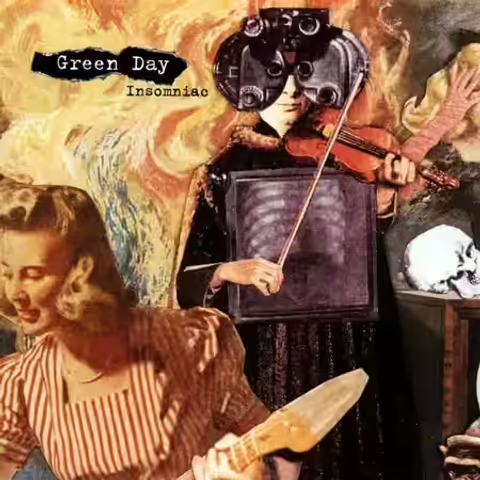
Eighteen months after Dookie sold ten million copies and turned three Berkeley punks into a stadium proposition, Green Day made a record they could barely promote. The lead single's video, a methamphetamine addict having a tooth extracted on camera, was pulled from MTV. Every single on the album contained the words "fuck" or "shit". The cover was a collage by a Dead Kennedys associate that hid a skull for each band member inside a quotation of a 1533 Hans Holbein painting. The band went home from the studio to a town that no longer wanted them, having been formally banned from the 924 Gilman Street club where they had grown up.
Insomniac is what happens when a punk band wins and refuses to enjoy it. Recorded at Hyde Street in San Francisco between December 1994 and May 1995 with Rob Cavallo back behind the desk, it is harder, faster and bleaker than the record that made Green Day famous, and it is the album Billie Joe Armstrong still calls the most honest thing he has ever done. The story of how it came together, how it sold three million copies while feeling like a commercial failure, and how it pushed the band straight into the burnout that produced Nimrod two years later, is one of the most interesting in 1990s punk.
| Field | Detail |
|---|---|
| Artist | Green Day |
| Album | Insomniac |
| Release Date | 10 October 1995 |
| Label | Reprise Records |
| Producer(s) | Rob Cavallo and Green Day |
| Studio | Hyde Street Studios, San Francisco, California |
| Genre | Punk rock, pop punk, hardcore punk |
| Track Count | 14 |
| Total Runtime | 32:49 |
| Billboard 200 Peak | 2 |
| UK Albums Chart Peak | 8 |
| Other Notable Chart Peaks | Austria 2, Canada 2, Australia 5, New Zealand 5, Sweden 5, Finland 1 |
| Certifications | 2x Platinum (RIAA, 1996), Platinum (BPI, ARIA, RIAJ), Gold in multiple territories |
| Estimated Sales | Over 2.1 million in the US (as of 2012); over 6 million worldwide reported by various sources |
| Key Singles | Geek Stink Breath, Stuck with Me, Brain Stew / Jaded, Walking Contradiction |
Cultural Context: Punk in the Year of Jagged Little Pill
By the autumn of 1995, the alternative-rock boom that Nevermind had triggered four years earlier was eating itself. Kurt Cobain had been dead for eighteen months. Alanis Morissette's Jagged Little Pill was the year's commercial monolith, on its way to thirty-three million copies and a stranglehold on radio. Foo Fighters released their self-titled debut in July. The Smashing Pumpkins were finishing Mellon Collie and the Infinite Sadness, which would arrive thirteen days after Insomniac and eclipse it on the cover of every magazine. Oasis put out (What's the Story) Morning Glory? on 2 October. Eight days later Insomniac landed in a market still working out whether punk had been a fad or a permanent shift.
That permanent shift owed almost everything to Dookie. Released in February 1994, it had detonated the assumption that mainstream radio would not play three-chord punk, and dragged the rest of the genre's California scene up with it. The Offspring's Smash, on the indie label Epitaph, sold over eleven million copies in 1994 alone. Rancid, Bad Religion and NOFX all sat in the slipstream. The major labels, having spent 1992 and 1993 chasing every flannel shirt in Seattle, were now signing anything with a checkered Vans pattern. Punk was supposed to be the future. Green Day, who had unwittingly written the prospectus, were supposed to deliver the next chapter.
Berkeley had a different opinion. The 924 Gilman Street club, the all-ages co-op where Green Day had cut their teeth, formally banned the band after they signed to Reprise. The walls were graffitied with their names crossed out. The local fanzines wrote them off as sellouts. To outsiders this looked like the predictable mid-career grumble of a scene losing its biggest act; from the inside it was a slow public divorce.
The Band's Story Up to This Point
Green Day were, by the end of 1994, one of the most successful rock bands on the planet and the least equipped to deal with it. Billie Joe Armstrong was twenty-two, newly married to Adrienne Nesser and a first-time father. Mike Dirnt had spent his teens couch-surfing in East Oakland; he was now wealthy and conspicuously famous. Tre Cool, who had replaced original drummer John Kiffmeyer in 1990, had also just had his first child with his then-wife. None of the three came from money, none had finished college, and none had any particular plan for what to do with the kind of fame that Dookie had handed them.
That fame had been earned over four albums in five years. 39/Smooth (1990) and Kerplunk (1991) on Lookout! had sold respectably for an East Bay punk indie. Dookie, recorded in three weeks for around $200,000, had been a Reprise A&R bet that paid back roughly fifty times over. Rob Cavallo, the Warner Bros. A&R man who had signed them and produced the record, was no longer a young executive trying to prove himself; he was the producer who had broken Green Day, and his phone rang constantly.
Armstrong, who had spent the preceding year being asked the same six questions by every interviewer in North America, was wrestling with a problem few punk bands ever face: how to tell the truth on the next record when the next record is the most anticipated punk album of the decade. The answer was to write fast, write angry, and stop trying to be likeable.
"I think I was just lost. I couldn't find the strength to convince myself that what I was doing was a good thing. I was in a band that was huge because it was supposed to be huge, because our songs were that good. But I couldn't even feel that I was doing the right thing, because it felt like I was making so many people angry."
Billie Joe Armstrong, Kerrang!, 2018
Pre-production and Demos
Most of Insomniac was written and rehearsed in a small Cape Cod-style house Armstrong had rented in East Oakland. The walls of the rehearsal room were papered with handwritten notes giving each new song an instruction for the right tempo and mood. Two of the surviving examples, both quoted in the 1995 Rolling Stone profile that followed the band into the studio, read "Must pop Valium for this one" and "Must take crank for this one". That was the band's working shorthand. The album itself would split roughly the same way: tightly wound, acid-bright pop punk on one half; slower, heavier, downer-paced songs on the other.
"Insomniac" was not the original title. The band briefly considered Jesus Christ Supermarket, a phrase Armstrong has since said he regrets retiring, and Tight Wad Hill, after the song of the same name. The eventual title was lifted from a working name for the demo of "Brain Stew" and from a remark by collage artist Winston Smith, who told Armstrong, when asked how he produced such intricate cover art so quickly, that the answer was simple.
"It's easy for me. I am an insomniac."
Winston Smith, recalled by Billie Joe Armstrong, winstonsmith.com gallery, 1995
Armstrong had his own version of the same condition: a newborn son who screamed through the night, a mind that would not switch off when the screaming stopped, and a publishing deal that had set deadlines for songs nobody had written. Several of the album's tracks, in particular "Armatage Shanks" and "Stuart and the Ave.", had actually been drafted before Dookie was even released, but were re-cut once the band saw what tools the new album wanted.
Creating the Album
Sessions ran at Hyde Street Studios in San Francisco from December 1994 to May 1995. Hyde Street had Wally Heider Studio Three at its core, the room where Creedence Clearwater Revival had cut Cosmo's Factory and Dead Kennedys had recorded Fresh Fruit for Rotting Vegetables. The choice was not accidental. Cavallo and the band wanted somewhere with proper outboard, working tape machines and a punk lineage, in roughly that order.
The recording process itself was a study in contradiction. The band were committed to the punk virtue of high-energy live takes, but they were also chasing a much bigger guitar sound than they had ever previously got on tape. Cavallo and Armstrong developed a ritual of lining up a row of vintage amps in front of the live room and tracking the same riff through each one to decide which voicing made it onto the master. Bob Bradshaw of Custom Audio Electronics was brought in to thicken the guitar signal chain. Tre Cool changed the cymbal selection from song to song. The Beatles and Cheap Trick were named more often in studio conversation than the Sex Pistols.
"He helped the band make huge guitar walls out of riffs and grow away from the shiny-happy locker-room dip-shittery of Dookie."
Andrew Earles on Rob Cavallo, Gimme Indie Rock, Voyageur Press, 2014
The band's working method was punishing. Before takes, the three would drink coffee until they were physically shaking, blast through the song at full volume, and then collapse onto the studio couch immediately afterwards. This was a deliberate decision: most of Insomniac was tracked live in the room, with overdubs kept to the minimum required to land a single vocal pass and double a rhythm guitar. The instrumental introduction to "Panic Song" was so violent that Cool tore the calluses off his hands and slumped against the wall between takes; Cavallo recalled the drummer's hands resembling, in his words, a bloody mess.
The pressure was not just physical. Dookie had been recorded in three weeks by a band with nothing to lose. Insomniac was being recorded over six months by a band that had spent the previous year being told they were the future of rock, by people whose financial models depended on it being true. Reprise gave the band a substantially larger budget and got out of the way. Cavallo, by all accounts, did the same.
- Recorded at Hyde Street Studios, San Francisco, December 1994 to May 1995.
- Engineered by Kevin Army, with Richard Huredia and Bernd Burgdorf as second engineers.
- Mixed by Jerry Finn, who would go on to define the sound of late-1990s pop punk through his work with Blink-182 and Rancid.
- Mastered by Bob Ludwig at Gateway Mastering in Portland, Maine.
- Bob Bradshaw of Custom Audio Electronics was hired specifically to develop a thicker, more saturated guitar tone.
- Most basic tracks were cut live in the room, with very few overdubs.
Personnel and Credits
| Role | Player | Notes |
|---|---|---|
| Core band | ||
| Lead vocals, guitar | Billie Joe Armstrong | Sole credited lyricist except for "Panic Song", co-written with Mike Dirnt. |
| Bass, backing vocals | Mike Dirnt | Co-wrote "Panic Song"; lead bass intro on the same track inspired by Geddy Lee. |
| Drums, percussion | Tre Cool | Tore the calluses off his hands tracking the "Panic Song" intro. |
| Production and engineering | ||
| Producers | Rob Cavallo and Green Day | Same producing partnership as Dookie. |
| Engineer | Kevin Army | Long-time East Bay engineer; had worked on Operation Ivy's Energy. |
| Second engineers | Richard Huredia, Bernd Burgdorf | |
| Mixing | Jerry Finn | Later defined the sound of Blink-182's Enema of the State and Rancid's ...And Out Come the Wolves singles. |
| Mastering | Bob Ludwig | Gateway Mastering, Portland, Maine. |
| Guitar tone consultant | Bob Bradshaw | Custom Audio Electronics; brought in to thicken the rhythm guitar sound. |
| Artwork | ||
| Cover art | Winston Smith | Long-time Dead Kennedys collage artist; collage titled God Told Me to Skin You Alive. |
| Art direction | Dirk Walter | |
| Typographic design | David Harlan | |
Two names on this list are worth pausing over. Jerry Finn, who mixed the album, was on his way to becoming the most important behind-the-glass figure in commercial pop punk; if a record between 1995 and his death in 2008 sounded like a clean punk band on FM radio, Finn had probably touched it. And Winston Smith, whose collages had defined the Dead Kennedys' visual identity since 1981, was hired specifically because Tre Cool had known him from the Lookout! Records era and called him on the off chance.
The Songs
Fourteen tracks, thirty-two minutes and forty-nine seconds. The record opens with three songs in a row that clear the two-minute mark by single-digit seconds, then briefly slows for "Geek Stink Breath", then slams back into hardcore tempos until the slower middle stretch of "Panic Song", "Brain Stew" and "Jaded". It closes on "Walking Contradiction", a song built almost entirely on a repeating four-bar chorus phrase. The pacing is deliberately exhausting.
| # | Title | Writer(s) | Length | Single? | Notes |
|---|---|---|---|---|---|
| 1 | Armatage Shanks | Billie Joe Armstrong | 2:17 | Working title pre-Dookie; opens with the line "Stranded, lost inside myself". | |
| 2 | Brat | Armstrong | 1:43 | Snot-nosed slob waiting to inherit; written in roughly an afternoon. | |
| 3 | Stuck with Me | Armstrong | 2:16 | UK only | The "I'm not part of your elite" line is a direct response to the Gilman ban. |
| 4 | Geek Stink Breath | Armstrong | 2:15 | Lead | About methamphetamine use; peaked at 27 on Billboard Hot 100 Airplay. |
| 5 | No Pride | Armstrong | 2:19 | Narrator at the bottom of society, content to stay there. | |
| 6 | Bab's Uvula Who? | Armstrong | 2:08 | Title from a 1976 SNL Gilda Radner sketch; opens with the line "I've got a knack for fucking everything up". | |
| 7 | 86 | Armstrong | 2:47 | Spain/Germany promo | About the Gilman Street ban; "to be 86'd" is bartender slang for being permanently barred. |
| 8 | Panic Song | Armstrong, Mike Dirnt | 3:35 | Opens with two-minute instrumental intro; inspired by Armstrong's anxiety and Dirnt's mitral-valve panic attacks. | |
| 9 | Stuart and the Ave. | Armstrong | 2:03 | About a real Berkeley intersection and an old break-up. | |
| 10 | Brain Stew | Armstrong | 3:13 | Yes (paired) | Working title was "Insomniac"; biggest hit on the album. |
| 11 | Jaded | Armstrong | 1:30 | Yes (paired) | Released as a single paired with Brain Stew. |
| 12 | Westbound Sign | Armstrong | 2:12 | About Adrienne Armstrong moving from Minneapolis to California. | |
| 13 | Tight Wad Hill | Armstrong | 2:01 | Tight Wad Hill is a real spot above California Memorial Stadium where people watch games for free. | |
| 14 | Walking Contradiction | Armstrong | 2:31 | Promo | Closing track; Grammy-nominated music video. |
"Geek Stink Breath" is the song the album is most often remembered for. Armstrong has said in interviews that it was not autobiographical so much as observational: he had watched friends' teeth rot from methamphetamine, and he wrote a song about an accelerated pulse and a face full of scabs over a riff that lurched between the verses like the drug itself. Reprise put it out as the lead single anyway, with a music video shot in genuine close-up at a real dental procedure. MTV pulled it within weeks.
"Brain Stew" is the album's other long-tail hit, and the one that turned out to be more durable than anyone expected. Built on a chromatic descending five-chord riff, played in the studio by Armstrong on Mike Dirnt's bass amp for a particular kind of ugly low-end, it segues directly into "Jaded" with no gap. The pair were released together as a single in April 1996. Music journalist Andrew Earles later called "Brain Stew" "one of the better mainstream radio moments" of the decade. Stadium PA systems in 2026 still play it.
The deeper material rewards repeated listening more than the singles do. "86" is a Gilman Street goodbye letter, "to be 86'd" being bartender slang for being permanently barred, and the song is structured as a confused and angry monologue from a young man who has just discovered that the door of the place he grew up in no longer opens for him. "Panic Song" is built on a two-minute instrumental introduction in which Dirnt's bass plays an ascending Geddy-Lee-shaped figure over Cool's drums; the lyric, when it finally arrives, is one of the bleakest things on a Green Day album, comparing the world to "a sick machine breeding a mass of shit". Both Armstrong and Dirnt suffered from genuine panic attacks at the time of writing, Dirnt's caused by a congenital enlarged mitral valve.
"Stuart and the Ave." is named after the real intersection of Stuart Street and Telegraph Avenue in Berkeley and is a break-up song. "Westbound Sign" is its mirror image: a love song, by Green Day's standards, about Adrienne Nesser leaving Minneapolis to be with Armstrong in California. The closer "Walking Contradiction" is the one moment on the record where the band sounds like it might still be having fun, and it earned the album its only Grammy nomination, for Best Music Video at the 1997 ceremony.
B-sides, Outtakes and Lost Songs
For a band that wrote as quickly as Green Day, Insomniac produced surprisingly few orphans. The most notable B-side, included on the Australian and Japanese editions of the album as a hidden bonus track, is "I Want to Be on T.V.", a cover of a 1981 Fang song written by Sam McBride and Tom Flynn. Fang were a Berkeley hardcore band Armstrong had grown up watching at Gilman, and the cover doubles as an in-joke about the band's complicated new relationship with mass media.
The "Geek Stink Breath" CD single carried an unreleased track called "I Don't Want to Know If You Are Lonely", a Husker Du cover that has since reappeared on compilations. The "Stuck with Me" UK single carried two further outtakes, "When It's Time" and an alternate version of "Brat". The Spanish and German "86" promo single contained a non-album cut titled "Tired of Waiting for You", a Kinks cover. Several sessions tapes from the December 1994 to May 1995 period are known to circulate among collectors, but the band has never authorised an outtakes release on the scale of, say, the deluxe editions American Idiot later received.
The 25th-anniversary deluxe edition, issued in March 2021, did finally lift the curtain. It paired a remastered original album with eight live tracks recorded in Prague during the Insomniac tour. There were no surviving studio outtakes added; the band's own position has been that what was worth keeping made the record.
Album Artwork and Packaging
The cover is a collage by Winston Smith, formally titled God Told Me to Skin You Alive after the Dead Kennedys song "I Kill Children". Smith had been doing the Dead Kennedys' visual identity since 1981 and was a friend of Tre Cool's from the Lookout! Records years. He had told Cool casually that if Green Day ever wanted album artwork they should call him; once Dookie made the band a major-label proposition, they did.
The collage rewards close inspection. Three skulls, one for each band member, are hidden across the cover and back; one of them is rendered using the same anamorphic technique Hans Holbein the Younger used for the skull in The Ambassadors (1533), which only resolves into a skull when viewed at an angle. There is a naked woman, three small fairies, and at least four ghostly faces in the flames at the bottom. The dentist character pulling a tooth, which became the basis for the "Geek Stink Breath" video, is recycled from a collage Smith had originally made for the inside cover of the Dead Kennedys' 1982 album Plastic Surgery Disasters. Where Holbein's painting features a woman with an acoustic guitar, Smith's redrawing has her holding Billie Joe Armstrong's Sonic Blue Fernandes Stratocaster copy, the guitar Armstrong had nicknamed Blue.
The original CD booklet pressed with the album included no lyric sheet, an unusual choice for a major-label release in 1995, because Armstrong had asked that the songs not be parsed line-by-line in the press. The vinyl edition, reissued on 12 May 2009 as part of Green Day's complete-catalogue vinyl programme, restored the original gatefold artwork and added a printed insert. The 2021 25th-anniversary edition came as a 2-LP set with the live Prague disc on the second platter.
Release and Reception
Insomniac was released on 10 October 1995. It debuted at number 2 on the Billboard 200 with first-week sales of over 171,000 copies, denied the top spot by Mariah Carey's Daydream. It hit number 8 on the UK Albums Chart, number 2 in Austria and Canada, number 5 in Australia, New Zealand, Sweden and Europe-wide, and improbably number 1 in Finland. The RIAA certified it Platinum on 8 January 1996 and 2x Platinum by the end of that year. As of 2012 the album had sold over 2.1 million copies in the United States, with worldwide sales generally reported to have crossed six million.
By any normal yardstick this was a triumph. By the yardstick of Dookie, which had moved over ten million copies in the United States alone, it was a commercial cooling-off, and several critics framed it that way at the time. A staff writer at People compared it directly to Nirvana's In Utero as the kind of darker, less accessible follow-up a multi-platinum punk band makes when it does not want to repeat itself.
"In punk the good stuff actually unfolds and gains meaning as you listen without sacrificing any of its electric, haywire immediacy. And Green Day are as good as this stuff gets."
Mark Coleman, Rolling Stone, 2 November 1995
Most contemporary reviews fell between three and four stars. Rolling Stone's Mark Coleman gave it three and a half. AllMusic's Stephen Thomas Erlewine gave it four and concluded that Green Day "kept their blueprint and made it a shade darker", which is still the most accurate one-line summary of the record. Spin gave it 8/10. Robert Christgau in The Village Voice gave it an A-minus and noted that Armstrong's songs "conceptualize his natural whine with a musicality that undercuts his defeatism". Entertainment Weekly's David Browne gave it a B and registered the most interesting reservation:
"14 slices of hearty anarchy, played with a follow-the-bouncing-spitball compactness and vigor."
David Browne, Entertainment Weekly, 20 October 1995
The pushback Browne built into the rest of his review was that Green Day, between albums one and four, had not branched out the way the Clash had in the same span. The album was nominated for a Grammy for Best Alternative Music Album at the 1997 ceremony. It lost to Beck's Odelay. The "Walking Contradiction" video was nominated for Best Music Video, Short Form, and lost to the Beatles' "Free as a Bird". Rock Sound later placed the album at number 8 on its 2014 list of "The 51 Most Essential Pop Punk Albums of All Time".
Singles and Music Videos
Four singles came off Insomniac in roughly eleven months, an unusually long campaign for a punk band that had moved on emotionally before half of them came out.
| Single | Released | Director | Notes |
|---|---|---|---|
| Geek Stink Breath | 25 September 1995 | Mark Kohr | Featured an actual tooth extraction performed on camera. Pulled from MTV; reached 27 on Billboard Hot 100 Airplay. |
| Stuck with Me | 21 December 1995 (UK only) | Mark Kohr | Charted in UK, Australia and New Zealand. Not released as a single in the US. |
| Brain Stew / Jaded | 10 April 1996 | Kevin Kerslake | Two separate songs released as a paired single and a single combined music video. Biggest mainstream hit of the album. |
| Walking Contradiction | 20 August 1996 (promo) | Roman Coppola | Promotional only. Grammy-nominated for Best Music Video, Short Form. Set in a single take through chaotic city streets. |
Mark Kohr, who had directed all four of Dookie's videos, returned for the first two singles. The "Geek Stink Breath" clip was deliberately confrontational: a man in a dental chair has a tooth extracted, with intercut footage of the band playing in a clinical-looking room. MTV played a cut version briefly, then dropped it altogether. The full uncut version is the one Green Day put on its own VHS and DVD compilations from 1997 onwards.
"Brain Stew / Jaded" got a single video that ran the two songs back to back, directed by Kevin Kerslake (best known for Nirvana's "Sliver" and "Come as You Are"). The "Walking Contradiction" video was directed by Roman Coppola, son of Francis Ford Coppola, and depicts the band walking down a single city street while accidents and small disasters detonate behind them. It is the only Grammy nomination Green Day picked up for the entire Insomniac campaign, and the only one Coppola has ever received for a music video.
Touring and Live
The Insomniac Tour ran from 17 October 1995 to October 1996. It opened at the Seattle Center Arena and ran for over seventy-eight shows across North America, Europe, Asia and Oceania. Support acts on various legs included Riverdales (the Screeching Weasel offshoot featuring Ben Weasel), the Hi-Fives, and the Berkeley punk band Tilt. The tour played venues at a scale Green Day had simply never operated in: the Oakland Coliseum, the Pacific Coliseum, large hockey arenas across the American midwest, the Brixton Academy in London.
The band was visibly uncomfortable with the size of these rooms. Armstrong has said in subsequent interviews that the Insomniac arenas felt like a betrayal of the band's identity, and that the experience was the direct cause of the late-1996 European leg being cancelled outright. The band went home, decompressed, and used the gap to write more than three dozen new songs for what would eventually become Nimrod in 1997.
"We were becoming the things we hated, playing those big arenas. It was beginning to be not fun anymore."
Billie Joe Armstrong, recalled in Marc Spitz's Nobody Likes You: Inside the Turbulent Life, Times, and Music of Green Day, 2006
One legacy of the tour, however, was Tre Cool's transformation as a player. By his own account, becoming a father had not made him less aggressive behind the kit; it had let him hit harder than he ever had before. The Insomniac live versions of "Brain Stew" and "Walking Contradiction", several of which surfaced legitimately on the 25th-anniversary deluxe live disc and unofficially on bootlegs from Prague, Phoenix and Sydney, are noticeably faster and louder than the studio takes.
In TV, Film and Media
Despite limited promotional support, several songs from Insomniac have had unusually long sync afterlives.
- "Westbound Sign" was used in the teaser trailer for the 2006 Disney/Pixar film Cars.
- "86" appeared in the 1996 MTV-produced film Joe's Apartment.
- A remix of "Brain Stew" was made for the soundtrack to the 1998 Godzilla film, alongside Puff Daddy's "Come with Me" and Jamiroquai's "Deeper Underground".
- "Geek Stink Breath", "Brain Stew" and "Jaded" were all featured as playable tracks in the 2010 video game Green Day: Rock Band.
- "Brain Stew" has been used recurrently in live broadcast sport and pro-wrestling television over the past two decades.
Controversy, Censorship and Lawsuits
The most concrete controversy attached to Insomniac is the MTV decision to pull the "Geek Stink Breath" video. The two stated reasons were the explicit depiction of a real dental extraction, which raised broadcast standards problems, and the lyrical drug content, which raised the more nervous problem of a major broadcaster being seen to promote methamphetamine use. The band's response, communicated through their press representative, was that the song was anti-meth rather than pro-meth, and that the video was the song's literal subject matter. MTV did not change its mind.
The Winston Smith cover collage attracted milder objections from American Christian groups about the title God Told Me to Skin You Alive, which was reproduced in interior packaging. Reprise stickered some American copies with parental-advisory warnings. The album was not formally banned in any major territory.
The cancellation of the late-1996 European leg of the Insomniac Tour, while not a controversy in any legal sense, was the closest thing Green Day produced to a public-relations crisis at the time. Continental promoters reported it as a near-walkout. The band's official explanation was burnout and homesickness, and that explanation has held up: every member of the band has subsequently confirmed it.
Covers, Samples and Tributes
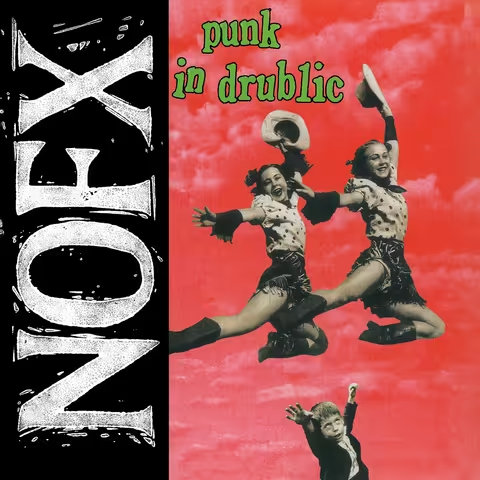
"Brain Stew" has had the most active afterlife of any track on Insomniac. The Eminem track "Mosh" from Encore (2004) does not credit it, but the descending guitar riff is widely identified as a homage. The song has been covered live by My Chemical Romance, Sum 41, Wheatus and the Used. "Geek Stink Breath" has been covered live by NOFX, who performed it during their 2014 farewell tour announcement leg. "Walking Contradiction" was covered by the Australian punk band Frenzal Rhomb on the Green Day tribute album Punk Goes Pop, Vol. 4.
The album itself does not sample anything in the modern sense. The closest it gets is the title of "Bab's Uvula Who?", lifted directly from a 1976 Saturday Night Live sketch starring Gilda Radner and Chevy Chase. The song's lyric does not otherwise reference the sketch.
Reissues, Remasters and Anniversaries
Insomniac has been reissued in three commercially significant editions since its 1995 release. The first was the 12 May 2009 vinyl reissue, part of the band's complete-discography vinyl programme through Reprise; this was a straight reissue with the original Smith artwork and no additional content. The second was the 25th-anniversary edition issued on 19 March 2021, which paired a remastered version of the original album with an eight-track live disc titled Live in Prague, drawn from a 1996 Insomniac Tour show. Among the live tracks were "Welcome to Paradise", "Longview" and "Burnout" from earlier records, alongside "Armatage Shanks", "Geek Stink Breath" and "Brain Stew" from the album itself. The third was a half-speed-mastered audiophile vinyl pressing released through Rhino's High Fidelity series in late 2023.
Bootlegs from the period are widely traded: a complete soundboard recording of the band's 21 March 1996 show at the Roseland Ballroom in New York and several FM broadcasts from Australian dates in early 1996 circulate in lossless form through the usual archive channels.
Legacy and Influence
Insomniac sits in a particular and slightly awkward position in Green Day's catalogue. It is the album the band always defends and the album most casual fans skip. It produced one bona fide rock-radio standard in "Brain Stew" and one durable single in "Geek Stink Breath", but it has nothing on it as immediately catchy as "Basket Case" or "Longview" from Dookie, and nothing as stadium-ready as "Good Riddance (Time of Your Life)" from Nimrod. What it has instead is a kind of compressed honesty that the rest of the catalogue, with the partial exception of 21st Century Breakdown, has never quite repeated.
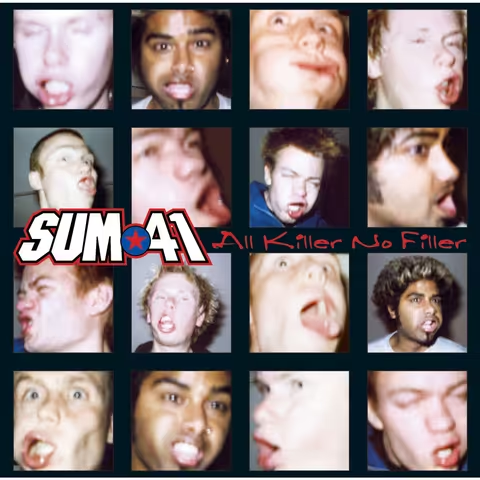
Its influence on the second wave of pop punk is hard to overstate. Blink-182's Enema of the State (1999), Sum 41's All Killer No Filler (2001), Jimmy Eat World's Bleed American (2001) and Yellowcard's Ocean Avenue (2003) all owe something to the Cavallo and Jerry Finn template that crystallised on Insomniac: a punk record produced as if it were a serious rock record, with high-budget guitar tones, deliberately compressed running times and an emphasis on melodic weight over scuzz. My Chemical Romance, who Cavallo would go on to produce for The Black Parade in 2006, have repeatedly cited Insomniac as a touchstone.
"I felt at the time that there was a real urgency to what we were doing. There was a real urgency to stake our claim and say, 'No, we belong here.' It was really important to us to make sure people knew that we weren't just a flash in the pan."
Mike Dirnt, Kerrang!, 2018
The band has continued to release records under its own name and as the side projects Foxboro Hot Tubs and the Network. Nimrod in 1997 reset the template; Warning in 2000 reset it further; American Idiot in 2004 made them, briefly, the biggest rock band on the planet again. Nothing in that subsequent run sounds quite like Insomniac, and that is largely because nothing in their lives ever again resembled the eighteen months that produced it.
Things You Might Not Know
| Fact | Detail |
|---|---|
| The working titles | Before settling on Insomniac, the band considered Jesus Christ Supermarket and Tight Wad Hill. Armstrong publicly tweeted in 2011 that Jesus Christ Supermarket was "a much better title". |
| The album title's source | Came from a remark by cover artist Winston Smith and from the working title of the demo for "Brain Stew", not from Armstrong's own sleep problems alone. |
| The hidden Holbein | One of the three skulls on the cover is an anamorphic distortion borrowed directly from Hans Holbein the Younger's 1533 painting The Ambassadors and only resolves when the cover is tilted. |
| Bab's Uvula Who? | The song title is taken word-for-word from a 1976 Saturday Night Live sketch with Gilda Radner and Chevy Chase, in which Radner's Bab character has uvula trouble. |
| The 924 Gilman ban | Track 7, "86", is a goodbye letter to the Berkeley club that formally banned the band from performing there after they signed to Reprise. "86" is bartender slang for being permanently barred. |
| Recycled Dead Kennedys art | The dentist character on the cover is recycled from a Winston Smith collage for the inside cover of Dead Kennedys' Plastic Surgery Disasters (1982). |
| Coffee, calluses and the wall | Tre Cool tore the calluses off his hands recording the introduction to "Panic Song" and slumped against the studio wall between takes; Cavallo later described his hands as "a bloody mess". |
| Mike Dirnt's heart | Dirnt suffered panic attacks during the writing of the album due to a congenital enlarged mitral valve in his heart; "Panic Song" is partly about that condition. |
| The Geek Stink Breath dental video | The "Geek Stink Breath" video featured a real, non-staged tooth extraction performed on camera, and was pulled from MTV within weeks. |
| The Roman Coppola video | "Walking Contradiction" was directed by Roman Coppola, son of Francis Ford Coppola, and earned the album its only Grammy nomination, for Best Music Video, Short Form, in 1997. |
| The European cancellation | The late-1996 European leg of the Insomniac Tour was cancelled outright because the band, particularly Armstrong, had become uncomfortable with arena-scale shows. |
| The Cars connection | "Westbound Sign" was used eleven years later in the teaser trailer for the 2006 Pixar film Cars, exposing the song to an entirely new audience. |
| The Fang cover | "I Want to Be on T.V.", a Fang cover, was included as a hidden bonus on the Australian and Japanese editions of the album as an in-joke about Green Day's complicated new media presence. |
| The Jerry Finn connection | Mixer Jerry Finn went on to mix Blink-182's Enema of the State and Rancid's ...And Out Come the Wolves singles, becoming arguably the most influential pop-punk mix engineer of his generation. |
Listen to the Riffology Podcast
If you have made it this far, you might enjoy the Riffology podcast, where the same conversational deep-dive treatment gets applied to a different album every week. Episodes cover the records that defined rock, punk, metal and pop music as we know it, with the same priority on the things you did not already know. The show is available on Apple Podcasts, Spotify, Amazon Music and every other major platform, and a new episode lands roughly every Friday.
Comments