The lead single from Pearl Jam's third studio album was a two-minute-and-forty-eight-second hardcore-punk ode to the format that radio had spent the previous decade declaring dead. "Spin the Black Circle" was released on 7 November 1994 with a back-sleeve credit that read, in deadpan industry-speak, "From the Epic album Life". By the time the album itself appeared two weeks later it had been re-titled Vitalogy, packaged inside a hardback medical-book replica that record shops could not figure out how to shelve, released on 22 November 1994 on vinyl only, and made the bestselling vinyl record of any week in the entire SoundScan era. It would hold that record for twenty years.

This is what the biggest American rock band of 1994 did to celebrate being the biggest American rock band of 1994: they released a vinyl-first record whose opening single existed mainly to scold the people buying CDs, refused to play any venue serviced by Ticketmaster, fired their drummer halfway through tracking, lost their lead guitarist to a rehab clinic, recorded most of the songs twenty minutes after writing them in soundcheck, included a thrift-shop accordion track that several reviewers called a deliberate provocation, ended the album with seven minutes of looped recordings of real psychiatric patients, and watched the singer collapse from food poisoning seven songs into the tour-opening Golden Gate Park show that Neil Young finished for him. Bassist Jeff Ament's later one-line summary of the Vitalogy campaign, given to Spin's "Ten Past Ten" oral history in 2001: "It pretty much killed us, killed our career." The album shipped five million copies in the United States and was nominated for Album of the Year. Both things are true.

Album Facts

FieldDetail
ArtistPearl Jam
AlbumVitalogy
Release Date22 November 1994 (vinyl); 6 December 1994 (CD and cassette)
LabelEpic Records
Producer(s)Brendan O'Brien and Pearl Jam
EngineerNick DiDia; Brett Eliason on "Hey Foxymophandlemama, That's Me"
MasteringBob Ludwig at Gateway Mastering, Portland, Maine
Studio(s)Kingsway Studio (New Orleans); Southern Tracks Recording (Atlanta); Doppler Studios (Atlanta); Bad Animals Studio (Seattle); Fox Theatre (Atlanta, on-stage)
Recording DatesNovember 1993 to October 1994
Genre / SubgenreAlternative rock, punk rock, grunge, art rock
Track Count14
Total Runtime55:09
Billboard 200 PeakNo. 1 (debuted at No. 55 on vinyl alone; 877,000 first-week copies when the CD landed)
UK Albums Chart PeakNo. 4
Other Notable Chart PeaksNo. 1 in Australia, Ireland, New Zealand and Sweden; No. 2 in Canada; No. 3 in Finland; No. 4 in Denmark and Portugal; No. 5 in Scotland; No. 7 in Austria, Norway and the Netherlands; No. 8 in Germany; No. 11 in Spain; No. 17 in Switzerland; No. 22 in France
CertificationsUS 5x Platinum; Canada 5x Platinum; Australia 4x Platinum; New Zealand Platinum; UK Gold; Germany Gold; Netherlands Gold; Spain Gold; Poland Gold
Estimated Sales6.9 million in the US (Nielsen SoundScan, July 2013); around 10 million worldwide
Key Singles"Spin the Black Circle", "Not for You", "Immortality"
Grammys"Spin the Black Circle" won Best Hard Rock Performance, 1996; album nominated for Album of the Year and Best Rock Album, 1996

Cultural Context

Late 1994 in American rock was, by any reasonable measure, the moment grunge stopped being a counter-cultural insurgency and became the dominant commercial language. Kurt Cobain had killed himself in April. Soundgarden's Superunknown had been a No. 1 album the previous March. Hole's Live Through This had landed a week after Cobain's death. Stone Temple Pilots' Purple was No. 1 when Vitalogy entered the studio for its final sessions. Alice in Chains had released Jar of Flies in January and would release the self-titled Tripod in November of the same year. Even outside the Pacific Northwest the year's biggest rock records, Green Day's Dookie, The Offspring's Smash, Weezer's Blue Album, Bush's Sixteen Stone, all carried some recognisable downstream debt to the bands grunge had produced.

The albums Vitalogy competed with for the November-December 1994 release window:

  • R.E.M., Monster (27 September 1994)
  • Nirvana, MTV Unplugged in New York (1 November 1994)
  • The Rolling Stones, Voodoo Lounge (11 July 1994; still selling heavily)
  • Eagles, Hell Freezes Over (8 November 1994)
  • Bon Jovi, Cross Road (10 October 1994)
  • Tom Petty, Wildflowers (1 November 1994)
  • Madonna, Bedtime Stories (25 October 1994)
  • Garth Brooks, The Hits (13 December 1994)

Pearl Jam outsold every rock record on that list in its first week. Vitalogy was the second-fastest-selling album in history at the time of release, behind only Pearl Jam's own Vs. from the previous year. The band had spent that record-breaking commercial moment turning down magazine covers, refusing to make music videos, declining most promotional television appearances, and publicly filing a US Department of Justice complaint against Ticketmaster for monopolistic service-fee practices. The album Vitalogy was the artefact in which that increasingly fraught relationship between the band and their own popularity got laid out in twenty-minute soundcheck improvisations, throwaway accordion ballads and a vinyl-first release schedule designed to wrong-foot the very industry that had made them the band most likely to outsell everyone in the room.

The Band's Story Up to This Point

Three years before Vitalogy, the same five musicians (Eddie Vedder, Stone Gossard, Jeff Ament, Mike McCready and Dave Krusen) had played their first show as Mookie Blaylock at the Off Ramp Cafe in Seattle on 22 October 1990. Ten, their debut, was released on 27 August 1991 to modest opening sales and built over fourteen months into a six-times-platinum success that placed them, with Nirvana and Soundgarden, at the head of the grunge commercial wave. Dave Krusen had been replaced by Matt Chamberlain and then by Dave Abbruzzese before the album was a year old.

Vs., released on 19 October 1993, was the moment Pearl Jam became the most commercially dominant band of their generation. It shipped 950,378 copies in its first week, an all-time SoundScan record at the time, and held the No. 1 position on the Billboard 200 for five weeks. The Vs. tour ran through Europe, Australia, North America and South America from spring 1993 into summer 1994. By the end of it the band's collective relationship with the music industry was visibly fraying.

The Ticketmaster dispute became the public face of that fraying. Pearl Jam had attempted to keep ticket prices for the Vs. tour at $18 with a maximum $2 service fee, well below the prevailing market price. Ticketmaster, then the dominant ticketing monopoly through exclusive long-term deals with the major American arena and theatre venues, refused to lower their own service charges. Pearl Jam filed a formal complaint with the US Department of Justice's antitrust division in May 1994. By the time Vitalogy was being mixed in summer 1994 the band were committed to touring exclusively on non-Ticketmaster venues, a commitment that would all but end their ability to tour large rooms in the United States for the rest of the decade.

The internal pressure was at least as bad. Producer Brendan O'Brien, sitting down with the band again at Kingsway in New Orleans in late 1993 to begin work on the third record, found them already pulling in different directions. Bassist Jeff Ament later told Spin:

"Communication was at an all-time low."

Jeff Ament, Spin "Ten Past Ten" oral history, August 2001

By the time the album was finished in autumn 1994, Dave Abbruzzese had been fired, Mike McCready had completed a stint in rehab for alcohol and cocaine addiction, Stone Gossard was actively contemplating leaving the band, and Eddie Vedder had become, for the first time, the final decision-maker on which songs made the record and which did not.

Pre-production and Demos

Vitalogy was effectively written, demoed and largely recorded in motion. The Vs. tour structure (load in, soundcheck, play, load out, drive) became the band's writing room. New ideas were drafted in soundcheck jams, refined over a few nights, then taken into whatever studio was nearest the next off day on the routing. Stone Gossard's later description for Spin's oral history:

"Eighty percent of the songs were written twenty minutes before they were recorded."

Stone Gossard, Spin "Ten Past Ten" oral history, August 2001

The first formal session took place late in 1993 in New Orleans at Daniel Lanois's Kingsway Studio, where Pearl Jam tracked "Tremor Christ" and "Nothingman" in a single short run. Most of the rest of the material was written and tracked in 1994 in sessions in Atlanta (at Brendan O'Brien's Southern Tracks Recording and at Doppler) and in Seattle (at Bad Animals, the studio owned by Heart's Ann and Nancy Wilson). "Immortality" was written in April 1994 when the band was on tour in Atlanta and recorded at the Fox Theatre on stage between soundcheck and showtime. The album was finished at Bad Animals after the tour wrapped.

The drift toward harder, faster, more aggressively short songs was partly a function of those circumstances. With no time for the kind of orchestrated arrangement work that had shaped Vs., the band defaulted to ideas that could be cut quickly, often as first or second takes. Vedder, who had played almost no guitar on Ten or Vs., began bringing his own short, sharp, punk-derived songs to the sessions. "Spin the Black Circle", "Not for You", "Whipping", "Satan's Bed" and "Last Exit" all originated as Vedder-led ideas. Gossard's reaction was telling:

"Vitalogy is the first one where Ed plays guitar and he wrote three to four songs. I remember thinking, 'This is so different. Is anyone going to like this?'... It had a more punk feel to it. Simple songs recorded really quickly."

Stone Gossard, Total Guitar, November 2002

The album also contains two songs that pre-dated the band entirely. "Better Man" had been written by Vedder in high school in San Diego in the late 1980s and performed by his pre-Pearl Jam band Bad Radio. Pearl Jam had rejected it from Vs. for being too obvious a pop hit; Brendan O'Brien, who called it a "blatantly great pop song", pushed the band to record it for Vitalogy anyway. "Hard to Imagine", also rejected from Vs. and re-attempted at the Vitalogy sessions, did not make the final cut and ended up first on the Chicago Cab soundtrack in 1998 and then on the 2003 rarities compilation Lost Dogs.

Creating the Album

The four studios that produced the bulk of Vitalogy had little in common beyond Brendan O'Brien's presence at all of them. Kingsway, a New Orleans townhouse in the French Quarter that Daniel Lanois had converted into a residential studio in 1989, gave "Tremor Christ" and "Nothingman" their loose, room-microphoned feel. Southern Tracks Recording in Atlanta, O'Brien's preferred home studio, handled most of the longer, more song-shaped material including "Corduroy" and "Immortality". Doppler Studios, also in Atlanta, picked up some of the overflow. Bad Animals in Seattle, where O'Brien had mixed Ten with Tim Palmer back in 1991, became the de facto home for the album's finishing work after the Vs. tour ended.

O'Brien's role on Vitalogy was simultaneously larger and smaller than it had been on Vs. He produced, recorded and mixed; he played pump organ, Hammond organ, Crumar bass pedals and piano on selected tracks; he frequently sat in as a fifth musical opinion when the band were at odds. He also stayed visibly out of the way of the band's increasingly fraught internal politics. His own contemporary description of the sessions, given for the album sleeve credits and quoted in numerous post-release interviews:

"Vitalogy was a little strained. I'm being polite, there was some imploding going on."

Brendan O'Brien, Spin "Ten Past Ten" oral history, August 2001

The "imploding" had several specific dimensions. Mike McCready, the band's lead guitarist, had been struggling with alcohol and cocaine addiction throughout the Vs. tour and entered an inpatient rehab facility during the Vitalogy sessions, missing several weeks of tracking. The guitar parts he did record across the album are noticeably more restrained than his Ten and Vs. work, with substantially fewer solos. His own later explanation:

"Vitalogy is not really a 'solo' album. I don't think the songs demanded solos; it was more of a rhythmic album."

Mike McCready, Guitar World, April 1995

Dave Abbruzzese's relationship with Vedder and Ament collapsed over the course of the sessions. The musical clashes were partly about Vedder's increasing assertion of veto power and partly about Abbruzzese's drumming style itself; Vedder wanted a looser, jazzier, less polished player. The personal clashes were about everything else. Stone Gossard was the band's traditional mediator; once Gossard stepped back from that role, the breakdown was rapid. Abbruzzese was formally fired in August 1994, after most of the album had been tracked but before mixing was complete. Gossard, who delivered the news, gave a candid account in the same Spin oral history:

"It was the nature of how the politics worked in our band: it was up to me to say, 'Hey, we tried, it's not working; time to move on.' On a superficial level, it was a political struggle: for whatever reason, his ability to communicate with Ed and Jeff was very stifled. I certainly don't think it was all Dave Abbruzzese's fault that it was stifled."

Stone Gossard, Spin "Ten Past Ten" oral history, August 2001

Jack Irons, the original drummer of Red Hot Chili Peppers (and the man who, several years earlier, had introduced Vedder to Gossard and Ament by handing the surfing San Diego singer a demo tape with the working title "Stone Gossard Demos '91"), was brought in as Abbruzzese's replacement. Irons played drums on the closing track, "Hey Foxymophandlemama, That's Me", and would go on to be Pearl Jam's drummer until 1998. Gossard again:

"Jack entered the band right at the end of making Vitalogy. Jack's a breath of fresh air, a family man. Everybody had a strong sense of friendship with him immediately. He was just there to play drums and help out."

Stone Gossard, Spin "Ten Past Ten" oral history, August 2001

Eddie Vedder's accordion appearance on "Bugs" came from a thrift-shop find in Atlanta during a tour day off. He had no prior accordion experience; the part on the recording is essentially him learning the instrument in real time. "Hey Foxymophandlemama, That's Me", the closing seven-and-a-half-minute sound collage, was built around looped audio recordings of real psychiatric inpatients from an unnamed hospital that the band's engineer Brett Eliason had obtained through a researcher contact. The track is credited as written by Ament, Gossard, Irons, McCready and Vedder; Abbruzzese, having been fired before it was recorded, gets no writing credit on the song that closes the album he played on.

Personnel and Credits

RolePlayerNotes
Core band
Lead vocals, guitar, accordionEddie VedderAccordion on "Bugs"; credited as "e.v." for book concept, theory of Vitalogy and typing
Bass guitar, standup bass, backing vocalsJeff AmentAlso credited as black-and-white photographer
Guitar, Mellotron, backing vocalsStone Gossard
Guitar, slide guitar, backing vocalsMike McCreadyRecorded around an inpatient rehab stay during sessions
DrumsDave AbbruzzesePlays drums on all tracks except "Hey Foxymophandlemama, That's Me"; fired August 1994
Additional musicians
Drums on "Hey Foxymophandlemama, That's Me"Jack IronsFormer Red Hot Chili Peppers drummer; Abbruzzese's permanent replacement
Pump organ, Hammond organ, Crumar bass pedals, pianoBrendan O'Brien
Production and engineering
ProducerBrendan O'Brien and Pearl JamSecond consecutive Pearl Jam album with O'Brien
Recording engineerNick DiDia
Recording and mixing, "Hey Foxymophandlemama, That's Me"Brett EliasonSourced the psychiatric-patient field recordings
AssistanceJohn Burton, Caram Costanzo, Karl Heilbron, Adam Kasper, Kevin Scott, Trina ShoemakerTrina Shoemaker would later win Grammys for engineering Sheryl Crow's The Globe Sessions
MasteringBob LudwigGateway Mastering Studios, Portland, Maine
Artwork
Art directionJoel Zimmerman
LayoutBarry AmentJeff Ament's brother
8-Baby photoLance Mercer
Book concept and "theory of Vitalogy"Eddie Vedder ("e.v.")Based on the 1899 Vitalogy: Encyclopedia of Health and Home by E. H. Ruddock and George P. Wood

The Songs

#TitleWriter(s)LengthSingle?Notes
1"Last Exit"Music: Pearl Jam; Lyrics: Vedder2:54Recorded live to tape at Atlanta's Fox Theatre during Vs. tour soundcheck
2"Spin the Black Circle"Music: Pearl Jam; Lyrics: Vedder2:481 (7 November 1994)Hardcore-punk paean to vinyl records; the band's first Grammy
3"Not for You"Music: Pearl Jam; Lyrics: Vedder5:522 (13 February 1995)Lyric explicitly attacks the music industry's exploitation of youth culture
4"Tremor Christ"Music: Pearl Jam; Lyrics: Vedder4:12B-side of "Spin the Black Circle"One of the first two songs recorded, at Kingsway in New Orleans, late 1993
5"Nothingman"Music: Ament; Lyrics: Vedder4:35Also tracked at Kingsway; Vedder later said it is about "if you love someone and they love you, don't fuck up"
6"Whipping"Music: Pearl Jam; Lyrics: Vedder2:34Lyrics printed in the booklet on a copy of a real petition to Bill Clinton against anti-abortion violence
7"Pry, To"Music: Pearl Jam; Lyrics: Vedder1:03One-minute meditation that spells out "P-r-i-v-a-c-y is priceless to me"
8"Corduroy"Music: Pearl Jam; Lyrics: Vedder4:37Reportedly inspired by Vedder finding a counterfeit version of his own corduroy jacket selling for $650; an X-ray of Vedder's teeth appears in the booklet instead of the lyrics
9"Bugs"Music: Pearl Jam; Lyrics: Vedder2:44Vedder solo on a thrift-shop accordion bought in Atlanta
10"Satan's Bed"Music: Gossard; Lyrics: Vedder3:30Originally written for Vs.
11"Better Man"Music and lyrics: Vedder4:28Promo onlyWritten by Vedder in high school for Bad Radio; the only Pearl Jam song with a sole Vedder writing credit on the album
12"Aye Davanita"Music: Pearl Jam; Lyrics: Vedder2:57Wordless mantra-funk instrumental; subtitled "the song without words" in the booklet
13"Immortality"Music: Pearl Jam; Lyrics: Vedder5:283 (6 June 1995)Widely assumed to be about Kurt Cobain; Vedder denies this, calls it "the pressures on someone who is on a parallel train"
14"Hey Foxymophandlemama, That's Me" (a.k.a. "Stupid Mop")Music: Ament, Gossard, Irons, McCready, Vedder; Lyrics: Vedder7:28Closing sonic collage built on looped recordings of real psychiatric inpatients; Jack Irons's only appearance on the album

"Last Exit" opens the album with the band tracking live to tape on the empty stage of Atlanta's Fox Theatre. Vedder counts the song in over Abbruzzese's rolling tom intro; the band crashes in at the seven-second mark; Vedder is shouting by the twenty-second. It is the most immediately physical opening to a Pearl Jam record before or since, and a deliberate inversion of the slow, mood-setting "Once" / "Even Flow" build of Ten. The lyric is a sprint through the imagery of mortality, the line "lost nine friends we'll never know" doing all the heavy lifting.

"Spin the Black Circle" arrives next at 2:48 of barely-controlled hardcore punk and lands harder for being so abrupt. Vedder's lyric, in a register he had not used on either previous album, is a sincere love song to the vinyl-record format itself ("see this needle, see my hand / drop, drop, dropping it down, oh so gently"). Released as the lead single on 7 November 1994, two weeks before the album, it gave Pearl Jam their first Billboard Hot 100 entry at number 18 and won the band their first Grammy at the 38th Annual Grammy Awards on 28 February 1996, taking Best Hard Rock Performance from a field that included Soundgarden's "Spoonman" and Megadeth's "Paranoid".

"Not for You" is the album's first long-form statement, almost six minutes of grinding 4/4 over which Vedder addresses, by turns, the music industry, the magazine industry and the readership of both. The line "this is not for you" is repeated past the point where any ambiguity is possible: Pearl Jam, in the middle of being the biggest band in the world, are explicitly telling the buyers of their record that the band's music is not for them. It would be the album's second single, reaching number two on Modern Rock and number three on Mainstream Rock in spring 1995.

"Tremor Christ" and "Nothingman" together represent the New Orleans Kingsway sessions, both stately, both slow, both built around water and weather imagery, both showcasing the band's increasing comfort with quieter dynamics. "Nothingman" carries an Ament-only music credit, one of only two on the album, and contains the only true ballad performance on the record. Vedder's later account of the lyric, to Robert Hilburn of the Los Angeles Times in November 1994:

"If you love someone and they love you, don't fuck up... 'cause you are left with less than nothing."

Eddie Vedder, Los Angeles Times, 20 November 1994

"Whipping" is a 2:34 hardcore blast in the "Last Exit" / "Spin the Black Circle" mould. "Pry, To" is the album's first piece of art-record perversity: one minute and three seconds of the phrase "P-r-i-v-a-c-y is priceless to me" being spelt out over an instrumental backing. "Corduroy" is one of the album's two or three undisputed peaks, a mid-tempo Gossard riff carrying one of Vedder's most-quoted lyrics ("I'd rather starve than eat your bread") and one of the album's most direct meditations on fame, reportedly triggered by Vedder finding an unauthorised replica of his own corduroy jacket selling for $650.

"Bugs" is the moment that splits the listenership. Two minutes and forty-four seconds of Vedder reciting an unsettling prose-poem about an apartment infestation, accompanied entirely by his own newly-acquired thrift-shop accordion. AllMusic's Stephen Thomas Erlewine called it "the sub-Tom Waits accordion romp"; Time's Christopher John Farley flagged it as one of the album's "share of stinkers" but added "one admirably experimental failure on a largely successful album"; Robert Christgau in The Village Voice singled it out as "genuinely weird" in a positive sense. Whatever else can be said about "Bugs", no other band selling 877,000 copies in a week would have put it on a record.

"Satan's Bed" is a Gossard-led mid-tempo grind that was originally intended for Vs. "Better Man", inserted right after, is the cleanest pop song Pearl Jam had ever recorded, a vintage Vedder-from-Bad-Radio composition about an abusive relationship that the band had repeatedly rejected for being too commercially obvious. Brendan O'Brien's persistence got it onto the album. It was never released as a commercial single, in line with the band's video-and-single embargo of 1994, but quickly became the most-played track from Vitalogy on US rock and adult-alternative radio and has since become one of the band's most-streamed catalogue songs of any era.

"Aye Davanita" is the album's most genuinely experimental piece, a wordless, repetitive group-vocal mantra over Carey-style polyrhythmic percussion, subtitled in the album booklet as "the song without words". The booklet page for "Aye Davanita" contains, instead of lyrics, a small poem about the wasted life of a young girl, one of several places in the package where the printed material acts as oblique commentary on rather than reproduction of the songs.

"Immortality" is the album's emotional summit and, for many fans, its defining piece. Written and recorded at Atlanta's Fox Theatre in April 1994 within a fortnight of Kurt Cobain's death, with lyrics that include the lines "as privileged as a whore / victims in demand for public show" and "cannot find the comfort in this world", it has been widely read as Vedder's response to Cobain's suicide. Vedder has consistently denied this:

"It's about the pressures on someone who is on a parallel train."

Eddie Vedder, Los Angeles Times, 20 November 1994

The denial is interesting partly because the song's first live performance (in Pinkpop, June 1992, well before Cobain's death) used different lyrics. Vedder changed the lyrics before recording. The song was released as the album's third commercial single on 6 June 1995.

"Hey Foxymophandlemama, That's Me", subtitled "Stupid Mop" in some publications, closes the album with seven minutes and twenty-eight seconds of looped audio recordings of real psychiatric inpatients, gathered by engineer Brett Eliason, layered over slow, drifting instrumental music from the four remaining band members and new drummer Jack Irons. Abbruzzese, by then fired, does not appear on it; Irons's only album appearance is here. The track is the most extreme single piece on the record, a deliberate provocation aimed at any listener still expecting Ten-era anthemic catharsis at the end of a Pearl Jam album.

B-sides, Outtakes and Lost Songs

The Vitalogy sessions produced a relatively small but pointed B-side trail. "Hard to Imagine", originally tracked for Vs. and re-attempted at the Vitalogy sessions, did not make either album; it surfaced first on the soundtrack to the 1998 Chicago Cab film and then on the band's 2003 rarities compilation Lost Dogs (though that version is the earlier Vs.-era take). Gossard, asked in 1998 by the fanzine Tickle My Nausea, said the song was cut because "it didn't fit with the other songs the band was writing at the time".

"Out of My Mind", a B-side on the "Not for You" CD single, was a live improvisation that the band debuted on the 1994 spring tour and played only twice in total before deciding to commit it to tape as a one-off. Vedder's own description, repeated in several mid-1990s interviews, was that it was "just a live improv". It has never been performed since.

The 2011 Legacy Edition reissue surfaced three previously unreleased pieces from the Vitalogy archive: an earlier guitar-and-organ-only mix of "Better Man" that strips out the band overdubs and leaves Vedder's vocal much more exposed; an alternate take of "Corduroy" from the Vitalogy sessions; and a 14 October 1993 demo of "Nothingman" recorded at John and Stu's in Seattle with future Three Fish drummer Richard Stuverud sitting in.

Album Artwork and Packaging

The Vitalogy CD packaging is one of the most distinctive major-label sleeve productions of the 1990s. Eddie Vedder had, on a tour day off in 1993, picked up a copy of Vitalogy: An Encyclopedia of Health and Home for the Family and the Library at a Pacific Northwest garage sale. The book, originally written by E. H. Ruddock and George P. Wood and first published in Chicago in 1899, ran through dozens of revised editions in the first three decades of the twentieth century. It was the kind of all-purpose home-medical reference book that working-class American households kept on a shelf next to the Bible. Its contents are simultaneously earnest and, by the standards of any subsequent century, almost comically dangerous, covering topics from "Marriage and Its Advantages" through to the recommended use of mercury salts and tobacco enemas as remedies.

Vedder brought the book to a band meeting. Ament's account, from Spin's oral history:

"Ed brought in that book, and we said, 'Man, that would make a great album cover.' We tried really hard to make it like a book, kind of tipped it so it opened horizontally, which pissed off record stores: they had to put it in sideways."

Jeff Ament, Spin "Ten Past Ten" oral history, August 2001

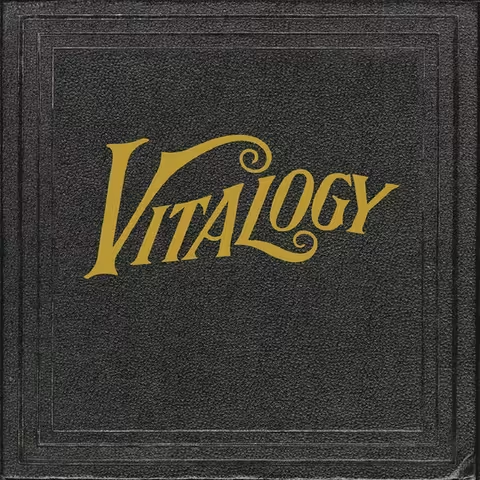
The CD packaging that resulted reproduces the look of the original Vitalogy book in remarkable detail. The cover is a plain black wrap with the title rendered in gold-foil cursive script. The inside is a thick, perfect-bound booklet that opens horizontally rather than vertically, on the longer-edge spine of an old hardback novel rather than the shorter-edge spine of a typical CD booklet. Inside, every original chapter heading from the source book is reproduced verbatim, intercut with original Pearl Jam material: lyrics, poems, photographs, hand-typed notes, an X-ray of Eddie Vedder's teeth (printed on the page where the "Corduroy" lyrics would normally be), and a copy of a real petition to President Bill Clinton against anti-abortion-clinic violence (printed on the "Whipping" page in place of those lyrics).

The packaging added approximately fifty cents per unit to manufacturing costs, which Epic Records absorbed. The band later discovered that some of the later editions of the original Vitalogy book were still under copyright, requiring last-minute legal consultations to determine which material the band could legally reproduce in the finished sleeve. Record retailers were vocal about how badly the horizontal-spine package fitted standard CD racks; many stores simply shelved it sideways for the entire holiday 1994 season.

Release and Reception

Vitalogy was released on vinyl on 22 November 1994. The two-week vinyl-only window was a deliberate stunt by the band, designed both as a gesture toward the dying physical format and as a public refusal of the major-label sales-week-one playbook. The LP sold 34,000 copies in its first week, debuting at number 55 on the Billboard 200 from vinyl sales alone, the first album to chart on that chart from vinyl sales alone since the CD had become the dominant format in the late 1980s. The 34,000-copy figure held the SoundScan record for the largest single-week vinyl sales for almost twenty years, until Jack White's Lazaretto sold 40,000 copies in its first week in June 2014.

When the CD and cassette versions appeared on 6 December 1994 the album went directly to number one on the Billboard 200 with first-week sales of 877,000 copies. It was the second-fastest-selling album in SoundScan history at that point, behind only Pearl Jam's own Vs. from the previous October. It also topped charts in Australia, Ireland, New Zealand and Sweden, reached number four in the UK, and went multi-platinum in nine countries within weeks of release. By July 2013 Nielsen SoundScan tracked total US sales at 6.9 million; the RIAA certified the album five-times Platinum.

Critical reception was strong but more divided than for Ten or Vs., as critics tried to make sense of the album's deliberately uneven shape. Stephen Thomas Erlewine in AllMusic gave four and a half stars:

"Thanks to its stripped-down, lean production, Vitalogy stands as Pearl Jam's most original and uncompromising album. Pearl Jam are at their best when they're fighting, whether it's Ticketmaster, fame, or their own personal demons."

Stephen Thomas Erlewine, AllMusic, December 1994

Al Weisel in Rolling Stone gave four stars and called it "a wildly uneven and difficult record, sometimes maddening, sometimes ridiculous, often powerful". Robert Hilburn in the Los Angeles Times gave the album four out of four stars: "This isn't just the best Pearl Jam album but a better album than the band once even seemed capable of making". Edna Gundersen in USA Today gave three and a half out of four and called it "the rebel yell of a band that is maturing without mellowing". Jim DeRogatis in the Chicago Sun-Times was more equivocal at three out of four, writing that the album "leaves you wishing that they'd just lighten up". Robert Christgau in The Village Voice gave an A-minus and singled out Vedder's sincerity in an "era of compulsory irony" as the album's most striking quality.

The negative reviews focused on the experimental tracks. Mark Jenkins in The Washington Post complained of a "lack of subject matter or lyrical substance". Newsday's Ira Robbins, while broadly positive, called the album "a compelling triumph of surface over substance". Time's Christopher John Farley flagged "Bugs" specifically as one of the album's "share of stinkers". David Browne in Entertainment Weekly gave a B+ with the most prescient warning of any contemporary review:

"Vitalogy marks the first time it's possible to respect the band's music as much as its stance, but despite its musical advances, Vitalogy leaves an odd, unsettling aftertaste. You walk away from it energized, but wondering what price Eddie Vedder, and Pearl Jam, will ultimately pay for it."

David Browne, Entertainment Weekly, 9 December 1994

Singles and Music Videos

SingleReleaseVideoChart peaks
"Spin the Black Circle" / "Tremor Christ"7 November 1994No commercial video produced (band-wide moratorium)US Hot 100 No. 18; US Mainstream Rock No. 3; UK No. 10; won 1996 Grammy Best Hard Rock Performance
"Not for You"13 February 1995No commercial video producedUS Modern Rock No. 2; US Mainstream Rock No. 3; UK No. 34
"Immortality"6 June 1995No commercial video producedUS Modern Rock No. 31
"Better Man"Promo radio only (1994-95)No commercial video producedUS Mainstream Rock No. 1 (eight weeks); US Modern Rock No. 1

Pearl Jam's then-current policy on music videos, which had begun in 1993 around Vs., remained in force across the Vitalogy campaign: no commercial music videos at all. The band's stated objection was to MTV's use of music videos as free promotional content for the network's own advertising business, with the bands and labels who produced the videos receiving no direct compensation. The policy held with rigorous consistency for the four years between Vs. and Yield. The cost was real: "Spin the Black Circle" became one of the rare lead singles from a No. 1 album to reach No. 18 on the Hot 100 with no MTV support whatsoever.

"Better Man", although never serviced as a commercial single, was sent to American rock radio as a promo. It spent eight weeks at number one on the Billboard Mainstream Rock chart in spring 1995 and also topped Modern Rock, both feats achieved without a Hot 100 entry (because the song was not commercially available as a single, it was ineligible for the Hot 100 under the chart rules then in force). It remains one of the band's most-played live songs of any era.

The Ticketmaster Fight

The single most important piece of context for Vitalogy is the running antitrust dispute between Pearl Jam and Ticketmaster that defined the entire 1994-1995 album cycle. The dispute began on the Vs. tour, where the band attempted to keep ticket prices at $18 with a $2 service fee. Ticketmaster, which had exclusive long-term contracts with most of the large American arena and amphitheatre venues, refused to lower its own service charges. In May 1994 Pearl Jam filed a formal complaint with the Antitrust Division of the US Department of Justice.

The complaint argued, in summary, that Ticketmaster's exclusive long-term contracts with venues, combined with the absence of any meaningful competing national ticket-selling service, constituted an unlawful monopoly that allowed Ticketmaster to charge service fees far above what a competitive market would set. Gossard and Ament testified before the US House of Representatives' Subcommittee on Information, Justice, Transportation, and Agriculture on 30 June 1994, in support of the complaint.

The Department of Justice closed its investigation in July 1995 without taking action against Ticketmaster, citing insufficient evidence of antitrust violations under the prevailing legal standards. The closure was widely reported at the time as a defeat for Pearl Jam. The band had by then committed, on principle, to touring only at non-Ticketmaster venues, a commitment that effectively meant alternative-ticket-vendor amphitheatres, fairgrounds, college sports halls and outdoor parks for the rest of the decade. Ament's later one-line summary remains the most quoted account of the policy's consequences:

"We were so hardheaded about the 1995 tour. Had to prove we could tour on our own, and it pretty much killed us, killed our career."

Jeff Ament, Spin "Ten Past Ten" oral history, August 2001

The Ticketmaster fight is now widely credited as one of the earliest and most consequential public challenges to live-music monopoly behaviour, predating the Live Nation / Ticketmaster merger investigations of the 2010s and 2020s by twenty-five years. Pearl Jam returned to playing Ticketmaster venues in 1998, but the band has continued to be unusually vocal about ticketing policy and pricing throughout its career.

Touring and Live

The 1995 Vitalogy Tour was Pearl Jam's first tour without Dave Abbruzzese and the first with Jack Irons. It was also the first tour conducted entirely outside the Ticketmaster venue circuit in the United States. Highlights of the campaign:

  • February-April 1995: short Asian and Australasian leg, including the band's first shows in Japan, Singapore and the Philippines
  • April-June 1995: short, complicated US run focused on the Midwest and West Coast at alternative-ticket-vendor venues
  • 24 June 1995: Golden Gate Park, San Francisco. Vedder was hospitalised for severe food poisoning the night before the show. He attempted to play, performed seven of twenty-one planned songs, then left the stage. Neil Young, who had recorded the as-yet-unreleased Mirror Ball with Pearl Jam earlier in the year, came on and finished the show as Pearl Jam's frontman in front of 50,000 people
  • 26 June 1995: the remaining tour dates were cancelled
  • September-October 1995: a partial rescheduling of the cancelled dates, plus the first US tour dates with Mirror Ball collaborator Neil Young as the band's touring partner

Vedder's later account of the Golden Gate Park show:

"That whole Golden Gate Park thing was a blur based on some bad food. It was really, really bad. Looking back at it, it doesn't seem as intense as it was, but it was horrible. I just felt not human, and looking back I should have got through that show somehow, and I think the fact that Neil was there made me feel like I could get off the hook in some way, and I did go out for a few songs."

Eddie Vedder, Spin "Ten Past Ten" oral history, August 2001

The 1995 tour also produced one of Pearl Jam's most unusual collaborative records. Mirror Ball, credited to Neil Young with Pearl Jam, was recorded in four days at Bad Animals in late January and early February 1995, immediately after the Vitalogy sessions wrapped. For contractual reasons Pearl Jam could not be credited as a band on the sleeve; the album appears under Young's name only. Two Pearl Jam EPs of leftover material from the Mirror Ball sessions, "I Got Id" / "Long Road" and "Merkin Ball", were released in late 1995.

In TV, Film and Media

Pearl Jam's video moratorium of 1993-1997 kept Vitalogy material off MTV almost entirely. "Better Man" has become the album's most widely synced song, appearing in episodes of The Sopranos, Sons of Anarchy and Yellowstone, and in trailers for several mid-2010s romantic dramas. "Just Breathe" and "Black", catalogue songs from other eras, are vastly more commonly licensed; the Vitalogy band-policy era simply produced fewer sync placements as a structural consequence of the band's then-restrictive licensing position. "Corduroy" appears on the in-game soundtrack of MLB The Show in several editions, in line with Eddie Vedder's long-standing public support for the Chicago Cubs. "Spin the Black Circle" was the first song chosen for Rock Band 2 when the title launched in 2008, in part because of its specific lyrical celebration of physical-media music consumption.

Covers, Samples and Tributes

"Better Man", by some distance the most-covered song from Vitalogy, has been performed live or recorded by Coldplay, Taylor Swift (a duet with Vedder at the 2011 ACL Festival), Eva Cassidy (whose posthumous 2003 take is one of the most-streamed covers), Brandi Carlile, and a generation of singer-songwriters working in the gentle-acoustic-cover idiom. The song was also performed by Vedder and Bruce Springsteen as a duet at Springsteen's 2013 Hyde Park, London show. "Nothingman" and "Corduroy" have both received well-known acoustic covers from the country and Americana scene, including a Brandi Carlile take of "Nothingman" that featured on the 2024 Sub Pop Pearl Jam tribute compilation. "Hard to Imagine" has been covered live by Ben Harper, who also covered "Indifference" from Vs. on the same tour.

Vitalogy's influence on the next wave of American rock is less direct than Ten's or Vs.'s. Where the first two Pearl Jam albums effectively defined the sound of mid-1990s adult-alternative rock radio, Vitalogy's enduring influence sits more in the territory of artistic-autonomy gestures: vinyl-first releases, anti-corporate touring positions, deliberately uncommercial sequencing decisions, and the use of album packaging as a self-contained art project. Direct musical descendants are harder to point to, although the explicitly anti-fame lyrical territory of "Not for You" and "Corduroy" can be heard reverberating through bands as different as Radiohead (on OK Computer's "No Surprises"), Modest Mouse (on Good News for People Who Love Bad News), Arcade Fire (on Reflektor) and Sleater-Kinney (across most of The Hot Rock).

Reissues, Remasters and Anniversaries

Vitalogy was reissued on 29 March 2011 alongside Vs. in three formats: a single-disc Expanded Version with three bonus tracks (the previously unreleased guitar-and-organ-only mix of "Better Man"; an unreleased alternate take of "Corduroy" from the Vitalogy sessions; and a 14 October 1993 demo of "Nothingman" recorded at John and Stu's in Seattle with Richard Stuverud on drums); a three-CD Deluxe Edition that included the legacy editions of both albums plus a previously unreleased live concert recording, Live at the Orpheum Theatre, Boston, April 12, 1994; and a Limited Edition Collector's Boxed Set with both reissues, the live disc, the original Ten reissue extras and a hardback book of new band-approved material. Bob Ludwig handled the remastering.

No standalone 30th-anniversary edition was issued in November 2024. Pearl Jam's catalogue is owned through the band's Monkeywrench Records and licensed to Epic / Sony for distribution, which gives the band unusually direct control over reissue timing. The 30th-anniversary moment passed without a public reissue announcement, though both Vs. and Vitalogy have appeared on Pearl Jam's streaming services since they made their catalogue available on Spotify in 2019, in the original 1994 mastering on the standard editions and in the 2011 Legacy mastering on the deluxe streaming editions.

Legacy and Influence

Vitalogy is the most-debated Pearl Jam album of the band's commercial peak. Rolling Stone placed it at No. 492 on its 2003 list of the 500 Greatest Albums of All Time and at No. 485 on the 2012 revision, before dropping it altogether from the heavily-restructured 2020 list. Among Pearl Jam fans, Vitalogy has consistently ranked second only to Ten in Rolling Stone's reader polls (a position confirmed most recently in the magazine's July 2013 poll). Among critics, the album sits in a complicated middle position: less canonised than Ten, less universally beloved than Vs., but more often cited as the band's most artistically interesting record.

The case for Vitalogy as the band's most important album rests on three observations. First, it is the record on which Pearl Jam, at the absolute peak of their commercial power, decisively chose art-decisions over commerce-decisions in a way that almost no other major-label band of the 1990s attempted at a comparable scale. Second, "Better Man", "Corduroy" and "Immortality" are three of the strongest individual songs in the band's catalogue, regardless of how the more experimental material around them is judged. Third, the Ticketmaster fight, the vinyl-first release schedule, the deliberate refusal of music videos, and the packaging-as-art-object approach all anticipate the artist-autonomy positions that the streaming-era music industry would spend the next thirty years rediscovering the hard way.

The case against Vitalogy, made most often by critics who prefer the more conventional song-shaped material of Vs. and Yield, is that the experimental tracks ("Pry, To", "Bugs", "Aye Davanita", "Hey Foxymophandlemama, That's Me") are deadweight, that the album would have been improved by being twelve songs of 45 minutes rather than fourteen songs of 55, and that the band's instinct to fight the industry from within was always going to produce more interesting press copy than music. Both readings have merit. What is no longer disputable is that Vitalogy is the album in which Pearl Jam became something other than the consensus successor band to Nirvana, and chose, in real time, to be a difficult, awkward, principled, internally fractious art-rock outfit rather than the easier and far more lucrative thing they could otherwise have been.

Things You Might Not Know

FactDetail
The original titleVitalogy was originally titled simply Life. The "Spin the Black Circle" 7-inch was pressed and shipped with the album credit "From the Epic album Life" on the back sleeve, two weeks before the band re-titled it after Vedder found the medical book.
The Vitalogy book is realVitalogy: An Encyclopedia of Health and Home was a real turn-of-the-century home-medicine book by E. H. Ruddock and George P. Wood, first published in Chicago in 1899 and reprinted in dozens of editions over the next thirty years. Vedder found a copy at a Pacific Northwest garage sale; the album sleeve reproduces several of its original chapter headings verbatim.
The vinyl-first recordVitalogy's vinyl release of 22 November 1994 sold 34,000 LPs in its first week and held the SoundScan record for the largest single-week vinyl sales for almost twenty years, until Jack White's Lazaretto in June 2014. It was also the first album to chart on the Billboard 200 from vinyl sales alone since the CD became the dominant format.
"Better Man" was a teenage Bad Radio songEddie Vedder wrote "Better Man" in high school in San Diego in the late 1980s and performed it with his pre-Pearl Jam band Bad Radio. He repeatedly rejected it for inclusion on Pearl Jam records. It only made Vitalogy at Brendan O'Brien's insistence.
The accordion came from a thrift shopVedder bought the accordion he plays on "Bugs" at a thrift shop in Atlanta on a Vs.-tour day off. He had no prior accordion experience; the performance on the record is essentially him learning the instrument in real time.
The closing track uses real psychiatric patients"Hey Foxymophandlemama, That's Me" is built on looped audio recordings of real psychiatric inpatients from an unnamed hospital, sourced by engineer Brett Eliason. The patients themselves did not know their recordings would be used on a Pearl Jam album.
The X-ray of Vedder's teethWhere the printed lyrics for "Corduroy" would normally appear in the booklet, the band instead inserted an X-ray of Eddie Vedder's actual teeth, taken at a Seattle dental clinic during the album sessions.
The petition to Bill ClintonThe "Whipping" page of the booklet does not print the song's lyrics; it reproduces a real petition to President Bill Clinton calling for federal action against the murders of abortion-clinic doctors then occurring across the southern United States.
The first Pearl Jam Grammy was for the punk single"Spin the Black Circle" won Pearl Jam's first-ever Grammy, Best Hard Rock Performance, at the 38th Annual Grammy Awards on 28 February 1996. Eddie Vedder, accepting the award, used his speech to say: "I don't know what this means. I don't think it means anything."
Dave Abbruzzese plays on most of the album he was fired fromAbbruzzese was fired in August 1994, after most of Vitalogy was already tracked. He plays drums on every track except the closing "Hey Foxymophandlemama, That's Me", and receives a co-writing credit on every song that uses his drum performances except that closer.
Jack Irons introduced Vedder to Pearl JamIn 1990, ex-Red Hot Chili Peppers drummer Jack Irons handed a demo tape with the working title "Stone Gossard Demos '91" to a young San Diego surfer-singer named Eddie Vedder. Vedder wrote vocal melodies and lyrics for three of the demos, including "Alive". Four years later, Irons replaced Dave Abbruzzese in Pearl Jam during the Vitalogy sessions.
The CD packaging cost an extra 50 cents per unitThe hardback-book CD packaging added approximately fifty cents per unit to Vitalogy's manufacturing costs, all of it absorbed by Epic Records. The horizontal-spine format also broke record-store shelving and required many retailers to display the album sideways.
Neil Young finished the Golden Gate Park showEddie Vedder was hospitalised with food poisoning the night before the 24 June 1995 Golden Gate Park show. He attempted to play, managed seven of twenty-one planned songs, and left the stage. Neil Young, who had recorded the as-yet-unreleased Mirror Ball with Pearl Jam that February, finished the show as the band's frontman in front of 50,000 people.
The Mirror Ball connectionPearl Jam recorded the Neil Young album Mirror Ball in four days at Bad Animals in late January and early February 1995, immediately after wrapping Vitalogy. For contractual reasons the album was credited to Neil Young alone; the band cannot be named on the sleeve, only listed in small type under personnel.
The Ticketmaster antitrust complaintPearl Jam's May 1994 formal antitrust complaint to the US Department of Justice against Ticketmaster was the highest-profile artist-led action against a music-industry monopoly in the 1990s. The DOJ closed its investigation without action in July 1995. The Live Nation / Ticketmaster merger of 2010 reignited many of the same antitrust questions Pearl Jam had raised sixteen years earlier.

Riffology Podcast

This album is the subject of an extended Riffology podcast episode, with the same level of session detail, contemporary review excavation and trivia-table commentary. The full podcast is available above, and also on Apple Podcasts, Spotify, Amazon Music, Pocket Casts and every other major podcast platform. New episodes drop weekly.