
By the autumn of 1984, Slayer were the most commercially successful band on Brian Slagel's young Metal Blade Records. Their 1983 debut, Show No Mercy, had moved 40,000 copies worldwide and become the label's biggest seller, a financial breakthrough underwritten largely by Tom Araya's earnings as a respiratory therapist in California and a loan from Kerry King's father. The interim Haunting the Chapel EP, released that December, had pushed the band's sound faster, meaner and tighter. The four songs on the EP showed Slayer pulling away from the Iron Maiden and Judas Priest signposts of the debut and toward something more violent. Slagel saw the opportunity. He decided to commit Metal Blade money to a proper second album.
The record they made between January and March 1985, and released on 8 April that year, was the album that decided what Slayer would become. Hell Awaits was the last Slayer LP Metal Blade would ever put out. By the end of 1985 Rick Rubin had signed the band to Def Jam, and Reign in Blood was on its way. Hell Awaits sits in that brief window when Slayer were still an underground proposition with progressive ambitions, still in love with Mercyful Fate, and still operating well outside the glossy hard-rock orbit of mid-Eighties American radio. It is, in retrospect, the pivot.
The label that bet on Slayer
Metal Blade had begun life as a compilation imprint. Brian Slagel had launched the label in 1982 to release Metal Massacre, the various-artists LP that gave Metallica their first ever appearance on vinyl. By 1984 the label was a small Los Angeles operation with a roster that mixed local hard rock with the new American underground. Slayer were the act that paid the rent. Show No Mercy had been a self-financed project; the band had stumped up for studio time themselves and delivered Metal Blade a finished record to press and distribute. Slagel had taken Slayer to the label believing they could sell, and the figures vindicated him.
For the second album, the arithmetic changed. Slagel and Metal Blade co-financed Hell Awaits with the band. This was a step up: a proper label-financed studio record with a producer credit, a hired engineer, mastering at a name house and a budget for a sleeve commission. The catch, of course, was that Metal Blade in 1984 was still a small label, and the budget reflected that. Slagel later admitted that the production decisions he made on Hell Awaits were partly a function of who and what he could afford.
From Show No Mercy to Haunting the Chapel
The bridge between the debut and Hell Awaits ran through Haunting the Chapel. The three-song EP, released in December 1984, had been recorded with engineer Bill Metoyer and produced by Slayer and Slagel. It contained "Chemical Warfare", "Captor of Sin" and "Haunting the Chapel" itself, and it was the first Slayer release to feature Dave Lombardo's double-kick playing at the centre of the arrangement. The EP did two things for the band. It demonstrated, to anyone who had bought Show No Mercy and wondered where the group might go next, that Slayer were getting faster and harder. And it gave Bill Metoyer the inside track to engineer the next full-length.
Lyrically the EP also opened the door to the satanic and occult preoccupations that would define Hell Awaits. Show No Mercy had been a record about black metal in the loose pre-Norwegian sense of the term: leather, swords, blood, devils. Haunting the Chapel sharpened the focus. By the time the band walked into the studio for the second LP, the imagery had settled. Hell Awaits would be a record about damnation, ritual, serial murder and the underworld, with Kerry King writing most of the lyrics and Jeff Hanneman pushing the arrangements into longer, more progressive shapes.
Inside Eldorado Recording
Sessions for Hell Awaits ran through early 1985 at Eldorado Recording in Los Angeles. Eldorado was favoured by Metal Blade through the mid-Eighties for cost-effective hard-rock sessions. It was a working studio, not a vanity facility, and Slagel used it because the rates fitted the budget and because Bill Metoyer knew the room. Metoyer had been Slagel's house engineer since 1983 and would go on to produce dozens of Metal Blade albums through the late Eighties for Fates Warning, Lizzy Borden, Trouble and Sacred Reich. On Hell Awaits he ran the room.
The sessions were the first time Slayer had been given the space to record at full kit and full volume without compromise. Dave Lombardo has said in subsequent interviews that this was the moment his playing audibly stepped up. "I didn't have to overdub the cymbals," he later told an interviewer, "and we had a really good engineer." Show No Mercy had been a budget-constrained record where Lombardo had been obliged to layer cymbals separately to keep the drum sound under control. At Eldorado he played the kit as he played it live, and Metoyer captured it.
Mastering went to Bernie Grundman, who had left A&M in 1984 to open Bernie Grundman Mastering in Hollywood. Grundman was, by 1985, one of the most sought-after mastering engineers in Los Angeles, and his name on a Slayer credit reflected Slagel's willingness to spend at the back end of the chain. Carolyn Collins assisted Metoyer through the sessions. The whole production team, Lombardo and Metoyer aside, was unfamiliar with the language of thrash; the album that emerged was made by a label-financed apparatus learning what to do with a band that was clearly louder, faster and more violent than anything else on Metal Blade's roster.
The room itself was small by major-label standards. Eldorado's live area could accommodate a drum kit and two guitar stations comfortably, with bass and vocals tracked separately. Metoyer worked the desk with a small monitor mix and quick turnarounds; sessions were tracked live wherever possible, with overdubs reserved for guitar solos and lead vocals. The whole process was finished in a matter of weeks, fast by 1985 standards for a record of this complexity.
Ron Fair, Bill Metoyer and Brian Slagel
The producer credit on Hell Awaits reads "Produced by Slayer and Brian Slagel". The reality on the floor was more complicated. Slagel had brought in Ron Fair, then on staff as director of A&R at Chrysalis Records, to take a hands-on production role despite Fair's complete lack of metal experience. Slagel has since acknowledged that Fair was a hired-in figurehead, brought to the project for industry credibility as much as for studio chops. The famous Fair quote, on first seeing Slayer at full tilt in the live room, has followed him through every Slayer history written since: "Wow, these guys are really angry."
The day-to-day production work, in practice, was divided between Bill Metoyer at the desk, Slayer themselves making the arrangement calls, and Slagel hovering at executive-producer level. The arrangement worked, in the limited sense that the record got finished. It did not, however, deliver the kind of sonic clarity that Slayer's material was beginning to demand. Tom Araya later called the production "poor quality" in retrospect, while immediately qualifying the comment: "Nowadays, production-wise, it's so under par. But for what it was at the time, those are amazing records to me. I guess we could go in and redo it. But why ruin it?" Lombardo, as noted, has consistently taken the opposite view. The truth sits somewhere in between. Hell Awaits sounds, on a 2025 listen, sludgy and amorphous compared to the sharp and clear production Rubin would deliver eighteen months later. But it is also, audibly, the record of a band finding its own voice without an outside producer imposing one.
The Mercyful Fate influence and the longer song
Both Jeff Hanneman and Kerry King were deep into Mercyful Fate by 1984. King has said publicly, in multiple interviews, that the longer and more structurally ambitious songs on Hell Awaits were a direct response to what King Diamond and Hank Shermann were doing in Copenhagen. Mercyful Fate's Melissa (1983) and Don't Break the Oath (1984) had shown that a thrash-adjacent band could write six-minute and seven-minute songs with multiple tempo zones and twin-guitar interplay without losing aggression. King and Hanneman wanted to do the same in Los Angeles, with the violence dial twisted further to the right.
The result is the most progressive record in the Slayer catalogue. Show No Mercy had been built on three-and-a-half-minute and four-minute songs in the tradition of British heavy metal. Hell Awaits opens with a six-minute title track and contains a six-and-a-half-minute "At Dawn They Sleep" and a six-minute-forty "Crypts of Eternity". Three of the seven tracks pass the five-minute mark. None of them feels padded. The new patience in the writing came directly from a year spent listening to King Diamond.
Equipment and tone
Kerry King played his BC Rich Mockingbird through Marshall stacks, the rig he had been using since 1983 and would keep using through most of the decade. Jeff Hanneman alternated between his own BC Rich Mockingbird and a Jackson, similarly fed through Marshalls. Tom Araya played a BC Rich Eagle bass through an Ampeg SVT. Dave Lombardo played a Tama kit with double bass drums, the configuration that would become thrash drumming's defining template.
The guitar tones on Hell Awaits remain more saturated, less dry and less surgical than the post-Rubin records. Both King and Hanneman pushed the amps into natural distortion rather than relying on noise gates or stompboxes to shape the sound. The result is a wall of low-end saturation that blurs the lines between the two guitars in a way that Reign in Blood and South of Heaven would deliberately reverse. On Hell Awaits the two guitar tracks merge into a single seething mass; on the post-Rubin records they sit at hard left and hard right with knife-edge separation. The earlier sound is less commercial. It is also, for many older Slayer fans, the more authentic Slayer guitar tone.
Tom Araya at the microphone
Araya's vocal performance on Hell Awaits pushes his range in a more conventional metal direction than on Show No Mercy. The title track's verse melodies sit in a higher tessitura than anything on the debut, and "At Dawn They Sleep" requires him to switch between mid-range singing and full-throat screams across the same vocal line. He recorded most lead vocals in single takes with Bill Metoyer at the desk, working quickly and without the extensive comping that would characterise later Slayer records.
Wikipedia notes one anecdote that has become part of the album's folklore. When Araya tracked the lead vocal for "At Dawn They Sleep", neither Hanneman nor King was in the studio; only Araya and Brian Slagel were present. The lyric sheet Araya was working from contained a misspelled word. He sang it as written, even though the resulting line was not actual English. The take stayed on the record. Hanneman and King, who had written the lyric jointly, only discovered the error when the album was pressed.
Araya's vocal style on Hell Awaits also marks the last appearance of the higher screams that would largely disappear from his repertoire after Reign in Blood. The opening passages of the title track and the bridge of "Crypts of Eternity" contain top notes that he would simply not attempt on the records that followed. The shift was partly stylistic, partly a response to the relentless touring schedule the band were about to enter, and partly Rubin's preference for a flatter, more declarative vocal delivery. For fans who came to Slayer through the Def Jam era, the Hell Awaits vocal is a small surprise: more theatrical, more sung, less barked.
Hell Awaits and the backwards-masked intro
The title track and album opener is famous, before its first audible note, for its backwards-masked intro. A demonic voice, treated and slowed, repeats the phrase "join us" and ends with "welcome back". The recording was assembled by playing the vocal forwards into tape and then reversing the master, a standard studio trick of the period made eerie by the actual content of what had been recorded. The intro runs almost a minute before the band crash in, and it remains one of the most-discussed pieces of audio in the Slayer catalogue. The technique was an open nod to the satanic-backwards-message panic that had swept American Christian-conservative media in the early Eighties; Slayer were happy to give the panic something real to point at.
When the band do enter, "Hell Awaits" builds slowly over its six-and-a-quarter minutes through three distinct tempo zones, culminating in one of the album's most overtly thrashing passages. The lyrics are King's; the music is by Hanneman and King jointly. The song's structural ambition, the multiple tempo changes, the extended instrumental opening, served as the band's explicit declaration that Hell Awaits would not be a faster Show No Mercy. It would be a different kind of record.
Kill Again
"Kill Again", the album's second track, runs to four minutes and fifty-six seconds of serial-killer narrative driven by Lombardo's double-kick figure underneath the verses. King wrote the lyric; Hanneman and King share the music credit. It is the album's most overtly thrash-shaped arrangement, with a propulsive single tempo and the kind of tight verse-chorus structure the rest of the record otherwise resists. Wikipedia notes that "Kill Again" became one of the longest-serving Hell Awaits cuts in the Slayer live setlist, persisting all the way into the band's farewell tour rotation in 2018 and 2019.
The song also functioned, on first release, as the most accessible point of entry on a record otherwise dominated by long, multi-section compositions. Anyone who came to Hell Awaits via the underground tape-trading network of 1985 tended to learn the riff to "Kill Again" first. It is the song most often quoted as a Hanneman and King apprentice statement of what would, on Reign in Blood, become the band's mature blueprint.
At Dawn They Sleep
"At Dawn They Sleep" is six minutes and seventeen seconds of mid-tempo doom that opens up at the back end into a Lombardo double-kick passage. Lyrics are co-credited to Araya, Hanneman and King; music is Hanneman alone. The song is Lombardo's stated favourite on the record. He has said in multiple interviews that he loves it "because it was kind of slow and grungy, but then it had that double-bass part at the end." The structural contrast between the verses and the closing thrash is the most cinematic moment on the album.
Dimebag Darrell picked "At Dawn They Sleep" as one of his twelve favourite songs in a March 1993 Guitar World feature, citing Slayer as the band that taught him "how to play with guts and aggression". The song's vampire narrative (the title refers to the vampires resting at dawn after the night's killing) is the most novelistic lyric on the record. It remained in the Slayer live setlist intermittently throughout the band's career and was performed during the 2018 to 2019 farewell tour.
Praise of Death and Necrophiliac
"Praise of Death" runs five minutes and twenty-one seconds, with Hanneman's lyrics over King's music. It is the album's most direct nod to Mercyful Fate's twin-guitar approach, with two distinct riff zones and back-to-back King and Hanneman solos in the middle section. The song is the most underrated cut on the album in the fan canon, partly because it was rarely played live and partly because it sits between two more famous tracks in the running order. The solo trade-off in the middle is, for guitar fans, one of the cleanest demonstrations on the record of the way King's vibrato-heavy lead style and Hanneman's more linear phrasing complement each other.
"Necrophiliac" is the album's shortest cut at three minutes and forty-six seconds. Hanneman and King share the lyric credit; Hanneman wrote the music. It is built around a Lombardo gallop and one of Hanneman's most economical solos. The song works as a relief valve from the longer, more progressive material that surrounds it, in much the way "Silent Scream" would three years later on South of Heaven. The lyric is the most overtly transgressive on a record full of transgressive lyrics, and "Necrophiliac" was for years one of the songs that Christian-conservative pressure groups in the United States used as evidence of metal's social menace.
Crypts of Eternity
At six minutes and forty seconds, "Crypts of Eternity" is the longest cut on the album. All three songwriters, Araya, Hanneman and King, share lyric duties; Hanneman and King co-wrote the music. The arrangement is the most overtly Mercyful Fate-shaped on the record, opening on a clean-guitar passage before crashing into the riff that drives the rest of the song. The clean intro is one of only two moments of relative quiet on the entire LP. When the distortion enters, the song moves through a series of riff zones connected by King and Hanneman solo trades.
Dimebag Darrell, in the same 1993 Guitar World piece in which he praised "At Dawn They Sleep", has cited the middle solo trade on "Crypts of Eternity" as one of Hanneman and King's best joint performances. The lyric, a hellscape vision of underground tombs and undying torment, is the most ornate piece of writing on a record that otherwise prefers the direct insult to the elaborate metaphor. "Crypts of Eternity" is the song most often picked by Slayer obsessives as the unsung classic of Hell Awaits.
Hardening of the Arteries
The album closer, "Hardening of the Arteries", runs three minutes and fifty-five seconds, with Hanneman receiving sole songwriting and lyric credit. The track has two structural distinctions in the Slayer catalogue. It is the only Slayer song to fade out on a continuous riff rather than ending on a hit. And its closing section directly mirrors the opening section of the title track, creating a deliberate loop: when the LP runs out and the needle returns to the start, the album feeds back into itself. The sequencing decision was made jointly by Hanneman and Slagel, and it remains one of the most elegant pieces of album-craft on any Slayer record.
For a band who would, on every subsequent album, end on a clear and final stop, the looping close of Hell Awaits is an outlier. It is also the most explicit statement of the record's thematic preoccupation. The hell the album describes does not end. The needle goes back to the start and the demonic voice begins inviting the listener in again.
Albert Cuellar and the Moebius trace
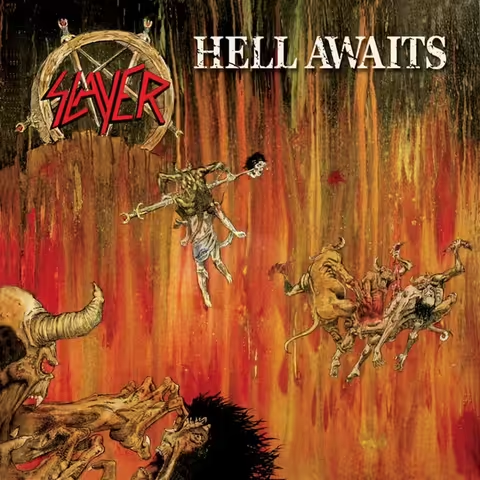
The cover painting, by Albert Cuellar, depicts a fiery hellscape populated by skeletal demonic creatures fighting in the foreground. It became one of the most-reproduced thrash-metal images of the Eighties and remains the band's most-bootlegged piece of artwork on shirts and patches forty years on. Araya later told The Quietus that the painting was put together "overnight", which is the only on-record comment any member of Slayer has made about the commission process.
In 2011 a blog post uploaded PDF scans of a 1977 issue of the Heavy Metal magazine comic series. The scans revealed that Cuellar's composition was a direct trace of a scene from the story "Approaching Centauri" by the French illustrator Jean Giraud, who worked under the pen name Moebius. The discovery was a minor scandal in the metal-art community and was widely circulated. It did not, however, dent the painting's iconographic status with Slayer fans, who treat the image as inseparable from the music whatever its sourcing. Layout was by Brian James; band photographs were by Lowell Katz. The Moebius source remains uncredited on every reissue.
Release, reviews and the Combat Tour
The album came out on 8 April 1985 on Metal Blade. It did not chart on initial release. American mainstream rock radio did not play it, and the major-label distribution networks that would later carry Reign in Blood were not available to Metal Blade's small independent operation in 1985. Reviewers nevertheless treated the album as a significant step forward from Show No Mercy. AllMusic's Eduardo Rivadavia would later give the album four out of five stars and call it "incredibly ahead of its time" and "a mandatory item in the band's remarkable discography". The Rolling Stone Album Guide (2004) likewise gave it four stars. Rock Hard scored it 9 out of 10. The book Legends of Rock Guitar (1997) described the album as "a psychotic exploration into the depths of Satanism and physical torture", commenting on the way "the sludgy riffs, which were pure Black Sabbath, are offset by some of King's and Hanneman's faster solos, giving Slayer entree into the speed metal realm".
Despite the absence of chart success, Brian Slagel has reported that the album has sold over one million copies worldwide across its catalogue life, an extraordinary figure for a record that never appeared on a mainstream chart on initial release. Chart entries did eventually arrive thirty-six years after the fact: the 2021 vinyl reissue charted at number 41 on the German Albums chart and number 24 on the UK Rock and Metal Albums tally compiled by the Official Charts Company. The album's commercial life, in other words, has been a long retrospective accumulation rather than a single peak.
The touring story is the part of the Hell Awaits chapter that Slayer fans tend to know best, and it deserves to be retold. Slayer toured the album through the second half of 1985 on the Combat Tour II, opening for Venom with Exodus in the middle slot. Slayer had never been on a proper tour bus before. They were invited onto Venom's bus during the run to drink and to listen to Hell Awaits played back. Araya entered the bus, in Lombardo's words, "hammered out of his mind", announced that he needed to use the bathroom and asked where it was. Venom singer Conrad "Cronos" Lant replied "Right here, right here in my mouth!" Araya took the offer literally and urinated on Lant's hair. Lant punched him in the face. Araya completed the rest of the tour with a black eye. Exodus guitarist Gary Holt, on the same tour, has said that the run was the moment Exodus and Slayer became lifelong friends: "It was two bands of friends playing with one band of heroes. We were just star-struck."
From Metal Blade to Def Jam, and the legacy
By autumn 1985 it was clear that Slayer were outgrowing Metal Blade. Slagel and the band understood that the distribution and marketing reach the label could offer no longer matched the appetite the band were generating in the underground. Rick Rubin had heard Hell Awaits in New York. He was already producing The Cult and LL Cool J at Def Jam, and he approached Slayer about a major-label deal. By the end of 1985 the band had signed with Def Jam and Columbia and were in the studio with Rubin recording what would become Reign in Blood. Hell Awaits remains the last Slayer studio album on Metal Blade and the only Slayer album with a Brian Slagel producer credit. Slagel and Slayer have stayed close for the four decades since; Slagel was credited on the 2018 reissues and remains the central figure in Metal Blade's Slayer archive.
The influence of Hell Awaits on what came next, in metal generally and in death metal in particular, is hard to overstate. Phil Anselmo of Pantera, Down and Superjoint Ritual told the writer D. X. Ferris in 2008 that "Hell Awaits just holds the entire thing. Every bit of everything to do with heavy music. Slayer are gods, the best band from California, for sure." Gene Hoglan of Death, Strapping Young Lad and Testament has cited the album in multiple interviews. Trey Azagthoth of Morbid Angel told Guitar for the Practicing Musician in 1993 that "when the Hell Awaits album came out it was something that everyone was looking forward to and it came out and gave everybody what they wanted. It gave me what I wanted. It was furious, exciting, and it was still new. It was memorable. I think it was a milestone; almost but not quite a good foundational album for death metal."
The album's influence is most easily measured in the early death-metal records that followed it. Possessed's Seven Churches (1985) and Death's Scream Bloody Gore (1987) both carry audible Hell Awaits fingerprints in their multi-section structures, double-kick gallops and lyric obsessions. Morbid Angel's Altars of Madness (1989) inherited the production aesthetic of the longer cuts on Hell Awaits before largely reinventing it. The first wave of Florida death metal in particular treated Hell Awaits as a foundational text, and the album's combination of progressive long-form writing with full-bore aggression remains the template most often cited by death-metal musicians of the late-Eighties Tampa scene. The title track has been covered by Cradle of Filth, Incantation, Earth Crisis and Mr Bungle; "Kill Again" by Angelcorpse; "Praise of Death" by Sinister; "At Dawn They Sleep" by Six Feet Under. The Slatanic Slaughter II and Gateway to Hell 1 and 2 tribute albums each include multiple Hell Awaits cuts.
The album is best understood as the pivot point between Slayer's underground emergence on Show No Mercy and the early demos, and their mainstream commercial breakthrough through Reign in Blood, South of Heaven and Seasons in the Abyss. It is the album that proved Slayer could write progressive long-form thrash without losing momentum. It is the template the early death-metal scene of 1986 to 1989 borrowed from most directly. Jeff Hanneman's death on 2 May 2013 from alcohol-related cirrhosis turned every Slayer album that featured his songwriting into a memorial document. Hell Awaits, as the record where his songwriting voice first emerged at full strength, has become a particular focal point of the Hanneman canon in posthumous retrospectives. The album remained in the Slayer live setlist through the farewell tour of 2018 and 2019, with "Hell Awaits", "Kill Again" and "At Dawn They Sleep" all appearing in setlists. From 2024 onwards the same three songs have appeared in the setlists of the Kerry King solo touring band. Forty years on, the record continues to do exactly what it did in April 1985: announce that this band intends to take metal somewhere darker.
Personnel
- Slayer: Tom Araya (vocals, bass); Jeff Hanneman (guitars); Kerry King (guitars); Dave Lombardo (drums)
- Production: Brian Slagel (producer); Slayer (co-producers); Ron Fair (engineering); Bill Metoyer (engineering); Carolyn Collins (assistant engineer); Bernie Grundman (mastering); Eddy Schreyer (remastering)
- Artwork: Albert Cuellar (cover painting); Brian James (layout design); Lowell Katz (photography)
Tracklist
| # | Title | Length |
|---|---|---|
| 1 | Hell Awaits | 6:16 |
| 2 | Kill Again | 4:56 |
| 3 | At Dawn They Sleep | 6:17 |
| 4 | Praise of Death | 5:21 |
| 5 | Necrophiliac | 3:46 |
| 6 | Crypts of Eternity | 6:40 |
| 7 | Hardening of the Arteries | 3:55 |
Things you might not know
| Fact | Detail |
|---|---|
| Last Metal Blade Slayer LP | Hell Awaits is the final Slayer studio album released on Metal Blade. By the end of 1985 the band had signed to Def Jam and Columbia, and Reign in Blood arrived the following year. |
| First label-financed Slayer record | Show No Mercy had been self-financed by the band, with Tom Araya's hospital wages and a loan from Kerry King's father covering the studio bill. Hell Awaits was the first record Metal Blade actually paid for. |
| Backwards-masked intro | The title track opens with a demonic voice repeating "join us" and ending with "welcome back", recorded forwards and reversed on the master. It runs nearly a minute before the band enter. |
| Ron Fair quote | Ron Fair was a Chrysalis A&R staffer with no prior metal experience. On first seeing Slayer in the live room he is widely reported to have said "Wow, these guys are really angry." |
| Full kit, no cymbal overdubs | Dave Lombardo was given the budget to record at full kit and full volume without overdubbing cymbals separately, the first Slayer session to allow it. |
| The cover was a Moebius trace | Albert Cuellar's hellscape painting was discovered in 2011 to be a direct trace of a scene from "Approaching Centauri" by the French illustrator Jean Giraud (Moebius), published in a 1977 issue of Heavy Metal magazine. |
| The album loops | "Hardening of the Arteries" closes on the same riff that opens the title track. When the LP runs out and the needle returns to the start, the record feeds back into itself. |
| Over a million sold | Brian Slagel has reported over one million worldwide sales across the catalogue life of Hell Awaits, despite the album never having charted on its initial 1985 release. |
| Covered widely | Cradle of Filth, Incantation, Earth Crisis and Mr Bungle have all covered the title track. "Kill Again", "Praise of Death" and "At Dawn They Sleep" have also been recorded by other bands. |
| The Cronos incident | On the 1985 Combat Tour II with Venom and Exodus, Tom Araya is reported to have urinated on Venom singer Cronos Lant after Lant suggested he relieve himself in Lant's mouth. Araya finished the tour with a black eye. |
How to listen now
The original 1985 Metal Blade pressing in LP and cassette is the canonical edition for collectors, with the Albert Cuellar painting at full bleed and the inner-sleeve lyric layout by Brian James. The post-1986 Def American era reissues bundled Hell Awaits into the Slayer back catalogue at Rubin's new label, and the 2003 box set Soundtrack to the Apocalypse drew on the album for several of its selections. The 2021 vinyl reissue, on Metal Blade, became the album's first ever chart appearance: number 41 on the German Albums chart and number 24 on the UK Rock and Metal Albums tally. The full record is available on streaming via Metal Blade's catalogue distribution through BMG and Universal. For live recordings, the album remained present in the setlists of the Slayer farewell tour through 2018 and 2019, and "Hell Awaits", "Kill Again" and "At Dawn They Sleep" have all appeared in the setlists of the Kerry King solo touring band from 2024 onwards.

Comments