By late 1988 Florida had quietly become the operating address for North American death metal. Death's Scream Bloody Gore had landed in 1987 and Chuck Schuldiner had moved his band south from California after a stint in Sweden. Possessed had broken up in the Bay Area in mid-1987, leaving Schuldiner as the loudest voice for the new style. In Tampa, Glen Benton was assembling Deicide; Obituary were tracking Slowly We Rot at Morrisound Recording in the northern suburbs; and a band called Morbid Angel, who had drifted down from Charlotte, North Carolina with most of an album already written, were about to walk into the same studio with the lineup that would finally make their debut record stick.
Trevor Putnam, who had renamed himself Trey Azagthoth in honour of HP Lovecraft's Azathoth deity, had been writing the songs that would become Altars of Madness since 1985. An earlier version of the band had actually recorded a complete first album, Abominations of Desolation, at Morrisound in 1986 with the lineup of Azagthoth, Mike Browning on drums and vocals, Richard Brunelle on guitar and John Ortega on bass. The band themselves shelved it; Earache would not release it until 1991. By late 1988 the lineup had stabilised around Azagthoth, Brunelle, new bassist and vocalist David Vincent, and new drummer Pete Sandoval, who had been playing in the Los Angeles grindcore band Terrorizer alongside Napalm Death's Jesse Pintado. Sandoval was the brutal blast-beat anchor the band had been looking for; he would not return to Los Angeles to record Terrorizer's World Downfall debut until September 1989, nine months after the Altars sessions wrapped.
The Florida scene in 1988
The Tampa-Brandon-Clearwater corridor in late 1988 was not a scene in any organised civic sense. It was a handful of bands rehearsing in garages and storage units, two competing record shops trading demo tapes, and the Morris brothers' studio in the northern suburbs that would track almost all of them. What it had, that no other American city had, was density. Within a thirty-mile radius you could find Morbid Angel, Death, Obituary, Deicide, Cannibal Corpse (who would relocate from Buffalo in 1994 but were already working with Morrisound by 1989), Atheist, Massacre and a long tail of bands that never made it past their second demo. Trey Azagthoth would later characterise the period to Decibel as one in which "everybody was trying to outdo each other and make each other quit", a sense of competition he likened to the East Coast and West Coast hip hop rivalries of the early Nineties.
What distinguished the Florida sound from the British grindcore that Earache Records had been promoting through Napalm Death, Carcass and Bolt Thrower was not speed: the British bands were as fast or faster. It was articulation. Tampa's bands were writing riffs that resolved, structures that repeated, solos that had recognisable melodic shapes. The death metal that grew out of Florida in 1988 and 1989 sounded like extreme metal played by musicians who had grown up on Slayer, Mercyful Fate and Iron Maiden rather than on Discharge and Crass. Altars of Madness, when it landed, would crystallise that distinction.
There was also a geographic logic to the cluster. Florida's climate and cost of living made it possible for a touring drummer or a guitarist working a day job to rent a cheap one-bedroom in the Tampa suburbs and rehearse five nights a week. New York and Los Angeles, where the older thrash scenes had hardened in the early Eighties, were too expensive for that. By 1988 the second-tier American metal scene was effectively migrating south: Death from California, Cannibal Corpse a few years later from Buffalo, half a dozen others from points unknown. Morbid Angel had taken the same route from Charlotte. The studio infrastructure that the Morris brothers had built in northern Tampa, almost by accident, became the gravitational centre for everyone arriving.
Digby Pearson and Earache
Digby "Dig" Pearson, a Nottingham-based grindcore promoter, had founded Earache Records in 1985 out of his bedroom in Heanor, Derbyshire. By 1988 he was building a roster around the bands that John Peel was playing on Radio 1: Napalm Death, Bolt Thrower, Carcass, Heresy. By the middle of that year Pearson was looking across the Atlantic for the American counterparts to British grindcore. Morbid Angel's Thy Kingdom Come demo had reached him in late 1987 and stayed in his rotation. He sent the band an offer to fund a proper studio session at Morrisound and signed the resulting record for an Earache UK release.
In the United States, where Earache had no distribution at that point, the album was licensed to Combat Records for a later release. Combat would not put it out until 7 December 1990, by which point the British edition had been in the underground for eighteen months and had already done most of the work of establishing the band's reputation. Pearson handled what the original sleeve credits call "executive production"; the actual arrangement and production were credited to Morbid Angel themselves; engineering and mixing were Tom Morris's work at the desk. The arrangement reflected the way Earache operated in 1988: Pearson signed bands, paid for sessions and shipped records, but he did not direct the music in the studio.
Morrisound and the Tom Morris template
Morrisound Recording had been opened by brothers Tom and Jim Morris in 1981 in northern Tampa as a regional country and Christian-music studio. Through the mid-Eighties the Morris brothers had picked up the early Tampa metal scene almost by accident, tracking Savatage, Crimson Glory and Obituary's pre-Roadrunner demos. By the late Eighties Morrisound was the de facto Tampa death metal studio, and Tom Morris had developed a tracking and mixing methodology specifically for the new style.
The Morris template was dry, close-mic'd guitars; a controlled dead-room drum sound with the kick and snare both gated; vocal compression sufficient to maintain density across the screamed delivery without making the lyrics fully unintelligible. Pete Sandoval's blast beats demanded a kick drum sound that the rock-pop default at Morrisound could not deliver; Morris compressed and gated the kick to recover the attack the new drumming style required. The full Altars of Madness album was tracked, mixed and mastered in approximately three weeks across December 1988.
Despite the "Morbid Angel: arrangement, production" credit, the actual interpretive work in the room was largely Morris's. The band came in with finished arrangements; Morris's task was to find a tracking and mixing approach that would not collapse the songs into mud. The dryness of his mix is the album's defining sonic signature: where contemporaneous British grindcore records like Napalm Death's From Enslavement to Obliteration carried wet, almost amateurish room mics, Altars of Madness sounded clean enough that the individual notes of Azagthoth's solos came through despite the velocity.
The session schedule was tight by any standard. Three weeks to track, mix and master an eleven-song album with two lead guitarists, blast-beat drums and a vocal performance that no Morrisound engineer had previously had to capture would, on a major-label budget, have been considered impossible. Pearson's Earache budget left no room for second guesses. Morris's strategy was to commit early: track each song's rhythm parts in one or two takes, layer the lead guitar work on the same day, hold the vocal day for last so Vincent could pace himself. The pre-production they had done in Tampa before walking into the studio was, on Vincent's later account, exhaustive; the band knew every transition by feel and could move through the arrangements at the speed Morris's clock demanded.
The mastering, also done at Morrisound, used a relatively conservative low end by the standards that would later prevail in death metal. The bass is present but not loud; the kick drum sits as a transient rather than as a sub-bass element. Listened to today on modern monitors the album sounds remarkably mid-rangey, almost old-fashioned, especially next to the brick-walled Florida death metal records of the late Nineties. That mid-range focus is part of what has let Altars of Madness age so well: the record does not depend on the production trends of any particular year, and it survives the translation through every subsequent generation of playback equipment.
The gear in the room
Trey Azagthoth's main guitar through the Altars sessions was a BC Rich Ironbird, replaced gradually through the album's touring cycle with the Jackson Soloist that would become his signature. He ran direct into a Marshall JCM800 head pushing two 4x12 cabinets at high gain, with his pitch and tap-arm work performed on the Soloist's Floyd Rose tremolo system rather than through any pedal-based pitch shifter. Richard Brunelle held down the rhythm parts with a similar BC Rich and Marshall set-up, mostly mirrored to Azagthoth's tracks for the heaviest rhythm work but isolated to one side for the solo trade-offs.
David Vincent's bass was a BC Rich Mockingbird through a Hartke rig. Pete Sandoval's kit was a Tama Granstar with a 22-inch double bass and the twin pedals that had powered his work in Terrorizer. The kick triggers, gates and compression that became audible signatures of Florida death metal were all applied by Morris at the desk rather than added at source by the band. The bass, in keeping with the period, was largely buried in the mix; Vincent's vocal track, by contrast, sat well forward.
Vincent's voice
David Vincent's death-metal growl on this record drew on the early British grindcore vocabulary established by Napalm Death's Lee Dorrian and on Chuck Schuldiner's earlier Death recordings. Vincent kept his throat more open than Schuldiner did, sitting his guttural register higher in the spectrum than the gurgled lows that Glen Benton and John Tardy would popularise on later Florida releases. The result was a vocal track articulable enough that listeners could in theory follow the lyric, while still carrying the harmonic distortion of a full death growl.
Vincent tracked his vocals over a long single day with Tom Morris at the desk and reportedly required only two or three takes per song. He would later tell Decibel that the sessions felt like a "trial run" and that he was "really pleased that everything came together when it finally did". The vocal performance was the part of the record that critics and peers most often singled out as the breakthrough: a death metal lead that operated as a coherent instrument in the mix, rather than as a layer of undifferentiated noise.
The songs, part one
"Immortal Rites" is the album's opener and the song the world first heard as Morbid Angel's calling card. Four minutes four seconds long, Azagthoth's music with Vincent's lyric, it opens with the now-iconic lead figure that descends from the high register into the first riff. Vincent's lyric, "We gather here in this room. Subconscious minds allied. Call upon immortals. Call upon the oldest ones to intercede," frames the rest of the record's lyrical territory: a ritual invocation that reads as straightforwardly literal rather than as the theatrically Satanic posing that Slayer had been doing for half a decade. Both Vincent and Brunelle have separately cited "Immortal Rites" as their favourite cut on the album.
"Suffocation", Azagthoth and Vincent's music with Vincent's lyric, runs three minutes fifteen seconds and is the album's most direct blast-beat showpiece for Pete Sandoval. The track shares its title with the New York death metal band Suffocation, who formed in 1988 and released their debut album under that name in 1991. "Visions from the Dark Side" follows at four minutes ten seconds, the mid-album cut that established the band's Lovecraftian-cosmic mode, with Azagthoth's leads moving into the dissonant pitch-bending territory that would become his signature.
"Maze of Torment" is one of the album's two singles in the contemporary sense, lifted onto an Earache promotional 12 inch. Four minutes twenty-five seconds, Azagthoth's music with Vincent's lyric, it is the song that codifies the band's structural template: a 70-second riff, a 70-second contrasting riff, a 30-second blast-beat insanity interlude, the first riff again, the second riff again, an Azagthoth solo, the close. Almost every subsequent Morbid Angel song follows some variant of that shape.
The songs, part two
"Lord of All Fevers and Plague" is the CD-only bonus track that did not appear on the original 1989 Earache vinyl or cassette. Three minutes twenty-six seconds, both music and lyric by Azagthoth, it sits in the middle of the running order on CD pressings, between Maze of Torment and Chapel of Ghouls. It carries the most overtly Lovecraftian lyric on the album, drawing directly on Azagthoth's reading of HP Lovecraft. Its absence from the vinyl pressings has made the song a useful diagnostic for record collectors trying to date an unmarked copy.
"Chapel of Ghouls" is the longest cut on the record at four minutes fifty-eight seconds and probably the most-played in the band's live set across the next thirty years. Azagthoth's music; the lyric is co-written with the band's previous drummer-vocalist Mike Browning. Ghouls attack the church, crush the priest, turn the cross towards hell. Brunelle takes the song's middle solo: the original Earache liner notes credit reads "Solo: Brunelle", one of the few moments on the album where the rhythm guitarist gets a featured lead. The song would headline the band's live set across both Vincent eras, from 1989 to 1996 and from 2004 to 2015, and it remains the closer in the David Vincent solo touring band's setlist to this day.
The songs, part three
"Bleed for the Devil" is the shortest cut on the album at two minutes twenty-three seconds, both music and lyric by Azagthoth. A direct, blast-beat-driven Satanic invocation, it owes more to the grindcore vocabulary Earache was simultaneously promoting in Napalm Death and Carcass than to the longer death-metal narratives elsewhere on the record. The brevity is the point: where the rest of Altars of Madness operates by accumulation, "Bleed for the Devil" operates by impact.
"Damnation", Azagthoth and Vincent's music with Vincent's lyric, runs four minutes ten seconds and operates as a contrast to the surrounding blast-beat material. Azagthoth's leads here move into more melodic territory, anchored by a mid-tempo rhythm rather than by Sandoval's gallop. "Blasphemy" follows at three minutes thirty-one seconds, the most overtly anti-religious lyric on the album: "Blasphemy of the holy ghost. The Father, the Son, the Holy Ghost are dead." Both music and lyric are Azagthoth's. Several countries banned the album from import in 1989 and 1990 specifically on blasphemy grounds, with this track named in the customs paperwork.
"Evil Spells" closes the album at four minutes thirteen seconds. Azagthoth's music and lyric, it is a slower-burning piece that allows his lead work to function more in the role of a Pink Floyd-influenced melodic instrument than as the constant blast-beat shred of the album's opening half. Azagthoth has named Pink Floyd, particularly the Wish You Were Here and Animals-era David Gilmour, as a defining influence on his solo approach on this record. "Evil Spells" is where that influence is most audibly on the surface.
Dan Seagrave's painting
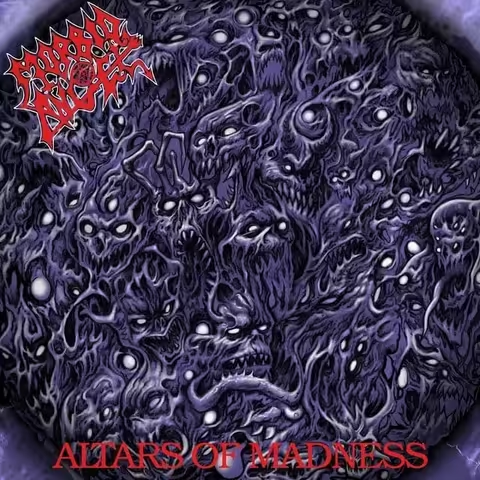
Dan Seagrave was an eighteen-year-old British art student in Sheffield when Earache commissioned him for the Morbid Angel cover. He had previously done a handful of British thrash-metal covers, including for Warfare, but Altars of Madness was his debut death metal cover and the painting that established him as the visual identity of late-Eighties and Nineties death metal. He would go on to paint Suffocation's Effigy of the Forgotten, Gorguts's Considered Dead, Entombed's Left Hand Path and Clandestine, Pestilence's Consuming Impulse and dozens more across the four decades since.
The Altars of Madness image, Seagrave has explained in subsequent interviews, was intended to depict a flat disk composed of fossil material, imprisoning captured souls; the foreground demon-figures are emerging from the fossilised surface rather than from a sphere or a hellscape. Seagrave has corrected the common misreading of the central object as spherical in multiple later interviews. The painting set the template for the next decade of Earache death metal sleeves and arguably defined the visual genre as much as Tom Morris's mixing template defined its sonic one.
Release and reception
Altars of Madness arrived on Earache in the United Kingdom on 12 May 1989. Kerrang!'s Jason Arnopp gave the album five stars in the 2 September 1989 Rekordz column. Metal Hammer's John Duke gave it four stars in the 11 December 1989 LPs round-up. The Rock Hard review in the October 1989 German edition scored it 7.5 out of 10. The album did not chart on initial release because death metal was, in 1989, definitionally a non-charting style; Earache had no chart-promoter contacts and Combat had not yet picked the album up for the US market.
Reception across the underground was immediate and durable. Altars of Madness became Earache's biggest-selling album to that point. The American edition finally arrived on Combat on 7 December 1990, by which time Death's Spiritual Healing in February 1990, Obituary's Cause of Death in September 1990 and Entombed's Left Hand Path in June 1990 had all already established that the Florida and Stockholm death metal scenes were the genre's centre of gravity, and that Earache and Combat were the labels that mattered. The eighteen-month gap between the UK and US releases looks, in hindsight, like an accident; in practice it gave the album time to grow in the underground rather than being burned by a too-large initial promotional spend.
Touring the record
The British promotional cycle began with the Earache Grindcrusher tour in late 1989, on which Morbid Angel joined Napalm Death, Bolt Thrower and Carcass as a four-band Earache UK package. The tour was filmed and released as Grindcrusher: The Earache Sampler Tour. The Live Madness 89 set, recorded at Nottingham Rock City on 14 November 1989, later surfaced on the 2006 DualDisc reissue of the album.
The first North American tour followed in 1991 after the Combat release, with Morbid Angel supporting Sepultura's Arise tour. The first Morbid Angel headline tours came in 1991 and 1992 around Blessed Are the Sick, but Altars of Madness material remained the live setlist core through the entire David Vincent era. Even after Vincent's second departure in 2015, the Steve Tucker-fronted touring band has continued to lean on the 1989 record for its anchor songs: "Immortal Rites" as the opener, "Chapel of Ghouls" as the closer, and a rotating three or four other cuts in the middle.
The Grindcrusher package in November 1989 is worth pausing on. The four bands shared a single tour bus, a single back line of borrowed amplifiers and a single Earache road crew. Napalm Death were the nominal headliners on the strength of their John Peel Sessions exposure, but Morbid Angel's slot, second from the top, was the one that visibly converted the British audience night after night. Reviews in Kerrang! and Sounds across November and December 1989 single out the precision of Sandoval's drumming and the audibility of Azagthoth's solos in venues where the rest of the bill turned into a wash of noise. The Nottingham Rock City date on 14 November, captured on video by Earache's in-house crew, became the canonical document of the band's first European visit and the basis of the Live Madness 89 release seventeen years later.
Building the canon
The long retrospective canon-building around Altars of Madness has been remarkably consistent. Decibel inducted the album into its Hall of Fame in April 2006 with a feature article that described the record as having "turned death metal both upside down and inside out". Terrorizer's retrospective rated it both Morbid Angel's and death metal's finest hour. Loudwire's 2022 feature on the best metal album from forty subgenres picked it as the best death metal album of all time.
"Before Altars, there was no clear distinction between death, speed or thrash among regular metalheads. It was just brutal metal. But Altars of Madness opened people's eyes."
Robban Becirovic, Close-Up magazine, Sweden
Stephen Hill, writing in Metal Hammer in 2022, named it one of the ten best albums Earache had ever released. "Morbid Angel may not have invented death metal," Hill wrote, "but with their debut album, they raised the bar so high that the genre is still frantically straining to reach its majesty to this day." The consensus across thirty-five years of retrospective writing has been that Altars of Madness was the moment the broader metal audience first realised, as Becirovic put it, that something new was going on.
Influence and second-wave debts
The album's direct influence on the second wave of Norwegian black metal is documented in interviews with the principals: Emperor's Ihsahn, Mayhem's Necrobutcher and Cradle of Filth's Dani Filth have all cited Altars of Madness as foundational. The Norwegian bands took the Morris dryness and the Azagthoth dissonance and married them to their own tremolo-picked riff vocabulary. Technical death metal owes Azagthoth a more specific debt: Cynic's Focus, Atheist's Unquestionable Presence, Gorguts's Considered Dead and Suffocation's Effigy of the Forgotten all draw directly on his lead vocabulary.
The deathcore movement of the early 2000s, with Job for a Cowboy, Suicide Silence and Whitechapel at its front edge, has also consistently cited Morbid Angel as foundational. The argument can be made that almost every American extreme metal band of the last thirty-five years has a recognisable line of descent from this record, either through the riff vocabulary, through the Morris production template or through the touring economics that Altars of Madness made viable.
The Norwegian influence is the most interesting case because the cultural distance was the largest. By the time Mayhem and Emperor were forming, in 1990 and 1991 respectively, the Altars vinyl had taken roughly eighteen months to reach the Bergen and Oslo record shops and another six months to penetrate the small rehearsal scenes around them. The album functioned in Norway less as an immediate stylistic influence than as a proof of concept: an underground extreme metal record made by a band with no major-label support could be heard in a country it had never toured, by listeners it had never met, and could change the trajectory of an entire local scene. Several of the Norwegian principals have, in subsequent interviews, described their first exposure to Altars of Madness as a moment of permission rather than as a moment of imitation.
What changed for the genre
Altars of Madness was the moment the Florida death metal scene became a discrete commercial style with its own audience, distinct from the older thrash-metal market. Where Slayer's Reign in Blood in 1986 and South of Heaven in 1988 had sat just inside the boundary of what major-label distribution would handle, Altars of Madness sat decisively outside that boundary. It proved that an underground-distributed extreme metal album could still sell hundreds of thousands of units globally without major-label support, without radio play and without MTV.
The commercial template the album established underwrote the rest of Earache's late-Eighties and Nineties roster, and by extension Roadrunner's, Nuclear Blast's, Century Media's and Relapse's parallel rosters. The whole infrastructure of independent extreme metal as a self-sustaining business sector was built on the proof of concept Altars of Madness provided. Pearson would later say, in interviews from the late Nineties, that the album was the single Earache release that most changed the label's commercial trajectory.
Morbid Angel after Altars
The Pearson-era Earache run continued through Blessed Are the Sick in 1991, Covenant in 1993 (which became the first death metal album to chart in the UK), and Domination in 1995. Brunelle was effectively gone by the Blessed Are the Sick sessions in 1991 and was replaced in the studio and on tour; he would die in 2017. Vincent left the band the first time in 1996. The Steve Tucker era produced three studio albums between 1998 and 2003. Vincent returned for the 2004 Heretic album, and Pete Sandoval's health issues took him out of the lineup in 2010 and forced the recruitment of Tim Yeung.
The 2011 Illud Divinum Insanus, an industrial-experiment record that fans and critics alike rejected, brought Vincent's second tenure to an effective halt; he formally left in 2015. The Steve Tucker-fronted Kingdoms Disdained in 2017 returned the band to its Altars-era extremity. Across all of that, Altars of Madness has remained the band's foundational text, the canonical record that newcomers are pointed to and the live setlist core. It is also, as noted, the only Morbid Angel studio LP completed by the four-piece classic lineup of Vincent, Azagthoth, Brunelle and Sandoval.
Personnel
- Morbid Angel: David Vincent (bass, vocals); Trey Azagthoth (guitars); Richard Brunelle (guitars); Pete Sandoval (drums).
- Production: Dig (executive production); Morbid Angel (arrangement and production); Tom Morris (engineering and mixing).
- Cover painting: Dan Seagrave.
Tracklist
| # | Title | Length |
|---|---|---|
| 1 | Immortal Rites | 4:04 |
| 2 | Suffocation | 3:15 |
| 3 | Visions from the Dark Side | 4:10 |
| 4 | Maze of Torment | 4:25 |
| 5 | Lord of All Fevers and Plague (CD bonus) | 3:26 |
| 6 | Chapel of Ghouls | 4:58 |
| 7 | Bleed for the Devil | 2:23 |
| 8 | Damnation | 4:10 |
| 9 | Blasphemy | 3:31 |
| 10 | Evil Spells | 4:13 |
| Total | 38:53 |
Things you might not know
| Fact | Detail |
|---|---|
| Trey's real name | Trey Azagthoth was born Trevor Putnam and renamed himself after HP Lovecraft's Azathoth deity in the mid-Eighties, before the band signed to Earache. |
| The shelved pre-album | Morbid Angel had recorded a complete first album, Abominations of Desolation, at Morrisound in 1986 with a different lineup. They shelved it themselves; Earache eventually released it in 1991. |
| Sandoval's previous band | Pete Sandoval came to Morbid Angel from the Los Angeles grindcore band Terrorizer and brought the blast-beat vocabulary with him; Terrorizer would not record their own World Downfall debut until September 1989, nine months after the Altars sessions. |
| Signed from a bedroom | Earache founder Dig Pearson signed the band off a 1987 demo tape sent to him at his bedroom office in Heanor, Derbyshire. |
| The Morris template | Engineer Tom Morris's dry close-mic'd guitar and gated-kick template became the Florida death metal sonic standard and was reused on Obituary, Deicide and Cannibal Corpse records. |
| Seagrave's first death metal cover | Cover painter Dan Seagrave was only eighteen years old, and Altars of Madness was his first death metal sleeve. |
| A CD-only song | Lord of All Fevers and Plague was a CD-only bonus and did not appear on the original 1989 vinyl or cassette. |
| Eighteen months late in America | The US edition did not arrive until Combat released it on 7 December 1990, eighteen months after the UK release. |
| A song and a band that share a name | The Suffocation track shares its title with the New York death metal band that formed in 1988 and released its debut in 1991. |
| Brunelle's hidden solo | It was Brunelle, not Azagthoth, who played the middle solo on Chapel of Ghouls; the original Earache liner notes credit reads "Solo: Brunelle". |
| The only one with the classic lineup | Altars of Madness is the only Morbid Angel studio LP completed by the four-piece classic lineup of Vincent, Azagthoth, Brunelle and Sandoval. |
How to listen now
The original 1989 Earache vinyl is the canonical pressing for collectors and is the form in which most British listeners first heard the album. The 2002 remastered CD edition added remixes of Maze of Torment, Chapel of Ghouls and Blasphemy as bonus tracks. The 2006 DualDisc edition paired the 2002 remaster with the Live Madness 89 video filmed at Nottingham Rock City on 14 November 1989. Further Earache reissues followed in 2011 and 2015. The May 2016 Full Dynamic Range vinyl reissue is the audiophile pressing of choice for those without access to a clean 1989 original. A November 2018 digipak edition consolidated the bonus material. The album is on Earache's official streaming catalogue on Spotify, Apple Music and Tidal in both its original and remastered forms.
Comments