
Megadeth in 1988: a band reassembled on the fly
By the time the studio lights came on at Music Grinder in Los Angeles in the summer of 1987, half of Megadeth had been thrown overboard. Dave Mustaine had fired guitarist Chris Poland and drummer Gar Samuelson during the final ragged weeks of the Peace Sells tour, recruited a drum technician and a guitar teacher to fill the two empty chairs, signed his band over to a major label after years on Combat, and walked into the third Megadeth album with something to prove that no thrash record before it had ever been asked to prove: that this whole project could survive its bandleader.
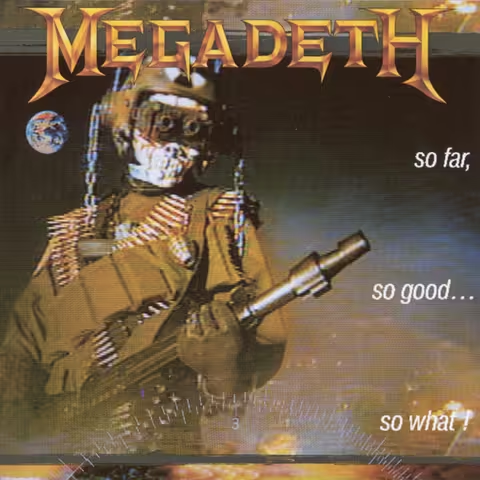
So Far, So Good... So What!, released by Capitol Records on 19 January 1988, became the album where Mustaine answered that question by daring fate to stop him. It arrived with a Sex Pistols cover featuring Steve Jones on guitar, a song written in one sitting on the day Mustaine learned of Cliff Burton's death, a furious response to the Parents Music Resource Center, a producer fired mid-mix after being spotted outside in his underwear feeding an apple to a deer, and a closing chart story that took the band platinum in the United States, silver in the United Kingdom and onto the cusp of arena status. It is the most uneven of Megadeth's classic-period records and, paradoxically, the one that proved Megadeth was here to stay.
Album Facts
| Field | Detail |
|---|---|
| Artist | Megadeth |
| Album | So Far, So Good... So What! |
| Release date | 19 January 1988 |
| Label | Capitol Records |
| Producers | Paul Lani, Dave Mustaine |
| Studios | Music Grinder, Los Angeles (recording); Bearsville, Woodstock, New York (initial mixing, abandoned); The Enterprise, Hollywood (final mixing); Precision Lacquer, Hollywood (mastering) |
| Genre | Thrash metal |
| Track count | 8 |
| Total runtime | 34:26 |
| Billboard 200 peak | 28 |
| UK Albums Chart peak | 18 |
| Other notable peaks | Finland 5, Germany 27, Switzerland 28, Sweden 37, Canada 40, New Zealand 41, Netherlands 51, Japan 57 |
| Certifications | RIAA Platinum (United States), Music Canada Platinum, BPI Silver (United Kingdom, 2004 reissue) |
| Estimated sales | Approximately 400,000 US copies in the first month; over one million United States units total |
| Key singles | Hook in Mouth, Anarchy in the U.K., Mary Jane, In My Darkest Hour |
The state of Megadeth at the end of the Peace Sells tour
To understand why this record is the way it is, the Peace Sells tour has to come first. Peace Sells... but Who is Buying?, released in September 1986 on Combat with later major-label distribution through Capitol, had been the breakthrough that pulled Megadeth out of the trading-circuit underground and into the same conversation as Metallica, Slayer and Anthrax. The album sold strongly, the title track became one of the era's anthems, and MTV finally played the video. For the first time, Mustaine had a band that the wider rock press took seriously.
What the wider rock press did not see was the chaos inside the touring party. Both lead guitarist Chris Poland and drummer Gar Samuelson had developed heavy drug habits during the cycle, and the touring expenses of the band were being haemorrhaged through their dependencies. Poland in particular reached a point at which he was pawning band equipment to feed the habit; Mustaine, no stranger to substance issues himself but determined that the music came first, eventually concluded that the project could not continue with either of them. By the end of the tour both Poland and Samuelson were out.
That left Mustaine and bassist David Ellefson as a two-man band with a new contract. Capitol had picked the group up directly for the next record, having previously handled only the major-label distribution of Peace Sells in partnership with Combat. The label's executive producer Tim Carr was attached. Money for proper studio time was, for the first time in Megadeth's history, actually on the table. All that was missing was half the band.
The pressure on Mustaine in late 1986 was considerable. He had been fired from Metallica in spring 1983 and watched that band's career accelerate into the stratosphere with Master of Puppets in early 1986. He had then built his own group in three years of hard graft only to watch his rhythm section dismantle itself from within. The cycle had also coincided with a personal low point. The song that would emerge as In My Darkest Hour was written in this period, the immediate aftermath of news arriving on 27 September 1986 that Cliff Burton, the bassist Mustaine had played alongside on the No Life 'til Leather demo sessions and whom he still regarded as a friend, had died when Metallica's tour bus crashed in Sweden. No one in Metallica contacted Mustaine directly. He heard about it the way fans heard about it, through word of mouth.
That, then, was the state of Megadeth as Mustaine started auditioning replacements for the third album: commercially ascendant, contractually upgraded, personally wrecked, and structurally hollowed out.
The new lineup: Chuck Behler, Jeff Young and the auditions
The first chair filled was the drum stool, and it was filled in the most pragmatic way imaginable. Samuelson's own drum technician, Chuck Behler, had been shadowing the kit for months, knew the existing Megadeth catalogue inside out and could play it cold. He was offered the job and accepted. Mustaine has since spoken about briefly considering Slayer's Dave Lombardo for the chair, and Lombardo was approached, but Lombardo's loyalties were elsewhere and the conversation was short. Behler, who had effectively been auditioning for the position from a folding chair behind Samuelson for the duration of the Peace Sells tour, slotted in without disruption.
The guitar chair was harder. The first hire was Jay Reynolds of Malice, a Los Angeles glam-tinged metal band who had supported Megadeth on a leg of the Peace Sells run. Reynolds rehearsed with the band and was on the books as the lead guitarist for the third album. As the recording date approached, however, it became clear that the technical demands of the new material were beyond what Reynolds could deliver in a studio context. The solos Mustaine was writing for the new songs assumed a player at the level of Poland; Reynolds was a competent club guitarist but he was not that player.
In a moment that has the quality of a sitcom plot, the man Reynolds was taking guitar lessons from in order to bring his playing up to speed was a young session and teaching guitarist called Jeff Young. Reynolds eventually told Mustaine that his own teacher was the better fit for the album and stepped aside. Young was brought in, auditioned, and got the gig. Mustaine has acknowledged in interviews over the years that the way Reynolds was handled at the time was unkind and that he has carried some regret about it; the Reynolds episode is one of the small grace notes of the album's pre-history.
Two other names that floated in and out of the audition conversations are worth noting. Slash from the not-yet-megastar Guns N' Roses, then a Sunset Strip fixture before Appetite for Destruction broke, was reportedly under consideration for the guitar chair before the Young hire. Lombardo, as mentioned, was sounded out for the drums. Neither rumour came to anything, but both indicate just how thin the bench of competent Los Angeles thrash and hard-rock players was in the autumn of 1986. The two musicians who actually got the chairs, Behler and Young, were both essentially understudies in the room.
With the lineup locked, Mustaine and Ellefson started writing in earnest. For the first time in Megadeth's recorded history, Ellefson stepped up as a co-writer in his own right, with credits on four of the eight finished songs: Mary Jane (music), In My Darkest Hour (lyrics), Liar (music) and Hook in Mouth (music). The Ellefson contribution is one of the under-told stories of the record. Where Peace Sells had been almost entirely a Mustaine writing exercise, So Far, So Good was a partnership.
Recording at Music Grinder, Los Angeles, 1987
The album was tracked through 1987 at Music Grinder Studios on Cahuenga Boulevard in Los Angeles, a mid-sized facility that had served as the recording home for a string of West Coast hard rock and metal records of the period including work by Stryper and, later, Slaughter. The choice of room reflected the budget bump that came with the Capitol deal; this was a step up from the kind of facility that had hosted the earlier Megadeth records.
The producer in the chair was Paul Lani, an experienced engineer-producer who had come to Mustaine's attention through his work remixing tracks from Peace Sells for the Capitol distribution version of that album. Mustaine knew Lani's ears, trusted them in principle, and brought him in as both producer and engineer for the new record. Tim Carr from Capitol took the executive producer credit. Matt Freeman handled engineering assistance.
The sessions were technically the most ambitious of Megadeth's career to that point. The instrumental opener Into the Lungs of Hell included synthesised horns and percussion alongside the standard band setup, a textural choice that pushed beyond the lean four-piece template of Killing Is My Business and Peace Sells. The intricate descending guitar lines of Mary Jane required clean takes that the new lineup had to nail under pressure. The Anarchy in the U.K. cover demanded that the two guitar parts, eventually one of them from Mustaine and the other from a guest who had not yet been booked, fit together in a way that honoured the original.
By all later accounts, the actual tracking phase at Music Grinder went smoothly enough. The friction came in the mix. Mustaine has said since that as the recording phase wound down he had begun to lose confidence in Lani's direction. He felt that the producer was being indecisive, that calls were being deferred rather than made, and that the album was drifting. He kept his counsel. Lani, for his part, decided that what the project needed was a change of scenery.
That decision is the one that ended his run on the album.
The Bearsville disaster and the firing of Paul Lani
Lani relocated the mixing sessions to Bearsville Studios, the legendary residential facility near Woodstock in upstate New York founded by Albert Grossman, on the theory that taking Mustaine out of Los Angeles would clear his head and unblock the record. Mustaine flew east. The two booked in, set up at the desk and started mixing.
The Bearsville sojourn is the single most quoted producer-firing story in metal history, and the version Mustaine has told repeatedly is straightforward. One morning at the residential complex Mustaine got up, walked to the kitchen, started making coffee, and looked out of the window. Outside, in the early morning light, stood Paul Lani in his underwear, holding an apple out at arm's length, feeding it to a deer that had wandered up from the trees.
Mustaine watched, finished his coffee, packed his bag and got on a flight back to Los Angeles that same day. By the time he landed, Lani was off the record. The deer story has been told and retold by Mustaine in interviews, in his 2010 memoir Mustaine: A Heavy Metal Memoir and in podcast appearances since; the consistency of the version across decades is striking and the anecdote is almost certainly the literal trigger, although the deeper cause was Mustaine's earlier loss of faith in the mixing direction.
The replacement was Michael Wagener, a German engineer and producer based in Los Angeles who had worked on Accept, Dokken and a slew of mid-1980s hard rock and metal records. Wagener took on the mix at The Enterprise in Hollywood, working from Lani's tracking masters. Stephen Marcussen handled the final mastering at Precision Lacquer, also in Hollywood. The whole rescue operation was completed quickly enough that the January 1988 release date was held.
The mix itself has been a sore point for Mustaine ever since. He has on multiple occasions described the Wagener mix as "muddy" and the overall sound as "pedestrian", and the 2004 reissue of the album, which he personally remixed alongside Ralph Patlan and Lance Dean, was an explicit attempt to correct the record. The fact that the four 1987 Paul Lani mixes were included as bonus tracks on that reissue (Into the Lungs of Hell, Set the World Afire, Mary Jane and In My Darkest Hour) speaks to Mustaine's ongoing ambivalence: he had Lani's mixes in the can and considered them publishable enough to reissue, even after firing the man who made them.
"The mixes that we have right now sound pedestrian and almost amateurish. I don't want my children to hear that, so I'm gonna fix this record before I die."
Dave Mustaine, on his motivation for the 2004 remix of So Far, So Good... So What!
Steve Jones and the Anarchy in the U.K. cover
Megadeth's reading of Anarchy in the U.K. is the most discussed single piece of the album. Mustaine had been a Sex Pistols obsessive since his teenage years; the 1976 single, written by John Lydon, Steve Jones, Glen Matlock and Paul Cook and released as the Pistols' debut, was one of the records that had shaped his sense of what rock and roll antagonism sounded like. Putting a thrash version of it on the third Megadeth album was both a tribute and a statement: the punk and metal traditions, often kept in separate pens by the press of the period, lived in the same house in Mustaine's head.
The masterstroke of the cover was getting Jones himself to play the second guitar solo on it. Jones, then living in Los Angeles and rebuilding a career after the Pistols, was approachable in a way the band's vocalist was not, and the booking was made. The solo arrives at exactly one minute forty seconds into the track. The audible handover between Mustaine's lead and Jones's lead has the texture of two musicians from two related but distinct traditions briefly inhabiting the same song, and is one of the more rewarding cross-generational moments in late-1980s metal.
There is, however, the lyric problem. Mustaine has openly admitted that when he came to record the vocal he sang several of Lydon's lyrics incorrectly because that was how he had always heard them. The most discussed misreading is the line "I am an anti-Christ", which on Mustaine's vocal comes across in a phrasing some listeners read as a different sentiment entirely. The point has been argued for forty years and Mustaine, by then a born-again Christian, eventually had the song dropped from the Megadeth live set in the early 2000s because the perceived anti-Christian sentiment of certain lines no longer sat comfortably with him.
For Megadeth's late-1980s live show, however, Anarchy in the U.K. was a setlist staple. It was a short, fast, recognisable song, it gave the audience a chance to bellow back at the stage, and it allowed Mustaine to make explicit the thrash-meets-punk lineage he was trying to draw.
Songs and themes, track by track
The eight songs on So Far, So Good... So What! cover, in compressed form, almost every preoccupation that would define the rest of Megadeth's career: technical ambition, political fury, personal grief, addiction, censorship and a peculiar brand of black humour. None of the songs run beyond seven minutes; six are under five. The whole album clocks at thirty-four minutes and twenty-six seconds.
1. Into the Lungs of Hell (3:29). The instrumental opener is the most production-forward track on the record. Built around a chugging riff that erupts into orchestral synth swells, it features synthesised horns, winds and percussion layered on top of the band, and serves as a statement of intent: this album is going to sound bigger than its two predecessors. The piece has an almost film-score architecture, complete with a false fade and a re-entry, and shows Mustaine flexing arrangement chops well beyond the standard thrash playbook. Drummer Behler's first studio performance with the band is on this track, and he delivers it cleanly.
2. Set the World Afire (5:48). This is the oldest song on the record. Mustaine has said many times that he wrote it in spring 1983, on the bus ride back to California after being fired from Metallica in New York. The lyrics, which deal with nuclear annihilation, were famously composed on the cardboard backing of a Sno Balls snack cake (sometimes misremembered as a Hostess cupcake wrapper) during the journey; the original cardboard, by Mustaine's account, was kept for years afterwards. The studio recording begins with a sample from "I Don't Want to Set the World on Fire" by The Ink Spots, recorded in 1941, which fades from a vintage radio crackle into the band's opening riff. The song was Megadeth's first piece of writing as a band-in-being and, fittingly, opens the proper run of vocal tracks on the third album.
3. Anarchy in the U.K. (3:00). The Sex Pistols cover, written and originally recorded by Lydon, Jones, Matlock and Cook in 1976. Discussed in detail in the preceding section.
4. Mary Jane (4:25). Co-written by Mustaine and Ellefson and the oldest of the Ellefson contributions, this song had first appeared on a Megadeth demo as far back as 1983. The lyrics tell the story of a young witch buried alive by her father near the Loon Lake cemetery in Minnesota, with the local legend holding that anyone who disturbs her grave will themselves die. Mustaine summons her spirit at the song's opening with a spoken-word incantation, and the song proceeds through a series of descending guitar lines that have remained one of the album's most frequently revisited cuts in fan polls. The riff has a darker, more melodic quality than the album's other tracks and is one of the clearest early signs of where the band would go on Rust in Peace.
5. 502 (3:28). The title is a reference to the police shorthand used in California for driving under the influence. The lyric is about fast cars, lawlessness and the buzz of getting away with it; the irony is that Mustaine himself was arrested for drunk driving in March 1989 when he crashed into a police car. The song is the album's shortest and most straightforwardly thrash piece, all riff and tempo, with very little of the textural detail of the surrounding tracks.
6. In My Darkest Hour (6:16). The emotional centre of the record. Mustaine wrote the music in a single sitting on the day in late September 1986 that he learned of Cliff Burton's death; Ellefson contributed the lyrics, though the song's emotional driver remained Mustaine's own grief and isolation. The structure breaks from the standard thrash template of the period: it opens with a clean, almost mournful guitar figure, builds through a mid-tempo verse, and only reaches full velocity in its final third. It is a song about loneliness, betrayal and the absence of comfort, and it was the first time the thrash genre had really stretched itself to accommodate something this emotionally direct. The 2004 reissue version extends the running time slightly to 6:26. It remains the most-performed song from the album in the band's live set, used by Mustaine on countless tours since as a moment of stillness in the middle of a fast and loud show.
7. Liar (3:20). A diss track in the most literal sense. The lyric is directed at former Megadeth guitarist Chris Poland and accuses him, in barely coded terms, of stealing band-owned guitars during the Peace Sells tour and selling them to fund his heroin habit. Ellefson is credited with the music. The song's bridge ("you stink, you scum, you're a slimy git") and its closing curse on the addressee are about as personal as Mustaine ever got on record about another musician. Years later Mustaine and Poland reconciled enough for Poland to contribute additional guitar to the 2004 reissue.
8. Hook in Mouth (4:40). The album's closer is a furious response to the Parents Music Resource Center, the censorship pressure group co-founded by Tipper Gore in 1985 that had been pushing the recording industry to apply parental advisory stickers to records with explicit content. Mustaine spells out F-R-E-E-D-O-M letter by letter in the chorus, then runs through what he characterises as a list of behaviours typical of the censors: book burning, witch hunts, the muzzling of dissent. The lyric is one of the most overtly political pieces of writing in Megadeth's catalogue, and Mustaine wrote at the time that the song was directed at those who, in his words, were trying to "take away our freedom of speech". The PMRC controversy provided thrash and hard rock as a whole with a useful villain throughout 1986 to 1988; Hook in Mouth is one of the genre's most explicit anti-PMRC statements alongside Frank Zappa's Senate testimony and Metallica's own less direct contributions.
Personnel and credits
| Role | Person | Notes |
|---|---|---|
| Megadeth | ||
| Lead vocals, guitars | Dave Mustaine | Bandleader; sole or co-writer on all eight tracks |
| Bass guitar, backing vocals | David Ellefson | Co-writer on Mary Jane, In My Darkest Hour, Liar and Hook in Mouth |
| Guitars | Jeff Young | Recruited 1987 from session and teaching work; his only Megadeth album |
| Drums, percussion | Chuck Behler | Former drum technician to Gar Samuelson; his only Megadeth album |
| Guest musician | ||
| Guitar solo | Steve Jones (Sex Pistols) | Second solo on Anarchy in the U.K., arriving at 1:40 |
| Production and engineering | ||
| Producer, engineer | Paul Lani | Fired during mixing at Bearsville Studios, New York |
| Producer | Dave Mustaine | Co-production credit |
| Executive producer | Tim Carr | For Capitol Records |
| Engineering assistance | Matt Freeman | At Music Grinder, Los Angeles |
| Mixing | Michael Wagener | At The Enterprise, Hollywood, after Lani's departure |
| Mastering | Stephen Marcussen | At Precision Lacquer, Hollywood |
Tracklist
| No. | Title | Writer(s) | Length | Notes |
|---|---|---|---|---|
| 1 | Into the Lungs of Hell | Mustaine | 3:29 | Instrumental opener with synthesised horns and percussion |
| 2 | Set the World Afire | Mustaine | 5:48 | Lyrics written on a Sno Balls cardboard backing in 1983; opens with an Ink Spots sample |
| 3 | Anarchy in the U.K. | Rotten, Jones, Matlock, Cook | 3:00 | Sex Pistols cover; second solo by Steve Jones at 1:40 |
| 4 | Mary Jane | Mustaine, Ellefson | 4:25 | From the 1983 Megadeth demo; descending guitar lines |
| 5 | 502 | Mustaine | 3:28 | Titled after the California police code for DUI |
| 6 | In My Darkest Hour | Mustaine (music), Ellefson (lyrics) | 6:16 | Written in a single sitting on the day Mustaine learned of Cliff Burton's death |
| 7 | Liar | Mustaine, Ellefson (music) | 3:20 | Diss track about former guitarist Chris Poland |
| 8 | Hook in Mouth | Mustaine, Ellefson (music) | 4:40 | Anti-PMRC censorship anthem |
| Total: 34:26 | ||||
Singles and reception
Capitol pulled four singles from the album in 1988, spaced through the first half of the year to maintain visibility on the record long after the initial release. Hook in Mouth led on 11 January 1988, eight days ahead of the album, framing the record as a censorship-fight statement before the broader public had a chance to hear the rest. Anarchy in the U.K. followed on 17 February 1988, leveraging the Steve Jones cameo for the music press. Mary Jane went out on 12 May 1988 to coincide with the European headline tour, and In My Darkest Hour closed the campaign on 17 June 1988.
Contemporary reviews were mostly positive, with a couple of notable caveats. Jim Farber, writing in Rolling Stone, gave the album three out of five and argued that it propelled the band "right at the top of the thrash-rock heap" and concluded that "amid today's narcoleptic pop scene, albums like So Far, So Good... So What! offer a disruptive noise that's welcome indeed". J. D. Considine, writing in Spin, identified the same quality from a different angle, suggesting that the record showed "genuine maturity" beyond the band's earlier work.
The German press was even warmer. Holger Stratmann, reviewing for Rock Hard, awarded a perfect 10/10 and called the album "the new masterpiece of Megadeth", a verdict that has aged well in Continental European fan circles even where the Anglosphere has cooled on the record. The Village Voice's Robert Christgau filed a more typically idiosyncratic B-, with particular praise for the Anarchy cover, which he wrote that Mustaine had executed "like a champ".
Not every review was so generous. Duncan Strauss in the Los Angeles Times gave the album two out of five and queried the durability of the writing beneath the surface aggression. The most damning notice came retrospectively from AllMusic's Steve Huey, whose 2.5 out of 5 verdict cast the album as juvenile in comparison with both Peace Sells and Rust in Peace. Both of those readings have shaped the album's reputation among critics over the long term: an audience-pleasing record that the press has never quite ranked alongside its neighbours in the discography.
The fan reception was unambiguous. The band's existing audience embraced the record on release, and the first-month sales figures (see the next section) confirm that the marketing campaign and the single-led rollout worked.
Charts and commercial breakthrough
So Far, So Good... So What! was the album that pushed Megadeth from cult-favourite status to genuine mass-market metal act in the United States and most of Europe. The chart story is instructive across territories.
- United States: Number 28 on the Billboard 200, achieved with effectively no commercial radio airplay; the record went there on word of mouth, MTV's Headbangers Ball, the press campaign and a relentless touring schedule.
- United Kingdom: Number 18 on the UK Albums Chart, a stronger placing than the United States in chart terms and the band's first appearance in the upper reaches of that listing.
- Finland: Number 5, the album's highest chart position anywhere in the world and an early hint of the disproportionate Megadeth following that would persist in the Nordic countries.
- Germany: Number 27, supported by Rock Hard's perfect review and a strong showing on the festival circuit later that year.
- Switzerland: Number 28.
- Sweden: Number 37.
- Canada: Number 40.
- New Zealand: Number 41.
- Netherlands: Number 51.
- Japan: Number 57.
The most striking single statistic is the first-month United States sales figure of approximately 400,000 copies, which made it the fastest-selling Megadeth album to that point by a considerable margin. The record was eventually certified platinum by the Recording Industry Association of America, the band's first platinum album in the United States, and platinum by Music Canada. The British Phonographic Industry certified the 2004 reissue silver, denoting United Kingdom sales of 60,000 units for that edition alone on top of the original 1988 sales.
The tour and the second lineup collapse
Megadeth toured So Far, So Good... So What! aggressively for almost a calendar year. The cycle opened in late 1987 with a European warm-up run supported by Kreator and Overkill, including an appearance at the Queens Hall in Leeds on 13 December 1987 as part of the Christmas on Earth festival. The European leg established the album's lead singles in the live set and gave the new Behler-Young lineup time to gel on stage before the larger North American shows.
From January through March 1988, Megadeth toured North America as direct support to Dio, with Savatage opening. The Long Beach Arena show in March 1988 was reviewed by the Los Angeles Times's Duncan Strauss (the same critic who had given the album a chilly 2/5) and Strauss conceded that Megadeth had upstaged Dio comprehensively on the night. The tour was the band's first time playing arena-scale rooms as a regular feature of a campaign rather than an occasional opportunity.
In spring 1988 Megadeth headlined Europe, supported by Testament and Sanctuary; the run gave the band the experience of being the top of the bill in major continental rock cities for the first time. In August 1988 they were booked onto the German Monsters of Rock festival series, opening at Schweinfurt. The Megadeth performance there was apparently judged by promoters to be insufficient for the slot, and the band were dropped from the remaining festival dates and replaced for those shows by Testament. The Australian leg later in the year ended early, with ongoing drug problems within the lineup widely reported as the cause.
By the close of the touring cycle in late 1988 the working relationships inside the band had deteriorated badly. In early 1989 Mustaine fired both Behler and Young. The decision opened the door to the audition process that brought in Nick Menza and Marty Friedman, the lineup that would record the universally celebrated Rust in Peace in 1990 and reset the band's critical standing for the next decade.
- European warm-up: Late 1987, with Kreator and Overkill
- North America: January to March 1988, supporting Dio with Savatage
- European headline: Spring 1988, with Testament and Sanctuary
- Monsters of Rock, Germany: August 1988, one show at Schweinfurt before being dropped
- Australia: Late 1988, ended early
Legacy
So Far, So Good... So What! occupies a strange position in the Megadeth catalogue. It is the platinum record that put the band on the commercial map in the United States and yet it has never been the album that critics or even much of the long-term fan base put forward as their favourite. The two records on either side of it have a clarity of purpose that this one does not: Peace Sells... but Who is Buying? is lean and political, Rust in Peace is a technical landmark. The third album, sandwiched between them, is messier than either, partly because of the lineup turmoil and partly because of the troubled mix.
And yet the songs have legs. Set the World Afire, In My Darkest Hour and Hook in Mouth have remained core elements of Megadeth's live set on and off across the past three decades. In My Darkest Hour in particular has become one of the songs Mustaine reaches for whenever a tour needs an emotional anchor, and it is widely covered by other artists. The Anarchy in the U.K. arrangement, controversial in the band's own house ever since Mustaine's conversion, is still cited as one of the more interesting metal-on-punk crossovers of the period.
The 2004 remix and remaster, undertaken by Dave Mustaine, Ralph Patlan and Lance Dean, is the version most current listeners have encountered. It substantially reworks the Wagener mix that Mustaine had been unhappy with since the day it was finished, and appends as bonus material the four 1987 Paul Lani mixes that had been shelved when Lani was fired: Into the Lungs of Hell (3:32), Set the World Afire (5:53), Mary Jane (4:08) and In My Darkest Hour (6:11). For collectors of the band's history, the reissue is the definitive document, the only place where both versions of the mixing story can be heard side by side. For many long-term fans the 2004 reissue is also controversial, with the original Wagener-mixed 1988 vinyl and CD retaining a partisan following that prefers its rawness.
In the broader 1988 thrash conversation the album sits in distinguished company. Metallica's ...And Justice for All would arrive eight months later, Anthrax's State of Euphoria followed in September, Slayer's South of Heaven landed in July; the year before had given the genre Anthrax's Among the Living, and the year that followed would deliver Testament's Practice What You Preach and Sepultura's Beneath the Remains. So Far, So Good... So What! is one of the early markers of the year in which thrash metal had its first sustained commercial peak as a movement.
The Bearsville anecdote has long since transcended the album itself. The image of Paul Lani in his underwear feeding an apple to a deer at first light is one of the most-quoted producer-firing stories in the history of heavy metal and one that, for better or worse, will probably outlive any conversation about the actual mixes Lani delivered. It is the kind of folklore that becomes a record's calling card.
Things You Might Not Know
| Fact | Detail |
|---|---|
| The Sno Balls lyric | "Set the World Afire" was written by Dave Mustaine on the cardboard backing of a Sno Balls snack cake on a long-distance bus journey home from New York to California in spring 1983, immediately after he was fired from Metallica. |
| The Ink Spots opening | The studio recording of "Set the World Afire" opens with a sample of "I Don't Want to Set the World on Fire" by The Ink Spots, originally recorded in 1941. |
| The Steve Jones cameo | The second guitar solo on the Sex Pistols cover Anarchy in the U.K. arrives at exactly one minute forty seconds and is played by Sex Pistols founding guitarist Steve Jones, then living in Los Angeles. |
| The deer at Bearsville | Producer Paul Lani was fired by Mustaine after Mustaine looked out of the kitchen window of the Bearsville Studios residential complex one morning and saw Lani outside in his underwear, feeding an apple to a deer. |
| The drum tech who got the gig | New drummer Chuck Behler had been working as drum tech to the man he replaced, Gar Samuelson, throughout the entire Peace Sells touring cycle. |
| The guitar teacher who got the gig | New guitarist Jeff Young was hired only after his own student, Jay Reynolds of Malice, had been brought in and stepped aside, telling Mustaine that his teacher was the better fit for the record. |
| The Slayer drummer who didn't | Slayer's Dave Lombardo was briefly considered as drummer before Behler was confirmed; Slash from Guns N' Roses was also among the candidates floated for the guitar position before Young got the call. |
| The 502 prophecy | The track 502 is named after the California police shorthand for driving under the influence; Mustaine was arrested under exactly that offence in March 1989, the year after the album's release. |
| The one-sitting song | In My Darkest Hour was written by Mustaine in a single sitting on the day in late September 1986 that he learned through word of mouth, not from any Metallica member, of Cliff Burton's death in a tour bus crash in Sweden. |
| The Monsters of Rock dropping | Megadeth opened the German Monsters of Rock festival at Schweinfurt in August 1988 and were dropped after one show; Testament took the slot for the remaining dates. |
| The shelved Lani mixes | The four 1987 Paul Lani mixes that Mustaine fired Lani in the middle of were eventually released as bonus tracks on the 2004 remix and remaster of the album, alongside Mustaine's own corrected mix. |
| The title's three dots | The official Capitol release spells the album title with a literal three-dot ellipsis ("So Far, So Good... So What!"), not the single Unicode ellipsis character that some discographies use; the punctuation matters to Mustaine and the band have corrected it consistently in reissues. |
The Riffology podcast
The Riffology podcast covers the records that made heavy music what it is, one album at a time, with the long-form attention these stories deserve. New episodes are released regularly and are available on all major podcast platforms including Apple Podcasts, Spotify, Amazon Music and Pocket Casts. Subscribe to follow the band stories, the producer feuds, the festival disasters and the records that came out of all of it.

Comments