Introduction
Tony Iommi was halfway through tracking Megalomania at Morgan Studios in Willesden when a stranger walked into the live room, asked which one of them was Tony, and handed him a writ. The session stopped. Lawyers were called. Affidavits were signed at the mixing desk. Then Black Sabbath went back to work, finished the take, and used the moment as the title of the album's closing song. Sabotage, released on 28 July 1975, is the only Black Sabbath record made entirely under legal siege, and it sounds like it: harder than Sabbath Bloody Sabbath, angrier than anything in their catalogue, and pulled in two opposing directions by a band that wanted to make a straight rock album and could not stop themselves writing a choral piece for the English Chamber Choir while they were at it.
Ozzy Osbourne wrote in his autobiography that "writs were being delivered to us at the mixing desk". Geezer Butler summed up the band's headspace in four words: "concerned, tired, drunk, stoned". Bill Ward, decades later, gave the album its truest one-line review. "It was probably the only album ever made with lawyers in the studio." Patrick Meehan, the manager Sabbath had fired in late 1974 after years of unanswered questions about where the money was going, was suing for breach of contract. The band was hemorrhaging cash on legal fees, on the brink of a tax bill that would clean them out, and somehow producing what many critics now regard as the most underrated record in their first six. The story of Sabotage is the story of four exhausted men at Morgan Studios making a great album because the alternative was thinking about what was waiting for them outside.
Album facts
| Field | Detail |
|---|---|
| Artist | Black Sabbath |
| Album | Sabotage |
| Release date | 28 July 1975 (US); September 1975 (UK) |
| Label | NEMS (UK), Vertigo (Europe), Warner Bros. (US) |
| Producers | Black Sabbath and Mike Butcher |
| Studio | Morgan Studios, Willesden, London (Studios 3 and 4); mixing and mastering in New York City |
| Genre / subgenre | Heavy metal with proto-thrash, progressive and choral elements |
| Track count | 8 (plus the hidden track Blow on a Jug) |
| Total runtime | 43:44 |
| UK Albums Chart peak | 7 |
| US Billboard 200 peak | 28 |
| Other notable chart peaks | Norway 6, Austria 6, Germany 17, Canada 33, New Zealand 33 |
| Certifications | Silver (BPI, 1 December 1975); Gold (RIAA, 16 June 1997) |
| Estimated sales | 500,000+ US shipments; 60,000+ UK shipments based on certifications alone |
| Key singles | Am I Going Insane (Radio), released 13 February 1976; B-side Hole in the Sky |
1975: punk on the doorstep, lawyers at the desk
The year Sabotage landed was one of the most loaded in the history of rock. Led Zeppelin had already released Physical Graffiti in February. Aerosmith dropped Toys in the Attic in April. Bruce Springsteen rebuilt his career with Born to Run in August. Pink Floyd put Wish You Were Here out in September, the same month Sabotage hit British shops. Queen closed the year with A Night at the Opera in November, and Patti Smith ended it with Horses in December. Eight months later, in London, the Sex Pistols would play their first gig and the rock establishment Sabbath were part of would start to look very old very quickly.
Inside that calendar, Sabbath looked like a band running out of road. The British music press, never warm towards them, had been writing them off since the first album. Heavy rock was being parodied by the same critics who would later canonise it. The drift towards prog ambition on Sabbath Bloody Sabbath had earned them respect they did not particularly want and confused some of the audience who had come for War Pigs. And the economics underneath all of this were collapsing.
- Petrol was rationed across the West in the wake of the 1973 oil crisis and a second shock that ran through 1974.
- The UK inflation rate hit roughly 24 per cent in 1975, the highest figure in living memory.
- Top tax rates in Britain reached 83 per cent on earned income and 98 per cent on investment income, which would eventually drive Sabbath out of the country.
- The major-label royalty structures of the early 1970s meant a band could go platinum and still owe money. Sabbath, on cross-collateralised contracts they had not read, were a case study.
Sabbath were not naive when they fired Meehan. They were furious. They were also, as Butler later admitted, too late.
From Aston to Ontario Motor Speedway
By April 1974 Black Sabbath had stood in front of 300,000 people at the first California Jam, sharing the bill with Deep Purple and Emerson, Lake and Palmer. Iommi played in a blue silk shirt fringed with white, Ozzy in a purple-tasselled white jacket and outsized moonboots, Butler in silver satin, Ward bare-chested. They had four years of relentless touring and five studio albums behind them. They were, by any measure available in 1974, one of the biggest rock bands in the world. They were also collapsing. Iommi had been hospitalised with exhaustion on the Sabbath Bloody Sabbath tour. The band asked to skip Cal Jam and were told by management that they could not.
That refusal was the moment, in Geezer Butler's recollection, when the trust finally broke. Patrick Meehan had taken over from Birmingham promoter Jim Simpson in 1970 and built Sabbath into a global concern through his Worldwide Artists company. He delivered America. He delivered the country houses and the flash cars. What he did not deliver, as far as Sabbath could tell, was a straight answer about how much they were actually earning. "Patrick Meehan never gave you a straight answer when you asked him how much dough you were making," Ozzy wrote. Butler put it more bluntly: "We felt we were being ripped off."
Shortly after Cal Jam the band notified Worldwide Artists that the relationship was over. Meehan responded with litigation. The four members of Black Sabbath spent late 1974 and most of 1975 splitting their time between the studio, lawyers' offices and Patrick Meehan's deposition rooms. They walked into Morgan in February 1975 already exhausted, already cynical, and already certain that whatever they made together would have to be paid for in lawyer time at the other end of the day.
Pre-production: writing songs in lawyers' waiting rooms
There is no neat demos-then-tracking story with Sabotage. Sabbath wrote and arranged on the floor at Morgan, in long jam sessions broken by court dates. Iommi, identified by producer Mike Butcher as the band's "unofficial leader", brought in skeletons of riffs that the band wrestled into shape. Some were old, some came together in a single afternoon. The funky coda to Symptom of the Universe, by Iommi's own account, "evolved from an in-studio improvisation, created very spontaneously in a single day, and the decision was made to use it in that song."
The album they thought they were making was a deliberate course-correction. Sabbath Bloody Sabbath had pulled in Rick Wakeman on keys and orchestral arrangements, and Iommi felt the band had pushed as far in that direction as it should go. "We could've continued and gone on and on, getting more technical, using orchestras and everything else, which we didn't particularly want to," he said. "We took a look at ourselves, and we wanted to do a rock album." That intention survived the first two tracks. Then Iommi, the man who had supposedly called time on the orchestras, walked into Morgan with an idea for a piece featuring a 24-voice choir and a Celtic harp.
The Meehan litigation shaped the writing in two ways. Most of Ozzy's anger went onto the page directly: The Writ is one of a handful of Sabbath songs Ozzy wrote himself, "a bit like seeing a shrink", he said, "all the anger I felt towards Meehan came pouring out". Butler's lyric writing went the other way. With Hole in the Sky he reached for the apocalyptic, with Megalomania for the autobiographical, and with Symptom of the Universe for something close to theology.
Creating Sabotage: four months at Morgan
Morgan Studios in Willesden, north-west London, was one of the most heavily booked rooms in Britain in 1975. Robin Black, longtime Jethro Tull engineer, kept the room running. Mike Butcher, promoted from engineer on Sabbath Bloody Sabbath to producer on Sabotage, slept on its sofas. Sabbath worked there for a total of four months in early 1975, split into three-week sessions, mostly in Studios 3 and 4. The sessions ran on Morgan time: Butcher arriving at two in the afternoon, the band drifting in around four, work starting in earnest at nine and stretching to one or two the next morning.
Morgan had a bar, which was probably a mistake. Butler later remembered an evening at the dartboard with Charlie Watts of the Rolling Stones, the pair of them so drunk they nicknamed the board "Bill's beard" because of the stuffing leaking out around the number 3 mark. There were "bags of the stuff", as Butcher recalled, in terms of cocaine and marijuana. But the band drew a line at the live-room door. "When it came to laying track, my intake of anything mind-altering would diminish somewhat," Ward said. There was one exception that Butcher remembers: an attempt to track Ozzy live with the band that had to be abandoned because the singer was passed out drunk on the studio sofa.
"We were in the studio one day and in court or meeting with lawyers the next. The sound was a bit harder than Sabbath Bloody Sabbath. My guitar sound was harder. That was brought on by all the aggravation we felt over all the business with management and lawyers."
Tony Iommi, in Iron Man: My Journey Through Heaven and Hell with Black Sabbath, 2011
That harder guitar sound is on the record from the first second. Hole in the Sky opens with the hum of amplifiers set to maximum and a scream of "Attack!" from the control room. The scream was an in-joke. A support band on a recent Sabbath tour had a manager who shouted "Attack! Attack!" from behind them every night. Butcher, recording, leaned into the Tannoy and did the same thing into the live room. It made the take. It made the album.
The Writ took its name from a parallel real-world event. "Some guy walked in and said, 'Black Sabbath?'" Butcher recalled. "And Tony said, 'Yeah.' The guy said, 'I have something for you,' and gave him a writ." Butcher suggested the title to the band. Ozzy wrote the lyric in something close to a real-time confession. The track itself opens with laughter from an Australian friend of Butler's who happened to be visiting London, mixed with the cries of a baby Butcher found on an unmarked cassette tape lying on a Morgan console, slowed to half speed to make it eerier. The cassette was never claimed.
Mixing and mastering moved to New York in the spring. It was there, late one night, with the band gone home, that Butcher captured the album's most notorious bit of contraband. Ozzy and Ward were larking about at the studio piano. Butcher pushed record. The result, a 31-second tribute to skiffle act Mungo Jerry called Blow on a Jug, ended up tacked on to the end of The Writ as a hidden track on some pressings. "This stupid fucking thing," Ward said years later. "A drunken song that Ozzy and me would sing together in a van or on a plane. That's me on piano, and Ozzy blowing on one of those brown cider jugs, playing it like a tuba."
The signature production touches across the record are mostly arrangement decisions rather than gear tricks: Ward's love of backwards-cymbal swells, Iommi multi-tracking guitars across three or four lines on Megalomania, Ozzy doubling himself with a Moog synthesiser line on Am I Going Insane (Radio). The instrumentation credits tell the most ambitious story. Iommi, primarily a guitarist, is credited on Sabotage with guitars, piano, synthesiser, organ and harp. It is the most polymath performance of his career and a sign of how much was being done by the four people in the room.
Notable gear and arrangement details
- Iommi's signature Gibson SG run into modified Laney amplifiers, with detuning to C sharp and B on some passages.
- Butler's Fender Precision bass through Laney rigs, often double-tracked to thicken Iommi's heavier riffs.
- Ward's Ludwig kit, miked for the era's then-new triggered backwards-cymbal effects.
- Ozzy's Moog synthesiser line on Am I Going Insane (Radio), one of the earliest Sabbath uses of synth as a lead voice.
- A Celtic harp, played by Iommi, on Supertzar.
- Tubular bells, played by Ward on Supertzar, with a clear nod to Mike Oldfield's score for The Exorcist.
Personnel and credits
| Role | Player | Notes |
|---|---|---|
| Black Sabbath | ||
| Lead vocals | Ozzy Osbourne | Plus Moog synthesiser on Am I Going Insane (Radio); backing vocals on Blow on a Jug |
| Guitars and keys | Tony Iommi | Electric and acoustic guitars, piano, synthesiser, organ, harp |
| Bass | Geezer Butler | Principal lyricist on six of the eight album tracks |
| Drums and percussion | Bill Ward | Drums, bongos, claves, tubular bells (Supertzar), piano and scat vocals on Blow on a Jug |
| Guest performers | ||
| Choir | The English Chamber Choir | 24 voices on Supertzar; arrangement by Will Malone |
| Laughter on The Writ | Uncredited Australian friend of Butler's | Visiting London during the sessions, recorded at Morgan |
| Voice on The Writ intro | Unknown baby on found cassette tape | Half-speed playback engineered by Mike Butcher; tape never claimed |
| Production and engineering | ||
| Co-producer | Black Sabbath | Iommi often acting as de facto musical director |
| Co-producer and engineer | Mike Butcher | Promoted from engineer on Sabbath Bloody Sabbath; oversaw NYC mix |
| Engineer | Robin Black | Jethro Tull's regular engineer; Morgan house engineer at the time |
| Tape operator | David Harris | "Saboteur" in the album credits; instrumental Don't Start (Too Late) named for his habit of starting tape late |
| Choir arrangement | Will Malone | Wrote and conducted the English Chamber Choir parts on Supertzar |
| Artwork | ||
| Sleeve concept | Graham Wright | Bill Ward's drum tech and a working graphic artist; proposed the mirrored cover image |
| Photography | Uncredited Morgan Studios shoot | Test session that became the final cover after the planned shoot collapsed |
The two oddities in that table are the ones worth lingering on. Black Sabbath did not normally credit hidden contributors. They did on Sabotage, partly because David Harris's role as "saboteur" became a long-running joke inside the band and partly because Will Malone's choir arrangement on Supertzar was so far outside the Sabbath playbook that it would have looked dishonest to leave the credit off. Robin Black, for his part, never gave many interviews about the record. He was the quiet, professional anchor that allowed Mike Butcher to focus on the band rather than the desk.
The songs
| # | Title | Writer(s) | Length | Single? | Notes |
|---|---|---|---|---|---|
| 1 | Hole in the Sky | Butler, Iommi, Osbourne, Ward | 3:59 | B-side | Opening track; ends with a sudden cut into Don't Start (Too Late) |
| 2 | Don't Start (Too Late) | Butler, Iommi, Osbourne, Ward | 0:49 | Acoustic instrumental for Iommi; titled for tape operator David Harris | |
| 3 | Symptom of the Universe | Butler, Iommi, Osbourne, Ward | 6:29 | Widely cited proto-thrash riff; acoustic coda created live in one day | |
| 4 | Megalomania | Butler, Iommi, Osbourne, Ward | 9:42 | Album centrepiece; lyric based on a Butler heroin experience | |
| 5 | The Thrill of It All | Butler, Iommi, Osbourne, Ward | 5:55 | Two-part song hinging on a quiet middle break and Iommi synth lines | |
| 6 | Supertzar | Butler, Iommi, Osbourne, Ward | 3:44 | Instrumental with English Chamber Choir; Iommi on harp, Ward on tubular bells | |
| 7 | Am I Going Insane (Radio) | Butler, Iommi, Osbourne, Ward | 4:14 | A-side | Ozzy on Moog; "Radio" is rhyming slang for "mental" |
| 8 | The Writ | Butler, Iommi, Osbourne, Ward | 8:45 | Includes hidden track Blow on a Jug at the end on some pressings |
Hole in the Sky is the most economical opener in the Sabbath catalogue. Mick Wall described its main riff as "door-slamming" and "wouldn't have been out of place on Paranoid". Ward's drum part shifts between roughly 120 and 180 beats per minute under that riff, applying what musicologist Nolan Stolz calls "an Afro-Cuban-like feel" that is easy to miss in a song this brutal. Butler later called the lyric his most prophetic, name-checking the ozone hole, Cold War paranoia and oil rationing in a verse that sounds like it could have been written last week. The song ends in a hard cut, splicing straight into the album's smallest gesture: Don't Start (Too Late), Iommi's 49-second acoustic instrumental named after David Harris's habit of pressing record a beat too slow.
Symptom of the Universe is the song most people use to start arguments about whether Sabbath invented thrash. Its main riff, palm-muted, descending, in a tritone-leaning E minor, is the structural template Metallica, Anthrax and Slayer would build careers on. Kirk Hammett told Consequence in 2025 that "just that song, in terms of the attitude, the choice of notes, how it was played, and the fact that it was the main part of the song and the hooks of it. Once you hear that riff, you'll always hear it again and again. That riff in itself shifted heavy metal." Yngwie Malmsteen told Guitar Player in 2008 that Iommi's use of the flat fifth "would have got him burned at the stake a couple hundred years ago".
Butler's lyric is the part of the song people forget. Asked what Symptom of the Universe was about, the bassist told Songfacts: "That was about love. Love is the symptom of the universe. That's what gets us all through it." He elaborated to Classic Rock that "the title was about love, fate and belief. Love is the symptom that brings forth life. Death is the cure, but love never dies. I was very religious growing up, and everything in my life seemed to be pre-planned." The final 90 seconds, that funky acoustic coda, comes out of the song without warning. It was the four of them jamming in the live room while a tape rolled, overdubbed later with acoustic guitar. Iommi was happy enough with it to bolt it onto the back of the track instead of saving it for a separate cut.
Megalomania, at 9:42, is the album's emotional core. Butler's lyric is taken almost line for line from what he later described as "a rare heroin experience" in which he "stayed up all night looking in the mirror: I was God, and my reflection was the Devil. It was the battle of the two biggest egos in the universe. Unfortunately I don't remember the outcome." The arrangement matches the lyric. Ozzy whispers the opening verses over a hesitant Iommi figure, then builds across nine minutes into a full-band assault for the final third, with Iommi multi-tracking guitar lines until the chorus is six layers thick. Ward, who later said he and Ozzy both heard The Writ and Megalomania as twin tracks about the Meehan situation, plays through the song without a single fill that breaks the mood.
The Thrill of It All opens side two and is the closest Sabotage comes to filler, which is to say it would have been the centrepiece of half the rock albums released in 1975. Two distinct sections, hinged on an Iommi organ figure, are stitched together by Ward's tom work and Butler's most propulsive bass line on the record. Supertzar follows, and is unlike anything else in the Sabbath catalogue. Will Malone wrote and conducted the choir parts for 24 singers from the English Chamber Choir at Morgan, with Iommi on harp, Ward on tubular bells, and Iommi's slow death-march guitar riff carrying the bottom end.
The story of Ozzy's first encounter with the choir is one of Sabbath's better internal jokes. According to Iommi, the singer walked into Morgan one afternoon, saw a 24-voice classical choir warming up in the live room, decided he must be in the wrong studio, and walked back out. Ward later described the piece as "a demonic chant". Ozzy's own assessment was characteristically vivid: he later said it sounded like "a noise like God conducting the soundtrack to the end of the world". Supertzar would become the band's walk-on tape from 1975 onwards, used to introduce the band live for the rest of the original line-up's career.
Am I Going Insane (Radio) is the album's most divisive track and its only single. Built around a Moog line Ozzy played himself, the lyric is, as Butler put it, "definitely autobiographical". The "(Radio)" in the title is not, as American buyers initially assumed, an indication of a radio edit. It is British rhyming slang: "radio rental" for "mental". Ward called the Moog work irritating during the sessions and brilliant in hindsight. "Oz drove us all nuts with that Moog thing, but the song was great. And in hindsight, it was kind of a precursor for his solo career. His personality was blooming on this song."
The Writ closes the record and is one of the angriest songs Black Sabbath ever recorded. Ozzy wrote almost all of the lyric himself, which was unusual: Butler was the band's principal lyricist throughout the Ozzy era. Lines like "you bought and sold me with your lying words" and the title's threatening "are you Satan? are you man?" are addressed to Patrick Meehan directly. The track moves through three distinct movements over 8:45, ending on the line "everything is gonna work out fine", which Ozzy delivered with an audible question mark and which the closing chords promptly contradicted.
B-sides, outtakes and the hidden track
Sabbath were not, in the 1970s, a B-side band. They issued one single from Sabotage, Am I Going Insane (Radio), in February 1976. The B-side was Hole in the Sky, repurposed from the album rather than cut new. There were no commissioned non-album tracks. Across studio outtakes recovered for the 2021 Super Deluxe reissue, the surviving material is mostly alternate mixes and live rehearsal-room jams rather than buried songs. Two pieces tucked into the Asbury Park live disc, the band's 5 August 1975 show, are the most-circulated unofficial recordings from this era.
Then there is Blow on a Jug, the 31-second hidden track tacked onto the end of The Writ on some pressings. Mike Butcher captured it in New York without telling the band, lifting microphones onto Ward and Ozzy as they messed about at a piano late one night. Ward played the keys; Ozzy blew across the top of a brown cider jug like a tuba. Butcher used a half-speed effect on parts of it. The result is a Mungo Jerry pastiche that Ward swears he had no idea would end up on the album. "I didn't know it was on there until I bought the record," he said later.
- An early instrumental run-through of Megalomania circulated on bootleg in the 1980s, with an extended Iommi solo over the closing section.
- The Asbury Park 1975 live tape, finally officially released on the 2021 Super Deluxe edition, captures Sabbath premiering Hole in the Sky and Symptom of the Universe before Sabotage came out.
- A single-edit mix of Am I Going Insane (Radio) was prepared for the Japanese market in 1976 and is now included on the deluxe edition's bonus disc.
The cover: red tights, a kimono, and one of rock's worst-loved sleeves
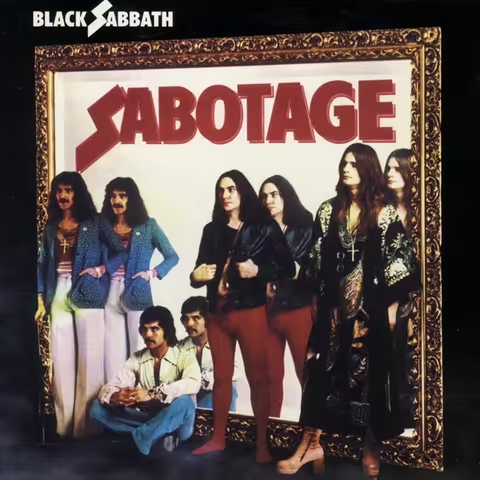
Few rock album covers have been mocked as consistently as the Sabotage sleeve. Loudwire put it on a list of the 50 worst album covers in 2012. The story of how it ended up looking the way it does is funnier than the result it produced. Graham Wright, Bill Ward's drum tech and a working graphic artist, conceived a mirrored-image cover with each band member appearing reflected in glass. The plan was for the four of them to dress in black for the photo session and for the design team to composite the images afterwards. The plan did not survive contact with Black Sabbath.
The band turned up at Morgan, believing this was a test shoot rather than the real one. No black costumes had been laid out. The designers carried on anyway, telling the band the images could be fixed in post. Ward wore a black leather jacket and his wife's red tights, with a pair of Ozzy's underpants underneath to preserve modesty, because his own jeans were filthy and the tights were the cleanest thing in the laundry pile. Ozzy was in a Japanese-style kimono. Butler was in chrome platforms. Iommi was the only member who looked even remotely like he had dressed for an album cover. The photo got published as-is. The first time most of the band saw it was on the shelves at their local record shop.
"I had this old pair of jeans that were really dirty, so I borrowed my wife's tights. And so that my bollocks wouldn't be showing under the tights, I also borrowed Ozzy's underpants, because I had none."
Bill Ward, in How Black Was Our Sabbath, recounted in Classic Rock, 2021
Wright was sanguine about the misfire decades later. "Ironically," he said, "the sleeve design that was intended to illustrate the idea of sabotage had instead become a victim of sabotage itself. By the time they saw it, it was too late to change." The album's back cover and inner sleeve are no kinder, with the band photographed in the same outfits in front of the mirror. The Sabotage sleeve has since been reissued in slightly cleaner colour-grades, most recently on the 2014 remaster and the 2021 Super Deluxe edition, but the fundamental composition has never changed. It is one of the few classic-rock covers where the entire band agreed, on the record, that they hated it.
Release and reception
Sabotage came out in the United States on 28 July 1975 and in the United Kingdom in September. On the UK Albums Chart it peaked at number 7, the same position Sabbath Bloody Sabbath had reached two years earlier. On the Billboard 200 it stalled at number 28. That was, in the context of the band's first six records, a clear step down: every previous Sabbath album had cracked the US Top 20, and Sabotage would prove to be the first Sabbath release not to be certified platinum in America. Internationally it performed at the high end of Sabbath's catalogue: number 6 in Norway, number 6 in Austria, number 17 in Germany, and chart placings in Canada, New Zealand, Belgium and Switzerland.
Contemporary press notices were better than the chart performance suggested. Billy Altman's Rolling Stone review (issue 196, 25 September 1975) opened with one of the most enthusiastic Sabbath sentences ever printed in a major US magazine: "Sabotage is not only Black Sabbath's best record since Paranoid, it might be their best ever." Altman picked out "the usual themes of death, destruction and mental illness running throughout this album" and singled out Hole in the Sky and Megalomania for praise. The British press was less convinced. Sounds and Melody Maker gave it lukewarm coverage. NME was indifferent, although by 1975 NME was indifferent to most things that were not glam, soul or the early stirrings of pub rock.
Retrospective reassessment has been kinder. AllMusic's Greg Prato called it the "final release of Black Sabbath's legendary First Six" while flagging that the chemistry was beginning to disintegrate. The Spin Alternative Record Guide rated it 9 out of 10. Sputnikmusic gave it 4.7 out of 5. Chuck Eddy ranked it 20th in his 1991 book of the 500 best heavy metal albums of all time and called it Sabbath's most eccentric record, a collection of "strange cut-up pastiches inside stranger cut-up pastiches" that anticipated Queensryche's Operation: Mindcrime by more than a decade. Rolling Stone returned to it in 2017 and placed it 32nd on the magazine's 100 Greatest Metal Albums of All Time list.
Awards-wise, there were none. The Grammys did not have a metal category until 1989, the Brit Awards did not exist in their current form, and Sabbath were, in 1975, the most influential rock band in the world that the British music establishment systematically refused to take seriously. The Mercury Prize was almost two decades away. What Sabotage has accumulated instead is critical rehabilitation, and it has been quietly relentless: Pitchfork, Paste, Decibel, Metal Hammer, Classic Rock and Kerrang! have all run pieces in the last decade describing it as the most underrated record in the Sabbath catalogue.
Singles and promotion
Black Sabbath did not promote albums in the way that the singles-driven side of the industry did. There was no music video for Sabotage in the modern sense: MTV was six years away, promo clips were rare for British heavy rock acts, and Sabbath's audience was a tour audience rather than a Top of the Pops one. Promotion happened on the road and on television specials.
| Single | Release date | B-side | Chart peaks | Notes |
|---|---|---|---|---|
| Am I Going Insane (Radio) | 13 February 1976 | Hole in the Sky | Did not chart in UK or US | Japanese release used different sleeve artwork; single edit prepared for radio but not widely circulated at the time |
The single's commercial failure is part of the Sabotage story, not separate from it. Am I Going Insane (Radio) is the most pop-shaped song on the record, but its title confused American programmers and its lyric did not. Without a hit single Sabotage relied entirely on the album as a unit, which is part of why it has aged so well. There was no radio-edit version of Symptom of the Universe to date-stamp the record. The most prominent television performance of the era was an appearance on Don Kirshner's Rock Concert, filmed at the Santa Monica Civic Auditorium during the US leg of the Sabotage tour. The setlist for that broadcast included Killing Yourself to Live, Hole in the Sky, Snowblind, War Pigs and Paranoid, and Iommi's guitar solo on Snowblind was accompanied by plastic snowflakes dropped from the lighting rig onto the band and the front rows.
The Sabotage tour: keyboards, KISS, and Ozzy's motorbike
The Sabotage tour ran from August 1975 until November of that year and was the first time Black Sabbath toured with a full-time keyboardist. Gerald "Jezz" Woodroffe joined the live line-up to cover the synthesiser parts on Am I Going Insane (Radio) and the choral arrangement of Supertzar. Sabbath used a backing tape for the choir parts and built a custom intro segment around Supertzar that became the band's walk-on music for the rest of the Ozzy era. The opening sequence, with the choir tape filling the arena and the four members appearing on a darkened stage, was, for the period, an unusually theatrical entrance for a heavy rock band.
KISS opened the bulk of the US dates, including some of the largest arena shows of the tour. The pairing was uneasy: KISS were ascendant, their stage show was bigger than Sabbath's, and several reviews of the time noted that the headliner was being outperformed by the support. The tour itself was cut short in November 1975 after Ozzy was injured in a motorcycle accident, the first of several Osbourne mishaps that would punctuate the remainder of the original line-up's career.
- The Don Kirshner's Rock Concert broadcast at Santa Monica Civic Auditorium, with around two thousand fans in the room and plastic snow falling during Snowblind.
- A 5 August 1975 show at the Convention Hall in Asbury Park, New Jersey, recorded in full and finally released officially on the 2021 Super Deluxe edition.
- The first tour appearances of Symptom of the Universe and Hole in the Sky, both of which entered Sabbath's live rotation almost immediately and stayed there.
- The introduction of Supertzar as the band's walk-on tape, a fixture from 1975 to the original line-up's final shows in 1978.
By the end of 1975 the band was, in Butler's words, "burned out". The Sabotage tour was supposed to be the start of a long campaign behind the album. It ended early, in a hospital ward, and Black Sabbath went home to assess the damage from the Meehan legal battle.
In film, TV and later media
Sabotage's songs have had a quieter sync life than the band's earlier catalogue. War Pigs, Paranoid and Iron Man are the Sabbath tracks that get licensed for car ads and superhero soundtracks; Hole in the Sky, Megalomania and Symptom of the Universe live mostly inside metal documentaries and music-press playlists. The most prominent on-screen appearance of a Sabotage track in the years immediately after release was Symptom of the Universe in the 1995 film The Jerky Boys, performed in-character by the band Helmet, with Ozzy in a brief cameo as their manager. The 2010 documentary God Bless Ozzy Osbourne featured extended footage from the Sabotage-era sessions, including Butler and Iommi discussing the lawsuit on camera for the first time in decades.
Megalomania appears in editorial use across multiple Sabbath retrospectives, including Mick Wall's 2015 biography Black Sabbath: Symptom of the Universe and Nolan Stolz's 2017 academic study Experiencing Black Sabbath, both of which treat the song as the band's most ambitious extended composition before the original line-up dissolved.
Lawsuits, lost money, and what Meehan cost the band
The Patrick Meehan lawsuit was not resolved on the back of Sabotage's release. The legal battle continued through 1976 and 1977. By the time it was settled, Butler later estimated, the band had spent thousands of dollars in legal fees, paid off a substantial chunk of Meehan's contractual claim to extricate themselves, and then walked straight into an Inland Revenue tax bill they could not pay. "We had to pay him off to get out of our contract," Butler said. "It cost us thousands of dollars of lawyers' bills. And then we got a huge tax bill. The Inland Revenue didn't sympathise with us. They blamed us for being naive. Most of our money went to lawyers and taxes."
Don Arden, later the father-in-law of Ozzy Osbourne and one of the most feared managers in British rock, took the band on in 1976 with day-to-day duties handled by Mark Forster, ironically a former Meehan employee. Arden could not stop the slide. The 1976 follow-up Technical Ecstasy stalled commercially. The 1978 album Never Say Die! went lower still. Ozzy was fired in 1979. Sabbath, with Ronnie James Dio replacing him, reinvented themselves for the new decade, but the original four-man chemistry that made the first six albums had been ruptured during the making of Sabotage, and the rupture never fully healed.
There was no censorship row, no banned video, no parental-advisory sticker. The single most controversial decision around Sabotage was internal: the band's choice to keep Blow on a Jug on the record. Some pressings dropped the hidden track entirely. Most kept it. None of the Sabbath members has ever been able to explain in interviews why it survived the final mix.
Covers, samples and tributes
Symptom of the Universe is the most-covered track on Sabotage by a long margin. Metallica have played it live regularly across the decades, including a 1995 cover during the band's club-tour reset. Sepultura recorded it for the 1995 Sabbath tribute Nativity in Black. Anthrax have used the riff as a soundcheck staple since their first European tours. Pantera and Bullet for My Valentine have both publicly cited the song's main riff as foundational. Yngwie Malmsteen named it as the first Iommi riff he ever heard.
Megalomania has been covered less often but more interestingly. The Cardigans recorded a lounge-style version for a 1999 Swedish compilation, an arrangement that strips out the heaviness to expose the song's underlying chord changes. Doom-metal bands from Cathedral to Electric Wizard have used its slow-building structure as a template. Supertzar has been used as walk-on music by multiple metal bands since Sabbath stopped touring it: Slayer, Anthrax and Metallica have all reportedly considered or used variations of the choral idea. The 1994 Nativity in Black tribute album, executive-produced by Anthrax's Scott Ian, drew on Sabotage's catalogue across multiple tracks.
Sabbath themselves did not borrow heavily on Sabotage. The album is one of the least sample-friendly in the catalogue, with too much narrative dialogue and choral material to lift cleanly. The major exception is the hidden track Blow on a Jug, which has been used as a found-sound element in DJ sets and ironic metal compilations for the last four decades.
Reissues, remasters and anniversaries
Sabotage has had three significant reissues. The 1996 Castle Communications remaster restored the original UK mix and corrected a long-standing pitch issue on early CD pressings. The 2009 Sanctuary remaster added expanded liner notes by Hugh Gilmour and confirmed several long-rumoured session details, including the origin of the baby crying on The Writ. The 2014 remaster, prepared as part of Sabbath's catalogue rebuild around 13, refined the dynamics and is the version represented by the cover art on this article.
The headline reissue is the 2021 Super Deluxe Edition. Released in June 2021 across four CDs (and a corresponding vinyl set), it added the full 5 August 1975 Asbury Park concert across two discs and a fourth disc collecting the Am I Going Insane (Radio) single edit and the Japanese-market single artwork. Critical reception was overwhelmingly positive. Metacritic aggregated a score of 92 out of 100 across major reviews. Paste called it "the lavishly packaged sound of indignant fury". Kerrang! described the package as "the closest thing we have to a Sabotage director's cut".
- 1986 Castle CD: first digital release; widely regarded as a pitchy, thin master.
- 1996 remaster: restored UK mix order, corrected pitch.
- 2009 remaster: improved dynamic range, new liner notes.
- 2014 remaster: catalogue-wide rebuild; basis for current streaming versions.
- 2021 Super Deluxe Edition: four discs, Asbury Park 1975, hardback book, replica seven-inch artwork.
There has not been an Atmos or spatial-audio mix of Sabotage at the time of writing. The band's catalogue has been remixed for spatial audio in stages, and Sabbath's surviving members have suggested in interviews that the original tapes for several tracks are in fragile condition. A full Atmos pass for Sabotage remains, as of 2026, one of the most-requested gaps in the catalogue.
Legacy: the album everyone underestimates
Sabotage occupies an awkward place in the Black Sabbath discography. Paranoid is the album everyone owns. Master of Reality is the album metal players reach for. Sabbath Bloody Sabbath is the critical favourite. Sabotage is the album people discover after the others, usually with the disorientation of realising the band were better in 1975 than the band's own history suggests. The original four-man line-up would record only three more albums together (Technical Ecstasy in 1976, Never Say Die! in 1978, and the Heaven and Hell-era reset with Dio in 1980), and none of them would match the focused fury of Sabotage's eight tracks.
The album's specific influence on thrash metal is more documented than any other Sabbath record. Symptom of the Universe is cited as a founding text by James Hetfield, Kirk Hammett, Scott Ian, Kerry King and Dave Mustaine. The Sabotage approach to song structure, with one-riff openers giving way to multi-section middle tracks giving way to choral-and-acoustic experiments, became the template thrash bands would either follow (Metallica's And Justice for All, Megadeth's Rust in Peace) or react against (Slayer's Reign in Blood).
"That album, it was so hard for us making it. But when I listen back to it now, God, it's incredible."
Bill Ward, Classic Rock, 2021
Within the band, Sabotage is the record around which the original line-up's later interviews keep returning. Ozzy has described it as the last Sabbath album he was completely engaged with before the rest of the 1970s became a blur. Butler has been more cautious, saying he is proud of the lyrics but cannot listen to the record without remembering the lawyers. Iommi has been the most positive of the four, calling it in Iron Man "the album where we proved we could make a heavy album and an experimental album in the same room at the same time". Ward's own assessment, given in 2021, is the one most often quoted: a band that took some knocks, and carried on, and made something incredible while it was being hit from every direction.
Things you might not know
| Fact | Detail |
|---|---|
| The album title is literal | Tony Iommi chose Sabotage because the band felt they were being "sabotaged all the way along the line", with writs being served at the mixing desk during the recording. |
| The first scream | The "Attack!" yell that opens Hole in the Sky was producer Mike Butcher shouting through the Tannoy from the control room, mimicking a support band's manager on a recent Sabbath tour. |
| Iommi multi-instrumentalist | Tony Iommi is credited on Sabotage with guitars, piano, synthesiser, organ and harp, the most varied set of instrument credits he received on any Sabbath album. |
| The baby on The Writ | The eerie crying that opens The Writ came from an unmarked cassette Mike Butcher found on a console at Morgan, played back at half speed; the tape was never claimed. |
| Geezer's friend | The unhinged laughter on the same intro belonged to an unnamed Australian friend of Butler's, recorded one evening when he was visiting London. |
| Bill Ward's outfit | The drummer's red tights on the cover were his wife's, borrowed because his own jeans were filthy; he wore a pair of Ozzy's underpants underneath for modesty. |
| Don't Start (Too Late) | The 49-second acoustic instrumental is named after tape operator David Harris, whose habit of pressing record a beat late earned him the album credit "saboteur". |
| The hidden track | Blow on a Jug was recorded in New York by Mike Butcher without the band knowing, capturing Ozzy and Bill Ward larking about at a piano with a brown cider jug. |
| Ozzy and the choir | Walking into Morgan and seeing 24 members of the English Chamber Choir warming up for Supertzar, Ozzy assumed he was in the wrong studio and walked out. |
| Charlie Watts at darts | Geezer Butler spent at least one evening of the sessions playing darts with Charlie Watts in Morgan's studio bar, on a board so battered they nicknamed it "Bill's beard". |
| Megalomania's origin | Butler's lyric was based on what he described as a single all-night heroin experience, during which he believed he was God and his mirror reflection was the Devil. |
| Iommi's instrument list | The Celtic harp on Supertzar was played by Iommi, who taught himself the necessary fingerings during the sessions; Will Malone conducted the choir while Iommi tuned. |
| Radio Rental | The "(Radio)" in Am I Going Insane (Radio) is not a radio-edit indicator; it is British rhyming slang, "Radio Rental" for "mental", confusing US radio programmers in 1976. |
| First touring keyboardist | Gerald "Jezz" Woodroffe became Black Sabbath's first full-time touring keyboardist on the Sabotage tour, brought in to cover the synth and choral parts live. |
| Don Kirshner snowflakes | During the band's Don Kirshner's Rock Concert broadcast at the Santa Monica Civic Auditorium, plastic snowflakes were dropped from the lighting rig onto the audience during Iommi's solo on Snowblind. |
Hear more on the Riffology podcast
Sabotage is one of the records the Riffology podcast keeps coming back to: a band at war with their own management, making proto-thrash and choral pieces in the same week, and producing something that the rest of metal would spend the next twenty years trying to catch up with. If this kind of long-form Black Sabbath storytelling is your thing, find the Riffology podcast on Spotify, Apple Podcasts, Pocket Casts or wherever you usually listen. New episodes drop regularly, and there is plenty more on the rest of the original line-up's catalogue.
Comments