In late summer 1992 a four-piece San Diego band called Mighty Joe Young finished their debut album for Atlantic Records, mastered it, picked an opening shipment date, and lost their name. A Chicago blues guitarist who had been recording as Mighty Joe Young since the 1960s sent a letter, the cease-and-desist arrived during mastering, and the band were left with a finished record, no group to release it under, and a release schedule that would not move. Singer Scott Weiland, who had carried a lifelong fondness for the red and green logo on STP Motor Oil cans, suggested keeping the initials. Guitarist Dean DeLeo proposed Stereo Temple Pirates. The band settled on Stone Temple Pilots, and the album they had spent May 1992 recording with a then little-known Atlanta producer named Brendan O'Brien was released as Core on 29 September 1992.
Within ten months it was sitting at No. 3 on the Billboard 200, "Plush" was at No. 1 on Album Rock Tracks, and Rolling Stone's readers had just voted Stone Temple Pilots the best new band of 1993 in the same issue in which the magazine's critics voted them the worst.
Album Facts
| Field | Detail |
|---|---|
| Artist | Stone Temple Pilots |
| Album | Core |
| Release Date | 29 September 1992 |
| Recorded | May 1992 |
| Studio | Rumbo Recorders, Canoga Park, Los Angeles |
| Producer | Brendan O'Brien |
| Engineer | Nick DiDia |
| Second engineer | Dick Kaneshiro |
| Mastering | Tom Baker |
| Label | Atlantic Records |
| Genre | Grunge, alternative metal, hard rock, alternative rock |
| Track Count | 12 |
| Total Runtime | 53:36 |
| Billboard 200 Peak | No. 3 (3 July 1993) |
| UK Albums Chart Peak | No. 27 |
| Other Notable Peaks | No. 8 Canada, No. 9 Sweden, No. 10 Netherlands, No. 11 New Zealand, No. 21 Austria, No. 22 Finland, No. 29 Australia |
| Certifications | US 8x Platinum, Canada 2x Platinum, Australia Platinum, New Zealand Platinum, UK Silver |
| Estimated US sales | 8,000,000 (RIAA shipments) |
| Singles | "Sex Type Thing" (September 1992) - "Plush" (February 1993) - "Creep" (1 November 1993) |
| Awards | 1994 Grammy, Best Hard Rock Performance with Vocal ("Plush") |
1992 in American Rock
September 1992 was, in retrospect, the single most concentrated month for American hard-rock debuts in the SoundScan era. Alice in Chains released Dirt the same month. Pearl Jam's Ten was still on its slow burn from August 1991 toward its peak position the following spring. Nirvana's Nevermind had hit No. 1 the previous January and was still in the upper reaches of the Billboard 200. Soundgarden were on tour with Badmotorfinger. The same month Core arrived, R.E.M.'s Automatic for the People, Bruce Springsteen's Human Touch, Faith No More's Angel Dust and Megadeth's Countdown to Extinction were all in the chart. The competition for radio rotation, MTV time and shop racking was as fierce as it has ever been in major-label rock.
Stone Temple Pilots arrived at the exact moment in which the music industry was learning how to market grunge. Atlantic was in the unusual position, for a major label in 1992, of having a brand-new band that read on paper as part of a movement they had no genuine geographic or scene connection to (San Diego, not Seattle) and a producer (O'Brien) whose previous work was Atlanta blues-rock rather than Pacific Northwest noise. The label's response was to lean into the connection rather than away from it: video budgets that emphasised flannel, press shots that emphasised long hair and stubble, a marketing push that put the band on tour as support for Megadeth and Rage Against the Machine. By the time critics caught up to the question of whether STP were a Seattle-style band or not, the band had already sold a million records.
From Soi-Disant to Mighty Joe Young
The thread that became Stone Temple Pilots started at a Black Flag concert in Long Beach in 1986, where the 18-year-old Scott Weiland and bassist Robert DeLeo realised, mid-set, that they were dating the same woman. Rather than fight about it they went home together, drank, and decided to start a band. They moved into a shared house in San Diego and began writing under the name Swing. Drummer Eric Kretz joined in 1987. Robert's older brother Dean, a guitarist living in New Jersey, was finally talked into moving west in 1989. The four-piece settled on the name Mighty Joe Young, after the 1949 Schoedsack and Cooper monster picture, and started playing the alternative-rock circuit in Southern California.
By 1991 they had built a steady following in San Diego and Los Angeles, and a five-song demo had reached Atlantic Records A&R man Tom Carolan. Carolan signed the band. Their working method going into pre-production was that Robert would write riffs and chord changes during the day at his job in a guitar shop, then bring them home to Weiland.
"When either one of us had a musical idea, we'd call each other. He would usually have more time to run over and work it out. It was perfect because, since I was at a guitar shop, I could pick up a guitar right there. Scott didn't really play an instrument. When he had an idea, he would hum it to me."
Robert DeLeo, Rolling Stone, 28 September 2017
Hiring Brendan O'Brien
Atlantic paired the band with Brendan O'Brien, a Georgia-based producer and multi-instrumentalist who in early 1992 was still better known as Rick Rubin's engineer-of-choice (he had recorded the Black Crowes' Shake Your Money Maker and The Southern Harmony and Musical Companion) than as a producer in his own name. Core would be O'Brien's first full producer credit on a major-label rock debut. He brought his engineer Nick DiDia with him; Dick Kaneshiro engineered the assistant chair. The combination of O'Brien and DiDia would go on to be the most prolific producer-engineer rock pairing of the next decade, but in May 1992 they were a pair of unknowns from Atlanta walking into Rumbo Recorders in Canoga Park, in the San Fernando Valley.
O'Brien's signature method was already in place: track the band live in a single room, treat the studio as a writing space, and finish songs in front of the players rather than around them. The whole album was tracked in May 1992 in roughly five weeks.
Recording at Rumbo
Rumbo Recorders was a converted bowling-alley studio owned by the Captain and Tennille, and by 1992 it was a workhorse rock room. Guns N' Roses had cut Use Your Illusion I and II there. Stone Temple Pilots set up in the main live room with minimal isolation. Robert DeLeo tracked his bass parts on a blue G&L L2000 Jazz Bass played through an Ampeg SVT with a Sennheiser 421 on the cabinet. Eric Kretz played a Yamaha Rock Tour Custom kit. Dean DeLeo recorded almost everything on the album on a 1978 Gibson Les Paul Standard.
The band's reference point, repeatedly, in interviews about the writing of Core, was a record that had been released twenty years earlier.
"You know how when you listen to a Led Zeppelin album, you listen to the entire album, not just the odd song? We wanted to make a record like that. We wanted to create a vibe which would run right through the whole album."
Robert DeLeo, Rolling Stone, 28 September 2017
The Led Zeppelin influence is audible. Where the band's grunge contemporaries were tracking dry and small (Cobain at Sound City, Vedder at London Bridge), Core was tracked big: long drum reverbs, fully harmonised bass lines, the kind of arrangement detail that came out of arena rock rather than punk. The record's heaviest moments owe more to Master of Reality and Mob Rules than to Bleach. "Sin", the album's six-minute centrepiece, uses the kind of stop-start hard-rock dynamic that Stone Temple Pilots would still be touring on twenty-five years later.
O'Brien's production decisions paid off in the room. Robert DeLeo's bass tone, run through the Ampeg SVT with no compression on the way to tape, sits unusually high in the final mix; the album is one of the few hard-rock records of its era in which the bass routinely drives the song rather than simply tracking the kick drum. Kretz's drums were close-mic'd but with the room mics committed to tape, giving the album its characteristic ambience. Dean DeLeo's guitar parts were almost all single-tracked, with O'Brien refusing the wall-of-overdubs approach that had defined hard-rock production through the late 1980s. The whole record clocks in under 54 minutes, with no fade-outs and no overdub solos longer than eight bars.
The Songs
| # | Title | Music | Length | Single? | Notes |
|---|---|---|---|---|---|
| 1 | Dead & Bloated | R. DeLeo, Weiland | 5:10 | No | Opens with a sampled Weiland vocal recorded through a Sony Walkman. |
| 2 | Sex Type Thing | D. DeLeo, Kretz | 3:37 | Yes (Sep 1992) | Lead single. Written from the point of view of a male predator; widely misread as endorsement. |
| 3 | Wicked Garden | R. DeLeo, D. DeLeo | 4:05 | Promo only | No. 11 on Mainstream Rock, No. 21 on Alternative Airplay without a formal single release. |
| 4 | No Memory | D. DeLeo | 1:20 | No | Acoustic instrumental interlude played by Dean DeLeo. |
| 5 | Sin | R. DeLeo | 6:04 | No | Album centrepiece. Six minutes of stop-start dynamic. |
| 6 | Naked Sunday | R. DeLeo, D. DeLeo, Kretz, Weiland | 3:49 | No | Only full-band writing credit on the record. |
| 7 | Creep | R. DeLeo | 5:34 | Yes (1 Nov 1993) | Third single; No. 2 on Mainstream Rock. |
| 8 | Piece of Pie | R. DeLeo | 5:24 | No | Originated as a demo called "Only Dying", recorded for The Crow soundtrack. Pulled after Brandon Lee's death and replaced with "Big Empty". |
| 9 | Plush | R. DeLeo | 5:13 | Yes (Feb 1993) | Album's biggest hit. No. 1 Album Rock for 17 weeks. Won the 1994 Grammy for Best Hard Rock Performance with Vocal. |
| 10 | Wet My Bed | R. DeLeo | 1:36 | No | Short vocal-collage interlude. |
| 11 | Crackerman | R. DeLeo, Kretz | 3:14 | No | Live-set staple from the first tour onward. |
| 12 | Where the River Goes | D. DeLeo, Kretz | 8:30 | No | Eight-and-a-half-minute closer. |
"Sex Type Thing" is the song that opened the band's commercial account and almost ended their critical one. The lyric is written in the first person from the point of view of a sexual aggressor; Weiland, who had been the victim of a sexual assault as a teenager, intended the song as a condemnation of the perspective it inhabits. It was very widely read as endorsement, including in Deborah Frost's notorious Entertainment Weekly review.
"Plush" arrived in February 1993 and changed the album's trajectory completely. Robert DeLeo had built the chord progression in open D tuning; Weiland wrote the lyric in a hot tub, drawing on a true-crime story he had read about a woman who had been kidnapped and found dead, repurposing the imagery as a metaphor for a relationship in collapse. Kretz cited the Mexican Day of the Dead and the band's anxieties about their own future as further inputs. The single went to No. 1 on Album Rock Tracks for seventeen consecutive weeks and reached No. 9 on Alternative Airplay. At the 1994 Grammys, "Plush" won Best Hard Rock Performance with Vocal, beating Aerosmith, Living Colour, the Smashing Pumpkins and Soundgarden.
"Creep", released as a single in November 1993 a year after the album, became the third Mainstream Rock top-three single from Core. "Wicked Garden" was never given a formal single release at all and still climbed to No. 11 on Mainstream Rock and No. 21 on Alternative Airplay on the strength of radio adoption alone.
"Piece of Pie" started life as a demo called "Only Dying", written specifically for the The Crow soundtrack at the request of the film's music supervisors. Brandon Lee's accidental on-set death in March 1993 led the band to withdraw the song, which they thought was inappropriate given the song's title and lyrical material. It was replaced on the soundtrack by "Big Empty", the lead single from Purple; "Only Dying" was reworked into "Piece of Pie" for Core.
Personnel and Credits
| Role | Player | Notes |
|---|---|---|
| Stone Temple Pilots | ||
| Lead vocals | Scott Weiland | Lyrics on every track. |
| Bass | Robert DeLeo | Wrote the music for "Sin", "Creep", "Piece of Pie", "Plush", "Wet My Bed" and "Crackerman". |
| Guitars | Dean DeLeo | Tracked the album almost entirely on a 1978 Les Paul Standard. |
| Drums | Eric Kretz | Yamaha Rock Tour Custom kit. |
| Production | ||
| Producer, mixing | Brendan O'Brien | His first full producer credit on a major-label rock debut. |
| Engineer | Nick DiDia | O'Brien's long-time engineering partner. |
| Second engineer | Dick Kaneshiro | |
| Mastering | Tom Baker | |
| Artwork | ||
| Art direction | Kevin Reagan / Design Hosmann | |
| Photography | Katrina Dickson | Inside booklet portraits. |
| Illustration | Christian Clayton | Cover image of Eve taking the apple from the Tree of Eden. |
The Cover and the Name Change
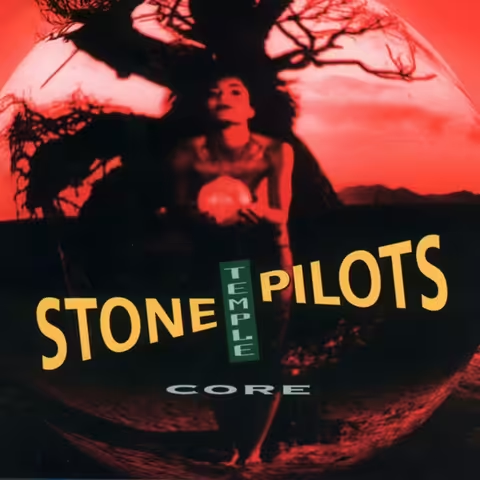
The cover illustration is by Christian Clayton, then a young Los Angeles painter working in a heavily stylised, religious-iconography mode. The image depicts Eve, mid-reach, taking the apple from the Tree of Eden. Weiland chose the album title Core as a reference both to the apple core in the Genesis story and to the band's intention to make a record that was "all spine, no fat". The Adam and Eve concept ran across the booklet: the inside imagery, shot by Katrina Dickson, paired the four band members with religious tableaux.
The whole package nearly came out under a different artist name. The band were still calling themselves Mighty Joe Young when they finished tracking. The album was scheduled for September, mastering was complete, and a cease-and-desist arrived from the lawyer for the Chicago blues guitarist Joseph "Mighty Joe" Young, who had been recording professionally under the name since the 1960s. With weeks until release, the band had to rename themselves on the fly. Weiland's STP Motor Oil fixation gave them the initials. Dean's "Stereo Temple Pirates" got the words. The final compromise was Stone Temple Pilots, and the band had a name only a few weeks before they had an album in record-shop racks.
Release and Critical Reception
Core was released on 29 September 1992. It entered the lower reaches of the Billboard 200 and stayed put for two months while "Sex Type Thing" picked up rock-radio play. The album was certified gold by the RIAA on 20 April 1993 and platinum on 9 June 1993. By 3 July 1993, with "Plush" at No. 1 on Album Rock Tracks, Core peaked at No. 3 on the Billboard 200. It has since been certified eight-times platinum, with approximately 8 million US copies shipped, and remains the band's best-selling album.
The critical reception was a different story. The lead single "Sex Type Thing" arrived in the middle of a contemporary debate about misogyny in hard-rock lyrics; the band's vocal resemblance to Eddie Vedder did them no favours either. Deborah Frost's Entertainment Weekly review of the album was the line in the sand.
"Mike Tyson's rape defense transcribed into grunge rock. It's unclear whether STP, which sounds like it has crash-landed Pearl Jam into Alice in Chains, is condemning or identifying with its narrator. With a real point of view, this band could be bigger than an accident."
Deborah Frost, Entertainment Weekly, 12 March 1993
Paul Evans in Rolling Stone wrote that "the inner child of Stone Temple Pilots is Iron Maiden, and that kid just won't quit howling". Robert Christgau gave the album a B-minus in The Village Voice and labelled it a "Turkey of the Year". The Spin Alternative Record Guide handed out four out of ten.
The trade press in the UK was warmer. Don Kaye gave the album four stars in Kerrang!, praising the "confidence and identity" rare in a debut. Jeremy Clarke in Select gave it four stars: "Core is the real thing, a tough, loaded and listenable set with enough identity to pre-empt accusations of copycat tail-chasing. What makes STP matter isn't just their sound, but that they're a respectable attempt at metal with brains."
The critic-versus-reader split crystallised in Rolling Stone's 27 January 1994 issue, in which the magazine simultaneously ran:
- A critics' poll naming Stone Temple Pilots Worst New Band of 1993.
- A readers' poll naming Stone Temple Pilots Best New Band of 1993.
Weiland would brood on the first reviews for the rest of his life.
"It was really painful in the beginning because I just assumed that the critics would understand where we were coming from, and that these just weren't dumb rock songs."
Scott Weiland, Entertainment Weekly, 2008
Singles and Music Videos
Three singles, in this order:
- "Sex Type Thing" - released September 1992 alongside the album. No. 23 Mainstream Rock, No. 60 UK. Video directed by Josh Taft, who shot Pearl Jam's "Alive" and "Even Flow", in a deliberate visual misreading-as-condemnation of the lyric. Picked up medium rotation on MTV.
- "Plush" - released February 1993. No. 1 Album Rock Tracks for 17 weeks, No. 9 Alternative Airplay, No. 18 Pop Songs, No. 23 UK. Two videos: the band-performance version and a separate MTV Unplugged version, both heavily rotated. The breakthrough single.
- "Creep" - released 1 November 1993. No. 2 Album Rock Tracks, No. 12 Alternative Airplay. Video directed by Kevin Kerslake (Nirvana's "In Bloom", "Come as You Are").
YouTube embed: Stone Temple Pilots, "Sex Type Thing" official music video.
Touring and Live
The first leg of the Core touring cycle was as support. In late 1992 Stone Temple Pilots opened for Megadeth on a US arena run; in early 1993 they opened for Rage Against the Machine on a US club tour. By the summer of 1993 they were headlining theatres and amphitheatres. Notable shows included a 17 July 1993 appearance at the Castaic Lake Natural Amphitheater outside Los Angeles, a slot at the 1993 Reading Festival on 27 August, and an MTV Unplugged taping in November 1993 that was held back until January 1994 for broadcast and not released on disc until the 2017 25th anniversary edition.
Television appearances followed in lockstep. A Saturday Night Live performance of "Plush" and "Big Empty" in April 1994 came just as Purple was about to be released. By the end of the Core-into-Purple touring cycle, the band were headlining arenas in their own right.
The early-tour shows had their own particular character. Weiland, in the first months on the road, was deliberately working against his own commercial moment. He took to performing in costume changes between songs, in heavy stage make-up, in dresses, in a Bing Crosby cardigan. The band built a long live arrangement of "Sin" with extended Robert DeLeo bass solos; "Wicked Garden" was routinely stretched to twice its album length. Several songs from the album that would become Purple ("Vasoline", "Big Empty", "Pretty Penny") were already in the set by the end of the Core tour, debuted live before they had been recorded.
Bootlegs of the early Core tour shows have been actively traded by the band's fanbase since 1993. The most commonly circulated of these (a 12 November 1992 club show at the Coach House in San Juan Capistrano, opening for Megadeth, and a 2 May 1993 show at the Roseland Theater in Portland with Butthole Surfers and Flaming Lips) capture a four-piece bar band still finishing the transformation from Mighty Joe Young into the act that would headline Lollapalooza two years later.
Reissues, Outtakes and the 25th Anniversary Box
The big reissue arrived on 29 September 2017. Rhino's Core 25th Anniversary Super Deluxe Edition packed four discs plus a vinyl LP and a DVD into a single boxed set: a remastered Core; a disc of demos and B-sides including "Only Dying" (the original Crow-soundtrack version of "Piece of Pie"), "Andy Warhol" and the band's cover of "Dancing Days"; a live disc compiled from the 17 July 1993 Castaic Lake show and the 1993 Reading Festival set; and the full MTV Unplugged session that had only previously circulated as a bootleg. The DVD added the MTV Unplugged broadcast in video form for the first time. Smaller-format Expanded and Deluxe editions covered the same material at lower price points.
Among the loose ends the boxed set finally tidied up: confirmed running orders for several demo versions; the first official release of the "Plush" acoustic Unplugged arrangement that had been a fixture of Weiland tribute reels since his death in December 2015; and a previously unreleased 12-inch picture-disc remix of "Sex Type Thing".
Legacy
The case for Core as a Pearl Jam knock-off, vigorously made in 1993, has not aged well. Almost everything specific to Core (the open-tuned acoustic intros, the half-time bridges, the unembarrassed use of arena-rock arrangement, the willingness to write a six-minute centrepiece and an eight-and-a-half-minute closer) has very little to do with Pearl Jam and a great deal to do with the band's 1970s reference points. Brendan O'Brien would go on to produce Vs. for Pearl Jam the following year on the back of his work here; he, DiDia and the rest of the team built the template for the 1990s American hard-rock record on this album.
The numbers tell the rest of it. Core is 8x platinum in the US, the band's best-selling record by a margin, and "Plush" remains one of the most-played songs in US rock-radio history. Rolling Stone placed the album at No. 11 in its 2019 list of the 50 Greatest Grunge Albums. Guitar World ranked it No. 10 in its top ten guitar records of 1992, the year of Dirt, Rage Against the Machine and Vulgar Display of Power. Loudwire and Revolver have repeatedly returned it to their best-of-1992 and best-grunge lists.
"STP always encouraged their own hype, so this fully-stocked monument to their introduction to the world is a fitting one."
Emma Johnston, Classic Rock / Louder, 6 September 2017
For the band itself, Core set a template that Purple would refine, Tiny Music would explode, and the post-2008 reunion records would return to. Scott Weiland's death in 2015 and Chester Bennington's brief tenure as his replacement aside, the surviving members are still on the road with songs from this album. As of 2026 the band continues to tour with Jeff Gutt on vocals; "Plush", "Sex Type Thing", "Creep" and "Wicked Garden" remain in the set every night.
Things You Might Not Know
| Fact | Detail |
|---|---|
| The Mighty Joe Young problem | The album was mastered, sequenced and scheduled under the band's original name. A cease-and-desist from Chicago bluesman Joseph "Mighty Joe" Young forced the rename to Stone Temple Pilots with weeks to go. |
| STP Motor Oil | Weiland kept proposing initials that matched the red and green logo on STP Motor Oil cans, a brand he had been fond of since childhood. |
| Dean DeLeo's first name | The first version Dean DeLeo proposed for the new band name was Stereo Temple Pirates. The final wording walked it back two words at a time. |
| The whole album was tracked in May 1992 | Core took roughly five weeks to record at Rumbo Recorders in Canoga Park. |
| One Les Paul, almost everything | Dean DeLeo recorded almost every guitar part on the album with a single 1978 Gibson Les Paul Standard. |
| "Piece of Pie" was the Crow song | The track originated as a Weiland demo called "Only Dying", offered to the The Crow soundtrack. The band pulled it after Brandon Lee's death; the slot was filled by "Big Empty" from Purple. |
| Brendan O'Brien's debut producer credit | Core was the first major-label rock debut O'Brien produced under his own name. He would go on to produce Pearl Jam, Rage Against the Machine and Soundgarden directly off the back of it. |
| 17 weeks at No. 1 on Album Rock | "Plush" held the top of the Billboard Album Rock Tracks chart for seventeen consecutive weeks in mid-1993. |
| A Grammy in their first year | "Plush" won the 1994 Grammy for Best Hard Rock Performance with Vocal, beating Aerosmith, Living Colour, the Smashing Pumpkins and Soundgarden. |
| Worst and Best New Band in the same issue | The 27 January 1994 issue of Rolling Stone declared the band Worst New Band in its critics' poll and Best New Band in its readers' poll on facing pages. |
| An eight-and-a-half-minute closer | "Where the River Goes", the last track, runs 8:30. The album also contains two short interludes ("No Memory" and "Wet My Bed") and a six-minute centrepiece ("Sin"). |
| The MTV Unplugged tape sat for 24 years | Pearl Jam's grunge-era Unplugged taping was released straightaway; Stone Temple Pilots' November 1993 Unplugged session was bootleg-only until the 2017 25th anniversary box. |
Podcast
The Riffology podcast covers Core as a full-episode deep dive on the Stone Temple Pilots debut. Subscribe wherever you get your podcasts, and follow the threads on the rest of the site from Core through Purple, Tiny Music, the 2010 reunion record, and the wider Brendan O'Brien production catalogue.
Comments