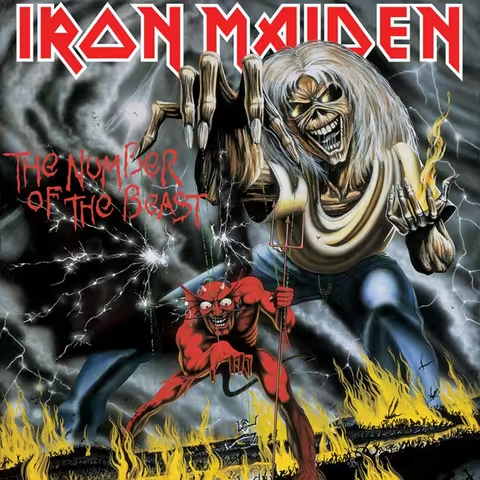
Martin Birch handed the garage invoice to Steve Harris and watched the bassist's face change. The producer had clipped a mini-bus during the Battery Studios sessions, a mini-bus reportedly carrying a group of nuns, and the repair bill that came back from the body shop was for exactly six hundred and sixty-six pounds. The band were halfway through cutting an album called The Number of the Beast, with a Derek Riggs painting of Eddie controlling Satan ready to go on the sleeve, and now the producer's car was in on the joke. Birch, the man who had produced Deep Purple's Machine Head and Black Sabbath's Heaven and Hell, was not generally a believer in omens. He paid it anyway.
The album that grew out of those few strange weeks at Battery Studios in early 1982 would do more to define what heavy metal sounded like for the rest of the decade than any record released that year. It was the first Iron Maiden album with Bruce Dickinson at the microphone, the last with Clive Burr behind the drums, and the first with Adrian Smith's name in the writing credits. It produced the band's first top-ten UK single, their first UK number one album, an American tour that picked up its own travelling 25-foot crucifix of protest, and a title track whose spoken Book of Revelation introduction had been turned down by Vincent Price for being too cheap a payday. Forty years on it has sold something in the region of twenty million copies, headed an HMV poll of the greatest British album of the previous sixty years, and earned its own BBC Classic Albums documentary. This is how all of that happened.
| Field | Detail |
|---|---|
| Artist | Iron Maiden |
| Album | The Number of the Beast |
| Release date | 22 March 1982 (US, Harvest / Capitol); 29 March 1982 (UK, EMI) |
| Producer | Martin Birch |
| Engineer | Martin Birch; Nigel Hewitt-Green (second engineer) |
| Studio | Battery Studios, London |
| Genre | Heavy metal, NWOBHM |
| Track count | 8 (original UK LP); 9 with "Total Eclipse" on later editions |
| Total runtime | 39:11 (original LP) |
| UK Albums Chart peak | 1 (entered at 1 on 10 April 1982, 31 weeks in top 75) |
| US Billboard 200 peak | 33 (entered at 150) |
| Other notable peaks | Austria 3, France 4, Finland 5, Netherlands 6, Sweden 7, Australia 8, Italy 10, Germany 11, Canada 11, Norway 13 |
| Certifications | UK Platinum (BPI); US Platinum (RIAA, 1986); Canada 3x Platinum; Australia Platinum; Gold in Germany, France, Italy, Japan, Netherlands, NZ, Poland, Spain, Switzerland, Austria, Belgium |
| Estimated worldwide sales | 14 million (2010, New York Times) to 20 million (2022, fortieth anniversary) |
| Singles | "Run to the Hills" (8 February 1982, UK 7); "The Number of the Beast" (26 April 1982, UK 18) |
Iron Maiden before The Number of the Beast
By the autumn of 1981 Iron Maiden had two albums, three years of relentless touring and a vocal problem. The self-titled debut, released in April 1980, had reached number four in the UK and made the band the standard-bearers of what the music press were calling the New Wave of British Heavy Metal. Killers had followed in February 1981, the first with Martin Birch behind the desk and the last with Dennis Stratton's replacement Adrian Smith now fully settled in on second guitar. The band had played their first dates in the United States, Canada and Japan, the latter producing the live EP Maiden Japan. They were no longer a pub-rock proposition. They were a touring rock act with an international booking sheet.
The problem was Paul Di'Anno. The original frontman had a punk swagger that had defined the first two records, but his stamina was deserting him. Long tours, late nights and substance use had eroded his voice, and the rougher, bluesier register he sang in was struggling with the more ambitious melodies Harris was beginning to write. Birch, who would later be unusually candid about it, said that he had simply not believed Di'Anno was capable of handling lead vocals on the kind of complicated directions Harris wanted to explore. Di'Anno was fired in September 1981 after the Killer World Tour wrapped, his final show with the band a gig at the Rainbow Theatre in London.
The arrival of Bruce Dickinson
The replacement was already known to Maiden's circle. Bruce Dickinson, then twenty-three, fronted the NWOBHM band Samson, whose drummer Thunderstick wore a leather executioner's hood on stage and whose set Steve Harris had seen first-hand. Harris had also caught Dickinson at the 1980 Reading Festival, and registered the voice. The audition was a formality. The contract was not.
Dickinson's deal with Samson's management was still in force, and the small print was unforgiving: he was barred from taking any songwriting credit on his first Iron Maiden record. He could sing the songs and he could rewrite them, but his name could not appear on the sleeve. According to several later interviews Dickinson made what he has called a "moral contribution" to "Children of the Damned", "The Prisoner" and "Run to the Hills", reshaping melodies and lyrics in the rehearsal room. None of that work is reflected in the credits, all of which on those three songs went to Steve Harris alone. It is one of the great asterisks of British rock songwriting.
The vocal upgrade was instant and obvious. Dickinson's operatic, four-octave attack let Harris write at the top of his ambition. Birch summed it up with characteristic dryness: "When Bruce joined, it opened up the possibilities for the new album tremendously."
The producer: Martin "Farmer" Birch
By 1982 Martin Birch was the most experienced hard-rock producer in Britain. He had engineered Deep Purple's Machine Head and produced their Burn, Stormbringer and Come Taste the Band. He had recorded Rainbow's Rising and Long Live Rock 'n' Roll, Whitesnake's first run of records, and Black Sabbath's two Ronnie James Dio-fronted classics, Heaven and Hell and Mob Rules. He had produced Killers for Maiden the previous year and the working relationship had already settled. The band trusted him. He understood that what they wanted was not a polished American radio record but a louder, sharper, more theatrical version of the band that played live.
His method was hands-on. He produced, engineered, mixed and where necessary refereed. Birch's nickname "Farmer" came from his unflappable down-to-earth manner in the control room, but his ear was uncompromising; he was prepared to keep a band on a take all night until the part snapped into place. Nigel Hewitt-Green was the second engineer.
Battery Studios and the five-week sprint
The sessions took place at Battery Studios in Willesden, north-west London. The band had less time than they wanted. According to Mick Wall's authorised biography Run to the Hills, recording and mixing both had to be completed in five weeks, after the group had used up too many of their pre-production days writing. Most Iron Maiden albums up to this point had been built from material road-tested before the band ever set foot in the studio. This one was different. Five of the eight tracks had been previewed at the back end of the Killer World Tour in November and December 1981, but the title track and "Gangland" were written from scratch in the studio, and "Invaders" was a rewrite of an older song called "Invasion".
The schedule pressure had consequences. Steve Harris has since said he regards "Invaders" as a weak opener that the band would have replaced if they had had anything better to hand. Birch worked them in long shifts to get vocals tracked, double-tracked guitars layered, and a single's worth of material mixed for an even earlier release than the album itself.
The 666 story
The Battery sessions also produced the body of folklore that has followed the record around ever since. Press reports of the time talked of lights snapping on and off, equipment failing without explanation, recording gear behaving strangely. The set-piece anecdote, repeated in the Classic Albums documentary and in Metal Hammer's 2005 thirtieth-anniversary feature, is Martin Birch's road accident. Birch's car was in a collision with a mini-bus said to be carrying a group of nuns. The body shop's repair quote came back at six hundred and sixty-six pounds. Maiden's lore has long held that the producer talked the garage into adjusting the figure to get out from under the curse; what is documented is the bill itself. It is one of the great recording-studio coincidences in rock, and it cost Birch a small fortune in retellings.
Vincent Price's fee and Barry Clayton's reading
The spoken introduction to the title track is one of the most recognisable thirty seconds in metal. "Woe to you, O Earth and sea, for the Devil sends the beast with wrath, because he knows the time is short." The band wanted Vincent Price to read it. The horror actor, then in his early seventies and still synonymous with the genre, quoted a fee of 25,000 pounds. The band were not prepared to pay it. They hired Barry Clayton, a British actor and radio voice, who delivered the lines with the sepulchral gravity of a midnight ghost-story host. The lines themselves are a loose paraphrase rather than a direct quotation from Revelation, despite what the original sleeve credits suggested.
"I simply didn't think Paul Di'Anno was capable of handling lead vocals on some of the quite complicated directions I knew Steve wanted to explore. When Bruce joined, it opened up the possibilities for the new album tremendously."
Martin Birch, quoted in Mick Wall, Iron Maiden: Run to the Hills (Sanctuary, 2004)
Personnel and credits
| Role | Player | Notes |
|---|---|---|
| Iron Maiden | ||
| Lead vocals | Bruce Dickinson | His debut Maiden album. Uncredited co-writer on "Children of the Damned", "The Prisoner" and "Run to the Hills". |
| Guitar | Dave Murray | Founder member, sole guitarist on the early lineup. |
| Guitar | Adrian Smith | First Maiden album with Smith as a credited writer ("The Prisoner", "22 Acacia Avenue", "Gangland"). |
| Bass, lead songwriter | Steve Harris | Sole or co-writer on all eight tracks. Source of the title-track nightmare. |
| Drums | Clive Burr | Final album with Maiden. Replaced by Nicko McBrain in December 1982. |
| Additional performer | ||
| Spoken word | Barry Clayton | Book of Revelation paraphrase that opens "The Number of the Beast". |
| Production | ||
| Producer, engineer | Martin "Farmer" Birch | Second of ten consecutive Maiden albums he would produce. |
| Second engineer | Nigel Hewitt-Green | Tracking and mix assistance at Battery. |
| Artwork | ||
| Cover illustration | Derek Riggs | Painting originally intended for the "Purgatory" single, held back by Rod Smallwood. |
| Cover concept | Rod Smallwood | Manager, also credited for some photography. |
| Photography | Ross Halfin, Simon Fowler, Toshi Yajima, Andre Csillag, Bob Ellis, P.G. Brunelli | Sleeve and inner photographs. |
| Reissue credits | ||
| Remastering (1998 CD) | Simon Heyworth | Restored the original black sky to the cover and "Total Eclipse" to the running order. |
The Iron Maiden of The Number of the Beast is a lean five-piece, with no guest musicians, no string sections, no producer-as-player credits. Barry Clayton's voice is the only sound on the record that does not come from the band themselves. That austerity is part of the album's character. Forty years of metal records have stacked on choirs, orchestras and uncredited ringers; this one is just five men in a room in Willesden, and that is exactly how it sounds.
The songs, side one
| # | Title | Writer(s) | Length | Single? | Notes |
|---|---|---|---|---|---|
| 1 | "Invaders" | Harris | 3:20 | Rewrite of an older Harris song, "Invasion". | |
| 2 | "Children of the Damned" | Harris | 4:34 | Inspired by the 1963 film and the John Wyndham novel The Midwich Cuckoos. | |
| 3 | "The Prisoner" | Smith, Harris | 6:03 | Opens with dialogue from the Patrick McGoohan TV series The Prisoner. | |
| 4 | "22 Acacia Avenue" | Harris, Smith | 6:34 | Charlotte the Harlot sequel; built on Adrian Smith's Urchin song "Countdown". | |
| 5 | "The Number of the Beast" | Harris | 4:25 | Yes | Spoken intro by Barry Clayton; inspired by a Steve Harris nightmare after Damien: Omen II. |
| 6 | "Run to the Hills" | Harris | 3:50 | Yes | First Maiden top-ten UK single; subject is the displacement of Native Americans. |
| 7 | "Gangland" | Smith, Burr | 3:46 | Clive Burr's only Maiden writing credit; Harris later said he regretted using it over "Total Eclipse". | |
| 8 | "Hallowed Be Thy Name" | Harris | 7:08 | Closing epic; widely cited as among the greatest metal songs ever written. |
"Invaders" opens the record at a sprint, all double-time gallop and Dickinson hitting the upper register inside the first bar. Steve Harris has been the song's harshest critic, calling it a placeholder; in context, it functions as a quick blast of the Killer-era Maiden before the album moves into more ambitious territory. "Children of the Damned" is the first sign of what the new line-up could do. Built on a clean, almost folk-rock arpeggio that erupts into one of the most quoted choruses in metal, it borrows its title from the 1963 film and its DNA from Black Sabbath's "Children of the Sea", an inspiration Dickinson acknowledged on his BBC Radio 6 tribute show after Ronnie James Dio's death.
"The Prisoner" arrives next, opening with a thirty-second clip of Patrick McGoohan and Leo McKern's dialogue from the 1967 ITV series. Maiden's manager Rod Smallwood had to telephone McGoohan himself in California to ask permission to use the audio. Smallwood describes the conversation as one of the most nervous of his career. McGoohan listened for a moment, established that the request had come from a rock band, and reportedly answered, "What did you say the name was? A rock band, you say? Do it." "22 Acacia Avenue" closes the first side, the second instalment in the Charlotte the Harlot saga that Harris had begun on the debut. The riff is older than Iron Maiden itself; Adrian Smith had written it years earlier in his pre-Maiden band Urchin under the title "Countdown".
The songs, side two
Side two opens with the album's most famous track and its most contested. "The Number of the Beast" began as a nightmare. Steve Harris had been up late watching the 1978 horror sequel Damien: Omen II and woke from a vivid dream that became the song's first verse. The lyric is partly Revelation, partly Robert Burns's Tam o' Shanter and partly Harris's own midnight cinema. After Barry Clayton's introduction the song breaks into a galloping bass figure that has become as identifiable a Maiden signature as Eddie himself. The lyric is unambiguously the perspective of a horrified witness rather than a worshipper. American religious groups, who took it the other way, were not paying close attention.
"Run to the Hills" follows. The lead single, released as a preview on 8 February 1982 in advance of the UK tour, was the first Maiden track recorded with Bruce Dickinson and the band's first UK top-ten single, peaking at number 7. Lyrically it is unusual: the first verse is sung from the perspective of the Native Americans suffering the European colonisation of North America, the second and third from the perspective of the cavalry. Dickinson, speaking at an IBM conference in Stockholm in 2012, revealed that the melody draws on the "rising sixth" interval, the same musical move he had heard analysed in a documentary on "My Way". The video used live footage and clips from a 1923 Buster Keaton parody called The Uncovered Wagon.
"Gangland" is the album's runt, by the band's own admission. Co-written by Adrian Smith and Clive Burr, it sits in the running order in place of "Total Eclipse", which had been pulled forward to fill the B-side of "Run to the Hills". The band had to choose between the two and chose wrong.
The album closes with "Hallowed Be Thy Name", seven minutes and eight seconds about a condemned man walking to his own hanging. The slow, mournful intro that builds into a sprinting double-time finale is one of the most studied arrangements in the genre. AllMusic calls it "perhaps the most celebrated of the band's extended epics". Dickinson has called it fantastic, and said that performing it live feels like narrating a film to the audience. It has stayed in nearly every Iron Maiden set since 1982, with only the Maiden England (2012 to 2014), the second leg of the Book of Souls (2017) and the Future Past (2023) tours leaving it off.
"We just chose the wrong track as the B-side. I think if 'Total Eclipse' had been on the album instead of 'Gangland' it would have been far better."
Steve Harris, quoted in Mick Wall, Iron Maiden: Run to the Hills (Sanctuary, 2004)
B-sides, outtakes and the Total Eclipse mistake
The album had only two real outtakes. "Total Eclipse" was co-written by Harris, Dave Murray and Clive Burr and recorded during the same Battery sessions. Forced to pick between "Total Eclipse" and "Gangland" for the running order, with the loser becoming the "Run to the Hills" B-side, the band sided with "Gangland" under time pressure. Both Harris and the band as a whole have spent four decades wishing they had done the opposite. "Total Eclipse" was added to the 1998 enhanced CD edition and replaced "Gangland" on the 2022 fortieth-anniversary vinyl, formally rewriting history.
The other notable B-side from the period is a live version of "Remember Tomorrow" pulled from the Hammersmith Odeon tapes, which appeared on the title-track single. Both B-sides have been collected on the 1995 Castle two-CD reissue, which incorrectly credited "Total Eclipse" to Paul Di'Anno.
The Derek Riggs cover and the blue-sky misprint
The sleeve painting was originally meant for a different record. Derek Riggs had produced it for the "Purgatory" single in 1981, but Maiden's manager Rod Smallwood decided it was too strong for a 7-inch picture sleeve and held it back for the album. The composition shows Eddie holding the strings of a horned Satan figure, who in turn is pulling the strings of a smaller Eddie below. Smallwood's stated concept was a question: who is really the evil one here, and who is manipulating whom? Riggs has said the framing came from a Doctor Strange comic he had read as a child in the 1960s, in which the villain held the hero on puppet strings. The hellscape behind the figures came from his reading of medieval European Christian art.
Riggs has admitted he made Satan look like Salvador Dali as a private joke. Satan was originally going to have wings made of lightning and smoke, which are still faintly visible in the finished piece, but Riggs ran out of time. The biggest production error was the sky: the original 1982 pressings show it as bright blue, the result of a printing mistake, when Riggs had painted it black. The 1998 CD remaster corrected the colour and every edition since has carried the intended grey-black sky. Gene Simmons of Kiss, asked his opinion of the sleeve in a 1993 Kerrang! interview, suggested it probably had "elves and dragons holding it up". Stormtroopers of Death parodied the painting on their 1999 album Bigger than the Devil.
Singles and music videos
| Single | Released | UK | Ireland | B-side | Video |
|---|---|---|---|---|---|
| "Run to the Hills" | 8 February 1982 | 7 | 16 | "Total Eclipse" (Harris / Murray / Burr) | Live footage cut with scenes from the 1923 Keaton parody The Uncovered Wagon |
| "The Number of the Beast" | 26 April 1982 | 18 | 19 | "Remember Tomorrow" (live, Hammersmith Odeon) | Performance video |
| "Run to the Hills" (live re-release) | 1985, 2002 | 26 (1985), 9 (2002) | 18 (1985) | Various live tracks | 2002 re-release proceeds to the Clive Burr MS Trust Fund |
| "Hallowed Be Thy Name" (live) | 4 October 1993 | 9 | 16 | "The Trooper", "Wasted Years", "Wrathchild" (all live) | Recorded at the Olympic Arena, Moscow, 4 June 1993 |
The "Run to the Hills" sleeve continued the Riggs Eddie-versus-Satan storyline, this time showing Eddie wielding a tomahawk. The single shifted faster than any Maiden release before it, and as of 2017 had sold more than 200,000 copies in the UK alone, earning a BPI Silver certification (later upgraded to Gold). The 2002 charity re-release for the Clive Burr MS Trust Fund, after Burr's multiple sclerosis diagnosis, charted at UK number 9, the band donating all proceeds.
Critical reception, then and now
Sounds, the British weekly that had championed the NWOBHM, gave the album a five-star review on release. Garry Bushell's enthusiasm was the early consensus in the UK metal press. AllMusic later called it "among the top five most essential heavy metal albums ever recorded, a cornerstone of the genre", and gave it the full five stars. Sputnikmusic awarded four and a half. Pitchfork, reviewing Maiden's first four reissues in 2018, scored The Number of the Beast at 9.0, with Andy O'Connor describing it as the moment the band found their voice.
J.D. Considine's contemporaneous Rolling Stone review, in the 24 June 1982 issue, was three and a half stars and warier in tone, treating Maiden as a band the magazine was prepared to take seriously rather than embrace. BBC Music's later retrospective by Sid Smith praised the complex arrangements directly: "Whereas even some of the venerable HM institutions (think Black Sabbath) would struggle to make material that was something more than a collection of minor-key riffs, Iron Maiden pull this feat off with considerable elan." The Daily Vault, decades on, settled on an A-minus.
The list placements have only accumulated. Q put it at number 100 in 100 Greatest British Albums Ever in 2000, at number 40 in 40 Best Albums of the '80s in 2006, and named it one of the 50 Heaviest Albums of All Time in 2001. Classic Rock ranked it number 15 in its 100 Greatest British Rock Albums and called it the most important metal album of the 1980s. IGN, Metal Rules and Rolling Stone all eventually placed it inside their respective top-five all-time metal album lists, with Rolling Stone settling on number 4 in 2017. In 2012 HMV ran a Diamond Jubilee customer poll for the best British album of the previous sixty years, and The Number of the Beast topped it, beating both Led Zeppelin IV and Sgt. Pepper. Robert Dimery's 1001 Albums You Must Hear Before You Die has it as one of only two Maiden records in the book.
Commercial performance and certifications
The album entered the UK Albums Chart at number one on 10 April 1982, the band's first chart-topper, and stayed in the top 75 for 31 weeks. In the United States it entered the Billboard 200 at 150 and climbed to number 33, a striking position for a heavy metal record at a time when American mainstream radio gave the genre almost no support. The RIAA certified it Gold on 4 October 1983 and Platinum in 1986. The BPI made it Platinum in the UK; Music Canada took it to three-times Platinum on shipments of 300,000.
Around the rest of the world it hit number 3 in Austria, 4 in France, 5 in Finland, 6 in the Netherlands, 7 in Sweden, 8 in Australia, 10 in Italy, and 11 in both Germany and Canada. The New York Times reported in 2010 that worldwide sales had passed 14 million; estimates around the 2022 fortieth anniversary regularly cited figures of around 20 million.
The American Christian backlash
The album walked into America at exactly the wrong moment for an act trading in horned mascots and Revelation imagery. Social conservatives in the United States, particularly in the Bible Belt, took the cover, title and lyric of the title track as proof that Maiden were Satanists. Public burnings of the band's records were organised. One religious group, the Wall biography records, refused to burn the LPs at all out of concern about toxic fumes from the vinyl, and broke them up with hammers instead; the documentation is silent on whether the anxiety was theological or toxicological. The subsequent US tour was picketed at multiple venues; protestors handed out leaflets, and at one date a 25-foot wooden cross was carried into the parking lot. None of it slowed the album down.
"It was mad. They completely got the wrong end of the stick. They obviously hadn't read the lyrics. They just wanted to believe all that rubbish about us being Satanists."
Steve Harris, quoted in Mick Wall, Iron Maiden: Run to the Hills (Sanctuary, 2004)
The Beast on the Road tour
The supporting tour was named, inevitably, The Beast on the Road. It ran from February 1982 through to December 1982, taking in the UK, Europe, North America, Japan and Australia. Highlights of the British leg included shows at the Hammersmith Odeon in London, recorded for posterity and eventually released as Beast over Hammersmith in 2002. On the European leg Maiden played their first dates behind the Iron Curtain. In North America they served as the support act on tours by Rainbow, Judas Priest and Scorpions, frequently stealing the headliner's audience on the way through. The Reading Festival on 28 August 1982 gave them a victorious home crowd just as the album's chart run was peaking.
- Touring routes ran across the UK in February and March, then Europe, the US, Canada, Japan and Australia.
- The Rods supported on early UK dates.
- US tour incidents included the 25-foot cross protest and several venue cancellations under religious pressure.
- The Hammersmith Odeon performance on 20 March 1982 is the most widely circulated live recording of the album material with Clive Burr on drums.
The aftermath: Clive Burr and the McBrain line-up
Clive Burr finished the US leg in difficulty. The cause has been described in different ways by different members of the band: family bereavement, exhaustion, the pace of the tour, and a relationship with the road that did not match Harris's. By the time Maiden returned to Europe in autumn 1982 Burr was out and Nicko McBrain, the former Trust drummer who had played support to Maiden the previous year, was in. The official announcement was in December 1982. McBrain's first studio album with the band would be 1983's Piece of Mind. He remained Maiden's drummer for the next forty-two years, finally stepping back from touring in December 2024.
Clive Burr toured intermittently afterwards and was diagnosed with multiple sclerosis in the mid-1990s. He died in March 2013. The Clive Burr MS Trust Fund, established by the band, has channelled royalties from the 2002 "Run to the Hills" re-release and various live recordings into research and patient support.
Legacy and influence
The line of influence runs through almost every metal band that mattered in the rest of the decade. Lars Ulrich was at the Hammersmith shows. Slayer, Megadeth, Anthrax and Metallica have all credited Maiden's NWOBHM template, and The Number of the Beast in particular, as the moment that showed thrash how dynamics, narrative scope and operatic vocals could co-exist with speed. Dream Theater played the album in full at La Mutualite in Paris on 24 October 2002, an entire show that was released as an official bootleg. Machine Head, Cradle of Filth, Iced Earth, Therion, Michael Schenker and Billy Corgan's Djali Zwan have all recorded album tracks. The title track has been a fixture in syncs from Tony Hawk's Pro Skater 4 and Guitar Hero III through to 28 Years Later: The Bone Temple.
In its own discography it is the album that broke Iron Maiden out of cult success. Piece of Mind (1983), Powerslave (1984), Live After Death (1985), Somewhere in Time (1986) and Seventh Son of a Seventh Son (1988) all followed, all produced by Birch, all building on what The Number of the Beast had established about the band's ambition and theatricality.
The Hallowed Be Thy Name lawsuit
A footnote that nobody saw coming for thirty years: a section of the "Hallowed Be Thy Name" lyric was lifted from a 1973 song called "Life's Shadow" by an obscure British band called Beckett, whose agent at the time was a young Rod Smallwood. Harris had seen Beckett perform "Life's Shadow" live as a teenager and, according to Maiden's lawyers in the eventual proceedings, used the lines as a placeholder he did not get round to changing before the album's release. Harris and Dave Murray settled with one of the song's credited writers, Robert Barton, in the 1980s. The other writer, Brian Ingham, was unaware until 2011 and pursued his own claim through the High Court. On 12 March 2018 the case was settled out of court, with the band's spokesperson citing pragmatic reasons and escalating legal costs.
Reissues, remasters and anniversaries
The album has been reissued and repackaged repeatedly. The 1995 Castle two-CD limited edition added "Total Eclipse" and a live "Remember Tomorrow" as bonus material. The 1998 EMI / Sanctuary enhanced CD, remastered by Simon Heyworth, restored "Total Eclipse" to the album proper, included the music videos for the title track and "Run to the Hills" as video files, and corrected the original blue-sky cover misprint to the black sky Derek Riggs had painted in the first place. A 1998 vinyl reissue followed.
For the fortieth anniversary in 2022 EMI released a retro cassette edition on 18 March 2022 (UK and Europe) and 25 March 2022 (US), and a three-LP package on 18 November 2022 bundling the album with Beast over Hammersmith, the long-bootlegged 20 March 1982 Hammersmith Odeon show. The 2022 vinyl edition formally replaced "Gangland" with "Total Eclipse" in the running order, a forty-year-old executive decision finally undone. A BBC Classic Albums documentary on the record was filmed in 2001 and remains the single most useful piece of behind-the-scenes footage for anyone wanting to hear Birch, Harris, Dickinson, Murray and Smith talk about the sessions on camera.
Things you might not know
| Fact | Detail |
|---|---|
| The 666 garage bill | Martin Birch's car collided with a mini-bus reportedly carrying a group of nuns during the sessions, and the body-shop quote came back at exactly 666 pounds. |
| Vincent Price's quote | The horror actor asked 25,000 pounds to read the spoken intro to the title track; Maiden hired Barry Clayton instead, for a fraction of that. |
| Dickinson's missing credits | An outstanding contract with his previous band Samson barred Bruce Dickinson from any writing credit on his Maiden debut, despite his shaping of "Children of the Damned", "The Prisoner" and "Run to the Hills". |
| The blue sky misprint | The original 1982 sleeve background printed bright blue by mistake; Derek Riggs had painted it black, and the 1998 CD remaster restored the intended colour. |
| 22 Acacia Avenue's earlier life | The riff predates Iron Maiden. Adrian Smith wrote it years earlier in his pre-Maiden band Urchin, under the title "Countdown". |
| The Prisoner permission call | Manager Rod Smallwood telephoned the actor Patrick McGoohan personally to ask permission to use the dialogue clip; McGoohan reportedly answered, "What did you say the name was? A rock band, you say? Do it." |
| Hallowed Be Thy Name lawsuit | A section of the lyric was lifted from a 1973 song by the band Beckett. The case was eventually settled out of court in March 2018. |
| The Total Eclipse mistake | The band picked "Gangland" over "Total Eclipse" for the album. The 1998 CD reissue restored "Total Eclipse" to the tracklist, and the 2022 fortieth-anniversary vinyl replaced "Gangland" with it entirely. |
| Records smashed, not burned | One US religious group refused to burn Maiden's LPs and broke them with hammers instead, apparently worried about toxic fumes from burning vinyl. |
| Clive Burr's only credit | "Gangland" is Clive Burr's only Iron Maiden songwriting credit. He was out of the band by December 1982. |
| Run to the Hills tempo | The song clocks in at 178 BPM in G major; Dickinson revealed at an IBM conference in Stockholm that the melody is built on the "rising sixth" interval, the same one used in "My Way". |
| The Salvador Dali joke | Derek Riggs admitted he gave the cover's Satan figure the face of Salvador Dali as a private gag. |
| HMV's Diamond Jubilee poll | In 2012 HMV asked customers to vote for the best British album of the previous sixty years. The Number of the Beast won, beating Led Zeppelin IV and Sgt. Pepper. |
| Hammersmith Odeon, March 1982 | The 20 March 1982 Hammersmith show was eventually released as Beast over Hammersmith and bundled with the album's 2022 fortieth-anniversary three-LP package. |
Final thoughts
Few records have had to do as much work as The Number of the Beast did in five weeks at Battery Studios in early 1982: introduce a new singer, rewrite the songwriting partnership, finish ahead of schedule, withstand a 666 invoice from a north London body shop and a 25,000-pound brush-off from Vincent Price, and become the launchpad for a band that has now sold more than 130 million records. It is the album where Iron Maiden stopped being a NWOBHM contender and became the dominant heavy metal band of the 1980s, and the template for nearly every major metal record that followed. The Riffology podcast episode on the record goes deeper into the recording stories, the lyric arguments and the long shadow of the 666 bill; it is available on all major podcast platforms.
Comments