
Atlantic Records were told they could not have it. The master tapes for Led Zeppelin's fourth album sat in Jimmy Page's possession until the label agreed to release a record with no title, no band name and no catalogue number on its spine, just four hand-drawn symbols on the inner sleeve. A press agent told Page it was professional suicide after a year away from touring. Page's answer, recorded later by the Trouser Press: "We just happened to have a lot of faith in what we were doing."
Recorded between December 1970 and February 1971, mostly in a draughty Victorian poorhouse in Hampshire called Headley Grange with the Rolling Stones' mobile truck parked in the drive, the album that fans came to call Led Zeppelin IV welded acoustic folk to riff-driven hard rock, smuggled an eight-minute song called "Stairway to Heaven" onto FM radio without ever issuing it as a single, and produced the most-sampled drum break in popular music. It has since sold more than 37 million copies and sits at 24-times platinum with the RIAA.
| Field | Detail |
|---|---|
| Artist | Led Zeppelin |
| Album | Led Zeppelin IV (untitled, also known as Four Symbols, Zoso, Runes) |
| Release date | 8 November 1971 |
| Label | Atlantic Records |
| Producer | Jimmy Page |
| Engineer | Andy Johns; mixing also by George Chkiantz |
| Studios | Headley Grange (Hampshire) with Rolling Stones Mobile; Island Studios, London (Basing Street); Sunset Sound, Los Angeles (mix) |
| Genre | Hard rock, folk, blues rock |
| Track count | 8 |
| Total runtime | 42:37 |
| UK Albums Chart peak | 1 (90 weeks on chart) |
| US Billboard 200 peak | 2 (held off by Sly and the Family Stone's There's a Riot Goin' On and Carole King's Music) |
| Certifications | RIAA 24x Platinum; BPI 6x Platinum; Music Canada 2x Diamond |
| Estimated sales | Over 37 million worldwide |
| Singles | "Black Dog" / "Misty Mountain Hop" (2 December 1971); "Rock and Roll" / "Four Sticks" (21 February 1972, US promo) |
Cultural context: rock in late 1971
The autumn of 1971 was crowded. Within twelve months Led Zeppelin IV was released into a marketplace already carrying:
- The Rolling Stones, Sticky Fingers (April 1971)
- Jethro Tull, Aqualung (March 1971)
- The Who, Who's Next (August 1971)
- Black Sabbath, Master of Reality (July 1971)
- Deep Purple, Fireball (September 1971)
- John Lennon, Imagine (September 1971)
- Pink Floyd, Meddle (November 1971)
- David Bowie, Hunky Dory (December 1971)
- T. Rex, Electric Warrior (September 1971), at UK number one when Led Zeppelin IV arrived
Headley Grange itself sat inside that scene. Andy Johns, the engineer Page recruited, had just finished work on Sticky Fingers; it was Johns who pushed the band toward the Rolling Stones Mobile Studio after the band considered, then rejected, recording at Mick Jagger's house Stargroves. Atlantic Records was simultaneously the home of Aretha Franklin, Otis Redding's catalogue, and the new wave of British rock the label had bet on with Led Zeppelin's first three albums.
Led Zeppelin III and the critical backlash
To understand the fourth album you have to understand what greeted the third. Released in October 1970, Led Zeppelin III had pivoted hard into acoustic and folk material, much of it written at Bron-Yr-Aur, the Welsh cottage Page and Plant retreated to after their fifth American tour. Critics, expecting a follow-up to the riff-heavy Led Zeppelin II, were either bemused or actively dismissive. Rolling Stone in particular had been derisive about Zeppelin from the band's debut onward, and III gave reviewers another stick.
Page told The Times in 2010 that the symbols-only sleeve of the next album was a direct response. The critics, he said, could not seem to review one Zeppelin record without referencing earlier ones, so he decided to take the references away. There would be no title, no band name, no chart-friendly hook on the spine. The four members would each pick a glyph and the music would have to do the rest.
"Out of eight cuts, there isn't one that steps on another's toes, that tries to do too much all at once."
Lenny Kaye, Rolling Stone, 23 December 1971
Bron-Yr-Aur and pre-production
Page and Plant had returned to Bron-Yr-Aur in the summer of 1970 to write. The first fragment of "Stairway to Heaven" came together there one evening, with Page running a cassette recorder beside him and stitching together pieces of taped music. Other songs, "Going to California" and "The Battle of Evermore" among them, drew on the same acoustic palette and the same Tolkien and folk-revival reading the band were doing on tour buses.
The full lineup reconvened at Island Studios on Basing Street in London on 5 December 1970 to begin tracking. "Black Dog" was the first song attempted there; an early pass at "When the Levee Breaks" was also tried at Island and abandoned because, in Page's words, it sounded flat. After roughly a month the band moved south to Headley Grange in Hampshire, the same country house where Led Zeppelin III had been partly demoed.
Headley Grange and the Rolling Stones Mobile
Headley Grange was a Victorian poorhouse-turned-rural-rental that, by 1970, was cold, damp, supposedly haunted, and almost completely free of distractions. John Paul Jones told biographer Dave Lewis that the lack of a bar or any leisure facilities was precisely the point: there was nothing to do except play. Page parked the Rolling Stones Mobile in the drive, ran cables up to the house, and let the band write and record in the same rooms. Songs grew out of soundcheck-style jamming in hallways, on the stairs and in front of the fireplaces.
Andy Johns engineered. Ian Stewart, the Rolling Stones' original pianist and the steward of the mobile truck, dropped by, sat down at an upright in the rehearsal room and ended up playing on "Rock and Roll". The track came directly out of a jam: Bonham started hammering out the intro to Little Richard's "Keep A-Knockin'", Page pulled a riff over it, Stewart joined in, and within minutes the band had a song. It was finished in roughly 15 minutes of writing time.
The communal arrangement also gave Bonham the room he needed. The drummer's snare and kick had always been recorded close-miked on the first three albums; at Headley Grange, with high-ceilinged rooms and a stone-floored entrance hall, Johns and Page started thinking of the building itself as part of the kit.
The stairwell drum sound on When the Levee Breaks
The story has hardened into rock folklore, but it is true. After the failed Island Studios attempt at "When the Levee Breaks", Bonham set up his Ludwig kit in the lobby at Headley Grange, at the foot of a three-storey stone staircase. Andy Johns suspended two Beyerdynamic M 160 ribbon microphones above the stairwell, fed them through a pair of Helios F760 compressor-limiters set aggressively enough to create a breathing pump, and added a Binson Echorec for delay. Bonham counted in, and the room did the rest.
"I just stuck the mics up the stairwell, two M 160s, and that was the sound. It was the room as much as it was John."
Andy Johns, MusicRadar interview, 2013
Parts of the song were tracked at a faster tempo and slowed down on tape, which is why the harmonica and the slide guitar sound so syrupy and pulled-down. "When the Levee Breaks" was the only track on the album mixed at Sunset Sound in Los Angeles; the rest were eventually remixed back in London. Page singled out the panning at the song's fadeout, where everything except Plant's voice begins to swirl, as one of his proudest mixes.
The break Bonham played in those first eight bars has become one of the most-sampled drum recordings in pop history, turning up on records by Eminem, Dr. Dre, the Beastie Boys, Mike Oldfield, Sophie B. Hawkins, Beyonce ("Don't Hurt Yourself", 2016) and dozens more.
Personnel and credits
| Role | Player | Notes |
|---|---|---|
| Core band | ||
| Vocals, harmonica | Robert Plant | Harmonica on "When the Levee Breaks" |
| Electric and acoustic guitars, mandolin, production | Jimmy Page | Mandolin on "The Battle of Evermore"; production and final mix decisions; remastering 1990 and 2014 |
| Bass, electric piano, mandolin, recorders, synthesiser | John Paul Jones | Recorders on the intro to "Stairway to Heaven"; analog synth on "Four Sticks" |
| Drums | John Bonham | Ludwig kit; co-credited on "Rock and Roll" and "When the Levee Breaks" |
| Guest musicians | ||
| Duet vocals | Sandy Denny | "The Battle of Evermore"; the only female voice on a Led Zeppelin studio recording. Awarded her own symbol on the inner sleeve as an asterisk. |
| Piano | Ian Stewart | "Rock and Roll"; the Rolling Stones' founder-pianist, in the building because of the mobile truck |
| Production | ||
| Engineering, mixing | Andy Johns | Recommended the Stones' mobile after engineering Sticky Fingers |
| Mixing | George Chkiantz | Worked alongside Johns at Island Studios |
| Executive production | Peter Grant | Manager; refused every Atlantic request to issue "Stairway to Heaven" as a single |
| Artwork | ||
| Photography | Keith Morris | Cover photograph composition |
| Inner illustration | Barrington Coleby (credited "Barrington Colby M.O.M.") | "The Hermit", influenced by the Rider-Waite tarot card of the same name |
| Design coordination | Graphreaks | Sleeve layout |
The songs, side by side
Side one moves at sprint pace and ends with a hymn. Side two opens at a stoned trot and finishes with a flood. There are eight tracks across 42 minutes, with no filler and no decorative connective tissue between them. Several of the songs were nearly something else first.
Side one
"Black Dog" takes its name from a stray Labrador that wandered around Headley Grange during the sessions. Jones devised the call-and-response riff to confuse the listener about where the bar lines fell; it went through several rehearsal-room iterations before the band could play it cleanly. Plant's a cappella interjections were modelled on Fleetwood Mac's "Oh Well", and Page recorded the outro solos plugged directly into the mixing desk without an amplifier.
"Rock and Roll" emerged from the Bonham/Stewart/Page jam in 15 minutes and was bolted on as a side-one curtain raiser. Plant's lyric, written quickly, is a knowingly nostalgic snapshot of the early rock and roll the band had grown up on. Stewart's piano, banged out on whatever upright was in the room, gave the track its barrelhouse feel.
"The Battle of Evermore" was an accident of instruments. Page picked up a mandolin Jones had left lying around, taught himself the chord shapes, and wrote the song almost in one sitting. Plant's lyrics drew on a book he had been reading about the Scottish Independence Wars and on Tolkien. Sandy Denny of Fairport Convention was invited to sing the part of the town crier opposite Plant's narrator. She remains the only female vocalist credited on a Led Zeppelin studio album, and was awarded her own three-triangle symbol on the inner sleeve.
"Stairway to Heaven" began at Bron-Yr-Aur and was finished at Headley Grange, with Plant scribbling lyrics next to the fire while Page strummed chord shapes. The basic track was cut at Island Studios with Bonham on drums, Jones on electric piano and Page on acoustic guitar. Jones added four overdubbed recorders for the introduction. Page recorded three takes of the closing solo on a 1959 Fender Telecaster Jeff Beck had given him during their Yardbirds days, plugged into a Supro amplifier, and chose the best of the three. The song was first played live at Belfast's Ulster Hall on 5 March 1971; Jones later recalled the audience was bored, "all waiting to hear something they knew". Atlantic Records pressed for it as a single in 1972 and 1973. Manager Peter Grant refused every time. The eight-minute, single-less anthem became the most-requested track on FM rock radio in the United States.
"I knew it was good. I didn't know it was going to become like an anthem, but I did know it was the gem of the album, sure."
Jimmy Page, quoted in Cross and Flannigan's Heaven and Hell, 1991
Side two
"Misty Mountain Hop" was written at Headley Grange around Jones's electric piano figure. Plant's lyric was inspired by a real altercation between students and police over drug possession; the title is lifted from The Hobbit. "Four Sticks" took its name from Bonham playing the entire song with two drumsticks in each hand; Jones added an analog synth line, and the band needed several attempts to get a clean take. Page and Plant later re-recorded it with members of the Bombay Symphony Orchestra in 1972, a version eventually released on the deluxe edition of Coda.
"Going to California" was an acoustic track originally titled "Guide to California", changed when the band travelled to Los Angeles for the album mix. Jones played mandolin and bass; Page fingerpicked acoustic guitar; Plant's lyric is part Joni Mitchell tribute, part travelogue about Californian earthquakes and unattainable women.
"When the Levee Breaks" closes the album. Plant brought the original Memphis Minnie and Kansas Joe McCoy recording from 1929 to the band; Page rebuilt it around a one-chord modal drone rather than the original twelve-bar structure; Bonham's drums, recorded in the lobby as described above, drove the rest. Plant added a tape-slowed harmonica part. Memphis Minnie eventually received writing credit alongside the four band members.
| # | Title | Writers | Length | Notes |
|---|---|---|---|---|
| 1 | Black Dog | Page, Plant, Jones | 4:55 | Lead single (with "Misty Mountain Hop" as B-side) |
| 2 | Rock and Roll | Page, Plant, Jones, Bonham | 3:40 | US promo single, February 1972 |
| 3 | The Battle of Evermore | Page, Plant | 5:51 | Sandy Denny duet vocals |
| 4 | Stairway to Heaven | Page, Plant | 8:02 | Never released as a commercial single during the band's career |
| 5 | Misty Mountain Hop | Page, Plant, Jones | 4:38 | B-side of "Black Dog" |
| 6 | Four Sticks | Page, Plant | 4:45 | B-side of "Rock and Roll"; later re-recorded with Bombay orchestra |
| 7 | Going to California | Page, Plant | 3:32 | Working title "Guide to California" |
| 8 | When the Levee Breaks | Page, Plant, Jones, Bonham, Memphis Minnie | 7:08 | Reworking of the 1929 Kansas Joe McCoy and Memphis Minnie original |
Outtakes and songs that got away
Three Headley Grange songs were tracked but held back from the album: "Down by the Seaside", "Night Flight" and "Boogie with Stu" (the latter featuring Ian Stewart on piano, hence the name). All three eventually surfaced four years later on the double album Physical Graffiti. An early version of "No Quarter" was also attempted at the sessions and shelved; it would be rebuilt entirely for Houses of the Holy. The first attempt at "When the Levee Breaks", recorded at Island Studios in December 1970, was repurposed as "If It Keeps On Raining" and finally issued on the 2015 Coda reissue.
- "Down by the Seaside" (released on Physical Graffiti, 1975)
- "Night Flight" (released on Physical Graffiti, 1975)
- "Boogie with Stu" (released on Physical Graffiti, 1975)
- "No Quarter", early demo version (rerecorded for Houses of the Holy, 1973)
- "If It Keeps On Raining" / early "When the Levee Breaks" (released on Coda reissue, 2015)
Artwork and the four runes
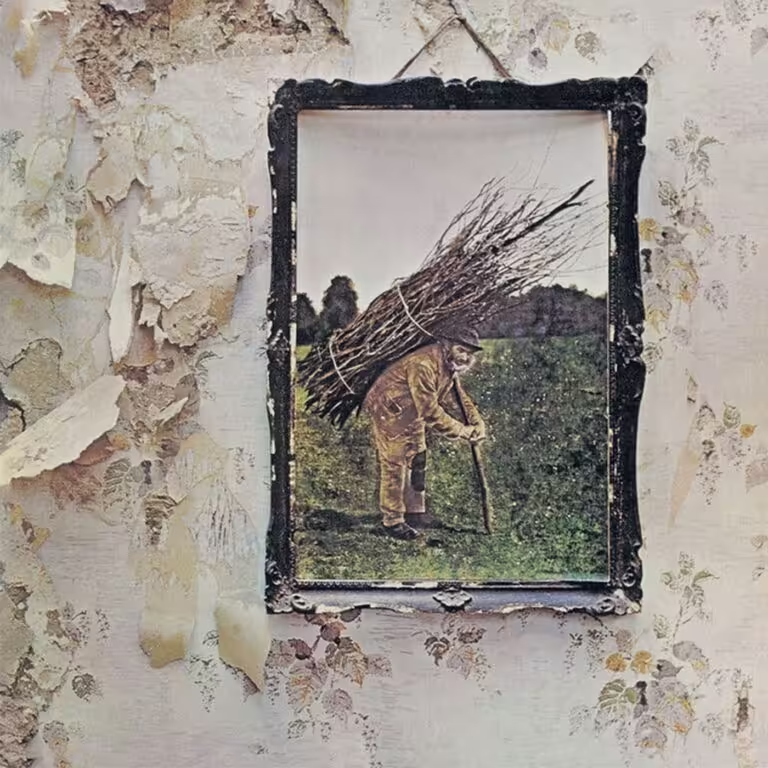
Plant bought the framed picture of the old man with the bundle of sticks in an antique shop in Reading. The image was affixed to the internal wall of a partly demolished suburban house; the residential tower visible across the rubble is Salisbury Tower in Ladywood, Birmingham. For decades the picture was assumed to be a Victorian oil painting. In November 2023, research published by Brian Edwards at the University of the West of England identified the source as a hand-coloured photograph taken in 1892 by Ernest Howard Farmer, the first head of the school of photography at Regent Street Polytechnic. The figure was Lot Long, a thatcher from Mere in Wiltshire, born 1823. The original print sold at auction in Horsham for 16,000 pounds in February 2026.
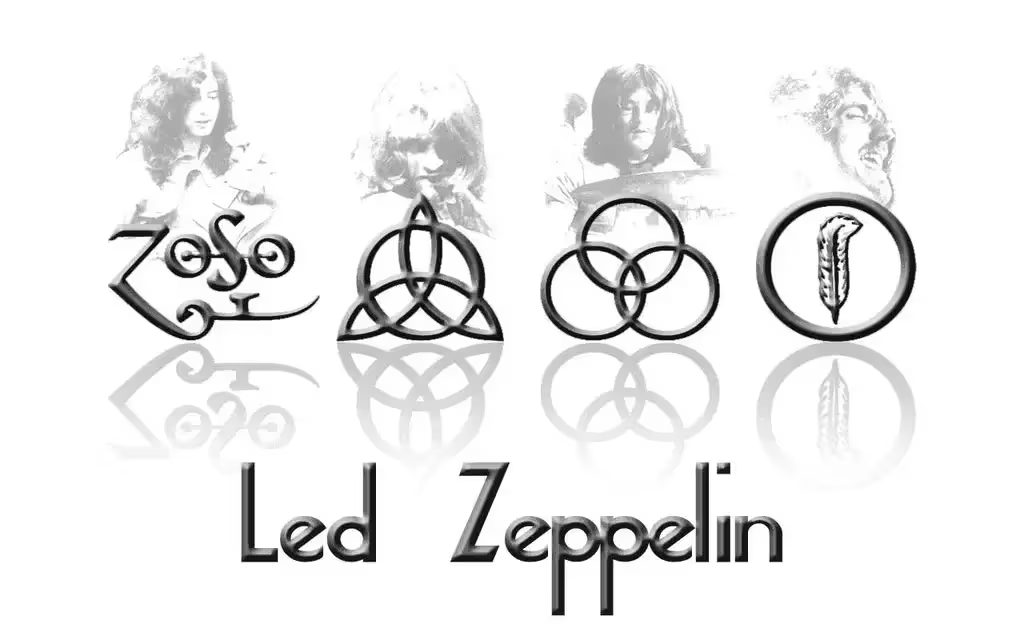
The four symbols on the inner sleeve and labels were each chosen by their member. Page designed his own and has never explained it; Jones picked his (a single circle through three vesicae piscis) from Rudolf Koch's Book of Signs to represent confidence and competence; Bonham took the three interlocking rings from the same book, a triad symbolising mother, father and child that also doubled as the Krupp armaments logo and, upside down, the badge of Ballantine beer; Plant designed his own feather-in-a-circle based on the supposed Mu civilisation. Sandy Denny was given a fifth, smaller symbol on the inner sleeve, three downward-pointing triangles, that doubled as the asterisk pointing to her credit.
The interior gatefold illustration "The Hermit" was painted by Barrington Coleby (credited as Barrington Colby M.O.M.) and modelled on the Hermit card of the Rider-Waite tarot deck. Page later played the same Hermit figure on screen in The Song Remains the Same in 1976. The lyric typeface for "Stairway to Heaven", printed inside the gatefold, was a complete alphabet Page had commissioned after spotting an Arts and Crafts magazine called The Studio in an antique shop.
Release, charts and reception
The album was released on 8 November 1971 on Atlantic. Promotion ran via teaser ads showing only the symbols. It entered the UK chart at number 10 and rose to number 1 the following week, eventually clocking up 90 weeks on the chart. In the United States it peaked at number 2 on the Billboard 200, held off the top spot by Sly and the Family Stone's There's a Riot Goin' On and, briefly, Carole King's Music. Australia, Canada, Germany, Italy and Norway all placed it in their top five. By 2014 it had sold more than 37 million copies worldwide. It is currently certified 24-times Platinum in the US (RIAA), 6-times Platinum in the UK (BPI) and 2-times Diamond in Canada.
Lenny Kaye's contemporary review in Rolling Stone (23 December 1971) called it the band's "most consistently good" album yet. Robert Christgau's first verdict was lukewarm; he later upgraded it to a masterpiece of "heavy rock" and called it the definitive Led Zeppelin record. AllMusic's Stephen Thomas Erlewine credited the album with "defining not only Led Zeppelin but the sound and style of '70s hard rock". Spin magazine's Joe Gross called it a "monolithic cornerstone" of heavy metal; Chuck Klosterman, also writing for Spin, named it the most famous hard-rock album ever made and the album that "unintentionally created metal".
"As forceful and frightening as Zeppelin ever got, and its seismic rhythms and layered dynamics illustrate why none of their imitators could ever equal them."
Stephen Thomas Erlewine on "When the Levee Breaks", AllMusic, 2011
Singles, music videos and radio
"Black Dog" was issued as the lead single on 2 December 1971 backed with "Misty Mountain Hop", reaching 15 in the US Billboard Hot 100 and 6 in Canada. "Rock and Roll" backed with "Four Sticks" followed on 21 February 1972 as a US promo with stereo and mono mixes on either side; it peaked at 47 in Billboard. The band, on Peter Grant's instruction, never authorised a single edit of "Stairway to Heaven", which kept buyers reaching for the album. By 2000 the song had been broadcast on US radio more than three million times. WAXQ in New York has run a listener-poll countdown of the top 1,043 rock songs every year since 2001, and "Stairway" has finished first every single time.
Music videos were not yet a marketing instrument in 1971, and Led Zeppelin made none of the songs into one. The closest the period offered was televised concert footage, including the Royal Albert Hall show from January 1970 and various 1973 dates that became the source material for The Song Remains the Same. The version of "Black Dog" most fans first saw on screen came from the 27 July 1973 Madison Square Garden run that anchored that film.
Touring and live performance
The band were already touring the album in skeleton form before its release. The "Stairway" debut at Belfast Ulster Hall came on 5 March 1971; Page premiered the song to a BBC studio audience at the Paris Theatre on 1 April 1971, broadcast three days later, which gave the world its first proper recorded version. By the autumn UK tour the four runes were appearing on the band's stage equipment: Page's on his amplifier, Bonham's on his bass-drum head, Jones's on a Rhodes piano cover, Plant's on a PA cabinet. Only Page's and Bonham's stuck around for subsequent tours.
The 1972 and 1973 American tours took the album's songs to ever larger venues. The 1973 Madison Square Garden stand was filmed for The Song Remains the Same. By 1975 the band were using "Stairway to Heaven" as the closer; Plant began telling interviewers he was tiring of the song, calling it "sanctimonious" by the end of the 1977 US tour. The final full-band performance of the song with Bonham was in Berlin on 7 July 1980, two months before the drummer's death.
In TV, film and other media
Atlantic and Peter Grant licensed the songs sparingly for decades. "When the Levee Breaks" famously closed Adam McKay's The Big Short in 2015, dropped over the credits as the film's argument about the 2008 financial crash landed. "Stairway to Heaven" turned up in the guitar-shop scene of Wayne's World in 1992, a comic riff on its own ubiquity. Bonham's "Levee Breaks" drum break has been sampled into the bones of records by Eminem ("Kim", "Untitled"), Dr. Dre, the Beastie Boys ("Rhymin' and Stealin'"), Mike Oldfield, Sophie B. Hawkins ("Damn I Wish I Was Your Lover") and Beyonce ("Don't Hurt Yourself", from Lemonade), among others. "Stairway to Heaven" was inducted into the Library of Congress National Recording Registry in 2023.
Controversy: backmasking, the Spirit lawsuit, and the Hermit
The album drew two strands of controversy. The first arrived in January 1982 on the Trinity Broadcasting Network show Praise the Lord, which claimed that "Stairway to Heaven" played backwards revealed Satanic messages. The supposed message, decoded from the line "if there's a bustle in your hedgerow", was alleged to begin "Here's to my sweet Satan". A California assemblyman tried to get warning-label legislation passed; Swan Song Records' official response was that "our turntables only play in one direction, forwards". Plant, irritated, told Musician magazine in 1983: "Stairway to Heaven was written with every best intention, and as far as reversing tapes and putting messages on the end, that's not my idea of making music."
The second was a copyright lawsuit. In May 2014, the trustee of the late Spirit guitarist Randy California filed suit alleging that the opening acoustic chord progression of "Stairway to Heaven" infringed Spirit's 1968 instrumental "Taurus". Spirit had supported Led Zeppelin on the 1968-69 American tour. A Los Angeles jury ruled in favour of Led Zeppelin in June 2016. The plaintiff appealed, the Ninth Circuit ordered a retrial in 2018, then sat the case en banc and ultimately ruled in favour of Led Zeppelin again on 9 March 2020. The Supreme Court declined to hear a final appeal on 5 October 2020, ending the dispute.
Reissues, remasters and anniversaries
The album has been remastered three times. Page worked with engineer George Marino in 1990 on the first proper digital remaster, which was used for the 1990 Led Zeppelin box set. A 1994 standalone CD reissue followed. The major event was the 27 October 2014 Page-supervised reissue, released alongside Houses of the Holy, in six formats: standard CD, deluxe two-CD, standard LP, deluxe two-LP, super-deluxe CD-plus-LP-plus-hardback-book, and 24-bit/96kHz digital. The bonus disc presented Page's original Sunset Sound mix of seven of the album's eight tracks, alternate mixes recorded at Headley Grange, and the "Alternate UK Mix in Progress" of "When the Levee Breaks". The Sunset mix of "Stairway", which the band had originally rejected, finally got an official release.
Legacy
Led Zeppelin IV settled almost immediately into the upper bracket of every "greatest album" list it could be placed on. Q ranked it the 26th greatest British album in 2000 and the 21st greatest album of any kind in 2006. Classic Rock placed it first on its 100 Greatest British Rock Albums Ever in 2006. Rolling Stone has had it at 66, 69 and 58 across three iterations of its 500 Greatest Albums list. Loudwire called it the best hard rock album of 1971 in its 2024 year-by-year survey. The Rock and Roll Hall of Fame's Definitive 200 placed it fourth all-time.
Within the band's own discography it is the pivot. Houses of the Holy, released 18 months later, took the layered acoustic-and-electric idea of "Stairway" and stretched it into reggae and funk territory. Physical Graffiti, released in 1975, finally found a home for the orphan tracks left over from these sessions. The artists who openly cite the fourth album as a touchstone include Heart, Metallica, Soundgarden, the Black Crowes, Greta Van Fleet, the Foo Fighters and most of the post-grunge generation that followed.
Things you might not know about Led Zeppelin IV
| Fact | Detail |
|---|---|
| The man on the cover | Identified in 2023 as Lot Long, a Wiltshire thatcher photographed in 1892 by Ernest Howard Farmer; the original print sold at a Horsham auction in February 2026 for 16,000 pounds. |
| Atlantic vs the band | Atlantic Records refused to release a record without a title or band name on the sleeve. Page held back the master tapes until they relented. |
| Sandy Denny's symbol | The fifth, smaller symbol on the inner sleeve, three downward-pointing triangles, was Denny's own; it doubled as the asterisk by her credit and made her the only guest ever given a Zeppelin rune. |
| Page's solo guitar | "Stairway to Heaven"'s closing solo was played on a 1959 Fender Telecaster gifted to Page by Jeff Beck during their Yardbirds days, plugged into a Supro amplifier; three takes were cut, and Page picked the best. |
| Bonham's stairwell | The "Levee Breaks" drum break was tracked with two Beyerdynamic M 160 ribbon mics suspended above a three-storey stone staircase at Headley Grange, fed through Helios F760 limiters and a Binson Echorec. |
| Rock and Roll's birth | "Rock and Roll" came out of Bonham noodling the intro to Little Richard's "Keep A-Knockin'" at the start of a session; the band wrote the whole song in roughly 15 minutes. |
| The 1929 source | "When the Levee Breaks" reworks Memphis Minnie and Kansas Joe McCoy's 1929 Columbia recording about the Great Mississippi Flood of 1927; Memphis Minnie is co-credited on the album sleeve. |
| Stairway's debut | The first public performance of "Stairway to Heaven" was at Belfast's Ulster Hall on 5 March 1971; Jones recalled the audience were "all bored to tears waiting to hear something they knew". |
| The Sunset Sound mix | Page's original mix of the album, done at Sunset Sound in February 1971, was scrapped after a London playback. Page remixed the whole record at Island Studios in July 1971. The Sunset mixes finally surfaced as bonus material in 2014. |
| Tracks that escaped | "Down by the Seaside", "Night Flight" and "Boogie with Stu" were recorded at these sessions and held back; all three eventually appeared on Physical Graffiti in 1975. |
| The Royal Mail stamp | The album cover was selected by the Royal Mail as one of ten Classic Album Covers issued as postage stamps in January 2010, the only Led Zeppelin sleeve to be so honoured. |
| The block of flats | The tower visible across the rubble on the back cover is Salisbury Tower in Ladywood, Birmingham; Page later said the cover was meant to dramatise a city-and-country contrast that had begun on Led Zeppelin III. |
"They were all bored to tears waiting to hear something they knew."
John Paul Jones on the first live performance of "Stairway to Heaven", BBC Radio 2 Sold on Song
Listen to the Riffology Podcast on Led Zeppelin IV
The full Riffology episode on Led Zeppelin IV unpacks the symbols, the Headley Grange stairwell, Bonham's drum sound, Sandy Denny's contribution and the eight-minute single that refused to be a single. The podcast is also available on Apple Podcasts, Spotify, Pocket Casts, Amazon Music and every other major platform. We'd love to hear your thoughts on the record in the comments.
<style type="text/css"></style>
<div id="pp-podcast-3942" class="pp-podcast single-episode has-header header-hidden has-featured playerview media-audio" data-teaser="" data-elength="18" data-eunit="" data-ppsdata="{"ppe-3942-1":{"title":"RIFF033 – Led Zeppelin – Led Zeppelin IV","description":"<h2>When four symbols replaced a title and Stairway refused the rules<\/h2>\n<p><strong>Hosts:<\/strong> Neil & Chris<br \/>\n<strong>Duration:<\/strong> ~88 minutes<br \/>\n<strong>Release:<\/strong> 12 January 2025<\/p>\n<h2>Episode Description<\/h2>\n<p>Welcome to another episode of <strong>Riffology<\/strong> – the podcast where two mates dissect the albums that shaped music history. This week, Neil and Chris tackle <strong>Led Zeppelin’s untitled fourth album “Led Zeppelin IV”<\/strong>, a record that turned mysterious runes, stairwell drum sounds and an eight-minute epic into the template for what a rock album could be.<\/p>\n<h3>What You’ll Hear:<\/h3>\n<ul>\n<li><strong>Late Conversion Confessions:<\/strong> Neil owning up to years of dismissing Zeppelin as “old man pub jukebox” music while he chased Slayer and Swedish death metal, and how he finally fell in love with the golden-era 60s\/70s records.<\/li>\n<li><strong>Album-as-Event Culture:<\/strong> How news of a new Zeppelin album was literal front-page material in Melody Maker, the 70s equivalent of a Beyonce drop or royal scandal, and what that says about how seriously albums were treated then.<\/li>\n<li><strong>Cover Art & Runes:<\/strong> The story behind the nameless sleeve, the crumbling house painting, the four symbols and the label\u2019s horror at releasing a record with no band name or title anywhere on it.<\/li>\n<li><strong>Headley Grange & Mobile Studios:<\/strong> Life in the house with <a href="/posts/the-making-of-the-rolling-stones-by-the-rolling-stones/">the Rolling Stones</a> mobile truck outside, writing and recording in hallways and stairwells instead of sterile hotel\u2013studio loops.<\/li>\n<li><strong>Production Vision:<\/strong> Jimmy Page as producer and orchestrator, balancing Bonham\u2019s explosive drums, Jones\u2019s arrangements, Plant\u2019s vocals and his own guitars so nothing dominates yet everything feels huge.<\/li>\n<\/ul>\n<h3>Featured Tracks & Analysis:<\/h3>\n<p>The hosts dig into “Black Dog” and its brain-bending timing, the folk\u2013to\u2013hard rock build of “Stairway To Heaven”, and the cavernous groove of “When The Levee Breaks” with its legendary stairwell drum sound. Along the way they unpick John Bonham\u2019s feel, John Paul Jones\u2019s recorder parts that many assumed were Mellotron, and how Page\u2019s production keeps a relatively thin, era-appropriate mix feeling massive and dynamic.<\/p>\n<h3>Tangential Gold:<\/h3>\n<p>True to Riffology form, expect delightful detours into:<\/p>\n<ul>\n<li>HMV restraint, three records in hand (including “Motley Crue: Dr. Feelgood” and a repress of “<a href="/posts/guns-n-roses-appetite-for-destruction/">Appetite for Destruction</a>”) and the internal monologue of a vinyl addict trying not to get roasted on the podcast.<\/li>\n<li>Wayne’s World, “No Stairway? Denied!” and the whole question of whether a song being overplayed (from “Stairway” to “Enter Sandman”) actually makes it any less great.<\/li>\n<li>Alice Cooper and Joe Elliott as DJ archetypes: rock stars who are still pure music nerds first and evangelists for records outside your teenage era.<\/li>\n<li>Teenage tribalism, Brutal Truth t-shirts, and the long road from “I will never listen to your old man Dire Straits and Led Zeppelin” to quietly obsessing over Zep IV\u2019s drum sounds.<\/li>\n<\/ul>\n<h3>Why This Matters:<\/h3>\n<p><em>“Led Zeppelin IV”<\/em> is more than just the album with “Stairway To Heaven” on it. The hosts argue that it captures a band at a rare crossroads: studio-schooled yet rule-free, commercially enormous yet still willing to release a record without their name on the cover. Its blend of hard rock, folk and blues, plus Page’s production experiments at Headley Grange, helped rewrite what rock albums could sound like and how seriously they could be treated as art.<\/p>\n<p><strong>Perfect for:<\/strong> Listeners who know the big hits but have never really sat with the whole album, younger rock fans curious why their heroes worship Zep, and anyone ready to drop the “overplayed” baggage and hear “Stairway” like it\u2019s 1971 again.<\/p>\n<h3>You can find us here:<\/h3>\n<ul>\n<li>Blog: <a href=\"https:\/\/riffology.co\">https:\/\/riffology.co<\/a><\/li>\n<li>All Episodes: <a href=\"https:\/\/podkit.riffology.co\/podcast\" rel=\"noopener noreferrer nofollow\" target=\"_blank\">https:\/\/podkit.riffology.co\/podcast<\/a><\/li>\n<li>iHeart: <a href=\"https:\/\/www.iheart.com\/podcast\/1323-riffology-iconic-rock-alb-176865775\/\" rel=\"noopener noreferrer nofollow\" target=\"_blank\">https:\/\/www.iheart.com\/podcast\/1323-riffology-iconic-rock-alb-176865775<\/a><\/li>\n<li>Apple: <a href=\"https:\/\/podcasts.apple.com\/gb\/podcast\/riffology-iconic-rock-albums-podcast\/id1691556696\" rel=\"noopener noreferrer nofollow\" target=\"_blank\">https:\/\/podcasts.apple.com\/gb\/podcast\/riffology-iconic-rock-albums-podcast\/id1691556696<\/a><\/li>\n<li>Spotify: <a href=\"https:\/\/open.spotify.com\/show\/1LIU9mein7QMw346q20nyy\" rel=\"noopener noreferrer nofollow\" target=\"_blank\">https:\/\/open.spotify.com\/show\/1LIU9mein7QMw346q20nyy<\/a><\/li>\n<li>X: <a href=\"https:\/\/x.com\/RiffologyPod\" rel=\"noopener noreferrer nofollow\" target=\"_blank\">https:\/\/x.com\/RiffologyPod<\/a><\/li>\n<li>Bluesky: <a href=\"https:\/\/bsky.app\/profile\/riffology.co\" rel=\"noopener noreferrer nofollow\" target=\"_blank\">https:\/\/bsky.app\/profile\/riffology.co<\/a><\/li>\n<li>Facebook: <a href=\"https:\/\/www.facebook.com\/riffology\" rel=\"noopener noreferrer nofollow\" target=\"_blank\">https:\/\/www.facebook.com\/riffology<\/a><\/li>\n<li>Email: <a href=\"mailto:info@riffology.co\">info@riffology.co<\/a><\/li>\n<\/ul>\n<hr>\n","author":"Riffology","date":"12 January 2025","link":"https:\/\/podkit.riffology.co\/episode\/riff033-led-zeppelin-led-zeppelin-iv","src":"https:\/\/op3.dev\/e\/podkit.riffology.co\/media\/riff033-led-zeppelin-led-zeppelin-iv.mp3","featured":"https:\/\/riffology.co\/wp-content\/uploads\/2026\/01\/podcast-episode-image-24a3744e7f308007d2228bb0ea1b7b3c-768x768.jpg","featured_id":6656,"mediatype":"audio","season":2025,"categories":[],"duration":"01:28:09","episodetype":"full","timestamp":1736720256,"key":"0cfadec9bab022151aca5267a5be2c47","fset":"https:\/\/riffology.co\/wp-content\/uploads\/2026\/01\/podcast-episode-image-24a3744e7f308007d2228bb0ea1b7b3c-768x768.jpg 768w, https:\/\/riffology.co\/wp-content\/uploads\/2026\/01\/podcast-episode-image-24a3744e7f308007d2228bb0ea1b7b3c-300x300.jpg 300w, https:\/\/riffology.co\/wp-content\/uploads\/2026\/01\/podcast-episode-image-24a3744e7f308007d2228bb0ea1b7b3c-1024x1024.jpg 1024w, https:\/\/riffology.co\/wp-content\/uploads\/2026\/01\/podcast-episode-image-24a3744e7f308007d2228bb0ea1b7b3c-150x150.jpg 150w, https:\/\/riffology.co\/wp-content\/uploads\/2026\/01\/podcast-episode-image-24a3744e7f308007d2228bb0ea1b7b3c.jpg 1400w","fratio":1},"load_info":{"loaded":1,"displayed":10,"offset":0,"maxItems":1,"src":"2df4d4ce9eed921b79bc659b02de6260","step":10,"sortby":"sort_date_desc","filterby":"led zeppelin iv","fixed":"","args":{"imgurl":"https:\/\/podkit.riffology.co\/cdn\/podcast\/podcast_artwork.jpg?v=1761495572","imgset":"","display":"","hddesc":0,"hdfeat":0,"oricov":"https:\/\/podkit.riffology.co\/cdn\/podcast\/podcast_artwork.jpg?v=1761495572","elength":18}},"rdata":{"permalink":"https:\/\/riffology.co\/wp-json\/wp\/v2\/posts","fprint":"2df4d4ce9eed921b79bc659b02de6260","from":"feedurl","elen":18,"eunit":"","teaser":"","title":"Riffology: Iconic Rock Albums Podcast","autoplay":""}}"><div class="pp-podcast__wrapper"><div class="pp-podcast__info pod-info"><div class="pod-info__header pod-header"><div class="pod-header__image"><div class="pod-header__image-wrapper"><img decoding="async" class="podcast-cover-image" src="https://podkit.riffology.co/cdn/podcast/podcast_artwork.jpg?v=1761495572" srcset="" sizes="(max-width: 640px) 100vw, 25vw" alt="Riffology: Iconic Rock Albums Podcast"></div><span class="pod-header__image-style" style="display: block; width: 100%; padding-top: 100%"></div><div class="pod-header__items pod-items"><div class="pod-items__title">Riffology: Iconic Rock Albums Podcast</div><div class="pod-items__desc"><p>Remember when payday meant choosing which CD or vinyl you were blowing it on? Standing in HMV doing the mental maths, convincing yourself two albums was basically essential. Riffology is Neil and Chris chasing that feeling again, one classic record at a time.</p>This is a show about the albums that raised us —
Nirvana, Pearl Jam, Motley Crue, Def Leppard,
Iron Maiden, Megadeth, Pink Floyd, Radiohead,
Skunk Anansie, Gojira, Soulfly and the rest.
If it’s 25+ years old, loud and iconic, we’re in.
Each episode is two Gen X mates diving into studio sessions, producer chaos and band drama plus the joy of taped-over cassettes, dodgy car stereos and sitting on the floor with a record sleeve.
We nerd out when we should: Albini vs Vig, room-miked vs close-miked,
Neve consoles, dynamic-range disasters and those “how did this get approved?” moments.
If you grew up when albums were events, this is your place. Some weeks it’s an old favourite; other weeks it’s something you abandoned in ’94. Either way, Riffology’s here to talk rubbish, tell stories and remind you why these records mattered.
When four symbols replaced a title and Stairway refused the rules
Hosts: Neil & Chris
Duration: ~88 minutes
Release: 12 January 2025
Episode Description
Welcome to another episode of Riffology – the podcast where two mates dissect the albums that shaped music history. This week, Neil and Chris tackle Led Zeppelin’s untitled fourth album “Led Zeppelin IV”, a record that turned mysterious runes, stairwell drum sounds and an eight-minute epic into the template for what a rock album could be.
What You’ll Hear:
- Late Conversion Confessions: Neil owning up to years of dismissing Zeppelin as “old man pub jukebox” music while he chased Slayer and Swedish death metal, and how he finally fell in love with the golden-era 60s/70s records.
- Album-as-Event Culture: How news of a new Zeppelin album was literal front-page material in Melody Maker, the 70s equivalent of a Beyonce drop or royal scandal, and what that says about how seriously albums were treated then.
- Cover Art & Runes: The story behind the nameless sleeve, the crumbling house painting, the four symbols and the label’s horror at releasing a record with no band name or title anywhere on it.
- Headley Grange & Mobile Studios: Life in the house with the Rolling Stones mobile truck outside, writing and recording in hallways and stairwells instead of sterile hotel–studio loops.
- Production Vision: Jimmy Page as producer and orchestrator, balancing Bonham’s explosive drums, Jones’s arrangements, Plant’s vocals and his own guitars so nothing dominates yet everything feels huge.
Featured Tracks & Analysis:
The hosts dig into “Black Dog” and its brain-bending timing, the folk–to–hard rock build of “Stairway To Heaven”, and the cavernous groove of “When The Levee Breaks” with its legendary stairwell drum sound. Along the way they unpick John Bonham’s feel, John Paul Jones’s recorder parts that many assumed were Mellotron, and how Page’s production keeps a relatively thin, era-appropriate mix feeling massive and dynamic.
Tangential Gold:
True to Riffology form, expect delightful detours into:
- HMV restraint, three records in hand (including “Motley Crue: Dr. Feelgood” and a repress of “Appetite for Destruction”) and the internal monologue of a vinyl addict trying not to get roasted on the podcast.
- Wayne’s World, “No Stairway? Denied!” and the whole question of whether a song being overplayed (from “Stairway” to “Enter Sandman”) actually makes it any less great.
- Alice Cooper and Joe Elliott as DJ archetypes: rock stars who are still pure music nerds first and evangelists for records outside your teenage era.
- Teenage tribalism, Brutal Truth t-shirts, and the long road from “I will never listen to your old man Dire Straits and Led Zeppelin” to quietly obsessing over Zep IV’s drum sounds.
Why This Matters:
“Led Zeppelin IV” is more than just the album with “Stairway To Heaven” on it. The hosts argue that it captures a band at a rare crossroads: studio-schooled yet rule-free, commercially enormous yet still willing to release a record without their name on the cover. Its blend of hard rock, folk and blues, plus Page’s production experiments at Headley Grange, helped rewrite what rock albums could sound like and how seriously they could be treated as art.
Perfect for: Listeners who know the big hits but have never really sat with the whole album, younger rock fans curious why their heroes worship Zep, and anyone ready to drop the “overplayed” baggage and hear “Stairway” like it’s 1971 again.
You can find us here:
- Blog: https://riffology.co
- All Episodes: https://podkit.riffology.co/podcast
- iHeart: https://www.iheart.com/podcast/1323-riffology-iconic-rock-alb-176865775
- Apple: https://podcasts.apple.com/gb/podcast/riffology-iconic-rock-albums-podcast/id1691556696
- Spotify: https://open.spotify.com/show/1LIU9mein7QMw346q20nyy
- X: https://x.com/RiffologyPod
- Bluesky: https://bsky.app/profile/riffology.co
- Facebook: https://www.facebook.com/riffology
- Email: info@riffology.co
Comments