Countdown to Extinction debuted at number two on the Billboard 200 in July 1992, held off the top spot by Billy Ray Cyrus and the apparently immovable Some Gave All. For a thrash band whose previous album had been admired in metal magazines and ignored everywhere else, finishing one rung below a country crossover record was the moment everything changed. Megadeth had just made the album that taught technical thrash how to write a chorus, and the rest of America had finally noticed.
The fifth Megadeth studio album was Dave Mustaine sober, Max Norman back in the producer's chair, Marty Friedman writing his first full sessions with the band, and a Hugh Syme sleeve that turned a horned animal into one of the most copied metal images of the decade. Recorded across four months at The Enterprise in Burbank under a six o'clock curfew enforced by the Rodney King riots, Countdown to Extinction reached double platinum without softening any of the edges that had got the band banned from MTV in the first place. It would stay the highest-charting Megadeth album for thirty years.
| Field | Detail |
|---|---|
| Artist | Megadeth |
| Album | Countdown to Extinction |
| Release Date | 14 July 1992 |
| Label | Capitol Records |
| Producers | Max Norman, Dave Mustaine |
| Studio | The Enterprise, Burbank, California |
| Recording Dates | 6 January to 28 April 1992 |
| Genre | Heavy metal, thrash metal |
| Track Count | 11 |
| Total Runtime | 47:26 |
| Billboard 200 Peak | 2 |
| UK Albums Chart Peak | 5 |
| Other Notable Peaks | New Zealand 5, Finland 5, Japan 6, Norway 8, Sweden 9, Austria 12, Australia 14, Germany 15 |
| Certifications | 2x Platinum (RIAA), 3x Platinum (Music Canada), Gold (BPI, RIAJ, ARIA) |
| Estimated Sales | Over 2 million in the US; more than 3 million worldwide |
| Key Singles | Symphony of Destruction, Foreclosure of a Dream, Sweating Bullets, Skin o' My Teeth |
Cultural Context: What 1992 Looked Like for Metal
The year that birthed Countdown to Extinction was the year mainstream rock split in half. Nirvana's Nevermind had reached number one in January 1992, dragging grunge out of the Pacific Northwest and into shopping malls. Pearl Jam's Ten was still climbing. Alice in Chains were preparing Dirt. Across the metal aisle, Pantera released Vulgar Display of Power that February and rewired what heaviness sounded like; Faith No More followed with Angel Dust; Stone Temple Pilots' Core arrived in September. The MTV that had spent the late eighties parading hair-metal poodles was suddenly looking elsewhere.
For a thrash band coming off a critically adored but commercially modest album, the temptation either to chase the new sound or retreat into the old must have been considerable. Megadeth did neither. The model they followed was Metallica's self-titled "Black Album" of August 1991, which had stripped speed-metal arrangements back to four minutes, mid-tempo, choruses that worked on car radios, and sold sixteen million copies in the United States alone. Drummer Nick Menza said it plainly to Spin: "Metallica has definitely opened the doors for other bands to step through. We're obviously the next band to step through that doorway."
Outside the studio, Los Angeles itself was on fire. The Rodney King verdicts came down on 29 April 1992, the day after Countdown to Extinction finished tracking, and within hours the city was in flames. By the time the band were mixing, parts of Burbank were under curfew. The album that came out of those four months would be the most overtly political record Mustaine ever wrote, sampling George H. W. Bush and referencing the Gulf War, prisoner abuse, paranoia and the extinction of species, all at mid-tempo, all with hooks.
The Band's Story Up to This Point
Megadeth had spent the eighties as the band Dave Mustaine formed after being fired from Metallica in 1983, a fact that hung over everything they did. The first four albums, Killing Is My Business... and Business Is Good! (1985), Peace Sells... but Who's Buying? (1986), So Far, So Good... So What! (1988) and Rust in Peace (1990), drew a clean upward arc, but the lineup was a chaos engine. Drummers and guitarists had come and gone in a haze of addiction, sacking and re-hiring. Mustaine himself had been a functioning heroin addict for years.
Rust in Peace fixed the personnel side. Marty Friedman, recruited from neoclassical duo Cacophony, brought a lyricism and modal vocabulary that pulled Megadeth's harmony language away from straight diminished thrash and toward something Eastern, Spanish and theatrical. Nick Menza, an ex-drum tech promoted to the throne, was a fastidious time-keeper with a metronome's patience. David Ellefson, the only other constant since the band's beginning, locked the low end. With Mustaine newly sober from heroin and alcohol going into Rust in Peace, Megadeth had at last managed to make one record with the same four faces who started it. Countdown to Extinction was, crucially, the second.
Mustaine has been candid about why the line-up finally settled. In a 1992 Billboard interview he admitted that he had sacked previous members Chuck Behler and Jeff Young because they refused to seek rehabilitative counselling. That moralistic streak, which would later define a great deal of his public persona, also gave him a band whose creative footprint was suddenly four wide. He told Billboard at the time that it was a "major accomplishment" that all four members contributed material, rather than the records being "nearly all Mustaine" as on the eighties albums. Friedman, talking to Ultimate Guitar, said that unlike Rust in Peace, the new album's creation was "completely different," and that the band had changed songs "a million times" before recording demos and going to the studio.
Ellefson was equally clear, much later, on what the four of them eventually understood:
"A lot of fans go to Rust in Peace, and I understand why. But that was a lot of wind in our sails. Album four is a pretty critical album for a band. By the time we got to Countdown to Extinction, I felt like that was album two of that lineup with Nick and Marty, and the first one that we did all together as the four of us. I think Countdown is when we really learned we became a band."
David Ellefson, Rock Celebrities, 2025
Pre-production and Demos
The music was written in two batches with a one-month break between them. The first writing session followed the Clash of the Titans tour with Slayer, Anthrax and Alice in Chains in late 1990 and early 1991. The second came in the autumn of 1991, after the band had taken a breather and could hear what they had with fresher ears. By the time they walked into pre-production, most of the record existed in some form of demo, but few of the arrangements were finished. The "million times" Friedman talked about was largely in the cutting room of his and Mustaine's own rehearsals before producer Max Norman ever heard them.
Mustaine's writing process for the singles was, on his own account, almost accidental. The riff to Symphony of Destruction came to him during a headache one afternoon driving down Riverside Drive in Toluca Lake. The lyric "My metal brains corroding, my head is going to explode" got scrawled on the back of a sushi receipt. By the time the demo was cut the song was twice the length it eventually ran, with whole bridges that got slashed in pre-production. Sweating Bullets was even less planned: Ellefson remembered the band wandering outside the rehearsal room with a basketball, shooting hoops in the parking lot, then drifting back in, at which point Mustaine picked up a guitar and "out fell the riff to Sweating Bullets."
The other half of pre-production was less romantic and more decisive. Nick Menza and Max Norman spent weeks programming click tracks for the whole record on computer, mapping out the tempos of every song so that Menza could record drums to a feel as well as a grid. It was not how Megadeth had made records before. On Rust in Peace, the band had played live to tape, kept what they could and replaced what they could not. On Countdown to Extinction, Norman wanted every fill, every bar, every transition to be deliberate before the red light went on. Menza, the most patient member of the band, took to it; Mustaine, who had previously prided himself on the spontaneity of his playing, was forced to slow down.
Mustaine has consistently credited the new approach to his sobriety. He had got clean before Rust in Peace and stayed clean through Countdown to Extinction, and the difference, he said, was that he could now hear what he was doing.
"When we did Rust in Peace, I was newly sober and had just hung up most of my bad habits at the time and got into the studio and really felt that fire inside. I don't know what happened. I don't go to meetings. I used to be an alcoholic, and I'm not anymore. I can put it down."
Dave Mustaine to Kory Grow, Rolling Stone, 2022
Inside The Enterprise: The Recording Sessions
Sessions ran from 6 January to 28 April 1992 at The Enterprise studios in Burbank, the same room where parts of Rust in Peace had been finished. Max Norman returned as co-producer with Mustaine, with Fred Kelly Jr. as engineer and mixer and Micajah Ryan adding further engineering. The Enterprise's signature SSL 4000-series console, racks of Neumann tube microphones for vocals, and a generous, naturally bright live room were all assets, but the most important thing Norman brought to the building was discipline. He came from a school of producers whose Ozzy Osbourne records, Blizzard of Ozz, Diary of a Madman and Bark at the Moon, had been built on the assumption that even the most virtuoso playing needed a structural editor. He was not a man given to nodding politely at a take.
Mustaine has told the story repeatedly of the morning Norman cut him down to size at the microphone.
"Max has, like I said, this really acerbic wit. And I remember one time I was singing my butt off on one of these songs, and I said, 'Was that good?' He goes, 'Not really.' And I thought, 'Ugh.' I think I've gotten a little bit tougher skin over the years, so it's cool."
Dave Mustaine to Kory Grow, Rolling Stone, 2022
Norman's perfectionism extended to the smallest gestures. If Mustaine or Friedman bent a note, it could not be a quarter step; it had to be a half or a full step, audibly intentional. Vocals were cut and recut until phrasing fell exactly where Norman wanted it. The two guitarists' tones, both running Jackson and ESP signature guitars through tube heads with a careful blend of close and room microphones, were tuned to leave specific frequency pockets clear for Ellefson's bass and Menza's snare to occupy. The result was a guitar tone with far more low-end weight than Rust in Peace, but cleaner highs and less of the harmonic fizz that had defined eighties thrash.
The second presence in the room was Eddie Kramer. The engineer's credits, which included Are You Experienced, Electric Ladyland, Houses of the Holy and Physical Graffiti, were enormous, and so was Kramer himself by reputation. He had been brought in to engineer parts of the album, but his manner did not endear him to Mustaine. The frontman's response, with Norman's gleeful collaboration, has become one of the best Mustaine stories on record:
"He's the guy that recorded Jimi Hendrix and makes sure that every living organism knows it. He would walk into our control room while we're working, like he's some big fucking dude. And I didn't care who he was. And the more he did that, the more it made me resent him. Max Norman has got this wicked vocabulary, so we would try and use really big words on each other. So the time came to write the sign on the door for Eddie Kramer to stay out. And it says: 'No Obsequious Bozophobes. This means you, Eddie Kramer.'"
Dave Mustaine to Kory Grow, Rolling Stone, 2022
The other long shadow over the building was the city outside it. The Rodney King verdicts came down on the afternoon of 29 April, the day after final tracking. Through the spring, with tensions already obvious, Burbank had been operating on a six o'clock curfew. The band were forced to pack up every evening just as the day was hitting its stride. Mustaine called it "like a school bell ringing," but he also credited the structure for keeping the record on schedule. There was no luxury of working through the night when the night had been cancelled.
Personnel and Credits
| Role | Player | Notes |
|---|---|---|
| Megadeth (core band) | ||
| Lead vocals, rhythm guitar | Dave Mustaine | All lead vocals; primary songwriter; co-producer |
| Lead guitar, acoustic guitar, backing vocals | Marty Friedman | Second studio record with Megadeth; co-wrote four tracks |
| Bass, backing vocals | David Ellefson | Co-wrote five tracks; only original member alongside Mustaine |
| Drums, backing vocals | Nick Menza | Mapped tempos with Norman in pre-production; named the album from a Time magazine article |
| Production and engineering | ||
| Production | Max Norman, Dave Mustaine | Norman previously produced or mixed Ozzy Osbourne and Bad Company |
| Engineering, mixing | Max Norman, Fred Kelly Jr. | Tracked and mixed at The Enterprise, Burbank |
| Additional engineering | Micajah Ryan | |
| Recording engineer (uncredited stints) | Eddie Kramer | Famously banned from the creative sessions by a hand-written sign |
| Artwork and visuals | ||
| Art direction, design | Hugh Syme | Known for Rush sleeves dating back to 2112 |
| Creative direction | Tommy Steele | Capitol Records in-house art director |
| Photography of cover elements | Cameron Wong | |
| Band photography | Chris Cuffaro | Shot the inner sleeve and singles imagery |
| Logo rendering | John Taylor Dismukes | |
| 2004 remix and remaster | ||
| Producer, mixing | Dave Mustaine | Solo remix, no Norman involvement |
| Mixing, engineering | Ralph Patlan | |
| Engineering, editing | Lance Dean | |
| Mastering | Tom Baker | Precision Mastering, Hollywood |
The Norman-Mustaine production credit later became a point of dispute. In 2021, Max Norman went public with allegations that Mustaine had attempted to take an outsized share of the production credit during the original sessions, claiming he had to confront the frontman directly. Mustaine has not addressed the specifics in print. The Capitol release retains the joint credit.
The Songs
| # | Title | Writer(s) | Length | Single | Notes |
|---|---|---|---|---|---|
| 1 | Skin o' My Teeth | Mustaine | 3:14 | Yes (4th) | Opens with one of Menza's most identifiable drum fills |
| 2 | Symphony of Destruction | Mustaine | 4:02 | Yes (1st) | Intros a snippet of Mozart's Requiem; the album's lead single |
| 3 | Architecture of Aggression | Mustaine, Ellefson | 3:34 | About Saddam Hussein and the Gulf War | |
| 4 | Foreclosure of a Dream | Mustaine, Ellefson | 4:17 | Yes (2nd) | Samples George H. W. Bush's "Read my lips, no new taxes" |
| 5 | Sweating Bullets | Mustaine | 5:03 | Yes (3rd) | Written in the parking lot during a basketball break |
| 6 | This Was My Life | Mustaine | 3:42 | One of the album's most overlooked deep cuts | |
| 7 | Countdown to Extinction | Mustaine, Menza, Ellefson, Friedman | 4:16 | Title track; named by Menza after a Time magazine article | |
| 8 | High Speed Dirt | Mustaine, Ellefson | 4:12 | Mustaine's lyrical love letter to skydiving | |
| 9 | Psychotron | Mustaine | 4:42 | Based on Marvel's cyborg anti-hero Deathlok | |
| 10 | Captive Honour | Mustaine, Ellefson, Friedman, Menza | 4:14 | Spoken-word courtroom skit precedes the song proper | |
| 11 | Ashes in Your Mouth | Mustaine, Friedman, Menza, Ellefson | 6:10 | Longest track on the album; the closest in tempo and arrangement to Rust in Peace |
Symphony of Destruction
The album's commercial cornerstone is, almost by accident, also its sparsest piece of writing. A pre-chorus bass figure, a bluesy descending guitar riff and a Mustaine snarl about "the new ten commandments" and the Pied Piper of Hamelin leading the masses to ruin, all built around a chord progression any pub band could pick up after one listen. Mustaine has said he was thinking partly of The Manchurian Candidate when he wrote the lyrics. The Mozart Requiem snatch at the start (the choral "Rex Gloriae" from the Domine Jesu Christe) was Norman's suggestion, and the radio edit that went out as the single ran a few seconds longer than the album cut to accommodate it.
Foreclosure of a Dream
Ellefson co-wrote the music, and the song is a rare Megadeth piece that gives him a structural role beyond the rhythm section. The Bush sample, taken from his 1988 Republican National Convention speech, was Mustaine's idea. The lyrics, about a foreclosed family farm, came partly from Ellefson's own Minnesota upbringing. The Billboard review of the album singled it out alongside Symphony of Destruction as a "powerful statement for hard rockers."
Sweating Bullets
Built around a swung, almost Tom Waits-ish call-and-response between two Mustaine voices ("Hello me, it's me again"), Sweating Bullets is the album's most personal song. Ellefson said the lyrics felt like "the inside of a crazed lunatic's mind"; Mustaine's reading of them in interviews has tied the song to the way it feels to be inside an addict's head, even after the addiction has gone. It is also the album's most idiosyncratic chart hit, reaching number 27 on the Mainstream Rock chart and getting heavy late-night MTV play through 1993.
The Title Track and Architecture of Aggression
The album's two most explicitly political pieces sit a few tracks apart. Architecture of Aggression, music co-written by Ellefson, is Mustaine's response to Saddam Hussein and the first Gulf War; the lyric reads as documentary, not protest. The title track, named by Menza after a Time magazine article on accelerating species loss, brings in a spoken-word interjection from a friend of Marty Friedman's who worked at a sushi restaurant near the studio. Her voice, almost conversational, reads out the line that gives the album its title: "One hour from now, another species of life form will disappear off the face of the planet... forever, and the rate is accelerating." The song won the Humane Society's Doris Day Music Award, also known as the Genesis Award, for raising awareness of animal rights.
Deep Cuts: Psychotron, Captive Honour, Ashes in Your Mouth
Three of the album's last four songs are why the thrash fanbase forgave Megadeth for the radio singles. Psychotron, inspired by the Marvel cyborg anti-hero Deathlok, is rhythmically dense and harmonically dark. Captive Honour, a deeply uncomfortable song about prison rape and abuse of inmates, opens with a courtroom skit and Mustaine playing the judge. Ashes in Your Mouth, at six minutes and ten seconds the longest piece on the record, closes the album in full Rust in Peace mode: shredding leads from Friedman, a tempo that nudges close to the old speed-metal pulse, and a lyric about the aftermath of war that refuses to land anywhere comforting.
Album Artwork and Packaging
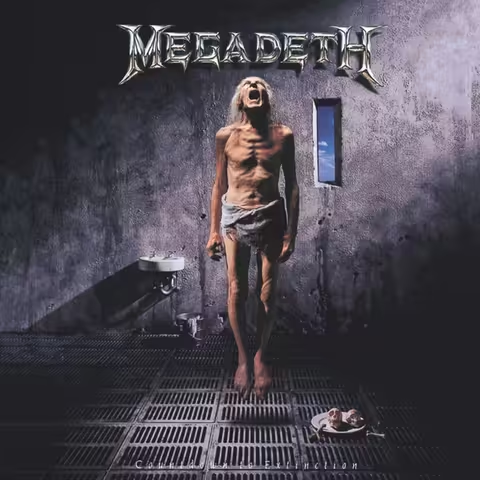
The sleeve is the work of Hugh Syme, the Canadian designer best known for his decades of cover art for Rush, including the Starman of 2112 and the bookshop scene on Moving Pictures. Tommy Steele, Capitol's in-house creative director, supervised. The cover depicts a horned grazing animal, often described as an antelope or a chamois, staring out of the frame at something the viewer cannot see. Megadeth's mascot Vic Rattlehead, the suited skeleton from earlier album sleeves, appears as a tiny silhouette deep in the background. The composition, with the band logo at the top and the album title at the bottom in clean Roman type, was unusually restrained for a thrash record in 1992; Hugh Syme would later say he wanted the image to "stop people, not chase them away."
Band portraits for the inner sleeve and single covers were shot by Chris Cuffaro, a Los Angeles photographer whose other early-nineties work included iconic black-and-white sessions with Pearl Jam and Soundgarden. The vinyl gatefold and the cassette J-card carried the lyric sheet in full, including the "extinction stat" spoken-word section in the title track. The classic Megadeth logo, by then a fan tattoo on its own merits, was redrawn fresh for the sleeve by John Taylor Dismukes.
Singles and Music Videos
| Single | Released | US Mainstream Rock | Other Notable Peaks | Video Director |
|---|---|---|---|---|
| Symphony of Destruction | 21 July 1992 | 29 | UK 15, NZ 15, Ireland 14, Finland 12 | Wayne Isham |
| Foreclosure of a Dream | 13 October 1992 | 30 | UK 26 | Wayne Isham |
| Sweating Bullets | 16 February 1993 | 27 | UK 26 | Wayne Isham |
| Skin o' My Teeth | 12 April 1993 | UK 24 | Wayne Isham |
All four singles were directed by Wayne Isham, the Salt Lake City filmmaker whose other early-nineties metal videos included Train of Consequences for the same band, 99 Ways to Die for Megadeth's Beavis and Butt-Head cameo era, and clips for Bon Jovi, Motley Crue and Def Leppard. Isham specialised in big-frame band performance shots cut against narrative inserts, and Symphony of Destruction is one of his most arresting: a burning American flag bearing the motto For the People, a gun trigger being pulled, a politician's unblinking eye, and ultimately a presidential motorcade scene where the candidate is assassinated by a sniper. The performance shots of the four band members were filmed separately, and the band do not appear together at any point in the cut.
The assassination scene was the controversy that defined the campaign. MTV played the unedited cut for the first month, then decided the moment was "too harsh" and pulled it, demanding a re-edit. The censored version stripped out the moment the trigger is pulled. Mustaine's defence at the time was characteristically dry: "I think it's more important that our point got across than the fact of whether or not we had to soften up a certain scene or lose it altogether." The song still reached the UK top twenty, certified Platinum by the RIAA, Silver by the BPI and Gold in New Zealand.
The European 12-inch and the cassette single for Symphony of Destruction also carried a notorious B-side: the Gristle Mix, a five-minute industrial remix produced by Trent Reznor and Chris Vrenna of Nine Inch Nails. It is one of the earliest cross-genre collaborations between American industrial and thrash, and it would later be used in WWE SmackDown! vs. Raw 2006 and Full Auto 2. Reznor's involvement gives the single CDs an enduring collector value.
Release and Reception
Countdown to Extinction was released on Tuesday 14 July 1992. First-week sales of 128,000 copies sent the album straight to number two on the Billboard 200. The album it failed to topple was Billy Ray Cyrus's Some Gave All, the debut record built around Achy Breaky Heart, which had a near-permanent grip on the top spot through the summer. For Megadeth, fans noted the irony for years: the closest a Megadeth record had come to a number-one slot in America, beaten by line-dancing music.
The international response broadly matched. The album charted at number five in the UK and New Zealand, six in Japan, eight in Norway and inside the top fifteen across most of Western Europe. Within two years of release it was certified double platinum in the United States and triple platinum in Canada; gold in the UK and Japan; gold in Argentina and Australia. Its title track won the 1993 Doris Day Music Award from the Humane Society for raising awareness of animal cruelty, and the album was nominated at the 1993 Grammys for Best Metal Performance, losing to Nine Inch Nails' Wish.
Critically the response was warmer than any previous Megadeth record. Spin called it "the finest thrash metal album ever made, although purists may find it a bit too polished and easy to swallow." Greg Sandow in Entertainment Weekly wrote that the band's "music has lost its former hurricane verve but keeps its crunch, and feels more rooted, even more melodic," scoring it A-minus. Joel McIver, reviewing the 20th-anniversary edition for Record Collector, called the album "a masterpiece of technical, melodic thrash" that showed Megadeth "at their best and most coherent."
The most quoted contemporary line came from Steve Huey at AllMusic:
"Megadeth guns for arena thrash success and gets it on Countdown to Extinction."
Steve Huey, AllMusic, 1992
Not every critic was sold. Karen Csengeri in Rolling Stone, reviewing in 1997 in a backward-looking piece, wrote that "while Countdown echoes the band's earlier work thematically, it's stylistically disappointing." The magazine softened its line considerably over the following two decades. In 2017 Rolling Stone placed the album at number 33 on its list of the 100 Greatest Metal Albums of All Time, where it remains.
Touring
The Countdown to Extinction Tour opened in late summer 1992 and ran, with breaks, until 8 December 1993, the band's longest campaign to that date. Support acts varied by leg and territory, but the most quoted American leg in 1992 paired Megadeth with Pantera, Suicidal Tendencies and White Zombie, an early showcase of three bands all on the brink of their commercial breakthroughs. The tour's first European leg headlined the Roskilde Festival in Denmark on 27 June 1992, just before the album's release, with the rest of the summer playing European festivals.
1993 brought two of the more memorable runs. In January the band toured the United States with Stone Temple Pilots as support, a billing that already looked like a deck reshuffle and would look stranger still a year later. In June 1993, Megadeth headlined the Milton Keynes National Bowl with Diamond Head opening, then immediately joined Iron Maiden and Metallica's European stadium tour as the third bill, walking onto the same stages as the band that had fired Mustaine ten years earlier. The reunion was not warm but it was lucrative, and it cemented Megadeth's position as the second-biggest American thrash band in Europe.
Notable tour milestones from the campaign:
- First Megadeth festival headline in continental Europe (Roskilde, 27 June 1992)
- First American arena tour as headliner with a thrash undercard (Pantera and White Zombie support)
- First UK national-stadium-class show as headliner (Milton Keynes National Bowl, June 1993)
- First shared stage with Metallica since Mustaine's 1983 dismissal (Iron Maiden and Metallica European stadium tour, summer 1993)
The Capitol Theatre show at the Cow Palace in San Francisco, 21 February 1992, was recorded in full and eventually released on the album's 20th-anniversary edition as a bonus disc. Captive Honour, Architecture of Aggression and Psychotron never received their proper live debuts until the 20th-anniversary tour in 2012, when the band, by then with Chris Broderick and Shawn Drover, played the entire record front to back.
In TV, Film and Media
The album's mainstream visibility opened doors that older Megadeth records had been firmly outside of. Symphony of Destruction soundtracked a Beavis and Butt-Head episode (Blood Drive) in which the duo are visibly enraptured by the riff and the video edits, with Beavis declaring Mustaine "rules" and headbanging through the chorus. The cameo did at least as much for Megadeth's standing among US teenagers in 1993 as MTV's News at Five.
The song has since appeared in PlayStation 2's Guitar Hero, Guitar Hero 5 and Rock Band 3 (with Pro Guitar/Bass upgrade), Rocksmith, True Crime: Streets of L.A., NFL Street 3, FlatOut 2 and others. The Trent Reznor / Chris Vrenna Gristle Mix appears in WWE SmackDown! vs. Raw 2006 and Full Auto 2: Battlelines. Sweating Bullets has soundtracked everything from professional wrestling intros to comedy sketches, and Foreclosure of a Dream was used in news coverage of the 2007-2008 American housing crash with a much darker editorial intent than Mustaine had ever intended for it.
Covers, Samples and Remixes
Songs from Countdown to Extinction have proved unusually amenable to reinterpretation. Symphony of Destruction has been covered by Arch Enemy, Nightwish, Tarja Turunen, 3 Doors Down (who have played it live close to seventy times), Paul Di'Anno, Hellsongs and the German parody outfit J.B.O., among others. The Gristle Mix by Reznor and Vrenna remains the most commercially circulated remix.
The album itself samples sparingly but memorably. Foreclosure of a Dream uses the George H. W. Bush "Read my lips" line from his 1988 Republican National Convention speech. The intro to Symphony of Destruction lifts a fragment of the Rex Gloriae choral from the Domine Jesu Christe in Mozart's Requiem. The title track features a friend of Marty Friedman's, a waitress at a Los Angeles sushi restaurant, reading a statistic on species loss. These are unusually literary choices for a thrash record of the period and are part of why the album reads better in 2026 than many of its peers.
Reissues, Remasters and Anniversaries
- July 2004 remix/remaster: Capitol released a Dave Mustaine-supervised remix and remaster with four bonus tracks, including Breakpoint and the Bill & Ted's Bogus Journey soundtrack contribution Go to Hell. The remix was controversial with purists and remains so.
- June 2006 audiophile reissues: Mobile Fidelity Sound Lab released an UltraDisc II gold CD; a 180-gram 2LP vinyl edition appeared in parallel. Both used Mustaine's 2004 mix.
- 6 November 2012 20th Anniversary Edition: A 2CD set returning to the original 1992 mix on disc one and adding a full Cow Palace 1992 live recording on disc two, plus a 24-by-36-inch poster and four collectible postcards. Liner notes by Kory Grow.
- 24 September 2013 Countdown to Extinction: Live: A live album documenting the 20th-anniversary tour's complete front-to-back performance of the record.
The 2004 remix has divided the fanbase for two decades. Mustaine remixed it without Max Norman and rebalanced several of the vocals and lead guitar lines, in some cases pulling Friedman's playing forward. The CD market gradually adopted it as the default; the 20th-anniversary edition restored the original 1992 mix for the first time on CD since the early nineties. The two versions sit side by side on streaming services to this day.
Legacy and Influence
Countdown to Extinction remained the highest-charting Megadeth album for thirty years, until 2022's The Sick, the Dying... and the Dead!, by which point the entire commercial landscape had been rewritten. Its 2x platinum certification has not been matched by any subsequent Megadeth record, and probably never will be. For the band, the album opened a five-record stretch of major-label gold and platinum records (Youthanasia, Cryptic Writings, Risk and Capitol Punishment) that bankrolled the rest of their career.
For the genre, the album's influence is harder to overstate. Together with Metallica's Black Album and Pantera's Vulgar Display of Power, it is one of the three records most often cited as the moment American thrash decided it was capable of being mainstream metal. Trivium, Lamb of God, Avenged Sevenfold, Killswitch Engage and a generation of metalcore guitarists have all named Countdown to Extinction in interviews as a formative listen. M. Shadows from Avenged Sevenfold put it on his Rolling Stone list of favourite metal albums; Trivium's Matt Heafy has been quoted calling Skin o' My Teeth one of the records that taught him how to phrase a thrash vocal.
Mustaine himself, asked by Rolling Stone how he felt the album had aged on its 30th birthday, was uncharacteristically settled:
"When I think of Countdown, I think of the live room in the Enterprise, where I started to really come into my own with the songwriting and the melody stuff. All the songs had melody in them before, but we weren't getting any attention from anybody that wasn't a super thrash/speed-metal fan. With Countdown, we reached the fair-weather fans that'll hear something on the radio, people that are at festivals for somebody else. However they stumble across us, I like when they discover this music and see that we are a horse of many colours."
Dave Mustaine to Kory Grow, Rolling Stone, 2022
Things You Might Not Know
| Fact | Detail |
|---|---|
| The Bozophobes sign | The Sharpie-on-the-door notice that banned Eddie Kramer from creative sessions read "No Obsequious Bozophobes. This means you, Eddie Kramer," and was reportedly drafted as part of a vocabulary contest between Mustaine and Max Norman. |
| The Mozart at the start | The choral fragment at the start of Symphony of Destruction is the Rex Gloriae section of the Domine Jesu Christe from Mozart's Requiem in D minor, K. 626. |
| A sushi receipt of a song | Mustaine wrote the opening lyric of Symphony of Destruction on the back of a sushi receipt during a headache while driving down Riverside Drive in Toluca Lake, Los Angeles. |
| The Time magazine title | Nick Menza read an article called The Countdown to Extinction in Time magazine and suggested the title to Mustaine, who built the title track around it. |
| The basketball-court riff | The riff to Sweating Bullets came to Mustaine immediately after a basketball break in the studio car park, in front of Ellefson, who often retells the story. |
| Trent Reznor in the credits | The Gristle Mix of Symphony of Destruction, included on the 12-inch and cassette single, was produced by Trent Reznor and Chris Vrenna of Nine Inch Nails, one of the earliest cross-genre industrial-thrash collaborations. |
| The Hugh Syme connection | The sleeve was designed by Hugh Syme, the Canadian artist responsible for almost every Rush cover from 2112 onwards, including Moving Pictures and Permanent Waves. |
| The Doris Day award | The title track won the 1993 Doris Day Music Award (the Humane Society's Genesis Award) for its environmental message, presented to a thrash metal band in a category usually reserved for soft rock. |
| Pulled from the GnR/Metallica tour | Megadeth had been pencilled in as opening act for the 1992 Guns N' Roses / Metallica stadium tour but were dropped before the run began, a snub Mustaine cites as a motivator for the touring choices that followed Countdown to Extinction's release. |
| The sushi-restaurant cameo | The female voice reading the species-loss statistic in the title track was not an actress but a waitress at a sushi restaurant near The Enterprise studios, a friend of Marty Friedman's, drafted in for one take. |
| Beavis and Butt-Head impact | The Beavis and Butt-Head episode Blood Drive, which played the Symphony of Destruction video almost in full, is widely credited inside the band as the moment Megadeth broke through to American teenage boys outside the metal-magazine subscriber base. |
| Held off the top by Achy Breaky Heart | Countdown to Extinction was kept from number one on the Billboard 200 by Billy Ray Cyrus's Some Gave All, the album that produced Achy Breaky Heart, which dominated the chart for most of the summer of 1992. |
Listen to the Riffology Podcast
Riffology is two Gen X mates digging into the records that raised them, one album at a time. The full episode on Countdown to Extinction goes deeper into the Enterprise sessions, the "No Obsequious Bozophobes" sign, the 1992 LA riots curfew and the moment Megadeth realised they had written a melodic thrash record that radio could actually play. The episode is out now on Apple Podcasts, Spotify, Pocket Casts and wherever else you get your podcasts.
Comments