By the summer of 1979, Rush had spent eight months on the road behind Hemispheres, an album so dense its title track took up an entire side of vinyl. They came home tired, slightly bored of their own complexity, and worried that the next record would push them somewhere they had already been. The answer, when it arrived in January 1980, was Permanent Waves: six songs, thirty-six minutes, and the precise moment Rush stopped being a cult progressive rock band and started being one of the biggest live acts in North America.
It was also the record on which Geddy Lee stopped shrieking, Alex Lifeson smuggled reggae into a Rush song without anyone noticing, and Neil Peart finally wrote lyrics simple enough for radio while still managing to namecheck the integrity of the artist versus the demands of commerce inside a hit single. Permanent Waves reached number three in the UK, number four in the US, sold out a six-month tour and became, briefly, the fastest-selling Rush album to date. Then Moving Pictures arrived a year later and put it in the shade. That sequence is no accident. Without Permanent Waves, there is no Moving Pictures.
Album Facts
| Field | Detail |
|---|---|
| Artist | Rush |
| Album | Permanent Waves |
| Release date | 14 January 1980 (Canada/US), 18 January 1980 (UK) |
| Label | Anthem (Canada) / Mercury (international) |
| Producers | Rush and Terry Brown |
| Engineer | Paul Northfield |
| Recording studio | Le Studio, Morin-Heights, Quebec |
| Mixing studio | Trident Studios, London |
| Mastering | Ray Staff |
| Genre | Progressive rock, new wave, hard rock |
| Track count | 6 |
| Total runtime | 36:05 |
| UK Albums Chart peak | 3 |
| Billboard 200 peak | 4 |
| Canada (RPM) peak | 3 |
| Certifications | RIAA Platinum (1m+ US), BPI Gold, Music Canada Platinum |
| Singles | "The Spirit of Radio" (Feb 1980), "Entre Nous" (Apr 1980) |
After Hemispheres: a band on the edge of itself
Hemispheres had nearly broken the band. The 1978 album was recorded in Wales at Rockfield, took longer than any previous Rush record, and pushed Lee's vocal range to the point of physical strain. The follow-up tour ran from October 1978 to June 1979, criss-crossing North America and the UK. By the time it ended, the trio agreed to do something they had never done before in the band's seven-year history: take six weeks off, properly, away from each other.
That break was as important as anything that happened in the studio later. When Lee, Lifeson and Peart reconvened in mid-July 1979 at Lakewoods Farm, a rented property near Flesherton in rural Ontario, they came back rested, suspicious of their own habits, and aware that prog rock as a genre was about to be steamrollered by punk and new wave. Yes was breaking up. Genesis had abandoned the long form. The British music press had declared anything in 7/8 to be the enemy. Rush were not interested in pretending punk had not happened, but they were not about to chop their hair off either.
"The idea behind the album was to make sure we did not lose the ability to write songs."
Geddy Lee, Scene magazine, February 1980
That sentence is the entire creative thesis of the record. Lee said the band's previous outings had been built up from sections, suites, ideas glued together; "Circumstances" on Hemispheres was the closest they had come to a song with an actual main flow, and even that had felt like an exception. Permanent Waves was a deliberate attempt to write songs first and complications second.
Lakewoods Farm and the songwriting reset
The first two weeks at Lakewoods Farm followed a pattern that should be illegal in any productive working environment: Lifeson cooked breakfast, Lifeson and Lee then jammed in the basement on instrumental ideas, and Peart drove off to a nearby cottage with a notebook to write lyrics on his own. The trio met up later in the day to bolt the two halves together. The result was three songs in a few days: "The Spirit of Radio", "Freewill" and "Jacob's Ladder".
That is an absurd hit-rate for a band whose previous albums had taken months of compositional grappling. The first attempt at the rehearsals had been a piece Peart later described as "a giant hodge-podge of instrumental mish-mash", working title "Uncle Tounouse". They wisely junked it as a song and recycled the better fragments into the rest of the record. Peart also drafted a long piece based on the medieval poem Sir Gawain and the Green Knight; that one got abandoned too, although passages of its music would survive into "Natural Science".
From Lakewoods the band moved to Sound Kitchen Studio in northern Toronto with Terry Brown, the producer who had been with Rush since 1975's Caress of Steel. Brown helped them tighten arrangements and put the new material onto tape as working demos. Then, in a gesture entirely uncharacteristic of a progressive rock band of the period, Rush did something nobody had taught them was allowed: they took the unfinished songs out on the road. A short warm-up tour through August and September 1979 saw "Freewill" and "The Spirit of Radio" debuted on stage at Varsity Stadium in Toronto and three weeks later at a club in Stafford, England, before a single note had been committed to a master tape.
It was the first time Rush had played a song live before recording it. The audiences had no idea, and the band came back from the road with arrangements that had been pressure-tested in front of paying customers.
Recording at Le Studio, Morin-Heights
The original plan had been to record at Trident Studios in central London, the room Bowie and Queen had built careers in. Trident was booked, then unbooked. The cost of London accommodation for three Canadians and a producer for the duration of an album made the maths brutal, and after two records made in Wales the band had grown sick of recording in a busy city. They wanted a remote location instead. Terry Brown suggested Le Studio in Morin-Heights, an hour north-west of Montreal: a residential studio in the Laurentian forest, with a private lake, and a set of monitors and outboard already favoured by Andre Perry's owners for high-end Canadian work.
Rush moved in for September 1979 with engineer Paul Northfield, an English transplant who would go on to engineer or produce most of the band's records into the 1990s. The basic tracking was straightforward by Rush standards: rehearse, multiple takes, pick the best performance, move on. Lee, Lifeson and Brown then began overdubbing while Peart, with no drum parts left to record, sat down to write a long piece to close the album. Three days of writer's block produced "Natural Science", the only song on the record that did not exist before the band entered the studio.
Some of the album's most memorable production touches were also the cheapest. The water sounds at the opening of "Natural Science" were not a sample or a synth patch; they were Brown and studio assistant Kim Bickerdike out on the lake with a pair of oars, splashing into a microphone. The same lake's natural reverb was used to record outdoor instrument parts. Hugh Syme, the album's sleeve designer and a friend of the band, was sent for to do the cover photography setup; while he was there he sat down and played the piano on "Different Strings".
"I just wanted to give it something that gave it a sense of static, radio waves bouncing around, very electric. We had that sequence going underneath, and it was just really to try and get something that was sitting on top of it, that gave it that movement."
Alex Lifeson on the opening of "The Spirit of Radio", Classic Rock, 2006
The rough mixes finished at Le Studio sounded close, but Brown insisted on doing the final mix at Trident in London, where he could hear it on a familiar room. That mix took two weeks. Ray Staff, Trident's house mastering engineer, cut the original lacquer. By the time the band came home in November 1979 they had an album.
The synth, the bass and the gear
- Geddy Lee added an Oberheim polyphonic, an Oberheim OB-1, a Minimoog and Moog Taurus pedals to his rig, the first heavy use of synthesisers on a Rush album.
- Lifeson played electric and acoustic six- and twelve-string guitars, with his own set of Taurus pedals for low-end fills when Lee was busy with synths.
- Peart added timbales, orchestra bells, tubular bells, a bell tree, wind chimes, crotales and a triangle to the kit, an arsenal that would become a Rush trademark on stage.
- Le Studio's signal chain ran through Solid State Logic and Trident desks, with Northfield favouring close miking on the kit and natural ambience captured outside.
- The mix room at Trident London, where the album was finished, was the same one used for The Dark Side of the Moon bounce-downs.
The Songs
| # | Title | Length | Notes |
|---|---|---|---|
| 1 | "The Spirit of Radio" | 4:59 | Lead single. Reggae outro. UK No. 13. |
| 2 | "Freewill" | 5:23 | Last Rush studio recording with Lee's full upper-register shriek. |
| 3 | "Jacob's Ladder" | 7:30 | Multiple time signatures. Side one closer. |
| 4 | "Entre Nous" | 4:37 | Second single. Lyrics drafted before Lakewoods. |
| 5 | "Different Strings" | 3:50 | First Rush song with lyrics by Lee since "Tears" on 2112. Hugh Syme on piano. |
| 6 | "Natural Science" | 9:18 | Three movements. Written entirely at Le Studio. |
Side one
"The Spirit of Radio" is what every musician who has spent ten years trying to write a hit and refused to admit it sounds like the moment they finally allow themselves. The opening guitar figure is in E mixolydian, played fast enough that it hangs in mid-air. Underneath sits a sequenced synth pulse that Lifeson built specifically to evoke "radio waves bouncing around". Then Peart drops in, Lee's bass joins on a beat unlikely to make sense in any classroom, and the band has somehow turned an essay about FM radio losing its soul to commercial format programming into a four-minute pop song. The lyric was inspired by Brampton, Ontario station CFNY-FM, which had taken "the spirit of radio" as its slogan and was, in Peart's view, the last free-form station in Canada that had not sold out. The reggae passage at the end was, by Lifeson's account, included for one reason and one reason only.
"To make us smile and have a little fun."
Alex Lifeson on the reggae outro of "The Spirit of Radio", Music Express, February 1980
"Freewill" was completed at Lakewoods within days. Most of it sits in 13/4, with passages in 15/4 and a 12/8 instrumental break that contains what Lifeson considers one of the most ambitious solos he has ever played. Lyrically it is the most directly philosophical song on the record, an explicitly secular argument for choice over predestination that has been parsed and debated by Rush fans for forty-five years. The final verse, sung in Lee's full piercing high range, is also the last time Lee would ever record a vocal at that pitch in a studio. From Moving Pictures onwards he would deliberately drop a register or two and let the songs sit in his speaking range.
"Jacob's Ladder" closes side one with seven and a half minutes of crepuscular menace. The title refers not to the biblical vision but to the meteorological phenomenon of sun rays breaking through clouds, named after that vision. Peart wrote the lyric around the simple image of weather changing, and the band built a dark, majestic instrumental landscape around it that owes more to Hemispheres than to "The Spirit of Radio". It was largely played live on the Permanent Waves tour and then disappeared from setlists for almost three decades.
Side two
"Entre Nous" opens the back half. Peart had finished its lyric before Lakewoods, the only song on the record to carry that pedigree, and described it as a personal letter rather than a position paper.
"It's a personal letter. Basically what it says is, let's stop fooling ourselves, we are different, let's admit it."
Neil Peart on "Entre Nous", Innerview interview, March 1980
The arrangement is unusually pop for Rush, almost AOR, and Mercury chose it as the second single in April 1980. Live the song was bizarrely neglected; it was not performed in concert until the Snakes and Arrows tour of 2007.
"Different Strings" follows. Lyrics by Lee, the first Rush track since "Tears" on 2112 to carry his name in the lyric credit, with a quiet, reflective instrumental and a piano part by Hugh Syme that drifts in and out of focus behind the band. It is the shortest song on the record and one of the most underrated.
And then "Natural Science" closes everything in three movements: "Tide Pools", "Hyperspace" and the title section "Permanent Waves". The opening section's water sounds were recorded with the oars on the studio's own lake; the closing fanfare uses time signatures that arguably ought not to work over a vocal melody but somehow do; and the lyric concept, broadly that scientific knowledge and natural humility have to coexist, lifts the song above the prog tradition of writing nine-minute pieces about robot kings. Lifeson reused passages of the abandoned "Sir Gawain and the Green Knight" sketch in the body of the music. Without that abandoned song, "Natural Science" does not exist in the form it does.
Hugh Syme and the cover art
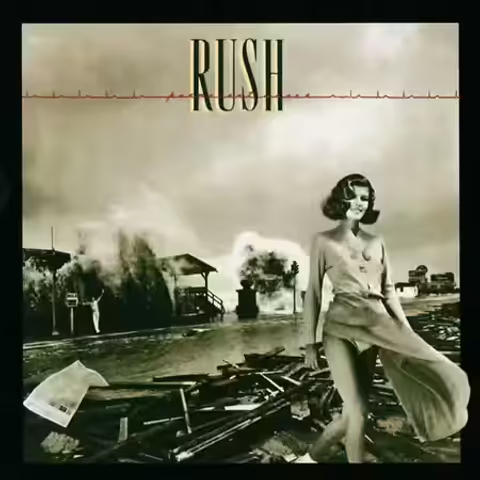
Hugh Syme had been Rush's sleeve designer since Caress of Steel in 1975. For Permanent Waves he assembled a cover that nobody who has ever stared at it has read correctly the first time. The background is a black-and-white photograph by Flip Schulke of the Galveston Seawall in Texas, taken on 11 September 1961 as Hurricane Carla broke over the Gulf coast. Lifted from that photo and dropped into the foreground in colour is Canadian model Paula Turnbull, in a yellow dress, smiling and waving with absurd good cheer at the chaos. To get her skirt to flutter in time with the storm wind, the studio crew set up a fan just out of shot during her photoshoot. The man in the background, also waving, is Syme himself.
The original cover ran into trademark issues before printing was complete. The Schulke photograph contained billboard signage that legal counsel for the corporate trademark holders objected to once they saw the proofs, and Syme had to airbrush out lettering on a number of advertisements visible against the seawall before the cover could go to press. Some of the alternate variants kicking around fan archives still show the unaltered original photo. The lettering on the cover itself, the word "Waves", was lifted from a Coca-Cola logo's typeface and tweaked until the legal department was satisfied no one was being sued.
The title was Peart's. He had picked it because it was useless as a concept theme, which was the joke; this was the first Rush album since their debut not to have a unifying narrative idea binding it together.
"It's a tongue-in-cheek reference to the new wave scene in music at the time, not towards the bands but the music press, particularly in England, that is inclined to write off any band that was around last week and go for whatever's happening this week."
Neil Peart on the album title, Chicago Tribune, March 1980
Singles and chart performance
Rush had only ever scraped the UK Top 40 once before, with a 1977 reissue of "Closer to the Heart". When "The Spirit of Radio" was released as a single in February 1980, the UK 7-inch ran a 3:00 edited version that has never appeared on CD. The single hit number 13 in the UK in March, by some distance the band's biggest UK hit then or since. In Canada it reached number 22 and in the US number 51 on the Billboard Hot 100, with promo 12-inches going out the previous December titled, incorrectly, "The Spirit of the Radio".
| Single | Released | UK | Canada | US Hot 100 | B-side |
|---|---|---|---|---|---|
| "The Spirit of Radio" | February 1980 | 13 | 22 | 51 | "Circumstances" (US) / "The Trees" (UK) |
| "Entre Nous" | April 1980 | did not chart | did not chart | did not chart | "Different Strings" |
The album itself shipped 300,000 copies into US stores on day one. Mercury Records put a heavy advertising spend behind it and RPM Weekly reported "intense early reaction", driven mainly by FM airplay rather than the singles. Within two months the album had sold half a million copies in the US, then certified Gold; by November 1980 the figure was 900,000. Platinum, certifying over a million units shipped, came in November 1987. The album reached number three in Canada and the UK and number four in the US, and became the fastest-selling Rush record up to that point. Moving Pictures the following year would surpass it in everything except the chart peaks.
In September 1980, after Permanent Waves had been certified Gold in Canada, the band sent the gold disc not to anyone in the music industry but to Terry Fox, who had recently been forced to abandon the Marathon of Hope cancer-research run after the disease returned to his lungs. Fox died nine months later. The plaque now sits in the Terry Fox archive.
Touring Permanent Waves
The Permanent Waves tour ran from 17 January to 22 June 1980, criss-crossing Canada, the United States and the United Kingdom, and was the first Rush tour ever to turn a profit rather than break even or lose money. The production was on a different scale to anything the band had taken on the road before:
- A 25-member road crew, more than three times the size of the Hemispheres tour crew.
- 60 tons of equipment moving by truck between cities.
- A mixing console reportedly costing $50,000, then a serious amount of money for a touring desk.
- Decommissioned Boeing 707 landing lights repurposed as stage lighting.
- A rear-screen projector behind the band, used to run films during longer pieces.
- A daily running cost of $12,500. Each member of the band was paid $1,000 per show.
The tour was where "The Spirit of Radio" cemented itself as a live staple, where "Freewill" had its piercing final verse delivered nightly by a Lee whose voice was, by the end of June, in tatters, and where "Natural Science" was first played in full despite having never been performed before the studio. It was also the last Rush tour on which the band would be billed as opener anywhere; from Moving Pictures onwards they would headline arenas exclusively.
Critical reception and reviews
Reviews were, with hindsight, kinder than Rush were used to. Rolling Stone's David Fricke gave the album a positive notice in May 1980, an unusual posture for the magazine in regard to a band it had spent the late 1970s ignoring or dismissing. Record Mirror's Malcolm Dome ran a 4.5-star review under the headline "No Beating The Rush", which is exactly as bad a pun as Britain's music weeklies were producing in 1980. Cash Box predicted the album would "click on AOR lists", a prediction so accurate it borders on the boring. Record World called the lead single "a crafty rocker that's an out-of-the-box AOR-pop smash".
The retrospective verdict has been even kinder. The 40th anniversary reissue in 2020 attracted five-star reviews from Classic Rock and the streaming-era equivalents, and PopMatters scored it 9/10 with the headline "Permanent Waves Endures with Faultless Commercial Complexity". Uncut's John Lewis covered the bonus disc favourably, and most retrospectives rank the album in the top five Rush records, behind Moving Pictures and usually behind 2112, but ahead of Hemispheres.
Personnel and credits
| Role | Player | Notes |
|---|---|---|
| Rush | ||
| Vocals, bass, synths | Geddy Lee | Oberheim polyphonic, OB-1, Minimoog, Moog Taurus pedals |
| Guitars | Alex Lifeson | Electric and acoustic six- and twelve-string, Moog Taurus pedals |
| Drums and percussion | Neil Peart | Plus timpani, timbales, orchestra bells, tubular bells, wind chimes, bell tree, triangle, crotales; cover concept credit |
| Guest musician | ||
| Piano | Hugh Syme | "Different Strings" only |
| Production and engineering | ||
| Producer, mixer | Terry Brown | Co-produced with the band; long-standing producer since 1975 |
| Engineer | Paul Northfield | Le Studio |
| Assistant engineer | Robbie Whelan | |
| Mixing assistants | Adam Moseley, Craig Milliner | Trident, London |
| Mastering | Ray Staff | Original master, Trident |
| Remastering | Bob Ludwig, Andy VanDette | Later reissues |
| Artwork and photography | ||
| Art direction, design, cover concept | Hugh Syme | Also man waving in cover photograph |
| Photography (cover background) | Flip Schulke | Galveston Seawall, Hurricane Carla, 11 September 1961 |
| Photography (band) | Fin Costello, Deborah Samuel | |
| Cover model | Paula Turnbull | Credited on sleeve as "Ou La La" |
| Hairdresser, cover model | Robert Gage | |
Reissues and the 40th anniversary
Rush's Mercury-era catalogue went through a comprehensive remastering programme between 2011 and 2015, supervised by Andy VanDette and authorised by the band. Permanent Waves was reissued on CD in 2011, again on CD and vinyl in 2015 with 24-bit/96kHz and 24-bit/192kHz formats, and then in May 2020 as a 40th anniversary edition. The 40th set added a previously unreleased live disc compiled from the Permanent Waves tour, with shows recorded at Manchester Apollo, Hammersmith Odeon and the Kiel Auditorium in St Louis. Several of those live tracks had been bootlegged for forty years; the official release finally gave them an authoritative mix.
The vinyl edition of the 40th included a previously unreleased live take of "A Passage to Bangkok" recorded at the Manchester Apollo, and the bonus disc included an extended performance of "Cygnus X-1: Book II Hemispheres" stitched together from the Hammersmith Odeon. For an album that had no obvious bonus material lurking in the vault, the live disc filled the gap satisfyingly.
Legacy and influence
The most important thing Permanent Waves did was set the conditions for Moving Pictures. The compression of complex playing into shorter forms, the use of synthesisers as colour rather than gimmick, the willingness to flirt with reggae, ska and pop without abandoning the band's identity, all of these would be perfected on the next record and turn Rush into a stadium act. Moving Pictures is, broadly, the album Permanent Waves learned how to make. Bands as varied as Dream Theater, Porcupine Tree, Coheed and Cambria and the entire late-1990s Canadian prog-metal underground have cited Permanent Waves as the album that gave them permission to write a hit chorus and a five-section instrumental in the same song.
"The Spirit of Radio" itself was inducted into the Canadian Songwriters Hall of Fame in March 2010 and named one of the Rock and Roll Hall of Fame's "500 Songs that Shaped Rock and Roll". British alternative rock band Catherine Wheel covered it in 1996. Its riff is taught in guitar schools as one of the canonical pieces a player should master before attempting anything in 7/4. Within Rush's own catalogue, "The Spirit of Radio", "Freewill", "Jacob's Ladder" and "Natural Science" all became permanent setlist fixtures, only being rotated out occasionally on later tours. "Entre Nous" and "Different Strings" remained, as Peart put it in his own tour book, the album's quiet survivors.
Neil Peart died on 7 January 2020 of glioblastoma, three days short of the 40th anniversary of the album's release. The 40th anniversary edition that arrived four months later carried a dedication to him.
Things You Might Not Know
| Fact | Detail |
|---|---|
| The first proper holiday | The six-week break in summer 1979 was the first time the three members of Rush had taken extended time off from each other since forming the classic lineup in 1974. It made the album possible. |
| The discarded Arthurian epic | Peart wrote a song based on the medieval poem Sir Gawain and the Green Knight at Lakewoods Farm. It was abandoned, but its musical fragments survived as parts of "Natural Science". |
| The oars in the lake | The water sound effects at the start of "Natural Science" are not synthesised. Producer Terry Brown and studio assistant Kim Bickerdike recorded themselves splashing oars on the private lake at Le Studio. |
| Hugh Syme on piano | The piano part on "Different Strings" was played by sleeve designer Hugh Syme, who happened to be at Le Studio for cover artwork meetings when the band needed someone to flesh out the song. |
| The 3:00 UK single | The UK 7-inch of "The Spirit of Radio" was a 3:00 edit that has never appeared on any CD release of the album or any compilation. Original copies are now collectable. |
| The fan in the photo shoot | The model on the cover, Paula Turnbull, had her skirt blown sideways by an off-camera electric fan during her photoshoot, to match the storm conditions in the Hurricane Carla background photo. |
| The Coca-Cola hint | The "Waves" lettering on the album cover was designed in a typeface heavily inspired by the Coca-Cola logo, after legal pressure forced Syme to change his original visible signage on the seawall photograph. |
| The wrong title on the promo | December 1979 promotional 12-inches sent to US radio stations were pressed with the song mistitled as "The Spirit of the Radio". A small number escaped into collector circulation before being corrected. |
| The gold record sent to Terry Fox | When the album was certified Gold in Canada in September 1980, Rush sent the disc not to a manager or label executive but to Marathon of Hope runner Terry Fox, days after he had been forced to abandon his cross-Canada cancer fundraising run. |
| The shriek that ends an era | The final verse of "Freewill" is the last time Geddy Lee performed in his trademark high register on a studio recording. From Moving Pictures onwards he sang lower and closer to his speaking voice. |
| Played live before recording | "The Spirit of Radio" and "Freewill" were debuted live at Varsity Stadium in Toronto in September 1979, and at a club in Stafford, England, weeks before they were committed to tape. It was the first time Rush had ever previewed material on stage before recording it. |
| The first profitable tour | The Permanent Waves tour, January to June 1980, was the first Rush tour ever to turn a profit. Each band member was paid $1,000 per show; the tour cost $12,500 a day to keep on the road. |
Forty-six years after release, Permanent Waves remains the moment the trio worked out how to compress everything they were good at into a form that would sit on FM radio without losing the things that made the band Rush in the first place. The opening guitar figure of "The Spirit of Radio" still sounds like signal punching through static; "Freewill" still pivots on a 13/4 chorus that nobody bothers to count; and "Natural Science" still climbs out of its private lake at Le Studio and turns into a fanfare. It is a record made by a band who had decided to write songs again, and who got six of them right on the first try.
Comments