By the time Slayer walked into Track Record in November 1983, every adult in their lives had effectively said no to this record. Metal Blade had no budget. Banks would not lend on a thrash demo. Tom Araya had to bankroll his own debut album out of a respiratory therapist's wages, with Kerry King's father topping up the rest, and the deal was that they had three weeks to get tapes on shelves or lose what little they had spent.
Show No Mercy is the sound of four people in their early twenties cashing in their working lives on a single roll of two-inch tape. The drums are over-bright because the engineer could not stop the cymbals bleeding into every microphone. The vocals scream "EVIL" in unison because a session bystander called Gene Hoglan suggested gang vocals on the way through the room. The cover is a Baphomet drawn by a roadie's dad. None of it should have worked, and almost everyone who heard it at the time said so. Forty-odd years later it is the blueprint Kerrang!, Metal Forces and a generation of death and black metal bands trace their grammar back to.
Album facts
| Field | Detail |
|---|---|
| Artist | Slayer |
| Album | Show No Mercy |
| Release date | 3 December 1983 |
| Label | Metal Blade Records |
| Producer(s) | Slayer (production); Brian Slagel (executive producer); Bill Metoyer (engineer, mixer) |
| Studio(s) | Track Record, Los Angeles |
| Genre / Subgenre | Thrash metal, speed metal, with audible roots in Venom, Iron Maiden, Judas Priest and Mercyful Fate |
| Track count | 10 |
| Total runtime | 35:02 |
| Billboard 200 peak | Did not chart on first release |
| UK Albums Chart peak | Did not chart on first release; reached No. 26 on the UK Rock & Metal Albums chart in November 2021 |
| Other notable chart peaks | No. 44 on the Offizielle Top 100 German Albums chart, 2021 |
| Certifications | None known |
| Estimated sales | Roughly 20,000 copies in the United States and 20,000 overseas, the highest-selling Metal Blade release of its day |
| Key singles | No commercial singles. "The Antichrist", "Die by the Sword" and "Black Magic" became live staples instead |
Cultural context: December 1983
The week Show No Mercy landed in shops, the American album chart was topped by Lionel Richie's Can't Slow Down, and MTV was rotating Michael Jackson, Duran Duran, the Police and Cyndi Lauper. The mainstream metal conversation, such as it was, ran through stadium-friendly LPs like Def Leppard's Pyromania, Quiet Riot's Metal Health and the post-Number of the Beast ascent of Iron Maiden. Glam metal was a year away from full saturation. Mötley Crüe's Shout at the Devil had been out for about three months.
Underneath all that, a second metal economy ran on tape trading, fanzines, swap meets and tiny independent labels run out of bedrooms in Los Angeles and the Bay Area. Brian Slagel's Metal Blade was one of those operations. Lars Ulrich's Metal Massacre compilation series was another vector for the same energy. Metallica's Kill 'Em All had appeared on Megaforce in July 1983 and was selling well in independent shops without any radio play. Venom had released At War with Satan's sister record Black Metal the year before. Mercyful Fate's Melissa was a few weeks old. Show No Mercy crash-landed into the middle of this conversation as the first full-length record by a band who had soaked in every one of those records and decided to make something rougher.
The American culture war was also closing in. The Parents Music Resource Center would not formally appear until 1985, but Christian and parents' groups were already mailing labels asking them to stop releasing certain titles. Slayer drew exactly that mail from day one. As Tom Araya later put it to Westword, "Back then you had that PMRC, who literally took everything to heart. When in actuality you're trying to create an image. You're trying to scare people on purpose."
The band's story up to Show No Mercy
Slayer formed in Huntington Park, California in 1981 around two guitarists who could not have looked more different: Kerry King, a stocky autograph hound from a working-class Los Angeles family, and Jeff Hanneman, a wiry military-history obsessive from the Inland Empire. They found Tom Araya, a Chilean-born respiratory therapist with a high tenor and a working bass technique, and Dave Lombardo, a Cuban-born teenager who had taught himself double-kick drums by copying Iron Maiden's records on a single pedal until he could afford a second.
For most of 1981 and 1982 they played covers at parties and small clubs across Southern California. Iron Maiden, Judas Priest, Black Sabbath, Mercyful Fate and Venom dominated the setlists. They wore eye liner and studs. King has joked many times that the early image was lifted in equal parts from Priest and Venom, and the rumour that the band were originally called Dragonslayer after the 1981 film has been denied by King so many times he treats it as a running joke.
The turning point came when Slayer opened for Bitch at the Woodstock Club, a small venue in Anaheim, in early 1983. Brian Slagel was in the audience. He had founded Metal Blade out of the back of his Los Angeles bedroom the previous year and was scouting bands for the third Metal Massacre compilation. As Slagel later told Metal Update, the Iron Maiden cover Slayer played that night was what caught him. He went backstage, asked the band for an original, and they wrote and recorded "Aggressive Perfector" specifically for the compilation. When Metal Massacre III dropped in mid-1983 and the underground started passing the track around, Slagel signed Slayer to Metal Blade properly. There was still no money, but there was now a label.
Pre-production and demos
There was almost no pre-production on Show No Mercy in any modern sense. Slayer wrote and rehearsed in garages and at Lombardo's parents' house. Songs were demoed on a four-track or simply worked out at rehearsal volume until everyone knew their parts. Several of the songs that ended up on the album, including "The Antichrist", "Die by the Sword" and "Black Magic", had already been kicked around for a year or more in the band's live sets.
The writing partnership that would define Slayer for the next thirty years was already in place. Hanneman would build songs around a single riff or lyric and bring them in fully formed; King would write his own pieces and edit Hanneman's; Araya provided lyrics in the cracks; Lombardo drove the tempo decisions. Hanneman later summarised the process to KNAC as "a free-for-all", saying, "It's all just whoever comes up with what. Sometimes I'll be more on a roll and I'll have more stuff, same with Kerry. It's whoever's hot, really. Anybody can write anything; if it's good, we use it; if not, we don't."
Eight of the album's ten tracks would carry either a Hanneman or a King writing credit, with the other two co-written. Araya is credited on the album as performer rather than writer, which is itself slightly misleading, because Hanneman has said in interviews that the band wrote the music first and that Araya often fitted his own lyric phrases into Hanneman's structures during rehearsal.
Creating the album: Track Record, November 1983
The whole record was cut in November 1983 at Track Record, a no-frills studio in Los Angeles that Metal Blade had used for earlier projects. The room was small, the budget was a handful of thousand dollars cobbled together by Araya and King's father, and the deal with Slagel was that the album had to be on shelves three weeks after the band finished mixing. There was no margin for second guessing.
Bill Metoyer engineered and mixed the record. He would go on to become one of the architects of Metal Blade's whole catalogue, eventually recording Lizzy Borden, Fates Warning, Sacred Reich and dozens of others, but at the time he was, like everyone else on the project, learning fast. The production credit on the sleeve simply reads "Slayer", with Slagel listed as executive producer.
The biggest technical war during the sessions was the drum kit. Lombardo was already a ferocious double-kick player, but Track Record could not contain him. Slagel later told Decibel's J. Bennett that he initially asked Lombardo to play without cymbals because they were so loud they bled into every microphone in the room. They eventually compromised: Metoyer dampened the cymbals with towels and recorded the toms and cymbals as separate passes, splicing them back together at mixdown. Lombardo has been candid for years about how much that frustrated him. Speaking to The Pit in 2015, he called Show No Mercy his least favourite Slayer album. "The engineer at the time had difficulties getting the right mix between the toms and the cymbals because they were too loud," he said. "The songs were great, just not my performance."
"Back then you had that PMRC, who literally took everything to heart. When in actuality you're trying to create an image. You're trying to scare people on purpose."
Tom Araya, Westword, 2004
The guitars were tracked through Marshall heads with King and Hanneman playing off each other in the room, leaning hard on the high-end of a sound the era allowed: thin, biting, treble-loaded, with very little of the bottom-end weight that would arrive on Reign in Blood three years later. Vocals were Araya's first proper studio takes on a full-length album, recorded fast, with the gang shouts overdubbed late in the sessions.
That "EVIL!" shout on the opening track is one of the small accidents that made the record. Gene Hoglan, who at the time was a high-school-age tape-trader hanging around Slayer's sessions and would go on to drum for Dark Angel and Death, was sitting in the control room and noticed the album's first chorus was missing something. As he later told Music Legends:
"It was Jeff and Kerry doing the 'Evil!' You know, it didn't sound too heavy and I mentioned to like Tom or Jeff or somebody like, 'You know you guys should consider maybe doing like big gang vocals on that, make it sound evil like demons and stuff,' and they were like 'Good idea.' We got about eight dudes sitting around in the studio, and now everybody jumped up and yelled 'EVIL!!!' I was like, 'Yeah, I got to sing on it!'"
Gene Hoglan, Music Legends, 2008
That single overdub may be Show No Mercy's most quoted half-second. It is also the only thing on the record made by committee.
Personnel and credits
| Role | Player | Notes |
|---|---|---|
| Core band | ||
| Lead vocals, bass | Tom Araya | Self-financed his own debut with respiratory therapist wages |
| Guitars, backing vocals | Jeff Hanneman | Backing "Evil!" gang vocal on opener "Evil Has No Boundaries" |
| Guitars, backing vocals | Kerry King | Borrowed money from his father to finance recording; backing "Evil!" vocal on the opener |
| Drums | Dave Lombardo | Cymbals dampened with towels and recorded separately from toms |
| Guest performers | ||
| Backing vocals | Gene Hoglan | Suggested and joined the gang "EVIL!" shout on "Evil Has No Boundaries"; later drummed for Dark Angel and Death |
| Production and engineering | ||
| Production | Slayer | Credited collectively on the sleeve |
| Executive production | Brian Slagel | Metal Blade founder; signed the band after seeing an Iron Maiden cover |
| Engineering, mixing | Bill Metoyer | Future Metal Blade in-house engineer for Lizzy Borden, Sacred Reich, Fates Warning and more |
| Artwork and design | ||
| Cover art and concept | Lawrence R. Reed | Father of friend and tour crew member Kevin Reed |
| Cover concept, logo, pentagram, photography | Steve Craig | Designed the inverted-cross logo and pentagram that still appears on the back sleeve |
| Back cover and sleeve photography | Don Cline, Lisa Wickwire | Photographed Hanneman holding a guitar with inverted crosses |
| Touring crew | ||
| Tour guide and de facto manager | Doug Goodman | Took a vacation from his grocery store job to drive the first tour; later tour-managed Green Day and Beck |
| Backline tech, roadie | Johnny Araya | Tom Araya's brother, 13 or 14 years old, set up sound |
| Drum tech, lights | Kevin Reed | Friend of the band, son of cover artist Lawrence R. Reed |
The Personnel section above is small for a reason. There were no guest soloists, no string sections, no backing vocalists outside the room, no celebrity engineers. The lineup that walked into Track Record in November 1983 walked out again three weeks later with Show No Mercy in its hands, and the only outside voice in the mix belonged to a teenager who happened to be hanging around the control room.
The songs
| # | Title | Writer(s) | Length | Single? | Notes |
|---|---|---|---|---|---|
| 1 | Evil Has No Boundaries | King (music); Hanneman, King (lyrics) | 3:09 | No | Opens with the Hoglan-suggested gang shout of "EVIL!" |
| 2 | The Antichrist | Hanneman (lyrics); Hanneman, King (music) | 2:49 | No | Became a live staple from 1984 onwards |
| 3 | Die by the Sword | Hanneman | 3:36 | No | Title track of the band's first headline US club tour |
| 4 | Fight till Death | Hanneman | 3:37 | No | Closest thing on the record to a Mercyful Fate homage |
| 5 | Metal Storm / Face the Slayer | King (lyrics on "Face the Slayer"); Hanneman, King (music) | 4:53 | No | Instrumental intro into a slow, doom-leaning second movement |
| 6 | Black Magic | King (lyrics); Hanneman, King (music) | 4:03 | No | The album's most-played song live; later covered by Slipknot's Joey Jordison and Sepultura |
| 7 | Tormentor | Hanneman | 3:45 | No | Originally a Pap Smear track Hanneman recycled |
| 8 | The Final Command | King (lyrics); Hanneman, King (music) | 2:32 | No | Shortest song on the album, closest to "Aggressive Perfector" in tempo |
| 9 | Crionics | Hanneman, King | 3:29 | No | Science-fiction lyric; one of the few non-Satanic tracks on the record |
| 10 | Show No Mercy | King | 3:06 | No | Title track; remains in setlists across the band's career |
For a debut, the running order is unusually confident. "Evil Has No Boundaries" announces the entire Slayer aesthetic in the first ten seconds: tritone interval, gang vocal, double-kick gallop, twin-guitar harmony. "The Antichrist" follows it as a sub-three-minute mission statement. By the time Lombardo lands on "Die by the Sword", the listener has been hit with three of the songs that will define the band's live show for the rest of the century.
"Metal Storm / Face the Slayer" is the record's secret weapon and its most informative track. The instrumental "Metal Storm" prologue runs against the speed-metal grain entirely. It is slow, atmospheric, almost doom in feel, and it tells you precisely how much Iron Maiden and Mercyful Fate the young Slayer still had in their record bags. King has admitted, with more humour than embarrassment, that Show No Mercy is "fuckin' Iron Maiden here and there". This is one of the places where he is right.
"Black Magic" is the song that travelled. It carries the album's catchiest twin-guitar hook, a clean Araya scream of the title before the kick-drum doubles, and a King solo that sounds like a man learning to play whammy bar in real time. It has been the most consistently performed track from the record across forty years of touring.
"Tormentor" arrived on the album second-hand. Hanneman had been writing it for a side project called Pap Smear with Dave Lombardo, and it ended up here when Pap Smear's other songs eventually surfaced years later on Undisputed Attitude. Listening back, you can hear two different futures of Slayer at once: the punk velocity that will dominate Reign in Blood, and the longer, slower, more orchestral side that will define South of Heaven.
"Crionics" is the outlier. Lyrically it is straight pulp science fiction about cryogenic preservation, with none of the satanic theatrics that surround it. Musically it is the densest piece on the record, with a stop-start arrangement that would have sounded more at home on Hell Awaits.
The title track closes the album as a kind of statement of intent for everything Slayer would become. Tempo locked, lyric blunt, riff functional rather than ornamental, vocal pitched as a snarl rather than a King Diamond shriek. Nothing on Show No Mercy is more "Slayer" than its title track.
B-sides, outtakes and the Aggressive Perfector question
Show No Mercy did not produce any commercial singles. Metal Blade was too small and Slayer was too marginal for the era's UK seven-inch culture or the American CHR radio machine to be interested. There were no contemporary B-sides.
The album does, however, have an important orphan song. "Aggressive Perfector", the track Slayer wrote for Metal Massacre III in mid-1983, never appeared on the original Show No Mercy LP. It sits chronologically between Slayer's earliest demos and the album itself, and feels like a missing track from the record's sessions. It was eventually restored to the canon in two ways: as a bonus track on later CD reissues of Show No Mercy, and as the closing track on Reign in Blood from 1987 onwards (with a re-recorded version that pushes its tempo significantly).
The 1987 reissue of Show No Mercy on CD also folded in the Haunting the Chapel EP, adding "Chemical Warfare", "Captor of Sin" and the title track. For many listeners, that combined CD became the canonical version of the album. It is musically tighter, sonically heavier, and includes "Chemical Warfare", which has been played at almost every Slayer show since 1984.
Album artwork and packaging
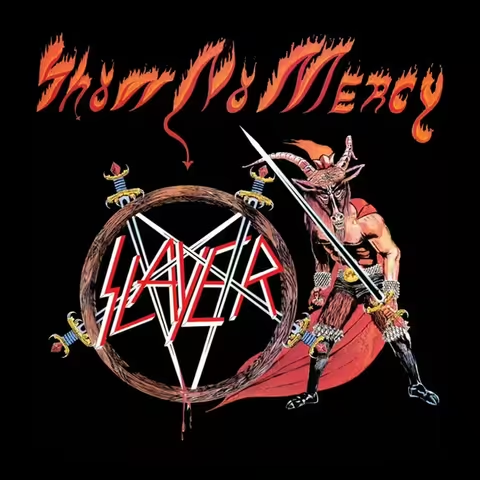
The Show No Mercy sleeve is the most discussed bad-good cover in metal history. It depicts a horned Baphomet figure, sword in hand, in a deliberately rough pen-and-paper style. It was drawn not by a professional illustrator but by Lawrence R. Reed, the father of Kevin Reed, who was helping the band with drum tech and lights. Steve Craig handled the inverted-cross logo, pentagram and the "side 666" gag on the back cover, where Hanneman is photographed holding a guitar with crosses turned upside down.
The artwork has been gleefully mocked over the years. Metal Hammer's Simon Young, writing in 2023 about hilariously ugly metal covers, called it "what happens when rural metal fans think it'll be a laugh to dress their goat in a cape, black swimming trunks and give them a sword. One minute, it's adorable, the next, your livestock is going fucking mental." It also made Metal Hammer's list of the 50 worst metal covers ever.
What gets lost in the jokes is how functional the sleeve was as marketing. In 1983, in a record shop full of leather-and-spandex glam metal covers, a hand-drawn Baphomet did the job a record sleeve should do: it stopped the right buyer in their tracks. Tape traders, fanzine writers and the small but growing thrash audience reached for the record specifically because it looked like nothing else on the shelf. Slayer would refine the visual language over the next three albums, but the cult logic behind it was already locked in here.
Release and reception
The first reviews of Show No Mercy were brutal, and that is the polite word. Kerrang!'s Dave Dickson, in issue 62 from 23 February 1984, dismissed it as "pure, unadulterated junk". The British rock press generally treated the record as derivative noise, with Slayer reduced to a Venom copy.
The European specialist press read it differently. Bernard Doe in Metal Forces, the underground tape-trader bible of the era, gave the album 9 out of 10 and called it "one of the heaviest, fastest, most awesome albums of all time". Holger Stratmann at Germany's Rock Hard also gave it 9 out of 10 and pinned the band's sound, accurately, as "heavy metal punk", more violent than Metallica or Exciter.
Sales matched the European critics rather than the British ones. By Slagel's own count, Metal Blade's average release at that point sold around 5,000 copies. Show No Mercy did roughly four times that in the United States, around 20,000, and around another 20,000 overseas. Within two years it would clear 40,000 worldwide, an extraordinary number for an independent debut from a band with no radio and no music videos.
The album never charted on its first release. Its only modern chart appearances came in November 2021, when it reached No. 26 on the UK Rock & Metal Albums chart and No. 44 on Germany's Offizielle Top 100 Albums chart, on the back of streaming activity and reissue campaigns. That is not the chart history of a flop. It is the chart history of an album that grew into a back-catalogue staple.
Singles and music videos
There were no music videos for any song on Show No Mercy. MTV would not entertain Slayer on its programming until much later, and Metal Blade had no budget to shoot one. "The Antichrist", "Die by the Sword" and "Black Magic" were promoted exclusively through live performance and word-of-mouth in fanzines.
The official "Black Magic" video embedded earlier in this article is a later live-and-archival cut put together by Metal Blade for the album's reissue campaigns. It is the only piece of period-adjacent moving image that exists for any song on the record.
Touring and live
Slayer's first US tour in support of Show No Mercy is one of the great low-budget rock-and-roll stories. Slagel handed Araya a list of venue addresses and phone numbers. Araya, still officially employed at a hospital, called the band one morning, said "Today's the day. Are we gonna do this?", and they set out in his Chevrolet Camaro towing a U-Haul trailer full of gear.
The tour had no manager. Doug Goodman, a friend who had been first in line for Slayer's first show in Northern California opening for Lääz Rockit, took a vacation from his job at a grocery store to help. He stayed on as their de facto tour manager for months and would later tour-manage Green Day and Beck. Kevin Reed, son of the cover artist, handled drums and lighting. Tom Araya's younger brother Johnny, 13 or 14 years old, set up the sound and worked the backline.
- The band lived almost entirely on gas, food and beer; per-diems were not part of the arrangement.
- They played a hotel in Winnipeg whose basement doubled as a venue, and stayed for four or five days because they had nowhere else to be.
- They played Boston's Lizard Lounge a few days after a car had crashed into the front of the venue, leaving the entrance boarded up.
- When King or Hanneman broke a string, Araya would hand them the bass and grab a guitar himself, with Hanneman complaining on stage that he wanted to play bass for the next song too.
- When the tour ended and they got home, Slagel asked, "So, where's the money?" The band, who had used everything to get from one venue to the next, did not realise that touring revenue had to be invoiced rather than donated.
This is the genuinely defining tour for Slayer as a touring band. The live persona that would carry them through Reign in Blood and beyond was built in Camaro miles in the first six months after Show No Mercy hit the shelves. Their first live home video, Combat Tour: The Ultimate Revenge, was filmed in March 1985 at Studio 54 with Venom and Exodus, but the band that walked on stage at Studio 54 had been forged on the Show No Mercy run.
In TV, film and media
For all its later cultural footprint, Show No Mercy has had relatively few notable sync placements. "Black Magic" has appeared in a handful of metal documentaries and skate videos, and "The Antichrist" surfaces occasionally on horror film soundtracks and television specials about the satanic panic. None of the songs from the album have entered the wider rock-radio canon in the way "Raining Blood" or "Angel of Death" did from later records.
That is, in part, a function of the album's production. Bands that lift from Show No Mercy tend to re-record its riffs rather than license its masters: the original Track Record mix is too lo-fi and too cymbal-bright for the loudness wars of modern film and TV.
Controversy, censorship and the PMRC
Show No Mercy attracted controversy before any of Slayer's later "Angel of Death" and "Jihad" rows. The Baphomet cover, the inverted crosses on the back sleeve, the "side 666" gag and the pentagram designed into the logo by Steve Craig were enough to put the album on Christian-group complaint lists almost immediately. Slayer received unsolicited mail from the Parents Music Resource Center even before the PMRC formally launched in 1985, demanding they stop releasing records. Araya has talked about this often in interviews, including the Westword piece in 2004, and his position has remained the same: the imagery was theatre, not theology.
The band's longstanding insistence that they were never practising Satanists has been a constant of their interview history. They have all said in different rooms that they were drawn to the imagery because it was forbidden, cinematic and effective on stage, not because any of them held actual beliefs. Hanneman, in a 2004 KNAC interview, described the writing process for songs like "The Antichrist" as a deliberate attempt to make something more shocking than what Venom were doing, with a straighter face.
There is no record of any specific store refusing to stock Show No Mercy on first release. The album was too small and too independent for that level of organised opposition. The lawsuits, the censorship hearings and the bus-bench removals would come later in Slayer's career, on the back of much bigger albums.
Covers, samples and tributes
Songs from Show No Mercy have been covered with surprising regularity for a debut album, especially given the absence of singles.
- "Black Magic" has been covered live by members of Sepultura, Slipknot drummer Joey Jordison, and various tribute lineups featuring members of Anthrax and Exodus.
- "The Antichrist" has appeared on multiple thrash-tribute compilations through the late 1990s and 2000s, including releases by Dwell Records.
- "Die by the Sword" has been covered by deathcore and hardcore acts looking to claim Slayer territory, including various Knocked Loose and Power Trip influences.
The album has also seeded an entire generation of riffs in death and black metal. Darkthrone's Fenriz has cited Show No Mercy as the direct inspiration for the band's current fusion of NWOBHM and black metal. Obituary and Death bassist Terry Butler called it "the blueprint for the beginning of death metal", saying, "When I heard Show No Mercy I wanted to play that way. It was a whole new level of mayhem. I wanted to play that way." System of a Down's Daron Malakian, writing for Revolver in 2021, said the album shaped him as both a person and an artist and that he carried it to Iraq when he lived there at 14, effectively introducing American thrash metal to his cousins.
Reissues, remasters and anniversaries
Show No Mercy has been reissued many times, in many forms, and the history of those reissues is part of how the album earned its second life.
- 1987 CD reissue: Metal Blade combined Show No Mercy with the Haunting the Chapel EP, adding "Chemical Warfare", "Captor of Sin" and "Haunting the Chapel" as bonus tracks. For most American CD buyers, this is the version they know.
- 1994 European CD reissue: Added "Aggressive Perfector" and "Chemical Warfare" as bonus tracks, running to 44:34.
- 2003 American Recordings remaster: Part of the wider Slayer back-catalogue remaster project supervised by Rick Rubin's label. Cleaned up the cymbal balance Lombardo had complained about and added "Aggressive Perfector" as a bonus.
- 2013 Metal Blade 30th anniversary vinyl reissue: Restored the original 10-track running order on 180-gram heavyweight vinyl with a faithful sleeve reproduction.
- 2021 streaming remaster and chart reentry: Pushed the album back into the German Albums Top 100 (No. 44) and the UK Rock & Metal Albums chart (No. 26).
- 2023 40th anniversary coverage: Loudwire, Metal Hammer and a wave of retrospective features re-evaluated the record in light of Slayer's farewell tour and 2024 reunion announcement. Metal Blade issued a limited "blood-filled" liquid vinyl variant capped at a tiny pressing run for collectors.
The album has never received a full super-deluxe box treatment of the kind Reign in Blood and Seasons in the Abyss have enjoyed. Slayer's catalogue politics around the original four-piece lineup, and Hanneman's death in 2013, have made any "expanded with demos" treatment unlikely in the short term.
Legacy and influence
It is easy now to talk about Show No Mercy as the first chapter in the most influential thrash discography ever made. At the time, it was a Metal Blade debut from a band most American critics had never heard of, whose drummer hated his own performance, whose cover was drawn by a friend's father, and whose first European review called it junk.
Three forces turned the record into a cornerstone. First, sales. Metal Blade's commercial life as a label was effectively underwritten by Show No Mercy. Second, the tape-trading economy. Copies of Show No Mercy ended up in dorm rooms in Florida, basements in Norway, garages in São Paulo. Third, the next four albums. Hell Awaits, Reign in Blood, South of Heaven and Seasons in the Abyss retroactively recoded Show No Mercy as Slayer's origin myth: not the masterpiece, but the spark.
The bands that name-check the record now read like a roll call of the genre. Darkthrone's Fenriz on the black-metal side. Death's Terry Butler and Obituary on the death-metal side. Sepultura's Andreas Kisser has said, "Without Slayer, Sepultura would never be possible." System of a Down's Daron Malakian, Behemoth's Nergal, Lamb of God's Randy Blythe, Knocked Loose and Power Trip have all cited it in interviews. Alex Skolnick of Testament put it best for the band's overall influence: "Before Slayer, metal had never had such razor-sharp articulation, tightness, and balance between sound and stops. This all-out sonic assault was about the shock, the screams, the drums, and most importantly the riffs."
"When I heard Show No Mercy I wanted to play that way. It was a whole new level of mayhem. I wanted to play that way."
Terry Butler, Obituary and Death, Metal Crypt, 2013
Inside Slayer's discography, Show No Mercy sits as the band's most NWOBHM-coloured record. It carries Iron Maiden's twin-guitar harmonies and Mercyful Fate's occult theatrics in a way the band would never wear so openly again. By Reign in Blood, three years later, those traces would be stripped out almost entirely in favour of hardcore punk's economy. The album is Slayer before they invented the version of Slayer that everyone else copies.
Things you might not know
| Fact | Detail |
|---|---|
| Self-financed | Slayer paid for their own debut by combining Tom Araya's wages as a respiratory therapist with money borrowed from Kerry King's father, because Metal Blade had no recording budget for them. |
| Slagel signed them off an Iron Maiden cover | Brian Slagel watched Slayer open for Bitch at the Woodstock Club in 1983, decided to sign them while they were playing an Iron Maiden cover, and asked for an original on the spot. |
| The cover artist was a roadie's dad | The Baphomet on the front sleeve was drawn by Lawrence R. Reed, father of Kevin Reed, who handled drum tech and lighting on the first tour. |
| Gene Hoglan's first vocal | The famous "EVIL!" gang shout on the opening track was Gene Hoglan's idea, suggested while he sat in the control room, and it gave the future Dark Angel and Death drummer his first appearance on a Slayer record. |
| Lombardo hated the drum sound | Dave Lombardo has called Show No Mercy his least favourite Slayer album because engineer Bill Metoyer had to dampen his cymbals with towels and record toms and cymbals separately. |
| Slagel wanted no cymbals at all | The label boss initially asked Lombardo to play the entire record without cymbals, fearing the bleed into other microphones would be impossible to fix in the mix. |
| "Tormentor" came from a side project | Jeff Hanneman originally wrote "Tormentor" for a side project called Pap Smear with Lombardo; the rest of the Pap Smear material appeared a decade later on Undisputed Attitude. |
| No singles, no videos | Show No Mercy produced no commercial singles and no music videos on its original release; "Black Magic" and "The Antichrist" became hits purely through the live show and tape-trading underground. |
| Hanneman dismissed his own album | Kerry King has joked many times that Show No Mercy is "fuckin' Iron Maiden here and there", and the band have rarely defended the album's production as anything other than rough. |
| The first US tour ran on Araya's Camaro | The Show No Mercy tour ran on Tom Araya's Chevrolet Camaro towing a U-Haul, with Doug Goodman, who quit a grocery store job to help, acting as de facto tour manager. |
| Araya's 13-year-old brother was the sound tech | Tom's younger brother Johnny Araya, then 13 or 14 years old, set up the backline and sound on Slayer's first tour, learning a trade he would carry into the band's later road crew. |
| The album never charted on first release | Show No Mercy did not appear on any national chart in 1983 or 1984; it finally reached No. 26 in the UK Rock & Metal Albums chart in November 2021, almost 38 years after release. |
| Daron Malakian's Iraq tape | System of a Down's Daron Malakian has said he carried a cassette of Show No Mercy to Iraq when he lived there as a 14-year-old, effectively introducing American thrash metal to his cousins. |
| Hilariously ugly, officially | Metal Hammer included the Show No Mercy sleeve on its 2023 list of the 50 most hilariously ugly metal album covers ever, with writer Simon Young comparing the Baphomet to a goat in a cape and swimming trunks. |
Riffology podcast
If you enjoyed this deep dive into Show No Mercy, the Riffology podcast covers Slayer's full discography and the wider thrash metal canon in long-form episodes. Riffology is available on Spotify, Apple Podcasts, Pocket Casts and every other major podcast platform. Subscribe wherever you listen and join the conversation about the records that built modern metal.
Comments