Phil Lynott walked up to Joe Elliott, put a hand on his shoulder, and delivered a verdict that Elliott would never forget. The two bands shared a label, Vertigo, and Lynott had heard an advance copy of Def Leppard's new album Pyromania. What he told the young singer was that the record was the reason he had just broken up Thin Lizzy.
"I heard your album. It's the reason I've split the band. I can't compete with that. The crappiest backhanded compliment I've ever had."
Joe Elliott, recalling Phil Lynott, Classic Rock, 2016
Elliott, then in his early twenties and a lifelong Lizzy fan, was too stunned to do anything but mumble and walk away.
The album that ended one of the great hard-rock bands and launched Def Leppard into the American stratosphere was built in a year of recording in two English studios, on a method so back-to-front it recorded the drums last, by a band that fired one of its founding guitarists halfway through and barely broke stride. Released on 20 January 1983, Pyromania spent the year selling roughly a hundred thousand copies a week in the United States, invented the commercial template that hair metal would chase for the rest of the decade, and was kept off the number-one spot on the Billboard 200 only by the biggest-selling album in history, Michael Jackson's Thriller. This is how a band from Sheffield and a perfectionist producer from Rhodesia made one of the defining records of the 1980s.
| Field | Detail |
|---|---|
| Artist | Def Leppard |
| Album | Pyromania |
| Release Date | 20 January 1983 |
| Label | Vertigo (Europe), Mercury (US) |
| Producer(s) | Robert John "Mutt" Lange |
| Studio(s) | Battery Studios, London; Park Gate Studios, Battle, East Sussex |
| Genre / Subgenre | Glam metal, hard rock, with pop-metal production |
| Track Count | 10 |
| Total Runtime | 44:59 |
| Billboard 200 Peak | 2 (held off the top by Michael Jackson's Thriller) |
| UK Albums Chart Peak | 18 |
| Other Notable Chart Peaks | Canada 4, Germany 20, Sweden 23, New Zealand 26, Finland 30, Japan 70, Australia 70 |
| Certifications | Diamond (RIAA, 10 million); 7x Platinum (Canada); Gold (France); Silver (UK) |
| Estimated Sales | Over 10 million in the US alone |
| Key Singles | "Photograph", "Rock of Ages", "Foolin'", "Too Late for Love" |
Cultural Context
Hard rock in early 1983 was at a crossroads. The New Wave of British Heavy Metal that had produced Def Leppard's first two albums had crested; Iron Maiden and Saxon were huge in Europe but had made limited commercial inroads into America. Across the Atlantic, MTV had launched in August 1981 and was eighteen months into rewiring how records were sold, and the channel was desperate for telegenic rock acts with a budget for promotional films. Synth-pop and new wave dominated the singles charts. The idea that a heavy guitar band could compete with Michael Jackson, Lionel Richie and the Police for mainstream radio and television airtime seemed, on paper, far-fetched.
What Def Leppard and Mutt Lange understood, ahead of almost everyone else in their genre, was that the production gloss the pop charts were using could be applied to hard rock without sanding off the riffs entirely. Pyromania arrived sounding like nothing else in metal: layered to a sheen, built on stacked vocal harmonies that owed as much to Queen and the Beach Boys as to Black Sabbath, and engineered for radio and MTV from the ground up. It was a calculated bet that the American mainstream would buy heavy guitars if they came wrapped in choruses you could sing on the first listen. The bet paid off so completely that within two years every record label in Los Angeles was signing bands trying to replicate it.
The album also sat at a generational hinge. It was the last Def Leppard record before drummer Rick Allen lost his left arm in a car crash on New Year's Eve 1984, an event that would delay the follow-up Hysteria for years and turn the band's story into one of survival as much as success. Pyromania is the sound of the band at its most uncomplicatedly hungry, before tragedy and before the four-year studio marathon that Hysteria became.
The Band's Story Up to This Point
Def Leppard had formed in Sheffield in 1977, founded by Rick Savage, Pete Willis and Tony Kenning as a teenage outfit originally called Atomic Mass, with Joe Elliott joining after missing a bus and bumping into Willis. Steve Clark auditioned by playing Lynyrd Skynyrd's "Free Bird" in full and was hired on the spot. By 1978 they had a settled core and a self-released EP; by 1979 they had signed to Vertigo and become poster boys for the New Wave of British Heavy Metal, a tag Elliott always resented because the band's ambitions pointed at America, not at the British metal underground.
Their 1980 debut On Through the Night charted respectably in Britain but drew accusations of selling out to America when the band played the Reading Festival and were pelted with bottles by a section of the crowd who felt they had gone soft. The 1981 follow-up High n Dry was their first with Mutt Lange, the South-African-raised producer who had just made AC/DC superstars with Highway to Hell and Back in Black. High n Dry sharpened the band considerably and produced the power ballad "Bringin' On the Heartbreak", but it stalled commercially. The band, the label and Lange all knew the third album had to break America or the project was finished.
The lineup that began the Pyromania sessions was Elliott on vocals, Steve Clark and Pete Willis on guitars, Rick Savage on bass and Rick Allen, who had joined at fifteen, on drums. By the time the album was finished, one of those guitarists would be gone, replaced by a player whose audition consisted largely of being fun to have around.
Pre-production and Demos
Pre-production began in Sheffield in January 1982. Lange, by now the band's de facto sixth member and creative tyrant, set an unusual brief. Rather than asking the band to bring finished songs, which he would only pull apart, he told them to gather raw ideas, riffs, vocal hooks, fragments, and bring those to London where the two parties would assemble the best of them into songs together. It was a working method that gave Lange enormous control over the final shape of every track and is a large part of why so many of the songs are co-credited to him.
The method was painstaking in the extreme. Lange would workshop a single vocal line for hours, stacking and re-stacking harmonies, chasing a perfection of pitch and arrangement that no hard-rock band of the era was attempting. Songs were built from the ground up in the studio rather than captured as live performances. Several of the album's eventual hooks existed first as nothing more than a hummed idea on a cassette before Lange and the band turned them into the anthems they became.
"Mutt's whole thing was, don't bring me songs, bring me ideas. We'd have a riff, a chorus melody, a title, and we would build the song in the room with him. He heard the finished record in his head before we'd recorded a note of it."
Joe Elliott, reflecting on the Pyromania sessions, VH1 Ultimate Albums
Creating the Album
Recording ran from early 1982 through to November, an extraordinarily long schedule for a hard-rock album of the period, split principally between Battery Studios in London and Park Gate Studios in Battle, East Sussex. The length of the sessions was entirely down to Lange's perfectionism. The album was not so much performed as constructed, layer by layer, take by take, over the better part of a year.
The recording method was radical and, in hindsight, deeply ironic. The band tracked the bass and guitars first, playing to a click track generated by a Linn LM-1 drum machine, and added Rick Allen's real drums last. This was the reverse of how almost every rock record had ever been made, where the drums and bass go down first as the rhythmic foundation. Lange's approach gave the band total flexibility to rearrange and re-cut sections of a song as the arrangement evolved, because the drums were not locked in early. The irony is that the band that built an album around a programmed click would, two years later, have to rebuild its entire sound around a drummer playing with one arm and a custom electronic kit.
Getting the guitar sound was a war of attrition. The band ran take after take through banks of Marshall amplifiers and could not get the tone Lange wanted. The frustration peaked at a point where, as the band later told it, they genuinely wanted to set fire to all the amplifiers and start again. That impulse gave the album its name. Pyromania is, in part, a joke about the studio sessions that nearly drove them to arson.
The sessions' biggest crisis was human, not technical. Pete Willis, a founding member, had a serious drink problem that worsened through the recording. His rhythm guitar parts had been tracked across the whole album and remain on every song, but his behaviour became untenable, and on 11 July 1982 the band sacked him. They moved fast to find a replacement and landed on Phil Collen, formerly of the glam band Girl and a friend of the band, who came in to play the solos and the guitar parts Willis had not yet recorded. Collen's recollection of walking into a nearly finished masterpiece is one of the great accounts of fortunate timing in rock.
"I had all the fun stuff, none of the heavy lifting. Pete and Steve had done these amazing rhythm guitar beds, and it was a joy to whizz around and play solos over the top. Mutt was going, 'Just have fun, be a lead guitarist, go nuts.'"
Phil Collen, on joining Def Leppard mid-album, Classic Rock, 2018
On the original LP, the credit situation was preserved visually: Willis appears in the background of a photograph of Joe Elliott, while the new full-time member Collen has his own photo. The mixing was as gruelling as the recording. Lange, Mike Shipley and the uncredited Nigel Green worked the final mixes around the clock; on at least one occasion Lange and Green pulled an all-nighter to finish tracks that had to be flown to New York on Concorde the next morning, because Shipley had passed out from exhaustion. The album was layered with a Fairlight CMI programmed by John Kongos and keyboards from Thomas Dolby, credited under the pseudonym Booker T. Boffin, with further uncredited keyboard work by Tony Kaye of Yes.
Personnel and Credits
| Role | Player | Notes |
|---|---|---|
| Core band | ||
| Lead vocals | Joe Elliott | |
| Guitars, backing vocals | Steve Clark | Recorded the bulk of the rhythm beds with Willis; died in 1991 |
| Guitar solos, backing vocals | Phil Collen | Solos on tracks 1 to 3, 6 and 7; joined July 1982 after Willis was sacked |
| Bass, backing vocals | Rick Savage | Founding member |
| Drums, backing vocals | Rick Allen | Drums tracked last, to a Linn drum-machine click |
| Rhythm guitar | Pete Willis | Plays rhythm guitar on all ten tracks; sacked mid-sessions for alcohol abuse |
| Additional musicians | ||
| Backing vocals ("The Leppardettes") | Mutt Lange, Terry Wilson-Slesser, Rocky Newton, Pete Overend Watts, Chris Thompson | The album's signature stacked vocal-harmony choir |
| Fairlight CMI programming | John Kongos | |
| Keyboards | Thomas Dolby | Credited under the pseudonym "Booker T. Boffin" |
| Additional keyboards | Tony Kaye | Of Yes; uncredited on the original release |
| Production and engineering | ||
| Producer, mixing | Robert John "Mutt" Lange | |
| Engineer | Mike Shipley | |
| Engineer, mixing | Nigel Green | Uncredited on the original release |
| Assistant engineer | Brian "Chuck" New | Battery Studios |
| Engineer | Craig Thomson | Park Gate Studios |
| Mastering | Bob Ludwig | |
| Artwork | ||
| Front cover illustration | Bernard Gudynas | The target-and-burning-building image |
| Back cover photograph | David Landslide | |
| Sleeve concept and design | Satori (Andie Airfix) | |
The personnel list tells the album's central story in miniature. Two guitarists are credited because one was sacked and the other inherited his half-finished record. The biggest single contributor after the band may be Mutt Lange, who not only produced and co-wrote most of the album but sang in the backing-vocal choir that gives the record its identity. The "Leppardettes" name was a knowing joke about how much of the band's heaviness was wrapped in sweetly stacked harmonies.
The Songs
| # | Title | Writer(s) | Length | Single? | Notes |
|---|---|---|---|---|---|
| 1 | Rock! Rock! (Till You Drop) | Clark, Elliott, Lange, Savage | 3:52 | Opens the album with a fanfare and a chant | |
| 2 | Photograph | Clark, Elliott, Lange, Savage, Willis | 4:12 | Yes | Lead single; six weeks at number one on Mainstream Rock |
| 3 | Stagefright | Elliott, Lange, Savage | 3:46 | The album's fastest, most metal-leaning track | |
| 4 | Too Late for Love | Clark, Elliott, Lange, Savage, Willis | 4:30 | Yes | Fourth single; a moody mid-tempo highlight |
| 5 | Die Hard the Hunter | Clark, Elliott, Lange, Savage | 6:17 | An epic about a soldier returning from war | |
| 6 | Foolin' | Clark, Elliott, Lange | 4:34 | Yes | Third single; builds from acoustic intro to anthem |
| 7 | Rock of Ages | Clark, Elliott, Lange | 4:09 | Yes | Opens with Lange's nonsense count-in "Gunter glieben glauchen globen" |
| 8 | Comin' Under Fire | Clark, Elliott, Lange, Willis | 4:20 | Listed inversely with track 9 on the original vinyl | |
| 9 | Action! Not Words | Clark, Elliott, Lange | 3:49 | B-side of "Photograph" | |
| 10 | Billy's Got a Gun | Clark, Elliott, Lange, Savage, Willis | 5:56 | Closes with the hidden instrumental "The March of the Wooden Zombies" |
"Rock! Rock! (Till You Drop)" opens the album exactly as a band trying to conquer America would want, with a fanfare, a chant and a stadium-sized invitation. It establishes the record's two governing qualities immediately: the riffs are heavy, but the production is so clean and the harmonies so stacked that nothing sounds remotely threatening. This was the formula in a nutshell.
"Photograph", the second track and lead single, is the song that broke the band. It has been variously described as pop metal, glam metal, hard rock and power pop, and the truth is it is all four at once, which is precisely why it worked. Joe Elliott has always insisted the lyric is not about Marilyn Monroe, despite the famous lookalikes in the video and the line about a photograph being all he has; he describes it as being about wanting something you can never get your hands on. Lange called it an anthem about young lust. It reached number twelve on the Billboard Hot 100 and spent six weeks at number one on the Mainstream Rock chart, an eternity for a rock single, and it remains the song the band closes almost every concert with to this day.
"Stagefright" is the album's heaviest, fastest moment, the closest Pyromania comes to the New Wave of British Heavy Metal the band were trying to outgrow. "Too Late for Love" is a moody, atmospheric mid-tempo song that became the fourth single, and "Die Hard the Hunter", at over six minutes the album's longest track, is its most ambitious, a mini-epic about a soldier coming home from war that opens with the sound of marching and gunfire and shows how much narrative weight Lange was prepared to load onto a hard-rock arrangement.
"Foolin'" builds from a near-classical acoustic guitar intro into one of the band's signature slow-burn anthems and became the third single, a top-forty hit. "Rock of Ages", the second single, is the album's other monster. It opens with one of the most famous count-ins in rock, Mutt Lange muttering the nonsense phrase "Gunter glieben glauchen globen", a string of invented syllables he used in place of the cliched "one, two, three, four" because he found the usual count boring. The phrase has been sampled and quoted endlessly since, most famously by Def Leppard themselves in later years. The song hit number sixteen on the Hot 100 and number one on Mainstream Rock.
The album's back half, "Comin' Under Fire", "Action! Not Words" and "Billy's Got a Gun", is less celebrated than the singles run but holds up as a unit, with "Billy's Got a Gun" closing the record on a tense, almost cinematic note before dissolving into a hidden fifty-six-second instrumental coda titled "The March of the Wooden Zombies". On the original Mercury vinyl pressing, "Comin' Under Fire" and "Action! Not Words" were accidentally listed in the wrong order, a small manufacturing quirk that collectors still note.
B-sides, Outtakes and Lost Songs
Because of the way the album was constructed, with songs assembled from fragments rather than tracked as a batch of finished band performances, there is relatively little in the way of fully realised Pyromania outtakes. The B-sides drew on album cuts and earlier material rather than dedicated new recordings. The hidden coda "The March of the Wooden Zombies" is the only true studio curio buried on the original record.
The 2009 deluxe edition's bonus disc filled in the wider picture of the era rather than the sessions specifically, gathering live recordings and tracks from across the early-eighties period, including a version of "Rock! Rock! (Till You Drop)", live takes of High n Dry material such as "Bringin' On the Heartbreak", "Switch 625" and "Mirror Mirror (Look into My Eyes)", and a cover of Creedence Clearwater Revival's "Travelin' Band" featuring Queen's Brian May on guitar. The 40th-anniversary reissue, released in 2024, expanded the package further with additional live and demo material, giving fans the deepest look yet at how the band sounded around the album that made them.
- "Action! Not Words" served as the B-side to "Photograph".
- "The March of the Wooden Zombies" is the hidden instrumental tagged onto "Billy's Got a Gun".
- The 2009 deluxe disc added a Brian May-assisted cover of CCR's "Travelin' Band".
- The 2024 40th-anniversary edition added further live recordings and period material.
Album Artwork and Packaging
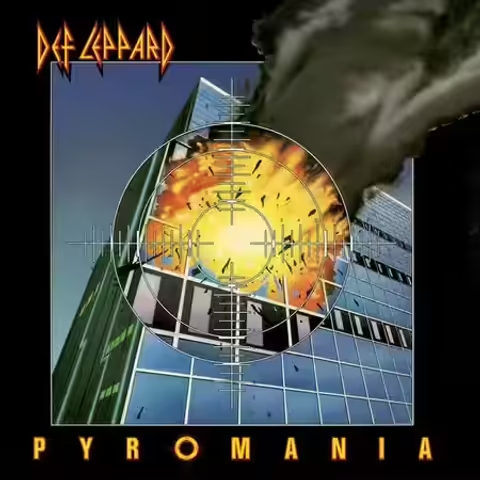
The cover is among the most recognisable in eighties rock: a rifle target trained on a high-rise tower block, with flames bursting from one of its windows, the crosshair magnifying the building at its centre. It was illustrated by Bernard Gudynas, with the sleeve concept and design credited to Satori, the studio of designer Andie Airfix, who would go on to define the visual identity of Hysteria and much of British hard rock's eighties and nineties artwork. David Landslide took the back-cover photograph.
The image fused the album's title with a sense of menace and spectacle that suited an album obsessed with firepower and noise. It was a deliberate move away from band-photo covers toward an iconic graphic the eye could read instantly on a record-shop shelf or, crucially, in a small thumbnail on a television screen, in keeping with the MTV age the album was built for. The target motif became one of the band's most enduring visual signatures.
Release and Reception
Released on 20 January 1983, Pyromania was an immediate and sustained commercial juggernaut. It became the first glam-metal album to break into the Billboard top ten, climbing there on 12 March 1983, before peaking at number two on 14 May and remaining inside the top ten until late November. It stayed on the Billboard 200 for an astonishing 123 weeks. It sold roughly six million copies in the United States in its first year alone, around a hundred thousand a week for much of 1983, and has since passed ten million, certified Diamond by the RIAA. Only Michael Jackson's Thriller, the best-selling album ever made, stopped it reaching number one.
Critically the album was well received and has grown in stature since. AllMusic's Steve Huey, in a five-star retrospective review, called it the record where "the band's vision coalesced and gelled into something more". Classic Rock and several reference guides have since awarded it full marks. Writing in Rolling Stone at the time, David Fricke gave it a strong notice and identified exactly what made it land.
"Much-needed fire back on the radio. They may not be highly original, but they mean what they play, and Lange's artfully busy mix is more emotionally charged than most of the synthesized disco that passes for modern music."
David Fricke, Rolling Stone, 1983
"Transcendent hard rock perfection on Pyromania was surprisingly successful; their reach never exceeded their grasp, which makes the album an enduring and massively influential classic."
Steve Huey, AllMusic
Not everyone was convinced. Robert Christgau gave the album a middling C in The Village Voice. The Canadian metal historian Martin Popoff went further, arguing that Pyromania marked the beginning of the band's "creative degeneration" and that Lange's "painstaking approach to detail" stripped the music of its "sweat and grit", making it sound "phony". The criticism cuts to the heart of the album's divisiveness among purists: the very polish that made it a phenomenon is, for some, the thing that drained the danger out of it.
The album's standing in retrospective lists has been considerable. Rolling Stone placed it at number 384 on its 2003 list of the 500 Greatest Albums of All Time, ranked it number 17 among the 50 Greatest Hair Metal Albums in 2015, and listed it at number 52 on its 100 Greatest Metal Albums in 2017. Q magazine placed it at number 35 in its 40 Best Albums of the Eighties in 2006, and in 2024 Loudwire named it the best hard-rock album of 1983.
Singles and Music Videos
Four singles were lifted from the album, and the videos were as important to its success as the songs. MTV's heavy rotation of the clips turned Def Leppard from a cult British metal band into American household names over the course of 1983.
- "Photograph" (28 January 1983) reached number 12 on the Hot 100 and number one on Mainstream Rock for six weeks; UK number 66.
- "Rock of Ages" (2 June 1983) reached number 16 on the Hot 100 and number one on Mainstream Rock; UK number 41.
- "Foolin'" (18 August 1983) became a top-forty hit and a Mainstream Rock top-tenner.
- "Too Late for Love" (25 November 1983) charted on the rock listings to round out the campaign.
The "Photograph" video, directed by David Mallet and shot on 2 December 1982 in Battersea, London, was the engine of the band's American breakthrough. It featured the video debut of new guitarist Phil Collen, a clutch of Marilyn Monroe lookalikes, and a minor censorship wrinkle: an uncensored version opens with a knife scene that the broadcast cut replaced with a stationary black cat. The clip went into heavy MTV rotation and effectively introduced Def Leppard to millions of American teenagers. The shoot fell on Rick Savage's twenty-second birthday.
"Photograph" has had an unusually long afterlife. Def Leppard performed it with Taylor Swift on CMT Crossroads in 2008, a pairing that earned award nominations, and the song appeared in Grand Theft Auto V in 2013 and as downloadable content for Rock Band 3 in 2011. VH1 named it the 13th-greatest hard-rock song of all time, and Loudwire ranked it the single best Def Leppard song.
Touring and Live
The Pyromania World Tour through 1983 was where the album's commercial momentum became unstoppable. Def Leppard toured America relentlessly, frequently as a support act early on before the singles propelled them to headline status, and by the latter half of the year they were playing to enormous crowds on the back of constant MTV exposure. The tour cemented the live identity that would carry the band for decades: high harmonies reproduced live, a clean and powerful sound, and "Photograph" and "Rock of Ages" as the climactic one-two punch of the set.
The tour is also, in retrospect, shadowed by what came next. The band came off the road at the end of the Pyromania cycle as one of the biggest rock acts in America, and then spent a difficult, drawn-out period working on the follow-up. On New Year's Eve 1984, drummer Rick Allen crashed his car near Sheffield and lost his left arm. His decision to continue, learning to play a specially designed electronic kit using his feet, became one of rock's most famous comeback stories and delayed Hysteria until 1987. Pyromania stands as the last document of the original, uncomplicated incarnation of the band before that turning point.
In TV, Film and Media
The album's songs have become staples of eighties-soundtrack shorthand. "Photograph" and "Rock of Ages" turn up routinely whenever film or television wants to evoke 1983, MTV culture or the glam-metal era. "Photograph" featured prominently in Grand Theft Auto V on the Los Santos Rock Radio station, introducing it to a generation of gamers, and has appeared in numerous compilations and rhythm games. The phrase "Rock of Ages" was later borrowed as the title of a jukebox musical and 2012 film celebrating the very hair-metal scene that Pyromania helped birth, though the band's song is distinct from that production.
Controversy and Criticism
Def Leppard avoided the parental-advisory and censorship controversies that dogged many of their hair-metal successors. The album's lyrics, even on a song like "Die Hard the Hunter", were more cinematic than transgressive, and the band's clean-cut image was a deliberate contrast to the sleaze of the Sunset Strip scene they inspired. The only mild censorship the album touched was the alternate, knife-free cut of the "Photograph" video made for broadcast.
The real controversy around Pyromania was aesthetic, and it was an argument the band's own peers were having. To critics like Martin Popoff, the album represented hard rock being sanded smooth and sold out, its grit replaced by studio gloss. To its defenders, that polish was exactly the innovation, the moment a metal band figured out how to make a genuinely heavy record that could also rule pop radio. Phil Lynott's backhanded compliment to Joe Elliott captures the tension perfectly: the album was so good at what it did that a rival found it demoralising, even as purists found it too clean.
Covers, Samples and Tributes
The most-quoted fragment of the entire album is not a riff or a chorus but Mutt Lange's nonsense count-in on "Rock of Ages", "Gunter glieben glauchen globen". The gibberish phrase has been sampled and referenced across pop and hip-hop, most prominently as the opening of the Bloodhound Gang's 1999 hit "The Bad Touch", which lifts it directly. It is one of the most unlikely pieces of accidental cultural currency in rock history, a producer's bored alternative to counting to four that outlived the count itself.
"Photograph" and "Rock of Ages" are both staples of eighties tribute and covers circuits, and the band's CMT Crossroads collaboration with Taylor Swift in 2008 reintroduced "Photograph" to a country-pop audience. The album's wider legacy as a sound, rather than a set of individually covered songs, is the more important tribute: an entire genre spent the rest of the decade trying to reproduce its production.
Reissues, Remasters and Anniversaries
The album has been reissued repeatedly across formats since 1983.
- 1989 Mobile Fidelity Sound Labs released a gold-disc Ultradisc edition as part of their audiophile series.
- 2009 A two-disc deluxe edition paired the remastered album with a bonus disc of live recordings and period material, including the Brian May-assisted "Travelin' Band".
- 2023 to 2024 The band launched 40th-anniversary celebrations, culminating in an expanded 40th-anniversary edition reviewed favourably by Classic Rock, adding further live and demo material.
The anniversary campaigns underlined how central the album remains to the band's identity. Four decades on, Def Leppard still open and close shows with its songs, and the record is routinely cited as the moment the band, and arguably the entire pop-metal genre, found its commercial voice.
Legacy and Influence
The influence of Pyromania is almost impossible to overstate within its genre. It was, as AllMusic and Ultimate Classic Rock both put it, the album that laid the groundwork for the band's world domination and inspired a wave of copycats. The entire mid-eighties explosion of melodic American hard rock, the Mötley Crües, Bon Jovis, Poisons and dozens of lesser bands signed in their wake, was chasing the commercial template Def Leppard and Mutt Lange built here: heavy guitars, enormous stacked vocal harmonies, radio-ready choruses and a production sheen aimed squarely at MTV and FM radio.
For the band itself, Pyromania set up an even bigger record. The lessons learned, and Lange's perfectionist method taken to an even greater extreme, produced Hysteria in 1987, which sold over twenty million copies and spawned seven singles. But Hysteria would not have been conceivable without the breakthrough Pyromania achieved, both commercially and as a proof of concept that a guitar band could win the pop game on its own terms.
The album's place in history is secured by the company it keeps in the sales record books. With over ten million copies sold in the United States, it sits among the best-selling albums in American history, and it did so as a hard-rock record in a year dominated by pop. Phil Lynott's despairing verdict, that he could not compete with it, turned out to be the album's truest review. Pyromania did not just make Def Leppard stars; it redrew the boundaries of what a heavy guitar band could achieve in the mainstream, and the genre it helped create spent the rest of the decade living in its shadow.
Things You Might Not Know
| Fact | Detail |
|---|---|
| The album that split Thin Lizzy | Phil Lynott told Joe Elliott that hearing Pyromania was the reason he broke up Thin Lizzy: "I can't compete with that." |
| Drums recorded last | The band tracked bass and guitars first to a Linn LM-1 drum-machine click, then added Rick Allen's real drums at the end, reversing the usual order of rock recording. |
| The title came from frustration | The band grew so exasperated trying to get the right guitar tone that they wanted to burn all their Marshall amps. That impulse gave the album its name. |
| A founding guitarist was sacked mid-album | Pete Willis was fired on 11 July 1982 for alcohol abuse, but his rhythm guitar remains on all ten tracks; Phil Collen played the solos and finished the record. |
| Held off number one by Thriller | Pyromania peaked at number two on the Billboard 200, kept from the top only by Michael Jackson's Thriller, the best-selling album of all time. |
| The famous nonsense count-in | "Rock of Ages" opens with Mutt Lange muttering "Gunter glieben glauchen globen", invented syllables he used because counting to four bored him. |
| That phrase became a hip-hop sample | The Bloodhound Gang opened their 1999 hit "The Bad Touch" by sampling Lange's "Gunter glieben glauchen globen" count-in directly. |
| Thomas Dolby's secret credit | Synth-pop star Thomas Dolby played keyboards on the album under the pseudonym "Booker T. Boffin"; Yes keyboardist Tony Kaye also played, uncredited. |
| The Photograph video debut | The "Photograph" video, shot in Battersea on Rick Savage's 22nd birthday, was new guitarist Phil Collen's first appearance on film with the band. |
| A hidden track | The last 56 seconds of "Billy's Got a Gun" contain a hidden instrumental called "The March of the Wooden Zombies". |
| A vinyl tracklisting error | On the original Mercury LP, "Comin' Under Fire" and "Action! Not Words" were listed in the wrong order, though they play in the intended sequence. |
| The last album before the crash | Pyromania was the final Def Leppard album before drummer Rick Allen lost his left arm in a New Year's Eve 1984 car crash, an event that delayed Hysteria for years. |
| Mixed against Concorde deadlines | Lange and Nigel Green worked all night on final mixes that had to be flown to New York on Concorde the next morning, after engineer Mike Shipley collapsed from exhaustion. |
| Mutt sang on it too | Producer Mutt Lange sang in the backing-vocal choir credited as "The Leppardettes", contributing to the stacked harmonies that define the record. |
Listen to the Riffology Podcast
The Riffology podcast digs into the records that shaped rock and the people who made them, and is available on all major podcast platforms. We would love to hear whether you reach for "Photograph" or "Rock of Ages" first when Pyromania comes round.
Comments