In December 1984, a band that had been together barely eighteen months walked into Indigo Ranch in Malibu with $8,000 of Combat Records' money and instructions to make a debut album. Within weeks Combat had stumped up another $4,000, the original producer was gone, and roughly half the budget had been converted into drugs, alcohol and food. The man at the centre of the chaos had been sacked from Metallica two years earlier and made no secret of why he was making the record at all. "After getting fired from Metallica," Dave Mustaine later said, "all I remember is that I wanted blood. Theirs. I wanted to be faster and heavier than them."

That singular, vengeful intent is the only reason Killing Is My Business... and Business Is Good! exists in the form it does. Tracked between December 1984 and January 1985, released in the UK on 17 May and the US on 12 June, the album is thin, ugly, gloriously chaotic and routinely cited as one of the foundation stones of American thrash metal. It is also the only Megadeth studio album that never charted on the Billboard 200, and the only one whose original cover was so badly bungled by the record label that the band has spent four decades trying to replace it.

Album Facts

Combat Records' original 1985 cover for Killing Is My Business..., a plastic skull crudely made up with tinfoil and ketchup.
Combat's improvised 1985 sleeve. Metal Hammer later included it in a list of the fifty most hilariously ugly metal album covers ever released.
FieldDetail
ArtistMegadeth
AlbumKilling Is My Business... and Business Is Good!
Release Date17 May 1985 (UK, Music for Nations) · 12 June 1985 (US, Combat)
LabelCombat Records (US) · Music for Nations (UK)
Producer(s)Dave Mustaine and Karat Faye, with Megadeth co-producing. Pre-production by Jay Jones.
Studio(s)Indigo Ranch Studios, Malibu, California · Crystal Sound Labs, Hollywood, California
RecordedDecember 1984 to January 1985
Genre / SubgenreThrash metal, speed metal
Track Count8 (original LP)
Total Runtime31:10
Billboard 200 PeakDid not chart (original); No. 169 for the 2018 Final Kill reissue
UK Albums Chart PeakDid not chart (original); No. 3 UK Rock & Metal Albums (2018 Final Kill)
Other Notable Chart PeaksGermany No. 35, Japan No. 35, Scotland No. 36 (all 2018 Final Kill)
CertificationsNo RIAA or BPI certification
Estimated SalesOver 254,000 US copies since SoundScan tracking began in 1991, per Blabbermouth
Key SinglesNone. No commercial singles were issued from the original release.

Cultural Context

The first half of 1985 belonged to mainstream pop and stadium rock. Like a Virgin, Born in the U.S.A. and Phil Collins's No Jacket Required ran the charts. Live Aid drew an estimated global audience of nearly two billion in July. American hard rock was dominated by the polished glamour of Mötley Crüe's Theatre of Pain and Bon Jovi's 7800° Fahrenheit, and the only metal record that came close to genuine mass-market success was Metallica's Ride the Lightning, an album that had crept onto the Billboard 200 the previous summer.

Underground, a faster, uglier sound was hardening. Slayer's Hell Awaits arrived in March on Metal Blade. Exodus's Bonded by Blood appeared in April after eighteen months of bootleg-tape worship. Anthrax had released Fistful of Metal a year earlier. The American thrash scene had finally produced enough records for the term to mean something specific, and it was about to acquire its single most antagonistic figure. Mustaine had been ejected from Metallica in April 1983 over drinking, drug use and behavioural issues; by December 1984 he was in Malibu making a record built almost entirely around the principle of being faster, meaner and more technically demanding than the band that had let him go.

The wider music industry barely noticed. Combat Records was a small independent operating out of New York, and thrash metal in 1985 was not yet a marketable subgenre. There were no music videos, no commercial singles, no radio campaign and no advance reviews in Rolling Stone. What there was, instead, was a circuit of fanzines, mail-order tape traders and a handful of European magazines like Metal Forces and Kerrang! who treated each new American thrash release as a small underground event. Killing Is My Business was made for that audience and that audience only.

The Band's Story Up to This Point

Megadeth formed in Los Angeles in 1983 from the wreckage of Mustaine's Metallica tenure. Within weeks of his sacking he had met bassist David Ellefson, a teenage Minnesotan who had moved to Hollywood to play music and lived in the apartment directly below Mustaine's. The pair began rehearsing together immediately. The lineup was unstable for over a year. Mustaine cycled through several vocalists, including Lor Kane, Billy Bonds and John Cyriis of Agent Steel, before deciding to handle vocal duties himself in addition to guitar and songwriting.

The guitarist and drummer searches were equally fraught. At various points the band rehearsed with Slayer's Kerry King filling in on second guitar for live shows because Mustaine had not yet recruited a full-time second guitarist. The lineup that finally stabilised, and that recorded the debut, drew its second guitarist Chris Poland and drummer Gar Samuelson from a Los Angeles jazz-fusion background, both having played in the New York fusion act The New Yorkers. That was unusual for a thrash band in 1985, and it is the single biggest reason Killing Is My Business sounds the way it does: the rhythm section swings in places where thrash rhythm sections of the era almost never swung.

The band recorded a three-song demo titled Last Rites in early 1984, engineered by Karat Faye and released on 9 March 1984. On the strength of those three songs, Combat Records signed Megadeth in November 1984. There was no major-label interest. The advance was small, the contract was standard small-indie boilerplate, and the band was given until early 1985 to deliver a finished album.

Pre-production and Demos

The Last Rites demo, engineered by Karat Faye, contained early versions of "Last Rites/Loved to Death", "The Skull Beneath the Skin" and "Mechanix". All three were later re-recorded for the album. The demo also features uncertain drum credits: David Ellefson has stated publicly that earlier-rumoured drummer Lee Rauch "never did any studio recordings with" Megadeth, attributing all demo drum work to Samuelson, though the liner-note record has long been ambiguous.

Several of the album's songs predate Megadeth entirely. "Mechanix" had been written by Mustaine before his Metallica tenure and was performed by Metallica during his time in the band. After his sacking, Metallica reworked the music and lyrics into "The Four Horsemen" for Kill 'Em All. Mustaine, furious that the song had been credited under the new title, sped his original version up further and put it on the debut. He has said openly that the move was meant to "straighten Metallica up". "Looking Down the Cross" had been written under the working title "Speak No Evil" in 1983, before Megadeth properly existed as a band.

Pre-production was handled by Jay Jones, a credit that appears in the liner notes alongside the producers. Beyond that, there is little surviving information about the demo phase. The band moved into Indigo Ranch in December 1984 with eight songs prepared, seven Mustaine originals and one cover, and a small amount of leftover demo material that would later resurface on the 2002 and 2018 reissues.

Creating the Album

Indigo Ranch was an unusual choice. The studio sat in the hills above Malibu, run by veteran engineer Richard Kaplan and known for an idiosyncratic vintage-equipment ethos, large live rooms and a remote location that made it expensive for a band on Combat's budget. The original plan was for Combat to install their own producer and complete the record cleanly. That plan collapsed within weeks.

The $8,000 advance was, by Mustaine and Ellefson's own accounts, gone alarmingly fast. Combat reluctantly added another $4,000, bringing the total to $12,000, an amount worth roughly $35,000 in 2024 money. Even that did not last. Ellefson, in his 2013 memoir My Life with Deth, confirmed that a majority of the budget had been spent on drugs, alcohol and food rather than studio time, prompting the band to fire their original producer and finish the album themselves with engineer Karat Faye. Chris Poland has publicly disputed parts of this account, telling Metal Injection in 2022 that the band "weren't even that far gone then", but the broad outline of a fired producer and a self-finished record is acknowledged in every credible source.

What remained of the budget went into Indigo Ranch, with overflow sessions at Crystal Sound Labs in Hollywood. Karat Faye, who had engineered the Last Rites demo, took on the dual roles of engineer and co-producer. Mustaine himself took the co-production credit, his first. The mixes were done quickly, with little outboard processing, on a fraction of the time and money that Metallica had spent on Ride the Lightning the previous year. The thinness that critics would later complain about was not an aesthetic choice. It was the sound of a band running out of money.

Even so, the record captured something that more expensive thrash albums of the period missed. Samuelson's drumming had a looseness and a jazz inflection that Lars Ulrich's playing on the early Metallica records did not. Poland's lead guitar work was technically far more advanced than the rhythm-and-pentatonic-burst vocabulary then dominant in thrash. Mustaine's rhythm playing was already among the sharpest in the genre. And Ellefson's bass, audible in the mix in a way it would not always be on later Megadeth records, locked the rhythm section together in odd-tempo passages that Metallica simply could not have played in 1985.

"Extreme speed was deemed the cool factor in thrash metal back in those days. I consider the album a solid debut release, but I wanted some of the songs to be recorded at a slower tempo."

David Ellefson, My Life with Deth, 2013

Personnel and Credits

RolePlayerNotes
Core band
Guitars, lead vocalsDave MustaineAlso plays piano on the "Last Rites" introduction. Sole credited songwriter except where noted.
Lead guitarChris PolandBriefly left the band mid-tour in 1985 and was replaced by Mike Albert; rejoined in October 1985.
Bass, backing vocalsDavid EllefsonCo-founder; lived in the apartment below Mustaine when the band began.
DrumsGar SamuelsonAlso plays timpani on "Rattlehead". Drew from a jazz-fusion background.
Demos (separate from album sessions)
Drums (demos)Lee Rauch or Gar SamuelsonCredit historically disputed. Ellefson stated in 2023 that Rauch "never did any studio recordings" with Megadeth.
Production and engineering
ProducerDave Mustaine, Karat FayeCo-produced by Megadeth. Original Combat-assigned producer was fired during sessions.
Pre-productionJay JonesCredited in the liner notes; minimal further information has been published.
EngineerKarat FayeHad engineered the band's 1984 Last Rites demo.
Artwork (original 1985 release)
Cover artworkCombat Records in-houseThe plastic-skull-with-tinfoil-and-ketchup cover was an emergency replacement after Combat lost Mustaine's original Vic Rattlehead sketch.
Original cover sketchesDave Mustaine, painted by Peyton TuttleMustaine's rejected design was reused on early Megadeth merchandise.
Touring lineup augmentations (1985)
Touring guitarist (briefly)Kerry KingSlayer's lead guitarist filled in on second guitar for early live shows before Poland was confirmed.
Touring guitarist (mid-tour)Mike AlbertJoined on 3 July 1985 to cover Poland's mid-tour exit; Poland returned in October.
2002 remix and remaster
MixerBill KennedyReleased through Loud Records on 5 February 2002.
Pro ToolsChris VrennaBest known as the original Nine Inch Nails drummer.
MasteringTom Baker
2018 Final Kill remix and remaster
MixerMark LewisTracks 1 to 8.
MasteringTed JensenSterling Sound, New York.

The unusual line in that table is Kerry King. For a brief period in early 1984, before Poland was fully integrated and before Slayer had finished tracking Hell Awaits, King played live with Megadeth at a handful of shows. He never recorded with the band. The episode is mostly remembered now as a footnote in the early friendship between Mustaine and the Slayer camp, but it speaks to how tight and small the American thrash scene was in 1984 and 1985: the second guitarist in one of its defining bands could moonlight as the touring guitarist in another and barely anyone outside the immediate scene noticed.

The Songs

#TitleWriter(s)LengthSingle?Notes
1Last Rites / Loved to DeathMustaine4:38NoPiano intro reinterprets J.S. Bach's Toccata and Fugue in D Minor. Retitled "Loved to Deth" on 2002 and later reissues.
2Killing Is My Business... and Business Is Good!Mustaine3:05NoLyric inspired by Marvel Comics' The Punisher, retold as a paid assassin.
3The Skull Beneath the SkinMustaine3:46NoIntroduces and explains the band's mascot, Vic Rattlehead.
4These BootsLee Hazlewood, additional lyrics by Mustaine3:44NoCover of Nancy Sinatra's hit. Pulled from pressings after 1995; restored with bleeped lyrics in 2002 and Hazlewood's originals in 2018.
5RattleheadMustaine3:42NoDedicated to the band's mascot and its fans. Samuelson plays timpani.
6Chosen OnesMustaine2:54NoPartly inspired by Tim the Enchanter from Monty Python and the Holy Grail.
7Looking Down the CrossMustaine5:01NoOriginally written 1983 as "Speak No Evil". Lyric draws on the temptation of Christ.
8MechanixMustaine4:20NoOriginally written before Mustaine joined Metallica; their slowed reworking became "The Four Horsemen". Recorded here at a deliberately faster tempo.

"Last Rites/Loved to Death" opens the album with an instrumental piano piece, played by Mustaine himself, that reinterprets a fragment of Bach's Toccata and Fugue in D Minor before the band crashes in. It is a small piece of theatre, but a telling one: thrash metal of 1985 did not, as a rule, begin with classical piano. Mustaine has described "Loved to Death" as his version of a love song, written about his girlfriend at the time.

The title track is a three-minute hitman narrative inspired by the Marvel Comics vigilante The Punisher, repurposed as a song from the perspective of a paid assassin who treats murder as a trade. It later acquired a small but real piece of news-cycle infamy when, in 2011, a man was arrested under suspicion of planning a shooting spree after posting an online request for a radio station to play the track, telling listeners it was "good music to go postal and kill a bunch of people to". The band was not implicated.

"The Skull Beneath the Skin" introduces Vic Rattlehead, the eye-shielded, ear-bracketed, mouth-clamped skeleton mascot who would appear on every subsequent Megadeth album cover the band actually controlled. The lyric describes the torture-and-occult origin of the character. "Rattlehead", three tracks later, is the explicit dedication to him, complete with Samuelson playing timpani at the climax.

"These Boots" is the album's most-discussed track for reasons that have nothing to do with the music. It is a thrashed-up cover of Nancy Sinatra's 1965 hit, with the original Lee Hazlewood lyrics partly replaced by Mustaine's. The replacement lyrics are crude, sexualised and, as Hazlewood would eventually argue, made without permission. The song would be the subject of a quiet but consequential legal dispute that reshaped the album's entire reissue history (see the Controversy section below).

"Chosen Ones" lifts an opening reference from Monty Python and the Holy Grail: the Tim the Enchanter scene is the unlikely seed of one of the most aggressive songs on the record. "Looking Down the Cross" had originally been written in 1983 as "Speak No Evil" and reworked into a five-minute piece that uses imagery from the temptation of Christ. It is the longest track on the album and the closest the record gets to the longer-form, structurally ambitious material Megadeth would explore on Peace Sells and beyond.

"Mechanix" is the record's defining grudge match. Mustaine had written the song before joining Metallica, performed it with them on stage, and watched them slow it down and rewrite it as "The Four Horsemen" after he was sacked. Putting it on the debut at a deliberately faster tempo than the version he had originally played them was, by his own admission, a calculated act of retaliation. The decision shaped the public perception of the entire album in 1985 and arguably the next decade of his career: every interview about the record returned to it.

"I sped up 'Mechanix' to straighten Metallica up. Metallica referred to me as a drunk, said I couldn't play guitar."

Dave Mustaine to Metal Forces, December 1985

B-sides, Outtakes and Lost Songs

There are no original 1985 B-sides. Combat did not issue a commercial single from the album and the band recorded no studio material beyond the eight album tracks during the Indigo Ranch sessions. What does exist, and what has filled out subsequent reissues, falls into three categories:

  • The three 1984 Last Rites demo tracks ("Last Rites/Loved to Deth", "Mechanix" and "The Skull Beneath the Skin"), engineered by Karat Faye before the band signed to Combat.
  • Live recordings unearthed for the 2018 Final Kill reissue, sourced from VHS tapes that Mustaine had stored in his attic. These included full-band performances from London (1987 and 1990), Bochum (1987) and Denver (1986).
  • A "previously undiscovered performance" by Gar Samuelson, surfaced in 2018, and referenced in the reissue's promotional material.

There is no credible evidence of finished but rejected songs from the original 1984 to 1985 sessions. The band simply did not have the budget or the time to record more than it released.

Album Artwork and Packaging

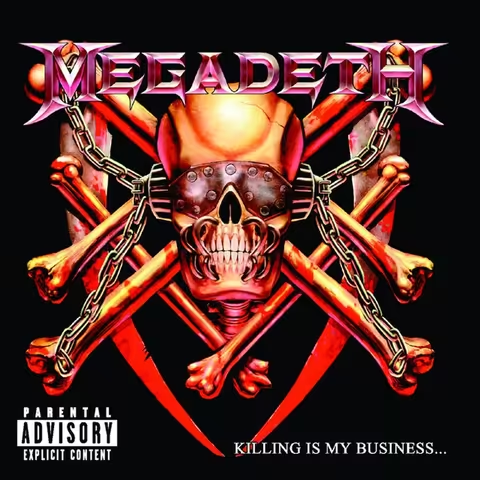
Mustaine's intended cover, produced in conversation with the rest of the band and Combat, was a colour painting of Vic Rattlehead in the three-wise-monkeys "see no evil, hear no evil, speak no evil" pose. He drew the original sketch himself and asked his friend Peyton Tuttle to paint a finished version. The painting was used on early Megadeth merchandise and survives. It was never used on the album.

According to both Mustaine's 2010 memoir and Ellefson's 2013 memoir, Combat Records lost the artwork. With a release date looming, the label improvised. The result was the now-notorious sleeve: a plastic novelty-shop skull, photographed in close-up, with strips of tinfoil and what is variously described as ketchup or red paint draped around it. Both the band's principals have repeatedly stated, in print and on stage, that they were "mortified". Metal Hammer later listed it among the fifty most hilariously ugly rock and metal album covers ever released.

The cover would not be properly replaced until 2002, when the Loud Records reissue commissioned designer Michael Mueller to redraw Mustaine's 1985 sketches as the album's new cover. That is the version most listeners now associate with the record. The original 1985 sleeve survives mostly on first-pressing vinyl, which has become a sought-after collectors' item largely because of its ugliness.

Release and Reception

The UK release came first, through Music for Nations on 17 May 1985. The US release followed on 12 June, with Combat handling distribution. There was no significant radio play, no commercial single and no major-publication review at the time. The album did not chart on the Billboard 200, a distinction it retains as the only Megadeth studio album not to do so. It nonetheless became one of Combat Records' bestselling releases of the period, on the strength of underground word-of-mouth and growing American interest in the emerging thrash scene.

The retrospective record is more enthusiastic. Colin Larkin's Encyclopedia of Popular Music called the album a "ferocious blast of high-energy thrash metal", weakened by thin production. AllMusic's Steve Huey gave the album three stars and described it as "as raw as Megadeth gets", though he criticised Mustaine's vocals as "amateurish at best" and noted that the riffs and compositions were not fully developed. KNAC's Frank Meyer was warmer in his retrospective review, crediting the album with putting Megadeth "at the forefront of heavy metal scene in the early 1980s" and paving the way for thrash metal's broader arrival.

Notable review scores collected by Wikipedia from contemporary and retrospective sources:

  • AllMusic: 3 out of 5 stars
  • Classic Rock: 4 out of 5 stars
  • Metal Hammer: 4.5 out of 5 stars
  • Rock Hard (Germany): 9 out of 10
  • KNAC: 5 out of 5 stars
  • Drowned in Sound: 8 out of 10
  • Louder than War: 8 out of 10
  • Q: 3 out of 5 stars
  • The Rolling Stone Album Guide: 3 out of 5 stars

Two threads run through almost every review of the original release: praise for the songs and complaints about the production. Adrien Begrand at PopMatters dismissed the original recording outright but praised the 2002 reissue, writing that the album "blazes on at a furious pace" and arguing that the record had a profound influence on heavy metal over the following two decades. The pattern would be repeated in 2018: each time the album has been remixed, critics have re-evaluated it upward.

"As raw as Megadeth gets, but the riffs and compositions aren't completely developed and Mustaine's vocals are amateurish at best."

Steve Huey, AllMusic review of the original 1985 release

Singles and Music Videos

None. Combat Records did not issue a commercial single from Killing Is My Business and the band did not record a promotional music video for any track on the album. Megadeth's first proper music video would come the following year with "Peace Sells" from the second album, by which point Capitol Records had signed the band and the budget situation had transformed.

The closest thing to a single from the era is the Last Rites three-song demo cassette, hand-distributed by the band in 1984. Original cassette copies of the demo, distinct from the demos later released on reissues, are vanishingly rare and trade for high prices in the tape-collecting market.

Touring and Live

Megadeth began playing live before the album was released. The earliest shows in late 1984 and early 1985 featured guest appearances by Kerry King, filling in on second guitar while Mustaine sorted out a permanent lineup. The first proper promotional tour started in mid-1985 with the Canadian speed metal band Exciter as tour partners.

The tour was eventful, even by mid-1980s thrash-metal standards. Mid-tour, Chris Poland walked out of the band. He was replaced on 3 July 1985 by guitarist Mike Albert, who covered the rest of the dates. Poland returned in October 1985 and remained with the band through the recording and tour of Peace Sells... but Who's Buying? in 1986. The story behind Poland's mid-tour exit has been told differently by different participants over the years, with substance use, money disputes and personality clashes all cited as factors.

The live setlist of the period leaned heavily on the album. Almost every track from the record was performed regularly during the 1985 and 1986 touring cycle. Over the following decades, the band has gradually dropped most of the songs from the live set. "Mechanix", performed at a still-faster tempo than the studio version, has remained a near-fixture across virtually every Megadeth tour since.

In TV, Film and Media

The original album received almost no sync placements. The cultural footprint of Killing Is My Business is shaped almost entirely by retrospective recognition rather than contemporary media exposure. "Mechanix" and the title track have appeared on a small number of metal-themed compilations, video game soundtracks and documentary features about thrash metal, most notably the 2005 documentary Get Thrashed. The album's wider cultural importance is more often discussed in print, in books like Jeff Wagner's Mean Deviation and Greg Prato's various oral histories of 1980s metal, than soundtracked.

Controversy, Censorship and Lawsuits

The defining legal episode concerns "These Boots". Lee Hazlewood, the songwriter behind the 1965 Nancy Sinatra original, eventually became aware that Mustaine had rewritten the lyrics into something he found deeply offensive, and demanded that the track be removed from the album. According to Mustaine's 2002 reissue liner notes, Hazlewood had been receiving royalties for several years before objecting, a point Mustaine made forcefully. The track was pulled from all pressings from 1995 onwards.

The 2002 Loud Records reissue restored the track but with Mustaine's altered lyrics bleeped out, since Hazlewood had not authorised them. The 2018 Final Kill remaster went further, replacing the vocal with a newly re-recorded version using Hazlewood's original 1965 lyrics. The forty-year history of one cover song, across three substantially different official versions, is the single most documented piece of recording-rights drama in Megadeth's catalogue.

A separate, smaller controversy attached to the album's lyrics. Bob Larson and other contemporary Christian commentators accused Megadeth of promoting Satanism, citing the title and the imagery of "Looking Down the Cross". Mustaine, raised in part as a Jehovah's Witness and later a vocal Christian, denied the charge firmly and on the record. "I'd rather just fucking thrash and be a metalist and listen to whatever I want to than be forced to listen to one style of music," he told Metal Forces in December 1985.

The title track briefly entered the news cycle in September 2011 when a man was arrested under suspicion of planning a shooting spree after posting an online request to a radio station to play the song. The episode resulted in no charges against the band or the album.

Covers, Samples and Tributes

The album's compositions have been covered relatively rarely compared with later Megadeth material. "Mechanix" sits in an unusual position because of its kinship with "The Four Horsemen": the two songs are routinely discussed and occasionally played back-to-back at tribute shows precisely to underline the connection between the early Mustaine catalogue and the early Metallica catalogue. "Skull Beneath the Skin" has been covered by a handful of underground thrash and death metal acts. There is no significant tribute album dedicated specifically to Killing Is My Business.

The album itself contains the band's first cover, "These Boots", which would become the template for a long Megadeth tradition of including a cover on most subsequent albums (Alice Cooper's "No More Mr. Nice Guy", The Sex Pistols' "Anarchy in the U.K." and Black Sabbath's "Paranoid" among them). The piano introduction to "Last Rites/Loved to Death" reinterprets Bach's Toccata and Fugue in D Minor, which qualifies more as a quotation than a cover in the conventional sense.

Reissues, Remasters and Anniversaries

Four substantive reissues have appeared since 1985, each addressing different perceived flaws in the original release:

  • 1995 onward: Standard pressings drop "These Boots" entirely following the Hazlewood objection.
  • 5 February 2002 (Loud Records): Full remix by Bill Kennedy, with Chris Vrenna handling Pro Tools editing and Tom Baker mastering. New cover artwork by Michael Mueller, based on Mustaine's 1985 sketches. "These Boots" restored with Mustaine's lyrics partially censored. Three Last Rites demos included as bonus tracks. This is the version most modern listeners have heard.
  • 8 June 2018 (Legacy Recordings): Killing Is My Business... and Business Is Good! - The Final Kill. Remixed by Mark Lewis and remastered by Ted Jensen. "These Boots" restored to Lee Hazlewood's original lyrics with newly recorded vocals. New artwork. Bonus material includes the 1984 demos and previously unreleased live tracks sourced from VHS tapes found in Mustaine's attic, drawn from shows in London (1987 and 1990), Bochum (1987) and Denver (1986).
  • October 2025 (40th anniversary): Vinyl and streaming reissue based on the 2002 remaster, but using the partial re-recording of "These Boots" from the Final Kill edition.

The Final Kill reissue is the version that finally gave the album its first chart positions, more than three decades after its original release. It charted at No. 169 on the Billboard 200, No. 3 on the UK Rock & Metal Albums Chart, No. 35 in Germany, and No. 35 in Japan. The 2002 SoundScan-era data is more striking still: over 254,000 US copies sold since 1991 alone, a figure that excludes the album's entire pre-SoundScan commercial life. The total worldwide career figure has never been officially published.

Legacy and Influence

The thirteen-month period after Killing Is My Business transformed Megadeth from a Combat-Records underground concern into a Capitol Records major-label band. The follow-up, Peace Sells... but Who's Buying?, would appear in November 1986 with a vastly larger budget, an actual Vic Rattlehead cover, a working single ("Peace Sells") with a permanent place on MTV's Headbangers Ball, and the kind of production polish that would elude the debut on every reissue attempt. The trajectory of Megadeth as a band, and as the second leg of what would later be called the Big Four of American thrash, begins with the debut even though the debut is rarely the album people start with when introducing a newcomer to the catalogue.

The album's specific legacy within thrash metal is twofold. First, it established the template for Megadeth's particular brand of the genre: technically ambitious, lyrically dense, openly antagonistic toward both the religious right and toward Metallica, and built on a guitar partnership in which the lead guitarist was nearly always significantly more virtuosic than the rhythm guitarist who was nominally the bandleader. Second, it served as a structural counter-argument to the simpler, more anthem-driven thrash being made elsewhere in 1985. The looser, jazz-inflected rhythm section that Samuelson and Ellefson brought to the record influenced everyone from Death and Atheist to the wider mid-period progressive-metal scene of the early 1990s.

Mustaine himself has had a complicated relationship with the album over the years. In a 2017 Rolling Stone career retrospective, he acknowledged the record's foundational status while distancing himself from the specifics of its production. Each new reissue has been accompanied by a fresh round of comments about how the original "wasn't done right" and how the latest mix is the version he always wanted listeners to hear. The forty-year campaign to fix the debut is, in its way, the longest-running creative project of his career.

"After getting fired from Metallica, all I remember is that I wanted blood. Theirs. I wanted to be faster and heavier than them."

Dave Mustaine, Mustaine: A Heavy Metal Memoir, HarperCollins, 2010

Things You Might Not Know

FactDetail
The budgetCombat advanced $8,000, then added a further $4,000. Worth about $35,000 in 2024 money. Half of it went on drugs, alcohol and food before recording finished.
The fired producerCombat's originally-assigned producer was sacked mid-sessions; Mustaine and engineer Karat Faye finished the record themselves. Chris Poland has publicly disputed the "drug budget" version of events.
The lost coverCombat Records mislaid Mustaine's original Vic Rattlehead artwork and improvised the now-notorious plastic-skull-with-ketchup sleeve as an emergency replacement.
Kerry King's brief Megadeth stintSlayer's lead guitarist played live shows with Megadeth in early 1984 before Chris Poland's role was finalised; he never recorded with the band.
The Bach introMustaine himself plays the piano introduction to "Last Rites", a reinterpretation of Bach's Toccata and Fugue in D Minor.
Tim the Enchanter"Chosen Ones" is partly inspired by the Tim the Enchanter character from Monty Python and the Holy Grail.
The Punisher inspirationThe title track's hitman narrative draws on the Marvel Comics vigilante The Punisher, though the lyric reframes the character as a paid assassin.
Three different "These Boots"Mustaine's altered version (1985), a bleep-censored version (2002) and a re-recorded version using Lee Hazlewood's original lyrics (2018) all exist on different official editions of the album.
The album that did not chartIt remains the only Megadeth studio album that did not chart on the Billboard 200 on original release. Every subsequent studio album has charted.
The Punisher song that nearly went postalIn 2011 a man was arrested over a planned shooting spree after telling a radio station the title track was "good music to go postal and kill a bunch of people to".
Timpani on a thrash recordGar Samuelson plays timpani on "Rattlehead", a credit almost unheard of in thrash metal in 1985.
Demo drummer confusionLee Rauch was long rumoured to play on the Last Rites demo, but Ellefson stated in 2023 that Rauch "never did any studio recordings" with Megadeth.
The attic tapesThe bonus live tracks on the 2018 Final Kill reissue were sourced from VHS tapes that Mustaine had stored, undocumented, in his attic for decades.
Mike Albert's dateMid-tour replacement guitarist Mike Albert joined the band on 3 July 1985 to cover Chris Poland's sudden departure, before Poland returned in October.
"Mechanix" as a riposteMustaine recorded "Mechanix" at a faster tempo than the version he had played in Metallica, expressly to "straighten Metallica up" after they had slowed it and rewritten it as "The Four Horsemen" for Kill 'Em All.

Podcast Call to Action

The Riffology podcast tells the long stories behind the albums that shaped rock, metal and alternative music, and few stories are quite as messy or quite as instructive as a $12,000 thrash record made by a man with a grudge, a fired producer and a ketchup-and-tinfoil album cover. Find the podcast on Spotify, Apple Podcasts, YouTube and every other major platform, and dig into the full Megadeth catalogue from the debut all the way to the latest.