The album that had to follow a tragedy
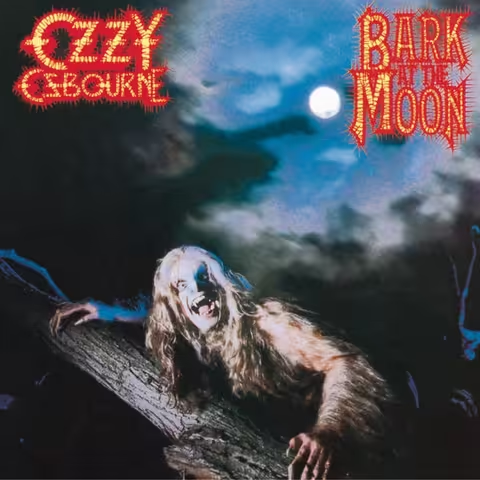
Eighteen months after Randy Rhoads climbed into a light aircraft above Leesburg, Florida, and never climbed out, Ozzy Osbourne released the third solo album of a career most people had assumed would not survive Black Sabbath, let alone the death of the guitarist who had defined its sound. Bark at the Moon, his answer to grief, lawsuits, lineup chaos and the new commercial weather of MTV, arrived in American shops on 14 November 1983 with a sleeve photo of its singer dressed as a werewolf and a horror-film promo for the title track that would put Osbourne on cable television for the first time in his life.
It is also the only Ozzy Osbourne album whose songwriting is credited entirely to Ozzy Osbourne, a sleeve detail that has been quietly disputed for forty years by everyone except the man whose name is on it. The story of Bark at the Moon is a story about a band reassembled from broken parts, about a producer trying to make a record sound like 1983, and about who actually wrote the songs that turned a damaged solo career into a multi-platinum mainstream metal franchise.
The quick facts
| Field | Detail |
|---|---|
| Artist | Ozzy Osbourne |
| Album | Bark at the Moon |
| Release date | 14 November 1983 (US), 2 December 1983 (UK) |
| Label | CBS Associated (US), Epic (UK) |
| Producers | Ozzy Osbourne, Bob Daisley, Max Norman |
| Studio | Ridge Farm Studio, Rusper, West Sussex (recording); The Power Station, New York City (mixing) |
| Engineer | Max Norman |
| Mixers | Tony Bongiovi (most tracks), Malcolm Pollack (Slow Down, Waiting for Darkness) |
| Genre | Heavy metal, glam metal, pop metal, hard rock |
| Track count | 9 (US edition); 9 (European edition with Spiders in the Night replacing Slow Down); 10 (2002 reissue) |
| Total runtime | 39:31 (US edition) |
| Billboard 200 peak | No. 19 |
| UK Albums Chart peak | No. 24 |
| Other notable peaks | Sweden No. 9, Canada No. 23, Finland No. 20, Australia No. 94, New Zealand No. 50 |
| Certifications | RIAA 3x Platinum (US, over 3,000,000), Music Canada Platinum, BPI Silver (60,000), ARIA Gold |
| Singles | Bark at the Moon (11 November 1983), So Tired (21 May 1984) |
Where Ozzy stood after losing Randy Rhoads
To understand Bark at the Moon, it helps to remember just how thoroughly the previous eighteen months had taken Osbourne apart. [Diary of a Madman](/posts/the-making-of-diary-of-a-madman-by-ozzy-osbourne/) had been finished in early 1981 and released in November of that year, putting him on a victory lap as a solo artist with two genuine classics, a bat-biting incident in Iowa and a No. 1 best-of with the Black Sabbath catalogue still ringing behind him. By the spring of 1982 he was on the road in the American south with the same band that had made the records: Rhoads on guitar, Bob Daisley on bass, Lee Kerslake on drums and Don Airey on keyboards.
On 19 March 1982, Rhoads, the band's hairdresser Rachel Youngblood and the tour bus driver Andrew Aycock were killed when Aycock buzzed the parked tour bus in a small Beechcraft Bonanza, clipped the vehicle and crashed into a nearby house. Osbourne was on the bus and witnessed the impact. The tour was paused, then completed with substitute guitarist Bernie Tormé, then with Brad Gillis of Night Ranger, who saw out the rest of the dates and the live album Speak of the Devil.
By the time the touring cycle stopped, Daisley and Kerslake had also gone, sacked or pushed out depending on whose lawyer is talking, and the relationship between Osbourne and his manager and wife Sharon had calcified into a working partnership in which Sharon increasingly negotiated with the rhythm section as an opposing party. The studio band that made Blizzard of Ozz and Diary of a Madman no longer existed. Osbourne needed a new guitarist, a new lineup and a record that could justify CBS Associated continuing to bankroll his solo career.
Auditioning Jake E. Lee
Brad Gillis was the safe choice. He had got Osbourne through the back end of the Diary of a Madman tour, his Floyd Rose-equipped Strat sounded close enough to Rhoads to keep the live show recognisable, and he was loyal. He was also already in Night Ranger, a band whose own commercial breakthrough was about to make him an awkward proposition for a long-term Osbourne job. Sharon Osbourne began auditioning replacements through the second half of 1982.
The man who got the gig was a 25-year-old Japanese-American guitarist from San Diego, real name Jakey Lou Williams, who had played in the Los Angeles bands Mickey Ratt (the proto-Ratt) and Rough Cutt. Jake E. Lee, as he was rebranded, was recommended to Sharon by Ratt drummer Bobby Blotzer and auditioned for Ozzy in a rehearsal room on the West Coast. He had a different vocabulary to Rhoads: more blues, more rhythmic chunk, less of Rhoads's classical filigree, but a strong ear for the pop hooks that the new album would need if it was going to live on early 1980s radio.
Lee was hired in late 1982 and almost immediately began writing the songs that would become Bark at the Moon. He moved to England, set up shop with Daisley, who had been brought back into the camp on a strictly contractual writing arrangement, and started turning out riffs in pre-production rehearsals at Ridge Farm.
The lineup that recorded Bark at the Moon
| Role | Player | Notes |
|---|---|---|
| Core band | ||
| Lead vocals | Ozzy Osbourne | Sole credited songwriter on the original 1983 sleeve. |
| Guitar, backing vocals | Jake E. Lee | Studio debut with Osbourne; signed away from songwriting credits before sessions began. |
| Bass, backing vocals | Bob Daisley | Wrote the majority of the lyrics and a significant share of the music; took a buyout in lieu of credit. |
| Drums | Tommy Aldridge | Live drummer since the post-Rhoads tour; this is his only studio appearance on an Osbourne album. |
| Keyboards | Don Airey | Returning from Blizzard of Ozz and Diary of a Madman; provides intros, organ pads and synth string colour throughout. |
| Production and engineering | ||
| Producers | Ozzy Osbourne, Bob Daisley, Max Norman | Daisley's production credit reflects his involvement in arrangement and pre-production as much as in writing. |
| Engineer | Max Norman | Tracking and overdubs at Ridge Farm. |
| Mixer | Tony Bongiovi | Mixed most of the album at The Power Station, New York City. |
| Mixer | Malcolm Pollack | Mixed Slow Down and Waiting for Darkness at The Power Station. |
| String arrangements | Louis Clark | The Electric Light Orchestra arranger, used on You're No Different and Centre of Eternity. |
| Reissue work | ||
| Remaster (1995 CD) | Brian Lee with Bob Ludwig | Restored the European bonus track Spiders to the worldwide CD edition. |
| Remix (2002) | Production team for the 2002 reissue series | Issued in the same wave as the controversial Blizzard of Ozz and Diary of a Madman re-recordings. |
| Disputed and rumoured | ||
| Co-writer (uncredited on original sleeve) | Jake E. Lee | Has stated in multiple interviews from 1986 onward that he wrote most of the music for Rock 'n' Roll Rebel, Bark at the Moon, Now You See It (Now You Don't), Waiting for Darkness and Slow Down. Ozzy later acknowledged the title track was co-written by Lee. |
| Co-writer (uncredited on original sleeve) | Bob Daisley | Has stated he wrote the bulk of the lyrics and significant music, and confirmed taking a buyout from the Osbournes in exchange for surrendering credit. |
Sessions at Ridge Farm Studio
Ridge Farm in Rusper, West Sussex, was a residential studio set in a Tudor-era farmhouse with rehearsal space, a control room and bedrooms above the live room, the same building where Queen had blocked out parts of [Sheer Heart Attack](/posts/the-making-of-sheer-heart-attack-by-queen/) and where Bad Company, Roxy Music and a young Genesis had all worked. For a band trying to bed in a new guitarist and a new drummer at the same time, it was an obvious choice: away from London, no clock on the wall, no nightly drive home, the band living together while Norman shaped the sound in the kitchen-adjacent control room.
Sessions ran through 1983 and were unusually focused for an Osbourne project. With Aldridge cutting drum tracks live to tape and Daisley playing along on bass, the rhythm section was locked down in a few weeks. Lee then layered guitars over the basic tracks, while Daisley and Lee worked up arrangements between takes. Osbourne sang in short, intense sessions, often in the evenings, with Norman running the desk.
The signature production move on the record is its sense of polish. Where Diary of a Madman had a still-rough power-trio-plus-singer feel, Bark at the Moon is dressed: Don Airey's keyboard pads sit underneath almost every chorus, Lee's guitars are double-tracked into a wider stereo field than Rhoads ever was, and Norman's drum sound is the heavy gated reverb that was becoming the standard for hard rock in the era after Pyromania. It is, recognisably, a 1983 record.
Max Norman in the producer's chair
Max Norman had engineered both Blizzard of Ozz and Diary of a Madman at Ridge Farm and had stepped up to a co-production role on the latter. For Bark at the Moon he was promoted to full producer alongside Osbourne and Daisley, and from this point on he became the closest thing Ozzy had to a house engineer-producer for the next decade. He would go on to produce or co-produce The Ultimate Sin, [No Rest for the Wicked](/posts/the-making-of-no-rest-for-the-wicked-by-ozzy-osbourne/) and No More Tears, and his fingerprints on Osbourne's late-1980s and early-1990s sound start here.
Norman's job in 1983 was twofold. He had to make a credible heavy metal record without Randy Rhoads, and he had to make it sound like something an American radio programmer in late 1983 could put next to Def Leppard's Pyromania or Mötley Crüe's Shout at the Devil without flinching. The compromise he and the band hit on, big drums, big keyboards, vocal-forward mixes and Lee's guitars treated more as a layer than a centrepiece, is the reason the album reads as a "1983 metal record" rather than a third Rhoads-era follow-up.
The writing-credit controversy
The thing nobody in the room could quite resolve was who actually wrote the songs. Forty-two years on, the basic shape of the dispute is well documented. Daisley, the bass player, was hired by Sharon Osbourne to write material for the record, with Jake E. Lee, the new guitarist, working up most of the music. Both men contributed material at Ridge Farm. Both men were then asked to sign contracts that gave them no songwriting or publishing claim on the finished album. Both signed.
Lee told Blabbermouth in 2014 that he had been presented with the contract after his guitar parts were already on tape, that he was told he could be replaced by another guitarist if he refused, and that the agreement included a clause forbidding him from talking about the arrangement publicly. He was 25, had no legal representation and signed. In a 1986 Guitar World interview he said the music to Rock 'n' Roll Rebel, Bark at the Moon, Now You See It (Now You Don't), Waiting for Darkness and Slow Down was his.
Daisley's account, given on his own website and in subsequent interviews, mirrors Lee's. He has said he wrote the bulk of the lyrics and that he co-wrote most of the music with Lee, and that he accepted a buyout payment from the Osbournes in exchange for surrendering credit. Lee Kerslake, the drummer Daisley had played with in Uriah Heep, told the magazine The Fuze in 2002:
"He was offered the chance to write with Ozzy. Words, music, write the album. The deal was, what was it, fifty or sixty thousand dollars or whatever it is."
Lee Kerslake, The Fuze, 2002
Osbourne himself partially conceded the point in the liner notes to the 1997 retrospective The Ozzman Cometh, stating that the title track had in fact been co-written with Lee. The original sleeve, however, has never been re-credited, and on every Osbourne pressing of Bark at the Moon still in print, only one name appears next to "Music and lyrics by".
The sound of Bark at the Moon
Where the Rhoads-era records lived in the friction between classical-trained guitar lines and Sabbath-derived riffs, Bark at the Moon sits comfortably in the middle of the early-1980s pop-metal mainstream. The keyboard textures are no longer used sparingly. The drum sound is huge and gated. The guitar tones are stacked rather than panned, and Lee's playing draws on Eddie Van Halen's harmonics, Michael Schenker's melodic phrasing and Randy California's bluesier vocabulary in roughly equal measure.
Tempo-wise, the record sits on the slower, heavier end of the post-NWOBHM mainstream. There is one ballad, two mid-paced grinders, two anthemic openers and a couple of nervy uptempo album tracks. There is no progressive epic on the order of Diary of a Madman or Mr Crowley. The aim is hooks, and the album hits more of them than its sleeve credit suggests.
Bark at the Moon (the title track)
The opening cut is the song every casual Ozzy fan knows by name. Its central riff, a chromatic descending figure punctuated by Lee's harmonic squeals, is one of the most recognisable in 1980s heavy metal, and it slams into the verse in a way that turns the song into an immediate radio identifier. Aldridge's drums are behind the beat just enough to give the riff a swagger; Don Airey's organ stab opens the track from silence; Osbourne's vocal sits high in the mix, pushed by the Norman-Bongiovi mix to dominate every chorus.
Lyrically, it is a horror movie in three minutes: a crypt opens, a creature rises, the village screams. It was the obvious first single, released on 11 November 1983 in the United States, and its accompanying video, the first Osbourne ever shot for a single, became the song's most enduring asset.
You're No Different
The second track is the album's most direct descendant of Diary of a Madman. A long, looping bass figure from Daisley underpins a verse where Osbourne sings about hypocrisy and persecution, with Louis Clark's string arrangement entering on the choruses to lift the song out of mid-tempo gloom. It is one of the moments where the record's debt to its absent guitarist is most audible: the modulating chord progression and the staccato palm-muted figure under the second verse have a Rhoads-shaped hole that Lee fills with a different vocabulary, leaning into bends and pinch harmonics rather than scalar runs.
The lyric, with its pleading "you can shed a tear and you can hide your fear" verse, has been read as a swipe at the journalists and religious campaigners who had spent the previous two years portraying Osbourne as a public danger. It has also, less politely, been read as a swipe at Sharon. Both readings have plausible support in interviews.
Now You See It (Now You Don't)
Track three is the song that most directly fingerprints the writing-credit dispute on the album itself. The lyrics, written by Daisley, are an undisguised rebuke aimed at Sharon Osbourne, who had fired Daisley from the band in 1981 and then rehired him on a contractual writing-only arrangement for this record. Daisley has said in subsequent interviews that he was startled the lyric made it onto the album:
"I'm amazed it was allowed on. They couldn't have read it properly."
Bob Daisley, recalling the Now You See It lyric, BobDaisley.com, archived 2013
Musically, it is one of the heaviest tracks on the record, built on a chugging Lee riff and a shuffle pulse from Aldridge. The song's title and chorus operate as a magic-trick metaphor for what Daisley felt had been done to him, twice: the credits, the bass parts, the writing fee, all there and then gone.
Rock 'n' Roll Rebel
The fourth track on the US edition, and the album's opener on the European pressing, is the most direct reply to the moral-panic period that had consumed Osbourne's life since 1981. Lyrically it is a defiant first-person address to the parent groups, the campaigners and the religious press who had spent Diary of a Madman's release year accusing Osbourne of corrupting American teenagers. "I'm just a rock 'n' roll rebel," runs the chorus, which is also the album's closest moment to a glam-metal arena chant.
Lee has said the music for Rock 'n' Roll Rebel was his and he is audibly enjoying himself: the verse riff is a galloping single-string figure, the chorus opens up into a wall of stacked guitars and the solo is one of his best on the record, weaving between bluesy bends and tapped intervals over Aldridge's snare backbeat.
Centre of Eternity
Side two opens with the album's longest and most cinematic track, listed as "Centre of Eternity" in some territories, "Forever" in others. Some European pressings used the latter title; bootlegs from the supporting tour show Osbourne announcing the song as "Forever" and as "Journey to the Center of Eternity" on different nights, suggesting a working-title situation that was never quite cleaned up before release.
Whatever it is called, it is the closest the record comes to the symphonic ambition of Mr Crowley. Don Airey's keyboard intro sets up a Hammer-horror tone, Louis Clark's strings re-enter for the choruses, and Lee's solo, a long, modal climb against a held minor chord, is the most overtly Rhoads-flavoured guitar passage on the album. It is also the moment where the record most clearly tries to reassure long-time fans that this is still the same band.
So Tired and the power-ballad gamble
So Tired is the song that broke the format. Built around an acoustic-guitar arpeggio, Louis Clark's string arrangement and an Osbourne vocal pitched at the soft, reflective end of his range, it is a full power ballad in the early-1980s Foreigner mould, with the band only crashing in for the choruses and the bridge. As an Ozzy Osbourne song it sounded radically out of register in 1983: there had been quiet moments on the previous albums, but nothing this overtly aimed at adult-contemporary radio.
It was released as the album's second single on 21 May 1984 and reached the UK top 20, becoming Ozzy's first solo top-20 UK chart hit as a single. Long-time Sabbath and Blizzard fans hated it; mainstream radio loved it. The song's reach, in retrospect, did exactly what the label had hoped for, broadening the audience, even at the cost of some of the original constituency.
Slow Down and Waiting for Darkness
The two tracks Malcolm Pollack mixed at The Power Station, rather than Tony Bongiovi, sit late on the US edition and have a slightly different sonic fingerprint to the rest of the album. Slow Down is an uptempo, almost punky track built on a stop-start riff, with Lee dropping into a bluesy solo over Aldridge's swung shuffle. It is the closest the record comes to the high-octane garage feel of the Diary band on a good night.
Waiting for Darkness is the album's atmospheric closer, a slow, dread-loaded piece with a gothic keyboard intro from Airey and one of the most restrained Ozzy vocals on the record. Lee has cited it as one of his favourite pieces of writing on the album. It bookends the record neatly: where Bark at the Moon opens with a creature stalking the village, Waiting for Darkness ends with the village waiting for the night to come back.
Spiders in the Night
Spiders in the Night was originally only included on the European, Australian, New Zealand and Greek pressings of the album, where it ran as the ninth track in place of one of the US-edition cuts. It is a mid-paced, riff-led track with one of Lee's most melodic verse figures and an Osbourne lyric about night terrors. From the 1995 CD reissue onward it has been included on every worldwide edition, listed there simply as "Spiders". The 2002 reissue carries it as track nine and adds the bonus B-side "One Up the 'B' Side" as track ten.
The full tracklist
| # | Title | Length | Single? | Notes |
|---|---|---|---|---|
| 1 | Bark at the Moon | 4:16 | Yes (1st single, 11 November 1983) | Title track; Ozzy's first official music video. |
| 2 | You're No Different | 5:49 | Strings arranged by Louis Clark. | |
| 3 | Now You See It (Now You Don't) | 5:10 | Daisley lyric aimed at Sharon Osbourne. | |
| 4 | Rock 'n' Roll Rebel | 5:23 | Opening track on the European pressing. | |
| 5 | Centre of Eternity | 5:15 | Listed as "Forever" on some European pressings. | |
| 6 | So Tired | 4:02 | Yes (2nd single, 21 May 1984) | Power ballad; UK top-20 single. |
| 7 | Slow Down | 4:20 | Mixed by Malcolm Pollack. | |
| 8 | Waiting for Darkness | 5:16 | Mixed by Malcolm Pollack. | |
| 9 | Spiders in the Night (Spiders) | 4:31 | European bonus track in 1983; on all editions from 1995 onward. | |
| 10 | One Up the 'B' Side | 3:23 | 2002 reissue bonus track. |
The album cover and the werewolf concept
The cover photograph is Osbourne in full prosthetic werewolf makeup, posed in a fog-bound graveyard, fangs bared, hand raised in a clawed gesture toward the camera. It was one of the most expensive sleeve shoots Osbourne ever did, requiring a multi-hour application of latex prosthetics in a single sitting and a constructed graveyard set with smoke machines. The European pressings used the same image with the embedded title logo outlined in blue to match the colour grading of the print run, and an alternative back cover photograph appeared on some territory variations.
The choice of imagery was a deliberate doubling-down on the horror-show persona that had hardened around Osbourne since the bat-biting incident at Veterans Memorial Auditorium in Des Moines in January 1982. Where the previous two solo sleeves had used painted artwork and conceptual horror, Bark at the Moon went straight at the icon: Ozzy as monster, photographed.
The Bark at the Moon promo video
The promotional film for the title track was the first proper music video Osbourne ever shot for a single, and it landed at exactly the right moment commercially. By late 1983, MTV had become the primary delivery mechanism for new American hard-rock singles, and a band without a video on rotation was effectively invisible in suburban America. The Bark at the Moon promo, directed in a Victorian-laboratory set with Osbourne in two roles, a mad scientist and the werewolf creature, leaned hard into Hammer Horror imagery and showed off the full prosthetic makeup in motion.
The video also stars drummer Carmine Appice, who had briefly replaced Tommy Aldridge in the live band after Aldridge departed post-recording. Appice's tenure was short. Aldridge returned mid-tour, and Osbourne later told Hit Parader in early 1984, when asked why the swap had been reversed:
"For health reasons. He was making me sick."
Ozzy Osbourne on Carmine Appice, Hit Parader, 1984
The Bark at the Moon video, with its prosthetics, lab coats, dry ice and pantomime menace, became a cable-TV staple and would eventually be one of the visuals most often used to represent Osbourne in the mainstream press for the rest of the decade.
Release, charts and certifications
CBS Associated released Bark at the Moon in the United States on 14 November 1983, with Epic following in the United Kingdom on 2 December. The title-track single arrived three days before the US release. The album entered the Billboard 200 in late November, climbed steadily on the back of the video and the supporting tour, and peaked at No. 19 on the chart. Within weeks of release it was certified gold for over 500,000 US sales.
In the UK, where Osbourne's solo career had always run a half-step behind the American chart, the album peaked at No. 24 and was certified silver by the BPI in January 1984 for 60,000 units. It was the third of four consecutive Osbourne albums to do so. Elsewhere, the record went to No. 9 in Sweden, No. 20 in Finland and No. 23 in Canada. By 2000, RIAA shipments in the United States had crossed three million, with the album certified 3 times platinum.
- US Billboard 200 peak: No. 19
- UK Albums Chart peak: No. 24
- Swedish Albums Chart peak: No. 9
- Canadian RPM Albums peak: No. 23
- RIAA certification: 3x Platinum (3,000,000+)
- Music Canada certification: Platinum (100,000)
- BPI certification: Silver (60,000)
- ARIA certification: Gold (35,000)
Critical reception
Contemporary press reception was respectful rather than rapturous. AllMusic's Steve Huey would retrospectively give the album three stars and place it as a transitional work. Martin Popoff, in his Collector's Guide to Heavy Metal: Volume 2: The Eighties, was rather more enthusiastic, scoring it 10 out of 10 and calling it one of the strongest mainstream metal albums of 1983. L.A. Weekly's Ben Westhoff, in a 2011 retrospective list, ranked it 21 in Chuck Klosterman's "Favorite Hair Metal Albums" feature, situating it firmly in the lineage that ran from Pyromania to [Slippery When Wet](/posts/the-making-of-slippery-when-wet-by-bon-jovi/).
The longer-term consensus among the metal press has been that Bark at the Moon is the album where Ozzy crossed from cult metal headliner into mainstream rock star. The Guardian's Alexis Petridis, writing in his July 2025 obituary of Osbourne, picked the album out as part of the run that "took heavy metal into the light", a description that captures how the record was positioned at the time and how it has been read since.
The Bark at the Moon Tour
The supporting tour ran from late 1983 through most of 1984, taking in the UK, Europe, North America and Japan. It was one of Osbourne's first solo runs to play major American arenas as a headliner, with Mötley Crüe among the support acts. The most significant lineup wobble came when Tommy Aldridge left after the recording sessions and Carmine Appice was hired in his place; Appice played the early dates and appeared in the title-track video, but Aldridge returned mid-tour. Lee's playing on the road was widely praised; bootleg recordings from the Salt Lake City show in particular have circulated for decades among Osbourne completists, and the European-titled "Forever" version of Centre of Eternity is audible on several of them.
The 1995 reissue and the 2002 remix
The album has been reissued twice in materially different forms. In 1995, Brian Lee remastered the original tapes with Bob Ludwig and the album was reissued on CD with the European bonus track Spiders restored to the standard tracklist. This reissue is the version most fans owned through the late 1990s.
The 2002 reissue is a stranger object. Issued in the same wave as the controversial reissues of Blizzard of Ozz and Diary of a Madman, in which Daisley's bass and Kerslake's drums had been re-recorded by Mike Bordin and Robert Trujillo at the Osbournes' direction, the 2002 Bark at the Moon features alternate mixes of many of the songs and adds the bonus track One Up the 'B' Side. The remix work has been disputed by fans who prefer the 1983 Bongiovi mixes, and the original mix has been the dominant version on streaming services in the years since.
Legacy and influence
For Osbourne, the album was a commercial vindication. It moved his solo career past the point where it could be defined entirely by Randy Rhoads and turned him into an arena headliner in his own right. For Jake E. Lee, it was the start of a four-year run that would also produce The Ultimate Sin in 1986 before Osbourne moved on to Zakk Wylde and Lee formed Badlands. For Daisley, it was another piece of the long, recurring credit dispute that would shape the rest of his professional relationship with the Osbournes.
For the wider genre, Bark at the Moon is one of the records that demonstrated heavy metal could live on MTV without surrendering its identity. It sits in the lineage running from Pyromania through Shout at the Devil to Slippery When Wet and Hysteria, the records that turned hard rock into pop without quite letting it stop being hard rock. The horror imagery and werewolf cover became a brand asset that Osbourne used for decades; the title-track riff has appeared on tribute records, in films, on sports broadcasts and in untold bar bands. Its influence on the next decade of mainstream metal, on the bands who watched the video on MTV and decided they wanted that career, is hard to overstate.
Things you might not know
| Fact | Detail |
|---|---|
| Brad Gillis nearly got the gig | Night Ranger's Brad Gillis, who had played the back end of the Diary of a Madman tour and the Speak of the Devil live album, was a serious candidate to be the studio guitarist on this record before Jake E. Lee was hired in late 1982. |
| Jake E. Lee's real name | The guitarist's birth name is Jakey Lou Williams. He took "Jake E. Lee" as a stage name during his Mickey Ratt and Rough Cutt years in Los Angeles, several years before he joined Osbourne. |
| The contract Lee signed | Lee has stated in multiple interviews from 1986 onward that he signed away his songwriting and publishing claims to the album under threat of being replaced after his guitar parts were already on tape, and that the contract included a non-disclosure clause forbidding him from talking about it publicly. |
| Daisley's payment | According to Lee Kerslake, Bob Daisley was paid in the region of fifty to sixty thousand US dollars to write the lyrics and contribute to the music in lieu of taking publishing credit on the sleeve. |
| Now You See It is about Sharon | Daisley has confirmed that the lyric to Now You See It (Now You Don't) was a pointed rebuke aimed at Sharon Osbourne, who had fired him from the band in 1981. He has said he was surprised the Osbourne camp let the lyric through. |
| The album's only Aldridge studio session | Despite being a fixture of Osbourne's live band for years, Bark at the Moon is the only Ozzy Osbourne studio album Tommy Aldridge ever played on. He left immediately after recording. |
| Carmine Appice in the video, not on the record | Drummer Carmine Appice does not appear on the album but does appear in the title-track video, which was shot during the tour after Aldridge briefly departed and Appice took his live seat. |
| The Hit Parader quote | When Hit Parader asked Osbourne in early 1984 why Aldridge had been brought back in place of Appice, Ozzy answered, "For health reasons. He was making me sick." |
| The Jollimore case | Shortly after the album's 1983 release, a Canadian man named James Jollimore murdered a woman and her two children, and Christian groups attempted to blame the music. The story landed on top of the existing US litigation around Suicide Solution from Blizzard of Ozz. |
| Centre of Eternity has three names | The track is titled "Centre of Eternity" on most pressings, "Forever" on some European pressings, and was introduced from the stage on the supporting tour as both "Forever" and "Journey to the Center of Eternity". |
| Louis Clark of ELO did the strings | The string arrangements on You're No Different and Centre of Eternity were written by Louis Clark, the arranger best known for his work with the Electric Light Orchestra and on the Hooked on Classics records. |
| Mixed at Bon Jovi's cousin's studio | The Power Station, where Tony Bongiovi mixed most of the album, was the New York studio founded by Bongiovi, who is a cousin of Jon Bon Jovi. The same room was used in the same period for hits by Bruce Springsteen, Madonna and Diana Ross. |
| Ozzy's first proper music video | The Bark at the Moon promo, with its lab-coat scientist and werewolf double role, was the first proper music video Osbourne shot for any of his solo singles, arriving as MTV reached the peak of its programming influence on the American hard-rock market. |
| The 2002 reissue is not just a remaster | Unlike the 1995 reissue, which restored the European bonus track Spiders to the worldwide CD edition without changing the mixes, the 2002 reissue features alternate mixes of many tracks and was issued as part of the same wave that produced the disputed Blizzard of Ozz and Diary of a Madman re-recordings. |
| Ozzy partly conceded the credit dispute | In the liner notes to the 1997 retrospective The Ozzman Cometh, Osbourne admitted that the title track of Bark at the Moon had in fact been co-written with Jake E. Lee, although the original sleeve has never been reissued with corrected songwriting credits. |
If Bark at the Moon is the album in your headphones at the moment, the Riffology podcast goes deep on the post-Rhoads era across several episodes. The show is available on Apple Podcasts, Spotify, Amazon Music and every other major platform; pull up an episode, pour yourself something dark and let the werewolf out for an hour.
Comments