The album that introduced Zakk Wylde
In the late summer of 1987, Ozzy Osbourne was without a guitar player. Jake E. Lee, who had given the Prince of Darkness two studio albums and four years on the road, had been fired by Sharon Osbourne, the Black Sabbath comeback was still five years away, and the heavy metal landscape had quietly reorganised itself around bands the Ozzy camp had once outsold and now did not. A demo tape from a 20 year old New Jerseyan called Jeffrey Phillip Wielandt arrived at Sharon's office while she was sifting unsolicited cassettes, and the kid on it played guitar like a man who had been raised on Randy Rhoads and Ronnie Van Zant in equal measure. She brought him in for an audition. He left the building as Zakk Wylde, and within twelve months he was on a record that would re-stake Osbourne's claim to the genre he had helped invent.
No Rest for the Wicked, his fifth solo studio album, was released in October 1988 on Epic in the United Kingdom and CBS Associated in the United States. It was recorded in Los Angeles in early to mid 1988 with two producers most metal fans had never heard of in the same sentence, the Queen and Cars veteran Roy Thomas Baker and the Fleetwood Mac and Pat Benatar specialist Keith Olsen. It reunited Ozzy with the bassist Bob Daisley after a two album estrangement, kept the drummer Randy Castillo from the previous record, added the Uriah Heep keyboardist John Sinclair, and brought a 1988 American MTV polish to a singer who had spent the previous decade being marketed as the British answer to Alice Cooper. It peaked at number 13 on the Billboard 200, has gone double platinum in the United States, and is the album that gave Zakk Wylde his career.
The quick facts
| Field | Detail |
|---|---|
| Artist | Ozzy Osbourne |
| Album | No Rest for the Wicked |
| Release date | October 1988 (UK 28 September on some pressings, US 28 October) |
| Label | Epic (UK), CBS Associated (US) |
| Producers | Roy Thomas Baker and Keith Olsen, except Miracle Man and Devil's Daughter (Holy War), produced by Keith Olsen alone |
| Studios | Enterprise Studios, Burbank, Los Angeles; Goodnight L.A. Studios, Van Nuys, California |
| Engineering | Roy Thomas Baker, Gordon Fordyce, Gerry Napier; mixed by Keith Olsen |
| Genre | Heavy metal, glam metal, hard rock |
| Track count | 9 (original US and UK), 10 (Japanese edition with The Liar), 11 (2002 reissue with Miracle Man live) |
| Total runtime | 43:08 (original edition) |
| Billboard 200 peak | No. 13 |
| UK Albums Chart peak | No. 23 |
| Other notable peaks | Finland No. 7, Norway No. 12, Sweden No. 18, Switzerland No. 26, Germany No. 29, Australia No. 40, Europe No. 47 |
| Certifications | RIAA 2x Platinum (US, over 2,000,000), Music Canada Platinum (100,000) |
| Singles | Miracle Man (24 October 1988), Crazy Babies (February 1989), Breaking All the Rules (promo, 1989) |
Ozzy after the Ultimate Sin tour
The decade had started so well. [Blizzard of Ozz](/posts/ozzy-osbourne-blizzard-of-ozz/) in 1980 and [Diary of a Madman](/posts/the-making-of-diary-of-a-madman-by-ozzy-osbourne/) in 1981 had hauled Osbourne out of his post-Sabbath wilderness and turned him into a solo artist who outsold his old band. The death of Randy Rhoads in March 1982 should have been the end of that story; instead, Sharon Osbourne reassembled the project around the journeyman Brad Gillis for the live record, then around Jake E. Lee for the next two studio albums, [Bark at the Moon](/posts/the-making-of-bark-at-the-moon-by-ozzy-osbourne/) in 1983 and [The Ultimate Sin](/posts/the-making-of-the-ultimate-sin-by-ozzy-osbourne/) in 1986.
The Ultimate Sin was an awkward record and the Sin tour was an awkward tour. The drink and the cocaine that had been the engine of the early eighties were now a liability. Osbourne and the bassist Phil Soussan fought over the writing credit on the single Shot in the Dark, the keyboardist Mike Moran had been a hired hand rather than a band member, and by the time the tour ended in early 1987 Sharon had decided that the whole assembly needed to be taken apart again. Lee was fired by phone. He has rarely returned the call.
What Osbourne needed in 1987 was, in a small way, what he had needed in 1980. A new guitar player who could deliver riffs, a producer or producers who could put him on American radio, and a band tight enough to survive a year on a tour bus. Sharon Osbourne ran the search. She listened to demos in her office and rang the people she trusted. The shortlist included names who would later end up in other big metal acts. The audition that worked was the kid from New Jersey.
Auditioning Zakk Wylde
Jeffrey Phillip Wielandt was born in Bayonne, New Jersey on 14 January 1967 and grew up in Jackson, the same town as the Toms River bar bands he eventually outgrew. He had played in the New Jersey covers band Stone Henge, taught guitar at a music shop in Jackson, and at 19 years old he was paying rent by gigging six nights a week in clubs that mainly wanted Van Halen, Iron Maiden and Lynyrd Skynyrd. The story Wylde has repeated for forty years is that a session photographer who knew Sharon Osbourne saw him in one of those clubs, told her about a kid who could play, and brokered the cassette that ended up on her desk.
The audition itself happened in Los Angeles in late 1987. Wylde flew out, jammed on Suicide Solution and I Don't Know with the band, and according to Sharon Osbourne's later interviews left the room before they had finished discussing him. He thought the audition had gone badly. Within days he was being told to start writing.
The new name was Sharon's idea. Wielandt was unsellable as a metal-album credit; Zakk Wylde, with the double k and the y, was a deliberately phonetic, deliberately American piece of rock and roll branding, signed off by Wylde himself. The blond hair, the lumberjack beard and the Confederate-flag bullseye on the Les Paul came later, mostly during the touring cycle for this record. The guitar style was already there: a fast vibrato learned from Frank Marino, the pinched harmonics that would become his signature, and a southern-rock chordal sense that nobody had previously put alongside Ozzy.
Why Bob Daisley came back
The bassist Bob Daisley had been with Osbourne on the first two records, written most of the lyrics, been thrown out before they were released, brought back for Bark at the Moon, written most of those lyrics, been thrown out again before The Ultimate Sin, and ended up in Black Sabbath in the meantime. The 1987 reconciliation was uneasy. By Daisley's own account, in his autobiography For Facts Sake and in repeated interviews, Sharon Osbourne rang him in 1987 and asked him to come back, partly because nobody else in the new lineup could write a lyric for the singer to sing.
Daisley did. He moved into a rental in Los Angeles for the early 1988 sessions, played the bass parts, and wrote or co-wrote every lyric on the record. He is credited on the writing of all nine original songs on the back cover. He is also, in a pattern that Daisley has now lived through five times, off the active band by the time the album is on the shop floor. Geezer Butler, Osbourne's old Black Sabbath foil, is installed on bass for the music videos and the No Rest tour. Daisley appears in none of the promotional footage and on none of the cover photography. The credit war that would later run through the 2002 reissues was already, quietly, being set up.
The producers Roy Thomas Baker and Keith Olsen
The choice of producer was Osbourne's. He had been impressed by the drum sound on Slade's 1987 album You Boyz Make Big Noize, which Roy Thomas Baker had co-produced, and he wanted that snare. Baker's metal credentials were minimal; his credentials with maximalist, multi-tracked, ultra-clean studio rock were unmatched. He had produced [A Night at the Opera](/posts/the-making-of-a-night-at-the-opera-by-queen/), News of the World and the first Cars album, and he liked stacking guitars eight and ten parts deep until they sounded like a wall.
Keith Olsen was brought in alongside him. Olsen had produced the 1975 self titled Fleetwood Mac album that began the band's American conquest, the Pat Benatar record Crimes of Passion, Whitesnake's 1987 multi-platinum self-titled album and a long list of arena radio acts. He owned Goodnight L.A. Studios in Van Nuys, which is how part of the album ended up being recorded there. By the credits on the back cover, Olsen took sole production credit on Miracle Man and Devil's Daughter (Holy War); the other seven tracks were co-produced by Baker and Olsen. Olsen also mixed the entire record.
The pairing was unusual for a heavy metal record in 1988. Most of Osbourne's contemporaries were working with metal specialists: Mutt Lange, Bob Rock, Bruce Fairbairn, Tom Werman. The Baker and Olsen combination gave the album a much glossier, more harmonically dense sound than the Max Norman records that preceded it, and that gloss is part of why it dates the way it dates. It is one of the most identifiably 1988 sounding Ozzy records.
Enterprise and Goodnight L.A.: the studios
The basic tracking was done at Enterprise Studios in Burbank, a complex that had hosted everything from Quincy Jones to Whitney Houston, with overdubs and mixing shifting to Goodnight L.A. in Van Nuys. Goodnight L.A. was Olsen's facility: a Studer-and-SSL setup he had bought specifically because he wanted to engineer his own sessions without booking somebody else's room. The album was recorded onto 24-track analogue tape and mixed through the SSL 4000 series desk that Olsen kept in the building.
Roy Thomas Baker, Gordon Fordyce and Gerry Napier are credited as engineers on the sleeve. Baker's role was hands-on; he was at the desk for most of the basic tracking, and several of the production tricks the record is known for, the multi-tracked vocal stacks on the chorus of Crazy Babies, the drum compression on Miracle Man, the synthesised choir on Fire in the Sky, are Baker calls. The mastering on the original release was credited to George Marino at Sterling Sound. The 2002 reissue was remastered by Chris Athens and produced for reissue by Bruce Dickinson, the Sony Legacy A and R executive, not the Iron Maiden singer.
The recording sessions
The recording was, by the standards of an Ozzy Osbourne record, civilised. Wylde has said in multiple interviews that the schedule was disciplined, the producers ran a clock, and Osbourne himself was in better shape than he had been on the previous album. Daisley wrote lyrics in a room next door while Wylde and Castillo cut the basic tracks. The vocals were left to last, partly because that was how Baker and Olsen liked to work, and partly because the writing of the lyrics ran right up against the cut-off.
The drumming is one of the less discussed pieces of the record. Randy Castillo had played on The Ultimate Sin and on the tour that followed, and the way Baker and Olsen recorded him on No Rest for the Wicked is closer to the sound of a 1980s power-pop record than a metal one: a tight, gated snare, deliberately damped toms and a kick drum that has been processed through enough outboard to qualify as a separate instrument. The drum sound on Miracle Man is, with Slade's You Boyz Make Big Noize, one of the two records that defined a small Baker drum-sound subculture in 1988.
Sinclair, Ozzy's new keyboard player, was given more room than Mike Moran had been given on the previous record. The pads on Fire in the Sky and the orchestral stabs on Devil's Daughter are him. Sinclair, an Englishman who had served time in Uriah Heep and would later join The Cult, was the only player on the album who had not previously worked with Osbourne or his managers.
The sound: Zakk Wylde on tape
The guitar tone Wylde delivers on this record is not yet the Black Label Society sound. He is still working out who he is. The signal chain in 1988 was a 1981 Les Paul Custom with EMG pickups into a Marshall JMP-1 preamp and a 50-watt Marshall head, with a chorus pedal for the cleans. The pinched harmonics, the sustained whole-step vibrato and the southern-blues phrasing are already there; the squeals and the chicken-pickings are still a couple of records away.
What is unmistakable, and what would become the through line of his career with Osbourne, is the willingness to take a verse riff and play it as a song. The opening of Miracle Man is a single-string lick that any decent guitar teacher could write out in eight bars; it is the way Wylde phrases it, the snap on the down-pick and the weight of the bend at the end of each line, that makes it sound like an arrival. The solos on Fire in the Sky and Devil's Daughter are the first Ozzy guitar solos that genuinely owe nothing to Randy Rhoads.
The personnel
| Role | Player | Notes |
|---|---|---|
| Core band | ||
| Lead vocals | Ozzy Osbourne | Executive producer; co-writer on every track |
| Guitar | Zakk Wylde | Born Jeffrey Phillip Wielandt; studio debut at age 21 |
| Bass | Bob Daisley | All nine original tracks; primary lyricist |
| Drums | Randy Castillo | Second Ozzy album after The Ultimate Sin |
| Additional musicians | ||
| Keyboards | John Sinclair | Ex-Uriah Heep; debut with Osbourne |
| Production and engineering | ||
| Producers | Roy Thomas Baker, Keith Olsen | Olsen alone on Miracle Man and Devil's Daughter |
| Engineers | Roy Thomas Baker, Gordon Fordyce, Gerry Napier | Tracked at Enterprise, finished at Goodnight L.A. |
| Mixer | Keith Olsen | SSL 4000 at Goodnight L.A. |
| Mastering (original) | George Marino | Sterling Sound, New York |
| 2002 reissue production | Bruce Dickinson | Sony Legacy A and R, not the Iron Maiden singer |
| 2002 remastering | Chris Athens | Sterling Sound |
| Artwork | ||
| Creative director | John Carver | Concept: Osbourne as Christ figure surrounded by children |
| Cover photography | Bob Carlos Clarke | Irish-born fashion and erotica photographer |
| Touring band, post-recording | ||
| Bass (live) | Geezer Butler | Replaced Daisley after sessions; ex-Black Sabbath |
The tracklist
| # | Title | Writer(s) | Length | Single? | Notes |
|---|---|---|---|---|---|
| 1 | Miracle Man | Osbourne, Wylde, Daisley | 3:44 | Yes | Jimmy Swaggart attack; Olsen alone produced |
| 2 | Devil's Daughter (Holy War) | Osbourne, Wylde, Sinclair, Castillo, Daisley | 5:15 | Olsen alone produced | |
| 3 | Crazy Babies | Osbourne, Wylde, Castillo, Daisley | 4:15 | Yes | Second single, US Mainstream Rock No. 14 |
| 4 | Breakin' All the Rules | Osbourne, Daisley, Wylde, Sinclair, Castillo | 5:15 | Promo | Promotional US single only |
| 5 | Bloodbath in Paradise | Osbourne, Wylde, Sinclair, Castillo, Daisley | 5:03 | References the Manson Family murders | |
| 6 | Fire in the Sky | Osbourne, Wylde, Sinclair, Castillo, Daisley | 6:24 | Longest track; Sinclair pad-driven intro | |
| 7 | Tattooed Dancer | Osbourne, Wylde, Daisley | 3:53 | Wylde's first co-write to feature on a B-side | |
| 8 | Demon Alcohol | Osbourne, Wylde, Castillo, Daisley | 4:30 | Addiction lyric written by Daisley | |
| 9 | Hero | Osbourne, Daisley, Wylde, Sinclair, Castillo | 4:49 | Unlisted hidden track on original CD and cassette | |
| 10 | The Liar | Osbourne, Sinclair, Daisley | 4:32 | Japanese edition only on 1988 release |
Miracle Man and Jimmy Swaggart
Jimmy Swaggart was a Pentecostal televangelist with a syndicated TV ministry and a particular line of attack on heavy metal. Throughout the mid 1980s he had named Osbourne directly in sermons, told audiences that rock music was the gateway to Satan, and contributed to the moral panic that produced the Parents Music Resource Center hearings and the eventual Tipper Gore parental advisory sticker. In February 1988, while the album was being written, Swaggart was photographed at a Travel Inn motel in New Orleans with a prostitute named Debra Murphree. He delivered his famous "I have sinned against you" sermon on national television on 21 February 1988, in tears.
Daisley wrote the lyric within days. Miracle Man is not a subtle song. The chorus has Osbourne pointing at Swaggart by name in everything but the literal naming; the line "Now Jimmy he got busted" leaves no doubt. The riff is Wylde's, written at the audition; the production by Olsen is dry, clean and structured to make sure the words land. Released as the album's first single on 24 October 1988, it became Wylde's introduction to the world. The music video, directed by Jean Pellerin, casts Osbourne as a sleazy televangelist on a parody chat show, complete with hair lacquer and an ill-fitting suit; Daisley does not appear, because by the time the video was shot he was out.
Devil's Daughter and Crazy Babies
The two Keith-Olsen-alone tracks open the record, and they are arguably the most polished pieces of production on the album. Devil's Daughter (Holy War) is the closest thing here to a deliberate single that was not released as one, with Sinclair's keyboard hook running under a Wylde chorus riff that opens on a sustained pinched harmonic. Daisley's lyric is a thinly veiled rewrite of the Garden of Eden as a Cold War parable. The chord progression on the bridge is Wylde's; the orchestral stab over the second verse is Baker's, even though he is not credited on the track.
Crazy Babies, the second single, is a slighter song, deliberately so. It was written quickly, recorded quickly, and aimed at American mainstream rock radio. It reached number 14 on the Billboard Mainstream Rock chart in early 1989, the band's highest chart placement on that chart in three years. The video, directed by Jean Pellerin again, is a budget MTV piece in which Wylde plays his white Les Paul against a chain-link fence, Castillo's drums catch fire and Osbourne stalks around a derelict warehouse. Geezer Butler appears as the bassist. Daisley, who played the part, does not.
Bloodbath in Paradise and the Manson reference
Bloodbath in Paradise is the most controversial song on the record, and the one that retrospectively defines its 1988 moment. Daisley's lyric references Charles Manson and the Tate-LaBianca murders of August 1969 directly, by name and by place, twenty years to within a year before release. The chorus has Osbourne singing as Manson; the verses describe the killings in Cielo Drive. The riff, a slow grind in E with Wylde stacking a clean arpeggio over the top, was one of the first things he and Daisley wrote together.
The song became the most-talked-about track on the album in the American press, almost entirely because of Tipper Gore. The PMRC had been holding hearings since 1985; the parental advisory sticker had been on the table for two years. No Rest for the Wicked was one of the first major-label metal records to carry the new sticker. Osbourne wore it as a badge of honour in interviews; Sharon Osbourne, who has rarely missed a marketing opportunity, used Swaggart and Gore in the same press cycle.
Fire in the Sky, Tattooed Dancer and Demon Alcohol
The deeper cuts on the second side are where the record breathes. Fire in the Sky, at 6:24, is the longest track Osbourne had put on a solo album since You Can't Kill Rock and Roll on Diary of a Madman; it opens on a Sinclair pad, builds for nearly two minutes before the first vocal, and finishes on a Wylde solo that is the first piece of writing of his that genuinely sounds like Zakk Wylde. The lyric is the most personal Daisley wrote for the record, a reflection on his late father and on the metaphysics he had been reading at the time.
Tattooed Dancer is the album's strip-club song, a 3:53 piece of cheerful misogyny that Wylde has since said he is embarrassed by. Demon Alcohol, on the other hand, is the song that most directly addresses Osbourne's own drinking. Daisley wrote the lyric in a hotel room near the studio, watching Osbourne work through what was at that point at least a bottle of brandy a day. The narrator is the bottle. Osbourne sings the bottle's part. The track ends with the bottle laughing at the singer, an effect Baker built by running Osbourne's vocal through a long room reverb and feeding it back through itself.
The hidden track Hero
Hero was the album's secret. It was not on the printed sleeve in 1988. It was not on the back-cover tracklist. It is on the master tape, tucked on after Demon Alcohol with a brief gap, on the original CD and cassette pressings, and it is a four-minute power ballad with a Daisley lyric about anonymous everyday heroes. The vinyl edition of 1988 in most territories did not include it for runtime reasons; the CD did.
The reasoning for the hiding has never been fully explained. Sharon Osbourne in interviews has said she felt the song was too soft for the front-loaded marketing of the album. Daisley has said in his book that he thought it should have been the second single. The track was added to the printed tracklist on the 1995 reissue and kept on every subsequent edition. By the 2002 reissue it had become one of the more frequently requested songs in the Osbourne live catalogue, although Osbourne has rarely played it on stage.
The Liar and the Japanese edition
Japan got a tenth track. The Liar was recorded in the same sessions, mixed by Olsen, and held back from the European and US pressings; it appeared as a bonus on the 1988 Japanese CD only, which became a sought-after import on the back of it. Osbourne, Sinclair and Daisley are credited as writers; Wylde is not, which suggests it was written before he was fully integrated into the songwriting process. The song is harder than anything on the main album, with a sneering Daisley lyric attacking, depending on whose interview you read, either a tabloid journalist or the Osbourne management's previous accountant. The Liar was added to the standard tracklist on the 2002 reissue and remained there.
Singles, B-sides and music videos
| Single | Release | UK | US Mainstream Rock | B-side | Video director |
|---|---|---|---|---|---|
| Miracle Man | 24 October 1988 | No. 21 | No. 28 | Crazy Babies (live) | Jean Pellerin |
| Crazy Babies | February 1989 | No. 47 | No. 14 | Sweet Leaf (live, Black Sabbath cover) | Jean Pellerin |
| Breaking All the Rules | 1989 (US promo) | Not released | Promo | None | None |
The Miracle Man video aired heavily on MTV's Headbangers Ball through the winter of 1988 and into 1989. It was the first Ozzy Osbourne promo to get sustained MTV daytime rotation since Bark at the Moon, helped by the fact that Swaggart was still a daily news item in the United States. The Crazy Babies clip was less successful as television but more useful as a tour-marketing tool. Neither video featured Daisley.
The B-sides are where serious collectors live. The 12-inch of Miracle Man carried a live version of Crazy Babies recorded at a pre-tour warm-up date in early 1989. The Crazy Babies 12-inch carried a Black Sabbath cover of Sweet Leaf that Osbourne recorded with Wylde and Castillo as a tongue-in-cheek bonus. Both B-sides have appeared on subsequent box sets but neither was on the main album for thirty-plus years.
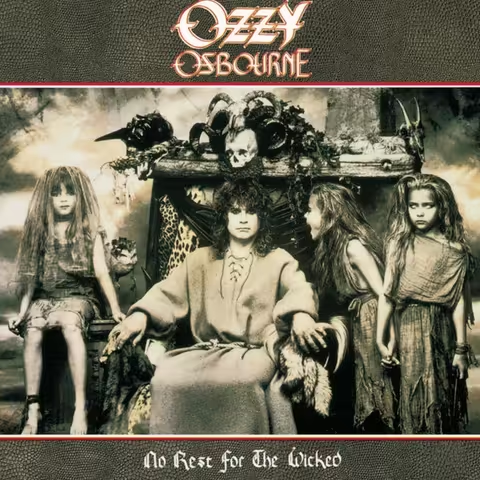
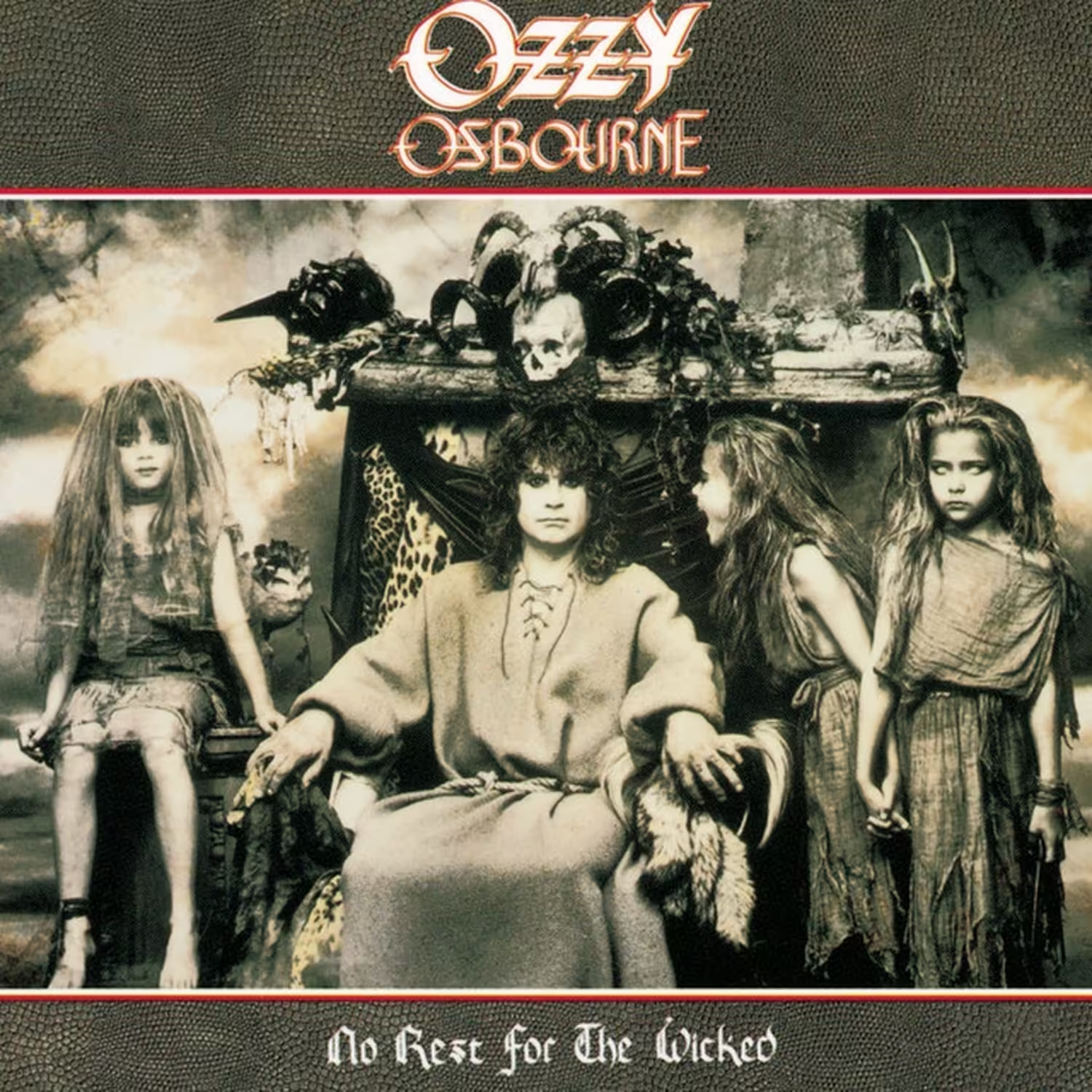
The cover and Bob Carlos Clarke
The sleeve is the second thing people remember about this record after Miracle Man. Bob Carlos Clarke, the Cork-born Surrey-based fashion and erotica photographer best known for his work with the Sunday Times Magazine and for his portraits of Marco Pierre White, was hired through John Carver, the creative director Sharon Osbourne had engaged for the project. Carver's concept was to put Osbourne in the visual position of Christ, in a long coat, surrounded by small children, in a graveyard at first light. The shoot took place at a churchyard in Surrey in spring 1988.
The image is unsettling on purpose. The children were cast through a child-modelling agency and shot under standard child-protection chaperone rules; the misty graveyard look was produced by a smoke machine working overtime in damp grass. The original Carlos Clarke print is now in private hands. The sleeve was reissued in 2002 in a slightly recropped form, and the 2024 Crystal Clear Records vinyl restored the original. Carlos Clarke himself died in 2006.
Reception in 1988
The reviews were divided. Rolling Stone's Jimmy Guterman dismissed the album in December 1988 with a one-star review, calling it "a parody of an Ozzy Osbourne record" and complaining that Osbourne was now coasting on his own myth. AllMusic, in retrospect, gave it four out of five and Stephen Thomas Erlewine wrote that "things start to improve for Ozzy on No Rest for the Wicked, as Zakk Wylde replaces Jake E. Lee on guitar and Osbourne comes up with his best set since 1983". Martin Popoff in his Collector's Guide to Heavy Metal gave it nine out of ten and singled out Devil's Daughter as the strongest track. Metal Hammer ran a positive feature in the issue dated 22 October 1988.
"Things start to improve for Ozzy on No Rest for the Wicked, as Zakk Wylde replaces Jake E. Lee on guitar and Osbourne comes up with his best set since 1983."
Stephen Thomas Erlewine, AllMusic review
The contemporary metal press was more interested in Wylde than in the songs. Kerrang! ran the first long Wylde interview in November 1988; Guitar World put him on the cover the following spring with a tutorial on the Miracle Man riff. The most useful retrospective re-evaluations came in the 2000s, when the album's status as the foundation of the Wylde-Ozzy run, eventually a decade-plus partnership taking in No More Tears, Ozzmosis, Down to Earth and Black Rain, was easier to see.
Charts and certifications
Commercially the album did what the Osbourne business needed it to do. It debuted on the Billboard 200 on 12 November 1988, peaked at number 13 in mid-December, and stayed in the chart for 36 weeks. The RIAA certified it gold in December 1988 and double platinum on 2 September 2020. In Canada it was certified platinum by Music Canada. In the United Kingdom it peaked at number 23 on the Official Albums Chart on 16 October 1988, a more modest result than The Ultimate Sin's number 8 but enough to justify the touring. Finland gave the record its highest international peak at number 7, with Norway number 12 and Sweden number 18 close behind.
- Billboard 200, USA: peak No. 13, 36 weeks on chart.
- UK Albums Chart: peak No. 23.
- Finland: peak No. 7.
- Norway: peak No. 12.
- Sweden: peak No. 18.
- Switzerland: peak No. 26.
- Germany: peak No. 29.
- Australia (Kent Music Report): peak No. 40.
- European Albums Chart: peak No. 47.
Awards were thinner. The album was not nominated for a Grammy, although Osbourne would finally win his first Grammy six years later for the live version of I Don't Want to Change the World, recorded on the follow-up tour. The 1988 metal awards were dominated, as they had to be, by Metallica's [...And Justice for All](/posts/the-making-of-and-justice-for-all-by-metallica/) and Iron Maiden's [Seventh Son of a Seventh Son](/posts/the-making-of-seventh-son-of-a-seventh-son-by-iron-maiden/).
The No Rest tour and Geezer Butler
The No Rest Festival, as the world tour was billed, ran from January 1989 through to the end of the year. It crossed North America, Europe and Japan, and is best remembered for two things. The first was the lineup change. Daisley was off the bus before the first show; Geezer Butler, Osbourne's old Black Sabbath colleague, was installed in his place and stayed on the road for the duration. Butler's tone and approach are completely different from Daisley's; the live recordings from 1989, some of which appeared on the 2002 reissue and on the 1993 Live and Loud compilation, sound noticeably different in the bottom end.
The second was the support act. [Anthrax](/posts/anthrax-among-the-living/) opened most of the North American legs, a deliberate booking by Sharon Osbourne to put Osbourne in front of a younger thrash-leaning audience. The Anthrax-Osbourne pairing was a foundational date for both bands; Charlie Benante has talked since about Wylde's sound checks being his guitar lessons. Selected European dates added other acts including Vinnie Vincent Invasion and Lita Ford, with whom Osbourne had recorded the 1988 hit duet Close My Eyes Forever in the same press cycle as this album, although it was not a No Rest for the Wicked track.
The Daisley credit war
Bob Daisley's grievance with the Osbourne organisation, which had been simmering since 1980, became publicly heated in the years after No Rest for the Wicked. Daisley argued, in interviews and in court, that the songwriting on the early Osbourne solo albums was at least co-written by him and that the credits had been juggled by the management. By the late 1990s the issue had moved into the United States courts. In 2002 the Osbourne organisation released remixed versions of Blizzard of Ozz and Diary of a Madman with Robert Trujillo's bass and Mike Bordin's drums replacing Daisley's and Kerslake's. The same wave of reissues touched No Rest for the Wicked, although the bass and drum parts were left alone, on the grounds that this was the only Osbourne record on which Daisley had been credited from day one. The 2011 court ruling on the Blizzard re-recordings sided with the Osbournes; Daisley's name was restored to the Blizzard credits in the 2011 deluxe edition. The No Rest credits never moved.
Reissues, remasters and the Bruce Dickinson remix
| Edition | Format | Release date | Notes |
|---|---|---|---|
| Original release | LP, CD, cassette | October 1988 | 9 tracks (CD and cassette include unlisted Hero) |
| Japanese edition | CD | November 1988 | Adds The Liar as track 10 |
| 1995 Sony reissue | CD | 22 August 1995 | Brian Lee and Bob Ludwig remaster; lists Hero on tracklist |
| 2002 expanded reissue | CD | 25 June 2002 | Reissue produced by Bruce Dickinson, Chris Athens remaster; adds The Liar and a live Miracle Man |
| 2014 vinyl reissue | 180g LP | 2014 | Friday Music limited edition, original mix |
| 2024 Crystal Clear vinyl | Coloured LP | 2024 | For the album's 36th anniversary; restored original cover crop |
The 2002 reissue is the one most likely to be in a current collection. Bruce Dickinson, the Sony Legacy executive (no relation to the Iron Maiden singer), produced it; Chris Athens remastered. The track order is rearranged to include The Liar and the 1989 live Miracle Man, which extends the running time from 43:08 to 51:28. The cover image is recropped slightly. Some sleeve liner notes in the 2002 edition are by Wylde himself.
What No Rest for the Wicked changed
The most obvious thing it changed was Wylde's career. He stayed in the Osbourne band, on and off, until the late 2000s; in between he formed Pride and Glory in 1994 and Black Label Society in 1998, the latter of which has now outlasted the Osbourne band as a working concern. He also became the template for what a Les Paul player in a major metal act could look and sound like in the post-Van-Halen era, an influence visible on Dimebag Darrell's solos in Pantera, on Synyster Gates in Avenged Sevenfold, and on a generation of YouTube-era pinch-harmonic specialists.
It also restored Osbourne commercially. The follow-up, No More Tears in 1991, with much of the same band, much the same production approach and a sharper set of songs, sold four million copies in the United States alone and made Osbourne, briefly, one of the highest-earning rock artists on the planet. Without No Rest for the Wicked, there is no No More Tears.
It is also, in a quieter way, the record that closed Osbourne's 1980s. The albums that came before it had been about reconstructing a damaged star around guest guitarists. From this album onwards, Osbourne was a band leader who had a band. The hires were his, the firings were Sharon's, and the records that followed were planned in advance rather than assembled in panic.
Things you might not know about No Rest for the Wicked
| Fact | Detail |
|---|---|
| Wylde's real name | Zakk Wylde was born Jeffrey Phillip Wielandt in Bayonne, New Jersey on 14 January 1967. The stage name was Sharon Osbourne's idea. |
| Slade's drum sound | Osbourne hired Roy Thomas Baker after hearing the drums on Slade's 1987 album You Boyz Make Big Noize, which Baker had co-produced. |
| The Christ on the cover | John Carver's concept brief asked Bob Carlos Clarke to photograph Osbourne as a Jesus figure surrounded by children in a Surrey churchyard. The image was meant to be uneasy. |
| The bottle laughs at the end | The laughter at the close of Demon Alcohol is Osbourne's own vocal fed through a long Roy Thomas Baker reverb chain and looped back into itself. |
| Daisley off the videos | Bob Daisley played every bass note on the record but appears in none of the music videos and on none of the press shots, because he was again fired immediately after sessions ended. |
| Geezer Butler on tour | Geezer Butler, Osbourne's Black Sabbath bandmate, replaced Daisley for the entire No Rest Festival world tour through 1989. |
| Anthrax opened | Anthrax supported on most North American legs of the No Rest tour. Charlie Benante has called Wylde's nightly sound checks the best guitar tutorials he ever attended. |
| The hidden Hero | Hero was not on the printed tracklist on original CD or cassette pressings. It is a power ballad and was Daisley's choice for a second single. |
| Japan got an extra song | The 1988 Japanese CD edition included a tenth track, The Liar, which was not released anywhere else until the 2002 reissue. |
| Swaggart's "I have sinned" | Jimmy Swaggart's televised "I have sinned" sermon, the trigger for Miracle Man, was broadcast on 21 February 1988, while Daisley was already writing lyrics for the album. |
| Two Bruce Dickinsons | The Bruce Dickinson who produced the 2002 reissue is the Sony Legacy A and R executive, not the Iron Maiden singer. |
| One Grammy follow-on | Osbourne's first Grammy win came on the album's follow-up tour, for the live recording of I Don't Want to Change the World, taped during 1992 with Wylde and Castillo still in place. |
The podcast
The Riffology podcast has its own deep dive on No Rest for the Wicked, recorded as Episode 21, with both hosts going through the record track by track, the auditioning of Zakk Wylde, the Swaggart connection on Miracle Man, the Daisley credit issue and the way the record set up No More Tears. It runs roughly an hour. You can listen on the episode page above, or subscribe to Riffology on Apple Podcasts, Spotify, Amazon Music or any of the usual podcast platforms.
Comments