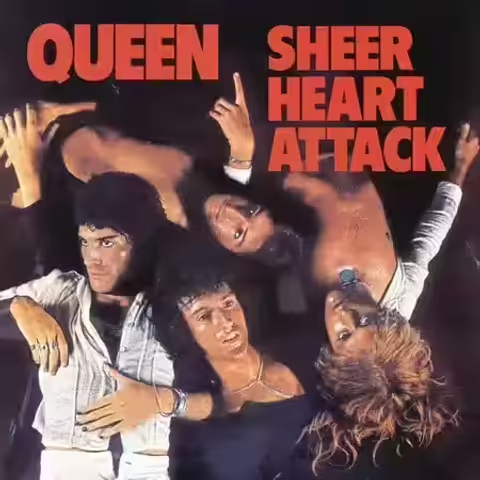
Queen had two weeks to write themselves out of a corner. Brian May was in hospital, the band were broke despite a number five UK album, and their accountant was telling them they could not pay their rent. Their manager wanted another version of Queen II. Their American tour had collapsed in Boston with their guitarist coughing up bile. The deadline was non-negotiable: a Christmas record, ready in October, in a studio they did not yet have.
Sheer Heart Attack is the album that came out of those two weeks of writing and the four months of recording that followed. It is the record that took Queen from a curiosity that British critics enjoyed sneering at into a band with a US Top 20 hit, an international single, and a sound that no longer sounded like anyone else's. It is also the record on which they finally stopped writing about ogres.
| Field | Detail |
|---|---|
| Artist | Queen |
| Album | Sheer Heart Attack |
| Release date | 8 November 1974 |
| Recorded | 7 July to 22 October 1974 |
| Label | EMI (UK), Elektra (US) |
| Producers | Queen and Roy Thomas Baker |
| Engineer | Mike Stone |
| Studios | Rockfield (Monmouthshire), Trident, AIR and Wessex Sound (London) |
| Genre | Hard rock, glam rock, with detours into vaudeville and proto-thrash |
| Track count | 13 |
| Total runtime | 38:41 |
| UK Albums Chart peak | 2 |
| US Billboard 200 peak | 12 |
| Other notable peaks | Canada 6, France 6, Netherlands 7, Finland 7, Norway 9, Australia 19, Japan 23 |
| Certifications | UK Platinum (BPI), US Gold (RIAA), Canada Platinum, Japan Gold |
| Lead single | Killer Queen / Flick of the Wrist (double A-side, UK No. 2, US No. 12) |
| Sleeve photography | Mick Rock |
After Queen II: famous on paper, broke in the bank
By the spring of 1974 Queen had two albums, a chart hit in Seven Seas of Rhye, a glamorous-looking Top of the Pops slot and almost no money. Their management contract with Trident, the production company that owned the studio they recorded in, paid them a flat weekly wage of around twenty pounds a head and routed publishing, recording and management commissions back to Trident on every line. The band would later describe it as the most thoroughly bad deal in British rock and roll, and they were not entirely joking.
Trident's owners, the Sheffield brothers, had bankrolled the first two records and were watching the third with the impatience of men who wanted a return. The Queen II Tour put the band in front of British audiences as headliners and then dropped them into America in April 1974 as the support act for Mott the Hoople, with Ian Hunter taking a paternal interest. Mercury found being a support act humiliating. He told a journalist at the time that being on second was, in his words, "one of the most traumatic experiences of my life."
Then on 11 May, two-thirds of the way through the American leg, Brian May went yellow in the dressing room in Boston. A doctor diagnosed hepatitis, possibly the gift of a contaminated needle from the vaccinations the band had been given before a planned trip to Australia earlier in the year. The remainder of the tour was cancelled. The other three flew home to a country in three-day-week recession with a guitarist in a hospital bed and a deadline for an album they had not started writing.
Two weeks to write an album
The band gathered at Trident Studios in central London in June 1974 to rehearse without their guitarist. Mercury, Taylor and Deacon worked up demos and arrangements while May sat at home recovering. The Japanese photographer Koh Hasebe interviewed the three working members on 13 June and described a band scrambling. By early July May had been declared well enough to play, the band had a clutch of new songs in skeletal form, and on 7 July the four of them drove three and a half hours west to Rockfield Studios, the residential farm complex in Monmouthshire that had recently hosted Hawkwind and Dave Edmunds.
"Nobody knew we were going to be told we had two weeks to write Sheer Heart Attack. And we had to. It was only thing we could do. Brian was in hospital."
Freddie Mercury, Melody Maker, December 1974
Mercury wrote Killer Queen, by his own account, in a single night at Rockfield. Brighton Rock had been carried over from the Queen II sessions, where it had been left off because the album was already too long. Stone Cold Crazy was unfinished business from Mercury's pre-Queen band Wreckage, dragged forward and rewritten. Tenement Funster came from Roger Taylor. Misfire, by John Deacon, was the first song the bass player had ever submitted that the band agreed to record. From the moment they turned the tapes on at Rockfield, the album that emerged was unlike either of its predecessors: shorter songs, more variety, less Tolkien.
Recording across four studios
Backing tracks for ten of the album's songs were cut at Rockfield between 7 and 28 July. At the start of August the band moved back to London and started overdubs at Wessex Sound Studios in Highbury, the converted church hall that would later host the Sex Pistols and the Clash. Then on 2 August, with the album less than half-finished, May went to a Harley Street specialist clinic feeling unwell, collapsed in the consulting room and was diagnosed with a duodenal ulcer. He was operated on the following day and discharged shortly afterwards to recover at home.
Work continued without him. Mercury wrote Flick of the Wrist during May's absence. Taylor and Deacon stepped up: Deacon played the prominent acoustic guitars on Tenement Funster while May was bedridden, and contributed nearly all the guitars on his own song Misfire, leaving only a few prominent Red Special phrases at the end for May to add when he returned. May himself, when he was strong enough to leave the house but not yet well enough to rejoin the band full time, booked a few days alone at AIR Studios at Oxford Circus and recorded Dear Friends and She Makes Me there largely on his own. By late August he was back with the rest of the band at Wessex.
One song, Now I'm Here, did not yet exist. May wrote it in hospital, looking back at the spring tour with Mott the Hoople. The backing track was cut at Wessex in early September; Mercury's vocals and the various overdubs were saved for the mixing sessions and not finished until the third week of October. Mixing itself moved to Trident, where the studio had finally got their long-promised 24-track machine working. Sheer Heart Attack was the first album Trident mixed on it. The band hired motorcycle couriers to ferry tapes back and forth between studios while overdubs and mixing happened in parallel.
Brighton Rock alone took four days to mix. Roy Thomas Baker and the band made about six hours of different mix-down passes for it, working in fifteen and twenty-second sections that were edited together later because no single 24-track pass could hold all the parts at once. Bring Back That Leroy Brown, the Mercury vaudeville pastiche, had seventy separate vocal tracks bounced down to fit. The album was finished at six in the morning of 22 October when the last mix of Now I'm Here was approved. The band were told the same day that release was already scheduled for two weeks later.
Roy Thomas Baker and the Queen production method
Roy Thomas Baker had produced Queen II and had pushed the band's appetite for elaborate overdubs to the limit of what an Ampex 16-track could hold. With Sheer Heart Attack he and the band split the production credit explicitly, and the credit on the sleeve reads simply: produced by Queen and Roy Thomas Baker. Engineering was Mike Stone, who would stay with them through A Day at the Races. Baker's role was less directorial than referee. The four members of Queen each had strong opinions about every overdub on every track, and Baker's job, by his own account, was to keep them all out of one another's faces while still capturing the part the song needed.
The signature production tricks that would later define the band were already on this record. The four-part vocal stacks that crowd Killer Queen's chorus were tracked in the same way as the wall of voices on the future Bohemian Rhapsody, with Baker and Mercury punching in line by line and listening back to make sure the harmonies were neither flat nor smudged. The overdriven guitar bell-tones in Killer Queen's solo, where May plays a triadic figure that rings out like a peal of cathedral bells, were achieved by stacking three takes of the same line with each note picked separately rather than strummed together. Brighton Rock's three-minute solo interlude, which uses an Echoplex tape delay run into separate amplifiers to build a contrapuntal duet between May and his own echoes, came directly out of his earlier experiments with the Son and Daughter solo on the first tour.
"The whole album was made in a very craftsman-like manner. I still enjoy listening to it because there's a lot to listen to, but it never gets cluttered. There's always space for all the little ideas to come through."
Brian May, on the Killer Queen sessions
Equipment in use across the four studios was a mix of the band's own gear and the studio house kits:
- Brian May playing the homemade Red Special, the guitar he and his father built from oak fireplace and a hatpin in 1963, into Vox AC30 amplifiers daisy-chained through his Dallas Rangemaster treble booster.
- Roger Taylor on a Ludwig kit miked with the standard Trident broadcast set-up: Neumann U67 overheads, AKG D12 on the kick, Shure SM57 on snare.
- John Deacon playing both his Fender Precision and a borrowed double bass, used on Bring Back That Leroy Brown to give the song its honky-tonk feel.
- Mercury on a Bechstein grand at Trident and a Knight upright tack piano for the harpsichord-flavoured Killer Queen verses.
- Trident A Range desk for tracking at Trident, an Helios at Wessex and a Cadac at AIR Oxford Circus.
The shift to short songs
Both of the first two Queen albums had been long. Queen II in particular ran on a side-long fantasy suite about a black queen, white queen and a princeling called the Fairy King, and had been pulled apart by some critics for the sheer density of its Tolkien references. Sheer Heart Attack is much shorter and unmistakably worldlier. Of the thirteen tracks, only two run beyond five minutes. Six are under three. Lily of the Valley clocks in at one minute forty-three, Dear Friends at one minute seven, and Misfire at one minute fifty.
The deliberate brevity was not a retreat. The album still leaps between styles in a way that nothing else in 1974 was attempting. Brighton Rock opens it with a public-holiday seaside narrative and a three-minute echo-stack solo. Killer Queen lands at the start of side one as music-hall-glam pop. Tenement Funster, Flick of the Wrist and Lily of the Valley segue into one another as a continuous three-song mini-suite, taking the listener from Taylor's roughed-up rock vocal into Mercury's most acidic lyric on the album and out the other side into a piano lullaby. Stone Cold Crazy, on side two, is two minutes and twelve seconds of distorted thrash that Q magazine would later describe as thrash metal before the term was invented and which Metallica would cover sixteen years later for a Grammy. Bring Back That Leroy Brown, three songs further on, is built around banjolele, double bass and Mercury's seventy-track vaudeville chorus.
"The album is very varied, we took it to extreme I suppose, but we are very interested in studio techniques and wanted to use what was available. We've been called a supermarket hype. But if you see us up on a stage, that's what we're all about. We are basically a rock band."
Freddie Mercury, contemporary press interview, 1974
Mercury's frustration with the British music press, which had often patronised the band as overcooked and pompous, runs through the lyrics as well as the interviews. Flick of the Wrist is widely read as Mercury settling scores with the Trident management deal: "Flick of the wrist and you're dead, baby" describes a contract that carves the artist up while smiling. Lily of the Valley, the song it dissolves into, is a one-minute lament about feeling cornered. The contractual claustrophobia is part of the album's texture and explains why the writing sounds tighter than anything Queen had recorded before. They were writing about people, not princes.
Killer Queen
Killer Queen is the song that changed the band's commercial trajectory, and it was almost not finished. Mercury wrote it at Rockfield while May was still recovering. The first time May heard it was through the wall of his bedroom on the studio's residential side, weeks before he was strong enough to play on it.
"The first time I heard Freddie playing that song, I was lying in my room in Rockfield, feeling very sick. After Queen's first American tour, I had hepatitis, and then I had very bad stomach problems and I had to be operated on. I remember just lying there, hearing Freddie play this really great song and feeling sad, because I thought, 'I can't even get out of bed to participate in this.' But then I got fixed up, thank God. And when I came out again, we were able to finish off Killer Queen. They left some space for me and I did the solo."
Brian May, recalling the Rockfield sessions
Mercury said the song was about a high-class call girl, written words first, melody and music second, the opposite of his usual order. The opening verse smuggles in a misattributed Marie Antoinette quote, the chorus drops in references to Moet et Chandon, geisha minarets and the Khrushchev-Kennedy summit. Mercury described it later as the kind of song you almost expect Noel Coward to sing, and characterised it as a "bowler hat, black suspender belt" number, which he meant as a compliment to its composition rather than its imagery.
It was released on 11 October 1974 as a double A-side with Flick of the Wrist, four weeks before the album. By 16 November it was at number two in the UK, held off the top by the David Essex single Gonna Make You a Star. It became the band's first US top-twenty placing, peaking at number twelve on the Billboard Hot 100 in spring 1975, and gave them their first appearance on Top of the Pops as the featured act rather than a curiosity slot. The Bohemian Rhapsody biopic later restaged that Top of the Pops appearance, working from the same week's archive footage that the band themselves had broken through with.
The songs
The album's thirteen tracks are catalogued below, with writers, lengths and lead-vocal credits taken from the Mercury-era pressing.
| # | Title | Writer | Lead vocal | Length | Notes |
|---|---|---|---|---|---|
| 1 | Brighton Rock | May | Mercury and May | 5:08 | Three-minute Echoplex guitar solo; opening sample lifted from a 1960 Authentic Sound Effects library record. |
| 2 | Killer Queen | Mercury | Mercury | 3:01 | UK No. 2 single; first US Top 20 hit. Tack piano and grand piano both played by Mercury. |
| 3 | Tenement Funster | Taylor | Taylor | 2:48 | Deacon plays acoustic guitars in May's absence. Segues into track 4. |
| 4 | Flick of the Wrist | Mercury | Mercury | 3:19 | Double A-side with Killer Queen. Widely read as a swipe at the Trident management deal. |
| 5 | Lily of the Valley | Mercury | Mercury | 1:43 | Piano-led coda to the side one mini-suite; lyric carries surviving Rhye-cycle imagery. |
| 6 | Now I'm Here | May | Mercury | 4:10 | Written by May in hospital; backing track recorded last. UK No. 11 single in January 1975. |
| 7 | In the Lap of the Gods | Mercury | Mercury and Taylor | 3:20 | Falsetto fanfare from Taylor reaches one of the highest notes on the album. |
| 8 | Stone Cold Crazy | Mercury, May, Taylor, Deacon | Mercury | 2:12 | First Queen song co-credited to all four members. Covered by Metallica in 1990 and won a Grammy in 1991. |
| 9 | Dear Friends | May | Mercury | 1:07 | Recorded by May alone at AIR Studios with piano. The shortest track on the album. |
| 10 | Misfire | Deacon | Mercury | 1:50 | Deacon's first composition for the band; he plays nearly all the guitars on it himself. |
| 11 | Bring Back That Leroy Brown | Mercury | Mercury | 2:13 | Vaudeville pastiche referencing the Jim Croce hit. Banjolele by May, double bass by Deacon, around 70 vocal tracks bounced. |
| 12 | She Makes Me (Stormtrooper in Stilettoes) | May | May | 4:08 | One of two songs May tracked at AIR with only Deacon for company. |
| 13 | In the Lap of the Gods... Revisited | Mercury | Mercury | 3:42 | Set-closer for Queen tours from 1974 to 1977. |
Stone Cold Crazy deserves a paragraph on its own. The riff predated the recording by three years; it had been part of Mercury's writing book since the Wreckage days and had been kicked around the band's stage set in slower, less aggressive arrangements. By the time it was tracked at Wessex it had been pushed to roughly the limit of what Roger Taylor's bass drum could keep up with, and it features one of the earliest extended guitar-and-drums double-time figures in British rock. Music journalist Jon Bryan, writing for Backseat Mafia, called the track "a precursor to thrash metal in everything but its sense of humour." Metallica's James Hetfield reportedly cut his teeth on the song's tempo and would later perform it onstage with the surviving Queen members at the Freddie Mercury Tribute Concert in 1992.
Brian May, the Red Special and an orchestra of one
Sheer Heart Attack is sometimes described as the album where Brian May invented a guitar style that nobody else has quite copied. The Red Special, built in his teens out of an oak fireplace mantle, mother-of-pearl buttons and a hatpin sprung tremolo, has a thinner, glassier midrange than a Les Paul or a Stratocaster, and through Vox AC30s set just over the brink of breakup it produces a tone that is unmistakably him within two notes. On Sheer Heart Attack he uses it as a layering instrument as much as a solo voice. The opening of Brighton Rock is two guitars in different rooms in different studios, mixed across the stereo image so that they appear to be playing back-and-forth. The Killer Queen solo's central section is three Red Special tracks playing the same triadic figure each one with one note articulated, so that what sounds like a chord is actually three independent guitar takes punched together.
The technique was so personal that Queen's later live shows would build elaborate three-amp staging just so that May could reproduce the studio echo-canon part of Brighton Rock as an unaccompanied centrepiece. He would still be doing it almost forty years later: Guitar World ranked the Brighton Rock solo at number 41 on its Greatest Guitar Solos list, and May performed a stripped-down version of it at the closing ceremony of the 2012 London Olympics on the roof of Buckingham Palace.
Mick Rock and the cover
The sleeve was photographed by Mick Rock, the British photographer who had also shot Queen II's iconic black-and-white portrait. The brief from the band was to abandon glam decadence and try something that looked less posed. The four members were lit from above with a single key light and told to look as though they had just collapsed onstage. Mercury had vaseline smeared in his hair to give the sweat-and-greasepaint look. The negative was solarised in post-production, and the back cover, by Mick Rock and the band acting as art directors, lays the four members across what appears to be the stage of a venue but is in fact the photographer's Pimlico studio floor.
It is the first Queen sleeve that does not feature a fantasy or heraldic motif. Mick Rock would go on to shoot Iggy Pop's Raw Power and Lou Reed's Transformer that same era, and the Sheer Heart Attack image sits in the same school: theatrical but disreputable, deliberately harder to admire than admire-from-a-distance. The album title, used inside on the lyric sheet but not on the sleeve front, was a phrase Mercury had coined to describe the kind of crowd response Queen wanted from a live audience: not warm applause but something close to physical assault.
Singles and chart performance
Killer Queen was the album's commercial hinge. It charted in fifteen countries, broke the band on US radio for the first time, and dragged Sheer Heart Attack itself onto the Billboard 200 inside its second week. The follow-up single, Now I'm Here, did most of the heavy lifting in Britain, peaking at number eleven on the UK Singles Chart in February 1975 and becoming a fixture of the band's live set every year until 1986.
| Single | Released | UK | US | Notable territories | B-side or AA-side |
|---|---|---|---|---|---|
| Killer Queen / Flick of the Wrist (double A-side) | 11 October 1974 | 2 | 12 | Ireland 2, Netherlands 3, Wallonia 4, Norway 4, Flanders 7 | Flick of the Wrist (AA-side) |
| Now I'm Here | 17 January 1975 (UK), May 1975 (Japan) | 11 | did not chart | West Germany 25, Netherlands 29, Wallonia 29 | Lily of the Valley |
Sheer Heart Attack itself peaked at number two on the UK Albums Chart on 24 November 1974, held off the top by Elton John's Greatest Hits. Across 1975 it climbed to number twelve on the US Billboard 200, the band's first US Top 20 album. It charted in the top ten in Canada, France, the Netherlands, Finland and Norway. The album was certified gold by the Recording Industry Association of America for half a million US shipments and platinum by the British Phonographic Industry. The Killer Queen single has subsequently been certified four-times platinum in the US and twice platinum in the UK on the strength of decades of catalogue sales and streaming.
Critical reception
Where Queen II had been pummelled by parts of the British music press for being baroque and ridiculous, Sheer Heart Attack was met with near-universal endorsement. NME, an outlet that had been openly hostile to the band on previous releases, called it "a feast. No duffers, and four songs that will just run and run." The Winnipeg Free Press praised "Brian May's multi-tracked guitar, Freddie Mercury's stunning vocalising and Roy Thomas Baker's dynamic production work" and called the record "a no-holds-barred, full-scale attack on the senses." Circus described it as "perhaps the heaviest, rockingest assault on these shores we've enjoyed in some time." Rolling Stone, while less excitable, gave the album three stars and conceded that "this band is skilled, after all, and it dares."
The most cutting contemporary review came from John Mendelsohn, who claimed in print that he could not find anything on either side of the record as good as Father to Son or Keep Yourself Alive from the debut. The retort came from Disc magazine, which placed Sheer Heart Attack third on its end-of-year album list for 1974, and from NME, which tied it for twenty-fourth on its own end-of-year list despite the relative recency of release.
"Sheer Heart Attack not only improves on every aspect of their sound suggested by the first two records, but delivers some of the finest music of their career. This is the band at the height of its powers."
Pitchfork, retrospective review of the 2011 reissue
Retrospective opinion has only sharpened. AllMusic's Stephen Thomas Erlewine described the album as the moment Queen "truly came into their own," noting that the theatricality had now been turned outward onto everyday characters rather than mythological ones. The BBC's Chris Jones wrote that "this was the album that finally saw Queen find their true voice." Classic Rock placed it at number 28 in its 100 Greatest British Rock Albums Ever list in 2006, Kerrang ranked it as high as number eight in a 2005 reader poll of the same category, Mojo placed it at number 72 on its 100 Greatest Guitar Albums list, and the album appears in the 1001 Albums You Must Hear Before You Die canon.
Touring and promotion
The Sheer Heart Attack Tour opened in Manchester on 30 October 1974 and ran through to 1 May 1975, taking in the UK, Europe, the United States and Japan. Now I'm Here was performed for the first time on opening night and would become a setlist fixture for the rest of Queen's life as a touring band. The American leg in spring 1975 was the band's first as headliners, supported by Kansas and on selected nights by Mahogany Rush. The Japanese leg, in April and May 1975, was the trip on which the band first realised the size of their following in Tokyo and Osaka, with airport scenes that closely mirrored the Beatles' first arrival a decade earlier.
Live highlights from the tour include the Hammersmith Odeon Christmas Eve 1975 show, recorded for posterity and finally released decades later as A Night at the Odeon, and the Rainbow Theatre concerts of November 1974 that surfaced commercially as Live at the Rainbow '74 in 2014. The Now I'm Here illusion, in which Mercury appeared to teleport from one side of the stage to the other while singing the line "now I'm here" and "now I'm there," was one of the visual flourishes the band used on this tour and would eventually drop. It was performed by an identically dressed stagehand triggered on cue from the lighting desk.
Legacy and influence
Sheer Heart Attack is the album on which Queen stop sounding like a curiosity and start sounding like Queen. Without it there is no A Night at the Opera six months later, because there is no commercial leverage on EMI to allow Bohemian Rhapsody to be six minutes long; without Killer Queen there is no Mercury solo career assumption that he can write a hit at will. Within the band's own discography, the album is the bridge between the Tolkien-and-Aubrey-Beardsley aesthetic of Queen and Queen II and the operatic-pop hybrid of A Night at the Opera, A Day at the Races and on into News of the World.
The album also seeds three later musical lineages. Stone Cold Crazy is the song most often pointed at as the proto-thrash track in British rock; Metallica's 1990 cover of it for the Rubaiyat compilation won the band a Grammy and pushed the song into the speed-metal canon. The Killer Queen vocal stack is the immediate precursor to the choral overdubs of Bohemian Rhapsody and to the harmony-first songwriting that would later inform Muse, the Darkness and the modern wave of theatrical hard-rock acts. Brighton Rock's echo-stack guitar solo became a textbook used by Eddie Van Halen, Steve Vai, Joe Satriani and other players who built their own versions of the multi-tap delay technique May refined that summer.
Several latter-day artists have cited the album directly:
- Katy Perry has said Killer Queen was "the song that made me discover music" at the age of fifteen, and she named her debut album One of the Boys after a Mercury lyric in the song.
- Metallica recorded Stone Cold Crazy for the 1990 Rubaiyat compilation and won the 1991 Grammy for Best Metal Performance with it; the same recording later turned up as the B-side to Enter Sandman.
- The Darkness's Justin Hawkins has named Sheer Heart Attack as his favourite Queen record, above the more obvious A Night at the Opera.
- Foo Fighters have repeatedly programmed Sheer Heart Attack tracks into their pre-show warm-up sets, and Dave Grohl performed Now I'm Here with Brian May and Roger Taylor at the 2014 Sundance benefit shows.
- Edgar Wright's 2017 film Baby Driver placed Brighton Rock at the centre of two key sequences and triggered a streaming spike that pushed the song back into the British charts more than forty years after its release.
Personnel and credits
| Role | Player | Notes |
|---|---|---|
| Queen | ||
| Lead vocals, piano, tack piano | Freddie Mercury | Wrote five of the album's tracks alone and shared a credit on Stone Cold Crazy. |
| Guitars, banjolele, vocals, piano | Brian May | Plays piano on Now I'm Here and Dear Friends; absent from early sessions due to hepatitis and a duodenal ulcer. |
| Drums, percussion, vocals | Roger Taylor | Wrote and sang lead on Tenement Funster; high falsetto on In the Lap of the Gods. |
| Bass guitar, double bass, acoustic guitar, electric guitars on Misfire | John Deacon | Wrote his first Queen-recorded song in Misfire; covers most of the rhythm guitars during May's absence. |
| Production | ||
| Producer | Roy Thomas Baker | Co-producer with the band; previously produced Queen II. |
| Producer | Queen | The four members credited collectively for the first time as co-producers. |
| Engineer | Mike Stone | Tracked at Rockfield, Wessex and AIR; mixed at Trident. |
| Sleeve and artwork | ||
| Photography and art direction | Mick Rock | Working with the band as creative directors. Negative was solarised in post. |
| Studios used | ||
| Backing tracks (most) | Rockfield Studios | Monmouthshire, Wales. Residential. 7 to 28 July 1974. |
| Two backing tracks and overdubs | AIR Studios | Oxford Circus, London. Used by May for Dear Friends and She Makes Me. |
| Overdubs and one backing track | Wessex Sound Studios | Highbury, London. Where Now I'm Here was tracked. |
| Mixing | Trident Studios | St Anne's Court, Soho. First album Trident mixed on its new 24-track machine. |
Things you might not know
| Fact | Detail |
|---|---|
| Two-week songwriting brief | Mercury, Taylor and Deacon were given two weeks at Trident in June 1974 to write the album from scratch while Brian May was still recovering from hepatitis at home. |
| Brighton Rock's seaside sample | The carousel sound effect that opens the album was lifted from a 1960 Elektra Records library album called Authentic Sound Effects Volume 1, compiled by Jac Holzman, the same Elektra boss who later signed Queen in the United States. |
| The whistler at the start | The "I Do Like to Be Beside the Seaside" whistled in that opening sequence is producer Roy Thomas Baker's own whistle, and the same whistled motif appears at the end of the Queen II track Seven Seas of Rhye. |
| Trident's first 24-track album | Sheer Heart Attack was the first project mixed on Trident Studios' newly installed 24-track machine. The desk had been delivered to the studio in 1972 but had not been operational until 1974. |
| Bring Back That Leroy Brown vocal stack | The Mercury vaudeville pastiche has roughly seventy distinct vocal tracks bounced down to fit the 24-track tape, comfortably the densest vocal arrangement on any pre-Bohemian-Rhapsody Queen track. |
| Brighton Rock's four-day mix | Roy Thomas Baker spent six hours of mix-down passes over four days getting Brighton Rock down. The track was assembled from edited fifteen-to-twenty-second sections because no single 24-track pass could hold all the parts. |
| Stone Cold Crazy and Metallica | Metallica's 1990 cover, recorded for the Rubaiyat: Elektra's 40th Anniversary compilation, won the band the Grammy Award for Best Metal Performance in 1991. James Hetfield later played the song onstage at the 1992 Freddie Mercury Tribute Concert with May, Taylor, Deacon and Tony Iommi. |
| Misfire was Deacon's first | Misfire is John Deacon's first Queen song to be recorded. He played most of the guitars on it himself, leaving only the lead phrases at the end of the track for May's Red Special. |
| Now I'm Here was written in hospital | Brian May wrote the song while recovering from his ulcer surgery, drawing on his memories of the Mott the Hoople tour. The "Hoople and me" line in the third verse refers directly to Ian Hunter's band. |
| Killer Queen's bell-tone solo | The triadic ringing figure in the middle of the Killer Queen solo is three Red Special takes stacked, each with only one note of the chord articulated, rather than a single guitar playing a chord. May coined the technique on the album and reused it for decades. |
| The Now I'm Here teleport trick | On the Sheer Heart Attack Tour, Mercury would sing the line "now I'm here" from one side of the stage and the line "now I'm there" from the other. The illusion was created by an identically dressed stagehand cued by the lighting desk. |
| The album's title | "Sheer heart attack" was Mercury's stock phrase for describing the kind of audience reaction the band wanted from a live show. It became the title of the album in October, weeks before release, and was reused for a song on News of the World three years later. |
| Baby Driver chart resurgence | The 2017 Edgar Wright film Baby Driver placed Brighton Rock at the heart of two scenes, including the climactic confrontation. The streaming spike pushed the song back onto the UK chart more than four decades after its release. |
| Olympics ceremony | Brian May performed a fragment of the Brighton Rock guitar solo on the roof of Buckingham Palace at the 2012 London Olympic Games closing ceremony. |
Comments