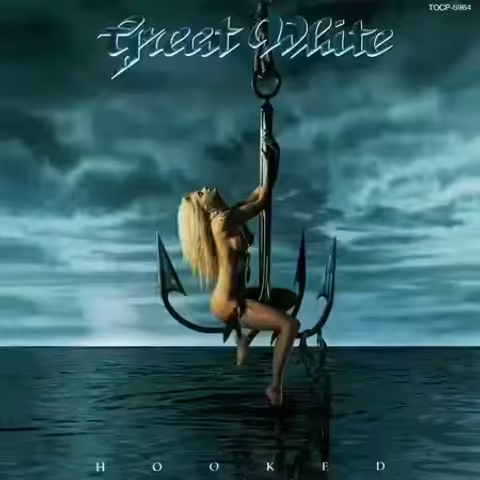
The most talked-about thing about Hooked was never one of its songs. It was the cover: a naked woman hoisted out of a flat, slate-grey sea on a giant steel fishing hook, an image so provocative that Capitol Records lost its nerve and quietly reissued the album with the model lowered safely beneath the waterline within weeks of release. For a band that had just sold millions of copies of glossy, radio-friendly pop-metal, it was a strange and slightly desperate way to announce a new record.
Released in February 1991, Hooked was Great White's fifth studio album and the moment the Los Angeles band tried to remind everyone who they had been before the hits. After the double-platinum success of ...Twice Shy, built around a cover of an Ian Hunter song, they made a deliberately bluesier, looser, less commercial record with no obvious smash single, and they made it right on the eve of the cultural earthquake that would sweep their entire genre away. It went gold, it slipped quietly down the charts, and then, more than a decade later, one of its songs became attached to one of the worst tragedies in American rock history.
Album Facts
Great White had spent the late 1980s being filed away as a glam-metal act, all hairspray and power ballads. Hooked was their attempt to be heard as the blues-rock band they always believed they were. The facts underneath it tell the story of a group at a commercial crossroads.
| Field | Detail |
|---|---|
| Artist | Great White |
| Album | Hooked |
| Release Date | 26 February 1991 |
| Label | Capitol Records |
| Producer(s) | Alan Niven, Michael Lardie |
| Studio | Total Access, Redondo Beach, California |
| Genre / Subgenre | Hard rock, blues rock |
| Track Count | 10 |
| Total Runtime | 51:51 |
| Billboard 200 Peak | 18 |
| UK Albums Chart Peak | 43 |
| Other Notable Chart Peaks | Switzerland 5, Germany 32, Finland 25, Canada 27 |
| Certifications | Gold (US, RIAA); Gold (Canada, Music Canada) |
| Estimated Sales | Over 500,000 (US shipments) |
| Key Singles | "Congo Square", "Call It Rock n' Roll", "Desert Moon" |
Cultural Context
Early 1991 was the last good year for the kind of band Great White were, even if nobody knew it yet. The Sunset Strip sound still ruled rock radio and MTV, and the charts were full of the bands Great White had toured arenas with. Within months, though, the ground would shift. Nirvana's Nevermind arrived that September, Pearl Jam's Ten was already out, and by 1992 the entire commercial ecosystem that had made Great White rich was being dismantled in real time.
Released into that brief calm before the storm, Hooked was competing for attention with a remarkable run of records. The wider world was distracted too: the Gulf War dominated the news through January and February 1991, and the music industry was about to learn that the audience's tastes had moved on. A bluesy hard-rock album with a censored cover and no killer single was always going to struggle to cut through.
- The Gulf War filled the news for the album's entire release window.
- Glam and pop-metal were still dominant on radio and MTV, for a few more months.
- Nirvana's Nevermind was only seven months away from changing everything.
- Freddie Mercury would die that November, closing a chapter of the rock era.
The Band's Story Up to This Point
Great White's road to Hooked began in 1977, when singer Jack Russell met guitarist Mark Kendall in Los Angeles. The early years were chaotic. In 1979 Russell was arrested and imprisoned after shooting a live-in maid during a botched robbery, serving 18 months of an eight-year sentence before talking his way back into the band. They cycled through names, Highway, Livewire, Wires, then Dante Fox, before settling on Great White, a nod to Kendall's stage nickname, earned through his white-blonde hair, white Telecaster and all-white stage gear.
The man who shaped them was Alan Niven, the New Zealand-born manager and producer who took the band on, suggested the name change, and would go on to manage Guns N' Roses as well as overseeing Motley Crue's debut self-release. After an EMI America debut in 1984 and a move to Capitol, the band reissued Shot in the Dark in 1986 and welcomed multi-instrumentalist Michael Lardie into the fold, the man who would quietly become their most important player. They finally broke through with Once Bitten... in 1987, which went platinum the following spring on the strength of "Rock Me" and "Save Your Love".
Two years later ...Twice Shy turned them into genuine stars. It went double platinum, earned a Grammy nomination for Best Hard Rock Performance, and spun off a run of hits: the title track, a cover of Ian Hunter's "Once Bitten, Twice Shy" that remains their only gold single, plus the Top 40 ballad "The Angel Song" and "House of Broken Love". Bassist Tony Montana had joined in late 1987, replacing Lorne Black, and the classic line-up was now set. On the back of that album the band toured arenas and stadiums alongside Bon Jovi, Tesla, Warrant and Badlands, and supported Alice Cooper on his Trash tour.
By the time they came to make Hooked, Great White had sold millions of records, an estimated eight million worldwide across their career, and shared stages with the biggest names in rock. They had also been comprehensively typecast as a hairspray-and-ballads outfit. AllMusic would later describe their sound, accurately, as something far older than the glam scene they were lumped in with.
"Great White's music is rooted in the bluesy hard rock aesthetic of classic rock radio of the 1970s."
AllMusic
A Deliberate Return to the Blues
If ...Twice Shy was the sound of Great White chasing the mainstream, Hooked was the sound of them trying to walk back toward their roots. The band had always idolised Led Zeppelin and AC/DC, and the new album leaned hard into that DNA: slower grooves, slide guitar, harmonica, and a looser, warmer feel than the tightly-produced hits that had made their name.
That instinct showed up most clearly in the choice of cover versions. Where most of their peers covered other rock bands, Great White reached for The Angels, the Australian pub-rock institution, and the Small Faces, the great British mod-rock band of the 1960s. On expanded and bonus editions they went further still, recording a clutch of straight blues covers that made their influences impossible to miss.
- "Can't Shake It", a cover of Australian pub-rockers The Angels.
- "Afterglow", a cover of the Small Faces' Steve Marriott and Ronnie Lane.
- Bonus-edition blues covers of Savoy Brown, Willie Dixon, Albert King and Dr. Feelgood.
It was a brave, slightly stubborn move. The audience that had bought ...Twice Shy for its glossy ballads was not necessarily looking for an album that doffed its cap to 1970s FM radio and Chicago blues. But it was, by every account, the record the band actually wanted to make.
Creating the Album
Recording took place between September and November 1990 at Total Access in Redondo Beach, the South Bay studio just down the coast from where the band had come up. Production was shared between Alan Niven and Great White's own Michael Lardie, the multi-instrumentalist who had become the band's secret weapon. Lardie played guitar and keyboards, sang, arranged, and engineered, wearing more hats on the record than anyone else in the room.
Detailed accounts of the sessions are thin, and it would be wrong to invent them. What the credits make clear is that this was very much a band-and-Niven production rather than the work of an outside hired gun, with Lardie's fingerprints on almost every aspect of the sound. He is credited not just with guitar and keyboards but with the album's arrangements and engineering, shaping the warmer, more spacious feel that separates Hooked from its slicker predecessor. The album was engineered with Melissa Sewell and mastered by George Marino, one of the most respected mastering engineers of the era, whose credits stretch from Led Zeppelin reissues to countless classic-rock landmarks.
The most notable outside contribution came from guitarist Michael Thompson, who added the slide guitar solo on "Cold Hearted Lovin'". Niven himself sang backing vocals, alongside Simone Shook and Terry Sasser. On the bonus blues cover "Down at the Doctor", the band pulled off a genuine coup, recruiting saxophone legend Clarence Clemons of Bruce Springsteen's E Street Band.
Personnel & Credits
The Hooked line-up is the classic early-1990s Great White, and it carries one quiet piece of history: it was the last Great White studio album to feature bassist Tony Montana, who left the fold afterwards. The supporting cast is small but includes one of the most famous saxophonists in rock.
| Role | Player | Notes |
|---|---|---|
| Core band | ||
| Lead and backing vocals | Jack Russell | |
| Guitar, backing vocals | Mark Kendall | |
| Guitar, keyboards, vocals | Michael Lardie | Also producer, arranger and engineer |
| Bass | Tony Montana | His last Great White studio album |
| Drums | Audie Desbrow | |
| Guest & session musicians | ||
| Slide guitar | Michael Thompson | Solo on "Cold Hearted Lovin'" |
| Saxophone | Clarence Clemons | On the bonus track "Down at the Doctor" |
| Backing vocals | Alan Niven, Simone Shook, Terry Sasser | |
| Production & engineering | ||
| Producers | Alan Niven, Michael Lardie | |
| Engineer | Melissa Sewell | |
| Mastering | George Marino | |
| Artwork | ||
| Cover photography | John Scarpati | Original cover image |
| Cover model | Kristine Rose | |
| Art direction & design | Hugh Syme | Created the revised, censored cover |
The Songs
For all its commercial caution, Hooked is a confident, well-played record. It opens with its strongest moment and then settles into a groove that rewards patience rather than chasing radio. The longer songs, several pushing past six minutes, give the band room to stretch out in a way the hit singles never had.
| # | Title | Writer(s) | Length | Single? | Notes |
|---|---|---|---|---|---|
| 1 | Call It Rock N' Roll | Montana, Lardie, Niven, Russell, Kendall | 3:56 | Japan | Lead single and video |
| 2 | The Original Queen of Sheba | R. Brewster, Niven, Lardie | 4:39 | Co-written with The Angels' Rick Brewster | |
| 3 | Cold Hearted Lovin' | Anderson, Niven, Russell | 4:19 | Michael Thompson slide solo | |
| 4 | Can't Shake It | J. Brewster, Neeson, R. Brewster | 4:45 | The Angels cover | |
| 5 | Lovin' Kind | Lardie, Niven | 4:45 | ||
| 6 | Heartbreaker | Lardie, Niven, Kendall, Russell | 6:44 | ||
| 7 | Congo Square | Kendall, Niven | 6:57 | UK | The album's epic centrepiece |
| 8 | South Bay Cities | Niven, Lardie | 5:25 | Named for the band's home turf | |
| 9 | Desert Moon | Lardie, Niven, Kendall, Russell | 4:32 | US | Later tied to the Station fire |
| 10 | Afterglow | Marriott, Lane | 5:49 | Small Faces cover |
"Call It Rock N' Roll" is the obvious highlight and the closest the album comes to a hit, a swaggering, mid-tempo anthem that became the lead single and the song most fans associate with the record. Co-written by all five members, it is the rare Hooked track that condenses the band's blues-rock instincts into a tight, radio-length package. "Congo Square", nearly seven minutes long, is the album's ambitious heart, a slow-burning Kendall and Niven epic that shows off the bluesier direction better than anything else here, and it was chosen as the British single for exactly that reason.
The collaborations run deep through the tracklist. "The Original Queen of Sheba" was co-written with The Angels' Rick Brewster, while "Cold Hearted Lovin'" features that guest slide solo from Michael Thompson. "Heartbreaker", another song to break the six-minute mark, lets the band stretch out in the unhurried, groove-led style they clearly relished, and "South Bay Cities" tips its hat directly to the stretch of coastal Los Angeles, Redondo Beach included, where the band had formed and where the album was recorded.
Elsewhere the covers do a lot of the talking. "Can't Shake It" reaches into the catalogue of The Angels, while the album closes with a faithful, affectionate take on the Small Faces' "Afterglow". "Desert Moon", a moody minor hit at the time, would take on a weight nobody could have imagined when it was recorded. Below is the song's lead-single companion, the official video for "Call It Rock N' Roll".
B-sides, Bonus Tracks & the Blues Covers
Some of the most revealing material connected to Hooked never made the standard ten-track album. Expanded and reissue editions added a run of blues and roots covers that lay the band's influences bare, and these bonus tracks are arguably where the album's true spirit lives.
- "Train to Nowhere", a cover of British blues-rock pioneers Savoy Brown.
- "Weak Brain and Narrow Mind", a Willie Dixon blues standard.
- "Down at the Doctor", a Dr. Feelgood cover featuring Clarence Clemons on saxophone.
- "The Hunter", the Albert King blues classic written by the Stax team.
The Japanese edition went furthest of all. It retained the original, uncensored cover and added a bonus CD titled Live in New York, recorded at Electric Lady Studios on 31 May 1991, a snapshot of the band tearing through both Hooked material and older favourites in front of an audience. For collectors, that Japanese pressing remains the definitive version of the record.
Album Artwork & Packaging
The cover is the part of Hooked that everyone remembers. Photographed by fashion photographer John Scarpati, the original image showed a nude female model, Kristine Rose, being lifted out of a calm sea on an enormous steel hook, the band's logo above her and the album title below. It was striking, provocative, and, for Capitol Records in 1991, a step too far.
Within weeks of the initial pressing, the label had art director Hugh Syme, best known for his decades of work with Rush, rework the image. Syme's revised cover lowered the hook below the waterline so that only the model's head and arms remained visible above the surface, a neat piece of damage control that kept the concept while removing the nudity. The original survived only on the earliest copies and on the Japanese pressing, which is part of why those editions are so prized today.
The hook itself was the whole point, a literal visual pun on the album's title and on the idea of music that gets its claws into you. It is one of the more memorable sleeves of the era, and the censorship saga only made it more notorious.
Release & Reception
When Hooked arrived in February 1991, the critical response captured exactly the tension at the album's heart. Reviewers noticed that this was a calmer, bluesier Great White, and not everyone was sure the band's audience wanted that. Q Magazine's Jeff Clark-Meads summed it up neatly.
"Relaxed, mellow and endearing, though this is likely to engender disappointment for those who hitherto considered Great White a metal act."
Jeff Clark-Meads, Q, 1991
AllMusic was warmer, awarding the album four stars in a later retrospective, while Martin Popoff's Collector's Guide to Heavy Metal was far harsher, scoring it just four out of ten. The split was telling: Hooked divided opinion precisely because it refused to be the album people expected.
Commercially, it was a clear step down from its predecessor. Hooked peaked at number 18 on the Billboard 200 and number 43 on the UK Albums Chart, though it performed strikingly well in Switzerland, where it reached number 5. It was certified gold in both the United States and Canada, a respectable result, but a long way from the multi-platinum heights of ...Twice Shy. Without a recognisable hit single to drive it, the album simply did not have the same commercial engine.
| Territory | Chart | Peak |
|---|---|---|
| Switzerland | Schweizer Hitparade | 5 |
| United States | Billboard 200 | 18 |
| Finland | Suomen virallinen lista | 25 |
| Canada | RPM Top Albums | 27 |
| Germany | Offizielle Top 100 | 32 |
| United Kingdom | UK Albums | 43 |
Singles & Music Videos
The singles campaign for Hooked was a scattered, territory-by-territory affair, which tells its own story about a label unsure of which song to push. Three different tracks were chosen as singles in three different markets, none of them breaking through the way the band's earlier hits had.
| Single | Territory | Release |
|---|---|---|
| "Congo Square" | United Kingdom | 4 February 1991 |
| "Call It Rock n' Roll" | Japan | 6 March 1991 |
| "Desert Moon" | United States | May 1991 |
"Call It Rock N' Roll" got the marquee music video and remains the song most associated with the album, a punchy statement of intent that opens the record. "Congo Square" led the charge in Britain, while "Desert Moon" was held back as the American single. None of them gave Great White the radio smash that ...Twice Shy had delivered so easily, and the lack of a defining hit is the single biggest reason Hooked is less remembered than the albums on either side of it.
Touring & Live
To support Hooked, Great White went out on the road in a role they had not occupied for years: opening act. The band toured Europe and Japan as support for the German hard-rock giants Scorpions, a step that underlined how the commercial wind had shifted. It was a gruelling run, and it was not without incident.
Midway through the touring cycle, guitarist Mark Kendall was hospitalised for three weeks with a hiatal hernia. Rather than cancel, the band drafted in guitarist Al Pitrelli, later of Megadeth and Trans-Siberian Orchestra, to cover for him until he recovered. The Live in New York recording captured on the Japanese edition, taped at Electric Lady Studios, is the best official document of how this material sounded on stage, a reminder that Great White were always a stronger live band than their studio reputation suggested.
In TV, Film & Media
Unlike the band's signature hits, the songs from Hooked never found a significant second life in film, television or advertising. There are no famous sync placements to point to, and the album's tracks have largely lived on through the band's own live shows and the loyalty of long-time fans rather than through the screen.
That relative obscurity makes the one piece of cultural memory attached to the album all the more painful, because the song that did end up in the headlines did so for the worst possible reason. For most of its life, though, Hooked simply went about its business as a fan-favourite album cut, the kind of record that rewards the people who already love the band rather than reaching for a new audience through a film trailer or a television montage.
Controversy, Censorship & the Long Shadow
The first controversy around Hooked was the cover, and the rapid corporate retreat that followed it. But the album's darkest association came twelve years after its release, and had nothing to do with the music itself. On 20 February 2003, a version of the band billed as Jack Russell's Great White was playing The Station nightclub in West Warwick, Rhode Island. As they opened their set, pyrotechnics set off by the band's tour manager ignited flammable foam soundproofing on the walls and ceiling around the stage.
The fire that followed killed 100 people, including the band's touring guitarist Ty Longley, and badly burned scores more. The opening song that night was "Desert Moon", drawn from Hooked. It became one of the deadliest nightclub fires in American history, and the band did not perform the song live again for years. Out of respect, it stayed off their setlists until the tour supporting their 2007 reunion album.
It is impossible to write the complete story of Hooked without acknowledging that shadow. A modest, well-meaning blues-rock album from 1991 became, through tragedy, permanently linked to a catastrophe that reshaped fire-safety law in the United States. The band reached a $1 million insurance settlement with survivors and victims' families in 2008, while admitting no wrongdoing.
Covers, Influences & Roots
More than most albums, Hooked wears its influences as text rather than subtext. Covering The Angels and the Small Faces on the standard edition, and Savoy Brown, Willie Dixon, Albert King and Dr. Feelgood on the extras, the band drew a clear line from 1960s British rock and American blues straight through to their own sound. It was a statement of lineage as much as a tracklist.
This was, after all, a band whose biggest hit was itself a cover, Ian Hunter's "Once Bitten, Twice Shy". Reinterpreting other people's songs was woven into Great White's identity from the start, and Hooked simply made that tendency explicit, using the covers to point listeners back toward the music that had shaped them. For a record often dismissed as a commercial misstep, it is a surprisingly generous and self-aware piece of work.
Reissues & Editions
The history of Hooked on physical formats is unusually tangled, largely because of the cover. Collectors track several distinct versions, and the differences matter to fans.
- The earliest US pressings carried the original, uncensored Scarpati cover.
- Most copies carry Hugh Syme's revised, partially-submerged artwork.
- The Japanese edition kept the original cover and added the Live in New York bonus disc.
- Later expanded editions appended the four blues-covers as bonus tracks.
There has been no lavish anniversary box set of the kind the band's bigger albums might warrant, and given the tragic associations of one of its songs, that is perhaps understandable. For now, the original Japanese pressing remains the holy grail for serious collectors, combining the uncensored art with the live bonus material in a single package, and copies in good condition change hands for a premium whenever they surface.
Legacy & Influence
In the long arc of Great White's career, Hooked sits at a hinge point. It was their last gold-certified studio album, the last to feature bassist Tony Montana, and the final record before the long commercial decline that the arrival of grunge accelerated. The follow-up, Psycho City, came in 1992, after which the band began a years-long journey through smaller labels and shrinking audiences before disbanding in 2001.
What followed was a long, difficult coda: the Station fire, the lawsuits, competing versions of the band, and Jack Russell's eventual departure and death in 2024. Russell himself later spoke painfully about the years when the band felt like a shadow of itself.
"It still sounded like Great White, but not, almost like we were doing a cover of ourselves."
Jack Russell, KNAC, 2007
The wounds ran deep enough that, years later, guitarist Mark Kendall ruled out ever working with Russell again, telling one interviewer that the prospect simply felt wrong.
"For us to go back to that, it just feels dark."
Mark Kendall, Blabbermouth, 2022
Within that turbulent history, Hooked endures as the great blues-rock statement Great White always had in them. It was never their biggest seller and it never produced their most famous song, but it is arguably the truest expression of who they were: a band of 1970s rock obsessives briefly, improbably, swept up in the glam-metal gold rush, and trying, on this one record, to point everyone back toward the blues.
Things You Might Not Know
| Fact | Detail |
|---|---|
| The censored cover | John Scarpati's original sleeve, a nude model on a giant hook, was deemed too risque by Capitol and revised by art director Hugh Syme within weeks of release. |
| Rush connection | Hugh Syme, who reworked the cover, is best known for designing album art for Rush across several decades. |
| A Springsteen sideman | E Street Band saxophonist Clarence Clemons guested on the bonus blues cover "Down at the Doctor". |
| Two hidden covers | The standard album includes covers of The Angels ("Can't Shake It") and the Small Faces ("Afterglow"), with more blues covers on bonus editions. |
| Montana's farewell | Hooked was the last Great White studio album to feature bassist Tony Montana, who left the band afterwards. |
| Swiss success | While it stalled at number 18 in the US and 43 in the UK, Hooked reached number 5 in Switzerland. |
| Opening act again | To support the album, Great White toured Europe and Japan opening for Scorpions, a step down from their arena-headlining days. |
| A future Megadeth man | When Mark Kendall was hospitalised mid-tour with a hiatal hernia, guitarist Al Pitrelli stepped in to cover for him. |
| The Japanese grail | Japan's edition kept the original uncensored cover and added a bonus live CD recorded at Electric Lady Studios in May 1991. |
| A song forever changed | "Desert Moon" was the band's opening song when pyrotechnics started the Station nightclub fire in 2003; it was retired from setlists for years afterward. |
The Riffology Podcast
Hooked is a fascinating, complicated record: a commercial gamble, a blues-rock love letter, a censorship saga, and an album shadowed by a tragedy nobody could have foreseen. If you want to dig deeper into the stories behind Great White, this album and the music that shaped it, the Riffology podcast is available on all major platforms. Pull up a chair, turn it up, and join us.
Comments