
After Stoosh: where Skunk Anansie stood at the end of 1998
By the closing months of 1998 Skunk Anansie were one of the biggest British rock bands of the post-Britpop wave, named alongside Manic Street Preachers, Therapy? and Radiohead whenever the trade press tried to imagine a domestic rock scene that did not revolve around a Camden indie haircut. The band had cut their teeth on the London pub circuit from 1994, signed to One Little Indian's offshoot before moving into the Virgin and EMI catalogue infrastructure, and broken through with Paranoid and Sunburnt in 1995, which reached number 8 on the UK Albums Chart and eventually went Gold. Stoosh in 1996 had landed at number 9 and gone Platinum, giving them their biggest singles to that point in Hedonism (Just Because You Feel Good) at UK number 13 and Brazen (Weep) at UK number 11.
Skin, born Deborah Anne Dyer in Brixton, had become one of the most recognisable frontwomen of the decade: a black lesbian with a shaved head and a four-octave range, fronting a band whose politics (anti-racism, anti-homophobia, anti-Conservative-government) sat openly at odds with the laddish Cool Britannia consensus of Loaded magazine and the Union Jack guitar. The band's deliberately provocative motto "Clit Rock" repurposed the cock-rock cliche on Skin's terms. By the end of the Stoosh tour they were headlining festival second stages worldwide and had supported U2 on the European leg of the PopMart tour in 1997. The third album would have to do something other than refine the formula.
The internal pressures going into the third record were complicated. Paranoid and Sunburnt had been the breakthrough; Stoosh had been the consolidation; an obvious third move would have been the smoothed-out cross-over album that sanded the rough edges off Hedonism and pushed the band into the adult contemporary chart territory their Virgin and EMI label home would have happily funded. The band rejected that move openly in interviews from the late Stoosh tour onwards, with Skin in particular making the point that the rock end of the band's sound, not the ballad end, was the part that mattered most to her. The decision that emerged from those internal conversations was to make a record that was harder, not softer; American, not British; and longer in arrangement and production time than anything they had previously committed to.
Going to America: choosing Andy Wallace
The decision the band reached, with their A and R contact at Virgin and with regular collaborator Len Arran (who would also end up co-writing four songs on the record), was to leave Britpop entirely. That meant leaving London, leaving the British producers and engineers who had shaped Paranoid and Sunburnt and Stoosh, and going to the United States to chase a harder, more textured, more produced sound from an American mixer-producer in the middle of one of the great commercial runs of his career.
The man they hired was Andy Wallace. By late 1998 Wallace's discography read like a survey of the previous twelve years of American rock: Slayer's Reign in Blood in 1986 and Seasons in the Abyss in 1990, the mix on Nirvana's Nevermind in 1991, Faith No More's Angel Dust and Helmet's Meantime in 1992, Rage Against the Machine's Evil Empire in 1996, and Sonic Youth and Jeff Buckley records in between. He had not yet made an album with a British rock band of this stature. Skunk Anansie would be his first, and the calendar that followed showed how busy that period was for him: he would go straight from the Post Orgasmic Chill mix into producing Bush's The Science of Things later in 1999, and on across the next decade into Avril Lavigne, Linkin Park's Hybrid Theory and System of a Down's Toxicity.
Clinton and Bearsville: two New York rooms
The sessions split between two studios on either side of the New York state line. Clinton Recording Studios on West 46th Street in midtown Manhattan handled most of the band tracking: a mid-Nineties SSL and Studer rock room sitting a block from Times Square, with a high-ceilinged live area Wallace favoured for drum sounds. The overdubs, the strings work after London, and a portion of the mixing moved to Bearsville Studios outside Woodstock in upstate New York, the residential complex Albert Grossman had built in the late Sixties and which had hosted The Band, R.E.M.'s Reckoning, Phish, and most recently the Loveless overdubs for My Bloody Valentine. Bearsville's appeal was the same as it had always been: total isolation, decent food, and a barn-sized tracking room.
The engineering crew was almost entirely American. Clif Norrell engineered, with Chris Laidlaw assisting. Steve Sisco assisted on the mix. Howie Weinberg, who had cut every Slayer, Rage Against the Machine, Sonic Youth and Nirvana record of the previous decade at Masterdisk in New York, mastered the album. None of this was accidental. The personnel on the credit list represented a deliberate purchase of a particular American post-grunge polish that no British studio chain could have assembled in one phone call.
The Wallace production approach
Wallace's signature approach in this period was already well documented by the records he had mixed. The fingerprints recur on the Skunk Anansie album: dense overlapping layered guitar parts panned hard, drums recorded relatively dry with room microphones added back on top, vocal lifts achieved through subtle harmonic doubling and short chamber reverbs rather than long hall plates, and a low end tightened by aggressive compression on the mix bus. The result, particularly on Charlie Big Potato and The Skank Heads, is one of the most mid-range-saturated, aggressively reverbed mixes in Wallace's catalogue.
Skin's vocals are doubled and chorused on Charlie Big Potato in a way she had largely resisted on the more rawly cut Stoosh, where her voice tended to sit alone in the centre of the mix. Wallace took the opposite view: the chorus needed to feel like four Skins arriving at once, and the effect on the radio mix is unmistakable. On the slower material, particularly Lately and Secretly, the doubling is pulled back almost to zero and a single lead vocal sits against a wash of orchestral string overdubs from London.
The room and the equipment
Skin tracked her leads on a tube U47 in the Clinton live room, the same microphone tradition Wallace had used on most of his Nineties rock mixes. Ace ran his SG and Les Paul through a stable of Marshall JCM800 and Mesa Boogie heads, building multiple guitar overdubs per chorus, sometimes four or five layers thick. Cass tracked on a Fender Precision through an Ampeg SVT for the rock cuts, switching to an Alembic for the more textural passages, and is credited with drum-machine programming on And This Is Nothing That I Thought I Had. Mark Richardson played a Pearl and DW hybrid kit, swapping snares between songs to find the right attack: a tighter wooden snare on the punk-tempo cuts and a deeper metal shell on the mid-tempo material.
Two of the more unusual credits belong to Skin. Cheap Honesty carries a theremin part, played by Skin and processed through Clif Norrell's tape delay, sitting underneath a tense Latin-tinged Richardson groove. We Don't Need Who You Think You Are has a vibraphone bed underneath the verses, also her credit. Neither instrument had appeared on a Skunk Anansie record before; both were a direct consequence of having time in a residential studio and a producer interested in texture rather than economy.
Wil Malone and the strings
The other major personnel addition came from London, not New York. Wil Malone, the British arranger best known for the strings on Massive Attack's Unfinished Sympathy and The Verve's Bittersweet Symphony, was hired to write and conduct string arrangements for Secretly, Lately and You'll Follow Me Down. A small chamber orchestra recorded the parts in London after the main American sessions; the multitrack was then flown back to Wallace for the final mix. Malone's writing on Secretly in particular, a long descending counter-melody that opens out across the chorus, is what lifts the song out of mid-tempo ballad territory and into the radio reach it eventually found across Europe.
The string sessions also represent the only major piece of the record that was not made on American soil. The decision to track them in London was partly practical (Malone worked there, his usual ensemble worked there) and partly economic (importing a chamber group to upstate New York for three songs would have been absurd). It left the album with a particular geographical fingerprint: an American rock production with a British orchestral overlay, both stitched together by Wallace at Bearsville. The decision to use a chamber-sized ensemble rather than a full orchestra was also deliberate; Malone's writing in this period favoured tight, close-miked string sections that could be mixed loud without losing definition, an approach that suited Wallace's dense-mid-range mix philosophy far better than a full Hollywood string section would have done.
Charlie Big Potato: the statement of intent
The album opens on Charlie Big Potato, a five and a half minute track co-written by Skin and Len Arran whose lyric reads as a barbed kiss-off to an unnamed target the band have never identified on the record. Musically the song is a deliberate ambush: eight bars of distorted bass and feedback before a half-time riff explodes, then Skin alternating spoken-word verses with a soaring chorus that pushes into her upper register.
Released as the lead single on 1 March 1999, three weeks before the album, Charlie Big Potato peaked at UK number 17, the band's third UK top twenty single, and reached number 3 in Iceland, number 1 on the UK Rock and Metal Singles Chart and number 18 in Scotland. It set out the new sonic territory unambiguously: this would be a harder, denser, more produced record than Stoosh, and the opening fifteen seconds of feedback were a non-negotiable signal to anyone tuning in expecting another Hedonism. The choice to lead the album campaign with the noisiest song on the record, rather than with one of the strings-led ballads that the label would have considered safer, paid off in chart return: a UK top twenty single built around a feedback-and-bass-distortion intro was not something the singles market in March 1999 was routinely producing. The song later appeared in the 2000 Paul Verhoeven film Hollow Man.
The hard cuts: On My Hotel T.V., We Don't Need Who You Think You Are, Tracy's Flaw, The Skank Heads
The early run of the album sits in deliberately aggressive territory. On My Hotel T.V. is a brisk three and a half minute alt-metal cut about life on the Stoosh tour, the dissociation of channel surfing in foreign cities at three in the morning, Skin's punctuated verse vocal sitting against a martial Richardson groove. We Don't Need Who You Think You Are is Skin's snarl at industry gatekeeping and identity policing, with the vibraphone bed under the verses and one of the album's most aggressive Ace solos in the bridge.
Tracy's Flaw, co-written by Skin, Ace and Len Arran, is a first-person character sketch of a flawed friend that turns into a guitar-driven anthem. The Skank Heads, at three minutes eleven seconds, is the album's hardest and shortest cut, written about racist and homophobic boneheads encountered on the road, played at punk tempo with Skin's vocal deliberately pushed into the red. The phrase later supplied the title of a 2016 Skunk Anansie deluxe compilation, by which point it had become as much a self-description as an insult thrown at someone else.
Lately and Secretly: the singles that broke the album in Europe
The album's commercial centre of gravity sits in two ballads. Lately, released as the third single on 26 July 1999, is a piano-led mid-tempo song with Malone strings, lyrics about emotional unavailability, and one of Skin's most controlled vocal performances on the record. It reached UK number 33 and stayed on European playlists into the autumn.
Secretly, the second single, came out on 10 May 1999 and became the album's biggest commercial hit. It reached UK number 16, the band's fourth UK top twenty single, and became a fixture on UK MTV playlists through the early summer. The Malone string chart sweeps the chorus; Skin sings the lyric of a closeted affair in third person before pivoting to first in the final verse, a structural choice that pays off the song's title only after three minutes of misdirection. The Giuseppe Capotondi-directed video remains the band's most recognisable single video and was widely played on UK and continental music television.
The extended pieces: Good Things, Cheap Honesty, You'll Follow Me Down
Three of the longer cuts on the second half show Ace's most ambitious arranging on the record. Good Things Don't Always Come to You, co-written by Skin, Ace and Arran and running five minutes and twenty-five seconds, escalates from an acoustic guitar verse to a wall of sound chorus across four distinct dynamic stages. It is the closest the album comes to a Wallace-era Faith No More structure, which is probably not an accident.
Cheap Honesty, co-written by Skin and Arran, is the home of the theremin part: a tense Latin-tinged Richardson groove with the processed theremin floating across the top, Skin singing in a low, almost conversational register. You'll Follow Me Down, the fourth single and another Skin and Arran co-write, was released in October 1999 and reached number 17 in Italy, where Skunk Anansie's continental profile was at its peak; the song did not chart in the United Kingdom. The video was directed by Thomas Krygier, who had earlier shot Hedonism and Brazen for Stoosh; the song itself is a slow-burning torch with the most prominent Malone string chart on the record, and a vocal in the verses that sits at the very bottom of Skin's range.
The closing run: And This Is Nothing, I'm Not Afraid, Post Orgasmic Sleep
The standard edition closes with two tracks that pull in opposite directions. And This Is Nothing That I Thought I Had (the title is a Skin lyric, not a punctuation error) is built on a programmed drum loop, a processed guitar drone, and what is probably Skin's most intimate vocal on the record: a few feet from the U47, almost whispered, with the room very dry. I'm Not Afraid, four minutes and forty-eight seconds, is a driving rock cut built around an Ace riff in dropped tuning; Skin closes the album in one take, a defiant statement of intent that revisits the album's themes of self-determination and refusal.
The thirteenth track, Post Orgasmic Sleep, was added only to the Japanese edition as a bonus and supplied the album with its title. Five minutes and seventeen seconds of slow, ambient closing piece, dominated by Skin's hushed vocal and Cass's atmospheric bass, it is the most overtly textural thing on any of the sessions. Its absence from the European and US editions is one of the small ironies of the record: most listeners outside Japan have never heard the song whose title sits on the front sleeve.
Two covers, one record: the Michael Nash Associates artwork
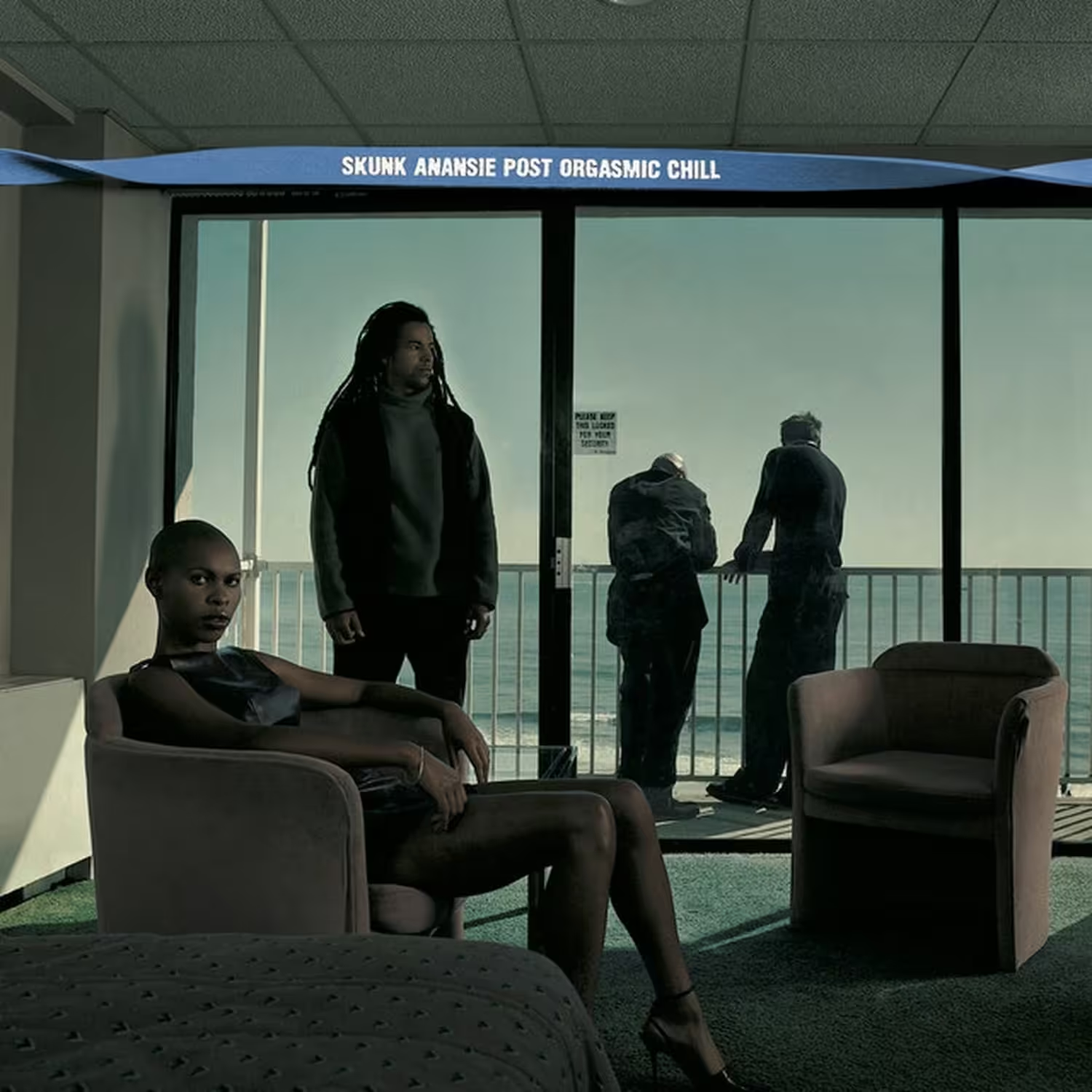
The album shipped with two distinct covers, both commissioned from London design partnership Michael Nash Associates and both shot during the band's New York recording trip. The European edition shows the band lounging in a stylised oceanside apartment in late-Nineties pastel tones, the colour palette deliberately soft against the music inside. The US edition, by contrast, lines the four members up on the Atlantic City boardwalk against a flat grey sky, a much harder image that reads as deliberately confrontational. The split made commercial sense at the time (American alt-rock buyers and European pop-rock buyers wanted different things from a record sleeve in 1999) and has since become a minor collector's quirk, with original first-pressing CDs of both editions trading among Skunk Anansie completists.
The sleeve type, by Michael Nash, is the same on both: a serif logotype set tight, with track listings in a small sans on the rear, deliberately avoiding any of the visual cliches of nu-metal cover art that were starting to take over American rock packaging in the same year.
Release, reception and the European chart story
Post Orgasmic Chill was released by Virgin Records on 22 March 1999 in the United Kingdom and rest of world, and through EMI's American imprint Virgin Records America in the United States. It was the band's first album under their long-term contract with Virgin and EMI; the previous records had been licensed to One Little Indian for the UK and Epic for the US, and the new arrangement gave the band direct access to EMI's continental European distribution.
The chart returns reflected that. The album entered the UK Albums Chart at number 16 and topped the UK Rock and Metal Albums Chart at number 1. On the continent it went further: number 5 in Germany, number 6 in Austria, number 6 in Belgium Flanders, number 8 in Norway, number 10 in the Netherlands, number 10 in Switzerland, number 12 in Finland, number 19 in France, number 24 in Scotland, number 27 in New Zealand, number 31 in Sweden and number 56 in Australia. The certifications followed: BPI Gold in the United Kingdom (100,000), IFPI Austria Gold (25,000), Italian FIMI 3x Platinum (300,000), IFPI Switzerland Gold (25,000), and an IFPI Europe Platinum award (1,000,000, granted in 2003 once the long European tail had run its course). The album also took year-end 1999 chart positions in Austria (number 49), Belgium Flanders (number 47), the Netherlands (number 47) and Germany (number 57).
Critically the album was respected if not universally adored at the time. AllMusic settled on three and a half stars out of five, NME gave it 8 out of 10, and Q ran a feature pegging the album as the band's most ambitious to date. Its retrospective standing has been more generous: it was included in the Robert Dimery-edited 1001 Albums You Must Hear Before You Die, the entry singling out the production and the Malone string arrangements as the moments that pushed the band beyond their Britrock peers.
Glastonbury 1999 and the world tour
The album cycle ran across 1999 and into 2000 and gave the band a year and a half of headline festival dates. The defining performance was the Pyramid Stage headline at Glastonbury on 25 June 1999, when Skunk Anansie became the first black artist to headline the Pyramid Stage in the festival's history. Beyonce would not follow until 2011 and Stormzy not until 2019. Skin's between-songs speech that night about the Stephen Lawrence inquiry, delivered in the gap between two of the heavier songs, became one of the most remembered Glastonbury moments of the decade and has been cited repeatedly in subsequent festival retrospectives.
The wider touring through 1999 and 2000 included V99, Reading and Leeds, Roskilde, Pinkpop and Rock am Ring, with the band running a production that emphasised the album's denser sound rather than translating it back into the rawer Stoosh-era live approach. The setlists leaned heavily on the new material; Charlie Big Potato opened most shows, Secretly anchored the middle, and Lately or You'll Follow Me Down sat near the encore. The continental European dates in particular drew larger audiences than the equivalent venues on the Stoosh tour, a direct read-out of the chart figures from Germany, Austria, Belgium and the Netherlands that placed the record in the top ten across the entire core EMI territory.
The Glastonbury headline itself sat on a Friday night bill that ran into the early hours of Saturday morning, with the band closing a long day of weather-disrupted scheduling. Skin appeared in a silver outfit that made her instantly visible to the cameras at the back of the field, and the set drew evenly from Stoosh and Post Orgasmic Chill while saving Charlie Big Potato for late in the running order. The Stephen Lawrence comments, delivered between two of the heavier songs, came almost a year after the Macpherson Report had been published and at a moment when the inquiry's findings were still part of the live British political conversation about institutional racism. The fact that the speech was made from the Pyramid Stage at all, by a black woman fronting a rock band in front of an audience that was overwhelmingly white, was the part that made it land; the BBC's broadcast footage of the moment has been re-cut into several documentaries since, including the festival's own 50th anniversary retrospectives.
Aftermath, the 2001 split, and the album's long legacy
The band announced in April 2001, halfway through the promotion for the Smashes and Trashes compilation, that they were splitting indefinitely to allow Skin to pursue a solo career. The official line was amicable and the timing was clean: there would be no fifth-album-that-killed-the-band narrative around Skunk Anansie. The decision was, in retrospect, an unusually disciplined one for a band coming off their commercial peak; most acts in that position would have pushed a fourth album through the same cycle and let the diminishing returns play out across the early 2000s. Splitting at the top instead left Post Orgasmic Chill as the unambiguous high-water mark of the band's first phase rather than the album before the long slide.
Skin released the solo album Fleshwounds in 2003 and Fake Chemical State in 2006, both on independent European labels and both stylistically closer to the Lately end of the Post Orgasmic Chill spectrum than to The Skank Heads. Cass spent the intervening years working with Hollywood Vampires and Robin Trower; Ace took on session work across the UK and continental scenes; Mark Richardson became the touring drummer for Feeder and stayed with that band through much of the 2000s, providing a useful piece of continuity with the British alternative-rock circuit that the original Skunk Anansie tour band had left behind. The 2009 reunion announcement and the Wonderlustre album in 2010 restored Skunk Anansie to UK and European touring viability and was followed by Black Traffic in 2012, Anarchytecture in 2016 and The Painful Truth in 2025. The eleven year gap between Post Orgasmic Chill and Wonderlustre is, to date, the longest pause in the band's catalogue.
The album itself matters in the band's catalogue and in the wider British rock story for three reasons. First, it was the moment Skunk Anansie escaped Britpop entirely by going to America and embracing alternative-metal production values, fractionally before nu-metal broke worldwide and made that approach the dominant commercial language of rock in 2000 and 2001. The timing of the record sits at an awkward and fascinating midpoint between two waves: too late to be part of the mid-Nineties Britrock conversation with Therapy?, Skin Up and the early Manics, too early to be marketed as a nu-metal record alongside Limp Bizkit and Korn. The result is an album that does not really belong to any movement, which is part of why it has aged well: there is no scene fashion to wear it down.
Second, it is the album on which Skin's vocal range was fully captured on tape. Across the twelve standard-edition tracks she moves from the half-spoken contempt of the Charlie Big Potato verses, through the operatic top notes on Secretly, to the close-mic'd intimacy of And This Is Nothing That I Thought I Had and the controlled mid-register of Lately. The earlier records caught one or two of those modes per album; Post Orgasmic Chill catches all of them, partly thanks to Wallace's willingness to commit different microphone and processing setups to different songs rather than imposing a single house vocal sound. Third, it sits at the band's absolute British and European commercial peak: the chart positions across the continent, the Glastonbury headline, the festival circuit, the European Platinum award and the FIMI 3x Platinum certification in Italy all converged on the same eighteen months in 1999 and 2000.
The album's standing in modern pop culture has been reinforced by the 2024 25th Anniversary Expanded Edition, a 2-CD reissue with B-sides, remixes and live tracks that returned it to UK rock-press attention twenty-five years after the original. The reissue campaign also brought back into circulation a handful of period B-sides that had only ever appeared on the original single CDs and were missing from most streaming editions, restoring a small but useful piece of the 1999 cycle that had quietly disappeared in the intervening two decades. Skin's continuing presence as a TV personality, BBC voice and DJ has kept the record in the conversation; her later vocal influence is visible across a generation of British female rock vocalists from PJ Harvey collaborators to the later wave of UK rock acts, and her interviews on the 25th Anniversary press cycle have been some of the most extensive she has given about the making of the record.
Charlie Big Potato, Secretly and Lately remain fixtures in the band's live set across every tour from the 2010 reunion through The Painful Truth shows in 2025; on most nights they account for three of the four most warmly received songs in the encore, alongside Hedonism from Stoosh. The Post Orgasmic Chill material has, in other words, become the spine of the live Skunk Anansie experience in a way that even the band could not have predicted in 1999, when the question was less about long-term canonisation than about whether the new harder direction would lose them the audience that had bought Stoosh. In the end it did the opposite. The album extended the band's reach across continental Europe, added a Glastonbury headline to their CV, and gave them three songs that have outlasted nearly every other Britrock single of the period.
Personnel
- Skin: lead vocals, theremin, vibraphone
- Cass: electric bass, acoustic bass, programming
- Ace: electric guitar, acoustic guitar
- Mark Richardson: drums, percussion
- Wil Malone: string arrangements, conductor
- Andy Wallace: production, mixing
- Clif Norrell: engineering
- Chris Laidlaw: assistant engineering
- Howie Weinberg: mastering (Masterdisk, New York)
- Steve Sisco: assistant mixing
- Michael Nash Associates: sleeve design and art direction
Tracklist
| # | Title | Length |
|---|---|---|
| 1 | Charlie Big Potato | 5:32 |
| 2 | On My Hotel T.V. | 3:34 |
| 3 | We Don't Need Who You Think You Are | 4:21 |
| 4 | Tracy's Flaw | 4:30 |
| 5 | The Skank Heads | 3:11 |
| 6 | Lately | 3:53 |
| 7 | Secretly | 4:45 |
| 8 | Good Things Don't Always Come to You | 5:25 |
| 9 | Cheap Honesty | 3:47 |
| 10 | You'll Follow Me Down | 4:01 |
| 11 | And This Is Nothing That I Thought I Had | 3:04 |
| 12 | I'm Not Afraid | 4:48 |
Things you might not know
| Fact | Detail |
|---|---|
| The title is a track that never appeared | Post Orgasmic Chill takes its name from the Japan-only bonus track Post Orgasmic Sleep, an ambient closing piece never issued on the European or US editions. |
| Recorded in New York with Andy Wallace | Sessions ran at Clinton Recording Studios in midtown Manhattan and Bearsville Studios in upstate New York with American producer Andy Wallace, fresh off the mix on Nirvana's Nevermind and production on Rage Against the Machine's Evil Empire. |
| Wil Malone wrote the string charts | Strings on Secretly, Lately and You'll Follow Me Down were arranged and conducted by Wil Malone, the same arranger behind Massive Attack's Unfinished Sympathy and The Verve's Bittersweet Symphony. |
| Skin played theremin and vibraphone | Beyond lead vocals, Skin is credited with theremin on Cheap Honesty (through Clif Norrell's tape delay) and vibraphone on We Don't Need Who You Think You Are. |
| First black Pyramid Stage headliner | On 25 June 1999, Skunk Anansie became the first black artist to headline the Glastonbury Pyramid Stage, a milestone Beyonce did not match until 2011 and Stormzy not until 2019. |
| Two distinct covers | Michael Nash Associates shot two separate sleeves: a pastel oceanside apartment scene for European editions and a flat-grey Atlantic City boardwalk image for the US edition. |
| Eleven year studio gap | Post Orgasmic Chill was followed by the 2001 indefinite split; the next Skunk Anansie studio album, Wonderlustre, did not arrive until 2010. |
| Wallace went straight to Bush | Andy Wallace moved directly from the Post Orgasmic Chill mix into producing Bush's The Science of Things later in 1999. |
| Canon-listed in 1001 Albums | The album is included in the Robert Dimery-edited 1001 Albums You Must Hear Before You Die, the only Skunk Anansie record on the list. |
| 25th Anniversary expanded reissue | The album was reissued in 2024 as a 25th Anniversary Expanded 2-CD edition with B-sides, remixes and live tracks from the 1999 and 2000 tour cycle. |
How to listen now
The original 1999 Virgin CD is still the most common second-hand format and turns up regularly in UK and European racks; the European and US first-pressing editions both have their own Michael Nash sleeves and are worth distinguishing if collecting. The album is available on all major streaming services through the Virgin and Universal catalogue. The 2024 25th Anniversary Expanded Edition is the recommended reissue: a 2-CD set with B-sides, remixes and live material from the 1999 and 2000 tour cycle, including contemporary recordings of Charlie Big Potato, Secretly and Lately. The reunited Skunk Anansie have kept all three of those songs in the live set across every tour from Wonderlustre in 2010 onwards, most recently on the dates around The Painful Truth in 2025, where Post Orgasmic Chill material continues to make up the largest single block of the encore.
Comments