On 4 September 2001, an Armenian-American band from Glendale, California released a record that opened with a three-minute attack on mandatory minimum sentencing and closed on a hidden Armenian church hymn. Inside seven days Toxicity was the number one album in the United States, the World Trade Center was a smoking crater, and the lead single had been quietly dropped from American rock radio because Clear Channel had decided the lyric "self-righteous suicide" was now too dangerous to broadcast.
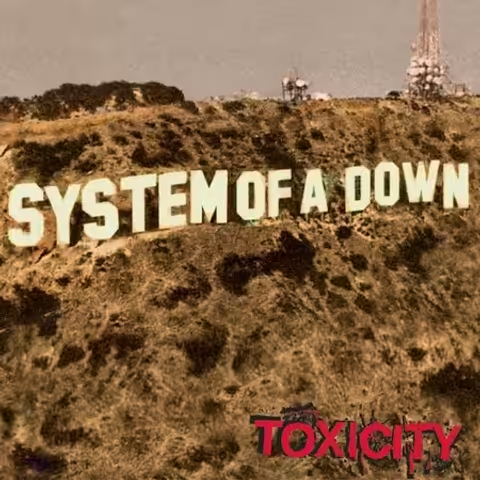
None of that should have happened. The producer, Rick Rubin, had told friends in 1997 that he loved the band but did not believe anyone else would. The cover replaced the Hollywood sign with the band's own name and was designed by Mark Wakefield, the man Linkin Park had fired as their singer two years earlier. The opening track was about CIA election rigging. And the album that became one of the bestselling metal records of the twenty-first century was built from over thirty songs the band recorded and then ruthlessly cut, the rejects ending up as the next album once they leaked onto Napster.
| Field | Detail |
|---|---|
| Artist | System of a Down |
| Album | Toxicity |
| Release Date | 4 September 2001 |
| Label | American Recordings / Columbia |
| Producer(s) | Rick Rubin, Daron Malakian (Serj Tankian co-producer) |
| Studio(s) | Cello Studios, Hollywood (recording); Enterprise, Burbank (mixing); Oasis Mastering, Studio City |
| Genre / Subgenre | Alternative metal, nu metal, with folk, jazz, prog rock and Armenian elements |
| Track Count | 14 |
| Total Runtime | 44:07 |
| Billboard 200 Peak | 1 (220,000 first-week sales) |
| UK Albums Chart Peak | 13 (UK Rock and Metal: 3) |
| Other Notable Chart Peaks | Australia 6, New Zealand 7, Belgium (Flanders) 8, Finland 8, Greece 8, Canada 1 |
| Certifications | 6x Platinum (RIAA, July 2022); 2x Platinum (BPI); 5x Platinum (ARIA); 3x Platinum (RMNZ, IFPI Danmark) |
| Estimated Sales | Over 12 million worldwide |
| Key Singles | Chop Suey! (August 2001), Toxicity (January 2002), Aerials (June 2002) |
Cultural Context
By the late summer of 2001 nu-metal had eaten the American rock charts. Limp Bizkit's Chocolate Starfish and the Hot Dog Flavored Water had ruled the previous autumn, Linkin Park's Hybrid Theory was on its way to becoming the bestselling album of the year, and Slipknot's Iowa would land the same fortnight as Toxicity. Korn, Disturbed and Staind were all in their commercial prime. The format was sportswear, downtuned riffs, scratch DJs, and an emotional register that ran from sulk to scream.
System of a Down were tagged as nu-metal because they shared a release window and a guitar tuning with that scene, but very little else. Their first album had toured beside Slayer, not Korn. Their lyrics quoted Charles Manson on environmentalism rather than complaining about parents. They wrote in odd time signatures and threw banjo, sitar and Armenian liturgical music into the same song without warning. Toxicity arrived at a moment when the rock mainstream was stranger than at any point since the early nineties, and even by that standard it sounded like nothing else on the radio.
The week of release became one of the strangest in modern American chart history. Toxicity debuted at number one. Eight days later, the planes hit the towers. The album stayed on top, and the cultural ground beneath it shifted overnight.
The Band's Story Up to This Point
Serj Tankian and Daron Malakian both attended the Rose and Alex Pilibos Armenian School in Los Angeles, eight years apart, and only met properly in 1992 at a recording studio. With drummer Domingo Laranio and bassist Dave Hakopyan they formed Soil, a band that played one show at the Roxy and made a single rehearsal-room recording before falling apart. Their manager, Shavo Odadjian, picked up a bass and reformed the project in 1994 as System of a Down, a name pulled from a Malakian poem originally titled "Victims of a Down". Odadjian argued for "system" because it would shelve them next to Slayer at the record shop.
The first drummer, Andy Khachaturian, lasted until 1997 and broke his hand punching a wall. John Dolmayan replaced him. Around the same time the band's demo tapes reached Rick Rubin, who signed them to American Recordings and produced the 1998 self-titled debut with engineer Sylvia Massy. "I loved them," Rubin said later. "They were my favourite band, but I didn't think anyone was going to like them apart from a small, likeminded group of people like me who were crazy. No one was waiting for an Armenian heavy metal band. It had to be so good that it transcended all of that."
The debut went gold on the back of "Sugar" and "Spiders" and a relentless touring schedule that put them on the Slayer-headlined Diabolus in Musica run, then Ozzfest, then their own Sno-Core headline with Mr. Bungle and Incubus in support. By the time they came off the road in 2000 they had a national audience but no breakout hit. Songs for the second album had been accumulating in soundchecks, in dressing rooms and on cassette tapes for the best part of two years.
Pre-production and Demos
Malakian wrote the bulk of the music for what became Toxicity in drop C tuning. He has explained the choice in mechanical terms: "For me, the drop-C tuning is right down the centre. It has enough of the clarity and the crisp sound, most of our riffy stuff is done on the top two strings anyway, but it's also thicker and ballsier." Most of the riffs that became "Chop Suey!", "Toxicity" and "Aerials" were written on a guitar tuned that way, then handed to Tankian, who wrote the bulk of the lyrics, and to Odadjian and Dolmayan, who took the parts apart and put them back together in rehearsal.
The band entered pre-production with more material than they could possibly use. By the time they walked into Cello Studios in March 2001 they had over thirty songs in some form. The brief from Rubin was to be ruthless and to widen the dynamic range. The first record had been an unrelenting block of noise. The second was supposed to breathe.
"Going into it, I knew Serj wanted to sing more, so I guess that was a kind of a progression and an evolution for the band. I wanted to do all that, yet not lose the heaviness of the band and I guess the hard, punk, metal aspect. You could lose that sometimes when you get a little too eclectic. So we were just trying to balance that fine line and not lose the fans."
Daron Malakian, Loudwire, 2015
Creating the Album
Recording ran from March to July 2001 at Cello Studios on Sunset Boulevard, the Hollywood facility built inside the old United Western Recorders rooms where Sinatra and the Beach Boys had cut some of their best work. The team was Rubin and Malakian as co-producers, Tankian as co-producer, David Schiffman as primary engineer, and assistants including Greg Collins, Darren Mora, Al Sanderson, Ryan McCormick and Jim Champagne working in shifts. Andy Wallace, by then the most decorated mixer in heavy rock after his work on Nevermind and a long list of Slayer records, took the tracks to the Enterprise in Burbank to mix. Eddy Schreyer mastered at Oasis in Studio City.
The room was the canvas. Cello's main hall let Dolmayan track real, ambient drums while Malakian piled overdubs of acoustic guitars, sitar, banjo and twelve-string into the gaps. Rubin himself contributed additional piano on a handful of cuts. Tankian added keyboard textures and string arrangements. The Armenian-American multi-instrumentalist Arto Tunçboyacıyan came in to perform the closing hidden piece, a vocal adaptation of the traditional Armenian church hymn "Der Voghormia" ("Lord Have Mercy") that segues out of "Aerials" and is credited on the sleeve as "Arto". Marc Mann was brought in to arrange and conduct strings on the songs that needed them.
The work ethic was monastic. Rubin's habit, then as now, was to keep the band tracking variations until something genuinely new appeared in the room. Tankian and Malakian were already trading lead vocals on songs like "Chop Suey!" and "Forest", with Malakian's high counter-melodies catching the ear in a way the debut had never permitted. By July they had cut at least thirty-one songs in finished or near-finished form. Fourteen made the running order.
The cuts were brutal and entirely deliberate. Several of the discarded songs, including "Innervision", "Mr. Jack" and "I-E-A-I-A-I-O", were already audience favourites from soundchecks and rehearsal recordings. They went on the shelf. The band's plan was to release them as a third album the following year. Napster had other ideas, and in late 2001 unfinished mixes from the Cello sessions began circulating online under the unofficial title Toxicity II. Within a year the band had been forced to re-record the leaked material as the album Steal This Album!, a release whose name and felt-pen-on-a-CD-R artwork were a direct response to the leak.
Personnel and Credits
| Role | Player | Notes |
|---|---|---|
| Core band | ||
| Lead vocals, keyboards, samples | Serj Tankian | Also string arrangements and primary lyricist |
| Guitar, vocals | Daron Malakian | Wrote the majority of the music; co-lead vocal on several tracks |
| Bass | Shavo Odadjian | Co-wrote "Toxicity", "Bounce" and "Jet Pilot" |
| Drums | John Dolmayan | Also contributed photography and collage to the sleeve |
| Guest and session musicians | ||
| Vocals, percussion | Arto Tunçboyacıyan | Performs the hidden track "Arto", an adaptation of the Armenian hymn "Der Voghormia" |
| String arrangement and conducting | Marc Mann | Strings on selected tracks including "Aerials" |
| Additional piano | Rick Rubin | The producer plays on a handful of cuts |
| Production and engineering | ||
| Producer | Rick Rubin | Signed the band in 1997; produced the debut |
| Producer | Daron Malakian | First production credit on a System of a Down record |
| Co-producer | Serj Tankian | |
| Engineer | David Schiffman | |
| Additional engineers | Greg Collins, Darren Mora | |
| Assistant engineers | Al Sanderson, Ryan McCormick, Jim Champagne | |
| Mix | Andy Wallace | At Enterprise Studios, Burbank |
| Mixdown engineer | Rich Balmer | |
| Mastering | Eddy Schreyer | Oasis Mastering, Studio City |
| Artwork | ||
| Cover art | Mark Wakefield | Linkin Park's first vocalist, replaced before Hybrid Theory |
| Studio photography | Martyn Atkins | |
| Back cover, water photography | Glen E. Friedman | Best known for his Bad Brains, Beastie Boys and Black Flag work |
| Photography, collage art | John Dolmayan, Hallie Sirota | |
| Art direction | Shavo Odadjian, Brandy Flower | Album art concepts by the band |
Two credits on that list deserve a beat of attention. Glen E. Friedman is the photographer who shot the early American hardcore scene, the cover of Public Enemy's Yo! Bum Rush the Show and the iconic Beastie Boys imagery; getting him to the back cover of a major-label metal record in 2001 was the band's signal that they wanted the package to read as art-punk rather than mall-rock. Mark Wakefield, meanwhile, had been Linkin Park's vocalist when they were still called Xero, and was replaced by Chester Bennington in 1999. He went on to a career in art direction and management, and the front cover of Toxicity is the most-reproduced piece of artwork he has ever delivered.
The Songs
| # | Title | Writer(s) | Length | Single? | Notes |
|---|---|---|---|---|---|
| 1 | Prison Song | Tankian, Malakian (lyrics) | 3:21 | Tankian's screed against mandatory minimums and CIA drug-war rigging | |
| 2 | Needles | Tankian, Malakian | 3:13 | Heroin metaphor, a tapeworm in the chorus | |
| 3 | Deer Dance | Tankian, Malakian (lyrics) | 2:54 | Inspired by the 2000 Democratic National Convention protests | |
| 4 | Jet Pilot | Odadjian, Malakian (music) | 2:06 | Among the oldest material on the record | |
| 5 | X | System of a Down | 1:58 | The shortest piece, almost a hardcore palate cleanser | |
| 6 | Chop Suey! | Tankian, Malakian (lyrics) | 3:30 | Yes | Working title "Suicide"; Grammy-nominated |
| 7 | Bounce | Odadjian, Malakian (music) | 1:54 | About group sex; described by Tankian as the band's "Mr. Brownstone" | |
| 8 | Forest | System of a Down | 4:00 | One of the most patient arrangements on the record | |
| 9 | ATWA | Tankian, Malakian (lyrics) | 2:56 | Air, Trees, Water, Animals; lifted from Charles Manson's environmental writings | |
| 10 | Science | System of a Down | 2:42 | ||
| 11 | Shimmy | Tankian (music) | 1:50 | Closest the album gets to outright thrash | |
| 12 | Toxicity | Odadjian, Malakian (music) | 3:38 | Yes | Title track and second single; #1 Mainstream Rock |
| 13 | Psycho | Tankian, Malakian (lyrics) | 3:45 | "Psycho groupie cocaine crazy" earned a parental sticker by itself | |
| 14 | Aerials | Tankian, Malakian (lyrics) | 3:55 | Yes | Final single; segues into the hidden Armenian hymn "Arto" |
The opening minute of "Prison Song" is one of the more aggressive ways an album that sold twelve million copies has ever started. Tankian shouts the statistic that the United States holds the world's largest prison population over a Malakian riff that punches downward in tight, percussive bursts. By the chorus he is naming policies, minimum sentences, drug war funding, CIA coups, in a way that makes the politics of every other song on a 2001 rock chart sound like greeting-card commentary. Tankian later explained the song was written in response to the way drug money had been used "to rig elections in other countries by the CIA" and the fact that around two million Americans were then in jail, "a lot of them in there for marijuana possession and things of that sort". The fact that it became a setlist anchor for the next twenty-five years tells you something about the audience the band attracted.
"It is about the unfairness of mandatory minimum sentences and how there are about 2,000,000 Americans in jail, and a lot of them are in there for marijuana possession and things of that sort. Instead of rehabilitating men who have drug problems, they are throwing them in prison. That is not really solving anything."
Serj Tankian, MTV, on Prison Song, 2000
"Chop Suey!" is the song that turned the album into a phenomenon. Built around a major-key open arpeggio that sounds borrowed from a folk record, it doubles into a thrash chorus, then resolves on Tankian and Malakian harmonising on a couplet that quotes the Catholic mass: "Father, into your hands I commend my spirit." The working title was the more pointed "Suicide", changed to a phonetic joke in mixing, and the song's lurch from black comedy to what sounds like genuine prayer is one of the most distinctive arrangements in twenty-first-century rock. It earned a Grammy nomination for Best Metal Performance at the 44th Grammys in 2002, the band's first.
The title track sits at position twelve and is the song the album is named after, but most listeners now meet it as the second single. Odadjian and Malakian wrote the music together, building the verse around a circular bassline that Tankian sings over like a man pacing the same patch of carpet. The chorus, "When I became the sun, I shone life into the man's hearts", is one of Tankian's more openly mystical lyrics, and the abrupt left turn into the spoken-word breakdown on the second pre-chorus is the kind of move the band could pull off without losing its grip on the song. "Aerials" closes the album, its waltzing chorus leaving room for the hidden Armenian hymn that fades in afterwards. It went to number one on both the Mainstream Rock and Modern Rock charts in 2002, the band's biggest American radio hit until "B.Y.O.B." surpassed it in 2005.
Among the deeper cuts, "Forest" rewards repeated listening more than anything else on the record. Its first half is Tankian's most restrained vocal performance to date; the second half tips into what fans have always called the band's "screaming-at-the-ocean" mode, and the contrast is the entire point. "ATWA" is the most uncomfortable song to have aged well: lifting Charles Manson's environmentalism into a chorus is the kind of decision a major-label record in 2001 could survive, and the band's defence at the time was that Manson "had an unfair trial". The song still gets played live; the press tickets that fact every tour. "Psycho" is the album's mid-section ringer, a song built around the line "Psycho groupie cocaine crazy" that became one of the band's most-quoted live moments. "Shimmy", at one minute fifty, is the closest the record gets to a pure thrash exercise; "Bounce", at one minute fifty-four, is the closest it gets to outright pop, and is also the only song on the album written explicitly about group sex. The breadth of subject matter is itself a statement.
"Needles is about pulling a tapeworm out of your ass. Which you can actually do yourself if there is an edge sticking out. Believe me, we have researched it."
Serj Tankian, Kerrang!, 2001
B-sides, Outtakes and Lost Songs
The over-thirty-songs figure is what makes Toxicity structurally distinct from almost every other major-label rock record of 2001. The band recorded enough material at Cello to fill a double album and a half, then cut to the strongest fourteen. Songs that did not make the final running order included "Innervision", "Mr. Jack", "I-E-A-I-A-I-O", "Bubbles", "Roulette", "A.D.D." and "Highway Song". A substantial number of those were demonstrably finished pieces, with Tankian's vocals tracked and Wallace's mixes already in progress.
The leak in late 2001 forced the band's hand. Once the unofficial Toxicity II compilation began circulating, releasing the songs properly as a follow-up was the only way to retain artistic and financial control. They re-recorded what they considered the strongest of the leaked tracks during late 2001 and early 2002 and released the result as Steal This Album! in November 2002, a year and two months after Toxicity, on a CD that looked like a hand-burned copy with the title written in Sharpie. About fifty thousand special copies featured custom artwork drawn by individual band members. The title was a triple reference: to Abbie Hoffman's 1971 counter-culture book Steal This Book, to the leakers themselves, and to the band's own slightly aggrieved sense that someone else had made the choice for them about which of their songs the public got to hear.
Album Artwork and Packaging
The cover is one of the most-reproduced images in twenty-first-century rock. Mark Wakefield's design replaces the Hollywood sign on the side of Mount Lee with the words "System of a Down". The photograph is an actual hillside, shot at an angle that lets the letters appear to be made of metal sheeting and scaffold rather than the painted wood of the real sign. The decision to use the Hollywood landmark as a stand-in for the band's name on a record made by a group that was defiantly not part of Hollywood's idea of a rock band was the kind of joke the band specialised in.
The interior art continued the collage aesthetic. Glen E. Friedman supplied the back cover, including the water photograph that anchors the inside spread. Martyn Atkins shot the band in studio. John Dolmayan and Hallie Sirota contributed additional photography. The lyric booklet doubled as a kind of zine, with the band's lyrics interleaved with images of riot police, factory chimneys and barbed wire. Red, Blue and French special editions were released in subsequent territories with bonus tracks and a behind-the-scenes video, but the standard sleeve was identical worldwide. No territory got an alternate cover.
Release and Reception
The contemporary reviews were unusually unanimous for a metal album. AllMusic's Eduardo Rivadavia called it "hands down one of 2001's top metal releases" and predicted "a lasting heavy metal classic". Don Kaye gave Blabbermouth one of its few perfect ten ratings and called System of a Down "one of the few bands that people may still be talking about ten years from now". Ben Myers in Kerrang! made it the magazine's metal album of the year before October. Q matched it to Slipknot for "manic intensity" while admiring its sixties-rock songcraft. Spin declared it album of the year for 2001. Metal Hammer declared it best of 2001. The handful of dissenters, mostly British indie magazines, mostly objected on the same grounds as Uncut, which called it "virtually unlistenable". On Metacritic the album currently sits at 73 out of 100.
"This album, both manic and schizoid, veers easily from sing-rap rhythm to Korn-ish hysterics to demonic baritone growl to doomily ruminative. The music insists on forward motion without trapping itself in a thrashy lock-step rut."
Keith Harris, Rolling Stone, 2001
The retrospectives have been more emphatic still. Rolling Stone placed the album at 27 on its 100 Greatest Metal Albums list and 44 on its 100 Best Albums of the 2000s. Pitchfork rated it 8.2 in a 2018 reappraisal that read like an apology for not having engaged with the record at the time. Loudwire ranked it the number one metal album of the 2000s and number eleven on its 50 Greatest Metal Albums of All Time. NME reader poll placed it sixth among the greatest metal albums ever. The Guardian included it in its 1000 Albums To Hear Before You Die. The Observer placed it at 34 on the Top 50 Albums of the Decade. Spin's eventual 300 Best Albums of the Past 30 Years list flagged Toxicity as one of the highest-ranked metal records on the entire countdown.
Commercially the album was an immediate and sustained success. It debuted at number one on the Billboard 200 with first-week sales of 220,000, also topped the Canadian albums chart, and reached number eight in Belgium and Finland, seven in New Zealand, six in Australia and thirteen in the UK. The RIAA certified it sextuple platinum in July 2022, signalling at least six million sales in the United States. Worldwide sales now stand above twelve million.
Singles and Music Videos
Three singles were lifted from the record, all of them charting on the Billboard Hot 100, an unusual feat for a metal album that contained no concession to pop radio.
- "Chop Suey!" (released 13 August 2001, three weeks before the album). Peaked at 76 on the Hot 100, top ten on Mainstream Rock, top ten on Alternative. Grammy-nominated for Best Metal Performance at the 2002 ceremony. Music video directed by Marcos Siega, shot in a single warehouse with the band performing in front of a crowd. After the September 11 attacks the song appeared on the unofficial Clear Channel "lyrically questionable" memorandum, which discouraged member stations from playing it because of the lyric "self-righteous suicide". The video kept airing on MTV throughout the controversy.
- "Toxicity" (released 22 January 2002). Peaked at 70 on the Hot 100 and number one on the Billboard Mainstream Rock chart. Music video shot by Siega in black and white, with the band performing in a derelict warehouse intercut with footage of cars on a Los Angeles freeway.
- "Aerials" (released 11 June 2002). The biggest American hit on the record, peaking at 55 on the Hot 100, number one on Mainstream Rock and number one on Modern Rock. The video, directed by Shavo Odadjian and David Slade, follows a deformed boy mocked by a community until he reveals an inner light; it remains one of the band's most-viewed videos and was nominated for the Grammy Award for Best Hard Rock Performance at the 2003 ceremony.
VH1 placed the title track at number 14 on its 40 Greatest Metal Songs in May 2006. Kerrang! eventually placed "Chop Suey!" at the top of their 2020 ranking of the band's twenty greatest songs. The rolling YouTube counters tell a quieter story: at the time of writing the official "Chop Suey!" video has surpassed billions of views, putting it among the most-watched rock videos of the streaming era and the only Armenian-American performance to do so.
Touring and Live
The plan for the album launch was a free thank-you concert in a Hollywood parking lot on 3 September 2001, set up to accommodate 3,500 fans. Between seven and ten thousand turned up. The Los Angeles Fire Department declared the venue unsafe, the show was cancelled at the last minute with no announcement, fans waited over an hour, and when security removed the System of a Down banner from the back of the stage the crowd rushed forward, destroyed approximately thirty thousand dollars of band gear, and rioted for six hours. Police made six arrests. Manager David "Beno" Benveniste later argued the entire incident could have been avoided if the band had been allowed to make a statement from the stage about the cancellation. The next day's in-store appearance was scrapped to avoid a repeat.
The record was released as scheduled on 4 September. Eight days later the September 11 attacks made the political climate of the album, written months earlier in a recording studio about an entirely different America, suddenly the only climate. The band toured the album anyway. They co-headlined with Slipknot through late 2001, then joined Slipknot's Pledge of Allegiance leg of the Iowa World Tour into 2002. At Van Andel Arena in Grand Rapids in October 2001 Odadjian was prevented from entering backstage by a private security firm, then beaten and dragged out of the venue. He sued the security company in 2003. The band's manager has said since that Odadjian was "racially profiled" because of his Armenian appearance, in the immediate post-9/11 climate of indiscriminate Middle Eastern profiling.
"At a time when Americans were ready to indiscriminately discriminate against anyone from the Middle East, the band's Armenian heritage made them easy targets for racial profiling; Odadjian was even harassed and beaten by guards at his own gig in the fall of 2001."
Chris DeVille, Stereogum, on the Toxicity 20th anniversary, 2021
Despite the incident the tour was a commercial success. Their headline appearance at Ozzfest 2002 cemented their position at the top of the bill in American mainstream metal.
In TV, Film and Media
Songs from Toxicity have been licensed to film and television sparingly, partly because the band have historically refused most sync requests. "Chop Suey!" appeared in The Sopranos in 2002 and has been used in everything from Family Guy to multiple Marvel Cinematic Universe trailer fan-edits, the latter usually unauthorised internet uploads rather than official sync placements. "Aerials" has been used to soundtrack documentary footage of the Armenian genocide on multiple occasions. The title track has become a stadium anthem in the United States, used by NFL teams as walk-on music. None of these placements have moved units in the way a Pearl Jam or Foo Fighters film sync might, because the album was already a permanent fixture in popular culture before the streaming era began.
Controversy, Censorship and Lawsuits
The two ongoing controversies attached to the record are the Clear Channel "ban" of "Chop Suey!" and the Hollywood riot. Both have been mythologised. The Clear Channel memo was an internal advisory rather than an outright ban, and member stations were free to ignore it; many did. The song's first-day-of-release proximity to the World Trade Center attacks meant the lyric had a power its writers had never anticipated, and the band has been careful since to point out that the song was written months before September 11, and that the "self-righteous suicide" line was about the way the language of self-justification and martyrdom has historically been used by both perpetrators and victims of state violence.
The Hollywood riot has been similarly inflated by the rock-historical record. Six arrests on a crowd of seven to ten thousand is, by historical American crowd-disturbance standards, a relatively contained outcome. The damaged equipment was insured. The band's main objection then and since was to the lack of communication from the venue and the police, rather than to the cancellation itself. Odadjian's later assault by Pledge of Allegiance Tour security in Grand Rapids was the more straightforwardly serious incident, and the lawsuit it triggered against DuHadway Kendall Security ran for several years before quietly settling.
Covers, Samples and Tributes
The most-circulated cover of any song on the album is Jack Black's improvised performance of "Chop Suey!" on Channel V Australia in 2002, a clip that Tankian himself has named as his favourite version of the song. Tenacious D have continued to perform fragments of it as a live joke. The song has been covered by metal-cover acts from Bahari to a 2024 viral version by Postmodern Jukebox. Lullaby Versions of System of a Down was released in 2013, and is a useful reminder of how strong the songwriting is when stripped of the band's signature instrumentation.
The album has been sampled relatively rarely; the band's licensing instincts have always been protective. The most prominent direct interpolation is in J.I.D's "Off Da Zoinkys", which lifts a fragment of the "Toxicity" main riff. Hip-hop producers including RZA, an active Wu-Tang collaborator with Odadjian on the Achozen project, have praised the album's drum sound as a touchstone but have largely declined to sample it directly out of respect for the band's wishes.
Reissues, Remasters and Anniversaries
Unusually for an album of this stature, there has never been an officially-sanctioned anniversary edition of Toxicity. There is no twentieth-anniversary box, no demos disc, no super-deluxe vinyl with the unreleased session material. The closest thing to a reissue is the album's appearance on coloured vinyl in subsequent pressings, including a clear-vinyl edition for Record Store Day. Daron Malakian has stated in interviews that the band considers the original mix to be the definitive document and is not interested in remixes, Atmos versions or alternate-take compilations. The official live-full-album version that fans have asked for periodically has not materialised. The Ringer published a substantial oral history of the sessions in September 2021 to mark the album's twentieth anniversary; that piece, written by Matthew Sigur, remains the most thorough single account of the recording.
Legacy and Influence
Twenty-five years on, Toxicity has accumulated the kind of canonical placement usually reserved for albums that sounded like the future when they arrived. The band have not released a studio album since 2005's Hypnotize, the second half of the Mezmerize/Hypnotize double set, and the rolling stalemate between Tankian and Malakian over what a sixth System of a Down record should be has frozen the discography in place. Toxicity remains the album by which they are measured, and increasingly the album by which a generation of heavier bands measures itself. Kerrang!'s 2021 list of "ten bands who would not be here without System of a Down" included a span of styles that would have been unthinkable to attribute to a single nu-metal-adjacent record from 2001:
- Avenged Sevenfold
- Beartooth
- Frank Carter and the Rattlesnakes
- Maximum the Hormone
- Tesseract
The band's continued live ubiquity has kept the album current. Their 2025 "Wake Up!" stadium tour through Latin America and selected American and Canadian dates leaned heavily on Toxicity; the 2026 European leg, announced in late 2025, is built around the same core of songs. Sick New World festival headline appearances in 2023 and 2024 played the title track and "Chop Suey!" within minutes of each other, every time, to crowds that could and did sing every word. In a streaming era where most rock albums of comparable vintage have receded into back-catalogue, Toxicity's monthly listener counts on the major platforms remain in the eight-figure range. The album also sits in the unusual position of being one of the bestselling metal records ever made by a band whose audience is not, on the whole, a metal audience. Its appeal cut sideways across rock, hip-hop, indie and pop fan bases at release and has not stopped doing so since.
Things You Might Not Know
| Fact | Detail |
|---|---|
| The cover artist was once Linkin Park's singer | Mark Wakefield was the original lead vocalist of Xero, the band that became Linkin Park, and was replaced by Chester Bennington in 1999. Two years later he designed one of the bestselling rock album covers of the decade. |
| The hidden track is an Armenian church hymn | "Arto", which segues out of "Aerials", is an adaptation of the traditional liturgical piece "Der Voghormia" ("Lord Have Mercy"), performed by Armenian-American multi-instrumentalist Arto Tunçboyacıyan. |
| Rick Rubin played piano on the album | The producer's playing credit on the personnel list is "additional piano". He performs on a handful of tracks on the record's quieter moments. |
| Glen E. Friedman shot the back cover | The hardcore-photography legend best known for capturing Bad Brains, the Beastie Boys and the early Public Enemy supplied the back-cover photography. |
| Drop C tuning | Almost the entire album was written and recorded in drop C, the tuning Malakian has described as the perfect balance of "clarity and crisp sound" with thickness. |
| Chop Suey was nearly called Suicide | The working title was changed late in mixing, partly for radio reasons and partly as a phonetic gag. The song's release date in August 2001 means the title change predates September 11 by several weeks. |
| The riot was a thank-you gig | The 3 September 2001 free Hollywood concert that ended in a six-hour riot was set up by the band as a free thank-you to fans, in a parking lot designed for 3,500. Up to 10,000 turned up. |
| Steal This Album! exists because of leaks | Unfinished mixes from the Cello sessions were leaked online in late 2001 as Toxicity II. The band re-recorded the material as Steal This Album!, released November 2002 with sleeve art designed to look like a hand-burned CD-R. |
| ATWA stands for Air, Trees, Water, Animals | The chorus is lifted directly from Charles Manson's environmental writings. Malakian defended the song at the time by arguing Manson "had an unfair trial". |
| The band cut thirty-plus songs down to fourteen | Cello Studios sessions in 2001 produced over thirty songs in finished or near-finished form. Fourteen made the album. Most of the rest were eventually released, in re-recorded form, on Steal This Album! |
| Andy Wallace mixed it | The mixer behind Nevermind, Reign in Blood and South of Heaven took the tracks to Enterprise Studios in Burbank. |
| Six platinum took twenty-one years | The RIAA's sextuple-platinum certification finally arrived in July 2022, almost twenty-one years after release, reflecting both continuing physical sales and streaming-equivalent volume. |
| It is the only Hollywood-sign album cover | No other major-label rock release has used the Hollywood sign device for its cover. The image is now the closest thing the band have to a logo. |
| The Japanese edition added a fifteenth song | "Johnny", a Tankian-written piece that did not make the international running order, was inserted as track eight on the Japanese release, pushing every subsequent song one slot back. |
| The album was made in five months | Tracking ran from March to July 2001. Mixing and mastering followed in August. Total studio time was approximately twenty weeks, an unusually fast turnaround for an album of this complexity. |
Listen to the Riffology Podcast
The Riffology podcast covers the records that shape rock and the players who make them, and is available on all major podcast platforms. We would love to hear which of Toxicity's fourteen tracks you reach for first.
Comments