By the spring of 1993 Sepultura had spent the best part of two years on the road. Arise had sold over a million copies, Roadrunner Records had a Brazilian export act outselling almost every signing on its roster, and the four men responsible were sick of the songs that had got them there. Max Cavalera, his brother Igor, Andreas Kisser and Paulo Jr. came off the Arise tour exhausted, suspicious of their own death-metal habits, and worried that another Scott Burns production at Morrisound in Tampa would lock them into a sound that was already calcifying around them. What they did next was leave South America for a Welsh dairy farm, retune their guitars down a step, hand the chair to Andy Wallace, and cut a record that broke their old shape open. Chaos A.D. went on to chart in 32 countries, sell more than two million copies, win Best Album at the first Kerrang! Awards and, with Pantera's Vulgar Display of Power a year earlier, give heavy metal a working blueprint for what came next.
This is the full story of how it happened: how a Brazilian thrash band decided that groove was more dangerous than speed, how a foetal heartbeat ended up at the top of the lead single, how an acoustic protest song was tracked inside the ruins of an eleventh-century castle, and how the album's promotional tour ended with a co-headline show in Irvine, California played in front of a sea of Brazilian flags hours after Romario lifted the World Cup in nearby Pasadena.
Coming off Arise: a band in need of a reset
Sepultura had spent the late 1980s clawing their way out of Belo Horizonte. Schizophrenia in 1987, Beneath the Remains in 1989 and Arise in 1991 had built a steep upward curve: each record was tighter, faster and better produced than the last, each pushed them further into the international thrash and death-metal conversation, and each was followed by a longer and more punishing tour. Arise, recorded at Morrisound in Tampa with Scott Burns at the desk, was the high-water mark of that approach. It sold close to a million copies on Roadrunner, broke the band into mainland Europe and Japan, and gave them a North American audience that no Brazilian metal band had ever held before.
The cost of that climb was creative fatigue. By the time the Arise tour ended in late 1992 the four members had been playing the same setlist for the best part of twenty months. Max Cavalera was openly bored of the riffs he had written for it. Andreas Kisser, the most musically restless member, was listening to Helmet, Killing Joke and the first wave of Roadrunner-stablemate hardcore. Igor Cavalera was working through New Model Army records on the tour bus. Paulo Jr. was tired of standing on stage playing parts that he had not recorded. The band had also reached the limit of what their existing process could do for them. Another month at Morrisound with Scott Burns would have delivered a creditable Arise sequel, and very nearly nothing else. They went looking for a producer who would force them to break with that template.
Choosing Andy Wallace
The shortlist was unusually broad. Sepultura took meetings or held conversations about Ministry's Al Jourgensen, who had built Psalm 69 into a crossover beachhead the year before, and the avant-garde New York composer John Zorn, whose Naked City project Andreas Kisser had been listening to obsessively. Jourgensen would have steered the record towards industrial textures; Zorn would have torn it into pieces and reassembled it in a way Roadrunner would probably have refused to release. Both options were live for a few weeks. In the end the band came back to a name they already knew. Andy Wallace had mixed Arise from a rough Morrisound assembly, and the version of Sepultura they had heard in his mixes was punchier, drier and rhythmically clearer than the one they were used to.
By 1993 Wallace was probably the most in-demand mixer in rock. He had mixed Nirvana's Nevermind, Slayer's Reign in Blood, Faith No More's Angel Dust and a clutch of records for Sepultura's Roadrunner peers. His reputation rested on a particular trick: he could pull guitars out of a wall of distortion and turn drums into a percussive event without losing the music's weight. Crucially for Sepultura he had also produced, not just mixed, often enough to know how to run a studio. He took the job on the condition that the sessions happened in Britain, well clear of the band's home city, and that Sepultura agreed to slow down. Wallace was explicit from the outset: he wanted to record the band playing in a room together, with rhythm and feel doing the work that blast-beats had been doing on Arise.
Rockfield Studios and the move to Wales
Rockfield, a working dairy farm turned residential studio outside Monmouth in South Wales, was Wallace's choice. The complex had hosted Queen's Bohemian Rhapsody sessions, Black Sabbath, Rush, Hawkwind, Motorhead and a long string of British rock records, and its two live rooms were known for the kind of natural decay Wallace wanted on Sepultura's drums. Just as important was the geography. Monmouth sits in a quiet bend of the River Wye, on the Welsh side of the English border. Sao Paulo it was not. There was no nightlife to disappear into, no friends to drop by, no press to chase. The band moved into the on-site cottages and spent the next several weeks in a working routine that began at the kitchen table and ended in a tracking room a few yards away.
The discipline that imposed turned out to be central to the album's sound. Wallace ran long days, encouraged live takes rather than punched-in perfection, and pulled the band away from the Floridian death-metal aesthetic that had defined Arise. Steve Remote came in to engineer, with Simon Dawson and Dave Somers assisting; Alex Newport, the Fudge Tunnel guitarist who happened to be around the British underground at the time, was brought in to advise on guitar sound and feedback. Wallace took the rough mixes back to The Wool Hall Recording Studios in Bath to finish, and George Marino, who had cut almost every important hard-rock master of the previous decade, did the lacquers in New York.
New tunings, new groove
The first thing Wallace did was push Sepultura to retune. Schizophrenia, Beneath the Remains and Arise had all been written in E standard, the default for almost every thrash record of the era. For Chaos A.D. roughly half of the songs were tracked in D standard, Kaiowas was set in drop C-sharp, and Propaganda was recorded in D-sharp standard. The drop in pitch sounds modest on paper. In practice it changed the band's centre of gravity. Riffs that would have been brittle and rangy in E sat heavier and slower; what had been notes became thick events. Max Cavalera later said that he had to fight Andreas Kisser over the tuning question and won the argument by pointing out that Black Sabbath had been playing in D for two decades. If Sabbath could do it, he reasoned, Sepultura could.
The retuning came with a second, more important shift. For the first time on a Sepultura record, Paulo Jr. played the bass parts himself. He had been the band's live bassist since 1984 but Andreas Kisser had tracked bass on Schizophrenia, Beneath the Remains and Arise. The decision to put Paulo Jr. on the album was practical as much as symbolic. The new songs were slower and groovier, and they wanted a player whose timing and attack came from years of pumping the same riffs out from a stage. Igor Cavalera, freed from the speed obligations of Arise, leaned hard into Afro-Brazilian patterns, samba-reggae lifts that he had grown up hearing in Bahia carnival broadcasts, and a more open, less mechanical kick pattern. The four of them, Wallace and Remote agreed early on, sounded like a different band the moment they slowed down.
Refuse/Resist and the new declaration
Refuse/Resist opens Chaos A.D. and opens, in turn, with a sound nobody had heard on a Sepultura record before: the foetal heartbeat of Max Cavalera's then-unborn first son, Zyon, recorded from an ultrasound scan and pushed through tape. Igor Cavalera comes in over it with a samba-reggae pattern that owes as much to Salvador's Olodum as it does to any metal influence, and only then does the riff arrive. Max joked in later interviews that the opening figure was so simple it could have been written by a death-metal band who only knew three notes. It is also the most memorable Sepultura riff of the decade. The chorus is a protest chant in three short syllables, written to be shouted back at a stage by ten thousand people, and the single sleeve made the connection unmistakable: a photograph of a South Korean student running at Seoul riot police with a Molotov cocktail held above his head.
Released as the lead single on 5 September 1993, Refuse/Resist was the record's first statement of intent on every front. The tempo was Sepultura's slowest opener to date. The drum signature was rhythmic before it was technical. The lyric was openly political. And the production, the first real audible argument for what Wallace was doing differently, treated the band as a four-piece live entity rather than a stack of overdubs. The song became a fixture of Sepultura's setlist within weeks of release and has stayed there, in one lineup or another, for more than three decades.
Territory and the political turn
If Refuse/Resist was the announcement, Territory was the proof that it was not a one-off. Written by Andreas Kisser and built around a slow, two-bar central riff that drops and rises through its own gravity, Territory took aim at the Israel-Palestine conflict in language that owed more to Public Image Ltd. than to Slayer. The lyric refused to take sides on the politics of either community and instead framed the violence as a self-replicating cycle of land, faith and revenge. Roadrunner agreed to bankroll a video shot on location: director and crew flew with the band to Israel and the West Bank in late 1993, capturing footage at checkpoints, separation walls and inside Jerusalem's Old City. The video was released alongside the single on 5 October 1993 and became one of the few Sepultura promos to land regular play on MTV Europe.
Politically and musically Territory was a deliberate widening of Sepultura's frame. The Arise lyrics had been broadly apocalyptic in the manner of late-1980s thrash; Chaos A.D. picked targets. Across the record the band took on state violence, censorship, indigenous land rights, the Waco siege, the corporate biotech industry and the Brazilian penal system. Territory and Refuse/Resist were the standard-bearers for that approach in the singles market, and together they gave Sepultura a public identity as a political band that the previous records had only hinted at.
Slave New World and Amen
Slave New World, the album's third single, was released on 25 May 1994 with a promo shot on the streets of central Sao Paulo. Its lyric, co-written by Evan Seinfeld of Biohazard, was an explicit anti-censorship broadside aimed at the Parents Music Resource Center campaigns and at the wider pattern of state and corporate gatekeeping that had defined the early 1990s American culture wars. Seinfeld had become close to the Cavalera brothers during a Biohazard-Sepultura tour in 1993, and his New York hardcore phrasing sits perfectly alongside Max's delivery. Musically the song is one of the album's purest moments of cross-pollination: a thrash chassis carrying a hardcore vocal cadence and a chorus that lifts on a Brazilian percussive snap.
Amen, the album's deepest cut among the political songs, addresses the Waco siege of February to April 1993 and the deaths of more than seventy members of David Koresh's Branch Davidian compound when the FBI assault collapsed into fire. Max Cavalera had been watching the live US news coverage from a hotel room in the middle of the Arise tour, and the lyric reads as a real-time reaction, framing Koresh as a self-styled prophet and the federal agencies as the other side of the same coin. The song never made it to single release but it is one of the moments on the record where Sepultura's lyric writing and Wallace's production work most clearly together: the verses sit on a sparse, dragging riff, the chorus opens out, and the whole thing leans on Igor Cavalera's snare placement rather than on speed.
Kaiowas inside Chepstow Castle
The strangest decision Sepultura made on Chaos A.D. was to leave the studio for a day and record an entirely acoustic track inside the ruins of an eleventh-century Welsh castle. Chepstow Castle stands a few miles down the Wye from Rockfield, on a limestone cliff above the river, and its inner ward is a roofless stone box with a remarkable natural reverb. Sepultura hauled an acoustic kit, two acoustic guitars, hand percussion and a portable recording rig into the inner ward, set up in a rough circle, and tracked Kaiowas live in a handful of passes. Max and Andreas Kisser played guitars, Igor and Paulo Jr. worked percussion together, and the castle's stonework supplied the ambience.
The song honours the Kaiowa people of Mato Grosso do Sul, an indigenous community in western Brazil who, in the early 1990s, made international news for a series of collective suicides in protest at being driven off their ancestral land by agribusiness expansion. Sepultura had read about the protests in the Brazilian press and wanted to mark them on the record. The all-acoustic format was non-negotiable to Max: a Kaiowa song built on distorted guitars would, he said, have been a contradiction. The band assumed at first that they would never be able to play it live, until Igor and Andreas Kisser saw a Neurosis live video in which the whole band stepped away from their amplifiers mid-set to drum together. Kaiowas joined the live set within weeks of the tour starting and has remained there ever since.
Biotech Is Godzilla and Jello Biafra
Biotech Is Godzilla is the shortest song on Chaos A.D. and the only one whose lyrics were not written inside the band. Max Cavalera had been a long-standing Dead Kennedys fan and called Jello Biafra at home in San Francisco from the Rockfield kitchen, asking, more or less, for "Nazi Punks F Off, part two." Biafra, then deep into his Lard and spoken-word work, refused to retread an old idea. Instead he offered something he had been sitting on since covering the United Nations Earth Summit in Rio de Janeiro the previous summer: a hardcore-style attack on the biotechnology industry, riffing on the suspicion that some of the global response to HIV and AIDS was being driven by corporate rather than medical interests. The lyric is paranoid in tone, deliberately so, and the song is a sub-two-minute thrash blast that sits in the middle of the album as a deliberate change of pace.
Recording the vocal involved bouncing Biafra's lyric back and forth across the Atlantic on a fax machine, with Max making cuts and substitutions to fit the rhythm of his own delivery. Biafra was credited as sole lyricist on the sleeve, a rare collaborative byline for a band whose lyrics were almost always Max's own. The track also marked the first time Sepultura openly brought the American hardcore tradition into the body of one of their own songs, a move they would repeat in different ways throughout the rest of the decade.
Nomad, Propaganda and the centre of the record
Three songs in the album's middle stretch carry the weight of the new aesthetic. Nomad, composed by Andreas Kisser, is built around a slow, descending main riff that Kisser later called Sepultura's answer to Metallica's Sad but True. Lyrically it follows people expelled from their homelands, broad enough to read as a meditation on displacement and specific enough to invoke Brazil's own internal migrations. Propaganda, the song that very nearly gave the album its name, builds from a clean intro into one of the record's most aggressive grooves, and was the working title on the studio whiteboard until the very last moment, when Max changed the album title to Chaos A.D. as a nod to the Misfits' 1983 record Earth A.D./Wolfsblood.
Manifest is the centrepiece of the album's political programme. The lyric is a faux-radio report of the Carandiru massacre of 2 October 1992, in which Brazilian military police killed 111 prisoners during an attempt to put down an inmate uprising at Sao Paulo's Carandiru Penitentiary, the largest prison in Latin America. Max Cavalera had been in Sao Paulo when the massacre happened. The song's vocal is staged as a news bulletin, with a flat, declarative delivery rather than a scream, and the music behind it works in a slow, processional pulse. It is the most politically explicit moment on a politically explicit record, and the moment at which Sepultura crossed permanently from a metal band that occasionally took political positions to a band whose political identity was inseparable from their music.
The Hunt and the covers session
Sepultura tracked four covers in the spare time during the Rockfield sessions: The Hunt by New Model Army, Policia by the Brazilian punk band Titas, Inhuman Nature by Final Conflict and Crucificados pelo Sistema by Brazilian hardcore stalwarts Ratos de Porao. Igor Cavalera was the New Model Army obsessive in the band, and it was his lobbying that put The Hunt onto the main album. Paulo Jr., according to the Cavalera brothers' later recollections, joked that the royalties they paid to New Model Army would probably go straight towards dentures for the famously toothless Justin Sullivan. The version on Chaos A.D. is faithful but heavier, played in the band's new lower-tuned register, and works as a closer for the political arc of the record.
The other three covers became B-sides. Policia, the Titas track, surfaced on the Brazilian edition of the album as a bonus track and on a clutch of single releases. Inhuman Nature and Crucificados pelo Sistema landed on Refuse/Resist and Slave New World B-sides and on assorted European promos. All three were later collected on the 1996 compilation Blood-Rooted, which gathered Sepultura's mid-1990s covers, B-sides and live tracks in one place. The fact that The Hunt was elevated to the main tracklist while the others were sidelined was a deliberate signal: Sepultura wanted Chaos A.D. to end on a New Model Army folk-protest riff rather than on another hardcore tribute.
Artwork, packaging and the Whelan painting
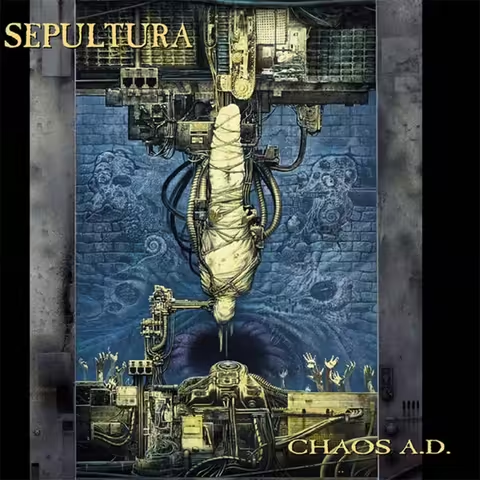
The cover of Chaos A.D. is a painting called Cacophony by the American fantasy and science-fiction artist Michael Whelan, completed in 1991. It shows a shrouded figure suspended upside-down above a many-armed machine, the figure's robes falling outwards and the machine's metal limbs reaching up. Whelan had not painted it for Sepultura; the band had seen a print and asked to license it. The result was a sleeve that looked nothing like the typical thrash cover of the period and quite consciously aligned the band with the more painterly tradition that ran through Iron Maiden, Rush and the heavier end of progressive rock. Inside the gatefold, the band photography was handled by Gary Monroe, whose portraits of the four members are framed with deliberate restraint.
The packaging treated Chaos A.D. as a serious cultural object. Lyrics were printed in full, with credits for Biafra and Seinfeld where appropriate, alongside political dedications and a brief band statement. The original CD ran twelve tracks at 47:04 and closed on Clenched Fist, a short, low, almost ambient outro that, on first pressings, ran into a hidden track at the end of the disc: a few minutes of laughter and studio chatter captured during the We Who Are Not as Others sessions. The hidden track was removed from later remasters, which is why it remains a quiet point of pride for owners of the original 1993 CD.
Release, charts and reception
Chaos A.D. was released in September 1993, with Roadrunner Records handling the worldwide rollout and Epic Records taking the North American distribution. The Epic deal, which was specific to this album, was Roadrunner's first major-label commercial partnership for Sepultura and was designed to push the band into the same retail and radio space as Pearl Jam, Rage Against the Machine and Soundgarden. Roadrunner spent close to a million US dollars on the marketing campaign, an unprecedented figure for the label at the time. The record's commercial geography was striking. It hit number 32 on the US Billboard 200, the highest position any Roadrunner album had ever reached, and number 11 on the UK Albums Chart.
Beyond those headline figures Chaos A.D. charted across most of Europe and the Pacific:
- Finland: number 4
- Portugal: number 6
- Germany: number 11
- Sweden: number 11
- New Zealand: number 15
- Switzerland: number 15
- Norway: number 16
- European Top 100: number 18
- Austria: number 19
- Netherlands: number 21
- Hungary: number 23
- Australia: number 27
- Scotland: number 84 (later re-entry)
Silver and Gold certifications followed quickly in Belgium, France and the UK. Total worldwide sales topped two million copies and have continued to accrue across reissues. The full certifications haul includes RIAA Gold (500,000 US shipments), UK BPI Gold (100,000), ARIA Gold in Australia (35,000), Pro-Musica Gold in Brazil (100,000), Gold in Indonesia (25,000) and NVPI Gold in the Netherlands (50,000).
Reviews were strong but not unanimous. AllMusic gave it 4.5 out of 5. Martin Popoff's Collector's Guide to Heavy Metal scored it a perfect 10. Entertainment Weekly went with a B-plus. Rolling Stone awarded 3.5 stars, Q magazine three, and NME six out of ten. The album won Best Album at the inaugural Kerrang! Awards in 1994. In the years that followed, the retrospective verdict moved upwards. Rolling Stone later placed Chaos A.D. at number 29 on its 100 Greatest Metal Albums list, NME placed it at 63 on its own equivalent, and Refuse/Resist landed at number 26 on VH1's 40 Greatest Metal Songs. Rolling Stone Brasil included Chaos A.D. and its successor Roots on its list of the hundred greatest Brazilian popular music records, a rare crossover for a metal band.
The Chaos A.D. tour and the World Cup night
The Chaos A.D. tour launched on 23 October 1993 with Paradise Lost opening. Sepultura toured almost without a break for the next eighteen months, working through Europe, North America, South America, Japan, Australia and a string of festival headline slots. The 1994 Monsters of Rock at Donington Park, where Sepultura played Kaiowas live in the daylight, was filmed for posterity. So was a substantial chunk of the supporting club and arena dates, eventually compiled and released as the 1995 VHS Third World Chaos, with linking interviews by Bruce Dickinson and backstage footage of Biohazard, the band's tour partners for much of 1994.
Two incidents from the tour became part of the album's folklore. The first was in Berlin, where local police acted on a false tip that the band's tour bus was loaded with cocaine. The search and seizure that followed enraged Max Cavalera so much that he rewrote the 1985 Bestial Devastation track Antichrist on the spot, retitled it Anti-Cop, and the band played the new version in the city that night. The second was on 17 July 1994 in Irvine, California, on a co-headline run with Pantera. The show fell a few hours after Brazil beat Italy on penalties in the 1994 FIFA World Cup Final, played in the nearby Rose Bowl in Pasadena. Sepultura took the stage draped in Brazilian flags, the audience a sea of South American green and yellow, and turned what had been billed as a Pantera home crowd into a celebration of the most distinctively non-American sporting victory of the year. In November 1994 Sepultura returned to Brazil for a five-city stadium tour with the Ramones, with the Brazilian thrash band Viper and the country-tinged hardcore act Raimundos opening. The same year, Sepultura contributed a cover of Black Sabbath's Symptom of the Universe to Bob Chiappardi's October 1994 tribute compilation Nativity in Black, cementing the band's standing in the wider rock canon.
Legacy and the birth of groove metal
The historian Ian Christe, in his 2003 book Sound of the Beast, credits Chaos A.D. and Pantera's Vulgar Display of Power with the birth of groove metal as a discrete subgenre, a music that descended from thrash but traded blast-beats for mid-tempo rhythmic weight. The argument has held up. Gojira's Joe Duplantier has named Chaos A.D. among his ten favourite metal records and credits it with what he calls the beginning of the entire nu-metal scene. Korn's Jonathan Davis has publicly thanked Sepultura for the influence on Korn's first three albums. Members of Slipknot, Lamb of God, Trivium and a wave of post-2000 metal bands have all cited it in interviews. In Brazil the album's openness to MPB and Afro-Brazilian rhythm gave a generation of local bands, including Overdose, Gangrena Gasosa and Angra, permission to fold their own national musical inheritance into a metal idiom that had previously read as wholly imported.
Within Sepultura's own catalogue Chaos A.D. set up Roots in 1996, the band's biggest and most polarising statement, and it remains for many fans, and for Max Cavalera himself in retrospect, the band's defining record. It was the album on which Sepultura stopped sounding like a Brazilian thrash band trying to keep pace with the Americans and started sounding like a Brazilian band whose music could only have come from where they came from. Three decades on, long after the Cavaleras left the lineup, Chaos A.D. is the record that almost every assessment of the band returns to first. The fifth Sepultura album was the one that justified everything that had preceded it and made everything that followed possible.
Personnel
- Max Cavalera: lead vocals, rhythm guitar, four-string guitar, nylon-string guitar
- Igor Cavalera: drums, percussion
- Paulo Jr.: bass, floor tom
- Andreas Kisser: lead guitar, 12-string viola, steel-string acoustic guitar
- Andy Wallace: producer, mixing
- Steve Remote: recording engineer
- Simon Dawson: assistant engineer
- Dave Somers: assistant engineer
- Alex Newport: guitar sound and feedback advisor
- George Marino: mastering
- Silvio Bibika: studio roadie
- Michael Whelan: cover artwork, painting titled Cacophony
- Gary Monroe: band photography
Tracklist
| # | Title | Length |
|---|---|---|
| 1 | Refuse/Resist | 3:20 |
| 2 | Territory | 4:47 |
| 3 | Slave New World | 2:55 |
| 4 | Amen | 4:27 |
| 5 | Kaiowas | 3:43 |
| 6 | Propaganda | 3:33 |
| 7 | Biotech Is Godzilla | 1:52 |
| 8 | Nomad | 4:59 |
| 9 | We Who Are Not as Others | 3:42 |
| 10 | Manifest | 4:49 |
| 11 | The Hunt | 3:59 |
| 12 | Clenched Fist | 4:58 |
Things you might not know
| Fact | Detail |
|---|---|
| The working title | The album was set to be called Propaganda after the sixth track until Max Cavalera changed it at the eleventh hour to Chaos A.D., a deliberate nod to the Misfits' 1983 record Earth A.D./Wolfsblood. |
| Castle session | Kaiowas was tracked entirely acoustic inside the roofless inner ward of medieval Chepstow Castle in Monmouthshire, a few miles down the River Wye from Rockfield Studios. |
| A heartbeat at track one | Refuse/Resist opens with the foetal heartbeat of Max Cavalera's then-unborn son Zyon, captured from an ultrasound scan and run to tape before Igor Cavalera's samba-reggae drum pattern enters. |
| Biafra's brief | Jello Biafra wrote the Biotech Is Godzilla lyric after attending the 1992 Earth Summit in Rio de Janeiro, refusing Max Cavalera's request for a sequel to the Dead Kennedys' Nazi Punks F Off. |
| Paulo Jr.'s first studio bass | Although Paulo Jr. had been Sepultura's live bassist since 1984, Chaos A.D. was the first studio album to feature his actual playing; Andreas Kisser had tracked bass on the three preceding records. |
| Only Epic album | Chaos A.D. is the only Sepultura studio album distributed in North America by Epic Records, part of a one-off Roadrunner deal designed to put the band into mainstream alternative-rock retail. |
| The Whelan painting | The cover image, Cacophony, is a 1991 painting by science-fiction illustrator Michael Whelan that Sepultura licensed after seeing a print; it was not commissioned for the album. |
| World Cup night in Irvine | Sepultura's 17 July 1994 co-headline show with Pantera in Irvine, California followed Brazil's penalty-shoot-out World Cup Final win over Italy in the nearby Rose Bowl by a matter of hours. |
| Berlin drug raid | A false tip-off to Berlin police, claiming the tour bus was loaded with cocaine, triggered a search and seizure that Max Cavalera answered by rewriting the 1985 song Antichrist as Anti-Cop and playing it in the city that night. |
| Kerrang! Best Album 1994 | Chaos A.D. won Best Album at the first Kerrang! Awards in 1994, beating a field that included most of the heavyweight rock and metal releases of the same year. |
How to listen now
Chaos A.D. is available on every major streaming platform under Roadrunner Records and remains in print on CD, with the 2017 remaster the most widely circulated digital edition. Original 1993 CD pressings are the ones to seek out for the hidden track of laughter and chatter at the end of Clenched Fist, which was dropped from later masters. Roadrunner reissued the album on heavyweight black and on a series of coloured vinyl variants through the mid-2010s and 2020s, and a 25th anniversary expanded edition added the Rockfield covers, B-sides and a handful of live tracks. For a live experience of the songs, Refuse/Resist, Territory and Kaiowas have remained core staples of Sepultura's setlists throughout their later career.
Comments