Robert John "Mutt" Lange walked into Battery Studios in March 1981 with two of the most lucrative rock records of the previous eighteen months already on his CV. Highway to Hell had pushed AC/DC to platinum in November 1979. Back in Black, recorded after Bon Scott's death, was on its way to becoming one of the best-selling albums in history. Waiting for him at Battery were five Sheffield lads, all under twenty-three, whose first album had been a critical and commercial belly-flop, who had been written off in the British music press as NWOBHM sell-outs, and who knew with cold certainty that this was their last realistic shot. Def Leppard had not chosen Lange because he was fashionable. They had chosen him because he had just done it twice in a row for a band that nobody, including Lange himself, expected to survive its lead singer.
What came out of Battery between March and June 1981 was High 'n' Dry, the album that ended one Def Leppard and began another. It is the connoisseur's choice in the catalogue, the rowdiest record they ever made, the last one with the original five-piece, and the first one that sounds like the band the world ended up knowing. Almost everything that Pyromania and Hysteria would later refine in chrome is already audible here in matt black: the stacked vocal harmonies, the gated drum sound, the radio-shaped choruses, the producer's obsessive demand for one more take. The difference is that on High 'n' Dry the band still rocks like a Sheffield club band, because in the spring of 1981 that is still what they are.
| Field | Detail |
|---|---|
| Artist | Def Leppard |
| Album | High 'n' Dry |
| Release date | 6 July 1981 |
| Label | Vertigo (UK), Mercury (US) |
| Producer | Robert John "Mutt" Lange |
| Studio | Battery Studios, London (with additional work at Morgan Sound) |
| Genre | Hard rock, heavy metal, NWOBHM |
| Track count | 10 (original LP); 12 (1984 reissue with bonus remixes) |
| Total runtime | 42:15 |
| Billboard 200 peak | No. 38 (1981); re-entered to No. 72 in 1983 |
| UK Albums Chart peak | No. 26 |
| Other notable peaks | Sweden No. 31 |
| Certifications | 2x Platinum US (RIAA); Platinum Canada (Music Canada) |
| Estimated sales | Over 2 million worldwide |
| Key singles | "Let It Go" (1981), "Bringin' On the Heartbreak" (1981; 1984 remix) |
Cultural Context
The summer of 1981 was the most important season for hard rock in a generation, and the band had unknowingly walked into a release window that would define the rest of the decade. 4 by Foreigner came out the same month. So did Escape by Journey, Bella Donna by Stevie Nicks, Precious Time by Pat Benatar, El Loco by ZZ Top and Pleasant Dreams by The Ramones. Earlier in the year Van Halen had released Fair Warning. Iron Maiden, Def Leppard's NWOBHM stablemates, had put out Killers in February. Motörhead had set the live-album bar with No Sleep 'til Hammersmith in June.
And on 1 August 1981, four weeks after High 'n' Dry hit the shops, a new American cable channel launched with a Buggles video. MTV was not yet on most cable systems and was barely a rumour in the UK, but within twelve months it would be the single most important promotional weapon any new rock band possessed. Def Leppard, more by accident than design, had just made an album with a producer who specialised in stadium-shaped melodies and would shortly hand MTV a brand-new power ballad with a usable live video already in the can. None of the other British rock bands releasing records in 1981 were anywhere near as ready for what was coming.
Beyond the charts the year was loud in other ways. Ronald Reagan was shot on 30 March, six days before the band started tracking. The wedding of Charles and Diana drew an estimated 750 million viewers worldwide on 29 July. Bobby Sands died on hunger strike in May. The Specials' "Ghost Town" sat at number one in the UK as Toxteth, Brixton and Moss Side burned. High 'n' Dry is not, by any stretch, a political record, but its title track and the swagger of its first three songs read in retrospect like a deliberate refusal of all of it. Saturday night was a fantasy worth selling.
The Band's Story Up to This Point
Def Leppard had been gigging the South Yorkshire working men's club circuit since 1977, when bassist Rick Savage and guitarist Pete Willis pulled in a school friend called Tony Kenning to drum and recruited eighteen-year-old Joe Elliott on vocals after Elliott missed a bus into town and walked past a rehearsal in a Sheffield spoon factory. Second guitarist Steve Clark joined in January 1978 after auditioning by playing the whole of Lynyrd Skynyrd's "Freebird" from memory. Fifteen-year-old Rick Allen replaced a sequence of drummers in November 1978. They self-financed and self-released the three-track Getcha Rocks Off EP on their own Bludgeon Riffola label in January 1979, sent it to Geoff Barton at Sounds, and within months were being held up by the British music press as the boyish poster band for what Barton's colleague Alan Lewis was christening the New Wave of British Heavy Metal.
The hype curdled fast. The debut album On Through the Night, produced by Judas Priest's Tom Allom and released in March 1980, sounded thin compared to the band's live shows. The lead-off single "Hello America" was read in the UK as a naked play for the lucrative US market and the band were booed off the stage at the Reading Festival that summer with bottles of urine thrown at them. The album limped to number fifteen in the UK and stalled at fifty-one in the US. Manager Peter Mensch, who had brought the band to AC/DC's Atlantic agency Leber-Krebs, made a cold-blooded call: the next record had to sound American, had to sound expensive, and had to be produced by the man who had just delivered Highway to Hell.
Lange, by all accounts, took the meeting partly because he liked the demos and partly because he liked the band. By March 1981 he was at Battery, the original five-piece was intact and broke and hungry, and the British music press was already sharpening knives for whatever was coming next. The teenagers from Sheffield had one record to either prove they belonged or quietly disappear.
Pre-production and Demos
Several songs that ended up on High 'n' Dry were road-tested long before Lange got near them. "Lady Strange" had been part of the live set on the On Through the Night tour. So had "Let It Go" and an embryonic "Mirror, Mirror". Other tracks were written from scratch during pre-production with Lange in late 1980 and early 1981, with Steve Clark and Pete Willis trading riffs in their flats and Joe Elliott working up vocal lines on a cassette four-track.
The non-album track "Me & My Wine", later resurrected and remixed as the B-side to the 1984 "Bringin' On the Heartbreak" reissue single, dates from these sessions and is effectively a High 'n' Dry-era song that did not make the cut. Likewise the original 1981 B-side configurations of the singles, including the use of "You Got Me Runnin'" as a B-side to the US "Bringin' On the Heartbreak" 7-inch, hint at how tightly the band were running the album once Lange had finished triaging.
Lange's pre-production approach, even at this early stage of his rock career, was the one he would later apply with industrial discipline to Pyromania and Hysteria: deconstruct every song to a single workable hook, rebuild the arrangement around that hook, then layer vocal harmonies until the chorus felt twice as wide as the verse. The Sheffield lads, used to writing on the hoof in pub backrooms, had never been put through anything like it.
Creating the Album
Recording began in March 1981 at Battery Studios in Willesden, north-west London, the facility Lange had effectively colonised after his AC/DC sessions. Some additional tracking was done at Morgan Sound in Willesden, a stone's throw away, although Battery was the centre of gravity for the project. The sessions ran for roughly four months, wrapping in June. Mike Shipley, an Australian engineer with Queen and The Cars on his CV, sat behind the desk. The assistant engineer was a young Nigel Green, who would go on to become one of Lange's regular collaborators through the rest of the decade. The studio was running 24-track analogue tape into either a Neve or SSL desk depending on which room was free.
Lange's working method shocked the band. Vocal sessions for "Bringin' On the Heartbreak" stretched across days. Joe Elliott has spoken in multiple interviews about being asked to sing single words over and over until Lange was satisfied with the consonant, never mind the phrasing. The famous Lange vocal stack, in which a single chorus line might be tracked twelve or fifteen times across the band and then comped into the illusion of one impossibly wide unison, was already in evidence here in a less obsessive form than it would take by Hysteria. Steve Clark and Pete Willis were drilled equally hard on their guitar parts, with Lange insisting on doubles, triples and quadrupling of rhythm guitars to thicken the bed.
"We were open-minded and so happy to be working with a producer like Mutt Lange. He was like a teacher and we wanted to learn from him. He was this rock guru and we were prepared to get in the pit with him and wrestle it out."
Joe Elliott, Classic Rock, 2020
The discipline came at a personal cost. Pete Willis, by every later account from the band, was already drinking heavily during the Battery sessions. He played all of his parts and is credited on every track, but the relationship between Willis and the rest of the band frayed visibly. A little over a year later, on 11 July 1982, midway through the Pyromania sessions in Dublin, Willis would be fired for showing up to the studio drunk and unable to track. The seeds of that decision were planted in the back rooms of Battery.
The budget, while never as ruinous as the £4.5 million Lange and the band would later spend on Hysteria, was a significant step up from the debut. Phonogram had backed Mensch's argument that this was the band's last realistic shot at the American market, and Lange's day rate alone was eye-watering by the standards of a NWOBHM band on its second album.
- Battery Studios, Willesden, London (primary)
- Additional tracking and overdubs at Morgan Sound, also Willesden
- 24-track analogue tape
- Neve and SSL consoles
- Lange-trademark stacked backing vocals tracked across all five band members
- Rhythm guitar parts double- or triple-tracked through Marshall stacks for thickness
Personnel and Credits
| Role | Player | Notes |
|---|---|---|
| Core band | ||
| Lead vocals | Joe Elliott | All tracks |
| Guitar, backing vocals | Pete Willis | Rhythm and lead; last full studio album as a band member |
| Guitar, backing vocals | Steve Clark | Rhythm and lead; sole writer of the instrumental "Switch 625" |
| Bass, backing vocals | Rick Savage | All tracks |
| Drums, backing vocals | Rick Allen | All tracks; eighteen years old at the time of release |
| Production and engineering | ||
| Producer | Robert John "Mutt" Lange | Also produced the 1984 remix overdubs |
| Engineer | Mike Shipley | Previously worked with Queen and The Cars |
| Assistant engineer | Nigel Green | Long-term Lange collaborator through the 1980s |
| Artwork | ||
| Cover design | Hipgnosis | The Storm Thorgerson and Aubrey Powell studio responsible for sleeves by Pink Floyd, Led Zeppelin, Peter Gabriel and Genesis |
What is striking about the credits is how little there is to add. There are no guest musicians, no string sections, no session keyboard player smuggled in by the producer, no uncredited Lange backing vocals (he would later sing extensively on Hysteria). The Lange of 1981 was still primarily a translator of what the band already played, not yet the architect of what they could be made to play. The album is, by the standards of his later work, almost shockingly a band recording.
The Songs
| # | Title | Writer(s) | Length | Single? | Notes |
|---|---|---|---|---|---|
| 1 | Let It Go | Willis, Clark, Elliott | 4:43 | UK A-side, Aug 1981 | Opening track; live favourite from the previous tour |
| 2 | Another Hit and Run | Savage, Elliott | 4:59 | No | Twin-guitar duel between Clark (first solo) and Willis (second) |
| 3 | High 'n' Dry (Saturday Night) | Clark, Savage, Elliott | 3:27 | No | Ranked No. 33 on VH1's 40 Greatest Metal Songs |
| 4 | Bringin' On the Heartbreak | Clark, Willis, Elliott | 4:34 | US A-side, Nov 1981; remix A-side Jun 1984 | Closes original side one with "Switch 625"; first MTV-era Def Leppard video |
| 5 | Switch 625 | Clark | 3:03 | No | Steve Clark's solo composition; instrumental fusion-influenced workout |
| 6 | You Got Me Runnin' | Willis, Clark, Elliott | 4:23 | B-side of "Bringin' On the Heartbreak" US 7-inch | Willis lead solo |
| 7 | Lady Strange | Willis, Clark, Allen, Elliott | 4:39 | No | Rare writing credit for Rick Allen |
| 8 | On Through the Night | Clark, Savage, Elliott | 5:06 | No | Shares title with the previous album; no relation in lyric |
| 9 | Mirror, Mirror (Look into My Eyes) | Clark, Elliott | 4:08 | No | Lange's trademark stacked backing vocals at their early peak |
| 10 | No No No | Savage, Willis, Elliott | 3:13 | No | The original vinyl run-out groove loops the final "no" infinitely |
The album opens with a one-two punch that announces the new band immediately. "Let It Go" rides a Willis riff that owes a debt to the chugging open-A bedrock of Highway to Hell, but Elliott's vocal sits in front of three other voices stacked behind him in classic Lange formation. "Another Hit and Run" runs a slow-burn intro into one of Clark and Willis's best twin-lead workouts, an arrangement that nods unmistakably to Thin Lizzy. The title track, "High 'n' Dry (Saturday Night)", is the album's drunken-singalong centrepiece and the closest the band ever came on record to writing their own "Whole Lotta Rosie".
The fourth and fifth tracks together form the most consequential six minutes of music Def Leppard had recorded to that point. "Bringin' On the Heartbreak" is the prototype of every power ballad they would later be famous for: clean-tone intro, slow tempo, Elliott reaching for the top of his range, Clark's lead break aching over the bridge. Then, with no pause, the song segues straight into Clark's instrumental "Switch 625", a three-minute fusion-tinged guitar showcase that locks into a galloping middle section with echoes of Allan Holdsworth and Pat Travers. On the original vinyl this sequence closes side one. Forty-five years later, almost every album-of-the-week round-up of High 'n' Dry singles it out as the moment the band became Def Leppard.
"This album contained the power ballad 'Bringin' On the Heartbreak' and the instrumental 'Switch 625', examples of their signature sound style prevalent in their next album Pyromania."
Wikipedia, citing AllMusic's Steve Huey
Side two is the side most fans argue over. "You Got Me Runnin'" is a workmanlike opener; "Lady Strange" is a survival from the live set with a guitar frenzy in its middle eight that has aged better than almost anything else here; "On Through the Night" recycles the title of the debut album without any apparent irony; "Mirror, Mirror (Look into My Eyes)" is the album's most Lange-fingerprinted song, a stacked vocal layer-cake that prefigures "Photograph" two years later; and "No No No" closes the record with a chant that, on original vinyl pressings, loops infinitely until the listener gets up to lift the needle.
B-sides, Outtakes and Lost Songs
"Me & My Wine" is the most important survivor of the sessions that did not make the LP. Written by Savage, Clark and Elliott, it was used as a B-side to early pressings of the singles and then resurrected, remixed, and added to the 1984 reissue of the album in a synth-overdubbed form that broadly matches the contemporary Pyromania production. The 1984 remix was also paired with a separately filmed David Mallet music video that gave Phil Collen, who had not been within a hundred miles of the original session, his on-screen credit on a High 'n' Dry song. Both versions still circulate.
The B-side configurations of the original 7-inch singles repurposed album tracks: "You Got Me Runnin'" sat on the back of the US "Bringin' On the Heartbreak" single, while UK pressings used "Me & My Wine" and live material. Unlike later Def Leppard releases there is no documented stack of unreleased session material from High 'n' Dry in circulation, although bootlegs of the band's pre-album live shows from 1979-1981 occasionally surface and capture earlier, rawer versions of "Lady Strange" and "Let It Go" before Lange got hold of them.
Album Artwork and Packaging
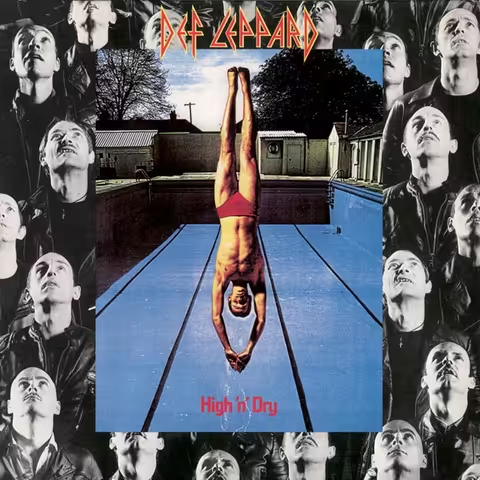
The sleeve was designed by Hipgnosis, the Storm Thorgerson and Aubrey Powell partnership responsible for the most photographed album covers of the 1970s: Pink Floyd's The Dark Side of the Moon and Wish You Were Here, Led Zeppelin's Houses of the Holy and Presence, Peter Gabriel's first three solo records, Genesis's The Lamb Lies Down on Broadway. Hiring Hipgnosis for a NWOBHM second album was a statement of intent. The cover image, a lone diver poised at the end of a board above a drained swimming pool, is a wordless visual pun on the album title. The back cover, in contrast, is a defiantly working-class group photograph of the five band members.
The 1984 reissue used new artwork built around the "Bringin' On the Heartbreak" theme to flag the package as different from the original 1981 LP, with sleeve copy emphasising the new bonus tracks. Several territories produced their own variations: in Mexico the lead single was released as "Llevarlo en la Desilusión", credited with the Spanish-language title "Yo y mi Vino" for the B-side and dressed in the cover art of "Too Late for Love" from Pyromania, an early piece of cross-promotion that took advantage of the band's late-1983 breakthrough.
Release and Reception
The album was released on Vertigo in the UK on 6 July 1981 and on Mercury in the US shortly afterwards. The UK rock press, having decided the band were transatlantic sell-outs eighteen months earlier, was largely unmoved. Sounds and Kerrang! gave it lukewarm reviews. NME, the inkie that had cheered the EP, ignored it. In commercial terms, the immediate impact was modest. The album peaked at number 26 in the UK and number 38 on the Billboard 200, an improvement on the debut but not a breakthrough.
What happened next was unprecedented for a NWOBHM band. The "Bringin' On the Heartbreak" video, originally filmed by Doug Smith as a live performance at the Royal Court Theatre in Liverpool on 22 July 1981 as part of an episode of Don Kirshner's Rock Concert for US network ABC, was picked up by the newly launched MTV and put into heavy rotation through the back end of 1981 and into 1982. The album re-entered the US chart in 1983 on the back of Pyromania's commercial explosion and climbed to number 72. By the mid-1980s it had been certified double platinum by the RIAA. AllMusic's Steve Huey, looking back, summed up its place in the discography concisely.
"Def Leppard's second album continues in the vein of the anthemic, working-class hard rock of their debut. While still opting for a controlled musical attack and melodies as big-sounding and stadium-ready as possible, the band opens up its arrangements a bit more on High 'n' Dry, letting the songs breathe and groove while the rhythm section and guitar riffs play off one another."
Steve Huey, AllMusic
The 461-voter Album of the Week Club retrospective in Classic Rock in 2020 awarded the record 8.5/10 and called it "the connoisseur's choice, a hard rock tour-de-force that fast-tracked them out of the NWOBHM ghetto". Sputnikmusic, in a 3.5/5 review, noted that "Def Leppard is clearly a more confident outfit here". Joe Elliott, when asked about the record nearly four decades on, was characteristically blunt.
"When you look back at it now, there are bits of it that hit and bits of it that missed. But generally speaking, as the second album, it was the start of where we were going to go."
Joe Elliott, Classic Rock, 2020
Singles and Music Videos
| Single | Release | B-side(s) | Chart peaks | Video |
|---|---|---|---|---|
| "Let It Go" | 14 August 1981 (UK) | "Wasted" (live) | Did not chart | Live performance, Royal Court Theatre Liverpool, 22 July 1981, dir. Doug Smith |
| "Bringin' On the Heartbreak" | 13 November 1981 (US); 22 January 1982 (UK) | "Me and My Wine"; "You Got Me Runnin'" (US 7") | Did not chart on original release | Live performance, Royal Court Theatre Liverpool, 22 July 1981, dir. Doug Smith; filmed for ABC's Don Kirshner's Rock Concert |
| "Bringin' On the Heartbreak" (1984 remix) | June 1984 | "Me & My Wine" (remix) | US Billboard Hot 100 No. 61 | New video shot February 1984 at Jacob's Biscuit Factory, Dublin, dir. David Mallet, featuring Phil Collen on rhythm guitar |
The first "Bringin' On the Heartbreak" video is one of the most consequential pieces of footage in early-1980s rock television. It was a low-budget multi-camera shoot of the band playing three songs live in front of a Liverpool theatre audience, intended for an American syndicated TV slot that by the autumn of 1981 was already being eclipsed by MTV. When the channel needed long-form rock content to fill its 24-hour schedule, the Doug Smith clip was one of the few hard-rock performance videos in circulation, and it landed in regular rotation almost by default. The band have estimated that the resulting US sales pulse turned a slow-selling album into a platinum one.
The 1984 remix is a separate beast. By the time Lange added synth and piano overdubs in February 1984, Def Leppard had become global stars on the back of Pyromania, and Mercury wanted a way to push their back catalogue at the new audience. David Mallet, who had directed Bowie's "Ashes to Ashes" and Queen's "Radio Ga Ga", shot the new video at Jacob's Biscuit Factory in Dublin. Phil Collen, who had replaced Pete Willis eighteen months earlier and had played on none of the original recording, mimed the rhythm guitar part. Both videos eventually appeared on the band's Historia compilation, although later DVD editions quietly swapped the remix audio back to the original 1981 mix on the second video, because by the late 1990s the consensus among Def Leppard fans was that Lange's synth overdubs had aged badly.
Touring and Live
The High 'n' Dry world tour ran from late summer 1981 into the summer of 1982, opening for Blackfoot, then Ozzy Osbourne, then Rainbow in the US. The band's profile in America rose steadily through the tour cycle as MTV traffic to "Bringin' On the Heartbreak" compounded. They returned to the UK to headline their own theatre tour in early 1982 to a far warmer welcome than On Through the Night had received. The original five-piece played their last show together on 11 February 1982 in Memphis.
The album's songs went on to long live afterlives. "Bringin' On the Heartbreak" and its segued partner "Switch 625" remained set staples for the next four decades, almost always played as a pair. "Let It Go", "Another Hit and Run" and the title track resurface in nostalgia-themed Def Leppard tours, particularly the 2017 European run during which the band played a stretch of High 'n' Dry material in tribute to the original five-piece. The album was never performed front-to-back in a curated tour the way Hysteria later was (at the 2013 Las Vegas residency Viva! Hysteria), but it has been the source of more deep-cut live revivals than any other Def Leppard record except Pyromania.
- 1981 UK theatre dates supporting the album's July release
- Late 1981 to early 1982: US arena support slots for Blackfoot, Ozzy Osbourne and Rainbow
- Early 1982: first UK headline theatre tour
- 11 February 1982, Memphis: final show of the original five-piece
- 22 July 1981, Royal Court Theatre Liverpool: source footage for both "Let It Go" and "Bringin' On the Heartbreak" videos
In TV, Film and Media
The instrumental "Switch 625" found a second life in the late 2010s thanks to its inclusion in Cobra Kai, the Netflix continuation of the Karate Kid franchise, used to score a training montage in a way that introduced the track to an audience that had never heard the original LP. "Bringin' On the Heartbreak" has appeared in multiple period dramas set in the early 1980s and is a fixture on US classic-rock radio. The Mariah Carey cover, discussed below, brought the song into a parallel R&B-radio universe that the original 1981 single never touched.
Covers, Samples and Tributes
The most famous cover of a High 'n' Dry song is Mariah Carey's 2002 version of "Bringin' On the Heartbreak", released on her Charmbracelet album and as that record's third single on 2 June 2003. Carey co-produced the track with Randy Jackson and recruited Jane's Addiction guitarist Dave Navarro to perform a newly written solo and additional guitar overdubs. The single peaked at number 5 on the US Billboard Hot Dance Club Songs chart (in remixed form) and number 28 in Switzerland. It missed the Billboard Hot 100 but charted into the top 30 on the US Adult Contemporary chart. Both Joe Elliott and Phil Collen made a point of publicly endorsing the cover.
"The fans really get it wrong sometimes. She's on our side and it's an honour she's done it. Really, that's the only way we're getting played."
Phil Collen on the Mariah Carey cover, Mariah Daily, 2003
Elsewhere in the cover landscape, "Switch 625" has been a guitar-school staple for the better part of forty years and is one of the most-played Steve Clark compositions in YouTube guitar-cover culture. The original 1981 "Bringin' On the Heartbreak" was placed at number 174 on Rolling Stone's 2014 list of the 100 Best Singles of 1984, on the strength of the remix push, a slightly contorted piece of magazine history given that the song itself is a 1981 recording.
Reissues, Remasters and Anniversaries
The album has had a more complicated reissue history than any of its peers. The 31 May 1984 reissue added the "Bringin' On the Heartbreak" remix and the "Me & My Wine" remix as bonus tracks, sequenced into the running order rather than appended (on vinyl the new "Me & My Wine" closes side one, while the remix of "Bringin' On the Heartbreak" opens side two). The bonus tracks were quietly removed from mid-1990s US CD reissues during a contractual dispute between the band and Mercury, although European pressings retained them. When the band and Mercury came to new terms in 2018, the album returned to streaming and download platforms in its full twelve-track 1984 configuration.
A digital remaster was rolled out across streaming services in 2018 alongside the rest of the catalogue. A further remastered CD and vinyl edition was released on 20 March 2020 through UMC/Mercury. The album was included in 2018's box set The Early Years 79-81, alongside the debut, the EP, B-sides, BBC sessions and demos. No full-length deluxe-edition treatment with session outtakes has ever been issued.
Legacy and Influence
The straight-line legacy is obvious. High 'n' Dry is the bridge between the NWOBHM debut and the global juggernaut of Pyromania two years later. Without the commercial proof-of-concept that the Lange-produced "Bringin' On the Heartbreak" video provided on MTV in 1981-82, it is unlikely that Phonogram would have backed the multi-year, multi-million-dollar Pyromania sessions that followed. Phil Collen, in subsequent interviews, has gone further: he has described the hiring of Lange as the moment Def Leppard stopped being a Sheffield club band and became, for better and for worse, a record-label band.
The indirect legacy is much larger. The arena rock that dominated American radio between 1983 and 1989, the Mötley Crüe of Shout at the Devil, the Bon Jovi of Slippery When Wet, the Whitesnake of the 1987 self-titled album, the Poison and Ratt and Cinderella records that ate MTV in the mid-1980s, all owe a measurable production debt to what Lange and Def Leppard worked out at Battery in 1981. The stacked vocal-harmony technique, the gated drums, the lacquered rhythm guitar bed, the slow-tempo ballad as commercial pivot point: all of it is here, in less polished form, on High 'n' Dry. By the time everyone else had worked out how to do it, Def Leppard had already moved on twice.
For the original five-piece, the legacy is bittersweet. Steve Clark, the architect of "Switch 625" and the writing centre of gravity on most of the album, died on 8 January 1991 of an accidental overdose of prescription drugs and alcohol. Pete Willis, fired in 1982, has lived a largely private life ever since and has declined almost all interviews about the band's commercial era. Rick Allen lost his left arm in a road accident on 31 December 1984. The Joe Elliott / Rick Savage / Rick Allen line that runs continuously through every Def Leppard album since 1980 traces back, on the studio record, to High 'n' Dry. Everything else changed.
Things You Might Not Know
| Fact | Detail |
|---|---|
| Lange's CV at hiring | When Mutt Lange started work on High 'n' Dry in March 1981 he had just produced Highway to Hell (1979) and Back in Black (1980) for AC/DC; the band's manager Peter Mensch shared the same management roster. |
| The infinite "no" | The original 1981 vinyl pressing of "No No No" loops the final "no" infinitely on the run-out groove; the original cassette screams "no" forty-six times before cutting off when the tape runs out. |
| Eighteen-year-old drummer | Rick Allen turned eighteen the year High 'n' Dry was released; he had joined the band as a fifteen-year-old in November 1978. |
| Steve Clark's solo writing credit | "Switch 625" is the only Def Leppard track ever credited solely to Steve Clark; he wrote, arranged and played both lead and rhythm guitar on the instrumental. |
| The Hipgnosis pedigree | The sleeve was designed by the same studio that had done The Dark Side of the Moon, Wish You Were Here, Houses of the Holy and the first three Peter Gabriel solo albums; it was their last full project before founder Storm Thorgerson and Aubrey Powell dissolved the partnership in 1983. |
| The 22 July 1981 video shoot | The first "Bringin' On the Heartbreak" video and the "Let It Go" video were both filmed on the same night at the Royal Court Theatre in Liverpool for an episode of ABC's Don Kirshner's Rock Concert; MTV repurposed both clips within weeks of the channel's launch. |
| Mexican territory single | "Bringin' On the Heartbreak" was released in Mexico under the title "Llevarlo en la Desilusión", with "Me and My Wine" translated as "Yo y mi Vino" and the sleeve borrowed from the 1983 "Too Late for Love" single. |
| Pete Willis's last full studio record | High 'n' Dry is the only Def Leppard album where Pete Willis is credited on every track as a full band member; he was fired on 11 July 1982 in Dublin during the early Pyromania sessions and replaced by Phil Collen. |
| The 1984 video Phil Collen on a song he never played on | The David Mallet-directed 1984 video for the remixed "Bringin' On the Heartbreak" features Phil Collen miming Pete Willis's rhythm part, although Collen had not joined the band when the original 1981 recording was made. |
| Mariah Carey covers Sheffield | Mariah Carey covered "Bringin' On the Heartbreak" on Charmbracelet in 2002; her version reached number 5 on the US Hot Dance Club Songs chart in remixed form and featured Dave Navarro on guitar. |
| VH1 list placement | "High 'n' Dry (Saturday Night)" was ranked number 33 on VH1's 40 Greatest Metal Songs poll; Mariah Carey's "Bringin' On the Heartbreak" was simultaneously ranked number 24 on VH1's "Least Metal Moments", subtitled "Bringin' On the Headache". |
| 123 weeks on the Billboard 200 | High 'n' Dry spent 123 weeks on the US Billboard 200 across its 1981 release and its 1983 post-Pyromania re-entry, an exceptionally long run for a NWOBHM-era hard rock album. |
Listen on the Riffology Podcast
Def Leppard's full catalogue, the original Sheffield five-piece, the Mutt Lange working method and the long shadow High 'n' Dry casts over everything from Bon Jovi to Mariah Carey are recurring threads on the Riffology podcast. The show is available on Apple Podcasts, Spotify, Amazon Music and every major podcast app. Pull up an episode the next time you put the record on; it pairs well with side one in particular.
Comments