Skid Row signed away the publishing on their 1989 self-titled debut to a company owned by Jon Bon Jovi and Richie Sambora, then watched the same album sell five million copies in the United States while a sizeable share of those royalty cheques landed in someone else's office.
It is a small, ugly fact tucked into the foundations of one of the loudest, biggest, most photogenic debut albums of the late-eighties hair metal boom, and it shapes everything that comes next. The Sayreville handshake between Dave Sabo and Jon Bon Jovi, the wedding gig audition that delivered Sebastian Bach, the Atlantic chequebook and Michael Wagener's studio at the back of a Wisconsin hotel, the Aerosmith tour and the bottle thrown at Bach's head, the rift that festered for decades and the reunion that has still never happened: all of it sits on top of that signature on a publishing contract the band did not fully understand when they signed it.
Album Facts
Before the storytelling starts, here is the record itself, in numbers.
| Field | Detail |
|---|---|
| Artist | Skid Row |
| Album | Skid Row |
| Release Date | 24 January 1989 |
| Label | Atlantic Records |
| Producer | Michael Wagener |
| Studio | Royal Recorders, Lake Geneva, Wisconsin (recorded 1988) |
| Genre / Subgenre | Glam metal, hard rock, heavy metal |
| Track Count | 11 |
| Total Runtime | 39:28 |
| Billboard 200 Peak | No. 6 |
| UK Albums Chart Peak | No. 30 |
| Other Notable Chart Peaks | No. 1 New Zealand, No. 5 Finland, No. 11 Canada, No. 12 Australia, No. 16 Italy, No. 22 Germany, No. 26 Switzerland, No. 35 Japan |
| Certifications | 5x platinum (US, RIAA, 1995); 3x platinum (Canada); platinum (Australia, Japan, New Zealand); gold (UK, Finland) |
| Estimated Sales | Over 5 million in the US; reports of more than 7 million worldwide |
| Key Singles | "Youth Gone Wild", "18 and Life", "I Remember You", "Piece of Me" |
Cultural Context: January 1989 on the Sunset Strip and Beyond
By the time Atlantic pressed the first 150,000 copies of Skid Row in late 1988, the glam metal economy had been running at full speed for the best part of four years and was already showing hairline cracks. Mötley Crüe's Girls, Girls, Girls, Bon Jovi's Slippery When Wet, Whitesnake's self-titled album, Guns N' Roses' Appetite for Destruction, Def Leppard's Hysteria and Poison's Open Up and Say... Ahh! had all sold in the multiple millions. MTV was a giant teeth-bared mouth that needed a new pretty band with big choruses and bigger hair every couple of weeks, and the major-label A&R offices were happy to oblige.
Skid Row arrived four days before Bon Jovi's New Jersey finished its run at the top of the Billboard 200 and three months before Appetite for Destruction's final ascent to number one. They were positioned by Doc McGhee, by Atlantic and by Bon Jovi themselves as the next New Jersey hard-rock export. What none of them could yet see was that the same year was producing a second wave of records that would knock the entire scene off its perch within three years: Soundgarden's Ultramega OK was four months old and Nirvana's Bleach would land that June. Skid Row's debut is one of the last great commercial wins for unironic hair metal, and on some level it knows it.
Their immediate peers tell the same story. Bon Jovi's New Jersey, Mötley Crüe's Dr. Feelgood, Warrant's Dirty Rotten Filthy Stinking Rich, Great White's ...Twice Shy and Aerosmith's Pump were all in the air. Skid Row sat slightly to the side of the Sunset Strip pack, partly because they were from Toms River, New Jersey rather than from a Hollywood squat, and partly because, as Sputnikmusic's Dave Donnelly put it, they had a charismatic frontman who let them be remembered as much for ballads as for sleaze.
The Band's Story Up to This Point
Dave "The Snake" Sabo grew up in Sayreville, New Jersey, in the same orbit as a young John Francis Bongiovi Jr. They were teenage friends and would-be guitarists, and Sabo briefly held a place in the earliest incarnation of Bon Jovi before being replaced by Richie Sambora. The two struck a handshake deal, the kind of thing that is normally promptly forgotten: whoever made it first would haul the other one up.
Sabo met bassist Rachel Bolan in a Toms River guitar store in 1986. They started rehearsing in Bolan's parents' garage and pulled in second guitarist Scotti Hill from a previous club band of Bolan's and drummer Rob Affuso, who was playing in a Rush tribute band. The lineup gigged hard up and down the East Coast with original singer Matt Fallon. By the time they opened for Bon Jovi on the 1987 Slippery When Wet tour, Doc McGhee had taken notice and quietly told the band that Fallon was the weak link.
The Bach audition is the moment the band's mythology really begins. The parents of Jon Bon Jovi watched a 6'4" Canadian teenager named Sebastian Bierk sing at rock photographer Mark Weiss's wedding in 1987. They tipped off the band. Bach, then 18 and still on a Canadian passport, was flown down to New Jersey, sang for the others and was in early that year. Bolan has since revealed that future Mötley Crüe and Hookers and Blow singer John Corabi also auditioned around the same period and would presumably have given the album a very different colour.
With the lineup locked, the band did the thing every East Coast hard rock act in 1987 desperately wanted to do: they signed with Bon Jovi's management. As part of the price, they signed publishing to Underground, the company Jon Bon Jovi and Richie Sambora controlled, ceding what Sebastian Bach has since described as the lion's share of the group's songwriting royalties. Sambora eventually returned his share; Bon Jovi did not, and that fact would later poison the relationship between Bach and his former neighbour for the rest of his life.
Doc McGhee then ran a label auction. Geffen and A&M both circled. Skid Row finally signed with Atlantic Records, brought in personally by company founder Ahmet Ertegun, with Jason Flom and Dorothy Sicignano handling A&R. Before any of that money could come back to them, they paid Gary Moore a reported $35,000 for the rights to the name his late-1960s Irish blues-rock outfit had used first.
Pre-production and Demos
By the time Skid Row arrived at the studio in 1988, the album was effectively already finished in their fingertips. The band had been playing these songs for the best part of a year in clubs and on the Bon Jovi support slot. Sabo and Bolan wrote almost the entire record together, with one foot in CBGB-style punk attitude and the other in the kind of widescreen melodic chorus that worked in arenas.
The two songs with the strangest pre-history are the album's biggest hit and its weirdest closer. "18 and Life", which would become the lead-off ballad single, had been written before Skid Row had a name. Sabo has told the story repeatedly: he saw a small newspaper item about an 18-year-old boy who, drunk and showing off, had picked up a gun, fired at a friend believing it to be unloaded and ended up sentenced to life. He took the headline home, sketched out the chorus and finished the song with Bolan. The demo, in various accounts, was pitched around New York and ignored before it sat on the band's own shelves long enough to become their breakthrough.
The album's closing piece, listed as "Midnight / Tornado", carries a co-writer credit for Matt Fallon, the original singer who never made it onto the record. It is the most obvious surviving fingerprint of the pre-Bach band, and a useful reminder that the version of Skid Row that Atlantic signed had been working long before its most famous voice arrived. "Big Guns" carries a four-way writing credit for Sabo, Bolan, Hill and Affuso, suggesting it came together in the rehearsal room rather than in a writing session. "Makin' a Mess" is the only song on the record that gives Bach a credit, which tells you everything about the balance of power around the writing.
Creating the Album: Michael Wagener and the Wisconsin Lock-In
Michael Wagener was, in 1988, exactly the producer Atlantic would have wanted on a hair-metal debut. The German engineer-turned-producer had cut his teeth on Accept, mixed Mötley Crüe's Theatre of Pain, worked on Dokken's Back for the Attack and produced Alice Cooper's Raise Your Fist and Yell. He had a reputation for big, clean guitar sounds, brutally tight drums and a no-nonsense studio manner. The band trusted him from the first session.
The chosen room was Royal Recorders in Lake Geneva, Wisconsin, then a relatively unfashionable destination for a major-label rock session. It was a residential studio housed at the back end of a hotel, which suited Wagener's preferred method of locking a band in and removing every plausible excuse to leave. As Snake Sabo later described it to Glide, the unpretentious building was its own discipline: Wagener wrote a schedule on a board, the band stayed dry while they recorded, and the session ran on time and on budget. The four-piece instrumental rhythm tracks went down quickly because the band had been playing the material live for months; Bach's vocals, by every account, were nailed in days rather than weeks, an early sign of the voice that would dominate the next two records.
Wagener doubled as engineer and mixer, with David Kent providing additional engineering. The mix was unfussy by the standards of, say, Hysteria: there is air around the cymbals, the guitars are panned hard and the bass is high enough to feel Bolan's punk roots without overwhelming the rhythm guitars. The signature production trick across the record is restraint. Where Mutt Lange would have stacked vocals 60 deep and triggered the snare with samples, Wagener leaves the band sounding like a band.
- Two guitarists tracking complementary parts rather than identical doubles, giving the record a left-right stereo bite.
- Bach's lead vocal mostly single-tracked in the verses with a thicker chorus stack, preserving the rasp.
- Real reverb chambers used in place of the era's standard digital plate emulations on the ballads.
- Bolan's bass tone deliberately gritty, audibly indebted to his early hardcore punk influences.
The label budget was modest by the standards of mid-tour Hysteria-style projects but generous enough to underwrite a long residential lockout. There were no producer firings, no walkouts, no replacement engineers brought in to redo the singles. The drama of Skid Row happened around the record, not inside the studio.
Personnel and Credits
The classic Skid Row lineup made this record, and the studio cast is unusually clean: no string sections, no guest vocalists, no rumoured ghost players to chase down. Wagener and a small art and A&R team handled everything around the band.
| Role | Player | Notes |
|---|---|---|
| Core band | ||
| Lead vocals | Sebastian Bach | Joined in early 1987, replacing Matt Fallon |
| Guitars, backing vocals | Dave "The Snake" Sabo | Co-founder; primary songwriter with Bolan |
| Guitars, backing vocals | Scotti Hill | Joined from a previous Bolan band |
| Bass, backing vocals | Rachel Bolan | Co-founder; punk-influenced playing colours the record |
| Drums, percussion | Rob Affuso | Previously in a Rush tribute band upstate |
| Production and engineering | ||
| Producer, engineer, mixer | Michael Wagener | Worked at Royal Recorders, Lake Geneva |
| Additional engineering | David Kent | House engineer on the session |
| A&R | Jason Flom, Dorothy Sicignano | Atlantic Records; deal signed personally by Ahmet Ertegun |
| Artwork | ||
| Front cover photography | David Michael Kennedy | Best known for portraits of Bob Dylan and Willie Nelson |
| Back cover photography | Mark Weiss | The rock photographer at whose wedding Bach was spotted |
| Logo design | Gina Guarini | The orange Skid Row script that became a T-shirt staple |
| Art direction | Bob Defrin | Long-serving Atlantic Records art director |
| Associated | ||
| Management | Doc McGhee | Also managed Bon Jovi and Mötley Crüe |
| Publishing | Underground (Bon Jovi / Sambora) | Source of long-running royalty disputes |
The single most interesting non-band credit on the sleeve is Mark Weiss's name on the back cover. The same photographer whose wedding had handed Skid Row their singer was now shooting them as a major-label act, which is the kind of small detail the band have rightly milked in interviews for decades.
The Songs: A Track-by-Track Walk Through the Debut
For an album that runs less than 40 minutes, Skid Row is unusually well sequenced. Sabo and Bolan front-load the rockers, drop in a ballad just before flipping the record, then build to "I Remember You" as the emotional payoff before the curtain comes down with the album's strangest track.
| # | Title | Writer(s) | Length | Single? | Notes |
|---|---|---|---|---|---|
| 1 | "Big Guns" | Sabo, Bolan, Hill, Affuso | 3:36 | Only full four-way band writing credit | |
| 2 | "Sweet Little Sister" | Sabo, Bolan | 3:10 | Often opened the live set | |
| 3 | "Can't Stand the Heartache" | Bolan | 3:24 | Solo Bolan credit | |
| 4 | "Piece of Me" | Bolan | 2:48 | Promo, 1989 | Short, punky, Wayne Isham video |
| 5 | "18 and Life" | Sabo, Bolan | 3:50 | June 1989 | No. 4 Billboard Hot 100 |
| 6 | "Rattlesnake Shake" | Sabo, Bolan | 3:07 | Live staple, not the Fleetwood Mac song | |
| 7 | "Youth Gone Wild" | Sabo, Bolan | 3:18 | January 1989 | Lead single and signature anthem |
| 8 | "Here I Am" | Sabo, Bolan | 3:10 | Classic mid-paced AOR cut | |
| 9 | "Makin' a Mess" | Sabo, Bolan, Bach | 3:38 | Only Bach co-write on the album | |
| 10 | "I Remember You" | Sabo, Bolan | 5:10 | November 1989 | No. 6 Billboard Hot 100 |
| 11 | "Midnight / Tornado" | Sabo, Matt Fallon | 4:17 | Co-written by original singer |
"Youth Gone Wild" is the moment the album declares itself. It opens with the slap of a snare and a fanfare guitar figure before Bach kicks into the line that became Skid Row's mission statement. There is a deliberate punk thrust to Bolan's bass under the chorus, a knowing nod to the New York hardcore he grew up listening to, and the lyric works as both an arena chant and an actual statement of self. It was the first single in January 1989 and, despite never breaking the top 40 of the Hot 100, became the song every Skid Row support slot ended on for the next three years.
"18 and Life" is the album's commercial pivot. Built around a single chiming guitar line and Bach's controlled, almost mournful lead in the verses, it sets up the chorus and the title hook with patience that very little other hair metal of the period was prepared to show. The Wayne Isham-directed video, with its now-notorious original cut showing Ricky spray-painting a smiley face with a red bullet-dot on the forehead, ran on MTV until complaints forced an edited version. It was the song that pushed the album from steady seller to multi-platinum smash and dragged the band onto the top tier of Bon Jovi's New Jersey Syndicate tour.
"I Remember You" finishes that job. Released as the fourth single in November 1989, after the album had already been on the Billboard 200 for the best part of a year, it reached number six on the Hot 100, took the album beyond its original buyers and became the slow-dance staple that high-school proms and end-of-night radio shows leaned on for the next decade. Sebastian Bach has often described it as the song that turned arena crowds from polite to feral.
The deeper cuts repay attention. "Piece of Me", written solely by Bolan, is barely two and three-quarter minutes of Ramones-by-way-of-Atlantic-Records punk metal and was given its own promo video. "Sweet Little Sister" is a beautifully sequenced second track that telegraphs the band's swagger before they slow anything down. "Rattlesnake Shake" - not the Fleetwood Mac song of the same name - runs at the brisk pace the band most enjoyed on stage. And "Midnight / Tornado", with its Matt Fallon co-writing credit and dramatic suite-like structure, is the strangest five minutes on the record: half power ballad, half storm-tossed coda that almost belongs on a later Skid Row album.
B-sides, Outtakes and Lost Songs
By the standards of long box-set discographies, the immediate vault around the debut is unusually empty. Skid Row, by the band's own admission, walked into the studio with the album already written and walked out with eleven songs that became the album. There are no celebrated unreleased session tracks of the kind that powered later Slave to the Grind bootlegs.
The genuine outtake is "Forever", a Sabo, Bolan and Hill co-write that finally surfaced as a studio bonus track on the 30th-anniversary digital reissue in January 2019. Long rumoured among fans, "Forever" is a mid-paced rocker recognisably from the same sessions and represents the only meaningful piece of bonus studio material the era has produced. The reissue also unearthed a complete live set recorded at The Marquee in Westminster, California, on 28 April 1989, including a cover of Kiss's "Cold Gin" that the band had been opening with on club shows but which has otherwise rarely surfaced in their official catalogue.
The single B-sides from this album cycle are mostly album tracks repurposed, plus an early version of the Sex Pistols' "Holidays in the Sun" recorded for the Make A Difference Foundation's Stairway to Heaven / Highway to Hell compilation that grew out of the Moscow Music Peace Festival. The Sex Pistols cover is the most interesting single non-album recording from the period and a useful glimpse of the rougher, more hardcore-tinted band that Bolan and Bach would lean further into on the second album.
Album Artwork and Packaging
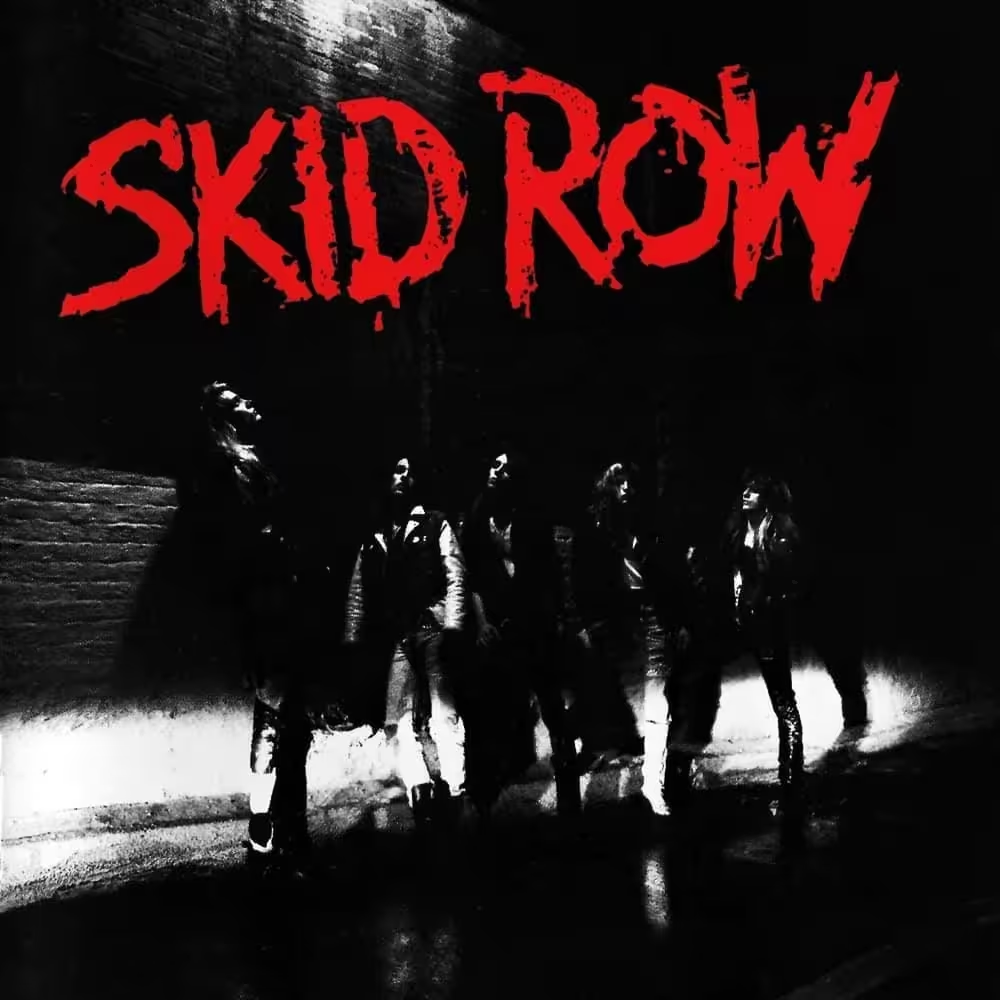
For an album sold into a genre that prized airbrushed cover paintings and full-band glamour shots, Skid Row is striking for what it does not do. Bob Defrin, the long-serving Atlantic art director responsible for sleeves across the label's catalogue, oversaw the project. David Michael Kennedy, better known for portraits of Bob Dylan and Willie Nelson, was hired for the front cover photography. Mark Weiss, whose wedding had handed the band their singer, shot the back. Gina Guarini designed the now-iconic Skid Row script logo in burnt orange.
The visual identity is deliberately stripped back. The dominant element is the logo itself: angular, slightly graffiti-influenced, dropped over a moody photographic background that refuses to compete with it. The choice was both editorial and commercial. By 1988, almost every cover in the genre had degenerated into the same kind of teased-hair group shot, and Atlantic clearly wanted Skid Row's sleeve to feel like a brand mark rather than a band photo. The logo went on to do more sales than any subsequent merchandise: 30 years later it is still one of the most counterfeited rock T-shirt designs in existence.
Release and Reception
The album landed on 24 January 1989 to mixed reviews and modest initial interest. Kerrang!'s Phil Wilding, in a four-and-a-half-star review headlined "Slippery Customers", called it formulaic but added that the praise the band was already getting from Bon Jovi's camp and the breadth of their material was "a big hint that they could be something very special in the future". Q magazine described the debut as a fusion of rock riffs and commercial hooks and called it a notable arrival. Spin's Erik Davis, writing that July, noted the album was slightly different from contemporary records by Warrant and Great White because it contained less of what he called the "fake-gutter narratives of sluts and bad boys".
"Slippery customers... a big hint that they could be something very special in the future."
Phil Wilding, Kerrang!, January 1989
The harsher voices were the Los Angeles Times's Aniss Garza, who found the record "highly unoriginal", and Robert Christgau, who gave it a C+ and joked that the disreputable women in Bolan's lyrics were at least "characters rather than objects". The German metal authority Rock Hard handed it a 7.0 with the verdict that this was an example of how American rock had largely stopped rewarding originality.
Modern reassessments have been kinder. AllMusic's Steve Huey calls it "typical pop-metal fluff" of the late 1980s but praises its consistency and singles out Bach's vocals for giving the songs "the much-needed nasty attitude". Canadian critic Martin Popoff, no soft touch with hair metal, called it a "basic, well-executed corporate metal feast" with Bach "raising the average to something worth reckoning". In 2017, Metal Hammer placed it on its short list of the ten hair-metal albums you need in your collection. In 2022, Loudwire ranked it the fourth-best hair-metal album of all time, noting that Skid Row "were decidedly more edgy, focusing more on razor-sharp riffs than razor-slashed stage wear".
Commercially the trajectory was a slow build, not an opening-weekend blockbuster. The album sold steadily through the spring on the back of "Youth Gone Wild", went platinum on the success of "18 and Life" in the summer, and only really exploded in the autumn once "I Remember You" cracked the Hot 100 top 10. It peaked at number six on the Billboard 200, stayed inside the top 40 for the best part of a year and was ultimately certified 5x platinum in the United States in 1995. It hit number one in New Zealand and the top 30 in the UK, Germany, Italy, Switzerland and Sweden.
The awards followed. At the 1990 American Music Awards Skid Row won Favourite Heavy Metal/Hard Rock New Artist and were nominated for Favourite Heavy Metal/Hard Rock Album. They were a Grammy nomination short in a year stacked with multi-platinum metal records, but by every other measure the industry had crowned them.
Singles and Music Videos
Atlantic released four singles over almost a full calendar year, an unusually patient campaign by late-eighties hair metal standards.
| Single | Release | US Hot 100 | Video Director | Notes |
|---|---|---|---|---|
| "Youth Gone Wild" | January 1989 | 99 (US Mainstream Rock 8) | Wayne Isham | Tour-bus and stage-footage video; instant fan-club anthem |
| "18 and Life" | 16 June 1989 | 4 | Wayne Isham | Edited version replaced original after MTV complaints |
| "Piece of Me" | 1989 (promo) | Did not chart | Wayne Isham | Short punk-tinged video shot on the road |
| "I Remember You" | 18 November 1989 | 6 | Wayne Isham | The ballad that pushed the album past 5x platinum |
Wayne Isham, then in the middle of a run that included Bon Jovi, Mötley Crüe and Def Leppard videos, directed all four. The "18 and Life" video is the artefact that most people from that era remember: a narrative piece following the song's Ricky, with a now-rare uncensored cut featuring spray-painted blood that MTV pulled within weeks of premiere. "I Remember You" used Isham's familiar arena-with-flashbulbs aesthetic and is the video most often cited by fans as the song that introduced them to the band.
Touring and Live: 17 Months on the Road
The Skid Row debut campaign turned into a 17-month worldwide tour, the kind of total saturation campaign that no longer really exists in the music business. Bon Jovi handed them the opening slot on the New Jersey Syndicate Tour days after the album landed and kept them there into the summer. The two New Jersey acts criss-crossed North America, Japan and Europe in front of a market that bought both records in giant numbers.
The August 1989 Moscow Music Peace Festival, organised by Doc McGhee as a court-ordered penance for an earlier drug-smuggling conviction, put Skid Row in front of a Russian crowd reported at 70,000 alongside Bon Jovi, Mötley Crüe, Scorpions, Cinderella and Ozzy Osbourne. A few days later, on 19 August, the band made their UK debut supporting Bon Jovi at Milton Keynes Bowl, then played a sweaty club show at London's Marquee the next night. In November they returned to the UK as Mötley Crüe's European Dr. Feelgood support, then headlined their own UK run that ended at Hammersmith Odeon. From October 1989 they spent the best part of a year opening for Aerosmith on the North American leg of the Pump tour.
The single most famous live moment of the cycle was not a triumphant headline encore but the so-called "bottle incident". On 27 December 1989 in Springfield, Massachusetts, a fan threw a bottle on stage during Skid Row's set. Bach threw it back, struck a 17-year-old female fan in the face, then went into the crowd to fight the original thrower. He was arrested after the show, posted $10,000 bail and was eventually given three years of probation. Footage of the incident appeared on the band's Oh Say Can You Scream home video the following year.
The notorious "AIDS Kills Fags Dead" T-shirt episode at another show in 1990 was a separate, worse moment for which Bach has since expressed regret, claiming he put on the T-shirt thrown by a fan without reading it. The band have spent the decades since living with both.
In TV, Film and Media
The album's songs have settled into a second life as sync placements. "I Remember You" turns up regularly in 1980s-themed film and television, from period-piece teen dramas to the modern wave of nostalgia documentaries. "Youth Gone Wild" has become shorthand for late-eighties metal culture in scripted television, appearing in everything from sports broadcasts to wrestling entrances; it is a fixture in the WWE soundtrack of the era and beyond. "18 and Life" is the one most likely to score a true-crime documentary about a botched teenage robbery, for obvious reasons. Sebastian Bach himself has had a long second career on Broadway and in scripted television (including a memorable recurring role on Gilmore Girls), keeping the album's profile alive among audiences who never bought a hair-metal record in their lives.
Controversy, Censorship and Lawsuits
Around the album itself, the controversies were small. The original "18 and Life" video edit was pulled by MTV and re-cut. The name itself had to be bought from Gary Moore for around $35,000 before any of it could be released, a transaction that has occasionally been romanticised as a legal dispute but was, in practice, simply a pragmatic licence fee. The publishing arrangement with Underground - Jon Bon Jovi's company - has never been the subject of a public lawsuit but has been the subject of decades of pointed press interviews from Sebastian Bach.
The Springfield bottle incident and the AIDS Kills Fags Dead T-shirt belong properly to the touring cycle rather than the record. They are, however, the controversies most likely to surface in any modern article about the album because they bracket the period in which Skid Row went from "Bon Jovi's friends" to a band that had to live with its own public misjudgements.
Covers, Samples and Tributes
The album's two ballads have been the most-covered songs in Skid Row's catalogue. "I Remember You" in particular has become a karaoke standard and a YouTube-cover-channel staple, surfacing in acoustic sets by post-grunge bands and country singers alike. "18 and Life" has been covered live by a long list of younger rock acts including members of Halestorm, whose Lzzy Hale would later briefly stand in as Skid Row's touring singer in 2024.
The band themselves have re-recorded "18 and Life" twice. A 2003 re-recording appeared on the Tony Harnell era's bonus material, and a 2015 stripped-back version was released as a free download to introduce the Solinger-replacement lineup of the band. Neither rerecording has displaced the original in radio rotation.
The Sebastian Bach revival tour treatment of the album, announced in 2019 around its 30th anniversary, has now produced full-album performances at festivals and theatres on three continents. Former Skid Row drummer Rob Affuso has appeared on stage with Bach on those nights, the closest the classic lineup has come to a reunion. Snake Sabo and Rachel Bolan have publicly declined to participate.
Reissues, Remasters and Anniversaries
For an album of its commercial stature, Skid Row has had a surprisingly thin reissue history. Atlantic put out a 30th-anniversary digital edition in January 2019 that bundled a remaster of the original album with the previously unreleased "Forever" and a complete live recording from The Marquee in Westminster, California, on 28 April 1989. The band have publicly stated that they had no input into the reissue and that Bach learned about it from the same press release as everyone else.
A long-promised vinyl deluxe edition with full session demos has not yet materialised. The most reliable sources of unreleased material remain the live VHS releases from the era, Oh Say Can You Scream (1990) and Road Kill (1993), and the well-circulated bootlegs from the New Jersey Syndicate, Pump and Slave to the Grind tours.
Legacy and Influence
Skid Row had, by the time the touring cycle for this album finished in the autumn of 1990, become one of the four or five biggest new hard-rock bands in the world. Slave to the Grind, recorded again with Wagener and released in June 1991, debuted at number one on the Billboard 200 - the first hard-rock album to do so under the modern SoundScan-era chart system - and confirmed that the debut had not been a fluke. By the time the classic lineup splintered in 1996 with Sebastian Bach's dismissal, the band's total worldwide sales were a reported 20 million records.
"Bach is gone, so whatever year he was gone is when they got in touch with me. When he left, here's a campfire, and Snake and Rachel are sitting around: 'Well, who do we wanna try out?' And my name was on the list."
Jason McMaster of Dangerous Toys, The Chuck Shute Podcast, May 2020
The debut sits in their catalogue as the foundational document: the record that broke them, the record that made the publishing dispute matter, and the record every subsequent Skid Row lineup has had to play live to keep the lights on. Loudwire's 2022 top-30 hair-metal albums placement at number four is roughly where the consensus has now settled. Bands as varied as Avenged Sevenfold, Halestorm, Black Veil Brides and Steel Panther have cited the debut as a touchstone.
"It hurts that we're not together. That album is 30 years old and I want to play it for the people who put me in the position I'm in."
Sebastian Bach, Blabbermouth, July 2019
The album also marked the high-water line. Skid Row was, with Dr. Feelgood and Pump, one of the last big-budget hair-metal debuts to go truly massive. Within 18 months Nirvana would release Nevermind and the entire economic model that Atlantic, Doc McGhee and Bon Jovi had built around bands like Skid Row would start to crumble. The band themselves were among the few to make a serious second album that could compete in the new climate; the rest of the genre largely could not.
Things You Might Not Know
| Fact | Detail |
|---|---|
| The Sayreville handshake | Dave "Snake" Sabo and Jon Bon Jovi grew up together and made a teenage handshake deal that whoever made it first would pull the other up; Sabo briefly held a guitar slot in early Bon Jovi before Richie Sambora replaced him. |
| The wedding-gig audition | Sebastian Bach was singing at rock photographer Mark Weiss's wedding in 1987 when Jon Bon Jovi's parents spotted him and tipped off the band; he was Skid Row's singer within weeks. |
| The Corabi audition | Future Mötley Crüe vocalist John Corabi auditioned for Skid Row before Bach, a detail Bolan has only publicly confirmed in the last few years. |
| The Bongiovi publishing trap | The band signed publishing to Underground, a company owned by Jon Bon Jovi and Richie Sambora, before they understood what they were giving away; Sambora later returned his share, Bon Jovi did not. |
| The Gary Moore name fee | Management reportedly paid Irish blues guitarist Gary Moore around $35,000 for the rights to the Skid Row name, which his late-1960s band had used first. |
| Ahmet Ertegun signed them | After negotiations with Geffen and A&M, Atlantic founder Ahmet Ertegun personally finalised the band's 1988 record deal. |
| The Wisconsin lockout | The album was recorded at Royal Recorders, an unfashionable residential studio at the back of a Lake Geneva hotel, with the band staying sober throughout the sessions per Michael Wagener's schedule. |
| "18 and Life" predates the band | Sabo had written the chorus before Skid Row even existed, inspired by a small newspaper item about an 18-year-old boy sentenced to life after accidentally shooting a friend with a gun he believed was unloaded. |
| Matt Fallon's lingering credit | Original singer Matt Fallon, fired before the album was recorded, still holds a co-writing credit on the closing track "Midnight / Tornado". |
| The MTV cut of "18 and Life" | The original video included a scene of the friend's body being represented by a spray-painted smiley face with a red bullet-dot on the forehead; MTV demanded an edit after viewer complaints. |
| 5x platinum, four years late | The RIAA did not certify the album 5x platinum until 1995, six years after release, by which point grunge had effectively ended hair metal's commercial run. |
| Number one in New Zealand | While the album peaked at number six in the US and number 30 in the UK, it spent time at number one in New Zealand and reached the top 30 in Germany, Italy, Switzerland and Sweden. |
| The Moscow penance gig | Skid Row played the August 1989 Moscow Music Peace Festival to a reported 70,000 people; the event was organised by manager Doc McGhee as court-imposed penance for an earlier drug-smuggling conviction. |
| Bach's $10,000 bail | After throwing a bottle back into the crowd at a Springfield, Massachusetts Aerosmith support slot in December 1989, Bach was arrested, posted $10,000 bail and was given three years of probation. |
| The reissue surprise | The 30th-anniversary digital reissue in January 2019, which included the previously unreleased "Forever" and a 1989 Marquee live set, was assembled without the band's involvement; they learned about it from the same press release as the public. |
Listen on the Riffology Podcast
The Riffology podcast spent a full episode on the Skid Row debut, picking apart the recording, the Bongiovi publishing dispute, the bottle incident and where the album sits in the catalogue alongside Slave to the Grind. Search for Riffology on Apple Podcasts, Spotify, Amazon Music, Pocket Casts or wherever you listen, or use the player at the top of this page.
Comments