
By the autumn of 1991, Guns N' Roses had spent four years carrying the weight of Appetite for Destruction on their backs, and the band that finally rolled into Geffen Records' release schedule on 17 September that year bore very little resemblance to the five-piece who had crashed the charts in 1987. They turned up with not one new record but two, released the same day under the umbrella title Use Your Illusion, and the second of the pair was the one in which the band stopped trying to write Appetite again and started, however unevenly, trying to write something else entirely. Use Your Illusion II is the political, art-rock-leaning half of the project: longer in average track length than its sister volume, slower in tempo, heavier with strings and piano, and built around the twin nine-minute centrepieces of Civil War and Estranged. Where Use Your Illusion I doubles down on the band's swagger, Use Your Illusion II is the sound of Axl Rose, Slash, Duff McKagan, Izzy Stradlin, Matt Sorum and Dizzy Reed reaching beyond their own template, scoring a string of huge singles in the process and exposing the cracks that would close the original line-up's career within a year of release.
The shadow of Appetite for Destruction and the trap of second album syndrome
The numbers Appetite for Destruction had put up between its July 1987 release and the start of the Use Your Illusion sessions were ruinously difficult to follow. The record had taken nearly a year to break, climbed slowly across 1988 on the back of the Welcome to the Jungle and Sweet Child o' Mine videos, and by the time MTV was finished with it the album had become the best-selling debut record in American history. The stop-gap acoustic EP G N' R Lies followed in November 1988 and confirmed that any move the band made in any direction would be met by an audience expecting the moment.
The band's chosen response was to refuse the premise of the difficult second album. Rather than narrow Appetite's formula and try to repeat it, they widened the lens, brought in keyboards and strings and acoustic ballads, and put out so much music at once that no single side of their personality could fairly stand for the whole. Inside the band, Steven Adler's addictions had reached a point where he could no longer hold a tempo, and the easy chemistry between Axl Rose and Izzy Stradlin that had powered the early material had soured. The Use Your Illusion records were written with one founding member already heading for the exit and another effectively gone, and the band that emerged at the end was not the band that had walked in.
The genesis of the double album concept and Slash's Walnut House writing sessions
Most of the material that became the two Use Your Illusion records was written, in its first form, over a short and concentrated period at Slash's house on Walnut Drive in the Hollywood Hills. Slash, Izzy Stradlin and Duff McKagan sat down with acoustic guitars across a handful of nights and pieced together demos for the bulk of the album, with Axl Rose contributing piano sketches and lyrical ideas that had been accumulating since the Appetite tours. In his 2007 autobiography Slash describes the process as deliberately loose, with songs allowed to take whatever shape they wanted rather than being filtered through the question of whether they belonged on a Guns N' Roses record.
The band stockpiled more than 30 songs, far more than would fit on a single 70-minute compact disc, and by early 1990 the discussion had shifted from which songs to cut to how to release the whole pile at once. A double album was floated, dismissed as commercially suicidal, then revived in the form that survived: two separately packaged single discs, released simultaneously, available individually or as a set. The split between the two volumes was made late and the logic was loose. Use Your Illusion I would carry the more straightforward rock songs and most of Stradlin's lead-vocal contributions; Use Your Illusion II would carry the longer, politically and emotionally heavier material, the ballads with the orchestrations, and the cover. The pair were sequenced as twins rather than as halves.
Inside the sessions: Mike Clink, six studios, 19 months and a change of drummer
Recording began on 13 January 1990 and did not finish until 3 August 1991. Across those 19 months the band moved through six rooms: A&M Studios and Image Recording in Hollywood; the Record Plant, Studio 56 and Conway in Los Angeles; and Metalworks in Mississauga, Ontario. Mike Clink, returning from Appetite for Destruction, was producer and lead engineer, with Jim Mitchell handling additional engineering and a long list of assistants passing through the sessions.
The most consequential personnel change happened early. Steven Adler, the band's original drummer and the rhythmic heartbeat of Appetite for Destruction, was by 1990 in no fit state to make a record. Multiple sources, including the band themselves in later interviews, describe sessions in which Adler could not hold a tempo and takes had to be abandoned. He completed his drum part for Civil War, the first piece of new material the band cut for the project, and was then dismissed. Matt Sorum, recently of The Cult, was brought in as his replacement and re-cut every other drum track on both records. Civil War remained as it was. That single song, on Use Your Illusion II, is Adler's last appearance on a Guns N' Roses studio record.
Sorum's arrival changed the band's rhythmic centre of gravity. Adler had played behind the beat, with the rubbery, just-late feel that gave Appetite its swing; Sorum played with a harder, squared-off attack better suited to bigger productions. Dizzy Reed, recruited as a sixth member, brought keyboards into the band's permanent arrangement for the first time, most audibly on Civil War, Breakdown and Estranged.
The mixing crisis: Bob Clearmountain fired and Bill Price airlifted in
By mid-1991 the band had a finished record in the can but no finished mix. Bob Clearmountain, the veteran whose work on Bruce Springsteen, the Rolling Stones and Bryan Adams made him one of the most respected mixers of the era, was hired to mix all 30-plus tracks across both volumes. He completed work on 21 of them before the relationship collapsed.
The reason, as Slash tells it in his autobiography, was a notebook. The band discovered that Clearmountain had been logging plans to layer sampled drums over Sorum's tracks during the mix, on the grounds that the live performances were not punchy enough for the productions being built around them. To a band whose entire identity rested on the idea that they were a real rock band playing real rock music, this was a betrayal, and Clearmountain was fired on the spot.
Geffen flew in Bill Price as the replacement. Price, an Englishman best known at that point for his work on the Sex Pistols' Never Mind the Bollocks and a long string of records for The Clash, was a curious choice on paper for a band so deeply rooted in Los Angeles hard rock, but he turned out to be exactly the right one. He restarted the mixes from scratch, kept Sorum's drum tracks intact and unaugmented, and brought back the dry, slightly aggressive midrange that the records would carry into the shops. Most of what listeners hear on the finished Use Your Illusion II is Price's work, not Clearmountain's.
The Kostabi cover and the Raphael source painting
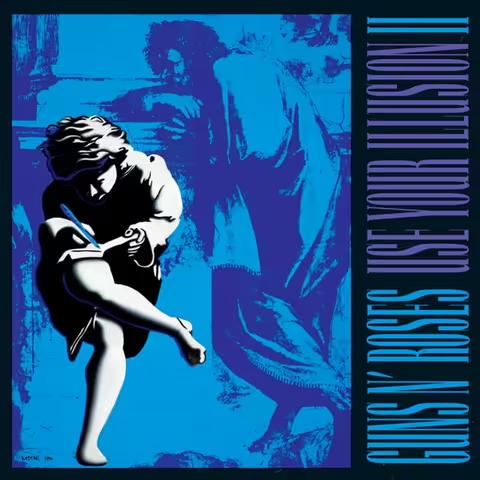
The cover paintings for both Use Your Illusion albums are by Mark Kostabi, the Estonian-American painter who had built a career and an art-world controversy out of running a studio in which assistants executed his ideas for him. The image is adapted from a small detail of Raphael's fresco The School of Athens, painted between 1509 and 1511 in the Stanza della Segnatura at the Vatican Apostolic Palace. Kostabi zoomed in on a single seated figure from the lower right of the composition and rendered it in flat, deliberately commercial colour blocks: red and yellow for Use Your Illusion I, blue and purple for Use Your Illusion II.
The identity of the figure has never been pinned down: art historians have not consistently linked the man in that part of the fresco with any specific philosopher, and Kostabi's adaptation does nothing to resolve the question. The phrase Use Your Illusion was the title Paul Kostabi, Mark's brother, had given to the original painting before the band took it; the album took its name from the artwork rather than the other way around.
Civil War: Steven Adler's last recording and the political turn
Civil War, the opening track on Use Your Illusion II, is the oldest piece of material on either album and the most clearly political song the band ever released. Built around a whistled introduction and a quote from Strother Martin's Cool Hand Luke speech, it moves through a slow, march-paced opening section, a heavier mid-section anchored by Slash's banjo and Dizzy Reed's piano, and a long coda built on the line about feeding off the souls of the gentle and the kind. Co-written by Axl Rose, Slash and Duff McKagan, it is one of the few Guns N' Roses songs in which the band's lyrical interests look outwards rather than inwards.
The song was debuted live at the Farm Aid IV concert in Indianapolis on 7 April 1990, more than a year before either Use Your Illusion record was released, and the studio version cut shortly afterwards is the take that appears on the album. It first surfaced on the 1990 Nobody's Child: Romanian Angel Appeal charity compilation organised by Olivia Harrison and Linda McCartney, appeared again in 1991 as a B-side to You Could Be Mine, and was finally issued as a single in its own right on 3 May 1993. Civil War is also the only track on either Use Your Illusion record on which Steven Adler plays drums; his appearance at the top of Use Your Illusion II is, intentionally or not, the closing credit of the original line-up.
14 Years and Yesterdays: Stradlin's lead vocal and West Arkeen's writing
The album's second track, 14 Years, is co-written by Axl Rose and Izzy Stradlin and sung by Stradlin himself, his only lead vocal on the record. It is the most Stones-leaning song in the band's catalogue, built on a loose, swinging electric piano part from Dizzy Reed and a chorus that reads, in retrospect, as a long farewell to the partnership at the heart of the band. Stradlin would leave Guns N' Roses two months after the records came out, and 14 Years is the last vocal he records for the group.
Yesterdays, the third track, is one of the rare Guns N' Roses songs with a four-way writing credit: Rose, the Hollywood songwriter and band associate West Arkeen, Del James, and Billy McCloud. Arkeen had been close to the band since the mid-1980s, co-writing or contributing to several songs in the band's circle, and Yesterdays is one of the more straightforwardly tuneful pieces on the record: a slow, organ-led ballad with a chorus designed to be played on FM radio. It was released as the third single from Use Your Illusion II on 2 November 1992, late enough in the album cycle that its chart impact was modest, but it has become one of the more durable deep cuts in the band's set.
Knockin' on Heaven's Door: the Dylan cover that escaped twice
The band's cover of Bob Dylan's Knockin' on Heaven's Door has a strange release history. A version of it had already appeared on the Days of Thunder soundtrack in 1990, more than a year before Use Your Illusion II, and that earlier mix is not quite the same recording that ends up on the album. The album version is the definitive one, longer, with the additional verse that begins with the line about the mother putting the gun in the ground, and with backing vocals from Isabella and Carmela Lento, the daughters of an associate of the band, layered behind the choruses.
Slash's solo on the album version is one of his most quoted, a slow, four-stage build across the back half of the song that owes as much to David Gilmour as to anything in the hard-rock vocabulary. The single was issued on 11 May 1992 in the United Kingdom, where it reached number two, and the live version recorded at Wembley Stadium for the Freddie Mercury Tribute Concert in April 1992 became, for a generation of British listeners, the definitive Guns N' Roses performance.
The mid-album cluster: Get in the Ring, Shotgun Blues and Breakdown
The middle of Use Your Illusion II is the part of the record that has aged least gracefully. Get in the Ring is a five-and-a-half-minute lyrical attack by Axl Rose on a list of named music journalists, including Mick Wall of Kerrang!, Andy Secher of Hit Parader and editors at Spin and Rip, complete with an invitation to fight the singer in a boxing ring. Co-written with Slash and Duff McKagan, and with McKagan trading the lead vocal back and forth with Rose, it is the most personal vendetta in the band's catalogue and a clear preview of the increasingly hostile public posture Rose would adopt over the next decade.
Shotgun Blues, immediately after it, is a fast, two-minute blast that survives mainly as a palate cleanser between Get in the Ring and Breakdown. The latter, a seven-minute Rose composition with a long instrumental coda, was reportedly the hardest song on either record to track: banjo, drum and piano parts had to be lined up against each other in ways that resisted easy synchronisation, and Matt Sorum has spoken about the song's drum part requiring multiple re-cuts before the band signed it off. The closing spoken-word monologue echoes the cinematic framing of Civil War's introduction, tying the two ends of the record together.
Pretty Tied Up, Locomotive and So Fine
Pretty Tied Up, subtitled The Perils of Rock 'n' Roll Decadence, is Izzy Stradlin's sole solo composition on the record and one of two tracks on the album to feature a coral sitar, the electric sitar variant favoured by Stradlin in the early 1990s. Lyrically the song is a piece of road-life sketchwork, contemporary critics took against the sexual politics of its lyric, and it remains one of the more divisive cuts on the album.
Locomotive, subtitled Complicity, is the eight-and-a-half-minute funk-metal experiment that sits at the centre of the record, co-written by Axl Rose and Slash in the Hollywood Hills house the two shared with Izzy Stradlin after the Appetite tours. It is the only song on either Use Your Illusion album in which the phrase use your illusion actually appears as a lyric, and the only sustained foray into funk metal in the band's discography. The arrangement bolts a slinky verse onto a long instrumental section in which Slash trades extended figures with Reed's organ, and the song closes with a quiet piano coda that bleeds, on the original CD pressing, directly into So Fine.
So Fine, the McKagan-written and McKagan-sung track that follows, is a stylistic outlier and the most personal lyric on the record. McKagan wrote it as a tribute to Johnny Thunders, the New York Dolls and Heartbreakers guitarist whose music had been formative for him in his teens and who had died of a drug overdose at the age of 38 in April 1991, while the Use Your Illusion sessions were still in progress. Howard Teman plays piano. McKagan's lead vocal, doubled and a little fragile, is the only one he ever takes on a Guns N' Roses studio record other than his shared moments on Get in the Ring.
Estranged: the nine-minute heart of the album and the Del James video trilogy
Estranged is the longest song on either Use Your Illusion record and, by some distance, the most ambitious thing the band ever put on tape. Nine minutes and twenty-three seconds long, written entirely by Axl Rose, it moves through a slow, piano-led opening, a long Slash solo section, a quieter middle passage built on clean guitar arpeggios, and a second solo coda that runs for nearly three minutes before the track finally fades.
The song was released as the fifth and final single from the album on 10 January 1994, and the accompanying video, directed by Andy Morahan with a story credited to Rose's friend Del James, was the third and final instalment in an unofficial video trilogy that had begun with Don't Cry and continued with November Rain. With a reported budget of around four million US dollars, Estranged was one of the most expensive music videos ever made at that point, and its imagery of Axl Rose swimming in San Pedro Bay alongside dolphins, of a SWAT team raiding his Malibu home, and of Slash walking on water out of the ocean to deliver the second solo, became one of the defining MTV set pieces of the era. The James short story Without You, written years earlier, had supplied the narrative spine for all three videos.
You Could Be Mine: Terminator 2 and the lead single that broke the album
You Could Be Mine, sequenced as the album's twelfth track, was the song that introduced Use Your Illusion II to the world. Released as the lead single on 25 June 1991, nearly three months before either album hit shops, it arrived attached to the soundtrack of James Cameron's Terminator 2: Judgment Day. The accompanying music video, directed by Andy Morahan, cuts between live footage of the band on stage and scenes of Arnold Schwarzenegger's T-800 hunting Axl Rose backstage and ultimately deciding not to terminate him.
The song itself is older than most of the album. Co-written by Rose and Stradlin, its original lyric is widely understood to refer to Stradlin's failed relationship with his ex-girlfriend Angela Nicoletti, and an early version of the riff and chorus had been kicking around since the Appetite for Destruction era. The lyric appears, in part, in the dedication pages of Appetite's original sleeve, where the band thanks Nicoletti and quotes the line about being precious and so insane. By the time the song was recorded for Use Your Illusion II, Rose had taken over the lead vocal entirely and the arrangement had been rebuilt around Sorum's drums into a fast, blunt, single-ready piece of hard rock.
Don't Cry with alternate lyrics and My World
The Don't Cry that appears on Use Your Illusion II is not the Don't Cry that appears on Use Your Illusion I. The two records carry different lyrical versions of the same song, with the same backing track but different vocal performances on top, and the band's stated reason for the dual release was that they could not decide which set of lyrics they preferred. The Use Your Illusion II version is the alternate-lyrics version, and the lead vocal is shared between Rose and Shannon Hoon, the Blind Melon singer whose friendship with Rose had begun in their shared Indiana hometown and who would die of a cocaine overdose in October 1995.
My World, the album's closing track, is the strangest and shortest piece of music on either Use Your Illusion record. A 1:24 industrial sketch built on a drum loop and a vocoder vocal from Rose, with drums, keyboards and sound effects credited to Johann Langlie, the entire piece was reportedly written, recorded and mixed in around three hours, with Rose claiming everyone in the recording room at the time was on mushrooms. Slash, McKagan, Sorum, Stradlin and Reed have all said in interviews that they did not know the song existed until they heard it on the finished record. As a closing statement for a 75-minute double album it is wilfully provocative, and it sets up the band's late-career fascination with electronics that would re-emerge, much expanded, on Chinese Democracy seventeen years later.
Release week, the simultaneous Number One and Number Two debut and the Use Your Illusion Tour
Use Your Illusion II hit shops at midnight on 17 September 1991, with many of the larger American record stores opening at midnight to accommodate queues that had begun forming the previous afternoon. The album sold 770,000 copies in its first week in the United States, debuting at number one on the Billboard 200, with Use Your Illusion I selling 685,000 copies and debuting at number two. It was the first time a single act had occupied both of the top two slots on the Billboard 200 in the same week since Jim Croce in 1974, and the same one-two finish was repeated that week in Australia, Japan, New Zealand and the United Kingdom.
Internationally the album reached number one in Australia, Argentina, Austria and the United Kingdom, number two in Germany, the Netherlands, Norway and Switzerland, and the top fifteen in France, Italy, Sweden, Belgium and Japan. As of 2010 SoundScan put United States sales at 5,587,000 copies. It has been certified seven times Platinum in the United States, nine times Platinum in Canada, six times Platinum in Argentina, five times Platinum in Australia, three times Platinum in Switzerland, twice Platinum in Japan, Denmark and Norway and Platinum in the United Kingdom, where Music Week reported the album had crossed 402,781 chart sales in 2022.
The Use Your Illusion Tour, which had begun in May 1991 to support an album that did not yet exist due to mastering delays, ran for 28 months and ended in July 1993. Izzy Stradlin left in November 1991, two months after the records were released, citing a refusal to keep working in a band where lateness on stage and unwillingness to engage with band members had become a daily condition. Gilby Clarke replaced him for the rest of the tour.
The most consequential live incident in the album cycle was the Riverport Riot on 2 July 1991, at what was then called the Riverport Amphitheatre in Maryland Heights, near St Louis, Missouri. During Rocket Queen, Rose noticed a fan filming the show on a hand-held video camera, security failed to confiscate it, and Rose dove into the crowd to seize it himself. He returned to the stage, blamed local security, threw the microphone down and walked off. The band followed him. Fans rioted: damage ran into hundreds of thousands of dollars, dozens of people were injured, and Rose was charged with assault and property damage. The liner notes of both Use Your Illusion records carry, in among the thank-you list, the phrase Fuck You, St. Louis! It is the band's permanent printed reply to the city, and one of the most pointed jokes on a rock record sleeve in the 1990s.
The Riverport night was not the only stadium-scale catastrophe of the tour. On 8 August 1992 in Montreal, the joint tour with Metallica collapsed mid-show when James Hetfield was burned by a pyrotechnic accident during Fade to Black. Guns N' Roses, headlining, came on late and cut their set short citing a sore throat from Rose, and the audience, primed by Metallica's enforced exit, rioted outside the Olympic Stadium. By the close of the campaign in mid-1993 the band's reputation as a live act was inseparable from the question of whether the singer would turn up at all.
Contemporary and retrospective reception
Reviews at release were mostly favourable. Greg Kot in the Chicago Tribune gave the records four stars out of four and wrote that they represented a staggering leap in ambition, musicianship, production and songwriting, with Use Your Illusion II carrying more knockout punches. Christian Wright in Rolling Stone also four-starred them and described the songs as ranging from ballad to battle, pretty to vulgar, worldly to incredibly naive. Robert Hilburn at the Los Angeles Times gave four stars, Janiss Garza at Entertainment Weekly gave it an A, Edna Gundersen at USA Today gave three and a half stars and called it rebellious, ambitious and powerful, and Q awarded the maximum five stars. The dissenting voices were sharp: Mary Anne Hobbs at NME gave the record four out of ten, citing what she called asinine lyrics and slack political rhetoric on Civil War, and Robert Christgau in the Village Voice singled out only Civil War as a choice cut.
Retrospective evaluation has been similarly split. Stephen Thomas Erlewine at AllMusic gives the album three stars out of five and calls it more serious and ambitious than Use Your Illusion I but also more pretentious. Ann Powers, writing in The New Rolling Stone Album Guide in 2004, gives it four stars and describes it as spacier than its sister volume, with Yesterdays and You Could Be Mine showing the band could still focus to great effect. Nick Barat, in a November 2024 Pitchfork reassessment of the entire Use Your Illusion project, gave it 8.8 out of 10. Both records were jointly ranked 41st on Rolling Stone's 2010 list of the 100 Best Albums of the 1990s.
Legacy: Izzy's departure, the 17-year silence and the place of Use Your Illusion II in 1991 rock
The autumn of 1991 is the most-cited release window in rock history for good reason. Nirvana's Nevermind landed one week after Use Your Illusion II, on 24 September 1991, and changed the commercial centre of gravity of American rock music within months. Metallica's self-titled record, often called The Black Album, had come out a month earlier in August and would go on to sell more copies than any of its contemporaries. Pearl Jam's Ten had been released a week before Metallica's record. Inside that fortnight, Use Your Illusion II was both the apex and the obituary of a particular kind of mainstream American hard rock.
For the band, the consequences were terminal in the medium term. Izzy Stradlin's departure in November 1991 ended the songwriting partnership that had powered every Guns N' Roses album to that point. The next studio release, The Spaghetti Incident?, was a covers record put out in November 1993 essentially to satisfy the band's contractual obligation to Geffen. After that, the band fell into a 17-year silence as a recording entity, broken only when Axl Rose, by then the sole surviving original member of the line-up, released Chinese Democracy in November 2008 under the Guns N' Roses name. The classic line-up did not record another album together; the Slash and McKagan reunion that began in 2016 has not yet yielded a new studio record.
"Use Your Illusion I and II were our White Album, maybe not as good."
Slash, Rolling Stone, 2016
That joke is also, in its way, the most accurate single summary of the record. Use Your Illusion II is sprawling, contradictory, frequently brilliant, occasionally indulgent, and structurally incapable of being summed up by any one of its 14 tracks. It is the album in which Guns N' Roses tried to become a different band, and the album that explains why the band they were going to become never quite arrived.
Personnel
| Musician | Role |
|---|---|
| W. Axl Rose | Lead vocals, piano, whistling, synthesiser, drum machine, backing vocals, art direction, design |
| Slash | Lead guitar, rhythm guitar, acoustic guitar, banjo on Civil War and Breakdown, art direction, design |
| Izzy Stradlin | Rhythm guitar, backing vocals, lead vocal on 14 Years, coral sitar on Pretty Tied Up, acoustic guitar |
| Duff McKagan | Bass, backing vocals, lead vocal on So Fine, co-lead vocal on Get in the Ring, percussion |
| Matt Sorum | Drums, percussion, backing vocals on all tracks except Civil War |
| Dizzy Reed | Keyboards, backing vocals |
| Steven Adler | Drums on Civil War only |
| Shannon Hoon | Co-lead vocal on Don't Cry (alternate lyrics) |
| Johann Langlie | Drums, keyboards and sound effects on My World |
| Isabella Lento, Carmela Lento | Backing vocals on Knockin' on Heaven's Door |
| Howard Teman | Piano on So Fine |
| Mike Clink | Producer, engineer |
| Guns N' Roses | Co-producers |
| Jim Mitchell | Additional engineering |
| Bill Price | Mixing |
| George Marino | Mastering |
| Mark Kostabi | Cover painting |
| Kevin Reagan | Art direction |
| Robert John | Photography |
Tracklist
| # | Title | Writer(s) | Length |
|---|---|---|---|
| 1 | Civil War | Rose, Slash, McKagan | 7:42 |
| 2 | 14 Years | Rose, Stradlin | 4:21 |
| 3 | Yesterdays | Rose, West Arkeen, Del James, Billy McCloud | 3:14 |
| 4 | Knockin' on Heaven's Door | Bob Dylan | 5:36 |
| 5 | Get in the Ring | Rose, Slash, McKagan | 5:42 |
| 6 | Shotgun Blues | Rose | 3:26 |
| 7 | Breakdown | Rose | 7:04 |
| 8 | Pretty Tied Up (The Perils of Rock 'n' Roll Decadence) | Stradlin | 4:48 |
| 9 | Locomotive (Complicity) | Rose, Slash | 8:42 |
| 10 | So Fine | McKagan | 4:08 |
| 11 | Estranged | Rose | 9:23 |
| 12 | You Could Be Mine | Rose, Stradlin | 5:43 |
| 13 | Don't Cry (alternate lyrics) | Rose, Stradlin | 4:45 |
| 14 | My World | Rose | 1:24 |
Things you might not know
| Fact | Detail |
|---|---|
| Clearmountain's notebook | The band fired veteran mixer Bob Clearmountain after discovering his plans to layer sampled drums over Matt Sorum's tracks. Sex Pistols engineer Bill Price was flown in to restart the mixes from scratch. |
| The only "use your illusion" lyric | The phrase Use Your Illusion only appears once across either album, in the lyrics to Locomotive (Complicity) on Use Your Illusion II. It is also the band's only sustained foray into funk metal. |
| The Estranged budget | The Andy Morahan-directed Estranged video, with its San Pedro Bay dolphin sequence and SWAT raid, cost an estimated four million US dollars, making it one of the most expensive music videos ever produced at the time. |
| Days of Thunder beat the album | Knockin' on Heaven's Door first appeared on the soundtrack to Tony Scott's Days of Thunder in 1990, more than a year before the album version reached shops in September 1991. |
| Stradlin's coral sitar | Izzy Stradlin plays a coral sitar, the electric sitar variant favoured in the early 1990s, on his sole solo composition Pretty Tied Up. It is one of the only sitar sounds in the band's catalogue. |
| My World took three hours | The closing track My World was, according to Axl Rose, written, recorded and mixed in around three hours, with Rose later claiming everyone in the room at the time was on mushrooms. Most of the band did not know the song existed until they heard it on the finished record. |
| The Riverport revenge in print | Both Use Your Illusion albums' liner notes carry the phrase Fuck You, St. Louis! in their thank-you credits, the band's permanent printed answer to the Riverport Riot of 2 July 1991. |
| Adler's drum farewell | Steven Adler plays drums on Civil War only and on no other track on either Use Your Illusion record. Civil War is his final studio appearance with Guns N' Roses. |
| Shannon Hoon's vocal | Blind Melon frontman Shannon Hoon, a childhood friend of Axl Rose, sings co-lead vocal on the Use Your Illusion II version of Don't Cry, which uses an entirely different lyric to the version on Use Your Illusion I. |
| Raphael's School of Athens | The cover painting by Mark Kostabi is adapted from a single seated figure in the lower right of Raphael's 1509-1511 fresco The School of Athens, in the Vatican Apostolic Palace. The figure has never been firmly identified with any specific philosopher. |
How to listen now
Use Your Illusion II is available on every major streaming platform, including Spotify and Apple Music, in its original 1991 sequence. Higher-resolution streams of the 2022 remasters are available on Apple Music and Amazon Music HD, and the album has been mastered for Dolby Atmos in spatial audio.
The most comprehensive way to hear the record today is the 2022 Use Your Illusion Super Deluxe box set, released to mark the album's 30th anniversary and assembled with the involvement of the surviving classic-era members. The set wraps both records together with previously unreleased live recordings from the 1991 Ritz Theatre show in New York and selected unreleased demos and rehearsal takes from the writing sessions, and is the only place outside the original CDs in which Civil War, Estranged and the other long-form pieces appear in their full studio mixes alongside their early-stage equivalents.
For collectors, the 1991 Geffen vinyl pressing of Use Your Illusion II remains the most sought-after format. Pressed as a double LP at 33 rpm with the full 75-minute running time split across four sides, original copies in clean condition turn up regularly on the second-hand market and remain the version that captures Bill Price's mix in the form the band first signed off.
Comments