By the time Slipknot returned to a Los Angeles control room in January 2001, nine men in red boilersuits could no longer be in the same room without violence. Corey Taylor was drinking himself unconscious between vocal takes, Joey Jordison and Paul Gray were writing seventeen hours a day to keep from speaking to anyone else, and producer Ross Robinson had a freshly fractured spine and a cassette of unfinished demos he refused to soften.
Iowa is the album that came out of that room. Released by Roadrunner on 28 August 2001, it was the band's second record and is still, twenty-five years later, the line in the sand for what mainstream metal could be allowed to sound like. Where the self-titled debut had been a chaos of turntables, samplers and rap-metal phrasing, Iowa was almost entirely riff and blast beat: shorter on hooks, longer in runtime, written by people who appeared to actively dislike each other and who put that dislike on tape with no varnish.
What follows traces the record from the Iowa warehouse where the songs were demoed in a four-foot fog of cigarette smoke, through the broken-back sessions at Sound City, to its arrival at the top of the UK Albums Chart in a week when the rest of the world was still trying to decide what nu metal was supposed to be. The story is uglier than the official biography. It is also, depending on your tolerance for masochism, a much better one.
| Field | Detail |
|---|---|
| Artist | Slipknot |
| Album | Iowa |
| Release Date | 28 August 2001 |
| Label | Roadrunner Records |
| Producer(s) | Ross Robinson, Slipknot |
| Studio(s) | Sound City, Sound Image (Van Nuys, California) |
| Genre | Nu metal, groove metal, heavy metal |
| Track Count | 14 |
| Total Runtime | 66:17 |
| Billboard 200 Peak | 3 |
| UK Albums Chart Peak | 1 |
| Other Notable Peaks | Canada 1, Scotland 1, Australia 2, Finland 3, Germany 4, New Zealand 5 |
| Certifications | Platinum (US, UK, Canada); Gold (Australia, France, Germany, Japan, Netherlands, New Zealand, Belgium) |
| Estimated Sales | Over 1.79 million worldwide |
| Key Singles | Left Behind, My Plague |
Coming off the debut
Slipknot's self-titled debut had landed in June 1999 as a kind of feral curiosity. The major labels were not sure what to do with nine masked men from Des Moines, the rock press could not agree whether they were a serious band or a horror-show sideshow, and the album quietly sold itself past the platinum line in the US while the band toured for almost two years without a meaningful break. By the time they came off the road in late 2000, the boilersuits were rotting, the original numbered identities were already curdling into a kind of in-joke that nobody found funny, and the men inside them had been awarded a level of fame their personal lives could not absorb.
Corey Taylor's drinking, well-documented in his later autobiographies, had reached the point where he was, in his own retrospective phrasing, only ever close to functional. Shawn Crahan, the percussionist who had effectively founded the band in 1995, was watching his children grow up between tour buses. Paul Gray and Joey Jordison were the only members in any state to write, and they spent October to December 2000 hunched over a four-track in a hired warehouse in Des Moines, putting demos together while the rest of the band tried to reassemble themselves at home.
"Iowa, even more than the first record, was the album we really wanted to make."
Joey Jordison, Kerrang!, 2012
Internal tension was not new. Personnel friction had been a feature of Slipknot since the day Anders Colsefni was replaced by Taylor in 1997. What was new in late 2000 was the absence of any unifying enemy. They were no longer the underdog band trying to prove that nine people could record a coherent record. They were one of Roadrunner's biggest assets, with a label budget waiting on them and an audience already deciding whether the second album would be a sellout. The pressure of expectation, in their telling, was the substance the record was forged out of.
Pre-production in a warehouse
Pre-production for Iowa began at the end of 2000 in a converted warehouse outside Des Moines that the band had rented as a rehearsal space. Jordison and Gray had the bones of most of the record before anyone else turned up. Taylor arrived with laryngitis and could barely speak. He sat at the back of the room with a notebook, listening as the band ran through demos, and wrote phrases in capital letters as the riffs hit him.
"We started doing pre-production for the album in a warehouse in Iowa itself. I had laryngitis and couldn't sing a note, so I was writing a lot of ideas down. When I heard them play 'Disasterpiece', I just wrote 'No one is safe' in huge letters. I knew from then that we were going to rip the throat out of the world with 'Disasterpiece'. That was the lynchpin for the whole album."
Corey Taylor, Kerrang!, 2012
The working title at this point was Nine Men, One Mission, a phrase the band briefly floated to the press before quietly killing it. By the time they flew to Los Angeles in mid-January 2001, the title had become Iowa, a stubborn declaration of where they were from in defiance of a music industry that had decided they belonged in California. Members later said the title was less about the state itself than about the version of themselves they could only access there: the part of them that had grown up bored, broke and angry, and which Hollywood was already trying to flatten.
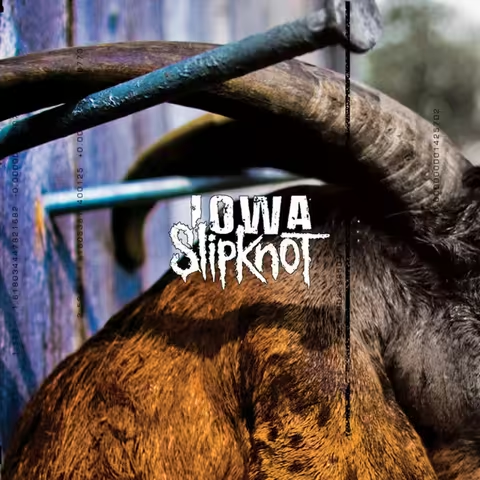
The art direction was equally insistent on the home state. Crahan, who had been taking photographs throughout the band's career, took the cover image during a session arranged shortly after the debut album shoot. The photograph showed a goat called Eeyore in stark studio lighting. Crahan later explained that the goat had been chosen because it was the band's totem animal: a creature dismissed as ugly, possessed of an unsettling yellow eye, and unmistakeably rural.
Inside Sound City
Recording proper began on 22 January 2001 at Sound City Studios in Van Nuys, with overdubs and additional tracking at the adjacent Sound Image. Sound City had been a working studio since 1969 and was, by 2001, the unfashionable choice. Most of its hit-making years (Fleetwood Mac's Rumours, Tom Petty's Damn the Torpedoes, Nirvana's Nevermind) were behind it, the carpet was held down with gaffer tape and the Neve 8028 console in Studio A was scarred by twenty years of cigarette burns. None of this bothered Slipknot or Robinson. What they wanted was the room, the desk and the absence of distraction.
The Neve 8028 was the studio's defining piece of equipment: a custom-built console, one of only four ever made, built by Rupert Neve's company in 1972. Engineers had spent three decades arguing over why drums recorded through it sounded the way they did, and the consensus, such as it was, blamed the desk's custom-tuned class A discrete preamps and its enormous routing capacity. Jordison's drums on Iowa are arguably the desk's last great calling card before the studio closed in 2011 and the console was relocated to Dave Grohl's Studio 606.
| Slipknot member | Number | Role on Iowa |
|---|---|---|
| Corey Taylor | #8 | Lead vocals |
| Mick Thomson | #7 | Guitar |
| Shawn Crahan | #6 | Percussion, backing vocals, editing |
| Craig Jones | #5 | Samples, media |
| Jim Root | #4 | Guitar |
| Chris Fehn | #3 | Percussion, backing vocals |
| Paul Gray | #2 | Bass, backing vocals |
| Joey Jordison | #1 | Drums |
| Sid Wilson | #0 | Turntables, vocals on (515) |
| Production | ||
| Ross Robinson | Producer | |
| Slipknot | Co-producers | |
| Mike Fraser | Engineering | |
| Andy Wallace | Mixing | |
| Steve Sisco | Assistant engineering | |
| George Marino | Mastering | |
| Steve Richards | Executive producer | |
| Artwork | ||
| Shawn Crahan | Creative direction, photography | |
| T42 Design | Art direction, layout | |
| Joey Jordison | Slipknot logo and Tribal-S logo design | |
| Stefan Seskis | Photography | |
| Neil Zlozower | Band photography | |
The signal chain was deliberately analogue. Mike Fraser, an engineer best known for his work with Aerosmith and AC/DC, ran most of the rhythm section straight to two-inch tape via the Neve. Jim Root and Mick Thomson tracked guitars through a combination of Mesa Boogie and custom-modified amplifiers, with the dry signal split into multiple cabinets to give the wall-of-noise quality that defines tracks like The Heretic Anthem. Andy Wallace, who had mixed Nirvana's Nevermind a decade earlier, was brought in for the mix and turned the album in across roughly six weeks, longer than anybody had budgeted for and the reason the original 19 June 2001 release date slipped to August.
Ross Robinson and the broken-back sessions
Ross Robinson had produced the band's debut and was always going to produce Iowa. By 2001 he was the most fashionable hard-rock producer in America, having defined the sound of Korn, Limp Bizkit, Sepultura's Roots and At the Drive-In's Relationship of Command. His approach was not technical. He shouted, threw microphone stands, made vocalists run laps around the studio between takes, and treated each session as a kind of psychiatric intervention. Slipknot, in their public statements about him, never sounded entirely sure whether they admired or feared him. They worked with him anyway.
Halfway through tracking, Robinson came off a dirt bike on the Pacific Coast Highway and fractured his back. He was taken to hospital, kept overnight, and returned to the control room the next afternoon in a back brace, refusing the painkillers his doctors had prescribed on the grounds that they would dull his ear. He spent the rest of the sessions standing for as long as his spine would allow, lying on the floor of the control room when it would not, and was, by the band's account, more confrontational after the accident than before it.
"Recording Iowa was fucking hell. I wanted to kill myself. There was drugs, bitches, rock 'n' roll, all that shit. People expected so much of us then. 'People = Shit' was our way of saying, 'Fuck off and leave us alone.'"
Shawn Crahan, Rocksound, 2009
Robinson's other intervention on the record was on Taylor's vocals. Vocal takes for the closing title track took place over a single night and remain the most-discussed twenty minutes in the band's history. Taylor recorded the song completely naked, induced vomiting between takes, and cut himself with broken glass. Robinson kept the tape rolling. The version on the record is one of those takes, mostly unedited.
"That's where the best stuff comes from. You've got to break yourself down before you can build something great."
Corey Taylor, FHM, December 2001
Sid Wilson's vocal contribution to the opening track (515) was caught under similarly raw circumstances. Wilson learned during a break in tracking that his grandfather had died. Robinson handed him a microphone, walked him into the live room, and recorded several minutes of the resulting breakdown, including Wilson screaming the word "Death" into the headphones. The opening of the album, as it appears on the finished record, is that recording put through a gate of distortion and tape echo. The track's title is the central Iowa area code, a homesick nod and an in-joke about the fact that the band's worst breakdown to that point had happened a thousand miles from anywhere they recognised.
Recording wrapped on 16 March 2001. Wallace's mixing began immediately and ran into early summer, which forced Roadrunner to push the release date and cancel a five-date warm-up tour that had been intended to introduce the new material. The final master was cut by George Marino at Sterling Sound in New York.
The songs
The fourteen tracks on Iowa were credited collectively to Slipknot, in line with the band's standing policy on songwriting royalties. In practical terms, Jordison and Gray wrote most of the music, Taylor wrote almost all of the lyrics in a notebook that he later said he could no longer bring himself to read, and the arrangements were beaten into shape collectively in the warehouse before anyone reached Sound City. The tracklist runs to one minute over an hour, which makes Iowa the band's longest studio album to that point, almost entirely on the strength of the fifteen-minute closing title track.
| # | Title | Length | Single? | Notes |
|---|---|---|---|---|
| 1 | (515) | 0:59 | Sid Wilson breakdown caught in the studio after his grandfather's death | |
| 2 | People = Shit | 3:35 | Album opener proper; later named one of the heaviest nu-metal songs of all time by Revolver | |
| 3 | Disasterpiece | 5:08 | Taylor's stated favourite Slipknot song; "the lynchpin for the whole album" | |
| 4 | My Plague | 3:40 | Yes | Featured on the Resident Evil (2002) soundtrack in a New Abuse mix |
| 5 | Everything Ends | 4:14 | Lyrically the album's most direct expression of suicidal ideation | |
| 6 | The Heretic Anthem | 4:13 | Pre-release giveaway as Heretic Song, limited to 666 copies via the band website | |
| 7 | Gently | 4:54 | Originally written and demoed during the Mate. Feed. Kill. Repeat. era | |
| 8 | Left Behind | 4:01 | Yes | Lead single; nominated for Best Metal Performance at the 44th Grammy Awards |
| 9 | The Shape | 3:37 | Title nods to Michael Myers from John Carpenter's Halloween | |
| 10 | I Am Hated | 2:37 | Performed by the band in the 2002 film Rollerball | |
| 11 | Skin Ticket | 6:41 | Doom-paced exception on an otherwise relentless record | |
| 12 | New Abortion | 3:36 | Working title for early demos was reportedly Iowabortion | |
| 13 | Metabolic | 3:59 | Co-written largely by Jordison and Gray during the warehouse demos | |
| 14 | Iowa | 15:03 | Longest continuous Slipknot song; recorded with Taylor naked, vomiting and self-cutting |
The album opens, after the (515) interlude, on People = Shit, four bars of double-kick from Jordison followed by Taylor screaming the chorus before the listener has a chance to set their feet. Slipknot had not previously been in the business of grand statements. People = Shit is one anyway: a forty-second misanthropic war cry built on a single octave-jump riff and a chant that the band would, for the next decade, struggle to play live in a country that had any kind of public health restriction on shouting.
Disasterpiece, which Taylor has consistently named as his single favourite Slipknot song, is the album's structural centre. It is also the song the band cite when asked about the lyrical extremity of the record. The line "I want to slit your throat and fuck the wound" appears in the opening verse and was, Taylor has since said, written from a place of self-loathing rather than aggression. The track's middle section, with its broken-time signature and Jordison's stop-start drum figure, is the most overtly technical writing on the album and was reportedly the take that took the longest to land.
The record's two singles, Left Behind and My Plague, sit either side of The Heretic Anthem at the centre of the running order and are the only tracks that allow daylight in. Both feature melodic Taylor choruses written cleanly enough to be playable on rock radio, and both were chosen by Roadrunner for that reason. The Heretic Anthem, with its "If you're 555, then I'm 666" chant, became the album's most enduring live track. The 666-copy pre-release giveaway in May 2001 had been a deliberate stunt, a single CD-R per fan posted from the band's website, and copies of that pressing now change hands for four-figure sums.
The closing title track, fifteen minutes of slowed-down dirge built on a single pulsing bass figure from Gray, is the most divisive piece of music in the band's catalogue. Some fans treat it as a masterpiece of mood-setting; others, including band members in interviews, have described it as essentially unlistenable in any setting other than alone, in the dark, with the album as a complete experience. It has never been performed in full live.
Lyrics, masks and the goat
Taylor's lyrics on Iowa are the rawest of his career. The themes circle a small set of obsessions: misanthropy, self-disgust, perceived betrayal by the music industry, suicidal ideation, and the specific kind of helplessness that comes from being a famously angry person in a relationship that has stopped working. He has said in multiple interviews since 2010 that he can no longer perform some of the songs in full because they pull him back to a state of mind he has spent twenty years trying to leave behind. Everything Ends in particular has been quietly absent from setlists for most of the last decade.
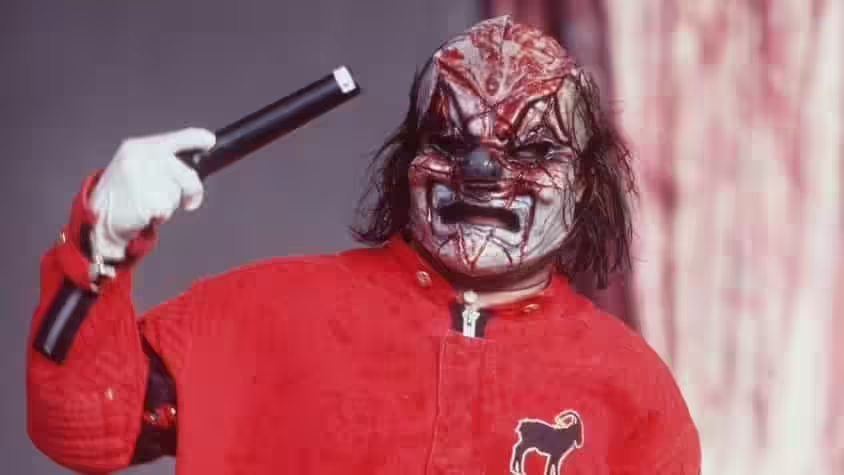
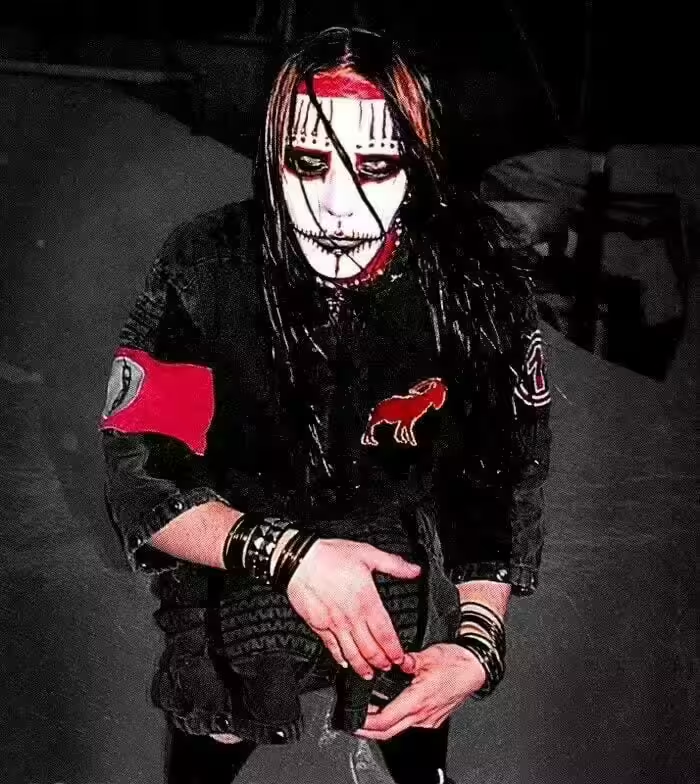
The masks were redesigned for the album cycle to match the lyrical mood. Crahan's clown mask was distressed and rotted, with a yellowing rictus grin that suggested something had gone visibly wrong with the man inside it. Taylor's mask was rebuilt in stiffened leather and given a longer, scarred dreadlock array. Jordison's kabuki design was made narrower and more skeletal. Mick Thomson's mask was rebuilt in chrome mesh that left only his eyes and mouth visible. Each redesign was, in the band's account, a reflection of how each member felt about himself by the end of the sessions, which means they should be read as a kind of self-portrait series rather than as costume design.
- Corey Taylor (#8): a weathered leather mask, stitched and scarred, with longer dreadlocks than the debut design.
- Shawn Crahan (#6): a yellowed, rotted clown mask, the rictus grin worn down at the edges.
- Joey Jordison (#1): a narrower kabuki face with sharper black markings, more skull than mask.
- Mick Thomson (#7): a chrome-mesh design, almost industrial, leaving only the eyes and mouth visible.
- Sid Wilson (#0): a gas mask variant, the first of the dozens of mask iterations Wilson would cycle through over his career.


The goat on the album cover, photographed by Crahan during the same shoot block as the debut album cover, was a real animal called Eeyore. Crahan has spoken about the photograph repeatedly over the years and has consistently rejected the obvious satanic reading. The goat, he has argued, is a Midwestern animal, an animal of working farms, and was chosen because it stood for everything Hollywood was actively trying to scrub off the band. Some pressings of Iowa use alternative covers (a smeared paint variant for some European territories, and a different goat photograph for the 10th anniversary edition), but the original shot remains the canonical image.
Release and reception
The album's August 2001 release week was kind to it. Iowa entered the UK Albums Chart at number one, knocking Bob the Builder's The Album off the top, which is the kind of detail that has aged into a small piece of British music folklore. It entered the Billboard 200 at number three, kept off the top by Alicia Keys's Songs in A Minor and Aaliyah's posthumously released self-titled album. It hit number one in Canada and Scotland, two in Australia, three in Finland and Ireland, and went platinum in the US within six weeks.
The reviews were largely positive but oddly bifurcated, with the rock press treating the record as a generational moment and the mainstream press not quite knowing what to do with it. Rolling Stone's David Fricke awarded it four stars and offered the line still most often quoted from the album's release window, calling Taylor's performance on the title track "a vivid evocation of a makeshift-cornfield grave at midnight". NME gave it eight out of ten. Q gave it four stars. Alternative Press, in a sentence reproduced on every reissue press release since, ran with this:
"Like having a plastic bag taped over your head for an hour while Satan uses your scrotum as a speedbag. It is over the top, you're going to be left in stitches."
Alternative Press, July 2001
Entertainment Weekly was the dissenter, awarding a C-minus and accusing the band of cosplaying extremity. Metacritic settled at 68, which is roughly where the album has sat in critical consensus ever since: short of all-time-list comfortable, well above respectable. Both singles were nominated for Best Metal Performance at the Grammys, Left Behind in 2002 and My Plague in 2003. Neither won. NME placed Iowa sixth on its 50 Albums of the Year list. Kerrang!, when it ran a 50 Best Albums of the 21st Century reader poll in 2009, ranked Iowa third. Rolling Stone listed it 50th on its 100 Greatest Metal Albums of All Time list in 2017.
Several other significant records arrived in the same window, which is part of why the album landed as hard as it did:
- Toxicity by System of a Down, released a fortnight after Iowa
- Lateralus by Tool, released earlier the same year
- Hybrid Theory by Linkin Park, still climbing the chart from late 2000
- The Sickness by Disturbed, on its second wind in 2001
- Fold Your Hands Child, You Walk Like a Peasant by Belle and Sebastian, for proportion
Singles and music videos
Left Behind was released as the lead single on 29 October 2001, two months after the album. The accompanying video, directed by Thomas Mignone, was filmed in a derelict Los Angeles warehouse and featured the band performing in a rain of plaster dust to a small audience of crash-test dummies and onlookers in white masks. It was edited around hard cuts, contained no narrative, and is, in a small but real way, a template for every metal performance video shot in the next decade.
My Plague followed on 8 July 2002. The single was issued in a New Abuse mix to coincide with its inclusion on the soundtrack to Resident Evil, the Paul W. S. Anderson film. The video, by P. R. Brown, leaned harder on horror imagery and drew the band's first run of MTV censorship notes. The B-side of the UK single was a live take of Liberate.
| Single | Released | UK Singles | US Mainstream Rock | B-side / format note |
|---|---|---|---|---|
| Left Behind | 29 October 2001 | 25 | 27 | Live B-sides on UK CD2; nominated Best Metal Performance, 2002 Grammys |
| My Plague | 8 July 2002 | 43 | New Abuse mix; included on Resident Evil OST; nominated Best Metal Performance, 2003 Grammys |
A planned third single, The Heretic Anthem, was discussed at Roadrunner but never went ahead. The label's marketing team felt the chorus's "555 / 666" couplet would block playlist adds at most US rock radio formats, and the 666-copy pre-release giveaway from earlier in the year had already done the work the single would have been intended to do. A 1,000-copy promotional 12-inch was reportedly pressed but never commercially released, and that pressing is one of the more in-demand items in the Slipknot collector market.
Touring, Ozzfest and the Iowa World Tour
The Iowa World Tour ran from August 2001 to roughly the autumn of 2002, the longest single tour cycle in the band's history at that point. It opened with a string of Ozzfest dates as a main stage support act, where the band's reception was abrasive in both directions: Sharon Osbourne is on record as having found their stage rider impossible, and several support slots were cut short by the band's preference for ending sets in genuine, unrehearsed violence. From November 2001 they co-headlined a US arena tour with System of a Down, then crossed to Europe in early 2002 for a string of dates in support venues that, in the UK at least, felt several sizes too small for the crowd they were attracting.
The defining live appearance of the cycle was their headline slot on the closing night of the 2002 Reading Festival on 25 August, performed in a thunderstorm to a main-stage crowd that the BBC's coverage estimated at over fifty thousand. The set was filmed and partially released on the Disasterpieces DVD the following year. Footage from the Iowa cycle, including the Reading set, sound checks and a long sequence of road footage shot by Crahan, makes up most of the Goat film included on the 10th anniversary edition.
"When we did Iowa, we hated each other. We hated the world; the world hated us."
Shawn Crahan, Roadrunner press, January 2008
The tour's toll was substantial. Taylor was hospitalised with alcohol-related health problems on more than one occasion. Wilson broke both heels in a stage jump in Pittsburgh in 2002 and finished the tour in a wheelchair fitted with custom Slipknot livery. Multiple band members have since said in interviews that they assumed the band was finished by the time they came off the road in late 2002, and the two-and-a-half-year gap before the next album, Vol. 3: (The Subliminal Verses), was, in part, time spent rebuilding personal relationships that the Iowa cycle had broken.
Aftermath and legacy
The version of Slipknot that returned in 2004 with Vol. 3 was deliberately a different band. Rick Rubin's production stripped Robinson's chaos out of the sound, the songs were shorter and considerably more melodic, and the lyrical extremity of Iowa was retired almost completely. Subsequent records, All Hope Is Gone in 2008 and .5: The Gray Chapter in 2014, continued the move towards groove-oriented riff-writing and conventional song structures. Iowa has, by every available metric, never been topped within the band's own catalogue for sheer sustained heaviness, and the band has consistently said in interviews that they have no plans to try to top it.
Bassist Paul Gray died in May 2010 of an accidental overdose. Joey Jordison, who had effectively been the band's musical director through the Iowa years, was dismissed from the band in late 2013 in circumstances that none of the parties have ever fully explained on the record, and died in 2021. Both losses sit on top of Iowa and have changed how the album reads. Songs that the band wrote together in a Des Moines warehouse during a period they hated each other have become a record of a working partnership that could not be reconstructed even if everyone now agreed it should be.
The album's influence outside the band is harder to measure, mostly because so many of the bands who have explicitly cited it as foundational, Lamb of God, Bring Me the Horizon, Trivium, Knocked Loose, Code Orange, Vended, sound nothing like each other. What they tend to have in common is the specific architectural decision of using blast beats inside a mainstream-rock song structure, which Iowa did about as visibly as a major-label record could. Loudwire has ranked the album second in its Top 11 Metal Albums of the 2000s and sixth on its 100 Best Hard Rock and Metal Albums of the 21st Century. Rolling Stone, fifteen years on from David Fricke's review, ranked People = Shit at number sixty in its 2023 list of the 100 Greatest Heavy Metal Songs.
Reissues and the 10th anniversary
Roadrunner reissued Iowa on 1 November 2011 in a 10th Anniversary Edition. The package included a remastered version of the album, a live disc featuring the audio of the Disasterpieces DVD, and a new film called Goat, edited by Shawn Crahan from his own road footage and intercut with new band interviews. The reissue was a UK Top 40 reentry. A vinyl picture-disc edition followed in 2012, with the cover-goat photograph printed onto the disc itself.
Subsequent reissues have included a 2016 audiophile remaster supervised by long-time Slipknot mastering engineer Howie Weinberg, a deluxe streaming edition with band-member commentary on selected tracks, and several limited-run coloured-vinyl pressings tied to Knotfest and Record Store Day. The 25th anniversary, falling in August 2026, has not as of this writing been confirmed by Roadrunner, but Crahan has indicated in interviews that an archival package is being assembled.
Things you might not know
| Fact | Detail |
|---|---|
| The working title | Slipknot briefly floated Nine Men, One Mission as the album title before settling on Iowa in late 2000. |
| Robinson's broken back | Producer Ross Robinson fractured his back in a dirt-bike accident mid-sessions, returned to the studio after a single overnight hospital stay, and refused painkillers for the rest of the record. |
| The 666 copies | The band gave away exactly 666 copies of The Heretic Anthem, then titled Heretic Song, via their website in May 2001 to match the chorus's "If you're 555, then I'm 666" line. |
| Sid Wilson's grandfather | The screams in (515) were recorded immediately after Wilson learned of his grandfather's death; the syllable he is repeatedly screaming is "Death". |
| The naked title-track vocal | Corey Taylor recorded the vocals to the closing title track completely naked, vomiting between takes and cutting himself with broken glass. |
| The release-week one-two | Iowa entered the UK Albums Chart at number one in the same week Bob the Builder's The Album was knocked off the top. |
| Eeyore the goat | The cover goat had a name. Crahan photographed Eeyore during the same shoot block that produced the debut album cover. |
| The Reading thunderstorm | Slipknot's headline slot at Reading 2002 was performed in a genuine electrical storm, in front of the largest live audience the band had ever played to at that point. |
| Sid Wilson's broken heels | Wilson broke both heels in a stage jump in Pittsburgh in 2002 and finished the Iowa World Tour in a custom Slipknot wheelchair. |
| Andy Wallace, again | The album was mixed by Andy Wallace, the same engineer who had mixed Nirvana's Nevermind ten years earlier in the same Sound City control room. |
| The Rollerball cameo | The band performed I Am Hated on screen in the 2002 John McTiernan remake of Rollerball. |
| The Bob the Builder line | Knocking Bob the Builder off the UK number one is now a standing joke between the band and British music journalists, repeated in roughly every other UK interview since. |
Listen to the Riffology Podcast
Riffology episode 38 is a long, knotted conversation about Iowa: the warehouse demos, the broken-back Robinson sessions, the Reading thunderstorm, and what it actually felt like to be a metal fan in late 2001 holding the CD for the first time. The full episode is embedded below, and is also available on Apple Podcasts, Spotify, Pocket Casts and every other major podcast platform.
If you enjoyed the read, the podcast is where the rest of the story lives. Two Gen X mates, twenty-five-year-old albums, no shortage of opinions about Ross Robinson.
Comments