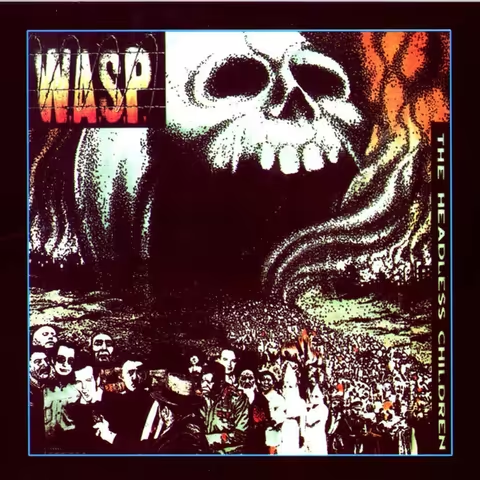
Blackie Lawless put Stalin, Hitler, Pol Pot, the Ku Klux Klan and Ayatollah Khomeini on the front of a W.A.S.P. album, replaced his shock-rock theatrics with a Pete Townshend cover, hired the drummer from Quiet Riot, and produced the entire record alone. The Headless Children, released on 21 March 1989, was the band's fourth studio LP and the moment the act most associated with foam blood, raw meat and a circular-saw codpiece quietly decided it wanted to be taken seriously.
It is also the W.A.S.P. record that sounds least like the W.A.S.P. of myth. The arrangements are longer, the keyboards (played by former Uriah Heep songwriter Ken Hensley) are higher in the mix, the rhythm section swings rather than gallops, and the lyric sheet quotes Reagan-era anxieties rather than rehearsing the Sunset Strip's usual menu of sex and demons. It sold harder than anything W.A.S.P. had managed before, broke them in Britain at number 8, broke Chris Holmes and Johnny Rod out of the band within twelve months, and effectively set up the Lawless solo project that became The Crimson Idol.
Album Facts
| Field | Detail |
|---|---|
| Artist | W.A.S.P. |
| Album | The Headless Children |
| Release date | 21 March 1989 |
| Label | Capitol Records |
| Producer | Blackie Lawless (sole producer) |
| Engineer and mixer | Mikey Davis |
| Mastering | Steve Hall at Future Disc; George Marino at Sterling Sound, New York |
| Genre | Heavy metal |
| Track count | 10 |
| Total runtime | 48:32 |
| Billboard 200 peak | 48 (13 weeks on chart, band's highest US position) |
| UK Albums Chart peak | 8 |
| Other notable chart peaks | Norway 13, Finland 18, Switzerland 19, Austria 19, Germany 22, Australia 55, Canada 76 |
| Certifications | UK Gold (BPI, 100,000 shipments) |
| Estimated sales | Not publicly itemised; UK sales above the Gold threshold of 100,000 |
| Key singles | Mean Man (February 1989), The Real Me (May 1989), Forever Free (28 August 1989) |
The world W.A.S.P. walked into in 1989
The Headless Children landed at a hinge moment for American heavy metal. Reagan had just left office. The Berlin Wall would fall later that year. Glam was still the dominant commercial sound on MTV, but Metallica's And Justice for All had reframed what serious metal looked like the previous autumn, Guns N' Roses had eaten the Sunset Strip whole with Appetite for Destruction, and the underground was already wired into the thrash and death-metal scenes that would soon make most hairspray-era acts feel quaint. Any band that had broken in the mid-eighties on the strength of its costumes was being asked, in 1989, what its songs were actually about.
W.A.S.P. had been asked that question more pointedly than most. Four years earlier, Animal (Fuck Like A Beast) had earned the group a place on the Parents Music Resource Center's Filthy Fifteen list, the small but loudly publicised collection of songs that Tipper Gore's group held up to congressional hearings in 1985. The PMRC fight produced the Parental Advisory sticker but it also produced an entire generation of metal frontmen who realised they were being judged solely on their most provocative single. The first three W.A.S.P. albums had a great deal of theatre and a great deal of pace, but they could be reduced to a punchline by anyone who wanted to. The Headless Children was the album where Lawless deliberately stopped writing punchlines.
From shock rockers to political metal band
The pivot is audible from the first thirty seconds of track one. The Heretic (The Lost Child) opens on a tolling guitar figure, builds slowly, lasts more than seven minutes and asks the listener to take the band seriously as composers. Across the album Lawless writes about nuclear deterrence, about a generation he calls decadent, about the squalor of Vietnam veteran homelessness, about institutional religion and about a chaotic and lonely society. The album's title track is structured as a panorama of news bulletins. Several songs explicitly name presidents, dictators and political ideologies. The hooks remain, the choruses remain enormous, but the territory has been rebuilt.
It would be a mistake to call it a concept album in the way that The Crimson Idol would become one three years later. The Headless Children does not have a narrator or a continuous story. What it has is a curated set of subjects, all of them angry, most of them political, with two carefully chosen outliers (the Pete Townshend cover and the long power ballad Forever Free) acting as breathing room between the heavier sermons.
The lineup change that everything else depended on
The single biggest variable on the record is who is sitting behind the drum kit. Steve Riley, who had played on the previous two W.A.S.P. studio albums, left to co-found L.A. Guns. In his place came Frankie Banali, who had spent the early eighties helping to define the sound of Quiet Riot on Metal Health, the first heavy metal album to top the Billboard 200. Banali is a different kind of drummer to Riley. He plays with a heavier shuffle, a more pronounced backbeat and a willingness to leave space, all of which suits the slower, longer arrangements Lawless was writing.
Banali is credited on the sleeve as an additional musician rather than a full member, but the relationship clearly worked. He stayed on for The Crimson Idol in 1992 and would remain associated with Lawless's work for years afterwards. Without that hire, it is hard to imagine The Headless Children sounding the way it does. The opening track alone would simply not survive a faster, punchier player.
The other arrival is Ken Hensley, who had written most of the songs that defined Uriah Heep's early-seventies prog-metal hybrid. Hensley appears on keyboards across the album, adding the swirling Hammond pads and church-organ inflections that give the title track and The Heretic their distinct theatricality. He, too, is listed as an additional musician. Chris Holmes and Johnny Rod, by contrast, remain full band members on the credits, although both would be gone within the year.
Blackie Lawless takes the producer chair
The Headless Children is the first W.A.S.P. studio album produced by Blackie Lawless alone. He had taken co-production credits before, but here the buck stopped with him for every musical decision. The signs are everywhere in the finished record: tracks routinely cross the five-minute mark; the dynamic range is wider than on any previous W.A.S.P. release; sections drop out to acoustic guitar or solo voice; choirs of backing vocalists appear; the keyboards are mixed forward rather than buried. None of that is the work of a producer trying to make a quick follow-up to a glam album. It is the work of a frontman trying to engineer his band's reinvention while it is being recorded.
Lawless was assisted in the room by engineer and mixer Mikey Davis, whose name appears on a string of late-eighties hard rock and metal records. Tom Nellen worked as the assistant engineer. Editing was handled by Rhonda Schoen. Steve Hall mastered the album at Future Disc; George Marino, the in-house mastering engineer at New York's Sterling Sound and one of the most quietly influential figures in American rock, cut the final master that went to vinyl and CD. The combination of a Los Angeles mix and a Marino master at Sterling is the sound much of late-eighties American hard rock used to want, and it is one of the reasons The Headless Children still translates well on modern playback systems.
Inside the recording sessions
Detailed studio diaries from these sessions have never been published in the same way they have for, say, contemporary Metallica or Def Leppard records. What is on the record itself, though, tells its own story. The drum sound is dry and close, the kick weighted but never triggered into the cartoonish cannon-fire of late-eighties hair metal. The rhythm guitars are double-tracked but allowed to breathe, with audible string noise and pick attack rather than the smeared chorus-heavy texture some of W.A.S.P.'s peers favoured. The vocal chain leaves Lawless's natural mid-range rasp intact rather than processing it into a sheen.
The longest single technical investment on the record is clearly Thunderhead. The choir credited on the song's backing vocals runs to eleven additional names, including Lita Ford, Diana Fennell, Mark Humphreys, Jimi Image, Minka Kelly, Thomas Nellen, Cathi Paige, Mike Solan and three Wallaces (Kevin, Melba and Ron). That is a lot of people in a room for one song, and it is a useful indicator of how much time Lawless and Davis were prepared to spend on a single arrangement. Thunderhead is six minutes and 45 seconds long and shares songwriting credit with Chris Holmes, which is rare on the album. Most of the rest of the record is a Lawless solo writing credit.
Personnel and credits
| Role | Player | Notes |
|---|---|---|
| Core band | ||
| Lead vocals, rhythm guitar | Blackie Lawless | Also sole producer |
| Lead guitar, acoustic guitar | Chris Holmes | Last W.A.S.P. studio album until 1997's Kill Fuck Die |
| Bass guitar, backing vocals | Johnny Rod | His final W.A.S.P. studio album |
| Additional musicians | ||
| Drums, percussion | Frankie Banali | Joined from Quiet Riot after Steve Riley's departure; first W.A.S.P. studio album |
| Keyboards | Ken Hensley | Formerly Uriah Heep's chief songwriter |
| Backing vocals on Thunderhead | Lita Ford, Diana Fennell, Mark Humphreys, Jimi Image, Minka Kelly, Thomas Nellen, Cathi Paige, Mike Solan, Kevin Wallace, Melba Wallace, Ron Wallace | Eleven-voice gang choir on the album's six-minute centrepiece |
| Production and engineering | ||
| Producer | Blackie Lawless | Sole production credit |
| Engineer and mixer | Mikey Davis | |
| Assistant engineer | Tom Nellen | |
| Editing | Rhonda Schoen | |
| Mastering | Steve Hall | Future Disc, Los Angeles |
| Mastering | George Marino | Sterling Sound, New York |
| Artwork | ||
| Art direction and sleeve design | John Kosh | Adapted from Daniel R. Fitzpatrick's political cartoon Gateway to Stalingrad |
The Real Me and the Pete Townshend gamble
Covering The Who is a high-risk move for almost any rock band, and it is a particularly high-risk move when the act doing the covering has spent four years being lampooned as a shock-rock outfit. The Real Me, originally a Pete Townshend composition from the 1973 rock opera Quadrophenia, sits second on The Headless Children's running order and lasts just three minutes 21 seconds. It is the shortest song on the album bar the instrumental Mephisto Waltz, and it works as a release valve after the slow, brooding opener.
What makes the cover succeed is the rhythm section. Banali's drumming closely tracks Keith Moon's tom-heavy energy without imitating it outright; Rod's bass picks up the melodic counterpoint that Quadrophenia's original arrangement gives to John Entwistle. Lawless does not try to out-sing Roger Daltrey. He simply attacks the lyric. The choice to release the song as the album's second single in May 1989 paid off in Britain, where the cover climbed to number 23.
The sessions also produced a second outside cover that did not make the album. Locomotive Breath, the Ian Anderson composition that opens side two of Jethro Tull's 1971 LP Aqualung, was tracked during the same sessions and released as the B-side of the Mean Man single. It would resurface decades later on the 1998 reissue of the album. Two outside covers on one record would have tipped the project too far towards a covers EP; releasing Locomotive Breath as a B-side gave the most committed W.A.S.P. fans something to collect without diluting the album's stated purpose.
Mean Man and the Chris Holmes problem
Mean Man is the song most non-W.A.S.P. fans can hum on demand. It also happens to be the album's most autobiographical lyric, although the autobiography is not Lawless's own. Lawless has been clear in interviews that he wrote Mean Man about Chris Holmes, the band's lead guitarist, whose drinking and on-tour behaviour by the late 1980s had become a story in itself. The song was openly dedicated to Holmes on its release. The chorus, in that light, reads less like a celebration than a slightly worried tribute.
It became the album's lead single in February 1989, climbed to number 21 in the UK and number 11 in Finland, and remains the most reliably anthologised W.A.S.P. song on greatest-hits collections. The song's strut is built on a half-speed shuffle that Banali could not have played in a galloping band; the riff, double-stopped and bluesy, is Holmes operating well within his comfort zone. There is a darker reading of the song that became unavoidable a few years later: Holmes's near-collapse in the Penelope Spheeris documentary The Decline of Western Civilization Part II: The Metal Years, filmed around 1986 but released in 1988, had already shown the world the version of him Mean Man is partly written about.
The title track and the Fitzpatrick cover
The album's title song is the centrepiece of its political case. Five minutes and 47 seconds long, structured around a slow, churning verse and a chorus that opens out into one of the biggest hooks Lawless ever wrote, it is intended as a panoramic survey of a society that has lost its way. The artwork supports the same reading. John Kosh, a British designer best known for sleeve work with The Beatles (Abbey Road and Let It Be) and the Rolling Stones, took as his starting point a 1942 political cartoon by Daniel R. Fitzpatrick called Gateway to Stalingrad and rearranged it for a band trying to make a point about the late twentieth century.
The figures grouped around the sleeve are a deliberately discomforting roll call: Stalin, Hitler, Himmler, Mussolini, Charles Manson, Jim Jones, Idi Amin, Pol Pot, Al Capone, Klansmen and Ayatollah Khomeini. There is no nuance in the selection; that is the point. The same chaos Lawless writes about in the lyric is staring out of the artwork. It is a cover that, in any other band's hands, would risk being read as a clumsy provocation. In the context of the album it lands as the visual mission statement.
The Neutron Bomber and Lawless's two stories
Track six raises one of the album's more interesting interpretive questions, because the songwriter has on the record given two distinct accounts of what it is about. In some interviews, Lawless has framed The Neutron Bomber as a meditation on Ronald Reagan and the power of America's nuclear arsenal. The album dropped a few months after Reagan left office, which lends weight to the reading; the lyrics about an unaccountable man with the power to incinerate cities are easy to map onto a sitting president.
In a May or June 1989 Metal Forces interview, however, headlined Headhunter, Lawless told a quite different story: that the song is about a guy named Ronny he grew up with on Staten Island, a serial arsonist who, by the time of the interview, was reportedly serving triple life. Both versions are on record from Lawless himself. The most plausible reading is that both are true at once, in the way a lot of songwriters work, building a political metaphor on top of a real biographical character so that the lyric works on two scales simultaneously.
Forever Free, Maneater and Rebel in the F.D.G.
Forever Free, the album's third single, released on 28 August 1989, is a power ballad in the late-eighties American sense: piano intro, slow build, twin-tracked guitar solo and a chorus aimed squarely at lighters in arenas. It is most often described as a deliberate homage to Lynyrd Skynyrd's Free Bird, which it resembles in shape if not in length. It reached number 25 in the UK, the lowest-charting of the three singles, and is the song most associated with the album's softer side.
Maneater, by contrast, is a return to the album's heavier instincts. A four-minute 46-second rocker driven by Banali's shuffle, it is one of two songs on the record whose subject is openly female (the other is Thunderhead). Rebel in the F.D.G. closes the album with five minutes eight seconds of mid-tempo defiance. The initials F.D.G. are explained in the liner notes as standing for Fucking Decadent Generation, a phrase that places the song firmly in the same diagnostic territory as the title track. The closing position is deliberate; Lawless wanted the album to end with a statement of position, not a fade.
Mephisto Waltz, Thunderhead and The Heretic
Three songs frame the album's argument. Mephisto Waltz, a one-minute 27-second instrumental in seventh position, acts as the divider between the two halves of the record. It is short enough to feel like a hinge rather than a track in its own right, and it gives the album a clear structural breath before Forever Free changes the mood.
Thunderhead, six minutes 45 seconds long and co-written with Holmes, is the album's most maximal arrangement: the eleven-voice choir, the long instrumental passage, the multiple key changes. The Heretic (The Lost Child) opens the record at seven minutes 16 seconds and is also a Lawless-Holmes co-write. The pair of songs bracket the album's first and middle thirds, and they are the strongest evidence that the songwriting collaboration between Lawless and Holmes still had life in it on the day the tapes rolled. The same partnership would not survive the touring cycle.
Tracklist
| # | Title | Writer(s) | Length | Single? | Notes |
|---|---|---|---|---|---|
| 1 | The Heretic (The Lost Child) | Lawless, Holmes | 7:16 | Long album opener; one of two Holmes co-writes | |
| 2 | The Real Me | Pete Townshend | 3:21 | UK 23 (single 2) | The Who cover from Quadrophenia (1973) |
| 3 | The Headless Children | Lawless | 5:47 | Title track and thematic centrepiece | |
| 4 | Thunderhead | Lawless, Holmes | 6:45 | Eleven-voice backing-vocals choir including Lita Ford | |
| 5 | Mean Man | Lawless | 4:50 | UK 21, Finland 11 (single 1) | Lyrical portrait of and dedication to Chris Holmes |
| 6 | The Neutron Bomber | Lawless | 4:03 | Reagan-era nuclear politics layered over a Staten Island arsonist | |
| 7 | Mephisto Waltz | Lawless | 1:27 | Short instrumental hinge between sides | |
| 8 | Forever Free | Lawless | 5:09 | UK 25 (single 3) | Power ballad widely read as an homage to Free Bird |
| 9 | Maneater | Lawless | 4:46 | Banali shuffle, heavy riff, late-album return to form | |
| 10 | Rebel in the F.D.G. | Lawless | 5:08 | F.D.G. explained in the liner notes as Fucking Decadent Generation |
Total runtime: 48:32 across 10 tracks. The 1998 reissue extends the running order with bonus material, addressed in the reissues section below.
Singles, B-sides and music videos
Three singles were lifted from the album over the course of 1989, in an order designed to maximise its British momentum:
- Mean Man, released February 1989. Peaked at number 21 in the UK and number 11 in Finland. B-side: Locomotive Breath, the Jethro Tull cover tracked during the album sessions but held back from the LP.
- The Real Me, released May 1989. Peaked at number 23 in the UK. The single's strongest international performance.
- Forever Free, released 28 August 1989. Peaked at number 25 in the UK. The album's softest moment leveraged for late-summer ballad airplay.
The British strategy worked. Three top-30 singles inside seven months kept the album visible long enough to drive it up to number 8 on the Albums Chart and across the BPI Gold threshold of 100,000 shipments. By the same point in the US the record had peaked at number 48 and spent 13 weeks on the Billboard 200, the highest position the band had ever reached but a more modest commercial outcome than the UK numbers. The choice of three singles, rather than four, was unusually disciplined for a major-label heavy metal record of the period.
Release, charts and critical reception
Released on 21 March 1989 per Billboard's listings of the period, The Headless Children arrived to a critical reception that ranged from cautious approval to genuine enthusiasm. Greg Prato, reviewing the album retrospectively for AllMusic, gave it four and a half stars out of five and called it "W.A.S.P.'s most accomplished work" and the band's "best constructed album", singling out The Real Me, Mean Man, The Heretic, Forever Free and the title track as the record's strongest moments.
Contemporary reviews were similarly favourable. Thomas Kupfer in Germany's Rock Hard awarded the album 7.0 out of 10, ranking it second only to the debut in the band's catalogue at that point, noting that the song structures were simpler and more melodic than on the previous record and that Lawless's voice remained undimmed by the heavier touring of the mid-eighties. The American magazine CD Review (September 1989) was cooler, giving the album 6 out of 10 in a Robert Santelli review. Martin Popoff's Collector's Guide to Heavy Metal, looking back from 2005, gave it 7 out of 10 and described it as:
"The W.A.S.P. record for those who don't like W.A.S.P., hollow, damp and alone, integrity discovered, humanity revealed."
Martin Popoff, The Collector's Guide to Heavy Metal, 2005
The chart story told the rest of the case. UK number 8 was by some distance the highest W.A.S.P. position on the Albums Chart up to that point. Across continental Europe the album reached the top 20 in Norway (13), Finland (18), Switzerland (19), Austria (19) and Germany (22). Outside Europe it peaked at 55 in Australia and 76 in Canada. The Billboard 200 peak of 48 was the band's American ceiling and would never be exceeded by any subsequent W.A.S.P. studio LP, although several would chart in the wider Billboard 200.
Touring and live history
The Headless Children tour, in late 1989, took the band through Europe in support of the album and is now best remembered for the Hammersmith Odeon shows in London. Two live tracks from those Hammersmith performances, L.O.V.E. Machine (four minutes 47 seconds) and Blind in Texas (six minutes 23 seconds), would resurface on the 1998 CD reissue of the album, and they capture a version of the band running the new material alongside the established singles in front of a sold-out British audience.
The tour also exposed the strain inside the lineup. By the time the band came off the road, Chris Holmes was finished with W.A.S.P., at least for the moment, and Johnny Rod was on his way out as well. Both left in 1990, ending what had been the band's most consistent personnel run. The Headless Children would prove to be the final W.A.S.P. studio album to feature Chris Holmes until he returned for 1997's Kill Fuck Die, and the last to feature Johnny Rod in any capacity. Frankie Banali was the only one of the new arrivals who would carry on into the next phase of the band.
The aftermath: breakup and The Crimson Idol
The 1990 departures effectively closed the chapter. Lawless announced that W.A.S.P. were finished, retreated from the road, and began work on what was originally conceived as a solo album. By the time the project crystallised it had become The Crimson Idol, a concept album about the rise and fall of a fictional rock star, released in 1992 under the W.A.S.P. name. Banali stayed on as the drummer; the rest of the players were different. The decision to rebadge the project as W.A.S.P. rather than as a Blackie Lawless solo record is what allowed the band to survive past 1990, and that decision is unimaginable without the credibility and chart performance The Headless Children had bought him eighteen months earlier.
In that sense The Headless Children is the structural pivot of W.A.S.P.'s entire catalogue. Before it, the band were a shock-rock act with diminishing returns. After it, they were a recognised heavy metal songwriting vehicle for Blackie Lawless, capable of carrying long-form concept records, and they have remained essentially that act for more than three decades. The album does not just contain the band's best songs of the period; it changes what the band is for.
Artwork and packaging
The sleeve, as already noted, is the work of British designer John Kosh, whose CV by 1989 already included Abbey Road, Let It Be, ELO's Out of the Blue and several Rolling Stones projects. The original Fitzpatrick cartoon Gateway to Stalingrad dates from 1942, when Fitzpatrick was the editorial cartoonist for the St. Louis Post-Dispatch, and was originally a comment on the eastern front of the Second World War. Kosh borrowed the visual structure (a stylised gateway with figures crowded around it) and replaced the original cast with a more contemporary group of twentieth-century villains.
The choice to credit the source cartoon openly on the sleeve was unusual for a metal release of the period. It signalled that the band wanted the album's politics to be read seriously, not as shock-rock shorthand. The packaging matches the artwork in tone: the gatefold and inner sleeve are dominated by lyric printing and a credits list rather than the live photographs and stage shots that had decorated previous W.A.S.P. records.
Reissues, remasters and anniversaries
The most significant reissue of The Headless Children appeared in 1998, when the album was remastered and released as an expanded CD with six bonus tracks. They were:
- Locomotive Breath (Ian Anderson / Jethro Tull cover, 2:59), originally the B-side of Mean Man.
- For Whom the Bell Tolls (3:47), a non-album cut not to be confused with the Metallica song.
- Lake of Fools (5:29).
- War Cry (5:33).
- L.O.V.E. Machine (4:47), live at the Hammersmith Odeon in 1989.
- Blind in Texas (6:23), live at the Hammersmith Odeon in 1989.
One technical consequence of the reissue is worth flagging for anyone comparing run times: in order to fit the bonus tracks onto a single disc, the opening track The Heretic (The Lost Child) was edited down from its original 7:16. Fans who want the full original arrangement of the opener should look for the 1989 vinyl or first-pressing CD rather than the 1998 remaster. Later reissues on Snapper, Madfish and other catalogue specialists have followed broadly the same approach, generally keeping the bonus tracks intact.
Legacy and influence
The Headless Children does not turn up on the most-cited critical lists of essential heavy metal records, in part because W.A.S.P. as a brand has remained a marmite proposition in metal criticism. Where it has been consistently championed is among writers and musicians focused on the period's transitional records: the late-eighties acts that tried to grow up at the same time as their audience. AllMusic's positioning of it as the band's most accomplished album has been echoed by retrospective coverage in Classic Rock, Metal Hammer and a string of online metal outlets.
The album also has a peculiar afterlife as a gateway record. It is the W.A.S.P. album most often pressed on listeners who think they do not like W.A.S.P., precisely the audience Martin Popoff identified. The Mean Man riff has been quoted, parodied and covered by enough younger bands to qualify as part of the heavy metal vocabulary. Forever Free turns up on metal-ballad compilations alongside November Rain and Home Sweet Home. The title track remains a fixture of W.A.S.P. live sets more than thirty years after release, often in extended form.
What the album most directly enabled, though, is the body of work that followed. The Crimson Idol would not exist in its eventual form without the proof of concept supplied by The Headless Children: long-form songs, theatrical arrangements, a willingness to write outside the shock-rock playbook. Lawless has effectively spent the rest of his career building on the territory mapped out on this record. The 1989 album is where W.A.S.P. became a songwriting concern rather than a stage act with songs attached.
Things you might not know
| Fact | Detail |
|---|---|
| The cover's source | John Kosh's sleeve is a direct rework of Gateway to Stalingrad, a 1942 political cartoon by St. Louis Post-Dispatch artist Daniel R. Fitzpatrick, recast for the late twentieth century. |
| The Heretic was shortened | To fit six bonus tracks onto the 1998 reissue CD, the seven-minute 16-second opener The Heretic (The Lost Child) was edited down from its original length. |
| The eleven-voice choir | Thunderhead's backing vocals are sung by eleven additional vocalists including Lita Ford, three members of the Wallace family and assistant engineer Tom Nellen's brother Thomas. |
| Two stories for one song | Lawless has given two accounts of The Neutron Bomber on record: a Reagan-era political metaphor in some interviews, and in a 1989 Metal Forces piece a portrait of a Staten Island arsonist named Ronny serving triple life. |
| The unused second cover | The sessions produced a second outside cover, Jethro Tull's Locomotive Breath, which was released as the B-side of Mean Man rather than included on the album to avoid tipping the project towards a covers EP. |
| F.D.G. spelled out | The closing track Rebel in the F.D.G. uses an initialism explained in the liner notes as Fucking Decadent Generation, a phrase that anchors the album's politics back to its title track. |
| Mean Man's dedication | The lead single was openly dedicated to Chris Holmes on release. Lawless has confirmed in interviews that the song's subject is Holmes's own lifestyle on the road. |
| Banali's previous job | Frankie Banali, the drummer on this record, had played on the first heavy metal album ever to top the Billboard 200: Quiet Riot's Metal Health, in 1983. |
| Hensley's day job before | Keyboardist Ken Hensley wrote the bulk of Uriah Heep's early-seventies catalogue, including Lady in Black, July Morning and Easy Livin'. |
| Marino at Sterling | The final master was cut by George Marino at Sterling Sound in New York, the same engineer behind master cuts for Led Zeppelin, AC/DC and a long list of canonical hard rock records. |
| Hammersmith captured | Two of the bonus tracks on the 1998 reissue, L.O.V.E. Machine and Blind in Texas, are live recordings from the band's 1989 Hammersmith Odeon shows on the Headless Children tour. |
| The PMRC backdrop | W.A.S.P. were one of the original Filthy Fifteen acts named in the PMRC's 1985 hearings, and The Headless Children is the album where Lawless visibly answered that scrutiny rather than ignored it. |
| Highest US chart position | The Billboard 200 peak of number 48 remains the highest US chart position W.A.S.P. ever achieved with a studio album. |
| UK BPI Gold | The British Phonographic Industry certified the album Gold in the UK for shipments above 100,000, a level no later W.A.S.P. studio album would reach in Britain. |
How to listen now
The album is widely available on the major streaming services in its 1998 remastered form, which means listeners who stream rather than buy will be hearing the slightly shorter edit of The Heretic (The Lost Child) and the six bonus tracks at the end of the running order. For the original sequencing and the uncut opener, the format of choice is the 1989 vinyl LP or first-pressing CD, both of which remain easy to find on the second-hand market at sensible prices. Madfish and Snapper have handled various territorial reissues across the catalogue over the years; condition rather than pressing date is usually the more important variable when buying second-hand.
For the curious, the order of listening that makes the strongest case for the album is the one Lawless arranged in 1989: tracks one through ten in sequence, with Mephisto Waltz functioning as the intentional breath between sides. Skipping straight to Mean Man, while understandable, undersells what the record is trying to do. The Headless Children is one of the relatively rare hard rock albums of its era that improves on full sit-down listening rather than on shuffle, and it is best heard that way.
The Riffology podcast
This piece is a written companion to a long-running podcast about the records that built heavy music. If the band, the producer or the era are of interest, the Riffology podcast covers Album Deep Dives like this one in conversational form. It is available on Apple Podcasts, Spotify and every other major podcast platform under the name Riffology.
Comments