Most landmark debuts arrive after years of writing, demoing and second-guessing. Left Hand Path arrived after about a week. Entombed walked into Sunlight Studio in Stockholm in December 1989 with three of their best songs written in the days before the session, no permanent bass player on the strength, and a producer who was still figuring out what a death metal record should sound like. They walked out with the founding document of an entire scene.
The album that emerged on 4 June 1990, on Earache Records in the United Kingdom and on Combat Records in North America that December, did not chart in any meaningful way. What it did instead was set the template for Swedish death metal so completely that the guitar tone alone, a Boss HM-2 pedal with every knob set to ten, would still be the sound people meant thirty-five years later when they said the words Sunlight sound out loud.
Album Facts
| Field | Detail |
|---|---|
| Artist | Entombed |
| Album | Left Hand Path |
| Release date | 4 June 1990 (UK, Earache); 7 December 1990 (US, Combat) |
| Label | Earache Records (UK); Combat Records (US) |
| Producer | Tomas Skogsberg with Entombed |
| Studio | Sunlight Studio, Stockholm, Sweden |
| Recorded | December 1989, in under a week |
| Genre | Death metal |
| Track count | 10 (LP); 12 with CD bonus tracks Carnal Leftovers and Premature Autopsy |
| Total runtime | 39:16 (core LP) |
| Cover artist | Dan Seagrave |
| Billboard 200 peak | Did not chart |
| UK Albums Chart peak | Did not chart |
| Certifications | None reported |
| Key singles | Left Hand Path; Drowned |
| Notable accolades | Decibel Hall of Fame inductee (August 2005); No. 82, Rolling Stone 100 Greatest Metal Albums of All Time (2017) |
Cultural Context: Stockholm, 1989
To understand why a record cut in a small Stockholm studio mattered so much, it helps to remember what death metal sounded like in late 1989. The genre had a centre of gravity, and that centre was in Florida. Death's Leprosy and Morbid Angel's Altars of Madness had defined a high-precision, almost technical strain of the music, recorded with engineers who wanted clarity and separation. The European underground was producing thrash that was getting nastier by the month, but the lines between thrash, grindcore and death metal were still being drawn in fanzine ink.
Stockholm in 1989 was the wrong city, on paper, to upend any of that. The country was still working through the political aftershocks of Olof Palme's 1986 assassination, the Berlin Wall had only just come down a few weeks before Entombed entered the studio, and the local rock industry's interest in extreme music was effectively zero. What the city did have was a small, hyperactive tape-trading network, a clutch of teenage bands who had moved on from Slayer and Celtic Frost into something blacker, and a producer who would record almost anyone, almost any time, for not very much money.
The band itself was made up of people who had grown up in the suburbs to the south of the city, who had been swapping demos with the same handful of friends since they were children, and whose entire frame of reference was European extreme music plus a deep and unembarrassed love of low-budget horror films. Most of them were still teenagers when they recorded the album that defined a scene, with Petrov and Andersson both seventeen at the time of the December 1989 sessions.
The wider context in heavy music that month is worth marking. Slayer's Seasons in the Abyss was still six months from release. Megadeth's Rust in Peace would not arrive until September. Pantera's Cowboys from Hell was in the same window. Death's Spiritual Healing and Obituary's Cause of Death had landed in the spring. Against that crowded field, an Earache debut by an unknown Stockholm four-piece had no obvious lane. The fact that the record ended up defining a regional sound rather than getting buried under the American releases of 1990 is itself a small commercial miracle, and one largely engineered by Digby Pearson's label work in Nottingham rather than by anything radio or print did for the band at home.
From Nihilist to Entombed
Entombed did not arrive fully formed. The band evolved directly out of Nihilist, a Stockholm five-piece that had been responsible for several widely traded demos in 1987 and 1988 and whose line-up overlapped almost entirely with the eventual Entombed roster. Nihilist included Nicke Andersson on drums, Alex Hellid on guitar, Uffe Cederlund on guitar, Lars-Goran Petrov on vocals and Leif Cuzner on guitar at various points across the band's short life.
Nihilist split in 1989. The reasons were the usual catalogue of teenage band-room politics, but the practical effect was that within weeks the same musicians were rehearsing again under a new name with a slightly tightened mission statement. Cuzner had drifted out of regular rehearsals by then, although his fingerprints were on the music in ways that would matter enormously by the time the record came out. Petrov was confirmed as the vocalist. Cederlund and Andersson would split bass duties because there was no one else to do it.
The decision to rebrand mattered. Nihilist's demos had circulated widely enough that the band could have traded on the name; instead they walked away from it and started again at zero. Entombed was a clean slate, and the songs being written for the first record reflected that. The riffs were dirtier, slower in places, more confident in their willingness to ugly themselves up. The Florida bands were sharpening their music; Entombed were deliberately blunting theirs.
The Sunlight Sound: Tomas Skogsberg and the Buzzsaw
Tomas Skogsberg ran Sunlight Studio out of a basement in the south of Stockholm. His back catalogue at the point Entombed booked in for Left Hand Path was a mix of demos for local thrash bands and oddments of pop, and his approach was almost entirely empirical. He liked to plug things in, see what happened, and keep what worked. He did not have a house sound so much as a willingness to chase one.
The signal chain that became famous is now well documented. Two guitars were tracked in B standard through Boss HM-2 Heavy Metal pedals with all four knobs, high EQ, low EQ, distortion and level, dialled hard right to ten. A third guitar ran through a Boss DS-1 in the centre of the mix alongside the bass, doubling the low end and giving the wall of HM-2 its bottom. The amplifier most often associated with the sound is a small Peavey Studio Pro 40 combo, which had no business producing a record of that physical weight and somehow did anyway.
The HM-2 is a stomp box that Boss had originally marketed to American hair-metal players in the mid-1980s and that nobody at Boss could possibly have imagined being used the way Entombed used it. With everything maxed it produces a thick, scooped, almost overloaded distortion that sounds, on first hearing, like a chainsaw being dropped onto a microphone from a height. Skogsberg's role was less to invent that sound than to recognise that it was the sound, to mic it properly, and to commit to it across an entire record without trying to clean it up.
"One of the most gruesomely perfect pieces of Swedish death metal ever committed to tape."
Metal Hammer, 2020
Leif Cuzner and the Birth of the HM-2 Tone
Credit for the Sunlight tone has shifted around since 1990. Skogsberg has often been named as its architect, which is fair in the sense that he was the engineer who captured and refined it. The band themselves have been clear in interviews, however, that the original creative leap belongs to Leif Cuzner. Cuzner, the Nihilist guitarist who did not quite make it through to the Entombed sessions, was the first player in their circle to twist every knob on the HM-2 to maximum and treat the resulting noise as a feature rather than a fault to be corrected.
Andersson has been particularly explicit about the lineage. Cederlund has too. Cuzner was a co-writer on a substantial portion of the Left Hand Path material, which is why his name appears alongside Andersson's and Cederlund's on the all-music composition credit on the back of the sleeve. He did not play on the record itself, but the riffs and the tone that defined it would not have existed in the form they did without him. He died in 2006, and the story of who really invented the buzzsaw has been one of the recurring corrections in the Swedish death metal literature ever since.
That kind of history matters. Sound credits in metal are often slippery, and Sunlight Studio is the case study. The tone has been adopted, in fits and starts, by everyone from At the Gates and Dismember through to second-wave hardcore bands like Nails and Trap Them in the 2010s. The cleanest historical account points back through Sunlight to the HM-2 to the kid in the rehearsal room who first noticed what happened if you stopped being polite with the gain.
Pre-production and the Songs Written in a Week
Pre-production for a record like Left Hand Path is a generous term. A substantial chunk of the album existed before the band booked the studio in late 1989, in some cases in versions already trialled in Nihilist's set. But three of its most defining cuts, the title track, Drowned and Bitter Loss, were written in the days immediately before the band rolled in. Cederlund has been candid about this in interviews; he has retrospectively called those tracks really sloppy, which is the kind of thing only a guitarist who knows his record went on to define a genre can afford to say.
The songwriting model was collaborative but uneven. Andersson, in addition to drumming on the record, was the dominant musical voice and the de facto bandleader. He wrote or co-wrote every track. Hellid contributed riffs and lyrical ideas; Cederlund contributed riffs and arrangement ideas; Cuzner's input was felt on the older material that had crossed over from Nihilist. Lyrics were shared between Andersson and Hellid.
The practical effect of writing songs days before tracking them was that some lyrics were not finalised until the band were in front of the microphone. Petrov has told a story that has become a small piece of Sunlight folklore: Andersson would stand behind him in the vocal booth holding a lyric sheet, pointing at the lines he was supposed to deliver next, because the running order on the page had been amended that morning and there had been no time to copy it cleanly. It is the kind of detail that explains the record's atmosphere of barely controlled urgency.
Recording in Sunlight Studio, December 1989
The sessions took place across a handful of days in December 1989. The exact day count varies depending on who is asked; the consensus is somewhere between five and seven, with mixing folded into the same window. The studio itself was not large. Skogsberg's room had a live area sized for a small rock band, a control room dominated by a modest console and outboard rack, and a culture in which the engineer-producer often played as many roles as the musicians did.
The tracking order followed the usual logic of a budget death metal session of the period. Drums first, with Andersson cutting takes against scratch guitars; then the rhythm guitars layered up; then bass, split between Cederlund and Andersson; then Petrov's vocals; then overdubs and any solos. The whole record was tracked to tape and mixed in the same building, with little if any work farmed out elsewhere.
- Two HM-2 rhythm guitar tracks in B standard, hard panned.
- A third centred guitar running through a Boss DS-1 to fatten the low end.
- Bass split between two non-bass players, with no permanent low-end specialist on staff.
- Vocals tracked with Andersson cueing lyrics from behind the singer.
- Whole record cut, overdubbed and mixed in under a week.
The economy of the production was forced rather than chosen, but it bled into the record's character. Left Hand Path sounds like a band committing to first instincts because they had no time to second-guess them, and like an engineer mic-ing a sound he liked and then refusing to apologise for it on the way out. It is one of the great rebuttals to the idea that money makes records sound better.
The mix itself does very little that draws attention to itself. There is almost no panning trickery beyond the hard-left and hard-right placement of the two HM-2 rhythm tracks. There are no notable reverb tails, no spatial effects on the vocals, no synthetic doubling. The whole record reads as a single, dense pane of distorted sound with Petrov's voice sitting flat on top of it. That deliberate refusal to decorate the production is one of the reasons the album dated so much better than its more polished American contemporaries. The record is not trying to sound modern; it is trying to sound like the band, and the band sounded like that.
Tracking Without a Bassist
The bass story is more interesting than the sleeve credits suggest. The band had no settled bassist when they walked in, so Cederlund and Andersson agreed to alternate. The split was simple in concept: one of them would track bass on a given song, the other would take the next one, and on it went through the running order. In practice the assignments have blurred slightly with time. Cederlund has said he believes he played bass on Drowned and Revel in Flesh; the album's actual credits list bass as shared between the two of them across the record without a track-by-track breakdown.
The decision had a sonic consequence. Neither player was a specialist, neither was particularly interested in writing bass parts that operated independently of the riff, and so the bass on Left Hand Path very largely shadows the rhythm guitars. That fits the record's logic. The DS-1 third guitar already lives in the centre of the mix with the bass. The combined effect is a single, sustained slab of low-mid frequency information that hits the ear as one unified weight. The lack of a permanent bassist did not produce a record with thin bass. It produced a record where the bass became indistinguishable from the rest of the wall.
The Songs
| # | Title | Writers | Length | Single? | Notes |
|---|---|---|---|---|---|
| 1 | Left Hand Path | Andersson / Hellid / Cederlund / Cuzner | 6:41 | Yes | Title track; Phantasm theme quoted at 3:54 |
| 2 | Drowned | Andersson / Cederlund | 4:04 | Yes | Written days before the session |
| 3 | Revel in Flesh | Andersson / Hellid | 3:45 | No | Cederlund recalls tracking bass |
| 4 | When Life Has Ceased | Andersson | 4:13 | No | Mid-paced doom-leaning groove |
| 5 | Supposed to Rot | Andersson | 2:06 | No | Shortest and most direct cut on side one |
| 6 | But Life Goes On | Andersson / Hellid | 3:02 | No | Carry-over from the late Nihilist era |
| 7 | Bitter Loss | Andersson | 4:25 | No | Written days before the session |
| 8 | Morbid Devourment | Andersson / Cederlund | 5:27 | No | Long-form workout, lurching tempos |
| 9 | Abnormally Deceased | Andersson | 3:01 | No | Furthest into pure grind territory |
| 10 | The Truth Beyond | Andersson / Hellid | 3:28 | No | Album closer on the LP edition |
Left Hand Path opens the record at a luxurious six minutes and forty-one seconds, longer than almost anything else in its style at the time. The riff is built on a circular descending line that does not so much resolve as keep collapsing in on itself. At 3:54 the song slows almost to a halt and the lead guitar quotes the main theme from Don Coscarelli's 1979 horror film Phantasm in plain hearing. The quotation is so undisguised it functions as a kind of cinematic handshake; Andersson has spoken about the band's relationship with horror video as a formative one, and the Phantasm theme makes that lineage explicit on the record's first track.
Drowned is the album's clearest single-shaped song. It is the shortest of the first three cuts, the most direct in its structure, and the one that has been the easiest to lift out and present in isolation. It was written days before the session and was tracked, like most of the record, with the kind of fast efficiency you can only manage when there is no time to deliberate. It became the song that journalists most often reached for when they needed a single piece of music to represent the album, and it remains one of the most covered cuts in the Swedish death metal canon.
The middle of the record is where the band's range becomes obvious. When Life Has Ceased is a slower, almost crawling piece that anticipates the doom-death hybrid bands that emerged from Britain a year or two later. Supposed to Rot is the album's compact attack, a two-minute burst that owes as much to grindcore as to death metal. Morbid Devourment, at five and a half minutes, is the most ambitious arrangement on the record, lurching between mid-paced grind and a closing section that almost slows into hardcore. Abnormally Deceased takes the grind influence furthest. The Truth Beyond closes the LP with a sense of grim finality that fits the album's title without belabouring it.
"One of the greatest metal songs ever composed."
Invisible Oranges, on the title track
Lyrics, Occultism and the Title
The album's title comes from the left-hand path of Western occult tradition, a phrase used by writers from Helena Blavatsky onwards to designate antinomian, individualist or transgressive spiritual practices in contrast to the right-hand path of orthodox religion. Alex Hellid found the specific phrasing in Anton LaVey's The Satanic Bible and brought it to the band; Nicke Andersson made the final call to use it as the album's name.
The lyrics, written between Andersson and Hellid, range across the standard early-death-metal preoccupations of bodily decay, mortality, anti-religious sentiment and personal autonomy. The title track is a manifesto of self-direction rather than a piece of Satanic theatre; the imagery elsewhere on the record draws more from horror cinema and from a kind of European materialist disgust with the body than it does from any structured occult system. The album is not a doctrinal record. It is a record that borrows the vocabulary of occultism to do something more local, which is to clear a space for the band's own sound and outlook against the orthodoxies of the genre it was helping to invent.
Dan Seagrave and the Cover Art
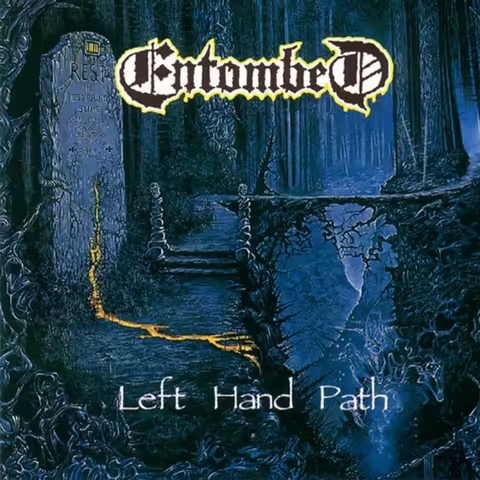
The sleeve of Left Hand Path was painted by Dan Seagrave, the English illustrator whose work in the late 1980s and early 1990s effectively defined the visual aesthetic of first-wave death metal. Seagrave's commission for the album produced a decaying biomechanical landscape: a cracked, ribbed structure receding into a sickly green-and-brown gloom, with a faint suggestion of a face or skull built into the geometry of the architecture. It is one of the most reproduced images in death metal sleeve art and the cover that anchored Seagrave's career.
The visual identity of the record matters in a specific way. By 1990, death metal was still working out what it was supposed to look like; record sleeves were oscillating between bad horror-comic illustration, grainy black-and-white photo collage and badly executed Photoshop predecessors. Seagrave's painted, almost airbrush-clean approach gave the genre something it had not had before, which was a visual register that could carry the music's atmosphere without resorting to cartoon gore. Sleeves for Suffocation, Gorguts and many others would soon follow the same template.
Release, Reception and the Critical Verdict
Earache Records released Left Hand Path on 4 June 1990 in the United Kingdom; Combat Records, then a Relativity imprint, picked the album up for North America and released it on 7 December 1990. There was no significant chart action in either territory. Death metal in 1990 was an album-cycle business conducted through tape trading, fanzines, college radio and a thin distribution network of specialist mail order companies. Sales numbers from that period are unreliable; the record's commercial impact lived in slow, steady cult accumulation rather than in opening-week figures.
Critical response at the time was scattered. Entertainment Weekly's David Browne reviewed the album in January 1991 and graded it C, a verdict that reads now less as informed criticism than as an accurate snapshot of how thoroughly the mainstream rock press was failing to engage with the music being made at the bottom of its own circulation map. The specialist metal press in Britain and continental Europe was more welcoming, and the album spread through fanzines and word of mouth at a pace that the major reviews never quite captured.
The retrospective verdict has been more emphatic. AllMusic's Jason Birchmeier described the record as an accomplishment in the death metal genre that foreshadowed the pivotal role that Scandinavia would soon play. Metal Hammer in 2020 placed it among the best metal albums of the 1990s and ranked it ninth on its list of the greatest death metal albums of all time. Kerrang's Chris Krovatin has written that the record moved away from the bloody mess of most of the era's death metal, instead favoring a sense of grim decay. Rolling Stone placed it at No. 82 on its 2017 list of the 100 Greatest Metal Albums of All Time. Decibel inducted it into its Hall of Fame in August 2005, naming it the first proper Swedish death metal album.
"May be the most copied Swedish metal record ever."
Andy O'Connor, SPIN, 2023
"As perfect a Swedish death metal album as there was in 1990."
Greg Pratt, Decibel, 2021
Touring and the Underground Spread
The touring picture in support of Left Hand Path has been less thoroughly documented than the record itself. Entombed played extensively across Europe in 1990 and 1991, often on small package bills with other Earache artists and other underground death metal bands; the band's profile in Britain was strong enough that Earache could route them through clubs and small theatres that paid well enough to keep them on the road. North American touring was thinner, partly because of visa and logistical constraints and partly because the Combat distribution effort was less aggressive than Earache's home market push.
The record's spread, in the end, was less a function of live shows than of the underground tape and mail-order ecosystem that defined the genre in that period. By 1991, a kid in Texas or in Brazil or in Japan was as likely to have a dub of the album from a tape trader as a Combat-pressed CD on their shelf. That mode of distribution flattered the music. Cassette copies of Left Hand Path sounded only slightly worse than the original, because the original was so deliberately rough at the source that the format barely degraded it.
Covers, Tributes and the Sunlight Lineage
The covers history is the clearest evidence of the record's transmission. The Belgian death metal band Aborted covered Drowned for the re-release of their 2005 album The Archaic Abattoir and recorded a version of the title track for the EP Coronary Reconstruction. Dozens of less famous bands have versioned the same two songs across compilation albums, split releases and bonus discs in the years since. The pattern is consistent: of the album's ten tracks, Drowned and Left Hand Path are the ones the world chose to keep.
The Sunlight lineage is the broader story. Skogsberg's studio became, almost immediately after Left Hand Path, the default place for a Swedish death metal band to record. Dismember's Like an Ever Flowing Stream, Grave's Into the Grave, Unleashed's Where No Life Dwells and Entombed's own follow-up Clandestine all came out of the same room within eighteen months of the debut. The signal chain Skogsberg refined for Entombed was the chain those records used, and the resulting wall of HM-2 distortion became indistinguishable, on first hearing, from band to band. That sameness was the point. A scene defined itself in part by sharing a sound.
Beyond Sweden, the influence has surfaced in unexpected places. American hardcore bands like Nails, Trap Them, Black Breath and Disfear (the latter eventually fronted, briefly, by Tomas Lindberg of At the Gates) all worked variations on the Sunlight tone in the 2000s and 2010s. The HM-2 became a piece of equipment with its own folklore, sold-out reissues and online cult, all traceable, in one line, back to a kid in Stockholm who decided to set every knob to ten and to a record that proved he was right.
Boss themselves eventually acknowledged the second life of the pedal. The HM-2W Waza Craft reissue, released decades after the original was discontinued, was pitched explicitly at the death metal market that had refused to let the pedal die. The marketing copy talked about the buzzsaw sound by name. It is a strange kind of corporate humility for a Japanese effects manufacturer to admit that a product it intended for one purpose had been adopted, repurposed and made famous by an audience the manufacturer never knew existed, and that the audience's use of the product had become the product's reason to be reissued.
Legacy and Influence
Left Hand Path is the record that the rest of Swedish death metal is measured against. That has been true in every period of the genre's life. It was true in 1991 when the second wave of Sunlight bands released their debuts; it was true in the late 1990s when a reactive purist movement re-emphasised the HM-2 sound after a few years of Wolverine Blues-style detours into rock; it was true in the 2010s when revivalist bands like Bloodbath and Tribulation reached back to the record explicitly; and it is true now, in any conversation about the foundation texts of European extreme metal.
The album's induction into the Decibel Hall of Fame in August 2005 was the formal acknowledgement, but the more telling endorsement has been the way other musicians talk about it. SPIN's Andy O'Connor argued in 2023 that the record may be the most copied Swedish metal record ever, a claim that has been disputed in detail and never disputed in spirit. The Rolling Stone placement at No. 82 in the 2017 list of greatest metal albums of all time is unusual mostly for the fact that a mainstream American rock magazine bothered to count the record at all.
Entombed went on to release Clandestine in 1991 and Wolverine Blues in 1993, the latter pulling the band away from straight death metal into the death-and-roll hybrid that defined their middle period. Line-up changes followed steadily; Petrov departed and returned more than once across the band's long life and died in March 2021. None of that subsequent history changed the place of the debut. Left Hand Path was the document that opened a door, and the door has stayed open for the best part of four decades.
Personnel and Credits
| Role | Player | Notes |
|---|---|---|
| Core band | ||
| Vocals | Lars-Goran Petrov | Tracked with Andersson cueing lyric changes from behind the booth |
| Guitar, bass | Uffe Cederlund | Believes he tracked bass on Drowned and Revel in Flesh |
| Guitar | Alex Hellid | Found the album title in Anton LaVey's The Satanic Bible |
| Drums, bass | Nicke Andersson | De facto bandleader; primary lyricist alongside Hellid |
| Songwriting credits (not played on record) | ||
| Co-writer | Leif Cuzner | Former Nihilist guitarist; credited with originating the HM-2 buzzsaw tone |
| Production and engineering | ||
| Producer, engineer, mixer | Tomas Skogsberg | Owner of Sunlight Studio; co-produced with the band |
| Co-producer | Entombed | Credited collectively on the sleeve |
| Artwork | ||
| Cover painting | Dan Seagrave | English illustrator; one of his defining early-1990s death metal sleeves |
Tracklist
| # | Title | Writers | Length | Notes |
|---|---|---|---|---|
| 1 | Left Hand Path | Andersson / Hellid / Cederlund / Cuzner | 6:41 | Phantasm theme quoted at 3:54 |
| 2 | Drowned | Andersson / Cederlund | 4:04 | Single; written days before session |
| 3 | Revel in Flesh | Andersson / Hellid | 3:45 | |
| 4 | When Life Has Ceased | Andersson | 4:13 | |
| 5 | Supposed to Rot | Andersson | 2:06 | |
| 6 | But Life Goes On | Andersson / Hellid | 3:02 | |
| 7 | Bitter Loss | Andersson | 4:25 | Written days before session |
| 8 | Morbid Devourment | Andersson / Cederlund | 5:27 | |
| 9 | Abnormally Deceased | Andersson | 3:01 | |
| 10 | The Truth Beyond | Andersson / Hellid | 3:28 | LP closer |
| CD bonus tracks | ||||
| 11 | Carnal Leftovers | Andersson / Cederlund | 3:00 | CD-only addition |
| 12 | Premature Autopsy | Andersson | 4:26 | CD-only addition |
Things You Might Not Know
| Fact | Detail |
|---|---|
| The week-long album | Left Hand Path was tracked, overdubbed and mixed in under a week at Sunlight Studio in December 1989. |
| No permanent bassist | Entombed walked into the sessions with no bass player on the roster, so Cederlund and Andersson alternated bass duties every other song. |
| The HM-2 origin story | Former Nihilist guitarist Leif Cuzner is credited by both Andersson and Cederlund as the first player in their circle to set every knob on the Boss HM-2 to ten. |
| Phantasm at 3:54 | The title track interpolates the main theme of Don Coscarelli's 1979 horror film Phantasm at the 3:54 mark. |
| The Peavey behind the wall | The defining buzzsaw rhythm tone is widely associated with a Peavey Studio Pro 40 combo, a small practice amp that had no business sounding that physically heavy. |
| Three songs written last | Left Hand Path, Drowned and Bitter Loss were all written in the days immediately before the sessions; Cederlund has called them really sloppy. |
| Andersson the vocal coach | Petrov has recalled Andersson standing behind him during vocal takes, holding the lyric sheet and pointing at which lines to sing because the words had been changed that morning. |
| EW graded it C | Entertainment Weekly's David Browne gave the album a C in his January 1991 review, a verdict that has aged less well than the record. |
| The LaVey title | Alex Hellid found the phrase Left Hand Path in Anton LaVey's The Satanic Bible; Nicke Andersson made the final call to use it. |
| Aborted's tributes | Belgian death metal band Aborted covered Drowned for the re-release of The Archaic Abattoir and the title track for the EP Coronary Reconstruction. |
| Decibel Hall of Fame | Decibel Magazine inducted the album into its Hall of Fame in August 2005 as the first proper Swedish death metal album. |
| The Rolling Stone count | Rolling Stone placed Left Hand Path at No. 82 on its 2017 list of the 100 Greatest Metal Albums of All Time. |
How to Listen Now
Left Hand Path has been kept in print steadily since its original 1990 release. The most recent significant reissue is the Full Dynamic Range Edition, which restores the original mastering levels and is the version most listeners encounter on streaming services today. The album sits naturally alongside Clandestine and Wolverine Blues for an Entombed primer, and alongside Dismember's Like an Ever Flowing Stream and Grave's Into the Grave for a Sunlight Studio scene primer. Anyone coming to Swedish death metal for the first time should start here.
For more long-form deep dives into the records that built modern heavy music, the Riffology podcast is available on Apple Podcasts, Spotify and every other major podcast platform; new episodes appear regularly and the back catalogue covers a wide spread of the same scenes this article touches.
Comments