Around 1976, in Ravenna, Ohio, Judith Marie Keenan suffered a cerebral aneurysm that left her paralysed on her right side. Her son James, then eleven years old, was beside her when it happened. She never walked again. She would spend the next twenty-seven years of her life in that condition, raised through her physical limitations by what those around her uniformly described as an unwavering Christian faith. She died in 2003. Multiply twenty-seven years by 365 days, and you get just under 9,900. Round it to a more poetic number, and you get the title of the album her son's band would release three years after her death.
Judith's son had by then changed his stage name to Maynard James Keenan and become the singer of one of the most cryptic, beloved and analysed bands in modern American rock. Tool had spent the five years since their previous album, Lateralus, in a deliberate retreat from the music industry. The four members had pursued side projects (Maynard in A Perfect Circle and the early stirrings of Puscifer; Danny Carey in countless drumming collaborations; Adam Jones in visual art and film; Justin Chancellor mostly in private). When they finally walked back into the studio in August 2005, they did so without David Bottrill, the producer who had shaped Aenima and Lateralus, because they wanted to make a record entirely on their own terms. The record they emerged with in May 2006 contained an eleven-minute elegy to Judith called "10,000 Days (Wings Pt 2)", a six-minute prologue called "Wings for Marie (Pt 1)", and nine other songs ranging from short interludes about Albert Hofmann to fifteen-minute alien-abduction monologues. It debuted at number one in seventeen countries, sold 564,000 copies in America in its first week, won a Grammy for the stereoscopic 3D sleeve, and then turned out to be the last new music the band would release for thirteen years.
Album Facts
| Field | Detail |
|---|---|
| Artist | Tool |
| Album | 10,000 Days |
| Release Date | 28 April 2006 (parts of Europe); 29 April 2006 (Australia); 1 May 2006 (UK); 2 May 2006 (North America) |
| Label | Tool Dissectional / Volcano Entertainment |
| Producer(s) | Tool (self-produced) |
| Engineer / Mixer | Joe "Evil Joe" Barresi |
| Studio(s) | O'Henry Sound Studios (Burbank, California); Grandmaster Recorders (Hollywood); The Loft (Hollywood); mixed at Bay 7 Studios (Valley Village, California); mastered by Bob Ludwig at Gateway Mastering Studios (Portland, Maine) |
| Recording Dates | August to December 2005 |
| Genre / Subgenre | Progressive metal, alternative metal, art rock |
| Track Count | 11 |
| Total Runtime | 75:45 |
| Billboard 200 Peak | No. 1 (debut); 564,000 first-week copies |
| UK Albums Chart Peak | No. 4 (Tool's highest UK position) |
| Other Notable Chart Peaks | No. 1 in Australia, Austria, Belgium (Flanders), Canada, Finland, Greece, Netherlands, New Zealand, Norway, Poland and the US Top Rock Albums chart; No. 2 in Denmark, Germany and Sweden; No. 3 in Switzerland; No. 4 in Italy, Scotland and the UK |
| Certifications | US 2x Platinum; New Zealand 2x Platinum; Australia Platinum; Canada Platinum; UK Gold; Germany Gold; Belgium Gold; Ireland Gold; Poland Gold |
| Estimated Sales | Over 1,736,000 in the US; more than 3 million worldwide |
| Key Singles | "Vicarious", "The Pot", "Jambi" |
Cultural Context
May 2006 was a strange moment in the American rock landscape. The nu-metal cycle that had dominated heavy music for half a decade was visibly winding down. Linkin Park had released Minutes to Midnight's lead single the following year and effectively closed out the era; Korn's See You on the Other Side had landed in December 2005 to soft commercial returns; Limp Bizkit had quietly stopped being a commercial concern. The most fashionable American rock was instead the new wave of post-hardcore and emo: Panic! at the Disco's A Fever You Can't Sweat Out was the year's surprise breakout; My Chemical Romance were finishing The Black Parade; Brand New, Taking Back Sunday and Thursday were the bands young rock fans actually argued about. On the heavier side, the metalcore second wave was peaking, with Trivium, Killswitch Engage, Bullet for My Valentine and Lamb of God all releasing major records that year. The Mars Volta's Amputechture was the closest contemporary equivalent to what Tool were doing structurally.
Heavy progressive music had no real mainstream home in 2006. Tool's choice to release a 75-minute album with two interconnected songs running 17 minutes back to back was, even by 2006's standards, a deliberate refusal to participate in the prevailing single-driven economy of the iPod era. The albums Tool's record was competing against for shelf space and rock-press attention that May:
- Pearl Jam, Pearl Jam (May 2006)
- Red Hot Chili Peppers, Stadium Arcadium (May 2006)
- Bullet for My Valentine, The Poison (February 2006 US release)
- The Strokes, First Impressions of Earth (January 2006)
- Arctic Monkeys, Whatever People Say I Am, That's What I'm Not (January 2006)
- Mastodon, Blood Mountain (September 2006)
- Slayer, Christ Illusion (August 2006)
- Trivium, The Crusade (October 2006)
- Lamb of God, Sacrament (August 2006)
- The Mars Volta, Amputechture (September 2006)
Tool sold more first-week copies than any of them. The album opened above the Red Hot Chili Peppers' double Stadium Arcadium the same week, and held its own commercially even as Pearl Jam, Pearl Jam's self-titled comeback record and the metalcore boom dominated rock press attention.
The Band's Story Up to This Point
By the start of the 10,000 Days writing window, Tool had released four full-length albums (Undertow in 1993, Aenima in 1996, Lateralus in 2001 and the half-collection Salival in 2000) and had become an arena-headlining act in the US, Europe and Australia. Lateralus had won them their third Grammy (Best Metal Performance for the title track) and confirmed their position as the most musically ambitious major-label metal band of their generation. Then they had largely vanished. Between 2001 and 2005, the band toured the Lateralus material extensively but began no significant new writing as a four-piece for nearly two years.
The reasons were partly artistic and partly logistical. Maynard had thrown himself into A Perfect Circle with Billy Howerdel, releasing Mer de Noms in 2000 (in the middle of Lateralus's gestation) and Thirteenth Step in 2003. The first Puscifer material was beginning to circulate. Adam Jones had been working on visual effects and film projects. Danny Carey was the most musically active outside Tool, drumming with Pigmy Love Circus, Volto and a continuing list of session collaborations. Justin Chancellor was, by his own description, the band member most committed to keeping Tool the central concern of his life and working most on what would become the next Tool record. There were also long-running label and management complications with Volcano Entertainment that the band had quietly resolved by 2004 through the formation of their own Tool Dissectional imprint, which would now release everything under their name with Volcano as the distributing partner.
The substantive trigger for the new album was, by Maynard's later account, the death of his mother Judith on 18 May 2003. Judith had been paralysed by a cerebral aneurysm in the spring of 1976, leaving the eleven-year-old Maynard as one of her primary at-home carers in the years that followed. The two had become close in the period between her stroke and his move to Michigan to live with his father; she remained the most consistently present figure in his musical and artistic upbringing. The "Wings for Marie" pair of songs, central to the architecture of the new album, would document Maynard's grief at her death and his fury at the religious community he believed had failed her.
The writing for 10,000 Days began in earnest in 2004, with a process Adam Jones described to MTV's Jon Wiederhorn in April 2004 as influenced by the avant-garde metal band Fantomas, who had toured with Tool the previous year:
"Hanging out with Fantomas has really shaken us. We were rotting in our own juices a little. We needed a kick in the ass, and that did it."
Adam Jones, MTV News, 7 April 2004
Mike Patton and Trevor Dunn's hyperactive density did not appear in the finished record in any direct way, but its influence on the new material's heaviness is audible. So is its appetite for unusual time signatures, abrupt tonal shifts and short interlude pieces.
Pre-production and Demos
The pre-production for 10,000 Days happened primarily at Carey's home in Los Angeles, where the drummer had built out a substantial private space he and Chancellor used for the bulk of the riff-and-rhythm work. The four members would gather in person for full-band rehearsals at intervals; Maynard, who lived in Arizona by this point and was running Caduceus Cellars winery, would fly in when his schedule permitted. Adam Jones would arrive with riff sketches and song concepts on multitracked demo tapes. Carey and Chancellor would shape the rhythmic skeletons. Maynard would write vocal melodies and lyrics last, often at his own studios in Arizona, sometimes returning to LA for full takes.
The lyrical content was clearly oriented toward the loss of Maynard's mother from very early in the process. The "Wings for Marie" two-part piece was being demoed by mid-2004. The shorter, more abrasive Adam Jones-led material ("Vicarious", "Jambi", "The Pot") came together throughout 2004 and the first half of 2005. The interlude pieces ("Lipan Conjuring", "Lost Keys", "Viginti Tres") were built around field recordings, electronic-drum textures and spoken-word performances that the band acquired during the writing process and integrated as palette-cleansers between the longer songs.
The single most consequential pre-production decision was the choice to self-produce. David Bottrill, who had produced both Aenima and Lateralus and was a major shaping force on Tool's mid-period sound, was not invited back. The band gave no public reason at the time. By all subsequent accounts the move was driven by a desire to make a record that reflected the four members' own collective taste without an outside arbitration. They hired Joe Barresi, an engineer known for his work with Queens of the Stone Age, Kyuss and Melvins, to engineer and mix. He was credited on the sleeve as "Evil Joe" Barresi at his own request.
Creating the Album
The main tracking sessions ran from August to December 2005 across three Los Angeles studios. The bulk of the work happened at O'Henry Sound Studios in Burbank, a building best known historically as the room where much of the Bonnie Raitt and Glenn Frey catalogue had been cut. Additional sessions took place at Grandmaster Recorders in Hollywood (where Tool had recorded their 1993 debut Undertow with Sylvia Massy and David Bottrill, returning to the room for the first time in twelve years) and at The Loft in Hollywood. Mixing was done at Bay 7 Studios in Valley Village. Mastering was handled by Bob Ludwig at Gateway Mastering Studios in Portland, Maine.
Adam Jones drove the album's sonic experimentation. He has been consistently credited (by himself, by Joe Barresi and by Chris Gill in Guitar World's June 2006 cover feature) with bringing a small arsenal of unusual recording techniques to the sessions. Chief among them was a homebuilt device he called the "pipe bomb mic", a guitar pickup mounted inside a brass cylinder that was used to capture distorted, midrange-heavy electric guitar sounds for several of the album's heaviest moments. Jones also tracked a talk-box guitar solo on "Jambi", the first time the device (best known from Peter Frampton's mid-1970s work and Aerosmith's "Sweet Emotion") had appeared on a Tool record. He played sitar parts on selected tracks for additional textural colour.
Danny Carey's percussion work was the album's other major instrumental innovation. Carey used a set of Synesthesia Mandala electronic drums (Vince De Franco's then-new MIDI trigger pads) extensively across the interlude tracks, controlling sound effects, atmospherics and rhythmic textures with the same physical vocabulary he applied to his acoustic kit. He also played tabla on selected tracks, continuing the Indian-percussion threads that had been a Tool fixture since "Lateralus". Justin Chancellor, in addition to bass, played additional guitars on "Lost Keys (Blame Hofmann)". Maynard's vocal performances were tracked across multiple sessions and locations.
Joe Barresi's role as engineer-mixer was extensive. He worked alongside the four band members on virtually every tracking session, captured Carey's drum sounds with the close-mic-heavy approach for which he had become known, and built the album's signature mid-range-forward, distinctly un-compressed mix. He later spoke to Tape Op magazine about the experience:
"They're four guys who all have very strong opinions and all know what they want. My job was to make it sound the way they were already hearing it, not to impose myself."
Joe Barresi, Tape Op, 2006
Several outside contributors appeared on the record. The British dark-ambient artist Lustmord (Brian Williams) provided the weather and atmospheric textures that open and close "10,000 Days (Wings Pt 2)". Bill McConnell, an Apache friend of Adam Jones, performed the vocal incantation on "Lipan Conjuring". Pete Riedling and Camella Grace provided the spoken-word voices of "Doctor Watson" and "Nurse" on "Lost Keys (Blame Hofmann)", the album's most theatrical interlude.
Personnel and Credits
| Role | Player | Notes |
|---|---|---|
| Core band | ||
| Lead vocals | Maynard James Keenan | Lyricist; recorded primarily in Arizona |
| Guitars, sitar, talk box | Adam Jones | Talk box solo on "Jambi"; sitar on selected tracks; art direction |
| Bass, additional guitars | Justin Chancellor | Additional guitars on "Lost Keys (Blame Hofmann)" |
| Drums, percussion, tabla | Danny Carey | Synesthesia Mandala electronic drum triggers on interlude tracks |
| Guest musicians | ||
| Weather effects on "10,000 Days (Wings Pt 2)" | Lustmord (Brian Williams) | British dark-ambient pioneer |
| Vocals on "Lipan Conjuring" | Bill McConnell | Apache vocal incantation |
| Voice of "Doctor Watson" on "Lost Keys (Blame Hofmann)" | Pete Riedling | |
| Voice of "Nurse" on "Lost Keys (Blame Hofmann)" | Camella Grace | Member of the band Butcher |
| Production and engineering | ||
| Producer | Tool (self-produced) | First Tool album without David Bottrill since Undertow (1993) |
| Engineering and mixing | Joe "Evil Joe" Barresi | |
| Mastering | Bob Ludwig | Gateway Mastering Studios, Portland, Maine |
| Artwork | ||
| Art direction | Adam Jones | Won 2007 Grammy for Best Recording Package |
| Illustrations | Alex Grey | Visionary artist; also illustrated Lateralus sleeve and "Parabola" video |
| Design and layout | Mackie Osborne | Long-time partner of Buzz Osborne of the Melvins; co-Grammy winner |
| Photography | Travis Shinn | |
The Songs
| # | Title | Writer(s) | Length | Single? | Notes |
|---|---|---|---|---|---|
| 1 | "Vicarious" | Carey, Chancellor, Jones, Keenan | 7:06 | Single (April 2006) | Opener; explores audience appetite for televised tragedy; Modern Rock No. 2 |
| 2 | "Jambi" | Carey, Chancellor, Jones, Keenan | 7:28 | Single (February 2007) | Title nods to the Pee-wee Herman character; talk-box solo from Adam Jones |
| 3 | "Wings for Marie (Pt 1)" | Carey, Chancellor, Jones, Keenan | 6:11 | Prologue to track 4; addresses Maynard's late mother | |
| 4 | "10,000 Days (Wings Pt 2)" | Carey, Chancellor, Jones, Keenan | 11:13 | The album's emotional and thematic centre; ends the two-part elegy for Judith Keenan | |
| 5 | "The Pot" | Carey, Chancellor, Jones, Keenan | 6:21 | Single (July 2006) | The album's most directly accessible track; Tool's first Mainstream Rock No. 1; lyrics widely read as an attack on hypocritical accusers |
| 6 | "Lipan Conjuring" | Carey, Chancellor, Jones, Keenan | 1:11 | Interlude; Apache vocal incantation by Bill McConnell | |
| 7 | "Lost Keys (Blame Hofmann)" | Carey, Chancellor, Jones, Keenan | 3:46 | Prologue to "Rosetta Stoned"; theatrical doctor-and-nurse scene; title nods to LSD pioneer Albert Hofmann | |
| 8 | "Rosetta Stoned" | Carey, Chancellor, Jones, Keenan | 11:11 | Stream-of-consciousness alien-contact monologue; one of Maynard's most virtuosic vocal performances | |
| 9 | "Intension" | Carey, Chancellor, Jones, Keenan | 7:21 | The album's most ambient extended piece; Mandala drum textures prominent | |
| 10 | "Right in Two" | Carey, Chancellor, Jones, Keenan | 8:55 | God-watching-his-children's-war meditation; extended Carey tabla and drum break in the middle section | |
| 11 | "Viginti Tres" | Carey, Chancellor, Jones, Keenan | 5:02 | Closing soundscape; title is Latin for "twenty-three"; some fans have layered it with "Wings for Marie (Pt 1)" to produce additional audio content |
"Vicarious" opens the album with a 6/8 main riff that is the heaviest, most direct moment of any Tool opener since "Stinkfist". The lyric is a meditation on the modern appetite for televised disaster (a theme picked up later in the same year by other artists but unusually direct in Tool's catalogue), turning halfway through into a wry confession that the singer is no different. Released to radio on 22 April 2006 ahead of the album, it reached number two on both Modern Rock and Mainstream Rock charts and earned the band a 2007 Grammy nomination for Best Hard Rock Performance. A music video, eventually released on DVD on 18 December 2007 rather than to MTV (Tool's longstanding position on music videos was that they should not be free), used a CGI animation directed by Alex Grey with additional Adam Jones design work.
"Jambi" runs on a riff in 9/8 that became one of Adam Jones's most-discussed signatures from the record. The title invokes the Pee-wee Herman wish-granting genie character (delivered by John Paragon in Pee-wee's Playhouse) in pursuit of a lyric about the trap of getting what you want. The track's centrepiece is a talk-box guitar solo Jones tracked using a vintage Heil unit, the first appearance of the device on a Tool record. It was released as the album's third single on 12 February 2007.
"Wings for Marie (Pt 1)" and "10,000 Days (Wings Pt 2)" together form a 17-minute centrepiece dedicated to Maynard's mother Judith. The Part 1 prologue, a sparse and largely instrumental piece, sets up the imagery of wings, hospital wards and final ascent. Part 2 is the album's emotional summit. Over Lustmord's enveloping weather-and-rain atmospherics, Maynard sings to his late mother in the second person, addresses the people who told her that her stroke was God's punishment and tells her that the only judgement she will face at the gates is a full pardon for everything that was done to her. The lyric "she's been crying for 10,000 days" is both literal arithmetic and the title's full meaning. The performance is Maynard's most direct, autobiographical and devastated vocal in Tool's entire catalogue. He has rarely spoken about the song in detail; in a 2006 interview with Revolver magazine he gave one of his fuller accounts:
"It's a tribute to my mom and a slap at all those people who put her through what they put her through. She believed in God and held to her faith and got shit on by everybody she knew for the last twenty-seven years of her life."
Maynard James Keenan, Revolver, June 2006
"The Pot" pivots the album back to direct hard rock. Originally written to a near-falsetto vocal melody that Maynard delivers in a register more associated with classic 1970s arena rock than with Tool, the song is the most accessible thing on the record. The lyric ("You must have been high...") is a wholesale assault on hypocritical moralistic accusation, widely interpreted as either a response to political moralism in the Bush-era United States or a more general indictment of holier-than-thou rhetoric. Released as the album's second single in July 2006, "The Pot" reached number five on Modern Rock and number one on Mainstream Rock, the first chart-topper Tool ever scored in that format. It received a 2008 Grammy nomination for Best Hard Rock Performance.
"Lipan Conjuring" is a 1:11 incantation delivered in Apache by Bill McConnell, a friend of Adam Jones. It serves as the bridge into the album's most theatrical interlude, "Lost Keys (Blame Hofmann)", which presents a scene between a doctor and a nurse (Pete Riedling and Camella Grace) discussing a patient who has just been admitted in a state of profound psychedelic disarray. The "Hofmann" of the title is Albert Hofmann, the Swiss chemist who first synthesised LSD in 1938 at Sandoz Laboratories in Basel.
"Rosetta Stoned" follows directly, a nominally first-person account by the patient described in the previous interlude. Maynard's vocal is a relentless, breathless stream-of-consciousness monologue documenting what appears to be an alien encounter, possibly a divine vision, possibly a chemically induced one. The song's mid-section instrumental breakdown is one of Danny Carey's most extended drum performances on record. "Rosetta Stoned" became, alongside "Wings Pt 2", one of the album's most analysed and most discussed tracks among Tool's notoriously detail-oriented fanbase.
"Intension" pulls the dynamic level down for a seven-minute ambient piece dominated by Carey's Synesthesia Mandala electronic-drum textures. "Right in Two" is a god's-eye-view meditation on human inability to do anything with a divine gift except start a war over it, featuring an extended middle section in which Carey switches between tabla, full kit and Mandala triggers in a sustained percussion display. "Viginti Tres" (Latin for "twenty-three") closes the album in a five-minute ambient soundscape. Some fans have demonstrated that, when layered against "Wings for Marie (Pt 1)", the two tracks produce additional audio content not present in either piece alone, one of several mathematical Easter eggs the band have planted in their records.
Album Artwork and Packaging
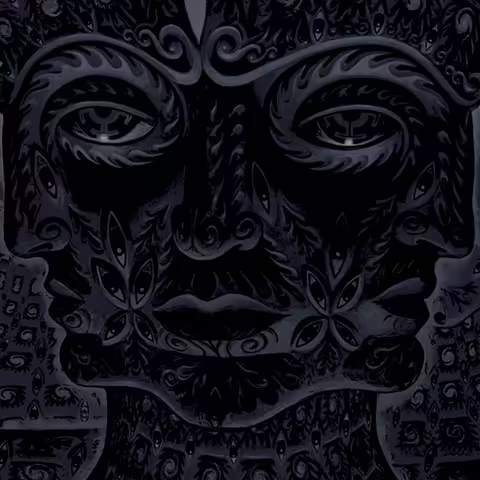
The physical CD packaging for 10,000 Days is one of the most ambitious major-label sleeve projects of the 2000s. The cover artwork is an Alex Grey illustration the artist later described to Examiner magazine as "a blazing vision of an infinite grid of Godheads during an ayahuasca journey". Grey, whose visionary anatomical and spiritual paintings had already provided the imagery for Lateralus and for the "Parabola" music video, painted a series of new works specifically for the album.
The execution was unusual. The CD itself was housed inside a thick cardboard-bound booklet partly covered by a hinged flap. The flap held a pair of stereoscopic eyeglasses, two large lenses that mapped to a pair of "eyes" visible on the cover. Looking through the lenses at the artwork inside transformed the two-dimensional illustrations into three-dimensional anaglyph images, producing an illusion of depth and distance impossible to capture on a flat digital release. The packaging was Adam Jones's concept; Mackie Osborne (long-time partner of Buzz Osborne of the Melvins) handled the layout and physical design.
The packaging won the Grammy for Best Recording Package at the 49th Annual Grammy Awards on 11 February 2007, with the award going to Jones, Grey and Osborne. It was Tool's fourth Grammy and the band's only Grammy in a non-performance category. Alex Grey's contribution to the visual vocabulary of 2000s American metal and prog was substantial; the Lateralus and 10,000 Days sleeves have been the artist's most widely distributed works.
Maynard James Keenan, as on every previous Tool album, declined to print the lyrics in the booklet. They were later posted to the band's official website. The four band photos inside the package (one for each member) were arranged in a manner the band's webmaster hinted in May 2006 could be combined to form "a kind of puzzle", though the band have never publicly explained the puzzle's solution.
Release and Reception
10,000 Days was released on 28 April 2006 in parts of Europe, 29 April in Australia, 1 May in the UK and 2 May in North America. It debuted at number one on the US Billboard 200 with first-week sales of 564,000, Tool's second consecutive number-one debut after Lateralus and the largest opening week of any rock album released in spring 2006. It topped the album charts in eleven additional countries (Australia, Austria, Belgium's Flanders region, Canada, Finland, Greece, the Netherlands, New Zealand, Norway, Poland and the US Top Rock Albums chart) and reached number four in the UK, Tool's highest-ever UK position. The album was certified platinum in the United States within five weeks of release and ultimately reached double platinum (1,736,000 copies) by 2010. New Zealand also certified it double platinum.
Critical reception was generally favourable but more divided than Tool had been accustomed to. Metacritic's aggregate of 19 contemporary reviews settled at 68/100, the lowest aggregate score of any Tool studio album up to that point. The positive reviews praised the album's musicianship and ambition. Rob Theakston in AllMusic gave it four stars:
"It's not only a step forward for the band, but a re-embracing of the epic-length rock songs found at the roots of early heavy metal."
Rob Theakston, AllMusic, May 2006
Nick Cowen at Drowned in Sound (8/10) called it "probably the most engagingly brilliant heavy metal album that'll be released on a major label all year". Evan Serpick in Rolling Stone (3.5 stars) wrote that the band "maintains a level of craftsmanship and virtuosity unparalleled in metal". Alternative Press gave it five stars and called it a record that "packs enough beauty, heartache and triumph that it will be dissected, studied and envied by younger bands for years to come". Musician magazine and Q were similarly enthusiastic.
The negative reviews focused on what several critics saw as Tool's repeating themselves. PopMatters's Adrien Begrand (6/10) framed it most pointedly:
"Stupendously packaged, the music robustly mixed and often achieving new levels of bleak beauty, 10,000 Days is too strong a work to call a disappointment, but the constant need to fill out a CD to 75-80 minutes is threatening to become the band's undoing."
Adrien Begrand, PopMatters, 6 May 2006
Jess Harvell in Pitchfork (5.9/10) wrote that "rather than delving further into experimentation or exploring their strengths, Tool have made an...A Perfect Circle record". Stylus Magazine's Ayo Jegede gave the album a D+ and used the review to argue that the band had stopped being progressive in any meaningful sense. Rolling Stone's year-end list placed it at number 38 in their 50 Best Albums of 2006. The album won the 2006 Metal Storm Award for Best Alternative Metal Album.
Singles and Music Videos
| Single | Release | Video | Chart peaks |
|---|---|---|---|
| "Vicarious" | 22 April 2006 (radio); released to consumers as a deluxe DVD-V single on 18 December 2007 | CGI animation; eventually released on DVD on 18 December 2007 with director credit to Alex Grey and Adam Jones | US Modern Rock No. 2; US Mainstream Rock No. 2; Grammy nom Best Hard Rock 2007 |
| "The Pot" | July 2006 | No commercial video produced | US Modern Rock No. 5; US Mainstream Rock No. 1 (Tool's first); Grammy nom Best Hard Rock 2008 |
| "Jambi" | 12 February 2007 | No commercial video produced | US Mainstream Rock No. 1; US Modern Rock No. 5 |
The "Vicarious" video was the first time Tool had produced a commercial music video since "Parabola" in 2001. Following the band's long-standing principle that music videos should not be given away to broadcast partners for free, the clip was withheld from MTV and the mainstream rock-video circuit and instead released on 18 December 2007 as a paid DVD-V single, packaged with a 5.1 surround mix of the song and extensive making-of material. The CGI animation, directed and designed by Alex Grey with Adam Jones, depicts a series of Grey's signature anatomical visionary scenes. The decision to charge for the video was widely covered at the time and split the rock press between those who saw it as a principled stand against the devaluation of music and those who saw it as wilful obscurantism.
No commercial music videos were produced for "The Pot" or "Jambi", although the latter was the subject of a striking fan-made stop-motion video by Croatian artist Filip Sucevic that circulated extensively on YouTube in 2009 and has frequently been mistaken for an official Tool clip. "Vicarious", playable as a track in Guitar Hero World Tour from October 2008, was the song most widely encountered by listeners who never owned the album.
Touring and Live
Tool toured 10,000 Days more intensively than they had toured any record since Aenima. Live highlights:
- May 2006: a short run of US warm-up dates ahead of the album release
- Summer 2006: European festival circuit including Pinkpop, Rock am Ring, Download Festival in the UK, and a UK arena run
- August-November 2006: US arena tour, supported variously by Mastodon, Isis and Melvins
- 2007: extended US, European and Australian tour cycle running into late 2007
- July 2007: Lollapalooza headline slot in Chicago
- 2008-2009: occasional festival headline appearances rather than dedicated touring
The live shows established the visual format Tool would maintain for the rest of their career: extended-set performances in which the band played in low side-lit silhouette while Adam Jones's projections (visionary art by Alex Grey, abstract stop-motion sequences and Jones's own film work) dominated the central screens. Maynard typically performed from the back or side of the stage in shadow, often standing on a riser behind the drum kit, deliberately ceding visual focus to the projections and the music. Mobile-phone photography and video recording were strictly prohibited and physically enforced by venue staff, a policy that would harden across the rest of the band's career and become the subject of regular debate among the wider concert-going public in the smartphone era.
Grammy and Awards
Adam Jones, Alex Grey and Mackie Osborne won the Grammy for Best Recording Package at the 49th Annual Grammy Awards on 11 February 2007 for the 10,000 Days stereoscopic 3D sleeve. The award was the only Grammy of the night for Tool but the only Grammy any Tool album has received in a non-performance category. The album also produced two further Grammy nominations: "Vicarious" was nominated for Best Hard Rock Performance at the same 49th ceremony (losing to Wolfmother's "Woman"); "The Pot" was nominated for Best Hard Rock Performance at the 50th ceremony in 2008 (losing to Foo Fighters' "The Pretender"). 10,000 Days also won the 2006 Metal Storm Award for Best Alternative Metal Album.
In TV, Film and Media
"Vicarious" became the album's most extensively placed track. It appeared as a playable song in Guitar Hero World Tour on its October 2008 release, was used in episodes of the FX series Sons of Anarchy, and has appeared in trailers for several action films. "Jambi" was used as the closing-credits music for a 2010 episode of Breaking Bad's third season. "The Pot" became one of Tool's most-streamed catalogue tracks in the streaming era despite never being officially serviced as a digital single, and remained a fixture of US rock radio rotations into the 2020s. Maynard's vocal melody on the bridge of "10,000 Days (Wings Pt 2)" has been sampled and reworked by EDM and ambient producers many times on streaming platforms, though Tool's well-known reluctance to license has kept official placements rare.
Covers, Samples and Tributes
Tool's songs are notoriously difficult to cover because of their odd time signatures, extended runtimes and distinctive vocal register; 10,000 Days material has been covered less often than Aenima or Lateralus tracks. "The Pot", the most accessible song on the record, has been covered by countless YouTube guitarists and several tribute bands but rarely by other major artists. The closing minutes of "10,000 Days (Wings Pt 2)" have appeared in classical-music transcriptions by film composers and conservatory students, including a noted 2017 string-quartet arrangement by the Brooklyn-based Aizuri Quartet that was performed at several US new-music festivals.
The album's influence on subsequent prog and progressive-metal records is substantial. Mastodon, Gojira, Periphery, TesseracT and the entire djent movement have all cited Tool generally (and 10,000 Days in particular) as a formative influence on their sense of how long-form heavy music should be structured. Maynard's autobiographical use of grief on "Wings for Marie" and "10,000 Days (Wings Pt 2)" opened up territory for emotionally direct songwriting in heavy progressive music that would later be inhabited by artists from Deftones (whose 2010 album Diamond Eyes drew comparable critical comparisons) through to Bring Me the Horizon's Sempiternal.
Reissues and Anniversaries
Until 2024 the album had never been reissued in any expanded or remastered form. Tool's catalogue was famously absent from streaming services from 2003 until 2 August 2019, when the band finally placed their entire body of work on Spotify, Apple Music and Tidal three weeks ahead of Fear Inoculum's release. 10,000 Days at streaming launch was presented exactly as it had been in 2006: the original 2006 master, the original Bob Ludwig mastering, no bonus material, no demos, no live cuts. The vinyl issue had been a separate matter; the album had been released on vinyl only intermittently, with original 2006 pressings becoming sought-after collector items and the band issuing a more widely distributed vinyl pressing in 2010 and again in 2017.
No anniversary box set has been announced as of mid-2026 (the album's 20th-anniversary year). Given the 2026 Reload box and the Master of Puppets, Black Album and Aenima reissue cycles of the previous five years, a 10,000 Days deluxe reissue is widely expected but has not been confirmed by either the band or by Sony Music's Volcano subsidiary.
Legacy and Influence
10,000 Days has aged into Tool's most divisive studio album. Among the four full-length Tool records released before the 2019 Fear Inoculum reset, it is the one most frequently placed at the bottom or near the bottom of fan rankings (with Undertow normally the only album ranked below it). Among the four most frequently placed near the top, depending on the ranker's preferences, are Aenima, Lateralus and Fear Inoculum itself.
The case against the album, made most prominently by Pitchfork's Jess Harvell in 2006 and consistently re-stated since, is that 10,000 Days was the moment Tool became a Tool tribute act. The case for it, made most often by Rolling Stone, AllMusic and the band's own fanbase, is that "Wings for Marie" and "10,000 Days (Wings Pt 2)" constitute Tool's emotional summit, that "Rosetta Stoned" is the most virtuosic vocal performance Maynard has ever delivered, that "Right in Two" is the album's underrated structural masterpiece, and that the album as a whole is the most direct distillation of what the four members of Tool sound like when no outside producer is in the room with them.
Both readings have merit. The album certainly contains the band's deepest emotional material. It also contains substantial passages of relatively undeveloped ambient texture that the band could have edited down (a fact the band themselves seemed quietly to acknowledge with the much tighter 86-minute Fear Inoculum thirteen years later, which contains fewer interlude pieces and longer through-composed songs). The 13-year gap that followed the album's release would, more than anything specifically about the music, define how 10,000 Days was eventually heard: as the last full-band statement of a band whose members had grown so comfortable working separately that they took longer to write their next album than Black Sabbath had taken to record their first six.
Maynard James Keenan, asked about the album years later in a 2015 Phoenix New Times profile, gave one of his more candid summaries:
"10,000 Days was the right album for that moment. Whether it's the right album for now, that's a different question."
Maynard James Keenan, Phoenix New Times, 2015
Things You Might Not Know
| Fact | Detail |
|---|---|
| The two meanings of the title | 10,000 Days refers both to the orbital period of Saturn (the actual figure is 10,759 days, underpinning the Saturn-return concept Maynard talked about throughout the campaign) and to the roughly 27 years his mother Judith spent paralysed before her death in 2003. |
| The Marie of "Wings for Marie" | "Marie" is Judith Marie Keenan, Maynard's mother. The two-part suite is her elegy, with the second part directly addressing the people Maynard believed had failed her in her religious community. |
| The first album without David Bottrill since 1993 | 10,000 Days was the first Tool record since the 1993 debut Undertow not produced by David Bottrill, who had shaped Aenima and Lateralus. The band self-produced and hired Joe Barresi to engineer and mix. |
| The "pipe bomb mic" | Adam Jones built and used a homemade guitar-pickup-inside-a-brass-cylinder device he called the "pipe bomb mic" to capture distorted, midrange-heavy electric guitar across the album's heavier moments. |
| The first Tool talk-box solo | Adam Jones's solo on "Jambi" was the first appearance of a talk box on a Tool record. He used a vintage Heil Talk Box, the same model Peter Frampton had popularised in 1976. |
| The Mandala drums | Danny Carey operated almost all of the album's interlude soundscapes using Synesthesia Mandala electronic drum triggers, then-new MIDI pads developed by drum technician Vince De Franco. |
| The Fantomas connection | Mike Patton's avant-garde metal band Fantomas toured with Tool in 2003, an experience Adam Jones credited with shaking the band out of a creative stupor and pushing them toward the heavier, more abrupt textures of 10,000 Days. |
| The Grandmaster reunion | Parts of 10,000 Days were tracked at Grandmaster Recorders in Hollywood, the same studio where Tool had cut their 1993 debut Undertow with Sylvia Massy. It was the band's first time back in the room in twelve years. |
| The Hofmann of "Lost Keys" | The "Hofmann" of "Lost Keys (Blame Hofmann)" is Albert Hofmann, the Swiss chemist who first synthesised LSD-25 in 1938 at Sandoz Laboratories in Basel and accidentally absorbed a dose into his fingertips on the 19 April 1943 "Bicycle Day" that would change post-war culture. |
| The Apache incantation | The vocal on "Lipan Conjuring" is performed in Apache by Bill McConnell, a friend of Adam Jones. The text is a traditional Lipan Apache incantation; the band have never published a full translation. |
| The "Viginti Tres" layering trick | Some fans have demonstrated that the closing track "Viginti Tres" (Latin for "twenty-three"), when layered against the album's "Wings for Marie (Pt 1)", produces additional audio content not present in either track alone, one of several mathematical puzzles Tool have planted in their records. |
| The Grammy for the box | The album won the 2007 Grammy for Best Recording Package for its stereoscopic 3D sleeve, the only Grammy Tool have ever won in a non-performance category. The award went to Adam Jones, Alex Grey and Mackie Osborne. |
| "The Pot" was Tool's first Mainstream Rock No. 1 | Despite Tool's then 14-year history of major-label rock radio play, "The Pot" was the band's first chart-topper on the Billboard Mainstream Rock Tracks chart. "Jambi" matched the feat a year later. |
| The Lustmord weather | The atmospheric rain and weather textures throughout "10,000 Days (Wings Pt 2)" were created by British dark-ambient pioneer Brian Williams, who records as Lustmord and has collaborated extensively with Throbbing Gristle, SPK and the late composer Wendy Carlos. |
| The 13-year wait | 10,000 Days was the last new Tool studio music until Fear Inoculum on 30 August 2019, a 13-year gap that is one of the longest between studio records by any active major-label rock band. |
| The streaming holdout | Tool's entire catalogue was absent from streaming services until 2 August 2019, when the band placed everything (10,000 Days included) on Spotify, Apple Music and Tidal three weeks ahead of Fear Inoculum's release. The 2019 streaming debut briefly pushed 10,000 Days back into the upper reaches of catalogue album charts. |
Riffology Podcast
If this is the kind of deep dive you enjoy, the Riffology podcast covers an album like 10,000 Days most weeks, with the same level of session detail, contemporary review excavation and back-of-the-sleeve trivia. The show is available on Apple Podcasts, Spotify, Amazon Music, Pocket Casts and every other major podcast platform. New episodes drop weekly.
Comments