Linkin Park wrote somewhere between fifty and a hundred songs, spent fourteen months locked in a Laurel Canyon mansion with Rick Rubin, and deliberately dismantled the rap-rock formula that had sold them tens of millions of records, then named the result after the clock that counts down to nuclear annihilation. Minutes to Midnight, the band's third studio album, was the first Linkin Park record not produced by Don Gilmore, the first to carry a Parental Advisory sticker, the first to feature guitar solos, and the first to leave its makers genuinely unsure whether their audience would follow them out the other side.
It worked. Released on 14 May 2007, the album debuted at number one on the Billboard 200 with 623,000 copies sold in seven days, the biggest opening week in the United States that year up to that point, and topped the chart in fifteen other countries on the same Sunday. The reviews were split down the middle, the fanbase argued about it for years, and the band were not quite the same group when they came out the other side. This is the complete story of how Linkin Park stopped sounding like Linkin Park, and got away with it.
The quick facts
| Field | Detail |
|---|---|
| Artist | Linkin Park |
| Album | Minutes to Midnight |
| Release date | 14 May 2007 |
| Label | Warner Bros.; Machine Shop |
| Producers | Rick Rubin and Mike Shinoda |
| Studios | The Mansion (Laurel Canyon, Los Angeles); NRG Recordings (North Hollywood) |
| Recording dates | January 2006 to April 2007 |
| Mixing | Neal Avron |
| Mastering | Dave Collins |
| String arrangements | David Campbell |
| Genres | Alternative rock, alternative metal, hard rock |
| Track count | 12 |
| Total runtime | 43:23 |
| Singles | "What I've Done"; Bleed It Out; Shadow of the Day; Given Up; Leave Out All the Rest |
| Billboard 200 peak | Number one (debut, 623,000 first-week United States sales) |
| UK Albums Chart peak | Number one (debut) |
| RIAA certification | 5x Platinum |
| United States sales | More than four million |
| Worldwide shipments (first four weeks) | Around 3.3 million |
Rock in 2007
To understand why Minutes to Midnight felt like such a gamble, it helps to remember where rock sat in 2007. Nu-metal, the genre Linkin Park had ridden to the top of the world at the turn of the decade, was effectively dead as a commercial force. The bands who had defined it were either reinventing themselves or fading, and the word itself had become an insult. For a group whose first two albums were among the most successful records the style ever produced, that left an awkward question: what does a nu-metal band do when nobody wants nu-metal any more?
The wider landscape offered no obvious template. Emo and metalcore were rising on one side, pop and hip-hop dominated the singles chart on the other, and the album as a format was beginning its long slide as digital downloads pulled listeners towards individual tracks. The iTunes Store was reshaping how records were bought and sequenced. Against that backdrop, a band with two diamond-certified albums behind them could have simply repeated the formula one more time and banked another huge opening week.
- Nu-metal, the band's original genre, had collapsed as a commercial trend.
- Metalcore and emo were the rising heavy-adjacent styles of the moment.
- The iTunes era was pulling listeners away from albums towards singles.
- Rick Rubin was simultaneously reviving careers across rock, country and hip-hop.
Linkin Park chose the harder road, and chose a producer who specialised in tearing things down rather than building them up. The decision defined everything that followed.
Where Linkin Park stood after Meteora
By the time the band reconvened to start work on the third album, they had spent the best part of six years as one of the largest rock acts on the planet. Hybrid Theory and Meteora had established a commercially dominant template built around metal-edged guitars, breakbeat-influenced drums, Mike Shinoda's rap verses and Chester Bennington's contrasting vocal intensity.
What followed Meteora was an unusually long break by major-label standards of the period. The band toured heavily through 2003 and 2004, recorded the live album Live in Texas, and in 2004 collaborated with Jay-Z on the mash-up project Collision Course, which paired Linkin Park recordings with Jay-Z vocals drawn largely from his own The Black Album. Side projects spread the members in different directions: Mike Shinoda's hip-hop outlet Fort Minor released The Rising Tied in 2005, while Chester Bennington began work with the side band that would eventually become Dead by Sunrise.
The cumulative effect, by the time writing for the third album started in earnest, was a group of musicians who had spent two years not being Linkin Park. They had been a hip-hop crew, a band's-worth of co-writers for other people, a touring road act and a remix collective. The straight-ahead rap-rock template that had defined their first two records had begun to feel, by their own account, like a uniform they were wearing more out of habit than belief.
"We were looking back at the things that we had done in the past, and I think we just figured that we had exhausted that sound. It was easy for us to replicate, it was easy for other bands to replicate, and we just needed to move on."
Mike Shinoda, Minutes to Midnight special edition documentary, 2007.
The commercial pressure on the third album was unusual in shape. Most major-label rock acts arrive at a third record with everything to prove. Linkin Park arrived at theirs with two diamond-certified albums behind them and enough touring history to know the existing audience would turn up for the first single whatever it sounded like. The pressure was therefore creative rather than commercial: not whether they could sell a third Linkin Park record, but whether they could write one worth making after the original formula had said most of what it had to say.
Why Don Gilmore was out and Rick Rubin was in
Minutes to Midnight is the first Linkin Park studio album not produced by Don Gilmore. Gilmore had shaped the polished, layered, ProTools-driven sound of Hybrid Theory and Meteora, and parting company with him for the third record was the single clearest signal, internally and externally, that the band wanted a different kind of album.
The replacement was Rick Rubin, by then one of the most decorated producers alive, with a working method that favoured live-feeling performances, sparser arrangements, fewer overdubs and more space. All of that sat awkwardly against the densely stacked Linkin Park aesthetic of the first two records, which was precisely the point. Rubin was hired to make the band uncomfortable.
"Rick has brought more of a stripped down, classic-rock and hip-hop kind of feel."
Chester Bennington, 2007.
Rubin was credited as co-producer alongside Mike Shinoda, an arrangement that gave Shinoda a more formal production role than on either previous album. Where Gilmore had defined the earlier studio identity, Rubin's involvement encouraged the band to question how much of that identity still needed to remain in place, and Shinoda's credit ensured someone inside the band was steering the granular sonic detail Rubin tended to leave alone.
Writing at The Mansion in Laurel Canyon
Pre-production and writing began in January 2006 at The Mansion, a residential studio in Laurel Canyon, Los Angeles, that Rubin had used previously with the Red Hot Chili Peppers and System of a Down. The choice was deliberate. Rather than commute in and out of a sterile commercial facility, the band moved into the building and treated it as a writing camp, working in different rooms and reconvening to compare ideas.
The volume of material was extraordinary by the band's standards. They wrote for more than six months and, by their own count, generated upwards of a hundred songs, recording somewhere between fifty and sixty of them in August 2006 alone. Their previous albums had each been built from around forty song ideas and completed in three to six months. This one took fourteen. Some ideas stayed close to the older formula; others pushed further into the alternative-rock direction the finished album would favour.
That slow selection process matters to the finished record. A twelve-song album running only forty-three minutes does not sound sprawling on paper, but the lengthy gestation gave the band time to test what still felt natural and what now sounded like repetition. The twelve surviving tracks are the ones that best defined the new identity rather than the old one.
Cutting the record at NRG
Tracking and overdubs took place primarily at NRG Recordings in North Hollywood, a studio better known to Linkin Park fans as a room where parts of Meteora had been cut. Sessions ran from 2006 into early 2007, with mixing and final touches concluding in April 2007 ahead of a May release. The engineering team, including Andrew Scheps, Ethan Mates and Dana Nielsen, was new to the band, another deliberate break from the personnel who had built the first two albums.
The approach pushed the band towards a more live-feeling sound. Mike Shinoda's rap parts, the most identifiable element of the earlier records, were drastically reduced, surviving on only two tracks, while guitars, drums and vocals were given more open space. The record also contains the first guitar solos of the band's career, on "What I've Done", In Pieces and the closing The Little Things Give You Away. Joe Hahn's turntable scratching, once a signature, was buried so low in the mix that it barely registers.
Some songs grew out of pure experimentation. Brad Delson spent time messing about with an EBow, a device that produces an infinite sustain on a guitar string, while the band were piecing together The Little Things Give You Away. They decided against using it on that song, but the sound it produced became the seed of the heavy, droning No More Sorrow. The church organ and military drumbeat on Hands Held High were originally meant to sit behind a melodic vocal until Rubin suggested the band try the opposite, foregrounding the stark backing and letting Shinoda rap over the top.
The mixing was handled by Neal Avron and the mastering completed by Dave Collins. Both choices reflected the wider decision the band had made: rather than reuse the team that had defined the first two records, the entire post-production chain on Minutes to Midnight was deliberately new.
Stripping out the rap-rock template
The most audible change between Meteora and Minutes to Midnight is the reduction of the rap-rock format. Of the twelve tracks, Shinoda raps on only two, Bleed It Out and Hands Held High, and his verses on the latter are closer in style to Fort Minor than to anything on the first two records. Several tracks dispense with rap altogether and place Chester Bennington's voice in arrangements that lean towards alternative rock, hard rock and, on Shadow of the Day and The Little Things Give You Away, a slower and more reflective register the band had previously approached only on the odd ballad-style album cut.
"This time around, Mike Shinoda is singing a lot more. It may seem like he's not on the record, but he's doing a lot of the harmonies. He also sings a couple of songs alone. We're presenting ourselves in a different way."
Chester Bennington, Folhateen, 2007.
The tracklist makes the change easy to map. Wake opens the album as an instrumental rather than a statement riff. Hands Held High gives Shinoda an unbroken lead vocal that is political rather than performative. In Between asks him to sing rather than rap. David Campbell's strings appear on several songs and extend the palette beyond guitar, bass, drums and turntables. By the time The Little Things Give You Away closes the album at six minutes and twenty-three seconds, the record has spent a full runtime proving that Linkin Park could stretch their core identity without abandoning it completely.
The Doomsday Clock and a political record
The album's title refers to the Doomsday Clock, the symbolic clock face maintained by the Bulletin of the Atomic Scientists since 1947. Its minute hand is moved closer to or further from midnight to reflect how close, in the judgement of its board, humanity is to global catastrophe. In January 2007 the clock was advanced to five minutes to midnight, the closest setting since the early 1980s, and the band took their title from that moment.
The name set the tone for a record more openly engaged with politics than anything the band had done before. Hands Held High addressed the war in Iraq directly, and "What I've Done", the lead single, aligned its video with imagery of war, environmental damage and historical violence. For a band whose earlier lyrics had focused almost entirely on internal psychological terrain, the outward turn was unmistakable.
The Parental Advisory sticker
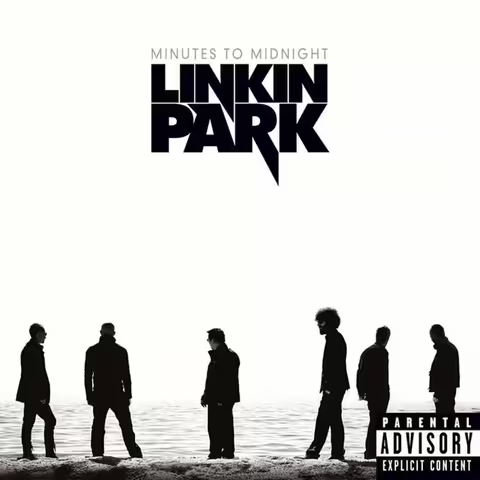
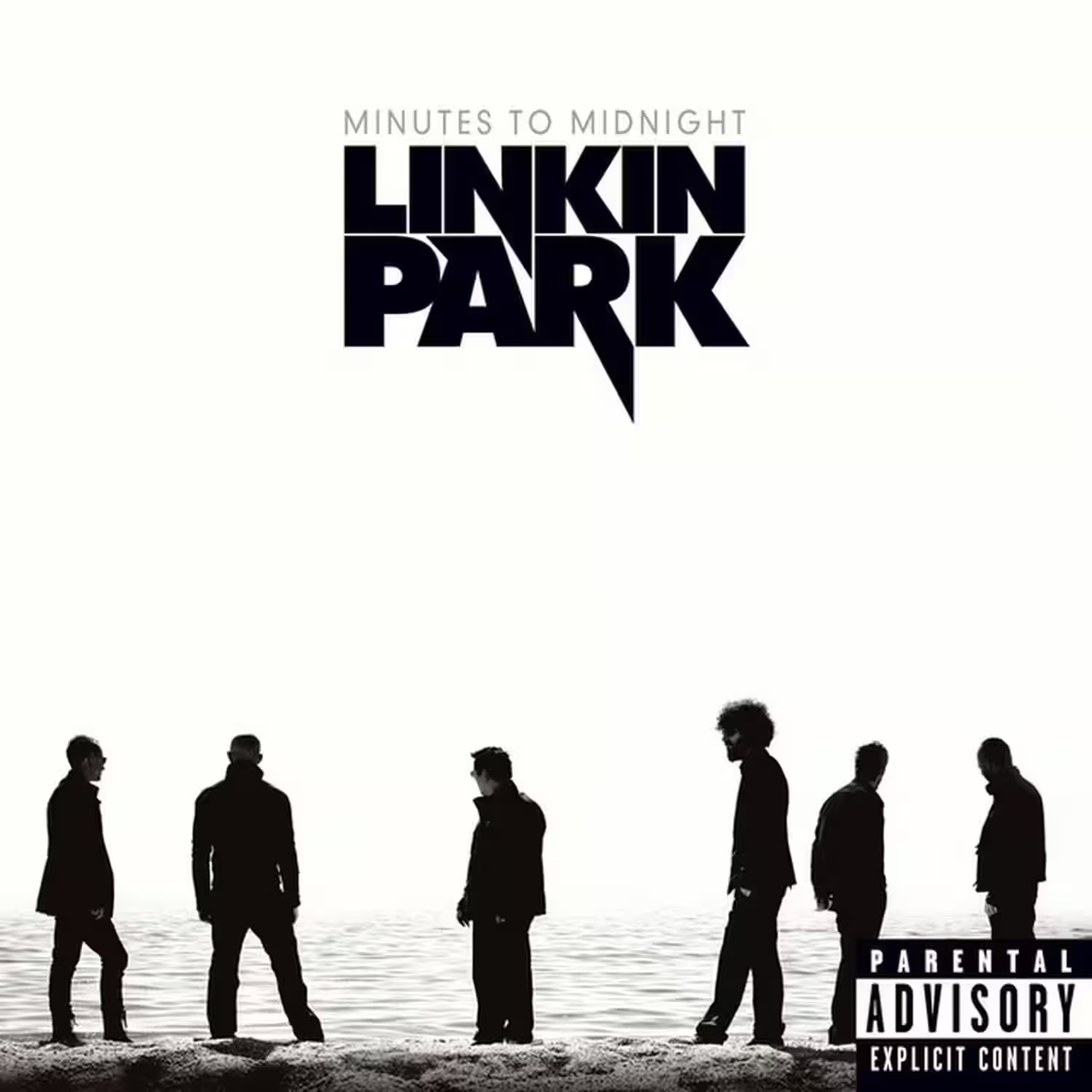
Minutes to Midnight was the first full-length Linkin Park studio album to carry a Parental Advisory label, prompted by profanity on Given Up, Bleed It Out and Hands Held High. The earlier collaboration with Jay-Z, Collision Course, had carried the band's first advisory sticker overall, but this was the first time one of their own studio records had earned it.
That detail mattered commercially as well as symbolically. Linkin Park were one of the few rock bands of the period whose albums were treated as major retail events, so packaging decisions carried practical implications for how the record was displayed and sold. Edited, non-advisory versions of both the standard and special editions were pressed for some territories. The sticker therefore functioned as another small sign that the band were willing to complicate their own mass-market image if the songs required it.
The band on Minutes to Midnight
| Role | Player | Notes |
|---|---|---|
| Linkin Park | ||
| Lead vocals, rhythm guitar | Chester Bennington | Lead vocals on the majority of tracks; rhythm guitar on Shadow of the Day and the B-side No Roads Left |
| Vocals, rhythm guitar, keyboards | Mike Shinoda | Co-producer; lead vocals on Hands Held High and In Between; raps on Bleed It Out |
| Lead guitar, backing vocals | Brad Delson | EBow on No More Sorrow; contributed to string arrangements |
| Bass, backing vocals | Dave "Phoenix" Farrell | |
| Turntables, samples, programming | Joe Hahn | Creative direction |
| Drums, percussion, backing vocals | Rob Bourdon | |
| Production and engineering | ||
| Producer | Rick Rubin | |
| Producer | Mike Shinoda | First Linkin Park production credit |
| Engineers | Andrew Scheps, Ethan Mates, Dana Nielsen | Phillip Broussard Jr. assisting |
| Mixing | Neal Avron | |
| Mastering | Dave Collins | |
| Additional musicians | ||
| String arrangements and conducting | David Campbell | Strings on Leave Out All the Rest, Shadow of the Day, Hands Held High, The Little Things Give You Away and No Roads Left |
| Artwork | ||
| Creative and art direction, design | Frank Maddocks | With Ellen Wakayama and Nikas Constant |
The tracklist
| # | Title | Writers | Length | Single? |
|---|---|---|---|---|
| 1 | Wake | Linkin Park | 1:40 | |
| 2 | Given Up | Linkin Park | 3:09 | Yes (2008) |
| 3 | Leave Out All the Rest | Linkin Park | 3:29 | Yes (2008) |
| 4 | Bleed It Out | Linkin Park | 2:44 | Yes (2007) |
| 5 | Shadow of the Day | Linkin Park | 4:49 | Yes (2007) |
| 6 | "What I've Done" | Linkin Park | 3:25 | Yes (2007) |
| 7 | Hands Held High | Linkin Park | 3:53 | |
| 8 | No More Sorrow | Linkin Park | 3:41 | |
| 9 | Valentine's Day | Linkin Park | 3:16 | |
| 10 | In Between | Linkin Park | 3:16 | |
| 11 | In Pieces | Linkin Park | 3:38 | |
| 12 | The Little Things Give You Away | Linkin Park | 6:23 |
All lyrics were written by Chester Bennington and Mike Shinoda, with the music credited to Linkin Park as a whole. Total runtime: 43:23.
Wake, Given Up and Leave Out All the Rest
The album opens with Wake, an instrumental that sets up the record without any obvious link to the band's previous opening tracks. There is no spoken-word sample, no rapped intro and no riff that announces a Linkin Park record the way the openings of Hybrid Theory or Meteora announced theirs. Wake is essentially a cinematic prologue: programmed drums, layered guitar textures and a building tension that resolves directly into the next track.
Given Up is one of the few moments on the album that sounds heavier than anything on the previous two. Built around a fast, punk-influenced tempo and a stripped-back arrangement, it is most famous for the moment in the bridge where Bennington holds a single raw scream for seventeen seconds. As an Easter egg, Brad Delson can be heard jingling a set of keys over multiple layers of hand-claps in the intro. Leave Out All the Rest, the third track, is the first appearance of David Campbell's strings and one of the songs with no rap part of any kind, a broad melodic ballad that closed the single campaign a year later.
Bleed It Out
Bleed It Out is the closest thing on Minutes to Midnight to a traditional Linkin Park single. Shinoda's verses are rapped over a hand-clap groove that owes more to hip-hop than to rock, and the chorus is one of the album's most direct vocal hooks from Bennington. Released as the second single in August 2007, it became a permanent fixture of the band's live set and a guaranteed crowd singalong for the rest of their touring career.
Shadow of the Day and "What I've Done"
Shadow of the Day, the third single, is the slowest and most atmospheric song on the record. Built around a sustained guitar progression and a vocal that holds back from the screamed peaks of the band's earlier work, with David Campbell's strings rising underneath the second half, it is one of the songs that most clearly demonstrates the alternative-rock direction the album took. Its debt to U2's broad, chiming style was noted at the time and has been ever since.
"What I've Done" was the lead single, released on 2 April 2007 ahead of the parent record. It was the first piece of new Linkin Park music the public had heard since Collision Course, and it established the cleaner, more stripped-back direction of the new era. Its video intercut the band's performance with archival footage of war, environmental destruction and historical violence, drawing a hard line under the band's earlier visual aesthetic. Coming after the slow build of Wake, the punk aggression of Given Up, the melodic lift of Leave Out All the Rest, the compact release of Bleed It Out and the spacious mood of Shadow of the Day, the lead single arrives as part of a sequence designed to prove range rather than consistency.
Hands Held High and the album's deep cuts
Hands Held High is the album's most explicitly political track and the only one with Shinoda on full lead vocals throughout. Built around a slow-marching keyboard pattern, a military-style drum line and a closing choral arrangement, it addresses the war in Iraq directly and dispenses almost entirely with the sound of a conventional rock track. The middle of the record then returns to heavier territory: No More Sorrow, grown out of Delson's EBow experiment, is the closest thing on the album to a traditional metal song, while Valentine's Day is one of its most stripped-back arrangements, a clean guitar figure that holds back until the final chorus.
In Between is one of the few songs where Shinoda takes a sung lead rather than rapping, over a sparse arrangement of clean guitar and programmed beat. In Pieces hands the lead back to Bennington and builds on a loose, almost reggae-inflected verse rhythm that opens into a heavier chorus, a contrast that would not have appeared on either previous album. The Little Things Give You Away closes the record at six minutes and twenty-three seconds, the longest track the band had recorded, built around a slow guitar progression, a multi-part Bennington vocal and a closing section dominated by Campbell's strings, before returning to the cinematic texture of Wake to bookend the album.
B-sides, outtakes and lost songs
With upwards of a hundred songs written, the cutting-room floor for Minutes to Midnight was unusually deep, and several of the survivors became prized among fans. The best known is No Roads Left, a Mike Shinoda lead vocal with Chester Bennington on guitar that was offered as a pre-order and special-edition bonus track. It has the feel of a road not taken, a glimpse of an album that leaned even further into Shinoda's voice than the finished record did.
- No Roads Left, a Shinoda-led bonus track with Bennington on guitar and David Campbell strings.
- Blackbirds, a session leftover later included as a bonus on A Thousand Suns and used in the band's iPhone game 8-Bit Rebellion!
- Across the Line, an up-tempo outtake circulated on bonus editions.
- "What I've Done" (Distorted Remix) and Given Up (Third Encore Session), alternate versions issued across the deluxe pressings.
The sheer number of bonus tracks, live cuts and remixes spread across the album's many international editions reflects both the volume of material recorded and the band's habit of rewarding their most dedicated fans with hard-to-find extras. Collectors spent years assembling the full set.
Album artwork and packaging
The cover and back artwork were photographed among the ruins of the North Shore Beach and Yacht Club on the eastern shore of the Salton Sea, in North Shore, California. Once a glamorous mid-century resort, the site had become a sun-bleached wreck as the inland sea around it turned saline and toxic, and the band used its decay as a visual echo of the album's apocalyptic title. The creative direction was led by Frank Maddocks, working with Ellen Wakayama and Nikas Constant, with Joe Hahn and Mike Shinoda also credited on the creative side.
A year after release, the band did something unusual with the packaging. They published ten alternative cover designs that had been considered for the album before the final choice was made, and made all ten available free on iTunes so fans could swap in whichever they preferred as their own album art. It was a small gesture, but a telling one for a band increasingly interested in handing creative choices to their audience.
Release week and chart performance
Minutes to Midnight was released on 14 May 2007 on Warner Bros. and Machine Shop after several delays that had pushed it back from a planned 2006 release. It debuted at number one on the Billboard 200 with first-week United States sales of 623,000 copies, the biggest opening week in the country in 2007 up to that point, and topped the album chart in fifteen other countries the same week, including the United Kingdom, Canada, Australia, Germany, France and Japan.
Worldwide shipments in the first four weeks reached approximately 3.3 million copies, and the album finished as the sixth best-selling album globally for 2007 according to the IFPI. It was eventually certified five times platinum by the Recording Industry Association of America, with United States sales of more than four million, two times platinum in the United Kingdom, and nine times gold in Germany. Billboard later placed it at number 154 on its Billboard 200 chart of the entire 2000s decade.
Those numbers matter because they show how little the creative risk damaged the band's commercial standing in the short term. A record that deliberately stepped away from the exact formula of Hybrid Theory and Meteora still opened at a blockbuster level, reached number one across multiple territories, and sustained a five-single campaign into May 2008. All five singles reached the Billboard Hot 100, a stronger singles performance than either of the first two albums had managed.
Critical reception
Reviews on release were genuinely mixed. The aggregator Metacritic settled the album at 56 out of 100, indicating average to mixed notices. The split fell along familiar lines for a band changing direction: critics who admired the broader palette praised the move away from the rap-rock template, while those who had favoured the earlier records argued the new direction had cost the band part of what made them distinctive.
"Most of Minutes is honed, metallic pop with a hip hop stride and a wake-up kick."
David Fricke, Rolling Stone, 2007.
Rolling Stone gave the album four stars out of five and later placed it at number 25 on its Top 50 Albums of 2007. Others were harsher. AllMusic's Stephen Thomas Erlewine called the sound "passe" and the result "a muddled, colorless murk", while NME's Dan Silver handed it a brutal two out of ten, describing it as "the sound of a band trying and failing to forge a new identity". Retrospective opinion has been kinder: in 2024, Loudwire staff named Minutes to Midnight the best hard rock album of 2007, and the record's reputation has generally risen as the band's later catalogue made its purpose clearer.
Singles and music videos
| Single | Released | Notes |
|---|---|---|
| "What I've Done" | 2 April 2007 | Lead single. Archival war-and-environment montage video; set the tone for the campaign. |
| Bleed It Out | 17 August 2007 | Second single. The most rap-driven track on the album. |
| Shadow of the Day | 16 October 2007 | Third single. Mid-tempo alternative-rock single with David Campbell strings. |
| Given Up | 3 March 2008 | Fourth single. Punk-influenced, built around a sustained scream in the bridge. |
| Leave Out All the Rest | 17 May 2008 | Fifth and final single. The non-rap ballad that closed the campaign. |
Five singles across thirteen months was a long campaign for a major-label rock record by the standards of the time. The video for "What I've Done" set the visual register, with later clips for Shadow of the Day and Leave Out All the Rest leaning further into narrative and away from the band-performance template of the Hybrid Theory era.
Touring Minutes to Midnight
The album was supported by the Minutes to Midnight World Tour, which ran from 2007 into 2008 and took the band through a large international cycle of arenas, amphitheatres and festivals. The headline shows were supplemented by the band's own travelling festival, Projekt Revolution, by then an established part of their touring identity, which packaged Linkin Park with a rotating bill of rock, metal and hip-hop acts.
Live, the new material slotted into setlists that retained substantial space for Hybrid Theory and Meteora. The contrast between the older songs and the new ones, with Shadow of the Day and Leave Out All the Rest sitting next to In the End and One Step Closer, made the stylistic distance the band had travelled audible inside a single show. The era's performances were later gathered on the 2012 release Minutes to Midnight, Live Around the World, which collected live versions of all twelve album tracks recorded in cities from Taipei to Melbourne between 2007 and 2010.
In TV, film and media
The album's biggest crossover into other media came through "What I've Done", which appeared on the soundtrack to the 2007 blockbuster Transformers, placing the song in front of an enormous global film audience in the same summer the album was climbing the charts. The pairing of the band's apocalyptic lead single with an effects-driven action franchise was a neat fit for a record named after the Doomsday Clock, and it became one of the most widely heard Linkin Park songs of the era.
Beyond that headline placement, the album's singles became staples of late-2000s rock radio, sports broadcasts and television montages, while the band's growing comfort with games and digital media foreshadowed later projects such as the iPhone game 8-Bit Rebellion!, which gave the outtake Blackbirds a second life. The banned-then-celebrated visual aesthetic of the "What I've Done" video also helped cement the band as one of the few heavy acts to keep a foothold on mainstream music television as the format declined.
What came next, A Thousand Suns
The follow-up to Minutes to Midnight was A Thousand Suns, released in September 2010 and again co-produced by Rick Rubin and Mike Shinoda. Where Minutes to Midnight had stepped away from the rap-rock formula, A Thousand Suns abandoned it almost entirely, embracing electronic textures, sample collage and concept-album sequencing. The line from the third album to the fourth was direct: without the experimentation that Minutes to Midnight licensed, the band would not have arrived at the record that came after it.
Seen from that angle, the third album is the hinge in the catalogue. The first two studio records built an identity that was instantly marketable and easily recognisable. The fourth would test how far that identity could be abstracted. Minutes to Midnight sits between those poles, keeping the hooks and the scale of a major-label rock release while changing the writing, production and vocal balance enough to make a later leap such as A Thousand Suns plausible.
Legacy
Minutes to Midnight sits at the centre of the Linkin Park catalogue both chronologically, as the third of the studio albums released during Chester Bennington's lifetime, and stylistically, as the pivot between the band's nu-metal era and its later, more exploratory phase. Whether a listener prefers the earlier or the later sound, the third album is the record on which the change happened.
Its singles have proved durable. "What I've Done", Bleed It Out and Shadow of the Day continue to define public memory of the record, while Leave Out All the Rest has gained stature in retrospective discussion, partly through its prominence after Bennington's death in 2017. For the band themselves, Minutes to Midnight was described in later interviews as the album that bought them the freedom to make everything that followed. The decision to leave the rap-rock template behind had been difficult to make and difficult to sell to a label that had built a marketing operation around the earlier sound, but the release-week numbers settled the argument for the rest of the band's career.
The album's place is therefore unusually stable. It is not simply remembered as the third record, or as the one that followed Meteora, but as the point where Linkin Park proved they could survive a conspicuous change in method. The production team changed. The balance between singing and rapping changed. The subject matter widened. The packaging changed. Yet the audience still turned up in sufficient numbers to send the album to number one and keep its singles in circulation for more than a year.
Things you might not know
| Fact | Detail |
|---|---|
| Over a hundred songs | The band wrote upwards of a hundred song ideas for the album and recorded between fifty and sixty of them in August 2006 alone. |
| The clock in the title | The album is named after the Doomsday Clock, which stood at five minutes to midnight when the record was being completed in early 2007. |
| Don Gilmore is gone | It is the first Linkin Park studio album not produced by Don Gilmore, who had produced both Hybrid Theory and Meteora. |
| Shinoda's first production credit | It is the first Linkin Park studio album to credit Mike Shinoda as a producer, alongside Rick Rubin. |
| The first guitar solos | It is the first Linkin Park album to feature guitar solos, on "What I've Done", In Pieces and The Little Things Give You Away. |
| An EBow became a song | No More Sorrow grew out of Brad Delson experimenting with an EBow while the band were working on The Little Things Give You Away. |
| Rubin flipped Hands Held High | The church organ and military drumbeat on Hands Held High were meant to back a melodic vocal until Rubin suggested foregrounding them and letting Shinoda rap. |
| The first Parental Advisory | It is the first full-length Linkin Park studio album to carry a Parental Advisory sticker. |
| Shot at the Salton Sea | The cover was photographed among the ruins of the North Shore Beach and Yacht Club on California's slowly poisoning Salton Sea. |
| Ten covers to choose from | A year after release the band put ten rejected cover designs on iTunes for free so fans could pick their own album art. |
| The biggest opening week of 2007 | The 623,000 first-week United States sales were the largest opening week in the country in 2007 at the point of release. |
| Number one in sixteen countries | The album debuted at number one on the Billboard 200 and in fifteen other countries the same week. |
| Onto a blockbuster soundtrack | "What I've Done" appeared on the soundtrack to the 2007 film Transformers, broadening its reach far beyond rock radio. |
| RIAA five times platinum | The album is certified five times platinum by the RIAA, with United States sales of more than four million. |
| Loudwire best of 2007 | In 2024, Loudwire staff named Minutes to Midnight the best hard rock album of 2007. |
The Riffology podcast
Minutes to Midnight is the sound of one of the biggest rock bands of its generation refusing to play it safe, and the gamble that bought them another decade of reinvention. If you want more stories like this one, the Riffology podcast digs into the albums that changed bands and the records that changed music, and is available on all major podcast platforms. Come and tell us where Minutes to Midnight sits in your own Linkin Park ranking.
Comments