Introduction
By the time Extreme's self-titled debut album reached A&M Records' release schedule in early 1989, the band's own label had already chosen the song they wanted the world to hear first, and it was not the one any A&R logic of the era pointed to. Instead of leading with a chest-thumping single, A&M slipped "Play with Me", a three-and-a-half-minute neoclassical shred sprint that quotes both Mozart's Rondo Alla Turca and a passage from Vivaldi's Four Seasons, onto the soundtrack of a low-budget time-travel comedy called Bill & Ted's Excellent Adventure. The film opened in February 1989, three or four weeks before the album. The lead single, in effect, was a guitar audition for the world.
That choice tells you almost everything about what Extreme were trying to do on their debut. Four Bostonians in their early twenties, signed by A&R man Bryan Huttenhower to A&M Records in 1987, paired with Queen's Grammy-nominated producer Reinhold "Mack" Mack, and convinced that the way to break out of a city already crowded with hair metal bands was to be louder, funnier, funkier and considerably more technically gifted than the competition. The album that emerged is uneven and openly indebted to Van Halen. It is also the launchpad for one of the finest hard-rock guitar players of the late 1980s, the first piece of public evidence that Gary Cherone and Nuno Bettencourt could write together, and the necessary stepping stone to the multi-platinum breakthrough that arrived eighteen months later.
Album Facts
| Field | Detail |
|---|---|
| Artist | Extreme |
| Album | Extreme |
| Release Date | March 1989 (lead single "Play with Me" released February 1989 via the Bill & Ted soundtrack) |
| Label | A&M Records (sold to PolyGram during the album cycle) |
| Producer(s) | Reinhold "Mack" Mack (tracks 1, 5, 6, 7, 8, 9, 10, 11); Extreme (co-production); Nigel Green (mixing on tracks 2, 3, 4) |
| Studio(s) | Recorded late 1988; mastered by Howie Weinberg at Masterdisk, New York |
| Genre | Glam metal, funk metal, hard rock |
| Track Count | 11 (CD); 10 on most vinyl pressings (with "Play with Me" only present on Australian and New Zealand vinyl) |
| Total Runtime | 45:00 |
| Billboard 200 Peak | #80 |
| UK Albums Chart Peak | Did not chart |
| Other Notable Chart Peaks | #97 Australian Albums (Kent Music Report); "Kid Ego" #38 US Mainstream Rock |
| Certifications | None at original release; later sold roughly 300,000 copies in the United States |
| Estimated Sales | ~300,000 (US) |
| Key Singles | "Play with Me", "Kid Ego", "Little Girls", "Mutha (Don't Wanna Go to School Today)" |
Cultural Context
Extreme arrived in record stores in March 1989, in a US hard-rock market dominated by a small handful of releases that left almost no oxygen for newcomers. Guns N' Roses were still touring Appetite for Destruction (released July 1987 and only just then peaking at number one on the Billboard 200). Bon Jovi's New Jersey, released the previous September, sat in the top ten. Mötley Crüe's Dr. Feelgood was still six months away and Aerosmith's Pump was eight. Above all the rock-radio chatter loomed Def Leppard's Hysteria, which had been on the Billboard 200 for eighty-three weeks by the time Extreme's debut shipped and was selling somewhere upwards of ten million copies a year.
This was the late peak of US glam metal, a moment when MTV's Headbangers Ball was the single most important promotional vehicle for a new hard-rock act and a debut album was judged commercially viable if it shifted a few hundred thousand copies and produced one or two videos that got moderate Ball rotation. The competition was also extremely crowded. Skid Row's self-titled debut would land in January 1989, weeks ahead of Extreme, and immediately go double platinum. Warrant's Dirty Rotten Filthy Stinking Rich also arrived in January. Tesla's The Great Radio Controversy followed in February. White Lion's Big Game would land in May. New England alone, Extreme's home territory, was generating a steady stream of hopeful hair-metal contenders, none of whom had yet found a national foothold.
The other thing happening in the spring of 1989 was the early rumble of a sound that would, within thirty months, gut every band on the previous list. The Pixies' Doolittle was released in April 1989. Soundgarden's Louder Than Love arrived in September. Nirvana's Bleach had been quietly out on Sub Pop since June. Nobody yet knew what was coming, but the cultural ground was already shifting under the hair-metal scene that Extreme had just signed up to compete in.
The Band's Story Up to This Point
The story of Extreme begins with two earlier Boston bands. In 1979, vocalist Gary Cherone and drummer Paul Geary were playing together in a teen band called Adrenalin. By 1980 they had renamed themselves The Dream, an identity that lasted until CBS Television bought the name for a short-lived series called Dreams and forced the band to rebrand. The pun they chose was "Ex-Dream", spoken aloud as "Extreme". It is one of the few hair-metal band names whose origin is genuinely literary.
On the other side of the same Boston club circuit, Portuguese-American guitar prodigy Nuno Bettencourt was working through a band called Sinful and bassist Pat Badger, a Berklee student, was playing in a group called In The Pink. Cherone and Bettencourt did not, in fact, meet via a fabled backstage brawl. They met through their brothers: Gary's brother Mark and Nuno's brother Paulo played together in a well-known Boston band called Flesh, and the introduction came naturally from that connection. Bettencourt joined Cherone and Geary in 1985; Badger completed the lineup in 1986.
Between 1985 and 1988 Extreme played anywhere in New England that would book them, building a local following large enough to be named Outstanding Hard Rock/Heavy Metal Act at the Boston Music Awards in both 1986 and 1987. The local-press shorthand, predictably, was that Boston had finally produced its own answer to Van Halen: Cherone as a Gary-shaped David Lee Roth and Bettencourt as a startlingly fluent young Eddie. The comparison was lazy but not inaccurate, and it was the comparison that brought A&M Records to their door. A&R director Bryan Huttenhower signed the band to A&M in 1987.
The deal was good timing on two counts. A&M had a strong rock roster and was already adjusting for the late-eighties hard-rock boom. And the band had been writing constantly. By the time they reached the studio in late 1988, Cherone and Bettencourt had built up a backlog of material substantial enough that the entire eleven-track debut was credited to the two of them, with only one exception: "Mutha (Don't Wanna Go to School Today)" carries a Cherone/LeBeaux/Hunt writing credit, the remnants of an older song from Cherone's pre-Extreme catalogue.
Pre-production and Demos
The Cherone-Bettencourt writing partnership took shape across 1985 and 1986 in the small Boston practice rooms and clubs where the band lived, with songs road-tested on club crowds at venues like The Channel, Bunratty's and T.T. the Bear's before they ever reached a producer. Several of the album's eventual tracks, including "Kid Ego" and "Mutha", existed in earlier club arrangements long before A&M's recording budget arrived; the credit on "Mutha" to Cherone, LeBeaux and Hunt reflects the song's origin in Cherone's earlier work with members of The Dream, the band's pre-Extreme lineup.
The thematic spine of the album, an obsession with childhood, schooldays and the rituals of growing up, came out of that pre-production period too. "Kid Ego", "Little Girls", "Mutha", "Teacher's Pet", "Big Boys Don't Cry" and the closing "Play with Me" all worry away at the same idea from different angles: youth as both subject and pose. It is the kind of unifying thread that bands either choose deliberately or back into by accident; in Extreme's case the evidence points to accident, since the songs were written across years and only the running order makes the connection visible.
The band's pre-production also fixed a stylistic decision that would matter more for their second album than the first: that the Bettencourt-Cherone writing axis was going to write vocally as well as instrumentally, with layered backing vocals as the band's signature texture. Listen to the chorus harmonies on "Watching, Waiting" or the stacked vocal pile-up at the end of "Rock a Bye Bye" and you hear them already reaching for a Queen-style choir effect. Some of these arrangements were demoed in cheap Boston studios before A&M signed off on the budget that put the band into Mack's hands.
Creating the Album
A&M's production choice was unusual. Reinhold Mack, known throughout the industry simply as Mack, was a German engineer-producer with a Musicland Studios pedigree in Munich, and the credit that mattered most to Extreme was Mack's co-production work on Queen's 1980 album The Game (a Grammy nomination) and his subsequent run with Queen through Hot Space and The Works. He had also worked with the Scorpions and the Rolling Stones. Pairing a Bavarian Queen producer with four hungry young Bostonians who admired Brian May above almost any other guitarist had the makings of either a perfect match or a slow disaster.
In the event it was neither, and the album's production credits make the messy compromise visible. Mack produced and engineered eight of the eleven tracks ("Little Girls", "Mutha", "Teacher's Pet", "Big Boys Don't Cry", "Smoke Signals", "Flesh 'n' Blood", "Rock a Bye Bye" and "Play with Me"), and was credited on mixing for the same eight. The remaining three songs, "Wind Me Up", "Kid Ego" and "Watching, Waiting", were instead mixed by Nigel Green, the English engineer best known for his work with Def Leppard during the Hysteria sessions. The reason for the split-production credit was never fully explained in print, but the sonic effect is audible: the Green-mixed tracks have a tighter, drier, more conventionally radio-ready 1989 mix that sits noticeably closer to the Mutt Lange / Nigel Green Hysteria template. The Mack-mixed tracks breathe more, with greater stereo width and a more layered approach to backing vocals and guitar overdubs.
The recording itself took place in late 1988. Bob St. John engineered alongside Mack on most of the sessions and shared a mixing credit on the Mack-produced tracks. The eventual master was cut at Masterdisk in New York by Howie Weinberg, who would go on to master a remarkable share of the rock canon, from Nirvana's Nevermind to Soundgarden's Superunknown. The band themselves received a co-production credit on the sleeve, a courtesy not always extended to debutants and an early indicator of how heavily Bettencourt was already involved in the technical side of the record. His personnel credit on the album, which lists "guitar, synthesizer, piano, backing vocals, percussion, orchestration, mixing", does much of the talking; he was an active hand in the desk decisions, not a bystander.
Two additional musicians are credited. Rapheal May plays harmonica on the opening track "Little Girls", a touch of acoustic colour grafted onto the album's first impression. And, more strangely, the sleeve credits "The Lollipop Kids" with background vocals on tracks 5 and 11, "Mutha" and "Play with Me", a knowing pseudonym for the children-and-friends gang vocals that give the choruses of those two songs their schoolyard chant feel. It is the most overtly Brian-May-meets-Slade production touch on the record and it sits squarely inside the album's thematic obsession with childhood.
Personnel and Credits
| Role | Player | Notes |
|---|---|---|
| Core band | ||
| Lead vocals | Gary Cherone | Also backing vocals; co-credited on album design and the EXTREME logo |
| Guitar | Nuno Bettencourt | Also synthesizer, piano, backing vocals, percussion, orchestration, mixing |
| Bass guitar | Pat Badger | Backing vocals |
| Drums | Paul Geary | Also percussion, backing vocals, co-credited on the logo |
| Additional musicians | ||
| Harmonica | Rapheal May | Track 1, "Little Girls" |
| Background vocals | The Lollipop Kids | Tracks 5 and 11, "Mutha" and "Play with Me"; pseudonym for the children-and-friends gang chorus |
| Production & engineering | ||
| Producer | Reinhold "Mack" Mack | Tracks 1, 5, 6, 7, 8, 9, 10, 11; also engineer and mixer on those tracks |
| Co-producer | Extreme | Credited on all tracks |
| Engineer | Bob St. John | Also mixing on Mack-produced tracks |
| Mixing | Nigel Green | Tracks 2, 3, 4, "Wind Me Up", "Kid Ego", "Watching, Waiting" |
| Mastering | Howie Weinberg | Masterdisk, New York |
| Artwork | ||
| Art direction | Jeff Gold | A&M Records in-house |
| Photography | Harris Savides | Later a celebrated cinematographer (Gus Van Sant, David Fincher) |
| Logo design | Gary Cherone & Paul Geary | Band members designed the EXTREME logo themselves |
Two credits in that list deserve a second look. The first is Howie Weinberg, who in 1989 was a respected mastering engineer at Masterdisk but had not yet become the go-to mastering engineer for grunge and alternative rock; his presence on Extreme's debut is an early example of A&M reaching for the best technicians available regardless of genre. The second is Harris Savides, the photographer credited with the cover image. Savides went on to become one of the most distinguished cinematographers of his generation, shooting features for Gus Van Sant (Elephant, Last Days, Milk), David Fincher (Zodiac), Sofia Coppola, Ridley Scott and Woody Allen, and dying in 2012 at the age of 55. The band's first album sleeve is, in retrospect, an early credit for a photographer whose work would later be studied in film schools.
The Songs
| # | Title | Writer(s) | Length | Single? | Notes |
|---|---|---|---|---|---|
| 1 | Little Girls | Cherone / Bettencourt | 3:47 | Yes, July 1989 | Opens with Rapheal May's harmonica; Mack production |
| 2 | Wind Me Up | Cherone / Bettencourt | 3:37 | No | Mixed by Nigel Green |
| 3 | Kid Ego | Cherone / Bettencourt | 4:04 | Yes, March 1989 | Reached #38 on US Mainstream Rock; mixed by Nigel Green |
| 4 | Watching, Waiting | Cherone / Bettencourt | 4:54 | No | The album's most reflective track; mixed by Nigel Green |
| 5 | Mutha (Don't Wanna Go to School Today) | Cherone / LeBeaux / Hunt | 4:52 | Yes, September 1989 | Only track not solely written by Cherone/Bettencourt; The Lollipop Kids on backing vocals |
| 6 | Teacher's Pet | Cherone / Bettencourt | 3:02 | No | Shortest track; punchy hair-metal romp |
| 7 | Big Boys Don't Cry | Cherone / Bettencourt | 3:34 | No | Continues the youth-themed lyrical run |
| 8 | Smoke Signals | Cherone / Bettencourt | 4:14 | No | One of the album's funkiest grooves |
| 9 | Flesh 'n' Blood | Cherone / Bettencourt | 3:31 | No | Title may nod to the Boston club band Flesh that connected Cherone and Bettencourt's brothers |
| 10 | Rock a Bye Bye | Cherone / Bettencourt | 5:57 | No | Album's longest cut; the most overt Queen homage |
| 11 | Play with Me | Cherone / Bettencourt | 3:29 | Yes, February 1989 (lead) | Quotes Mozart's Rondo Alla Turca; absent from most vinyl pressings |
Three songs do most of the heavy lifting in establishing what Extreme were trying to be. "Little Girls", the opener, is the album's calling card: a riff that almost shuffles, Rapheal May's harmonica laid across the top, a strong rising chorus and one of Bettencourt's tightest, most economical solos. It is the song that introduces the band as something other than a Van Halen tribute act, because the harmonica makes no Van Halen sense at all.
"Kid Ego", by contrast, is the song the radio promotion department wanted. It went out as a US single in March 1989, reached number 38 on the Mainstream Rock chart, and is the only song on the album to crack a Billboard chart in its own right. Cherone has been on the record many times that he finds the song faintly embarrassing in hindsight, partly because the lyric ("He's got a kid ego") strikes the older Cherone as juvenile. It is also one of the three Nigel Green mixes, which is part of why it sounds the most conventional 1989 rock single on the album.
"Watching, Waiting" is the album's most thoughtful song. It is also the third Green-mixed track and benefits from his economical approach; the vocal harmonies sit cleanly against an acoustic-led backing and Cherone reaches for an emotional register he avoids on most of the rest of the record. The lyric is hedged enough that it has been read in several ways over the years, including as a meditation with religious overtones, but the song works as an honest piece of late-eighties power balladry on its own terms.
From the mid-album onward the band settle into the groove that would define them on Pornograffitti a year later. "Mutha (Don't Wanna Go to School Today)" is the track that announced Extreme's sense of humour to MTV, opening with Bettencourt's harmonic-squeal-and-dive-bomb flourish before kicking into a Twisted-Sister-style truancy anthem; the Lollipop Kids chorus is the producer's tongue-in-cheek joke made loud. "Smoke Signals" is the album's funkiest cut and the closest Extreme come on the debut to the Get-the-Funk-Out template that would carry the next album. "Rock a Bye Bye", at almost six minutes, is the explicit Queen homage; stacked harmonies, multiple sections, an outro that uses Bettencourt's overdubbed harmony guitars as a Brian-May-style fifth voice.
And then, as the closer on the CD (and as a Bill & Ted bonus on most vinyl outside Australasia), "Play with Me". It is the song that has had the longest cultural afterlife of anything on the record. Three and a half minutes of breakneck shred with Bettencourt weaving two of the most famous melodies in western classical music, the second movement of Mozart's Piano Sonata No. 11 (the Rondo Alla Turca) and a passage from Vivaldi's Four Seasons, into the guitar work at full velocity. It is showy in exactly the way a debut single by a young virtuoso should be, and it had already done its job before the album shipped: in February 1989 it was sound-tracking Bill & Ted's mall chase, with Beethoven gleefully attacking a wall of synthesisers as the riff hurtled past. A genuine left-field calling card.
B-sides, Outtakes and Lost Songs
Extreme's debut album cycle did not produce the kind of rich B-side trove that comes with a more elaborate UK or Japanese marketing campaign. The 1989 singles were largely promo-only in the US and either album-track or live-cut backed in territories that did get commercial editions; no studio outtakes from the late-1988 sessions were officially released on the singles themselves. The band did record a Japan-only EP titled Extrakraft in 1990 (released through A&M Japan as the Pornograffitti cycle was ramping up), and that EP picked up a few stragglers from the debut-album orbit alongside early Pornograffitti material, but it is principally a Pornograffitti-era artefact rather than a debut outtakes release. Bootleg circulation of debut-era live tapes from the New England club run does exist among collectors, but no commercially released box set or expanded reissue has ever opened the late-1988 multitrack vault to the public. The debut-album material that exists is, with very few exceptions, the eleven tracks on the record.
Album Artwork and Packaging
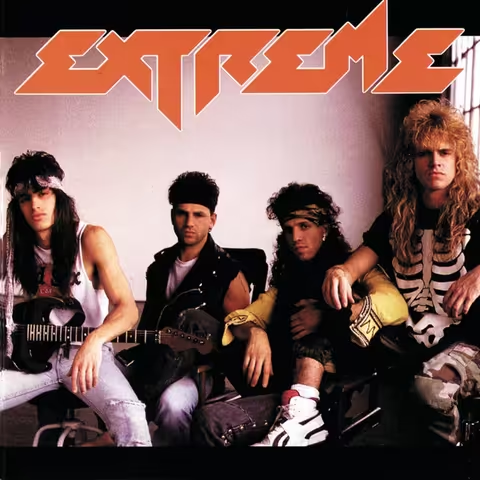
The cover is the platonic ideal of late-eighties debut-album packaging. Four band members posed in a single moody group shot, leather jackets, scarves, bandanas, ripped denim, big hair carefully tousled. The EXTREME logo runs across the top in a custom hand-drawn red-on-black wordmark with the E's stretched into spikes at either end. The art direction is by A&M's Jeff Gold, the cover photograph is by Harris Savides, and the logo itself is credited to Gary Cherone and Paul Geary, the singer and the drummer designed the band's wordmark themselves, and would continue to use variants of it on stage backdrops and merch into the 1990s. It is one of the comparatively few hair-metal album logos that survived its era as a recognisable brand mark.
The inner sleeve, in keeping with A&M's house style for the era, carries the lyrics, the personnel block, and a credit ("The Lollipop Kids – background vocals on tracks 5 and 11") that has spawned more than thirty years of guessing among fans as to who exactly the Lollipop Kids actually were. The official answer has always been a group of friends and producer-orbit children brought in to chant on the choruses; no individual name has ever been attached to the credit.
Release and Reception
Extreme reached US record shops in March 1989. The lead single, "Play with Me", had already been on the Bill & Ted's Excellent Adventure soundtrack since February. "Kid Ego" was lifted as the second single in March and reached number 38 on Billboard's Mainstream Rock chart, the only Extreme track from this album to chart in its own right. "Little Girls" followed in July, "Mutha" in September.
The album peaked at number 80 on the Billboard 200 in June 1989, hit number 97 in Australia, and sold around 300,000 copies in the United States over its lifetime. By the standards of the 1989 market, where Skid Row's debut shipped two million in the same year, those numbers are modest, but they were enough to convince A&M to fund a second album with a larger budget and a bigger-name producer. Bryan Huttenhower's signing decision paid off slowly rather than instantly.
Critical response was mixed and almost identical across the major outlets. Rolling Stone's Kim Neely awarded three out of five stars in her July 1989 review:
"An extremely good listen."
Kim Neely, Rolling Stone, July 1989
AllMusic, in a later retrospective, also landed on three out of five, with the now-much-quoted summary line:
"Extreme's first album shows the band struggling to shed their influences, particularly Van Halen, and develop a style of their own; consequently, it's wildly uneven, but guitarist Nuno Bettencourt is always worth hearing."
Stephen Thomas Erlewine, AllMusic
Martin Popoff's Collector's Guide to Heavy Metal gave it six out of ten. Long after the fact, Bryan Rolli at Ultimate Classic Rock would dismiss it in passing while reviewing Pornograffitti:
"Rote glam metal."
Bryan Rolli, Ultimate Classic Rock, 2021
No major outlet panned it, and no major outlet championed it.
That settled into a consensus position that has held ever since: the debut is the apprentice work of a band who would prove themselves on the next record. The retrospective re-evaluation that grunge gave to so much late-eighties hard rock has mostly bypassed it. The album's one notable accolade came almost two decades later: in December 2008, Guitar World ranked Extreme number eight on its Top 20 Hair Metal Albums of the Eighties, a generous placing for a debut that was, at the time, regarded as a developing-band record.
Singles and Music Videos
| Single | Release | Chart | Notes |
|---|---|---|---|
| Play with Me | February 1989 | Did not chart | Released via the Bill & Ted's Excellent Adventure soundtrack; quotes Mozart and Vivaldi; effective lead single |
| Kid Ego | March 1989 | #38 US Mainstream Rock | Only Extreme track from this album to chart in its own right; music video on Headbangers Ball; mixed by Nigel Green |
| Little Girls | July 1989 | Did not chart | Headbangers Ball video; harmonica intro from Rapheal May |
| Mutha (Don't Wanna Go to School Today) | September 1989 | Did not chart | Music video in the classroom-chaos vein; Lollipop Kids gang chorus; the most "MTV" of the four |
All four singles had accompanying videos that played in moderate rotation on MTV's Headbangers Ball, the late-Saturday-night rock-metal slot hosted in 1989 by Adam Curry. None of them crossed over to MTV's mainstream daytime rotation. The "Kid Ego" video, the most-played of the four, presents the band in a warehouse-band-performance setting with Cherone in mid-strut and Bettencourt unfurling the song's flashy lead break, a textbook 1989 hard-rock video. The "Mutha" clip leans into the song's schoolboy-truancy joke with the band clowning around a classroom set, and is the most enjoyable of the four to revisit. The "Little Girls" video took the funkier route, with cartoonish staging that took the title at its tongue-in-cheek face value.
None of the four singles was banned, censored or controversially withdrawn. There was no commercially released B-side programme of the kind that British and Japanese singles of the era often supported, with most US 1989 promo singles backed simply by album cuts.
Touring and Live
The Extreme Tour, as the debut-album touring cycle was billed, ran throughout 1989 and into early 1990. The band played hundreds of shows, mostly in US clubs and theatres on their own headline run, with regional support and festival appearances filling in around it. Notable hometown landmarks included an appearance at the WBCN "Rock of Boston" concert at the Boston Garden in December 1988, a foot-in-the-door arena slot ahead of the album's release that gave the band an early taste of a venue Aerosmith routinely sold out, even before they had a record on the shelves.
The band's most consequential support work came when they opened a string of dates on Aerosmith's Pump tour after that album's September 1989 release. Boston's pre-eminent hard-rock band giving the city's most promising newcomers the opening slot was a meaningful local handover. The cross-pollination of fan bases that an arena-support tour delivers is precisely the kind of momentum-building that A&M would have been hoping for from the debut album cycle, and Extreme cashed it in.
The band also made their Japanese live debut in October 1989, and discovered that Japan would become a stronghold for them; the country's appetite for technically formidable hard-rock guitarists was an immediate fit, and A&M Japan released the Japan-only Extrakraft EP early in 1990 to capitalise on it. Extreme have continued to tour Japan steadily across every era of the band's existence.
- Boston Garden (WBCN Rock of Boston), December 1988, pre-release showcase
- The Channel, Bunratty's and T.T. the Bear's, Boston, sustained club residency through 1988–89
- Headbangers Ball promo appearances and interviews, throughout 1989
- Aerosmith Pump tour support dates, late 1989 / early 1990
- First Japan tour, October 1989
In TV, Film and Media
The album's afterlife in screen and game media is, almost entirely, the afterlife of one song. "Play with Me" has had three distinct cultural moments across more than thirty years.
- Bill & Ted's Excellent Adventure (1989). The song scores the now-famous mall chase, with Beethoven gleefully throwing himself at a wall of synthesisers in a music shop as security pursue Bill, Ted and their kidnapped historical figures through the building. The cue is one of the two most-remembered musical moments in the film and gave Extreme an immediate national audience before their album was even on the shelves.
- Guitar Hero Encore: Rocks the 80s (2007). The song appeared as an expert-tier track in the Eighties-themed Guitar Hero spin-off, exposing the riff to a generation of teenagers playing the plastic-guitar games who in many cases had never heard of Extreme before they failed the song's solo section repeatedly.
- Stranger Things, Season 4 (2022). The opening episode of the Netflix series' fourth season is built around the song, which sent it onto streaming-service rock playlists and, briefly, back into wider cultural circulation more than thirty years after release. The Stranger Things music team had a documented appetite for surfacing eighties hard-rock songs that had drifted out of the mainstream conversation, and "Play with Me" was a textbook example of that strategy.
Covers, Samples and Tributes
The debut album has not generated a meaningful catalogue of covers or samples in the way Pornograffitti has, where "More Than Words" became one of the most-covered acoustic ballads of the early nineties and "Get the Funk Out" has been borrowed and interpolated repeatedly. The closest the debut-album material comes to wider currency is "Play with Me", which has been performed live many times by Bettencourt at solo and clinic appearances and turns up regularly in guitar magazines' technique features as one of the canonical examples of a finger-tapping classical-quote sequence. There is no widely-known tribute album dedicated to the record, and no headline cover version by a major artist has appeared in the years since.
The Mozart and Vivaldi quotations in "Play with Me" do, in their own way, count as the debut album's most distinctive piece of musical sampling-by-quotation. Bettencourt has talked in guitar-press interviews about lifting the Rondo Alla Turca theme deliberately as a way of marking himself out from the field of late-eighties shredders, and as a quiet nod to the classical-music repertoire that his father, a music-loving Portuguese immigrant, had played in the house when Nuno was a child.
Reissues, Remasters and Anniversaries
Extreme has been less aggressively reissued than its successor. The Japan-only Extrakraft EP, released in 1990, picked up a small handful of debut-era tracks alongside early Pornograffitti material but is not an expanded edition in the modern sense. The album sits in print on streaming services in its original eleven-track running order; vinyl pressings continue to exclude "Play with Me" outside Australia and New Zealand, a quirk of the original A&M international distribution agreement that has been preserved in subsequent vinyl reissues. No deluxe edition, no anniversary box, no expanded multi-disc reissue covering the late-1988 multitrack vault has appeared as of 2026. The album turned thirty-five in March 2024 with no official commemoration; whether the band's 2026 farewell-style activity will eventually bring an expanded reissue with it is, at the time of writing, an open question.
"Play with Me" has been included on every Extreme best-of compilation, including 1998's The Best of Extreme: An Accidental Collocation of Atoms? and 2002's Extreme – The Collection. "Kid Ego" and "Little Girls" appear on the longer of the two compilations. "Mutha" has appeared sporadically on greatest-hits packages.
Legacy and Influence
The most direct legacy of Extreme is that it made Extreme II: Pornograffitti possible. A&M's decision to fund a second album with Michael Wagener (Dokken, White Lion) at the desk and a sharper, funkier songwriting brief came out of the modest commercial momentum the debut had built and the strong band-on-the-ground word-of-mouth from the touring cycle. Pornograffitti, released in August 1990, would peak at number ten on the Billboard 200, sell two million copies in the US alone, and produce in "More Than Words" a US number-one ballad that would put the band on a stage they could never quite get back from. Nothing about that 1991 commercial peak was guaranteed by the debut, but the debut is the document that bought Extreme the second chance.
Inside the band's own discography, the album occupies the customary "interesting early work" slot. It was followed by Pornograffitti (1990), III Sides to Every Story (1992, a genuinely ambitious Queen-influenced concept record), Waiting for the Punchline (1995, a grunge-era recalibration that did not connect), the long hiatus, the reformation, Saudades de Rock (2008) and Six (2023). Of those, the debut is the only one whose songs do not regularly form the backbone of an Extreme live set.
Outside the band, the debut had two specific influences that outlasted its commercial moment. The first is on guitar players. A whole generation of late-eighties and early-nineties young guitarists found Bettencourt through "Play with Me" and worked their way back from there into his more sophisticated Pornograffitti and III Sides work; his current standing as one of the most-cited rock-guitar technicians of his generation begins, in publishing-history terms, with this album. The second is on Gary Cherone's career, which would take a strange detour seven years later when Eddie Van Halen hired him as Van Halen's third lead singer for 1998's Van Halen III, a brief and divisive chapter that ended in 1999. The shorthand the Boston press had been using since 1986, Cherone-and-Bettencourt as a Roth-and-Eddie analogue, turned out, briefly and improbably, to be literal.
The clearest single statement of Extreme's place in late-eighties rock came at the 1992 Freddie Mercury Tribute Concert at Wembley Stadium, when Brian May introduced the band to a global audience by saying that, of all the acts performing that night, Extreme were the ones who understood Queen best:
"Possibly more than any other group on this planet, the people that understand exactly what Queen have been about all these years, and what Freddie was about all these years."
Brian May, introducing Extreme at the Freddie Mercury Tribute Concert, Wembley Stadium, April 1992
May was talking about the band's whole catalogue rather than this specific record, but the debut album, with its overt Queen-style backing vocals on "Rock a Bye Bye" and the Mack production lineage running back to The Game, is the document that earned them the right to be on that stage in the first place.
Things You Might Not Know
| Fact | Detail |
|---|---|
| The band name's literary origin | "Extreme" is the spoken form of "Ex-Dream", a reference to Cherone and Geary's earlier Boston band The Dream, a name CBS Television bought out from under them for a series called Dreams. |
| The lead single was a movie cue | "Play with Me" was released in February 1989 via the Bill & Ted's Excellent Adventure soundtrack, a month before the album. A&M effectively gambled its debut single on a low-budget time-travel comedy. |
| Mack only produced eight of eleven tracks | Three songs, "Wind Me Up", "Kid Ego" and "Watching, Waiting", were instead mixed by Nigel Green of Def Leppard's Hysteria team, a fact that explains why "Kid Ego" sounds so different from the rest of the record. |
| Mozart and Vivaldi on a debut single | "Play with Me" quotes both the Rondo Alla Turca from Mozart's Piano Sonata No. 11 and a passage from Vivaldi's Four Seasons inside its 3:29 running time. |
| The cover photographer became an Oscar-shortlisted cinematographer | Harris Savides, credited with the cover photograph, went on to shoot Elephant, Last Days, Milk, Zodiac and many others for Gus Van Sant and David Fincher before his death in 2012 at the age of 55. |
| Cherone and Geary designed the EXTREME logo themselves | The hand-drawn wordmark across the top of the sleeve is credited to the singer and the drummer; it survived into the band's stage backdrops and merch for the next thirty years. |
| "Mutha" is the album's only outside co-write | All ten other songs are Cherone/Bettencourt; "Mutha" carries a Cherone/LeBeaux/Hunt credit, the residue of an older song from Cherone's pre-Extreme writing. |
| The Lollipop Kids credit | Background vocals on "Mutha" and "Play with Me" are credited to "The Lollipop Kids", a producer-orbit-children-and-friends pseudonym that has never officially been unmasked. |
| Cherone himself dislikes "Kid Ego" | The album's biggest US single is the song its writer has admitted in print to finding faintly embarrassing in hindsight; he has called it the one Extreme track that makes him cringe. |
| The brothers' band that connected the lineup | Gary Cherone and Nuno Bettencourt met through their older brothers Mark and Paulo, who played together in a well-known Boston club band called Flesh. |
| The Boston Garden warm-up | Extreme played the WBCN Rock of Boston bill at the Boston Garden in December 1988, before they had an album on the shelves, an arena-size gig in front of a hometown crowd as a pre-release showcase. |
| The album was not certified at release | Despite selling around 300,000 copies in the US, the album has never been certified Gold by the RIAA; Extreme's certification history begins with Pornograffitti. |
The Riffology Podcast
The Riffology podcast covers Extreme's self-titled debut, the Mack-Green production split, the Bill & Ted lead-single gamble and the band's long arc from Boston club residents to Pornograffitti superstars in more depth than this piece has room for. The podcast is available on Apple Podcasts, Spotify, Amazon Music and every other major platform.
Comments