By the spring of 1995 the smart money in Seattle had Alice in Chains down as finished. Layne Staley had spent the back end of 1994 fronting Mad Season with Mike McCready, leaking heroin marks onto Rolling Stone covers and recording an album that some at Sony quietly hoped would replace his day job. Jerry Cantrell was in his home studio cutting a solo record called Jerry's Kids. Sean Kinney was barely speaking to either of them, drinking, and refusing to play unless Staley got clean. Mike Inez had been the band's bass player for less than two years and had not yet recorded a full Alice in Chains album. Columbia weighed up letting Staley go.
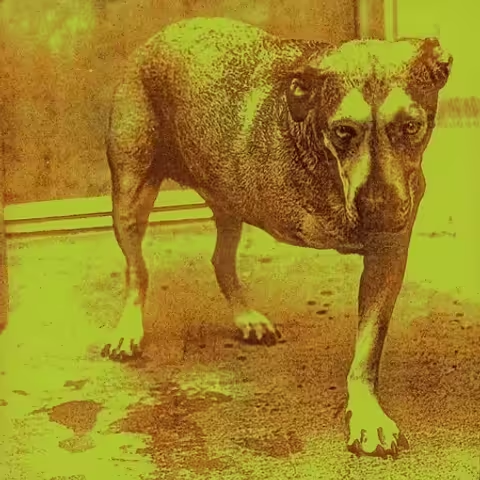
What came out of Bad Animals Studio that summer instead was a US number-one record built around a fax of a three-legged dog, recorded in 70 rolls of two-inch tape, and finished only after the label gave its lead singer nine days to deliver vocals or the project would be killed. The self-titled Alice in Chains, which the band, the engineers and the fans started calling Tripod the moment they saw the artwork, would be the last full studio album the original lineup would make. It is a record about everything falling apart, recorded by four men trying very hard not to let it.
Album Facts
| Field | Detail |
|---|---|
| Artist | Alice in Chains |
| Album | Alice in Chains (also known as Tripod, the Dog Album, the Dog Record) |
| Release Date | 31 October 1995 (vinyl) / 7 November 1995 (CD and cassette) |
| Label | Columbia Records |
| Producers | Toby Wright and Alice in Chains |
| Studio | Bad Animals Studio, Seattle (recording); Electric Lady Studios, New York (mixing) |
| Genre / Subgenre | Grunge, hard rock, sludge metal, doom metal |
| Track Count | 12 |
| Total Runtime | 64:47 |
| Billboard 200 Peak | 1 (debut, 189,000 first-week sales, 46 weeks on chart) |
| UK Albums Chart Peak | 37 (Rock and Metal Albums: 4) |
| Other Notable Chart Peaks | Australia 5, Canada 5, Norway 11, Sweden 11, Finland 13 |
| Certifications | 2 x Platinum (RIAA, US), Platinum (Music Canada), Gold (ARIA), Silver (BPI, UK) |
| Estimated Sales | Over three million copies worldwide |
| Key Singles | "Grind", "Heaven Beside You", "Again" |
A grunge graveyard, dressed up as a coronation
The autumn of 1995 was when grunge stopped pretending it was an underground. Pearl Jam were locked in their war with Ticketmaster and had just put out Vitalogy. Soundgarden were riding Superunknown into stadium territory. Smashing Pumpkins were about to drop Mellon Collie and the Infinite Sadness. Nirvana, after Kurt Cobain's death the previous April, no longer existed as a going concern, and the very word "grunge" had become a marketing tag glued onto half the bands at every modern rock radio station in America. The Offspring and Green Day were already redirecting the kids toward pop punk, and the music press had started using the phrase "post-grunge" without irony.
Into that thinning air Alice in Chains released a record that did almost nothing the rules said a 1995 rock album should do. There was no tour. There was no obvious lead single until Columbia rushed "Grind" out to combat a bootleg leak. There was no band logo on the cover. There was no smiling press photo, because the band had stopped doing press a year earlier. There was a yellow-tinted fax of a three-legged dog, twelve songs that ran past 64 minutes, and a singer whose voice had visibly hollowed out since fans last heard him. And it went straight to number one in America with the biggest opening week of the band's career.
- Pearl Jam, Vitalogy, late 1994, still selling.
- Soundgarden, Superunknown, Grammy-winning, on the road.
- Smashing Pumpkins, Mellon Collie and the Infinite Sadness, two weeks before Tripod.
- Foo Fighters, self-titled debut, July 1995, Dave Grohl's first move after Cobain.
- Bush, Sixteen Stone, riding to triple platinum on the back of Seattle's wake.
The band's story up to this point
Alice in Chains formed in Seattle in 1987 out of two ruined groups. Layne Staley had been singing in a glam-metal outfit called Alice N' Chains. Jerry Cantrell, homeless and crashing at the Music Bank rehearsal complex, had come out of a band called Diamond Lie. They put Sean Kinney on drums, his future brother-in-law Mike Starr on bass, and signed to Columbia in 1989 off a demo called The Treehouse Tapes. Facelift in 1990 introduced "Man in the Box" and a sound, Tony Iommi riffs slowed back down to dirge tempo, with vocal harmonies pitched a major third apart, that would never quite leave them.
Dirt in 1992, with five top-30 singles and what Steve Huey of AllMusic called the closest the band ever came to "a flat-out masterpiece", made them the heaviest of all the Seattle bands and forced everyone to take grunge's metal lineage seriously. Mike Starr was fired during the supporting tour for his addiction issues; Mike Inez, Ozzy Osbourne's live bassist, took the gig at Camden Underworld in January 1993. The acoustic-led EP Jar of Flies in early 1994 became the first EP ever to debut at number one on the Billboard 200.
And then Staley relapsed. Days before a 1994 summer tour with Metallica, Suicidal Tendencies and Danzig, the band cancelled everything. They missed Woodstock '94. Candlebox took the slot. The four of them effectively stopped speaking for six months. By the time Cantrell started thinking about how to drag everyone back into a studio, Sony had already begun privately discussing whether Mad Season was the more bankable project.
"Nobody was being honest with each other back then. If we had kept going, there was a good chance we would have self-destructed on the road, and we definitely didn't want that to happen in public."
Sean Kinney, Rolling Stone, 1996
Pre-production, demos and the frog session
Cantrell's plan was a feint. Some time in the back end of 1994 he started recording demos at his home studio with a couple of drummers, including Josh Sinder of Tad and Norman Scott of Gruntruck. Three songs came out of those sessions; one was a piece originally written before Alice in Chains existed called "Over Now". Then he and Mike Inez decamped to Bear Creek Studios in Woodinville, hired Ann and Nancy Wilson of Heart, and brought in Toby Wright as a producer. The band burned through ten thousand dollars in a week and recorded, in Wright's later phrase, "the croaking of frogs in a nearby pond".
The frogs were the point. Cantrell had reasoned that the only way to get Sean Kinney and Layne Staley to play with each other again was to start a record without them and wait for the news to leak. It worked. By January 1995, Kinney was back. By May, Staley had come in too, telling Rolling Stone the band reunited because they "felt like we were betraying each other" with their side projects. Wright kept the demo tapes from those Bear Creek sessions. Two of them, "Grind" and "Again", would survive almost untouched onto the finished album, including the very first take of Cantrell's "Grind" guitar solo, played through a Bogner Fish amp on his living-room ADAT and refused for re-recording by Wright over Cantrell's objection.
"It's a beautiful record, but it's sad, too. It's a little more exploratory, a little bit more meandering. It's not as crafted as the rest of our records were. There's a sadness to that record, it's the sound of a band falling apart."
Jerry Cantrell, Noisey, 2018
Creating the album: Bad Animals, an ultimatum, and 70 rolls of tape
Bad Animals was Heart's studio, a few minutes from Staley's condominium in downtown Seattle and equipped with a Solid State Logic G-Series console. The band picked it for the proximity. The sessions ran from April to August 1995. There were no finished songs at the start. Cantrell brought in his demo cassettes; Staley took them home and wrote lyrics to whatever caught him; the rest of the album was jammed into shape on the studio floor, the same way Jar of Flies had been built. Wright booked 48 channels per song and used so much two-inch tape that his assistant Sam Hofstedt later estimated the budget for the magnetic stock alone roughly equalled an entire modern album's production cost.
Susan Silver, the band's manager, was barred from the studio. Wright became the only intermediary between the four musicians and the outside world. The strategy was deliberate: Wright wanted the band cordoned off from their own personal disasters. It half worked. Kinney refused to use a metronome, so the songs breathe in tempo in a way Alice in Chains records had never quite done before. Cantrell tracked his guitars in stereo plus one centred lead, three tracks per song instead of the six or eight he had used on Dirt. The mic Staley most often sang into was a Soundelux U95 modified by Wright; the distorted vocal on "Grind" was recorded into a 1932 Turner Crystal microphone Wright had bought at a Seattle pawn shop for ten dollars.
Staley's addiction, however, was now beyond what scheduling tricks could cover. He arrived late or not at all. He locked himself in the studio bathroom for hours. Hofstedt was given a pager so Wright could be summoned to the studio whenever Staley turned up; on one occasion the producer drove in at one in the morning. The question of stopping the record was raised more than once. Wright held the line. He gave the band days off when the strain became too much, and stretched the schedule.
Eventually Sony intervened. Don Ienner, Columbia's president, had been openly sceptical of the project from the start. In the back half of the recording, Ienner and Sony vice president Michele Anthony called Staley one morning, congratulated him on the gold certification of Mad Season's Above, and gave him an ultimatum: nine days to finish his vocals, or Columbia would halt production. Wright was told the same thing. Staley wept on the phone. He showed up. The vocals got finished. The album wrapped in August 1995, with twelve songs from a pool of more than 25 written across the four months.
"I remember sitting in Donnie Ienner's office in New York before we started the record and him telling me, 'Good luck,' because he didn't think I'd be able to get a record out of them."
Toby Wright, quoted in David de Sola, Alice in Chains: The Untold Story, 2015
Personnel and credits
| Role | Player | Notes |
|---|---|---|
| Core band | ||
| Lead vocals, rhythm guitar on "Head Creeps" | Layne Staley | Wrote "Head Creeps" alone; lyrics to all tracks except "Grind", "Heaven Beside You" and "Over Now". |
| Guitar, backing vocals | Jerry Cantrell | Lead vocals on "Grind", "Heaven Beside You" and "Over Now"; sole writer of "Grind" and "Again". |
| Bass | Mike Inez | His first full studio album with Alice in Chains; co-wrote "Heaven Beside You", "Brush Away", "Shame in You", "God Am" and "Frogs". |
| Drums, percussion | Sean Kinney | Wrote all drum parts except "Again", which kept Norman Scott's demo arrangement; refused to play to a metronome; conceived the album cover. |
| Production and engineering | ||
| Producer | Toby Wright | Co-produced with the band; previously worked with Slayer and Corrosion of Conformity; the only intermediary between band and management. |
| Recording engineers | Toby Wright, Tom Nellen | Tracked at Bad Animals Studio, Seattle. |
| Assistant engineer | Sam Hofstedt | Carried a pager so Wright could be summoned when Staley arrived; immortalised on "Nothin' Song" with the line "Sam, throw away your cake". |
| Mix engineer | Toby Wright | Mixed at Electric Lady Studios, New York; assisted by John Seymour. |
| Mastering engineer | Stephen Marcussen | Hollywood-based mastering veteran. |
| Studio coordinator | Kevan Wilkins | Bad Animals. |
| Audio technicians | Darrell Peters, Walter Gemienhardt | Bad Animals. |
| Artwork and packaging | ||
| Artwork concept | Sean Kinney | Conceived the three-legged-dog cover. |
| Art direction | Mary Maurer | Long-time Sony art director. |
| Design | Doug Erb | Sleeve and booklet design. |
| Photography | Rocky Schenck, Rob Bloch | Schenck shot the rejected colour images of three-legged dogs and directed The Nona Tapes; Bloch contributed additional photography. |
| Guest contributions on early sessions (Bear Creek, 1994) | ||
| Contributors | Ann Wilson, Nancy Wilson | Joined Cantrell, Inez and Wright at Bear Creek Studios in 1994; the session that produced no usable music but successfully drew Kinney and Staley back into the band. |
The songs
| # | Title | Writer(s) | Length | Single? | Notes |
|---|---|---|---|---|---|
| 1 | "Grind" | Cantrell | 4:44 | Yes | Demo solo kept; pawn-shop mic on vocals. |
| 2 | "Brush Away" | Cantrell, Inez, Kinney | 3:22 | No | Critic favourite; near-singled. |
| 3 | "Sludge Factory" | Cantrell, Kinney | 7:12 | No | About the Sony ultimatum. |
| 4 | "Heaven Beside You" | Cantrell, Inez | 5:27 | Yes | Cantrell breakup ballad; gold single. |
| 5 | "Head Creeps" | Staley | 6:28 | No | Staley plays rhythm guitar; vocal distortion. |
| 6 | "Again" | Cantrell | 4:05 | Yes | Grammy-nominated; Norman Scott drum arrangement kept. |
| 7 | "Shame in You" | Cantrell, Inez, Kinney | 5:35 | No | Open tuning; Wright favourite. |
| 8 | "God Am" | Cantrell, Inez, Kinney | 4:08 | No | Wright's pick for first single; recorded after Staley's only on-record drug use. |
| 9 | "So Close" | Cantrell, Kinney | 2:45 | No | Shortest track on the album. |
| 10 | "Nothin' Song" | Cantrell, Kinney | 5:40 | No | "Sam, throw away your cake", the Hofstedt birthday cake. |
| 11 | "Frogs" | Cantrell, Inez, Kinney | 8:18 | No | Album's longest track; open tuning. |
| 12 | "Over Now" | Cantrell, Kinney | 7:03 | No | Drum take from London Bridge demo; pre-dates the band. |
"Grind" is the easiest entry point and the song that does the most work as a statement of intent. Cantrell wrote it as a direct response to the press rumours that Staley was dead and the band was over: a piece he later summarised as "a fuck-you-for-saying-something-about-my-life song". The line "in the darkest hole / you'd be well advised / not to plan my funeral / 'fore the body dies" is deliberate. The opening guitar figure rumbles in drop D; the chorus uses a Turner Crystal microphone bought for the price of a sandwich; the solo is the very first take Cantrell played at home before the album sessions even began, kept against his protests by Wright as the master mix stayed locked to the original ADAT cassette.
"Heaven Beside You" is the album's commercial peak, written by Cantrell about the end of his seven-year relationship with Courtney Clarke. He plays the lead vocal; Staley sings harmonies on the chorus. Steve Huey of AllMusic later called it "among the band's best work". It hit number three on Billboard's Mainstream Rock chart, number six on Modern Rock, number 35 in the UK, and went gold as a single in America, the band's second-highest charting domestic song after "No Excuses". The video, directed by Frank W. Ockenfels III, was their first to be shot without Staley appearing in front of the camera.
"Another attempt to reconcile the fact that my life and paths are tearing me apart from the person I love. All the things I write about her are a way for me to maybe speak to her, express things I could never express."
Jerry Cantrell on "Heaven Beside You", Music Bank box set liner notes, 1999
"Sludge Factory" is the album in miniature. Seven minutes long, in an open tuning Cantrell had stumbled into when a friend returned a borrowed guitar with the strings retuned, Staley uses it to write a transcript of the Sony ultimatum directly into the lyrics: a reference to the nine-day deadline, a swipe at "salesman pawn"-style label thinking, and a vocal styled with a heavy pitch shifter and stacked layers that sound less like a singer than a haunted PA system.
"Again" is the third single and one of two songs Cantrell wrote alone on the demos at Bear Creek. The drum part was originally tracked by Gruntruck's Norman Scott; when Kinney came back to the band, Cantrell asked him to play Scott's arrangement note for note, which forced Kinney into a mode he had never used. The song was nominated for the Grammy Award for Best Hard Rock Performance in 1997. The video, directed by George Vale and co-directed by Layne Staley himself, was nominated for Best Hard Rock Video at the 1996 MTV Video Music Awards. It is the last music video Staley appeared in; the 1999 "Get Born Again" clip used only archive footage.
"Head Creeps" is the album's strangest song and the only one Staley wrote and played guitar on. He uses pitch-shifted, near-feral vocals to attack the press for printing the rumour mill back at him; Cantrell stays out of the chorus harmonies almost entirely. "God Am" is Staley's argument with a higher power about why cruelty is permitted; Wright thought it should have been the lead single. "Frogs" closes out the eight-and-a-half-minute open-tuning territory of the back half. "Over Now" closes the album: the drum performance was kept from a demo Cantrell had cut years earlier at London Bridge Studios, predating Alice in Chains as a band, and the chorus poses a question Cantrell privately asked his bandmates one by one, could you stand right here, look me in the eye and say that it's over now? None of them could. So they kept playing.
B-sides, outtakes and lost songs
More than 25 songs were written over the four months at Bad Animals, and twelve made the final album. Wright believes the rest are still on tape in Sony's vaults. He thought, at the time, that some of those instrumentals might one day surface on a Cantrell solo project; some have, in pieces, but most have not. The European singles for "Again" carry two remixes, the "Tattoo of Pain Mix" and a Trip Hop / Jungle Mix, both produced by Praga Khan and Olivier Adams of Lords of Acid; both appear as bonus tracks on the Japanese pressing of the album. There is also a non-album song from this era worth tracking down: "Got Me Wrong", originally on the 1992 Sap EP, was re-released to radio in 1994 on the Clerks soundtrack and unexpectedly hit number seven on the Mainstream Rock chart in early 1995, helping to keep the band on the air during the silence before Tripod.
Album artwork and packaging
Sean Kinney's idea: a three-legged dog. Specifically, a memory of being a paperboy in Seattle and being chased by a real three-legged dog, which became the seed for the album's working title, Tripod. The other three rejected the title but kept the image, and a deliberate wider symbolism around the number three: it had been three years since Dirt, the rumours were that Staley was dead and only three of them were left, and the band's signature vocal harmony had always sat a major third apart.
Photographer Rocky Schenck cast and shot a series of real three-legged dogs for the cover. Cantrell and Staley rejected all of them. They picked a faxed black-and-white photograph of a different three-legged dog instead, on the basis that the fax distortion made it grittier. The colour shot Schenck had taken was eventually used on the 1999 Music Bank box set. The dog used in the "Grind" music video was named Sunshine; despite a persistent fan theory, none of the dogs in the photoshoots, video or cover belonged to Cantrell.
The back cover featured a found photograph of the Italian-American sideshow performer Frank Lentini, born with three legs, playing a lute. The image came from a Ripley's Believe It or Not exhibition. Mary Maurer art directed; Doug Erb designed the booklet. The Japanese distributor refused to use the cover, considering it offensive in its depiction of an injured animal; the Japanese pressing was issued in a blank white sleeve with the album title in dark blue text in the bottom-right corner, and is now a serious collector's item.
Release and reception
"Grind" went to radio on 6 October 1995, rushed out a few weeks early because an unfinished bootleg had leaked. The vinyl release of the album followed on 31 October, with CD and cassette editions on 6 November in the UK and 7 November in the rest of the world. Alice in Chains debuted at number one on the Billboard 200 with 189,000 first-week sales and stayed on the chart for 46 weeks. It hit number five in Australia, number five in Canada, number eleven in Norway and Sweden, and number four on the UK's Rock and Metal Albums chart.
Reviews were sharply divided. Jon Wiederhorn of Rolling Stone gave it four stars and called it "a musical rebirth", praising the lyrical honesty and the move away from raw distortion. The Charlotte Observer gave it four stars. AllMusic's Steve Huey called it the band's best-produced record but felt it "should have turned out better than it did". Kerrang!'s Jason Arnopp gave three stars and said it was "brave" but not what fans had hoped for. The Los Angeles Times gave 2.5. Spin gave it four out of ten, with Gina Arnold writing that grunge had become tiresome and that the album failed to stand out. Entertainment Weekly graded it a C, calling parts of it "self-indulgent, introspective noodling rock", but flagging "Head Creeps" as the standout. People, of all places, became a fan, calling the music "eerily compelling" and likening it to a Wes Craven or Clive Barker score.
"Liberating and enlightening, the songs achieve a startling, staggering and palpable impact."
Jon Wiederhorn, Rolling Stone, 30 November 1995
"Grind" was nominated for the Grammy Award for Best Hard Rock Performance in 1996. "Again" picked up the same nomination the following year, and the music video for "Again" was nominated for Best Hard Rock Video at the 1996 MTV Video Music Awards. The album was certified double platinum by the RIAA, gold by ARIA, platinum by Music Canada and silver by the BPI; estimated worldwide sales sit somewhere over three million copies. By the time it stopped being a live record on the charts, it had outsold every record in the band's catalogue except Dirt.
Singles, music videos and the Nona Tapes
| Single | Released | US Mainstream Rock | US Modern Rock | US Hot 100 Airplay | UK Singles | Director / Notes |
|---|---|---|---|---|---|---|
| "Grind" | 6 October 1995 | 7 | 18 | , | , | Promo / band performance video featuring Sunshine the three-legged dog. Grammy nom 1996. |
| "Heaven Beside You" | 29 January 1996 | 3 | 6 | 52 | 35 | Frank W. Ockenfels III. RIAA Gold single. |
| "Again" | February 1996 | 8 | 36 | , | , | George Vale, co-dir. Layne Staley. MTV VMA nom 1996; Grammy nom 1997. Last music video Staley appeared in. |
Columbia asked the band for an electronic press kit. The four of them, having decided they were not going to do interviews, made The Nona Tapes instead, a Spinal Tap-style mockumentary released on VHS on 12 December 1995, directed by Rocky Schenck. Cantrell played a fictional female journalist called Nona Weissbaum interviewing the rest of the band around Seattle. Kinney appeared as Bozo the Clown. Inez was played as a kidnapped musician forced to run a hot dog stand in his time off. Staley was filmed digging through a dumpster, with his interview answers overdubbed with completely different responses; the editing was Staley's idea. Columbia hated the tape on first viewing and considered it a waste of money; when it became a cult hit, Sony released it for sale anyway.
Touring, MTV Unplugged and the last shows
There was no Alice in Chains tour for this record. Cantrell told Kerrang! in January 1996 that they planned to tour. They didn't. There were four live appearances total in support of the album, and they form one of the most concentrated, painful runs of late-period concerts in nineties rock.
- 10 April 1996, MTV Unplugged. Brooklyn Academy of Music, Majestic Theater. The band added Comes With the Fall's friend Scott Olson on second guitar, the only time Alice in Chains performed as a five-piece. Setlist included "Rooster", "Down in a Hole", "Heaven Beside You", "No Excuses", "Would?" and a new song debuted that night, "Killer Is Me". Don Ienner, Michele Anthony and members of Metallica were in the crowd. Wright returned to edit the tape. The live album, Unplugged, was released on 17 July 1996, debuted at number three on the Billboard 200, and was certified platinum.
- 20 April 1996, Saturday Night Special on Fox. Introduced by Max Perlich, who had appeared in the "No Excuses" video. The first live electric performance of "Again".
- 10 May 1996, Late Show with David Letterman. A medley of "Again" and "We Die Young".
- 28 June – 3 July 1996, Kiss Alive/Worldwide Tour. Four shows opening for the reunited classic-lineup Kiss in Detroit (Tiger Stadium), Louisville, St. Louis and Kansas City. The slot had originally been Stone Temple Pilots'; when Scott Weiland went into rehab, Alice in Chains were offered it. Cantrell and Kinney wanted in. Staley refused multiple times before being persuaded. Billy Corgan and Alex Coletti were both at the Detroit show. Kerrang!'s Liz Evans reported that Staley looked physically unwell from the very first show.
The Kansas City show on 3 July 1996 was the final live performance of Layne Staley's life. Susan Silver, sitting backstage, told the tour manager she suspected as much. After the show, Staley overdosed on heroin and was rushed to a Kansas City hospital. He recovered. The band cancelled the rest of the run. They never played live with him again.
In TV, film and media
The 1995 album was not, by Cantrell's later count, a record that lent itself naturally to film placement; the closest it came was the use of "Heaven Beside You" as Rock Band downloadable content in 2010 and on Rocksmith 2014 in 2017. The band's earlier songs found more sync work; "Would?" had already become a fixture in Cameron Crowe's Singles in 1992, and Cantrell would cameo in Crowe's 1996 Jerry Maguire. The lasting screen footprint of Tripod is the music videos themselves, plus The Nona Tapes and the MTV Unplugged broadcast, each of which has spent the best part of three decades on rotation through Sony's catalogue and onto reissues.
Controversy and the Rolling Stone cover
The most public fight the album fought was not on radio but on a magazine cover. Jon Wiederhorn, the same writer whose four-star review had set the critical tone for Tripod, was sent to Seattle to write a feature on the band's return. He spent several days with Staley, Cantrell, Kinney and Inez. He noticed the marks on Staley's left arm, and asked. Staley admitted he was still using.
The article ran in the February 1996 issue of Rolling Stone. The interview itself was relatively measured, but the magazine's editors put a photo of Staley alone on the cover under the headline "The Needle and the Damage Done", an explicit reference to Neil Young's heroin elegy. Staley was furious. He felt the magazine had broken its promise to write about the band as four people, framing him as the only addict in a band where everyone was struggling. Wiederhorn defended his decision to mention Staley's drug use in the body of the piece, he said ignoring it would not have been honest reporting, but pointed out that the cover and the headline were a separate department's call. Staley never gave another print interview of any length. The damage to the band's relationship with the press for the rest of his life was permanent.
Reissues, remasters and anniversaries
The 1999 Music Bank box set contained nearly the band's complete catalogue, with extensive liner notes from Cantrell about the writing of "Heaven Beside You", "Again" and "Grind", and the colour Rocky Schenck dog photograph that the band had originally rejected. Greatest Hits in 2001 reprised "Grind", "Heaven Beside You" and "Again". The Essential Alice in Chains (2006) included those plus deeper cuts. The album has been pressed and re-pressed on vinyl in the streaming era, and from 2017 the band returned to record at Studio X, the renamed Bad Animals, for Rainier Fog, a deliberate full-circle move noted by Cantrell in interviews.
Legacy, influence and where it sits in the catalogue
Two months after the Kansas City show, Layne Staley's ex-fiancée Demri Parrott died of an overdose. Staley became a recluse. He recorded "Get Born Again" and "Died" with the band in 1998 and never went back into a studio. On 19 April 2002 he was found dead in his Seattle condominium; the autopsy concluded he had died on 5 April. Tripod stood as the band's last full studio album with him for almost fourteen years until Black Gives Way to Blue arrived in 2009 with William DuVall sharing vocals with Cantrell.
Where the record sits in the discography depends entirely on what a listener wants from Alice in Chains. Facelift is the introduction. Dirt is the masterpiece. Jar of Flies is the perfect EP. Tripod is the document, the fourth long-player and the one that bands like Godsmack, Staind, Avenged Sevenfold, Seether, Three Days Grace, In Flames and Opeth keep covering when they want to demonstrate exactly what mid-tempo, drop-tuned, harmony-driven misery sounds like at its highest level. Sully Erna of Godsmack has cited Staley as his single biggest influence. Sal Abruscato of A Pale Horse Named Death and Brandon Boyd of Incubus have both put the 1995 album in the small handful of records that defined what they wanted to do. The band Godsmack itself took its name from the Dirt-era song; the second-album acolytes were already on their way before Tripod even arrived.
Forty-six weeks on the Billboard 200, two million RIAA copies, two Grammy nominations, an MTV VMA nomination, a number-one debut, three top-ten Mainstream Rock singles. None of those numbers fit the way the album feels listening to it. Tripod is one of the loneliest number-one records ever made: a band that knew, while it was being recorded, that something was ending, who finished it anyway, who put a fax of a three-legged dog on the cover so nobody could miss the metaphor, and who released it into a market that briefly believed grunge was already over.
Things you might not know
| Fact | Detail |
|---|---|
| The frog session | The Bear Creek Studios session in 1994 cost the band $10,000 and produced literally nothing except a recording of frogs croaking in a nearby pond, the deliberate bait that lured Staley and Kinney back into the studio. |
| Don Ienner's blessing | Columbia's president told Toby Wright "Good luck" before the sessions started, openly expecting the project to fail; Wright still names it as the most useful piece of label encouragement he received. |
| The pawn-shop microphone | The distorted vocal on "Grind" was tracked through a 1932 Turner Crystal microphone Wright bought at a Seattle pawn shop for ten dollars. |
| The first-take solo | The "Grind" guitar solo on the album is the very first take Cantrell played at home on his ADAT, retained against Cantrell's protests by Wright and dropped straight into the master mix. |
| The drum that pre-dates the band | The drum take on "Over Now" comes from a London Bridge Studios demo Cantrell cut before Alice in Chains existed. |
| Sam's cake | The "Sam, throw away your cake" line on "Nothin' Song" is about assistant engineer Sam Hofstedt's birthday cake, shaped like a naked woman, that sat partially eaten in Bad Animals for over a month. |
| The Norman Scott loophole | The drum part on "Again" was originally written by Gruntruck's Norman Scott during Cantrell's home demo sessions; when Sean Kinney came back, Cantrell asked him to copy Scott's arrangement note for note. |
| The five-piece secret | The MTV Unplugged performance on 10 April 1996 is the only time Alice in Chains has ever performed as a five-piece, with Comes With the Fall's Scott Olson on second guitar. |
| The blank Japanese cover | Sony Japan refused to release the album with the three-legged-dog artwork and issued the disc in a plain white sleeve with dark-blue text instead. |
| The nine-day ultimatum | Don Ienner and Michele Anthony rang Staley one morning to congratulate him on Mad Season's gold certification, then gave him nine days to finish his vocals or Columbia would halt production; "Sludge Factory" is the lyric that came out of the call. |
| Sunshine the dog | The three-legged dog in the "Grind" music video was named Sunshine and was not the dog on the cover; despite a persistent fan rumour, none of the dogs photographed for the project belonged to Jerry Cantrell. |
| The last Layne video | "Again", co-directed by Layne Staley with George Vale, is the last Alice in Chains music video Staley filmed with the band; the 1999 "Get Born Again" clip used only archival footage. |
| Working title and brand of choice | Sean Kinney's preferred album title was Tripod, after a real three-legged dog that had chased him as a paperboy in Seattle; the band overruled him on the cover but the nickname stuck anyway. |
Listen to Riffology
If a 4,500-word read isn't your medium, the album-by-album conversations on the Riffology podcast cover the same era, Seattle in the long shadow of Dirt and Jar of Flies, the Mad Season detour, the Bad Animals rooms, the Kiss tour and the long quiet that followed. New episodes are available on Apple Podcasts, Spotify, Pocket Casts and every other major platform; if you've made it this far, you'll find plenty to keep you company.
Comments