Introduction
Few albums have changed the shape of heavy music like Metallica’s self-titled fifth album, more commonly called “The Black Album.” Released in August 1991, it did more than launch Metallica into the mainstream—it reshaped the sound and ambition of heavy metal for the decades that followed. With its iconic black cover, seismic singles, and bold shift in songwriting, “Metallica” stands as a true landmark in music history. In this article, I’ll guide you through every aspect of this classic: from its creation and the cultural climate that shaped it, to the technical wizardry behind its recording, and the legacy it continues to build. You’ll find detailed stories, hard facts, and insights from the band and their peers. Whether you’re a diehard fan or just curious about the album’s place in music, you’re in the right place.
Here’s what we’ll cover: a complete breakdown of the album’s origins, recording process, commercial triumph, track-by-track analysis, song meanings, touring stories, musical influences, legacy, media usage, and critical reception. You’ll also discover rare facts, reissues, and where the band stands today. By the end, you’ll have the most thorough resource on Metallica’s “Black Album” anywhere online.
| Attribute | Details |
|---|---|
| Album title | Metallica (commonly known as “The Black Album”) |
| Release date | 12 August 1991 |
| Genre | Heavy metal |
| Total runtime | 62:40 |
| Number of tracks | 12 (standard edition) |
| Record label | Elektra Records |
| Recording studio | One on One Recording Studios (Los Angeles), Little Mountain Sound Studios (Vancouver) |
| Producer(s) | Bob Rock, James Hetfield, Lars Ulrich |
“Metallica” made an immediate impact. It topped charts in ten countries, including the US and UK, and has sold over 30 million copies worldwide. In the US alone, it’s certified 16× Platinum, making it the best-selling album of the SoundScan era. Its five singles—“Enter Sandman,” “The Unforgiven,” “Nothing Else Matters,” “Wherever I May Roam,” and “Sad but True”—became staples on radio and MTV. The album’s simplified, heavier sound marked a new era for Metallica, helping to bring heavy metal into the mainstream.
James Hetfield summed up the shift: “We wanted a sound that hit you in the chest. Something that felt like us, but could fill stadiums.” Producer Bob Rock recalled, “We fought, we pushed, but we made something that changed all our lives.” Kirk Hammett added, “We wanted every song to be a single. We wanted every riff to matter.” Their efforts paid off—not only did “Metallica” win a Grammy and numerous awards, it’s still influencing artists and fans over three decades later.
For those who want to hear more, we’ve covered the album in detail on our podcast: Metallica – The Black Album (Podcast).
The Genesis of “Metallica”
To understand how “The Black Album” came to be, we need to look at the musical landscape of the late 1980s and early 1990s. Metallica had already made their mark with albums like Ride the Lightning, Master of Puppets, and …And Justice for All. These records were complex, aggressive, and defined by long, intricate songs. Yet, by 1990, the band felt they’d reached a creative crossroads. The thrash scene was changing, and Metallica wanted a new challenge.
During the “Damaged Justice” tour, the band began experimenting with simpler, more direct songwriting. They were inspired by the impact of albums like AC/DC’s “Back in Black” and the stripped-back power of bands like The Misfits and Soundgarden. Kirk Hammett, in a 2020 interview with Uncut, explained: “We wanted to make an album where every song could be a single. Shorter, punchier, but still heavy.”
Key creative contributors included James Hetfield (vocals, rhythm guitar, main lyricist), Lars Ulrich (drums, co-writer), Kirk Hammett (lead guitar, co-writer on several tracks), and Jason Newsted (bass, co-writer of “My Friend of Misery”). Michael Kamen arranged the orchestra for “Nothing Else Matters,” adding a new dimension to their sound. The band financed the album themselves, with Elektra Records covering the bulk of the $1 million production budget—a staggering sum for a metal album in 1991. The recording costs ballooned due to the album being remixed three times and the extended studio time, but the investment paid off.
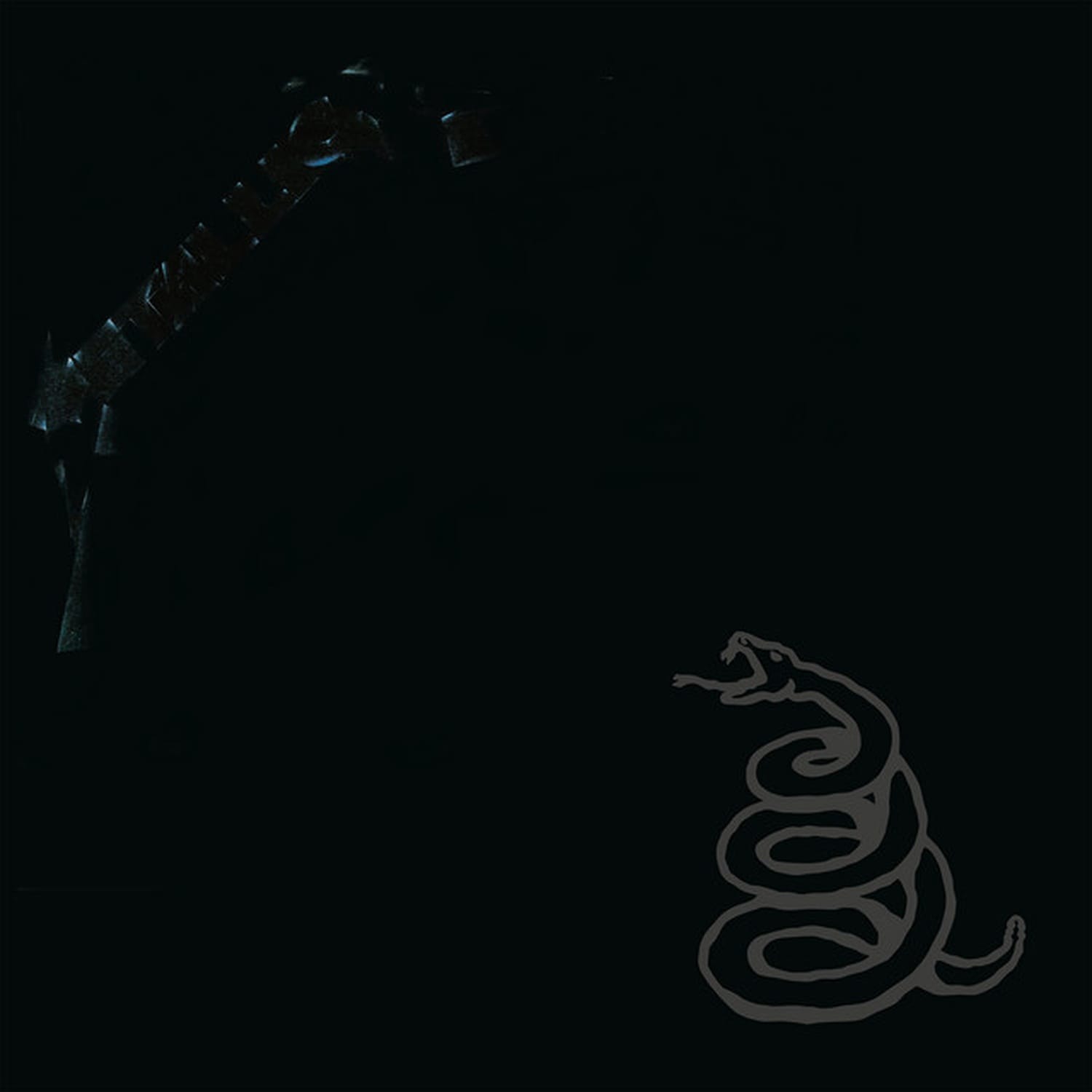
The album’s title, “Metallica,” was chosen after other options were considered and rejected. The cover, designed by Turner Duckworth, featured a barely visible black-on-black snake (from the Gadsden flag) and a subtle band logo, symbolising a rebirth and a blank slate. The design was inspired by Status Quo’s “Hello!” album, with a tongue-in-cheek nod to Spinal Tap’s “Smell the Glove.”
Below is a table of the band members and their roles during the making of the album:
| Band Member | Instrument/Role |
|---|---|
| James Hetfield | Vocals, rhythm guitar, acoustic guitar, lead guitar on “Nothing Else Matters”, producer |
| Kirk Hammett | Lead guitar, co-writer, producer |
| Jason Newsted | Bass, co-writer (“My Friend of Misery”) |
| Lars Ulrich | Drums, percussion, producer |
| Michael Kamen | Orchestral arrangement on “Nothing Else Matters” (guest) |
As well as their musical duties, Hetfield and Ulrich were hands-on in production. Financially, the band risked much, pouring in time and resources. They faced the pressure of following up a platinum-selling album, while navigating divorces and personal upheaval—Ulrich, Hammett, and Newsted all went through marital breakdowns during the sessions. The result was a record born from tension, ambition, and a hunger to break new ground.
Recording Process
The recording of “Metallica” began on 6 October 1990 at One on One Recording Studios in Los Angeles. The sessions, overseen by producer Bob Rock, lasted until 16 June 1991. Bob Rock was chosen for his work on Mötley Crüe’s “Dr. Feelgood” and The Cult’s “Sonic Temple.” The band wanted a “live” feel, recording together in the same room rather than isolating parts. This approach was new for Metallica, and it led to heated arguments and creative breakthroughs.
Key personnel included Bob Rock (producer), Randy Staub (engineer), Mike Tacci (assistant engineer), and George Marino (mastering). Bob Rock’s style was direct and uncompromising—he pushed the band to refine their performances, often demanding dozens of takes to get the perfect result. Lars Ulrich later admitted, “We were not very open to having anyone tell us what to do. But Bob made us better.” The sessions were long and fraught with tension, but the sound they achieved set a new standard for heavy music.
Let’s look at the likely hardware and gear used during the recording. While not every detail is public, based on studio reports and contemporary interviews, the following table summarises the main equipment and techniques:
| Hardware/Instrument | Details/Usage |
|---|---|
| Guitars | ESP MX220/250 (Hetfield), ESP KH-2 (Hammett), Gibson Les Paul (Hammett), Danelectro Jerry Jones Baritone (Hetfield), Gretsch White Falcon (Hetfield), Fender Telecaster with B-Bender (Hetfield) |
| Pickups | EMG 81/60 active pickups (Hetfield and Hammett) |
| Amplifiers | Mesa Boogie Mark IIC++, Jose-modded Marshall SLP (owned by Bob Rock), Bradshaw preamp/VHT power amp (Hammett) |
| Cabinets | Marshall 1960 4×12” with Celestion Vintage 30 speakers |
| Bass | Spector NS-2, Alembic, Ampeg SVT amps (Jason Newsted) |
| Drums | Tama Granstar kit (Lars Ulrich), Zildjian cymbals |
| Microphones | Neumann U87, Shure SM57 (guitar cabs), AKG D112 (kick), Sennheiser MD421 (toms) |
| Outboard Gear | Aphex EQF-2 EQ, Aphex CX-1 Compressor, Tube Screamers, Eventide harmoniser |
| Recording | Analog tape (24-track), mixed to digital for mastering |
Unique to these sessions was the layering of guitar tones. Bob Rock’s approach involved blending the aggressive attack of Mesa Boogie amps with the warmth of modded Marshalls, EQ’d to cut harsh frequencies. The bass, which had been criticised for being buried on “…And Justice for All,” was brought forward, and the drums were recorded for maximum impact, with fewer complex patterns but a bigger sound. The sessions were so demanding that the album was remixed three times before the band were satisfied.
Bob Rock’s production credits extend far beyond “Metallica.” Here’s a table of notable albums produced by Bob Rock that we’ve covered in detail:
| Producer | Artist | Album | Year |
|---|---|---|---|
| Bob Rock | Mötley Crüe | Dr. Feelgood | 1989 |
| Bob Rock | The Cult | Sonic Temple | 1989 |
Sessions were marked by tension, but also breakthroughs. For example, “Enter Sandman” was almost cut until Hetfield and Hammett rewrote the riff’s rhythm at Bob Rock’s insistence. The lyrics for “Nothing Else Matters” were so personal that Hetfield originally didn’t want them on the album. Yet, as Rock later said, “Those moments of conflict are what made the record great.”
Commercial Performance and Reception
When “Metallica” hit the shelves in August 1991, it exploded onto the charts. It debuted at number one on the Billboard 200, selling 598,000 copies in its first week. It stayed at the top for four consecutive weeks and reached number one in ten countries, including the UK, Australia, Canada, Germany, and Sweden. Over the years, it’s spent over 750 weeks on the Billboard 200, the fourth-longest run in history. The album has sold over 30 million copies worldwide, with 16 million certified in the US alone. It remains the best-selling album in the US since SoundScan began tracking sales in 1991.
Below is a table showing Metallica’s studio albums, ordered by release year. For each, I’ve included sales data where available, highlighting “Metallica” in blue for clarity.
| Album | Year | Sales Data |
|---|---|---|
| Kill ’em all | 1983 | 3 million (US) |
| Ride the lightning | 1984 | 6 million (US) |
| Master of puppets | 1986 | 6 million (US) |
| …and justice for all | 1988 | 8 million (US) |
| Metallica | 1991 | 16 million (US), 30 million (worldwide) |
| Load | 1996 | 5 million (US) |
| Reload | 1997 | 4 million (US) |
| St. anger | 2003 | 2 million (US) |
| Death magnetic | 2008 | 2 million (US) |
| Hardwired… to self-destruct | 2016 | 1 million (US) |
| 72 seasons | 2023 | n/a |
The album received a slew of awards and recognitions. It won the 1992 Grammy Award for Best Metal Performance and the MTV Video Music Award for Best Rock Video (“Enter Sandman”). It’s ranked in Rolling Stone’s 500 Greatest Albums of All Time (number 235 in 2020), Melody Maker’s best albums of 1991, and Spin’s 90 Greatest Albums of the ‘90s. In Germany, it’s certified 4× Platinum, and in the UK, 3× Platinum. The “Black Album” has become a staple of music collections around the world.
1991 was a year of huge releases. Other albums from similar artists included:
- Nevermind by Nirvana [11 million US sales]
- Ten by Pearl Jam [13 million US sales]
- Badmotorfinger by Soundgarden
- Use Your Illusion I & II by Guns N’ Roses
- Blood Sugar Sex Magik by Red Hot Chili Peppers
- Innuendo by Queen
- Slave to the Grind by Skid Row
- Arise by Sepultura
- No More Tears by Ozzy Osbourne
- Roll the Bones by Rush
Metallica’s “Black Album” stood out even among these giants, setting new records for a heavy metal release. The album’s awards and certifications are extensive:
- Grammy Award for Best Metal Performance (1992)
- MTV Video Music Award for Best Rock Video (“Enter Sandman”)
- Rolling Stone 500 Greatest Albums of All Time (number 235 in 2020)
- Billboard Music Award for Catalog Album of the Year (1999)
- Multiple platinum and diamond certifications worldwide
Elsewhere in heavy music in 1991, Nirvana’s “Nevermind” changed the face of alternative rock, and the Lollapalooza festival launched, showcasing bands like Jane’s Addiction and Nine Inch Nails. Grunge and alternative metal were on the rise, and the music world mourned the loss of Queen’s Freddie Mercury. The Soviet Union collapsed, marking the end of an era. In this climate of upheaval and innovation, “Metallica” became the definitive heavy album of the year.
Track Analysis
The singles from “Metallica” became some of the band’s most recognisable songs. “Enter Sandman” was released on 29 July 1991, reaching number 16 on the Billboard Hot 100 and earning Platinum status. “The Unforgiven” followed on 28 October 1991, hitting the Top 40 and charting in the Top 10 in Australia. “Nothing Else Matters” was released on 20 April 1992, peaking at number 6 in the UK and Ireland. “Wherever I May Roam” and “Sad but True” were also released as singles, both charting strongly on rock and mainstream charts. “Don’t Tread on Me” was released promotionally to rock radio.
Below is a detailed table of every song from the album, including length and writing credits. Singles are marked with an asterisk.
| Track Name | Length | Writing Credit |
|---|---|---|
| Enter Sandman* | 5:31 | Hetfield, Ulrich, Hammett |
| Sad but True* | 5:24 | Hetfield, Ulrich |
| Holier Than Thou | 3:47 | Hetfield, Ulrich |
| The Unforgiven* | 6:27 | Hetfield, Ulrich, Hammett |
| Wherever I May Roam* | 6:44 | Hetfield, Ulrich |
| Don’t Tread on Me | 4:00 | Hetfield, Ulrich |
| Through the Never | 4:04 | Hetfield, Ulrich, Hammett |
| Nothing Else Matters* | 6:28 | Hetfield, Ulrich |
| Of Wolf and Man | 4:16 | Hetfield, Ulrich, Hammett |
| The God That Failed | 5:08 | Hetfield, Ulrich |
| My Friend of Misery | 6:49 | Hetfield, Ulrich, Newsted |
| The Struggle Within | 3:53 | Hetfield, Ulrich |
Singles: “Enter Sandman,” “The Unforgiven,” “Nothing Else Matters,” “Wherever I May Roam,” and “Sad but True” all charted on the Billboard Hot 100. “Don’t Tread on Me” was a promotional single for radio.
Song Meaning and Lyrics
Every song on “Metallica” tells a story, but the singles in particular showcase the band’s new lyrical direction. “Enter Sandman” explores nightmares and childhood fears, blending the innocence of a bedtime story with dark, unsettling imagery. The lyrics—“Hush, little baby, don’t say a word… It’s just the beasts under your bed”—capture the tension between comfort and terror. As analysed by Aybeniz Özdemir, the song echoes Freud’s concept of the uncanny, with childhood fears resurfacing in adult life (Typelish: Enter Sandman and Freud’s Theory of the Uncanny).
“Don’t Tread on Me” is rooted in American revolutionary imagery, using the snake from the Gadsden flag as a symbol of liberty and vigilance. The lyrics, “Liberty or death, what we so proudly hail / Once you provoke her, rattling of her tail,” underline the theme of strength and warning (Metallica Wiki: Don’t Tread on Me).
“The Unforgiven” is a deeply personal song for James Hetfield, reflecting his strict religious upbringing and the loss of his mother. The lyrics describe a life shaped by control and repression, culminating in the line, “So I dub thee unforgiven”—a declaration of breaking free from those who caused pain (Teacher Ola: The Unforgiven Lyrics Explained).
“Nothing Else Matters” is perhaps Metallica’s most famous ballad. Written by Hetfield while on the phone with his girlfriend, it’s a love song about trust and connection: “So close, no matter how far / Couldn’t be much more from the heart.” Its universal message has made it a popular choice for weddings and ceremonies (One Fab Day: Ceremony Reading – Nothing Else Matters).
“Wherever I May Roam” is a road song, reflecting the band’s nomadic life: “And the road becomes my bride / Wherever I may roam / Where I lay my head is home.” It’s a celebration of freedom and self-reliance (Genius: Wherever I May Roam Lyrics).
“Sad but True” examines the darker side of human nature. Hetfield has described it as a song about honesty and self-destruction: “I’m your life, I’m the one who took you here… I’m your dream, make you real, I’m your eyes when you must steal.” The song is about the inner voice that leads us astray (Metallica Wiki: Sad But True).
Touring and Promotion of Metallica
Promotion for “Metallica” was on a scale rarely seen for a metal album. The band released five singles, each with a high-profile music video—most notably “Enter Sandman,” directed by Wayne Isham, which won MTV’s Best Rock Video in 1992. The album’s launch was supported by appearances on major TV shows and radio, as well as an aggressive press campaign.
The touring cycle was legendary. The “Wherever We May Roam” tour began in 1991, covering North America, Europe, and beyond. The band played at the Monsters of Rock festival in Moscow, performing to an estimated 150,000–500,000 people. In 1992, Metallica joined Guns N’ Roses for a stadium tour, during which Hetfield suffered severe burns in a pyrotechnics accident. Guitar tech John Marshall filled in on rhythm guitar while Hetfield continued to sing. The tour included over 300 shows across the globe, with notable stops at the Freddie Mercury Tribute Concert and Woodstock ‘94.
In 1991, Metallica shared stages with AC/DC, Pantera, and The Black Crowes at the Moscow Monsters of Rock, and with Guns N’ Roses and Faith No More on the North American stadium tour. Notable events included Hetfield’s on-stage injury in Montreal and the band’s epic three-night stand at Mexico City’s Palacio de los Deportes, later released in the “Live Shit: Binge & Purge” box set.
Influences and Legacy
“Metallica” was shaped by a range of musical influences. The band drew inspiration from classic heavy metal (Black Sabbath, Deep Purple, Judas Priest), punk (The Misfits, Ramones), and the raw simplicity of AC/DC. They also looked to more melodic sources—Bob Dylan, Bob Marley, and John Lennon—when writing lyrics for the album. The band’s sound was further influenced by producer Bob Rock’s work with Mötley Crüe and The Cult, aiming for a bigger, more accessible sound.
The table below shows the main influences on “Metallica” and the artists who were, in turn, influenced by the album:
| Influences on “Metallica” | Artists Influenced by “Metallica” |
|---|---|
| Black Sabbath | Godsmack |
| Judas Priest | Korn |
| AC/DC | Trivium |
| The Misfits | Avenged Sevenfold |
| The Rolling Stones | Machine Head |
| Soundgarden | Gojira |
| Bob Dylan, Bob Marley, John Lennon (lyrical) | Post-grunge and nu metal bands |
The album was released in 1991—a year of global change. The Soviet Union collapsed, marking the end of the Cold War. The Gulf War raged in the Middle East. The first website went live, launching the internet era. In music, Nirvana’s “Nevermind” and Pearl Jam’s “Ten” ushered in grunge, while Queen’s Freddie Mercury passed away, leaving a void in rock. “Metallica” captured the mood of a world in flux, combining heaviness with a newfound sense of melody and introspection.
Five Things About Metallica
Here are five verified facts about “Metallica” that every fan should know:
| Fact | Details |
|---|---|
| Longest-charting Metallica album | “Metallica” has spent over 750 weeks on the US Billboard 200, more than any other Metallica album. |
| Biggest-selling album of the SoundScan era | With over 16 million US sales, it’s the best-selling album since SoundScan began in 1991. |
| “Enter Sandman” nearly scrapped | The song’s main riff was reworked at Bob Rock’s urging. It went on to become the band’s biggest hit. |
| Orchestral arrangements by Michael Kamen | “Nothing Else Matters” features a full orchestra, arranged by Michael Kamen, a first for Metallica. |
| Massive touring success | The “Wherever We May Roam” tour saw the band play to over three million people worldwide. |
Media and Television Usage
Metallica’s songs have become fixtures in popular culture, but few tracks from “The Black Album” have been as widely used as “Enter Sandman.” Here’s a table showing some notable appearances:
| Song Title | Media | Year |
|---|---|---|
| Enter Sandman | Supernatural (S1E1, “Pilot”) | 2005 |
| Enter Sandman | The Tonight Show Starring Jimmy Fallon | 2016, 2024 |
| Enter Sandman | Love Island (UK) | 2020, 2023 |
| Enter Sandman | Rock Band, Guitar Hero: Metallica (video games) | 2007, 2009 |
Other songs from the album have appeared in sports broadcasts, commercials, and as entrance music for athletes—most famously, “Enter Sandman” for baseball pitcher Mariano Rivera. “Nothing Else Matters” is often used in wedding ceremonies and film soundtracks.
Critical Reviews and Retrospectives
“Metallica” was widely praised by critics on release and in later retrospectives. The album’s production, songwriting, and impact were highlighted by publications across the spectrum. Below is a table summarising key reviews:
| Publication | Review Score | Notable Quotes | Link |
|---|---|---|---|
| Rolling Stone | 4/5 | “A triumphant album that brought heavy metal to the masses.” | Read review |
| Q Magazine | 5/5 | “The sound of a band at the height of its powers.” | Read review |
| The Village Voice | 8th best album of 1991 | “A successful move from thrash to mainstream heavy metal.” | Read review |
| NME | 8/10 | “Intensity and precision—metal’s new benchmark.” | Read review |
After Metallica
Following the release of “Metallica,” the band became global superstars. The album’s success allowed them to experiment further, leading to the bluesy, alternative-influenced Load and Reload albums. Bassist Jason Newsted left in 2001, replaced by Robert Trujillo in 2003. The band faced personal and creative struggles, documented in the film “Some Kind of Monster.” In 2008, they returned to their thrash roots with Death Magnetic. Their most recent album, “72 Seasons,” was released in 2023. As of April 2025, Metallica remain active, touring globally and writing new material. The “M72 World Tour” continues into 2025, with major festival appearances and stadium shows.
Remasters and Reissues
“Metallica” has been reissued and remastered several times. The 30th-anniversary remastered edition was released on 10 September 2021, remastered by Bob Ludwig and overseen by Greg Fidelman. The deluxe box set includes a remastered double LP, CD, three live LPs, 14 CDs, six DVDs, and exclusive merchandise. Limited edition vinyl releases, including the “Some Blacker Marbled” 2LP, have sold out quickly. These reissues feature bonus tracks, live recordings, and rare demos, offering fans a comprehensive look at the album’s creation and legacy.
| Edition | Format | Release Date | Details |
|---|---|---|---|
| Remastered Deluxe Box Set | CD, LP, Digital | 10 September 2021 | Includes remastered album, live shows, demos, DVDs, memorabilia |
| Limited Some Blacker Marbled 2LP | Vinyl | 2021 | Sold out |
| Standard Remastered LP | Vinyl | 2014, 2021 | 180g vinyl, improved audio |
| 3CD Edition | CD | 2021 | Includes bonus tracks, demos |
Conclusion
More than thirty years after its release, “Metallica” remains a cornerstone of heavy music. Its influence is still felt in the riffs of new bands, the production of modern albums, and the energy of stadium crowds. The album’s mix of heaviness, melody, and raw honesty set a new standard for metal and rock alike. Metallica continue to tour and record, showing no signs of slowing down. With new music in the works and the M72 World Tour extending into 2025, their legacy grows ever stronger.
Further Reading
For more on Metallica and related albums, check out our own articles and podcasts:
- The Unlikely Success Story of Metallica (Blog Article)
- Metallica’s …And Justice for All: An Essential Album Analysis (Blog Article)
- Ride The Lightning: Metallica’s Thrash Metal Revolution (Blog Article)
- Master of Puppets: Unraveling Metallica’s Pivotal Album (Blog Article)
- Death Magnetic: Metallica’s Thrash Metal Revival (Blog Article)
- The Evolution of Load – Metallica’s Bold Move (Blog Article)
- The Making of Reload: Metallica’s Evolutionary Leap (Blog Article)
- Exploring Countdown to Extinction: Megadeth’s Defining Album (Blog Article)
- Dookie: Green Day’s Iconic Punk Rock Revolution (Blog Article)
- Appetite For Destruction: Guns N’ Roses’ Timeless Debut (Blog Article)
- Unleashing Power: Pantera’s Vulgar Display Revolution (Blog Article)
- Iron Maiden’s The Number of the Beast: A Metal Landmark (Blog Article)
- Orgy of the Damned by Slash – album review (Blog Article)
- Wikipedia page for Metallica
- Official Metallica website
- Elektra Records website
Let us know in the comments what your thoughts are on Metallica by Metallica. Did we miss anything? Share your experiences and join the conversation!
About the Author

Was ChatGPT involved in the writing of this article?
We probably write the same as everyone else these days. The rough draft is written by hand, usually starts as a copy/paste of the last article so we keep the same structure then each section is drafted. Once it’s pretty much finished, we’ll use AI as part of the edit process to get further ideas and spot errors. We try not to rely on it too much but it’s a great time saver and often picks things up that we miss during the initial draft.
For source material we tend to use this to see if it was written by AI – https://writer.com/ai-content-detector/ not that I mind specifically, but it’s handy to know where things come from if you’re referencing them.
Hope you enjoyed the article!