The first thing Flemming Rasmussen heard when he listened back to the first rough mix of Metallica's fourth album in early 1988 was the bass guitar. The next thing he heard, two weeks later in a long-distance phone call from New York, was James Hetfield and Lars Ulrich telling the two engineers they had hired in Rasmussen's absence to turn the bass down until it could just barely be heard, and then, in Rasmussen's recollection, "take it down a further three dBs". The Danish producer was three thousand miles away with no authority over the mix and no idea why. The two men carrying out the instruction, Steve Thompson and Michael Barbiero, hated it. The bassist on the receiving end of it, Jason Newsted, was a year and a half into his job replacing the late Cliff Burton, had recorded most of his parts alone in the studio with only the assistant engineer for company, and was about to discover what his contribution to the most ambitious Metallica record ever made was going to sound like to ten million American buyers.
What those ten million people would buy, starting on 7 September 1988, was a 65-minute, nine-track, riff-stuffed treatise on political and legal injustice with almost no audible bass guitar, a Vietnam-veteran-on-life-support music video, a Grammy nomination that went historically wrong, and a Lady Justice statue collapsing under the weight of her own scales on the front. It would also be the album that took Metallica from a thrash-metal cult act to a Top 10 Billboard 200 artist with a touring radius that filled arenas in three continents. This is how a record with no low end became the band's most ambitious statement of the 1980s, and the moment they realised, by the time they got off tour eighteen months later, that they could not go any further in this direction without losing the audience entirely.
Album Facts
| Field | Detail |
|---|---|
| Artist | Metallica |
| Album | ...And Justice for All |
| Release Date | 7 September 1988 (US, Metallica.com); 25 August 1988 (RIAA); 5 September 1988 (UK, per Benoit Clerc) |
| Label | Elektra Records (US) and Vertigo Records (UK and Europe) |
| Producer(s) | Flemming Rasmussen, James Hetfield and Lars Ulrich |
| Studio(s) | One on One Recording Studios, Los Angeles (28 January to 23 May 1988); mixing by Steve Thompson and Michael Barbiero in New York |
| Genre / Subgenre | Thrash metal and progressive metal; sometimes classified as technical thrash |
| Track Count | 9 |
| Total Runtime | 65:25 |
| Billboard 200 Peak | No. 6 (83 weeks on chart); 1.7 million US sales by end of 1988; platinum within nine weeks of release |
| UK Albums Chart Peak | No. 4 |
| Other Notable Chart Peaks | No. 1 Finland; No. 3 Germany; No. 5 Sweden; No. 7 Switzerland; No. 8 Norway and Spain; No. 9 Netherlands; No. 12 Austria |
| Certifications | US 8× Platinum (RIAA, 2003); Canada 3× Platinum; Australia 3× Platinum; Germany 2× Platinum; UK Platinum (BPI, 2013); Argentina, Finland, Poland, Switzerland Platinum; gold in several other territories |
| Estimated Sales | 9.7 million in the US (by 2023); over 12 million worldwide |
| Key Singles | "Harvester of Sorrow", "Eye of the Beholder", "One" |
Cultural Context
The album landed in a 1988 American mainstream that had no clear category for it. The Billboard 200's top end that autumn was Michael Jackson's Bad, George Michael's Faith, Tracy Chapman's debut and Guns N' Roses' Appetite for Destruction, which had spent fourteen months climbing from underground notoriety to No. 1. Hair metal owned MTV: Bon Jovi, Def Leppard, Poison, Whitesnake, Cinderella. The college-rock crowd had R.E.M.'s Green two months out. Underground hardcore was retreating into the indie-college circuit. Hip-hop had broken open with Public Enemy's It Takes a Nation of Millions and N.W.A.'s Straight Outta Compton, both released that summer.
Thrash metal, the genre Metallica had been instrumental in inventing in 1982 and 1983, was at its highest-ever cultural visibility. Within twelve months of ...And Justice for All, the other three members of what would retrospectively be christened the "Big Four" all released their own commercial breakthroughs: Anthrax's State of Euphoria (also September 1988), Slayer's South of Heaven (July 1988), Megadeth's So Far, So Good... So What! (January 1988). Pantera were still operating as a glam band in Texas and would not pivot until Cowboys from Hell in 1990. Sepultura had released the technically thrash Beneath the Remains debut on Roadrunner that year. Death metal as a defined commercial subgenre was barely a year old.
The records jostling for shelf space and metal-fan attention that autumn:
- Anthrax, State of Euphoria (September 1988)
- Slayer, South of Heaven (July 1988)
- Iron Maiden, Seventh Son of a Seventh Son (April 1988)
- Queensryche, Operation: Mindcrime (May 1988)
- Megadeth, So Far, So Good... So What! (January 1988)
- Suicidal Tendencies, How Will I Laugh Tomorrow When I Can't Even Smile Today (September 1988)
- Guns N' Roses, G N' R Lies (November 1988)
- Jane's Addiction, Nothing's Shocking (August 1988)
- Public Enemy, It Takes a Nation of Millions to Hold Us Back (June 1988)
The Band's Story Up to This Point
The fifteen months between Master of Puppets (3 March 1986) and the start of these sessions had nearly destroyed the band twice. The first time was 27 September 1986, when Metallica's tour bus skidded off a road outside Ljungby, Sweden, and rolled into a ditch. Bassist Cliff Burton, asleep in a bunk, was thrown through a window and crushed by the bus as it landed. He was 24. The remaining three members spent six weeks deciding whether to continue, then auditioned roughly forty bassists in Los Angeles, Chicago and New York between October and November. Jason Newsted, then of Phoenix thrash band Flotsam and Jetsam, was picked on the strength of an audition that included Burton's signature bass solo and the entirety of "Master of Puppets" played at speed and from memory. He officially joined the band on 28 October 1986.
Newsted's first studio work with Metallica was the August 1987 covers EP The $5.98 E.P. , Garage Days Re-Revisited, a deliberately rough five-track recorded at Hetfield's garage studio at his home in El Cerrito as both a stylistic palate-cleanser and a hazing-style initiation of the new bassist. Hetfield, Ulrich and Hammett gave Newsted the worst on-tour hotel rooms, played pranks ranging from the petty to the genuinely cruel, and made him pay for his own meals while they expensed theirs. He absorbed it all because, as he would later say with characteristic understatement, he understood Metallica was Hetfield and Ulrich's band and he was an employee.
The second near-derailment came in summer 1987. The band had committed to a heavy European festival run including the Monsters of Rock tour, originally to launch the album. In July, Hetfield broke his arm in a skateboarding accident in front of the Oakland Coliseum, where Metallica were scheduled to open for Aerosmith two days later. He flew on the tour anyway, with John Marshall, a guitar tech and later Metal Church guitarist, depping for him on stage. The injury, plus the festival commitments, plus a major-label business decision (manager Peter Mensch's reshuffle towards Phonogram in Europe in a deal eventually worth "well over a million pounds") pushed the start of the next album from late 1987 into January 1988.
"We took the Ride the Lightning and Master of Puppets concept as far as we could take it. There was no place else to go with the progressive, nutty, sideways side of Metallica, and I'm so proud of the fact that, in some way, that album is kind of the epitome of that progressive side of us up through the '80s."
Lars Ulrich, MTV News, 2008
Pre-production and Demos
Pre-production for what would become ...And Justice for All took place at El Cerrito and at the band's rehearsal space in San Rafael through late 1987 and early January 1988. Hetfield and Ulrich, working much as they had on Master of Puppets, were the primary songwriters. The two of them would sit with cassettes of riffs accumulated over the previous year of touring, sequence the best ideas into draft song structures, and then bring the rest of the band in to rehearse and arrange.
The crucial absence in this room was the songwriter who had previously had the most influence on Metallica's harmonic vocabulary: Burton. He had been the band's classical-influenced anchor, the one most likely to introduce a Bach-flavoured interlude or argue for a slower, more atmospheric passage. Without him, the songwriting tilted further towards Hetfield and Ulrich's instincts, which were towards complexity, layered riffing, frequent tempo shifts, and unusual time signatures. The result was a record on which only one track on the entire album (Newsted's co-write on "Blackened") featured a writing credit from outside the Hetfield/Ulrich axis, with Hammett picking up co-writes on four of the nine tracks ("...And Justice for All", "Eye of the Beholder", "The Frayed Ends of Sanity" and "Dyers Eve") and Burton receiving a posthumous co-write on "To Live Is to Die".
The Burton co-credit on "To Live Is to Die" is one of the most genuinely moving things in the entire Metallica catalogue. Newsted, recording his bass parts alone in the studio, was given a cassette of unused bass-line fragments that Burton had recorded during the Master of Puppets sessions and never used. Newsted assembled those fragments into a coherent bassline for the new song. Because the original Burton recordings were not used, the credit is officially "written by Hetfield, Ulrich and Burton" with the bass "performed by Newsted". The four-line spoken-word section that surfaces midway through the track is more complicated than the liner notes admit: only the closing two lines ("All this I cannot bear to witness any longer. Cannot the kingdom of salvation take me home?") were Burton's. The opening line ("When a man lies, he murders some part of the world") was lifted from the 1981 John Boorman film Excalibur, and the second line ("These are the pale deaths which men miscall their lives") comes from Stephen R. Donaldson's 1977 fantasy novel Lord Foul's Bane.
Lyrically, Ulrich described the writing of this album as Metallica's "CNN years":
"I'd read about the blacklisting thing, we'd get a title, 'The Shortest Straw,' and a song would come out of that."
Lars Ulrich, Rolling Stone (David Fricke), November 1991
Hetfield was the album's primary lyricist and, as Rasmussen would later observe, was writing lyrics during the recording sessions, often with the song already in progress. Topics, for the first time in the band's catalogue, were directly political: environmental collapse ("Blackened"), legal corruption ("...And Justice for All"), McCarthyite blacklisting ("The Shortest Straw"), censorship and the First Amendment ("Eye of the Beholder"), the suffering of an unidentifiable war victim ("One"), nuclear-age existential dread ("Blackened" again, "The Frayed Ends of Sanity"), and, most personally, a long rant at Hetfield's own parents for the Christian Science upbringing that had refused his mother medical care for the cancer that killed her ("Dyers Eve").
Creating the Album
Tracking began on 28 January 1988 at One on One Recording Studios in North Hollywood, Los Angeles. The choice was practical: Rasmussen had been keen to work in California rather than Copenhagen for the third record running because the band wanted to be on home soil after Burton's death. One on One was a relatively new facility owned by Survivor and Jimmy Iovine alumni and had become Los Angeles's go-to room for heavy rock in 1987 to 1988, hosting Aerosmith, Bon Jovi and others. Its main strengths for Metallica were a large live drum room and the kind of analogue console (a Neve VR) that Rasmussen liked.
The first problem was that Rasmussen was not actually there. Bookings on his calendar in Copenhagen pushed his arrival at One on One into early March, six weeks after the band had wanted to start. Mensch's office hired Mike Clink to fill the gap. Clink had just produced Guns N' Roses' Appetite for Destruction, which was about to begin its slow climb to the top of the Billboard 200, and was the hottest producer name in Los Angeles. The fit was not natural. Clink had been brought in to push Metallica towards radio-rock clarity and Metallica did not want to be pushed in that direction. He later said:
"As much as I believe they wanted me to put my magic on the tracks, I think that they were used to doing things on their own and doing it their own way."
Mike Clink, Metal Injection, 2020
The six weeks with Clink were not wasted, though. The band warmed up, tuned their gear, and tracked their two Garage Inc.-style cover B-sides during the period: Budgie's "Breadfan" and Diamond Head's "The Prince". They also kept the drum tracks that Clink had cut with Ulrich for two of the album proper's songs ("The Shortest Straw" and "Harvester of Sorrow"), which is the reason Clink is credited specifically as "drum engineering on The Shortest Straw and Harvester of Sorrow" in the album's liner notes and not as a session producer.
Rasmussen arrived in March and immediately had to fix the guitar sound, which the band did not like. From that point, the production followed an unusually rigid step-by-step process designed around the album's complex song structures. Each song began with a click track and Hetfield playing a guide guitar part to map the structure and tempo changes. Then, in this strict order: Ulrich tracked the drums, alone; Hetfield then tracked all the final rhythm guitar parts, layering multiple takes for the rhythmic density that became the album's signature; Newsted tracked his bass parts, alone, with only assistant engineer Toby "Rage" Wright present; Hetfield then tracked vocals; Hammett tracked all the lead guitars in the final stages. Newsted's experience was a particular shock. He had come from Flotsam and Jetsam, whose approach he later described to Ultimate Classic Rock as "basically everybody playing the same thing like a sonic wall". The Metallica method, with each musician recording in isolation and almost no group discussion of the parts, left him questioning what his actual contribution to the record's sound was.
Tracking wrapped on 23 May. The album was 65 minutes long and consisted of nine songs averaging just over seven minutes each, the shortest "Dyers Eve" at 5:14 and the longest "To Live Is to Die" at 9:49. There were no concise singles. There was, on paper, almost no chance of radio play.
The Mix (and the Disappearing Bass)
Mixing was handed to Steve Thompson and Michael Barbiero, a New York team known for their work on Guns N' Roses' Appetite for Destruction, Madonna and Tesla. The decision had been made before tracking was finished. Rasmussen, the man who knew the source tapes best, was not present for any of the mix sessions. This was not unusual at major-label level in 1988, but it had consequences here.
Thompson and Barbiero made two technical decisions that, between them, became the most-discussed production choices in 1980s metal. First, they used only the close microphones on Ulrich's drums and none of the room microphones, producing the famously "clicky", room-less drum sound. Second, when the rough mixes were sent to Hetfield and Ulrich for approval, the band asked the engineers to push the bass guitar down to the threshold of audibility, and then keep going.
"After Lars and James heard their initial mixes the first thing they said was, 'Take the bass down so you can just hear it, and then once you've done that, take it down a further three [dBs].' I have no idea why they wanted that, but it was totally out of my hands."
Flemming Rasmussen, Sound on Sound, May 2011
Thompson would later tell Ultimate Guitar that he wanted to quit the project over the decision and was blocked by management. Newsted heard the finished master and was openly unhappy. Rasmussen has gone further: in a 2018 interview around the 30th-anniversary reissue, he said that he, Newsted and Toby Wright are probably the only three people alive who have ever heard the bass tracks Newsted actually played, and that those tracks are, in his words, "fucking brilliant".
The official reasons offered have shifted over the years. Hetfield in 2009 said the bass was hidden because Newsted's basslines often doubled the rhythm guitar and made the two instruments indiscernible, and because Hetfield's heavily scooped rhythm-guitar sound (mids cut, bass and treble boosted) had already taken up the low-end frequencies the bass should have occupied. Hammett, in 2013, said the bass interfered with Hetfield's guitar sound when blended, so they took it out. Newsted himself, generously, said in 2013 that the bass tone he had achieved was thin to start with and that his picking style left little low end. The most candid version came from Hetfield and Ulrich together in 2019:
"Basically [we] kept turning everything else up until the bass disappeared. Our hearing was shot."
James Hetfield and Lars Ulrich, Kerrang!, August 2019
The cumulative effect of all this is that ...And Justice for All sounds, in critic Simon Reynolds's phrase, like "mechanized mayhem", with the drums clicking, the guitars layered to the point of mechanical density, and the rhythm section's bottom end essentially absent. Whether this is a flaw or a defining choice is now a thirty-eight-year-old debate. Pitchfork's Sean T. Collins, reviewing the 2018 reissue, came down hard on the side of "defining choice", arguing that the record's airless mechanical quality is inseparable from its musical and lyrical themes of institutional decay. Mastering was completed by Bob Ludwig at Masterdisk in New York. George Marino remastered for the 1995 reissue. Reuben Cohen handled the 2018 remaster.
Personnel and Credits
| Role | Player | Notes |
|---|---|---|
| Core band | ||
| Lead vocals, rhythm guitar | James Hetfield | Also acoustic guitar; harmony guitar; second guitar solo on "To Live Is to Die"; co-producer |
| Drums | Lars Ulrich | Co-producer |
| Lead guitar | Kirk Hammett | Co-writes on four of the nine tracks |
| Bass | Jason Newsted | First full Metallica studio album after the death of Cliff Burton; tracked alone with only the assistant engineer present |
| Production and engineering | ||
| Producer / engineer | Flemming Rasmussen | Third Metallica album in a row after Ride the Lightning and Master of Puppets; absent from the mix |
| Assistant and additional engineer | Toby "Rage" Wright | The only outside engineer present during Newsted's bass sessions |
| Drum engineering (two tracks only) | Mike Clink | Hired to fill the first six weeks before Rasmussen could start; drum takes for "The Shortest Straw" and "Harvester of Sorrow" kept from his sessions |
| Mixing | Steve Thompson and Michael Barbiero | Mixed in New York without Rasmussen present; took the bass instructions directly from Hetfield and Ulrich |
| Assistant mixing engineer | George Cowan | |
| Mastering | Bob Ludwig | Masterdisk, New York |
| 1995 remastering | George Marino | Sterling Sound, New York |
| 2018 remastering | Reuben Cohen | For the 30th-anniversary box set |
| Artwork | ||
| Cover concept | James Hetfield and Lars Ulrich | Modelled on Frankfurt's Fountain of Justice |
| Cover illustration | Stephen Gorman | |
| Cover design / art direction | Roger Gorman, Reiner Design Consultants | |
| Hammer illustration | Pushead | The pseudonym of Brian Schroeder, also responsible for Misfits and Septic Death artwork |
| Band photography | Ross "Tobacco Road" Halfin | |
The Songs
| # | Title | Writer(s) | Length | Single? | Notes |
|---|---|---|---|---|---|
| 1 | "Blackened" | Hetfield, Ulrich, Newsted | 6:42 | Newsted's only co-write on a Metallica studio album. Lyric: environmental collapse | |
| 2 | "...And Justice for All" | Hetfield, Ulrich, Hammett | 9:46 | Title from the closing line of the Pledge of Allegiance. Not played live between October 1989 and the 2007 Sick of the Studio tour | |
| 3 | "Eye of the Beholder" | Hetfield, Ulrich, Hammett | 6:25 | Single (US only, October 1988) | Last performed live in 1989 |
| 4 | "One" | Hetfield, Ulrich | 7:26 | Single (worldwide, January 1989) | Inspired by Dalton Trumbo's Johnny Got His Gun. Band's first ever music video. Grammy winner 1990 |
| 5 | "The Shortest Straw" | Hetfield, Ulrich | 6:35 | About McCarthy-era blacklisting; one of the Clink-engineered drum tracks | |
| 6 | "Harvester of Sorrow" | Hetfield, Ulrich | 5:45 | Single (UK only, August 1988) | The other Clink-engineered drum track; UK No. 20 |
| 7 | "The Frayed Ends of Sanity" | Hetfield, Ulrich, Hammett | 7:43 | Intro quotes the "Oh-Ee-Yah" Winkie Guards march from The Wizard of Oz. Did not debut live until 2014, Helsinki | |
| 8 | "To Live Is to Die" | Hetfield, Ulrich, Burton | 9:49 | Burton's posthumous co-write; bassline assembled by Newsted from Burton's unreleased fragments. Spoken word section partly from Excalibur and Lord Foul's Bane. Debuted live at the band's 30th-anniversary residency in 2011 | |
| 9 | "Dyers Eve" | Hetfield, Ulrich, Hammett | 5:14 | Lyric is a direct rant at Hetfield's parents about his Christian Science upbringing. Did not debut live until 2004 at The Forum, Inglewood |
"Blackened" opens the record with reverse-recorded guitars and Hetfield's first lyric on the album: an environmental apocalypse rendered as gospel. It is one of the few tracks Newsted co-wrote on, and one of two ("Dyers Eve" being the other) that maintained anything close to thrash-metal velocity throughout. The riff itself comes from Newsted, who later said he had brought it to the band as an offering, half-expecting to be told it was not Metallica enough. The reverse-guitar intro was Rasmussen's idea, modelled on a similar effect he had used in his earlier work in Copenhagen.
The title track sprawls to 9:46 and is, on its own, longer than several entire EPs Metallica had released earlier in the decade. Lars Ulrich's drum pattern in the verses is one of the most-imitated Metallica beats of the decade. Hetfield's lyric extends the album's central metaphor of a judicial system bought, sold and bound. The track was so long and structurally unwieldy that the band only played it live a handful of times during the Damaged Justice tour before dropping it; Kirk Hammett would later joke that the band came offstage one night after playing it and one of them said "fuck, that's the last time we ever play that fucking song". They didn't return to it live until 2007.
"Eye of the Beholder" was the album's lead US single in October 1988 and the first Metallica track to receive significant radio play in the United States. Lyrically it is the album's First Amendment song, arguing for free speech from a position of grim suspicion that the freedom is already gone. It has not been played live since 1989; the only live version commercially released is on the 2010 Six Feet Down Under EP, captured from a 1989 Australian show.
"One" is the song that broke the album commercially and broke Metallica's long-standing refusal to engage with MTV. The lyric was inspired by Dalton Trumbo's 1939 anti-war novel Johnny Got His Gun and the 1971 film Trumbo himself directed from his own screenplay. The song's structure is the most patient on the record, building from clean arpeggios through a stately march into a closing barrage of double-bass-drum sixteenth notes and machine-gun rhythm-guitar palm-mutes. The band acquired the rights to the Trumbo film expressly for the video, the first they had ever made. Performance scenes, directed by Bill Pope (later cinematographer on The Matrix), were shot in an aircraft hangar in Long Beach, California, in early January 1989. Film footage was edited together with the live performance by Michael Salomon. The video was a controversy among long-time fans, who had taken the band's prior refusal to make videos as an article of faith. It became Metallica's biggest hit to date.
"The Shortest Straw" addresses the Hollywood blacklist of the McCarthy era, a topic Hetfield had read into in the months leading up to the sessions. It is one of the Clink-engineered drum tracks, and the cleaner, drier kit sound is sometimes audible against the other songs. "Harvester of Sorrow", the album's second Clink-drum track, was the lead UK single in August 1988 and the only album track to chart in any territory before the album itself was released. Its riff is the simplest on the record and was reportedly the easiest to track.
"The Frayed Ends of Sanity" is the most overlooked track on the album, partly because the band did not perform it live until 26 years after its release. The opening guitar figure quotes, surprisingly, the "Oh-Ee-Yah, Eoh-Ah" march of the Winkie Guards from the 1939 film of The Wizard of Oz, a Halloween-shop reference Hetfield has confirmed in interviews. It eventually got its live debut on the Metallica By Request tour in Helsinki in 2014.
"To Live Is to Die" is the emotional centre of the record. The instrumental near-entirety of the song is built around the bassline Newsted assembled from Burton's unused recordings. The four-line spoken word section, with its half-Burton, half-found-text construction, has become one of the most-quoted passages in metal lyric history; the closing two lines ("All this I cannot bear to witness any longer / Cannot the kingdom of salvation take me home") were Burton's own, written in the months before his death. The song premiered live, with extreme deliberation, only at the band's 30th-anniversary residency at The Fillmore in San Francisco in December 2011.
"Dyers Eve" closes the album in five minutes and fourteen seconds of double-bass thrash and the most personal lyric Hetfield had ever written, an open letter from a child raised in religious isolation to the parents who raised him there. The Hetfield household had been Christian Scientist; his mother Cynthia had refused medical treatment for her cancer and had died when James was 16. The song is, in his own subsequent description, an unsent letter. He waited until 2004 to play it live for the first time; in the interim, his father had also died and his own thinking about the lyric had softened.
B-sides, Outtakes and Lost Songs
The ...And Justice for All sessions produced two cover B-sides that have outlived their original purpose: Budgie's "Breadfan" and Diamond Head's "The Prince". Both were tracked during the early-1988 Clink sessions as warm-up exercises while the band waited for Rasmussen. "Breadfan" appeared as the B-side on the European "Harvester of Sorrow" single in August 1988 and again on the US "Eye of the Beholder" single in October. "The Prince" was the US-only B-side of the "One" single in January 1989. Both later reappeared, alongside other covers from across the band's career, on the 1998 double album Garage Inc. Both songs have remained occasional live setlist surprises ever since.
The session vault was opened comprehensively for the 2018 30th-anniversary box set. Eleven CDs of previously unreleased material were assembled, including riff tapes from the band's late-1987 Hetfield/Ulrich pre-production sessions, rough mixes containing alternate Hammett solos and vocal harmonies that were later replaced, full session demos, and B-side rehearsals. Rolling Stone's Kory Grow noted in his review that the rough mixes were as close as the band would ever come to releasing a "bass mix" of the album, because the rough versions sent to Hetfield and Ulrich before the Thompson-Barbiero compression and EQ had the bass at a more conventional level. A live performance of "...And Justice for All" recorded at the Seattle Coliseum on 29 and 30 August 1989 (originally part of the Live Shit: Binge & Purge box) was also included.
The "...And Justice for Jason" fan project, in which a YouTube user remixed the entire album from the surviving stems with Newsted's bass restored to a natural mix level, has run on YouTube continuously since 2016 and has been viewed tens of millions of times. Newsted himself was sent a private CD-R of a different fan remix in 2013; he was politely complimentary about the effort but said in 2026 that the album as released is the album that should stand, and that an official remix would be a mistake.
Album Artwork and Packaging
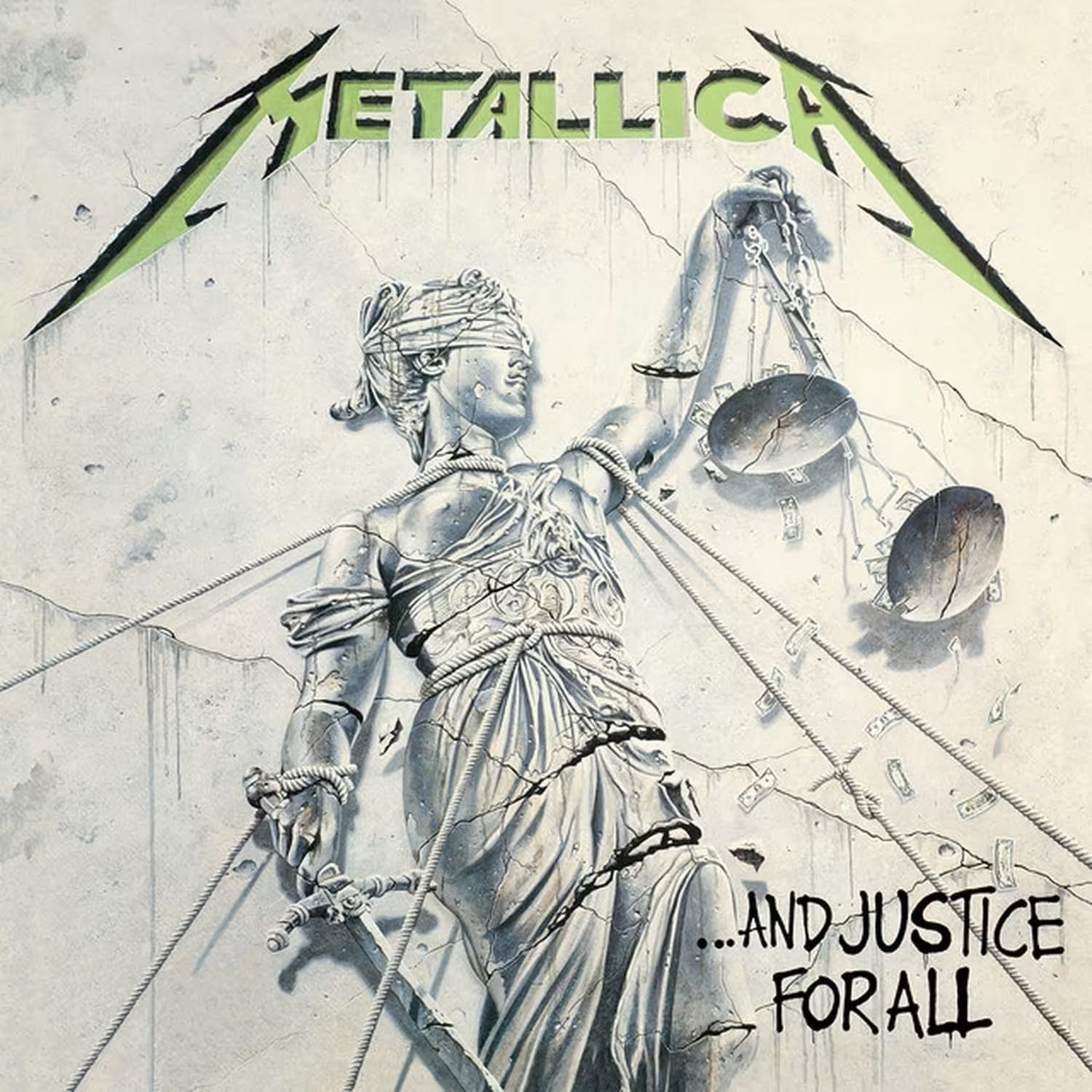
The cover art was painted by Stephen Gorman from a concept developed by Hetfield and Ulrich. Roger Gorman of Reiner Design Consultants in New York directed the overall design. The figure of Lady Justice was modelled on the bronze statue at the centre of Frankfurt's Gerechtigkeitsbrunnen (Fountain of Justice) in the Romerberg square. Stephen Gorman's painting adapts the statue: blindfolded, draped, scales in one hand and sword in the other, but with the scales overflowing with dollar bills and the entire figure bound in ropes that are visibly straining and beginning to break.
Ulrich gave the most direct articulation of the cover's meaning in a contemporary interview:
"It's about our court system in the US where it seems like no one is even concerned with finding out the truth any more. It's becoming more and more like the one lawyer versus another-type situation, where the best lawyer can alter justice in any way he wants."
Lars Ulrich, on the album's cover concept, 1988
The Pushead-drawn hammer (a stylised gavel) appeared throughout the packaging and on associated merchandise; Pushead, real name Brian Schroeder, was the Boise-based artist already known for his work for Misfits, Septic Death and Zorlac Skateboards, and would continue as an occasional Metallica collaborator into the 1990s. Band photography inside the gatefold was by Ross Halfin, the long-serving British photographer who had been documenting Metallica since 1984. The original 1988 LP and CD were issued with a black-and-white interior depicting the band onstage and shots of the band in court-style poses; the 2018 reissue restored these in full at higher resolution.
Release and Reception
The album was released by Elektra in the US on 7 September 1988 (the RIAA logs the date as 25 August), and by Vertigo Records in the UK and Europe within days. It entered the US Billboard 200 at No. 16 and climbed to No. 6 the following week, eventually spending 83 weeks on the chart. UK chart peak was No. 4; it topped the Finnish chart and reached the top five in Germany, Sweden and the UK, and the top ten in Norway, Switzerland and Spain. By the end of 1988, US sales were already 1.7 million; the RIAA certified the album platinum within nine weeks of release. Eight-times-platinum status arrived in 2003; sales had reached 9.7 million in the US by 2023, with global sales over 12 million.
Contemporary reviews were strong. Michael Azerrad in Rolling Stone awarded four stars and called the album "a marvel of precisely channelled aggression". Spin's Sharon Liveten praised the "gem of a double record" (the LP was a double on vinyl) for being both edgy and technically proficient. Tom Moon in the Philadelphia Inquirer wrote that Metallica had "redefined its genre, creating music that is as consistently tense and arresting as the topics the sometimes convoluted lyrics address". Neil Perry in Sounds called it Metallica at "their most confident". Borivoj Krgin in Metal Forces awarded a perfect 10 out of 10, arguing the musicianship was more impressive than that of Master of Puppets. The single most-quoted contemporary line came from Simon Reynolds in Melody Maker:
"This is completely sublimated rock, on a quest for a purity of form, light years beyond raunch or blues rock. Metallica turn heavy metal's melodrama into algebra. This isn't thrash, but thresh: mechanized mayhem."
Simon Reynolds, Melody Maker, 10 September 1988
The unhappier reviews were predictable: Robert Christgau in The Village Voice awarded a C+ and complained that the songs "lack song form". Greg Kot in the Chicago Tribune later called it the band's "most ambitious" but also "flattest-sounding" album. The bass-mix complaint has run through almost every retrospective review since: Ultimate Classic Rock's line that "just about any other metal band would be proud to call this album their signature work, but the thin production remains a big sticking point" has been the consensus formulation for thirty years. The Pazz & Jop critics' poll for 1988 placed the album at No. 39 of the year. Rolling Stone later ranked it No. 21 on its 100 Greatest Metal Albums of All Time (2017); Kerrang! placed it at No. 42 on its 100 Greatest Heavy Metal Albums of All Time.
Singles and Music Videos
| Single | Release | B-side(s) and territories | Chart peaks |
|---|---|---|---|
| "Harvester of Sorrow" | 28 August 1988 | Europe only; B-sides "Breadfan" (Budgie cover) and "The Prince" (Diamond Head cover) | UK No. 20 |
| "Eye of the Beholder" | 30 October 1988 | US only; B-side "Breadfan" | US Mainstream Rock chart entry; did not reach Hot 100 |
| "...And Justice for All" (edit) | 1988 (promo only) | US radio promo; edited from 9:46 down to a shorter version | Did not chart |
| "One" | 10 January 1989 | US B-side "The Prince"; UK B-side a live "Seek & Destroy" recorded in Dallas, 9 February 1989 | US Hot 100 No. 35; UK No. 13; Metallica's first ever music video |
The "One" video was directed for performance scenes by Bill Pope and edited together with Johnny Got His Gun film footage by Michael Salomon. It became one of the most-played metal videos in MTV's history and remains the single most important act of marketing Metallica ever undertook. Slant Magazine ranked it No. 48 on its list of the 100 Greatest Music Videos in 2003. The band have never made a full-on "One"-style narrative video again; every subsequent Metallica video has been either live-performance footage or an abstract concept piece.
Touring and Live
The Damaged Justice tour ran from 11 September 1988 through to 7 October 1989, taking in North America (multiple legs), Europe, the UK, Australia, New Zealand and Japan. It was Metallica's first headline arena tour in the United States. The stage production was the most elaborate the band had attempted, dominated by a full-sized replica of the Lady Justice statue from the album cover that, during the title track, would visibly collapse, the ropes around her snapping and her body crashing to the stage in pieces.
- 11 September 1988: tour opens at Pershing Auditorium, Lincoln, Nebraska
- 22 February 1989: Metallica perform a five-minute "One" at the 31st Annual Grammy Awards, Shrine Auditorium, Los Angeles, the first time a heavy metal band has performed at the ceremony
- March to May 1989: first North American arena leg; support from Queensryche
- May to July 1989: European leg, including Donington Park's Monsters of Rock festival on 19 August 1989 (the bill was Whitesnake, Aerosmith, Metallica, the Cult, Vow Wow)
- 29 and 30 August 1989: Seattle Coliseum shows filmed and recorded; later released as part of Live Shit: Binge & Purge in 1993 and the 2018 reissue box
- October 1989 onwards: Australia, New Zealand, Japan; the title track is dropped from the setlist after October 1989 and not returned until 2007
The Damaged Justice tour was, by every measurable definition, the moment Metallica became a mainstream live act. Rolling Stone's later assessment was that the tour "evolved the band into arena headliners". It was also the tour during which the band began to question, openly, whether they could continue in the progressive-thrash direction the album represented.
"Touring behind it, we realized that the general consensus was that songs were too fucking long [...] I can remember getting offstage one night after playing 'Justice' and one of us saying, 'Fuck, that's the last time we ever play that fucking song!'"
Kirk Hammett, Rolling Stone (David Fricke), 14 November 1991
By the end of the tour Ulrich was openly telling interviewers that the band had pushed the progressive side of Metallica as far as it could go and was looking for something "a bit simpler and maybe a little more physical". The next album, the 1991 self-titled record made with Bob Rock, was the result.
The Grammy Controversy
The 31st Annual Grammy Awards on 22 February 1989 inaugurated a new category: Best Hard Rock/Metal Performance Vocal or Instrumental. Metallica were nominated for ...And Justice for All. They were also asked to perform, and chose a five-minute version of "One", the first time any heavy metal act had performed at the ceremony. Hammett later recalled the band were "very nervous" and felt like "diplomats or representatives for this genre of music".
The category was widely expected to go to Metallica. It went to Jethro Tull for Crest of a Knave. The flute. Metallica were not in the room when the award was announced because Lars Ulrich had been told by an Academy publicist that they had no chance of winning, and the band had left the hall to do press elsewhere. Jethro Tull frontman Ian Anderson did not attend the ceremony, on the basis that he had been told by his label that the award would obviously go to Metallica. Manager Peter Mensch was photographed receiving the trophy on Tull's behalf. The decision was an instant scandal: Entertainment Weekly in 2007 ranked it among the ten biggest upsets in Grammy history.
"I'd be lying if I didn't tell you I was disappointed. Human nature is that you'd rather win than lose, but Jethro Tull walking away with it makes a huge mockery of the intentions of the event."
Lars Ulrich, Guitar World, December 2008
Metallica's response was the kind of self-deprecating commercial judo at which Ulrich would prove a master across the rest of his career. From the next pressing of ...And Justice for All onwards, the album shipped with a sticker on the shrinkwrap reading "Grammy Award LOSERS". The Recording Academy split the category in two the following year (Best Hard Rock Performance and Best Metal Performance), and Metallica won the new Best Metal Performance Grammy in 1990 for "One", the first ever award in the category. They would win it five times across the next nine years, eventually leading Ulrich to joke that the Academy invented a Metallica category by mistake.
In TV, Film and Media
"One" has had a longer cultural afterlife than any other song on the album. It appeared on Guitar Hero: Metallica in 2009 with the bass parts isolated from the rhythm guitar, the first time most listeners had ever heard Newsted's parts on the track distinctly. Kory Grow of Rolling Stone believed many of the ...And Justice for Jason fan-remix versions on YouTube were built using audio extracted from the game. The full 1989 "One" video was inducted into the MTV Video Music Awards' "Best Video of the 1980s" reader-vote canon in 2013. The song itself is a permanent fixture in the Metallica setlist, performed at almost every show the band has played since 1989; the live arrangement extends the opening battlefield sound effects from 17 seconds in the studio version to almost two minutes, and the closing build is accompanied by pyrotechnics around the stage.
Controversy, Censorship and Legal
The album itself drew no significant content-based controversy. There was no parental-advisory sticker conflict (the PMRC battle had focused on Slayer and Mötley Crüe more than on Metallica), no banned cover art and no significant plagiarism lawsuit. The on-record political content of "The Shortest Straw" generated no actionable backlash from the McCarthy-era figures it implicitly criticised. The "One" video used Johnny Got His Gun footage with Dalton Trumbo's estate's full permission; the band paid for the rights outright rather than license them, and the rights remained with the band thereafter. The only real legal controversy of the era was the Phonogram/Vertigo signing of the band's European rights in 1986 and 1987, which was a contract negotiation rather than a public dispute.
Covers, Samples and Tributes
"One" has been covered by Apocalyptica (in their cello-quartet arrangement on the 1996 Plays Metallica by Four Cellos debut album), by Korn (a 1999 cover for a charity compilation), by various symphonic-metal and progressive bands, and was famously performed by Metallica themselves in a near-acoustic format with the San Francisco Symphony for the 1999 S&M album. "Blackened" and "Harvester of Sorrow" have received only a small handful of covers, mostly from European thrash bands, in the decades since. The album's intricate songwriting style made it difficult to cover convincingly; tribute bands have tended to gravitate towards the cleaner-cut songwriting of Master of Puppets and the Black Album.
The album's most lasting influence is structural rather than literal. The technical-thrash subgenre that flourished in Brazil, Florida and Sweden across the early 1990s (Sepultura's Arise, Atheist's Unquestionable Presence, Death's Human, Carcass's Heartwork) all carry visible debts to the multi-section, fast-tempo, riff-stuffed songwriting of ...And Justice for All. Progressive metal bands from Dream Theater (whose Images and Words in 1992 cited the album as a direct influence) through Tool, Mastodon and Gojira have name-checked the record repeatedly.
Reissues, Remasters and Anniversaries
The album was repressed in standard form throughout the 1990s and 2000s, with a 1995 remaster by George Marino (Sterling Sound) and assorted vinyl repressings on various coloured-vinyl variants. The major reissue arrived in November 2018 as a 30th-anniversary deluxe box set on the band's own Blackened Recordings imprint. The box ran to eleven CDs, four DVDs, six LPs and a hardcover book, and included:
- A new 2018 remaster of the original album by Reuben Cohen
- The full Seattle Coliseum performances of 29 and 30 August 1989 (originally part of Live Shit: Binge & Purge)
- Riff tapes from the 1987 to 1988 Hetfield/Ulrich pre-production sessions
- Demo recordings of every album track at various stages
- Rough mixes with alternate Hammett solos, vocal harmonies and (crucially) a more audible bass
- The "Harvester of Sorrow", "Eye of the Beholder" and "One" singles and B-sides at full resolution
- Four DVDs of previously unreleased Damaged Justice tour footage and rehearsal video
The reissue was acclaimed; Metacritic aggregated a score of 93/100 across five major reviews. The decision to remaster rather than remix was Hetfield's. He spoke to Christopher Scapelliti at Guitar World in February 2017 about the choice:
"These records are a product of a certain time in life; they're snapshots of history and they're part of our story. ...And Justice for All could use a little more low end and St. Anger could use a little less tin snare drum, but those things are what make those records part of our history."
James Hetfield, Guitar World, February 2017
Legacy and Influence
The legacy of ...And Justice for All is, almost uniquely in the Metallica catalogue, twofold. The album is responsible for the band's first arena tour, their first Top 10 album, their first single in the US Top 40, their first music video, their first Grammy nomination, their first Grammy win (one year later), and the cultural moment at which thrash metal stopped being an underground concern. It is also responsible for the most famous bad-production decision in the genre's history, and the only audible reason a generation of bassists from Steve Harris fans through Cliff Burton apprentices stopped trusting Metallica to mix records honestly.
Within the band's own arc, the album marked the end of an era. Ulrich and Hetfield's stated retreat from the "progressive, nutty, sideways side of Metallica" led, within thirty months, to Metallica (the Black Album) of August 1991, a record that did precisely the opposite of ...And Justice for All: short songs, conventional verse-chorus structures, foregrounded bass, deliberately broad lyrics, and a producer (Bob Rock) hired specifically for his Bryan Adams-and-Mötley Crüe credentials. The Black Album sold 31 million copies. The progressive-thrash era of Metallica ended with the closing barrage of "Dyers Eve" in May 1988 and never quite returned, though traces of it have surfaced occasionally on every subsequent record from Death Magnetic through to 72 Seasons.
Almost every retrospective ranking of the Metallica catalogue places ...And Justice for All in the upper half, typically fourth, behind Master of Puppets, Ride the Lightning and the Black Album. Loudwire, Metal Hammer, Spin, Ultimate Classic Rock and Stereogum have all parked it there. Pitchfork's Sean T. Collins, in his 2018 review, went further and argued it is the band's best album, citing the songwriting as Hetfield and Ulrich's "most complex and vicious". Martin Popoff in his Top 500 Heavy Metal Albums of All Time ranks it 19th overall, the fourth-highest Metallica entry. Rolling Stone in 2017 placed it at No. 21 on their 100 Greatest Metal Albums.
The bass-mix question remains alive in 2026. Newsted, asked about the topic for the umpteenth time in May 2026, was unequivocal: the album should not be officially remixed. "I don't think you should go back and mess with things like that." The album's most famous flaw, after thirty-eight years, has become an inseparable part of its identity.
Things You Might Not Know
| Fact | Detail |
|---|---|
| The skateboard accident | James Hetfield broke his arm in a skateboarding accident in front of the Oakland Coliseum in summer 1987, two days before Metallica were due to open for Aerosmith. He flew on tour anyway, with John Marshall depping on rhythm guitar. |
| The Phonogram deal | Manager Peter Mensch's 1987 European deal with Phonogram was, in label boss Martin Hooker's words, "well over a million pounds, which at that time was the biggest deal we'd ever offered anyone". Metallica's combined British and European sales across three albums at that point were 1.5 million copies. |
| The Mike Clink six weeks | Mike Clink, hot off Guns N' Roses' Appetite for Destruction, was hired to fill the first six weeks of recording while Flemming Rasmussen was unavailable. The sessions did not gel but two of the album's drum tracks ("The Shortest Straw" and "Harvester of Sorrow") were kept from his work. |
| The bass instruction | Hetfield and Ulrich instructed Steve Thompson and Michael Barbiero, by telephone from Los Angeles, to push Newsted's bass down until it was just barely audible, and then "take it down a further three dB". Rasmussen, the album's producer, was not consulted. |
| The three people who heard the bass | Per Rasmussen, only three people in the world have ever heard the actual bass tracks Newsted played on the album in isolation: Newsted himself, assistant engineer Toby Wright, and Rasmussen. He has called the tracks "fucking brilliant". |
| Burton's posthumous co-write | "To Live Is to Die" is credited to Hetfield, Ulrich and Burton. The bassline was assembled by Newsted from cassette fragments of unused Burton recordings made before his September 1986 death. |
| The spoken word section | Only the closing two lines of "To Live Is to Die"'s spoken word section were Burton's. The opening line is from John Boorman's 1981 film Excalibur; the second line is from Stephen R. Donaldson's 1977 fantasy novel Lord Foul's Bane. |
| Christian Science roots | "Dyers Eve" is a direct rant from Hetfield at his parents about his Christian Science upbringing, which had refused his mother medical care for the cancer that killed her when James was 16. |
| The Wizard of Oz quotation | The intro to "The Frayed Ends of Sanity" quotes the "Oh-Ee-Yah, Eoh-Ah" Winkie Guards march from the 1939 MGM film of The Wizard of Oz. |
| The CNN years | Ulrich described the album's lyric-writing process as Metallica's "CNN years": he and Hetfield would watch the news channel for hours, picking song titles and concepts from the headlines. |
| The Lady Justice statue | Stephen Gorman's cover illustration was modelled on the 17th-century bronze statue at the centre of Frankfurt am Main's Fountain of Justice (Gerechtigkeitsbrunnen) in the Romerberg square. |
| The Pushead hammer | The stylised gavel/hammer illustration on the inner sleeve and tour merchandise is by Pushead (Brian Schroeder), then also known for his Misfits and Septic Death sleeves. |
| The Grammy publicist | Lars Ulrich was told by an Academy publicist that Metallica had no chance of winning the inaugural Best Hard Rock/Metal Performance Grammy. The band left the room to do press elsewhere. The award went to Jethro Tull. |
| The Jethro Tull sticker | From the next pressing of ...And Justice for All onwards, the album shipped with a "Grammy Award LOSERS" sticker on the shrinkwrap. The category was split into Best Hard Rock and Best Metal Performance for 1990, and Metallica won the new Best Metal Performance award for "One". |
| The four songs that took decades to play live | "Eye of the Beholder" has not been played live since 1989. "Dyers Eve" did not debut live until 2004 (Inglewood). "To Live Is to Die" debuted live in December 2011 at the band's 30th-anniversary residency at The Fillmore. "The Frayed Ends of Sanity" did not debut live until June 2014 in Helsinki on the Metallica By Request tour. |
| The Bill Pope connection | Performance scenes for the "One" video were directed by Bill Pope, then a music-video director. He later went on to shoot The Matrix, Spider-Man 2 and Scott Pilgrim vs the World as cinematographer. |
Riffology Podcast
If this is the kind of deep dive you enjoy, the Riffology podcast covers an album of this stripe most weeks, with the same level of session detail, contemporary review excavation and "wait, who played on what" trivia. The show is available on Apple Podcasts, Spotify, Amazon Music, Pocket Casts and every other major podcast platform. New episodes drop weekly.
Comments