Rick Rubin sat the four members of Metallica down at the back end of 2006 and told them to forget every record they had made since 1986. Write like the band that had cut [*Master of Puppets*](/posts/metallica-master-of-puppets/). Treat the studio as a place where you go to perform songs that already live in your bones, not somewhere you go to invent them on the clock. Two years, three studios, fifty hours of riff tapes and one of the loudest mastering jobs in modern rock later, Death Magnetic was that brief turned into a record.
It debuted at Number One in thirty-four countries, became the first album in chart history to give a single band five consecutive US Number One studio releases, won a Grammy and dragged Metallica back into the centre of metal after the divisive St. Anger and the queasy fame of Some Kind of Monster. It also became the most famous casualty of the loudness war, the moment a global rock audience finally noticed how badly mastered music had become. This is the full story of how it was made.
Album Facts
| Field | Detail |
|---|---|
| Artist | Metallica |
| Album | Death Magnetic |
| Release date | 12 September 2008 |
| Label | Warner Bros Records (US), Vertigo Records (rest of world) |
| Producer | Rick Rubin, co-produced by James Hetfield and Lars Ulrich |
| Studios | Sound City (Van Nuys), Shangri-La (Malibu), Metallica HQ (San Rafael) |
| Recording dates | 10 March 2007 to 22 May 2008 |
| Genre | Thrash metal, heavy metal |
| Track count | 10 |
| Total runtime | 74:54 |
| Billboard 200 peak | Number 1 (three consecutive weeks, 50 weeks on chart) |
| UK Albums Chart peak | Number 1 (two weeks) |
| Other notable peaks | Number 1 in 34 countries including Australia, Canada, Germany, France, Italy, Sweden, Ireland, New Zealand, Mexico, Argentina |
| Certifications | 2x Platinum (RIAA), Platinum (BPI), 4x Platinum (Canada), Diamond (Poland), 5x Gold (Germany) |
| Estimated US sales | 2.1 million as of March 2023 |
| Key singles | The Day That Never Comes, My Apocalypse, All Nightmare Long, Cyanide, Broken, Beat & Scarred |
Cultural Context: Metal in 2008
The world Metallica walked back into in September 2008 was not the world they had left. The recorded music industry was in free fall. US album sales had halved in five years, the iTunes Store had become the largest music retailer on earth, and the idea of a metal record selling half a million copies in three days felt like a relic of a previous economy. Lehman Brothers collapsed three days after Death Magnetic came out. Most of the band contemporaries had either softened, fragmented or quietly disappeared.
The metal landscape itself was crowded and unsure of itself. Slipknot All Hope Is Gone had arrived three weeks earlier and was promptly beaten to Number One by Metallica. AC/DC released Black Ice the following month. Mastodon Crack the Skye was being mixed. Opeth, Lamb of God, Killswitch Engage and Avenged Sevenfold all had records in the year chart, each pulling metal in a different direction at once. There was no obvious centre of gravity. The genre biggest acts were either retreating from extremity or refining it into something cleaner and more digestible. Into that gap Metallica delivered seventy-five minutes of long, twisty, fast, solo-laden, untuned-to-standard, capital-T thrash. Whatever else Death Magnetic was, it was completely unfashionable for the moment in which it landed.
The Long Road Back After St Anger
To understand what Metallica were running away from on Death Magnetic, you have to look at the five years that preceded it. St. Anger in 2003 had divided the band audience in a way no Metallica album ever had. It was made under the eye of a therapist, with Jason Newsted gone and producer Bob Rock playing the bass parts himself. It had no guitar solos. The snare drum sounded like a biscuit tin. The lyrics were raw to the point of embarrassment. And then Some Kind of Monster, the feature-length documentary that captured most of it, showed the world the contents of the band group therapy sessions and the spectacle of James Hetfield walking out for a year of rehab.
By the time Hetfield came back, the relationship between the band and a large slice of its old fanbase had to be rebuilt from scratch. The internal damage took longer. Rock had stepped in to bass duties to keep the project alive, and although his fifteen years of work had given Metallica [the Black Album](/posts/metallica-the-black-album/) and Load and Reload, the partnership had reached the end of what it could give. Lars Ulrich was open about wanting a different perspective in the room next time. The next album, whatever it was, had to be a deliberate statement of recovery.
The first sign of forward motion came on the European leg of the Madly in Anger with the World tour in 2004 and again on Escape from the Studio in 2006, when the band started using pre-show soundchecks as full writing sessions. By October 2004 Trujillo was telling interviewers there were already more than fifty hours of recorded jamming sitting on Pro Tools sessions at HQ. By April 2006 Hetfield said the new material reminded him of "old school" Metallica. By May, Hammett confirmed they had fifteen songs in some state of completion. None of it would survive Rick Rubin in its original form, but the soil had been turned.
Robert Trujillo Enters the Picture
Robert Trujillo had been a Metallica fan since Kill Em All, watched in real time as a teenager from Santa Monica. By the time he joined the band in February 2003 he had played bass for Suicidal Tendencies, Infectious Grooves, Ozzy Osbourne and Jerry Cantrell, and he came with a thick fingerstyle attack and a funk-and-hardcore sensibility that nobody else in Metallica had ever brought to the room. His first appearance with the band was as a sideman on St. Anger touring cycle. He did not play on the actual album, because Bob Rock had cut the bass parts himself before Newsted replacement was hired.
Death Magnetic was therefore Trujillo first Metallica studio record, five years into the job. Hetfield went on the record about how big a contribution it had been. "Trujillo has written more on the new Metallica album than Newsted had in fourteen years," he told Blabbermouth in July 2008, in a line that landed exactly as bluntly as it reads. All four members are credited on every piece of music for the first time on a Metallica album in their history. Trujillo bass is also genuinely audible on the record, which on a Metallica album was newsworthy: it was the first album since Master of Puppets where the bass parts were not buried by a mix decision somebody later regretted.
Bringing In Rick Rubin
The decision to part with Bob Rock and bring in Rick Rubin was confirmed by Billboard in February 2006. Rubin had spent the previous twenty years moving between rap, country, alt-rock and metal with a producer philosophy that was the opposite of Rock. He believed in stripping a band down, sending them home to do their homework, and waiting in the studio with the tape running only when the songs were already written. He had done it with Johnny Cash, with the Red Hot Chili Peppers, with Slayer, with System of a Down. He had a reputation for being absent from a lot of the actual recording, leaving it to engineers, which would later become part of the loudness controversy.
Rubin first directive to Metallica was, in spirit, to forget the previous twenty years and write the album that should have followed Master of Puppets. Long songs. Multiple movements. Standard tuning. Solos. The kind of arrangement complexity that the band had used in 1986 and almost completely abandoned by 2003.
"Rick big thing is to kind of have all these songs completely embedded in our bodies and basically next Monday, on D-Day, just go in and execute them. So you leave the creative element of the process out of the recording, so you go in and basically just record a bunch of songs that you know inside out and upside down, and you don't have to spend too much of your energy in the recording studio creating and thinking and analyzing. His whole analogy is, the recording process becomes more like a gig: just going in and playing and leaving all the thinking at the door."
Lars Ulrich, Blabbermouth, March 2007
Pre-Production and the Demo Tapes
Between March 2006 and February 2007 Metallica wrote at HQ in San Rafael, then narrowed twenty-five songs down to fourteen, then down to eleven. Each one had a working title that bore no relationship at all to where it would end up. "Hi Guy" was the working title for what became "That Was Just Your Life". "Casper" became "The Day That Never Comes". "Flamingo" was the demo name for "All Nightmare Long". "German Soup" became "Cyanide". "K2LU" was the placeholder for the nine-and-a-half-minute instrumental "Suicide and Redemption". The full set later appeared, in demo form with the working titles intact, on the Demo Magnetic bonus disc inside the coffin-shaped box edition.
The demos were strong enough to be talked about before anyone outside the camp had heard them. Matt Sorum, the ex-Guns N Roses drummer and a friend of Ulrich, was one of the first outsiders to be played a CD-R of the works in progress, and went straight to Rolling Stone with his reaction.
"Lars played me the demos from San Francisco, and I turned and looked at him and I said, 'Master that shit and put it out.' It's ridiculous. The demos were sick. Eight-minute songs, all these tempo changes, crazy fast. They're cutting everything to tape, no Pro Tools, live, no clicks."
Matt Sorum, Rolling Stone, July 2007
Hetfield, asked about the writing approach, kept coming back to a single image: that this time the band was rehearsing songs in the room as a band before the engineers were called in, in exactly the way they had on every album except St. Anger. The difference was that they were doing it in the same building where the record would be made, which made it impossible to draw a line between rehearsal and recording in the way Bob Rock had always insisted on.
The Recording Sessions
Recording proper began on 10 March 2007 and finished on 22 May 2008, fourteen months in total. The band rotated through three studios. The bulk of the basic tracking happened at Sound City Studios in Van Nuys, the same Neve-desked room Nirvana had used for Nevermind, which Dave Grohl would later turn into the subject of his own documentary. The fact that it was outside the Bay Area was significant in itself; the last time Metallica had cut a record outside Northern California was at One on One in Los Angeles in 1990 for the Black Album. They moved to Shangri-La in Malibu, Rick Rubin own studio, for overdubs and vocals, and back to HQ in San Rafael for additional recording and tail-end work.
Rubin gospel of "show up with the songs finished" meant that tracking went faster than any Metallica album since [*Ride the Lightning*](/posts/metallica-ride-the-lightning/). Sorum recollection of the band cutting to tape with no click matches what Greg Fidelman, who engineered and mixed the record, would later confirm in interviews: the basic tracks were largely played live by the four members in a room, with overdubs layered on top. There was Pro Tools editing, but it sat on a foundation of human performance rather than the other way round.
The schedule was loose by Metallica standards. The band would gather in the late morning, work through the afternoon, sit down to dinner together, then come back to listen and tweak. Rubin spent significant stretches of the year in Europe while the band were on the road. Communication was often by conference call. That distance would become more relevant when the mixes started coming back.
The Engineering Team and the Gear
Greg Fidelman was credited as engineer, mixer and recording engineer. Mike Gillies, Metallica long-serving studio engineer at HQ, handled additional recording. Andrew Scheps, one of Rubin regular collaborators, mixed several tracks. Dan Monti handled digital editing. Ted Jensen at Sterling Sound mastered the album. None of these names had previously made a Metallica record. The whole technical team turned over with Rubin arrival.
The gear was straightforward by Metallica standards. Hetfield played his ESP Explorers and Flying Vs through Diezel and Mesa Boogie heads. Hammett continued the ESP and Mesa partnership he had been using since the Black Album, layered with wah for the leads. Trujillo main bass was a Fernandes prototype with a chunky humbucker bridge sound that gave him the audible mid-range Metallica records had not had in a long time. Ulrich drum kit was a Tama Starclassic Bubinga, miked aggressively. None of the gear list was revolutionary. The change was the philosophy around what to do with it: less compression, more performance, more room.
- Tracking studio: Sound City Studios, Van Nuys, on a vintage Neve 8028 console.
- Overdubs and mix room: Shangri-La Studios, Malibu, Rick Rubin coastal HQ.
- Additional recording: Metallica HQ, San Rafael, the band own writing room.
- Mastering: Sterling Sound, New York, Ted Jensen at the controls.
- Recording approach: largely live to a Pro Tools rig, with the four-piece in a room together rather than tracked separately.
The Return of the Guitar Solo
The single most-discussed musical decision on Death Magnetic was the reintroduction of the guitar solo. St. Anger had famously had none, a choice Hetfield and Hammett had defended at the time as a deliberate stripping-away and that even most of the album defenders agreed had been a mistake. On Death Magnetic, almost every song has a full lead break, several have two, and the instrumental "Suicide and Redemption" runs nine and a half minutes with Hetfield and Hammett trading sections. The reintroduction was so deliberate that Rubin and the band cut two complete versions of the instrumental lead, one with a Hetfield solo and one with a Hammett solo, and released both as separate downloads through Guitar Hero.
The other instantly-audible return is the use of standard tuning. St. Anger had been drop-C and drop-B in places. Death Magnetic is in E for almost the entire record, with the brittle, top-heavy texture that puts Hetfield rhythm playing back into the same register as Master of Puppets and [*...And Justice for All*](/posts/the-making-of-and-justice-for-all-by-metallica/). The compositions stretched accordingly. Six of the ten songs run over seven minutes. The shortest, "My Apocalypse", is the only track under six minutes, and it is the closest thing to a pure thrash song the band had recorded in twenty years.
Personnel and Credits
| Role | Player | Notes |
|---|---|---|
| Core band | ||
| Vocals, rhythm guitar | James Hetfield | Also performs the guitar solo on Suicide and Redemption |
| Drums | Lars Ulrich | Tama Starclassic Bubinga kit, no click track on most basic tracks |
| Lead guitar | Kirk Hammett | First solos on a Metallica studio album since St. Anger had none |
| Bass | Robert Trujillo | His first Metallica studio album; co-writer on all ten tracks |
| Guest musicians | ||
| Orchestration | David Campbell | String arrangement on The Unforgiven III |
| Production and engineering | ||
| Producer | Rick Rubin | His first and to date only Metallica production |
| Co-producers | James Hetfield, Lars Ulrich | Credited as such on the sleeve |
| Engineer, recording, mixer | Greg Fidelman | Long-term Rubin collaborator; later produced Hardwired |
| Mixer | Andrew Scheps | Mixed several tracks at Shangri-La |
| Additional recording | Mike Gillies | Metallica HQ engineer of long standing |
| Mastering | Ted Jensen | Sterling Sound, New York |
| Digital editing | Dan Monti | |
| Artwork | ||
| Design and art direction | Turner Duckworth (David Turner, Bruce Duckworth, Sarah Moffat) | Grammy winners for Best Recording Package in 2009 |
| Cover photography | Andy Grimshaw | Built and shot the physical coffin-and-magnetic-field model |
The Tracklist and the Opening Salvo
| # | Title | Writers | Length | Single | Notes |
|---|---|---|---|---|---|
| 1 | That Was Just Your Life | Hetfield, Ulrich, Hammett, Trujillo | 7:10 | Working title Hi Guy | |
| 2 | The End of the Line | Hetfield, Ulrich, Hammett, Trujillo | 7:50 | Working title Neinteen; contains elements of The New Song | |
| 3 | Broken, Beat & Scarred | Hetfield, Ulrich, Hammett, Trujillo | 6:25 | Single 5 | Working title Black Squirrel |
| 4 | The Day That Never Comes | Hetfield, Ulrich, Hammett, Trujillo | 7:55 | Single 1 | Working title Casper; closest thing to a ballad |
| 5 | All Nightmare Long | Hetfield, Ulrich, Hammett, Trujillo | 8:01 | Single 3 | Working title Flamingo |
| 6 | Cyanide | Hetfield, Ulrich, Hammett, Trujillo | 6:41 | Single 4 | Working title German Soup; first track debuted live |
| 7 | The Unforgiven III | Hetfield, Ulrich, Hammett, Trujillo | 7:47 | Promo | Working title UN3; orchestrated by David Campbell |
| 8 | The Judas Kiss | Hetfield, Ulrich, Hammett, Trujillo | 8:02 | Working title Gymbag | |
| 9 | Suicide and Redemption | Hetfield, Ulrich, Hammett, Trujillo | 9:57 | Instrumental; first since Orion in 1986 | |
| 10 | My Apocalypse | Hetfield, Ulrich, Hammett, Trujillo | 5:01 | Single 2 | Working title Ten; won Best Metal Performance Grammy |
"That Was Just Your Life" opens the album with thirty seconds of ambient heartbeat before the riff arrives, a deliberate echo of the way "Battery" detonates out of an acoustic prologue at the start of Master of Puppets. The pacing of the first track is the manifesto for the whole record. Long intro, multiple riffs, fast central section, melodic chorus, two solos, extended outro. Nothing about it would have been welcome on St. Anger. "The End of the Line" follows in the same shape: a slower, almost doomy verse opening up into a furious thrash workout, with one of the album clearest hooks in the chorus. Both tracks share riff DNA with "The New Song", the eight-minute work-in-progress Metallica had debuted live in Berlin in 2006 and never released in finished form.
Broken, Beat and Scarred
The third track is the album clearest statement of the band renewed self-belief. Hetfield sings "What don't kill ya make ya more strong", a paraphrase of Nietzsche by way of every gym wall, and follows it with the line "Show your scars". Critics noted at the time that he was the last person on earth from whom a cliché could feel earned. The track is built on a mid-paced groove that lands closer to Load than to Kill Em All, and it became the album fan-favourite-to-be on first listen for most reviewers. It was released as the fifth single in April 2009, with an HD-shot live-from-Berlin video, after the more conventional radio singles had run their course.
The Day That Never Comes
Released on 21 August 2008, three weeks before the album, "The Day That Never Comes" was the first thing the public heard. It is, deliberately, the most accessible track on the record: a slow burn that opens with a clean arpeggio, builds through Hetfield biggest melodic chorus in years, then collapses in the second half into an extended instrumental coda dominated by Hammett. Rolling Stone called it the closest thing to a ballad on the album. Rock Sound compared the descending lead to Thin Lizzy. BBC Music called it "post-therapy angst" channelled into something cleaner than St. Anger had ever managed.
The video was directed by Danish filmmaker Thomas Vinterberg, of Dogme 95 fame, and shot in the Moroccan desert. It depicts a US military unit in an unnamed Middle Eastern conflict, a checkpoint encounter, and a closing twist that landed the video in a long lineage of post-9/11 metal videos that tried to say something serious about the wars in Iraq and Afghanistan without picking a side. Aesthetically it owed almost nothing to the heritage of MTV metal videos and quite a lot to Vinterberg own film work.
All Nightmare Long
"All Nightmare Long" is the album most overtly progressive track, eight minutes long and built on a triplet-driven gallop that would not be out of place on ...And Justice for All. The riff at the centre of the verse is one of the fastest pieces of writing on the record, and Hammett solo section is its most extended. Lyrically, the song was inspired by the conspiracy story of Soviet scientists who supposedly attempted to revive the dead with cosmic radiation in the 1940s, an angle that turned out to be perfect for the video.
Released as the third single in December 2008, "All Nightmare Long" was directed by Roboshobo (Robert Schober) and styled as a fake Soviet propaganda film. It was a long-form piece, more short film than music video, the kind of project labels do not greenlight on a regular metal single budget unless the parent album is selling. Schober had previously directed clips for Mastodon, Deftones and Disturbed, and the Soviet-era look stuck so firmly to the song that bootleg vinyl of Death Magnetic in Russia regularly cropped Schober stills as alternative sleeve art.
Cyanide and The Unforgiven III
"Cyanide" was the first Death Magnetic track Metallica played live, debuting at Ozzfest in Dallas on 9 August 2008, a full month before the album was out. It is a mid-paced grinder with a chorus designed for arena singalongs, and it has the most prominent bass intro on a Metallica record since Master of Puppets: Trujillo part opens the song before the guitars arrive, a piece of mix theatre nobody had heard the band attempt in two decades. It was released as the fourth single in early 2009.
"The Unforgiven III" is the curio of the record and the only album in Metallica history to contain the third part of a multi-album trilogy. The original "Unforgiven" appeared on the Black Album in 1991. "The Unforgiven II" closed Reload in 1997. "The Unforgiven III" arrives here, opening on a David Campbell string and piano arrangement before the guitars enter. It is structurally a Western ballad, a story about a sailor who loses everything and tries to start again, and it earned a Best Hard Rock Performance Grammy nomination at the 52nd Grammys in 2010. As of 72 Seasons there is still no Unforgiven IV. The trilogy ends here.
The Judas Kiss
Eight minutes long, lyrically the heaviest song on the record and the one Hetfield himself singled out as the centrepiece in interviews around the album launch, "The Judas Kiss" is the track that most clearly sets out the album death-and-temptation theme. The riff at the centre is one of Hammett: a circular, descending phrase that locks against Trujillo bass in a way that recalls the verse of "Sad But True". The chorus "bow down, sell your soul to me" line is the album strongest pure-metal hook. It was never released as a single but became a live staple from the World Magnetic Tour onwards, and it is the song the band still reach for when they want to play something from Death Magnetic in a festival setting.
Suicide and Redemption and My Apocalypse
"Suicide and Redemption" is Metallica first studio instrumental since "Orion" closed side one of Master of Puppets in 1986. Nine minutes and fifty-seven seconds long, structured in distinct movements with both guitarists trading lead sections, it was so important to the band as a statement that two complete versions were recorded: one with Hetfield as the lead soloist, one with Hammett. The two cuts were released as separate Guitar Hero downloads, titled "Suicide and Redemption J.H." and "Suicide and Redemption K.H." It earned a Best Rock Instrumental Performance Grammy nomination.
"My Apocalypse" closes the album on five minutes of pure thrash, faster than anything else on the record, with the album title sung at its centre as the lyrical key to the whole project. It was released as the second single, the day after "The Day That Never Comes". A short instrumental introduction was written and recorded by Hetfield in July 2009 and released as a free MP3 to be used as a live-show opener for the song. "My Apocalypse" won Best Metal Performance at the 51st Grammy Awards in February 2009, the album biggest competitive trophy.
Beyond Magnetic and the Outtakes
Eleven songs had been recorded for Death Magnetic. Only ten made the album, because the constraints of a single CD would not allow eleven tracks of that length. The eleventh, "Just a Bullet Away", was a Layne Staley tribute Hetfield had written about a "rock and roll martyr magnetised by death". Three other completed tracks were also held back. Together they would sit on the shelf for three years.
In December 2011, for Metallica 30th Anniversary concerts at the Fillmore in San Francisco, the band debuted all four. The day after each show, members of the official MetClub were emailed a download code for the rough mix. On 13 December 2011 the four songs were officially released as the Beyond Magnetic EP, with new mixes by Greg Fidelman, available initially as iTunes download and a few weeks later as a CD. The tracklist:
- Hate Train, six minutes of mid-paced groove with one of Hammett most overtly bluesy solos on a Metallica recording.
- Just a Bullet Away, originally titled Shine in the demo phase, the Layne Staley song.
- Hell and Back, slower and more melodic than anything on Death Magnetic proper, often cited as the strongest of the four.
- Rebel of Babylon, a riff-driven seven-minute thrash track that would later sit comfortably on Hardwired.
Parts of two other unfinished tracks from the sessions, "The New Song" and "The Other New Song" (later titled "Vulturous"), debuted live in 2006 and 2007 and never received finished studio releases. Riff sections from both ended up reused in "The End of the Line" and "All Nightmare Long".
Artwork and the Coffin Packaging
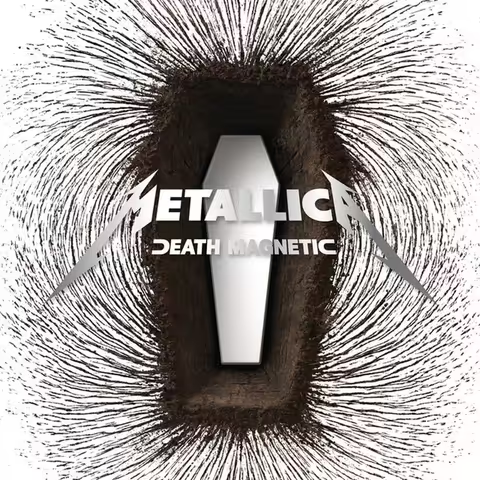
The sleeve was designed by Turner Duckworth, the San Francisco and London branding agency co-owned by Lars Ulrich friend David Turner. Turner Duckworth had built campaigns for Coca-Cola and Amazon, and Ulrich brought them in deliberately because they did not work in music. The brief was to find a single image that worked as a digital thumbnail on an iTunes shelf and as the front of a deluxe physical object at the same time.
The result combined three elements lifted from the album title: a white coffin, a grave, and a magnetic field. Andy Grimshaw built and photographed a physical model: a wedge-shaped coffin viewed from above, surrounded by concentric magnetic-field rings, against a stark white background. The original Metallica logo, dropped from the St. Anger sleeve, was restored to demonstrate continuity with the band pre-1991 identity. The white background was deliberately chosen to make the cover stand out against a metal genre dominated by black, red and grey sleeves.
The physical packaging extended the concept aggressively. The digipak booklet was die-cut, with each page resembling a layer of dirt being thrown onto the coffin as you turned it. The deluxe edition, The Box Magnetic, was a literal white coffin-shaped collector box, limited to 2,000 copies, containing the digipak CD, the Demo Magnetic bonus disc with the original working titles, a making-of DVD, an exclusive T-shirt, guitar picks, a flag, a backstage pass and a fold-out coffin-shaped poster. A separate vinyl edition put the album across five 180-gram LPs cut at 45 rpm. In 2009 Turner, Duckworth and Sarah Moffat won the Grammy for Best Recording Package, and the digipak picked up a D and AD award for packaging design.
The Leak and the Release
The album had been scheduled for 12 September 2008 worldwide. On 2 September a French record shop began selling physical copies ten days early, in what Vertigo Records insisted was an accident and what the wider industry suspected was a deliberate gamble. Within twenty-four hours the album was on every peer-to-peer network in the world. Vertigo UK arm responded by quietly moving the British release two days forward, to 10 September. Warner Bros in the US held the 12 September date.
"We're ten days from release. If this thing leaks all over the world today or tomorrow, happy days. Trust me. Ten days out and it hasn't fallen off the truck yet? Everybody's happy. It's 2008 and it's part of how it is these days, so it's fine. We're happy."
Lars Ulrich, on the leak, Blabbermouth, September 2008
The line landed almost incomprehensibly far from the Lars Ulrich who had sued Napster eight years earlier. It was widely read at the time as either belated wisdom or a recognition that the band had nothing to gain from picking the fight twice. On release day the FMQB radio network broadcast The World Premiere of Death Magnetic, ninety minutes that overran to two hours, simulcast across 175 stations in the US and Canada, with Dave Grohl and Taylor Hawkins of the Foo Fighters as the band interviewers. The first three days of sales were the most concentrated of Metallica career.
Critical Reception
The reviews were the warmest Metallica had received in eighteen years. AllMusic Stephen Thomas Erlewine called it "hearing Metallica sound like Metallica again". The Guardian called it "the strongest material the band have written in 20 years". Uncut said it "suspends your disbelief, demands your attention and connects directly with your inner adolescent". Rolling Stone gave it four stars and put it ninth on its albums of the year. Time placed it third on a Top Ten Albums of the Year list that contained almost no other metal. Kerrang, Metal Hammer and Revolver each crowned it their album of 2008.
"If you ignore the lyrics, Death Magnetic sounds more like it's about coming back to life. Everything comes together on the fan-favorite-to-be Broken, Beat and Scarred, which manages to channel the full force of Metallica behind a positive message. The aphorism Hetfield paraphrases happens to come from Nietzsche Twilight of the Idols, subtitled How to Philosophize With a Hammer. Metallica philosophizing may get shaky, but long may that hammer strike."
Brian Hiatt, Rolling Stone, September 2008
The notable outlier was Pitchfork, whose Cosmo Lee filed a 4.9-out-of-ten review three years after the fact, in 2011, calling the writing bloated and the mastering broken. Metacritic averaged the album at 78, comfortably the highest score for any Metallica record since Reload. Mike Portnoy, the Dream Theater drummer, posted a public note on the Roadrunner Records website that quickly travelled: "Death Magnetic is hands down the best Metallica album in twenty years. This is the CD I have been waiting for them to make since ...And Justice for All. And thumbs up to them for doing the first real Metallica instrumental in twenty years since To Live Is to Die. Welcome back, boys."
The Loudness War Controversy
Within forty-eight hours of release, the audio engineering community began posting waveform analyses of the album showing that the masters had been compressed to within an inch of their lives. The peaks were brick-walled flat. Where a song like "My Apocalypse" should have had headroom to breathe, the result was audible distortion: clipping in the cymbals, smearing in the kick drum, a wall of mid-range that left no air. The Guardian Sean Michaels framed it the same week as "the latest victim in the loudness war".
The smoking gun was the Guitar Hero release. To work in the game, the songs had been delivered as separate stems: drums, bass, guitars, vocals. Those stems went out before the mastering compression. When fans realised this, they began assembling "Guitar Hero versions" of the album that demonstrated, side by side, that the playable version of Death Magnetic sounded measurably better than the CD master. The story crossed over into the mainstream press: the Wall Street Journal, BBC Radio 4 You and Yours, Wired and Rolling Stone all carried it. A petition demanding a remaster collected 20,000 signatures inside a month.
Mastering engineer Ted Jensen, who had picked up his half of the cheque from Sterling Sound, publicly stepped aside. He told MusicRadar that the mixes had "already been brick-walled" by the time they reached his desk for mastering, a statement so unusual for a mastering engineer about his own client that it travelled around the world in twenty-four hours. The band co-manager Cliff Burnstein issued the only formal Q Prime statement, telling the Wall Street Journal that the complainers were a minority and the response had otherwise been "overwhelmingly positive". Lars Ulrich, in an interview with Blender, was the only band member to address the row in detail at the time. He confirmed that creative control of the production had largely been transferred to Rubin, while still defending the finished record. Rubin himself never commented publicly.
The album was never officially remixed. In June 2015 Metallica did remaster the digital downloads on iTunes under the new "Mastered for iTunes" standard, which restored a measurable amount of dynamic range and quietened the distortion, and that version is what now plays from the band official store and from Apple Music. The original CD master remains in print and sounds the same as it did in 2008.
Commercial Performance
Inside three days of US release, Death Magnetic sold 490,000 copies, the largest first-week tally for any Metallica album since 1996 Load. It debuted at Number One on the Billboard 200, where it stayed for three consecutive weeks and remained on the chart for fifty. It made Metallica the first act in chart history to debut five consecutive studio albums at Number One. It also topped nine other Billboard charts simultaneously, including Top Rock Albums, Top Hard Rock Albums, Top Alternative Albums and the Top Digital Albums chart, where 60,000 of its first-week sales came through downloads alone.
| Country | Chart | Peak |
|---|---|---|
| United States | Billboard 200 | 1 (3 weeks) |
| United Kingdom | OCC Albums Chart | 1 (2 weeks) |
| Canada | Billboard Canadian Albums | 1 (4 weeks) |
| Australia | ARIA Albums | 1 |
| Germany | Offizielle Top 100 | 1 |
| France | SNEP | 1 |
| Italy | FIMI | 1 |
| Sweden | Sverigetopplistan | 1 |
| Norway | VG-lista | 1 |
| Finland | Suomen virallinen lista | 1 |
| Ireland | IRMA | 1 |
| Netherlands | Album Top 100 | 1 |
| New Zealand | RMNZ | 1 |
| Mexico | Top 100 Mexico | 1 |
| Argentina | CAPIF | 1 |
| Japan | Oricon | 3 |
The album debuted at Number One in thirty-four countries in total. In Australia it was 2008 fastest-selling album. In Germany it shifted 100,000 copies in three days and was certified platinum the same week. The UK release sold 75,164 copies in three days. Canada certified the record four-times platinum within thirteen months. The RIAA certified it double-platinum in June 2010, and as of 2023 Metal Hammer reporting put its US total at 2.1 million.
Singles and Music Videos
| Single | Released | Director | Notes |
|---|---|---|---|
| The Day That Never Comes | 21 August 2008 | Thomas Vinterberg | Shot in Morocco; Vinterberg of Dogme 95 fame; reached 1 on Mainstream Rock Tracks |
| My Apocalypse | 26 August 2008 | None | Promotional, no official video; won Best Metal Performance Grammy 2009 |
| All Nightmare Long | 15 December 2008 | Roboshobo (Robert Schober) | Soviet-era fake propaganda short film |
| Cyanide | 2009 | None official | First album track debuted live, at Ozzfest Dallas 9 August 2008 |
| Broken, Beat and Scarred | 3 April 2009 | Wayne Isham | Live performance footage from Berlin O2 World; the album fifth and final single |
| The Unforgiven III | 2009 | None | Promotional single in select territories; nominated for Best Hard Rock Performance Grammy 2010 |
The World Magnetic Tour
The World Magnetic Tour was the longest of Metallica career to that point. It opened on 21 October 2008 in Phoenix, Arizona and closed on 21 November 2010 in Melbourne, Australia, two years and one month later, taking in close to two hundred shows across five continents. The North American opening leg ran into February 2009 and was followed by a European run that was briefly interrupted by a surprise show at SXSW in Austin to promote the Guitar Hero: Metallica game. Latin America, Israel, Japan, Oceania and a second North American leg followed in 2009 and 2010.
The stage was a four-sided affair: a square platform with no front or back, with the band rotating to face each section of the arena in turn, and a coffin-pattern lighting rig that lowered and rose throughout the set. Two video albums were released from the tour: Orgullo, Pasion, y Gloria: Tres Noches en la Ciudad de Mexico, capturing three Mexico City nights in June 2009, and Francais Pour une Nuit, a single show from Nimes in July. The tour summit was the 2010 Sonisphere date in Sofia, Bulgaria, where all four members of the Big Four of thrash, Metallica, Slayer, Megadeth and Anthrax, played together on the same stage for the first time. The closing-night encore, a joint cover of Diamond Head "Am I Evil?", was released as The Big Four: Live from Sofia, Bulgaria on home video.
Awards and Year-End Honours
The album took five Grammy nominations to the 51st Grammy Awards in February 2009 and converted three of them. "My Apocalypse" won Best Metal Performance. Rick Rubin won Producer of the Year, Non-Classical, the win partly justified by his work on this record. Turner Duckworth coffin sleeve won Best Recording Package. "Suicide and Redemption" was also nominated for Best Rock Instrumental Performance, and the album itself was up for Best Rock Album. At the 52nd Grammy Awards in 2010, "The Unforgiven III" was nominated for Best Hard Rock Performance.
Beyond the Grammys, the album won Best Heavy Metal Album and Biggest Surprise at the 2008 Metal Storm Awards, Best International Album at the 2009 Swedish Metal Awards, and topped the year-end albums lists of Kerrang, Metal Hammer and Revolver. Time magazine placed it third on its Top Ten Albums of 2008, ahead of records by Lil Wayne, Coldplay and TV on the Radio. Q made it 25 on its 50 Best Albums of the Year. Rolling Stone placed it ninth on its US year-end list. The IFPI ranked it the world fifth biggest-selling album of 2008, full stop.
Legacy, Influence and the Mastered for iTunes Reissue
What Death Magnetic did for Metallica career arc was straightforward: it restored their credibility as a current band rather than a legacy act. The next album, Hardwired to Self-Destruct in 2016, leant even harder into long-form thrash and was widely treated as Death Magnetic second act. 72 Seasons in 2023 went further again. The straight line from this record through those two and on to the band live set today is unambiguous: every Metallica album since 2008 has assumed an audience that wants long songs, fast tempos and big solos. That assumption did not exist on St. Anger.
For the wider audience the loudness controversy turned out to be the more lasting legacy. The fact that the issue was being argued on the front of the Wall Street Journal and on BBC radio about a metal record made the loudness war visible to people who had never thought about mastering. Within five years streaming platforms had begun normalising loudness on playback. Within ten, the LUFS standard had become an industry-wide reference. Death Magnetic did not start the loudness war, but it became the album most often pointed to as the moment its damage became impossible to ignore.
The 2015 Mastered for iTunes reissue restored a measurable amount of dynamic range to the digital versions of the songs and remains the version Apple Music streams. There has been no Atmos mix to date. There has been no anniversary box set yet, although the original Coffin Box edition has appreciated steadily in the collectors market: clean copies of the limited 2,000 units now change hands for several times their original 2008 price. The Beyond Magnetic EP remains the only post-release archival material the band has issued from the sessions, although five hundred hours of riff tapes from 2004 onwards are widely understood to be sitting in Metallica vault.
Things You Might Not Know
| Fact | Detail |
|---|---|
| The working titles | Every song had a code-name in demo form. Hi Guy became That Was Just Your Life, Casper became The Day That Never Comes, German Soup became Cyanide, Flamingo became All Nightmare Long. |
| The Layne Staley link | Hammett kept a photograph of the late Alice in Chains singer in the studio. It directly inspired the album title and the song that became Just a Bullet Away on the Beyond Magnetic EP. |
| Riff tape hours | By October 2004 the band had compiled more than fifty hours of jamming from soundchecks on the Madly in Anger with the World tour. |
| Considered title | Songs of Suicide and Forgiveness was one of the rejected working titles. Death Magnetic was picked from a shortlist of four when Hetfield met with Turner Duckworth. |
| The instrumental had two solos | Suicide and Redemption was released as two separate Guitar Hero downloads: one with Hetfield solo, one with Hammett. Only the Hammett version is on the album. |
| Vinterberg day job | The Day That Never Comes video was directed by Thomas Vinterberg, co-founder of the Dogme 95 Danish film movement; it was one of his rare commercial music-video credits. |
| The leak ten days early | A French record store sold copies on 2 September 2008. The leak was online within a day, and Vertigo UK moved the British street date forward to 10 September in response. |
| Five US Number One studio albums in a row | Death Magnetic made Metallica the first act in chart history to achieve five consecutive Billboard 200 Number One studio releases. |
| The Sound City connection | The bulk of the album was tracked at Sound City Studios in Van Nuys, the same room Nirvana used for Nevermind. Dave Grohl interviewed the band on release day; he made the Sound City documentary five years later. |
| The bass came back | Trujillo bass intro on Cyanide is the most prominent bass-led song opening on a Metallica studio album since Master of Puppets in 1986. |
| The mastering engineer publicly distanced himself | Ted Jensen told MusicRadar that the mixes had already been brick-walled before they arrived at Sterling Sound, an unusual public step for a mastering engineer to take against his own client. |
| Three Grammys, not one | The album won Best Metal Performance for My Apocalypse, Producer of the Year for Rick Rubin and Best Recording Package for the Turner Duckworth sleeve at the 51st Grammy Awards in 2009. |
| The coffin box is a collector item | The white coffin-shaped Box Magnetic edition was limited to 2,000 copies worldwide and now changes hands for multiples of its 2008 price in clean condition. |
| The trilogy ends here | The Unforgiven III is the third and so far final part of a trilogy that began on the Black Album in 1991. As of 72 Seasons there has been no fourth instalment. |
| The world fifth biggest-selling album of 2008 | IFPI ranked Death Magnetic the fifth biggest-selling album worldwide in 2008, behind only Coldplay, Duffy, AC/DC and the Mamma Mia cast recording. |
Riffology covers Metallica regularly across the podcast catalogue. New episodes drop weekly on Apple Podcasts, Spotify, Amazon Music, Pocket Casts and every other major platform. Subscribe wherever you listen, and let the cross-linker that runs after this post tie you back into the rest of the Metallica deep dives on the site.