On 3 September 1993, Green Day played 924 Gilman Street one final time, billed as a fictional band called Blair Hess. Word had already leaked that they had signed a five-album deal with Reprise, the same Warner Bros. imprint that had once handled Jimi Hendrix, and the all-ages Berkeley punk club's no-major-labels rule was not negotiable. By the end of the night the cooperative had banned them for good. They would not set foot inside Gilman again until a surprise benefit show in May 2015.
Less than five months later, on 1 February 1994, Reprise released Dookie. The first pressing of 9,000 copies sold out almost immediately. Producer Rob Cavallo had told the label he might shift 200,000; drummer Tre Cool had quietly hoped for 500,000. The record went on to sell more than 20 million copies worldwide, certify 2x Diamond by the RIAA in 2024, drag pop-punk out of the East Bay and onto MTV's heaviest rotation, and turn the band that Gilman had just disowned into the biggest punk act in the world. This is how that happened.
| Field | Detail |
|---|---|
| Artist | Green Day |
| Album | Dookie |
| Release date | 1 February 1994 |
| Label | Reprise Records |
| Producer(s) | Rob Cavallo, Green Day |
| Studio(s) | Fantasy Studios, Berkeley (recording); Devonshire Sound, North Hollywood (mixing); Music Grinder, Los Angeles ("Chump" and "Longview" re-cuts) |
| Genre / Subgenre | Punk rock, pop-punk, skate punk |
| Track count | 14 (plus a hidden 15th, "All by Myself") |
| Total runtime | 39:35 |
| Billboard 200 peak | 2 |
| UK Albums Chart peak | 13 |
| Other notable chart peaks | 1 in Australia (ARIA), Canada (RPM), New Zealand (RMNZ); top 10 in Germany, Sweden, Switzerland, Finland, Norway, the Netherlands, Italy, Portugal |
| Certifications | 2x Diamond (RIAA, 2024), Diamond (Music Canada), 5x Platinum (ARIA), 4x Platinum (IRMA, RMNZ, Hitlisten), 3x Platinum (BPI), Platinum (IFPI Europe) |
| Estimated sales | Over 20 million worldwide |
| Key singles | "Longview", "Basket Case", "Welcome to Paradise", "When I Come Around" |
Cultural context: punk in a grunge world
To understand why Dookie hit as hard as it did, you have to remember what the radio sounded like the week it dropped. Nirvana's In Utero was four months old. Pearl Jam's Vs. had just spent five weeks at number one. The Smashing Pumpkins were a year out from Mellon Collie. American rock radio had been almost entirely flannel and dirge since the autumn of 1991, and major labels were still scouring the Pacific Northwest looking, in Billie Joe Armstrong's own words, for "second- and third-rate Nirvanas and Soundgardens".
Green Day were the opposite of that brief. They were short, hooky, three minutes long, played at twice the tempo, and their lyrics were about masturbation and panic attacks rather than alienation as a cosmic condition. 1994 happened to be the year mainstream alternative rock peaked commercially, and the records the band found themselves competing with on year-end lists, Nine Inch Nails's The Downward Spiral, Soundgarden's Superunknown, Weezer's blue album, Beastie Boys' Ill Communication, Hole's Live Through This, were all heavier, longer, or more conceptually loaded than Dookie. The Offspring's Smash arrived two months later in April 1994 and detonated alongside it. By the end of the year Rolling Stone's readers had voted Dookie their favourite record of 1994 ahead of every one of those titles.
The band's story up to this point
Armstrong and Mike Dirnt had been playing together since they were fifteen, growing up in Rodeo, a small refinery town in Contra Costa County. They formed Sweet Children in 1987 with drummer John Kiffmeyer, signed to Larry Livermore's Berkeley independent Lookout! Records the following year, changed their name to Green Day (East Bay slang for an unproductive day spent smoking cannabis) and put out 39/Smooth in 1990. Tre Cool replaced Kiffmeyer in November 1990 while Kiffmeyer headed off to Humboldt State, and the band's second album Kerplunk followed in 1991. Both sold around 30,000 copies on Lookout!, which was enough to put the band on the radar of Sony, Geffen, Warner Bros. and Interscope.
Armstrong was wary. The labels were sending the band to dinners and, on one memorable occasion, to Disneyland. None of them seemed to understand what the band actually was. That changed when Rob Cavallo, then a young A&R man at Reprise who had just produced the Muffs' self-titled debut, came down to meet them. The audition, such as it was, consisted of Green Day playing Beatles covers for forty minutes; Cavallo eventually grabbed a guitar and joined in.
"He was the only person we could really talk to and connect with."
Billie Joe Armstrong on Rob Cavallo, quoted in Marc Spitz's Nobody Likes You (2006)
The band signed a five-album deal with Reprise in April 1993 and, crucially, kept the rights to their two Lookout! records. The Berkeley scene was furious. The fanzine Maximumrocknroll printed the news as a betrayal; the cooperative that ran 924 Gilman called a meeting and banned them. Local fans daubed "Green Day Sucks" on East Bay walls. Reflecting on it five years later, Armstrong was unsentimental.
"I couldn't go back to the punk scene, whether we were the biggest success in the world or the biggest failure. The only thing I could do was get on my bike and go forward."
Billie Joe Armstrong to Spin, 1999
Pre-production and demos
Most of the songs that ended up on Dookie were already written before Cavallo got involved. Armstrong had been hoarding material across the Kerplunk tour, including "Having a Blast", which he wrote in a hotel room in Cleveland in June 1992, and "Longview", whose signature bass line Mike Dirnt had famously stumbled into one night.
"When Billie gave me a shuffle beat for 'Longview,' I was flying on acid so hard. I was laying up against the wall with my bass lying on my lap. It just came to me. I said, 'Bill, check this out. Isn't this the wackiest thing you've ever heard?' Later, it took me a long time to be able to play it, but it made sense when I was on drugs."
Mike Dirnt, interview in Bass Player, November 1994
"Basket Case" had an even stranger gestation. Armstrong wrote a first draft of the lyrics around 1992 or 1993 on crystal meth, convinced at the time he had written the greatest song of his life. When he sobered up he found the words "embarrassingly bad", shelved the song, and only returned to it months later to rewrite it around the panic attacks he had been suffering before being formally diagnosed with panic disorder. He has called the rewrite "the best decision I'd ever made, probably, as a songwriter".
To convince Cavallo there was an album in them, the band cut a four-song demo on Armstrong's four-track recorder: "She", "Sassafras Roots", "Pulling Teeth" and "F.O.D." Cavallo's reaction, in his own words, was that he had "stumbled on something big". They followed it with a fuller demo at Andy Ernst's Art of Ears studio in San Francisco, the same room that had captured both Lookout! albums, which is where the rewritten "Basket Case" was first properly recorded.
Creating the album at Fantasy Studios
Recording proper began at Fantasy Studios in Berkeley in September 1993, two weeks after the Gilman ban. Fantasy was a working professional facility (Creedence, Santana and Journey had all cut records there) with a budget and a clock, and the band were visibly intimidated. The most studio time Green Day had ever spent in one go was the three days they took to make Kerplunk. Cavallo's first move, the night sessions began, was to take them across the street to a Mexican bar and get the band a round, even though Tre Cool was still seventeen and under-age.
Once they relaxed they made the most of the equipment. Armstrong spent days dialling in a guitar sound, eventually settling on a 100-watt Marshall Plexi 1959SLP head that he nicknamed "Pete". His main guitar was a Fernandes Stratocaster copy he called "Blue". His own description of the project's sonic mission has become Green Day folklore.
"We were just trying to go from loud to louder."
Billie Joe Armstrong to Guitar.com, November 2022
The rhythm tracks took most of the three weeks at Fantasy. Vocals were a different matter: Armstrong, who hates re-singing, blew through sixteen or seventeen lead vocals in two days, the majority of them in a single take. Engineer Neill King ran the sessions, with Casey McCrankin handling additional engineering.
The first mix was a problem. Armstrong had asked Cavallo to make the record sound "really dry, the same way the Sex Pistols record or the early Black Sabbath records sounded", and the result wasn't to anyone's taste. The album was remixed from scratch by Cavallo and Jerry Finn at Devonshire Sound in North Hollywood, the room where Tom Lord-Alge had mixed the Cure's Wish the previous year. While the remix was under way the band ducked into Music Grinder in Los Angeles to re-cut two songs, "Chump" and "Longview", because the original Fantasy masters were "plagued by an inordinate amount of tape hiss".
A few songs were recorded but did not make the album:
- "Good Riddance (Time of Your Life)", which Armstrong had written in 1990 and which would be parked until Nimrod in 1997.
- New Dookie-era versions of "2000 Light Years Away" and "Christie Rd." from Kerplunk, both shelved.
- A new pass at "409 in Your Coffeemaker" from the band's Slappy EP.
- "On the Wagon", later used as a B-side on "Basket Case".
Only one re-recording from the Kerplunk-era catalogue made the final tracklist: "Welcome to Paradise". The label saw a single in it, and Armstrong agreed the new version was superior. Total budget reports vary, but the record was cut well inside Reprise's recoupable envelope, a fact the label still occasionally mentions when Green Day's accountants are not in the room.
Personnel and credits
| Role | Player | Notes |
|---|---|---|
| Core band | ||
| Lead vocals, guitar | Billie Joe Armstrong | Wrote all lyrics except "Emenius Sleepus" (Dirnt) and "All by Myself" (Cool). Recorded vocals for 16 or 17 songs in two days. |
| Bass, backing vocals | Mike Dirnt | Wrote the "Emenius Sleepus" lyric and the famous "Longview" bass line. Co-credited writer on "Pulling Teeth". |
| Drums | Tre Cool | Plays lead vocals and guitar on the hidden track "All by Myself"; otherwise drums throughout. Seventeen years old when the Fantasy sessions started. |
| Production and engineering | ||
| Producer, mixing | Rob Cavallo | Co-produced with the band. First album he made with Green Day; he would go on to produce most of their major studio records up to and including Saviors (2024). |
| Producer | Green Day | Joint production credit. |
| Mixing | Jerry Finn | Brought in for the Devonshire Sound remix. Later produced Blink-182's Enema of the State and AFI's Sing the Sorrow before his death in 2008. |
| Engineer | Neill King | Tracked the Fantasy sessions. |
| Additional engineering | Casey McCrankin | Assisted Neill King at Fantasy. |
| Artwork and packaging | ||
| Cover artist | Richie Bucher | East Bay artist who had drawn a 7-inch cover for the band Raooul that Armstrong loved. |
| Back cover photography | Ken Schles | Crowd shot taken at the Roseland Ballroom, New York, in 1993, when Green Day were opening for Bad Religion on the Recipe for Hate tour. |
| Booklet artwork | Pat Hynes | Liner-note collage. |
The lineup on the record itself is unusually clean: no string sections, no guest singers, no producer-as-keyboard-player. Cavallo did not pick up an instrument on the album. Beyond Tre Cool's hidden track, every note on Dookie is played by the trio. It is, almost uniquely for a major-label debut of its era, a power-trio record with nothing hidden behind it.
The songs
| # | Title | Writer(s) | Length | Single? | Notes |
|---|---|---|---|---|---|
| 1 | "Burnout" | Armstrong / Green Day | 2:07 | Sets the album's tone in two minutes flat: total apathy played at sprint tempo. | |
| 2 | "Having a Blast" | Armstrong / Green Day | 2:44 | Written in Cleveland, June 1992. About a man planning a suicide bombing; uncomfortable to hear after Columbine. | |
| 3 | "Chump" | Armstrong / Green Day | 2:53 | Re-cut at Music Grinder. Segues directly into "Longview". First of three songs about Armstrong's ex Amanda. | |
| 4 | "Longview" | Armstrong / Green Day | 3:59 | Yes | Re-cut at Music Grinder. Dirnt's bass line written on LSD. Lead single. |
| 5 | "Welcome to Paradise" | Armstrong / Green Day | 3:44 | Yes (UK) | Re-recorded from Kerplunk. About squatting in a West Oakland warehouse. |
| 6 | "Pulling Teeth" | Armstrong, Dirnt / Green Day | 2:30 | Inspired by Dirnt breaking his elbow in a pillow fight with his girlfriend. | |
| 7 | "Basket Case" | Armstrong / Green Day | 3:02 | Yes | About Armstrong's panic disorder. Chord progression a thinly disguised Pachelbel's Canon. |
| 8 | "She" | Armstrong / Green Day | 2:13 | Promo | Title taken from a feminist poem Amanda showed him. Performed naked at Madison Square Garden in 1994. |
| 9 | "Sassafras Roots" | Armstrong / Green Day | 2:37 | Third Amanda song. Closest the record gets to Kerplunk sonically. | |
| 10 | "When I Come Around" | Armstrong / Green Day | 2:57 | Yes | Written about Adrienne Nesser, Armstrong's then-girlfriend and future wife. |
| 11 | "Coming Clean" | Armstrong / Green Day | 1:34 | Armstrong, then nineteen, writing openly about being bisexual. | |
| 12 | "Emenius Sleepus" | Dirnt / Green Day | 1:43 | Dirnt's only lead writing credit on the record. | |
| 13 | "In the End" | Armstrong / Green Day | 1:46 | About Armstrong's mother, a waitress, and her boyfriends. | |
| 14 | "F.O.D." | Armstrong / Green Day | 5:46 | Acoustic ballad that hard-cuts into a snarl. After 1:17 of silence, the hidden track "All by Myself" begins at 4:09. Written and performed by Tre Cool. About masturbation. |
"Longview" was the album's debut single and the song that broke the band on MTV. The arrangement is built around the moment three quarters of the way through where Armstrong has stopped pretending and admits, with audible weariness, that he is too lazy to even masturbate any more. The line "My mother says to get a job / But she don't like the one she's got" he later regretted on his mother's behalf, since she was a career waitress who, by Armstrong's own admission, genuinely loved her job. The song is named after Longview, Washington, where it was first played live in spring 1992; roadie Kaz Hope suggested the title.
"Basket Case" is the song that turned the record into a phenomenon. Released as the second single on 1 August 1994, it spent five weeks at number one on the Modern Rock Tracks chart and entered the UK top 10. Its accompanying Mark Kohr video, filmed in the abandoned Agnews Developmental Center in Santa Clara County, took itself to nine MTV Video Music Award nominations in 1995, including Video of the Year. It won none of them, but its over-saturated, hand-tinted look became the template for half the punk videos that would follow over the next four years.
"When I Come Around" is the album's stealth ballad, a downstroke-driven mid-tempo song built on four chords in G-flat major. Shipped to US radio in December 1994, it spent seven weeks at the top of Modern Rock Tracks, peaked at number six on the Hot 100 Airplay chart, and remained the band's biggest-selling 1990s single until "Good Riddance (Time of Your Life)" overtook it in 1997. The Mark Kohr video, filmed across the Mission District, Broadway and the Powell Street BART station in San Francisco and Berkeley, also features the band's then-future touring guitarist Jason White as a face in the crowd, walking with his girlfriend.
"She" is technically a promotional single rather than a commercial one, but the story behind it is the prettiest set-piece on the record. Armstrong's ex-girlfriend Amanda showed him a feminist poem she had written called "She"; he wrote a song around the title, showed it back to her, and only put it on the album once she had broken up with him and moved to Ecuador to join the Peace Corps. The same Amanda is also the subject of "Chump" and "Sassafras Roots", which makes Dookie something of a one-sided break-up album hiding inside a pop-punk record.
B-sides, outtakes and lost songs
For an album that took only three weeks to record, Dookie spun off an unusually rich set of B-sides, most of them rounded up for the 2023 30th-anniversary super-deluxe box.
- "On the Wagon" on the original "Basket Case" CD single. A genuine outtake from the Fantasy sessions, later collected on the 2002 B-sides compilation Shenanigans.
- A new version of "409 in Your Coffeemaker", intended for Dookie and cut at Fantasy, eventually used as a B-side and then on Shenanigans.
- A cover of the Kinks' "Tired of Waiting for You", B-side to "Basket Case".
- Live tracks recorded by Cavallo on 11 March 1994 at Jannus Landing, St. Petersburg, Florida, used as B-sides on every single from the album and later collected on the rare Live Tracks EP.
- "Good Riddance (Time of Your Life)", demoed during the Fantasy sessions and held back for Nimrod, where its acoustic version became a global hit in 1997.
- "J.A.R.", written in tribute to Mike Dirnt's friend Jason Andrew Relva, would have fitted Dookie tonally but was finished after the sessions and released on the Angus soundtrack in 1995, debuting at number one on Modern Rock.
The Dookie 30th Anniversary box released on 29 September 2023 added an entire disc of outtakes and demos, plus two full live concert recordings, including the riot-shortened 9 September 1994 set from Hatch Memorial Shell in Boston.
Album artwork and packaging
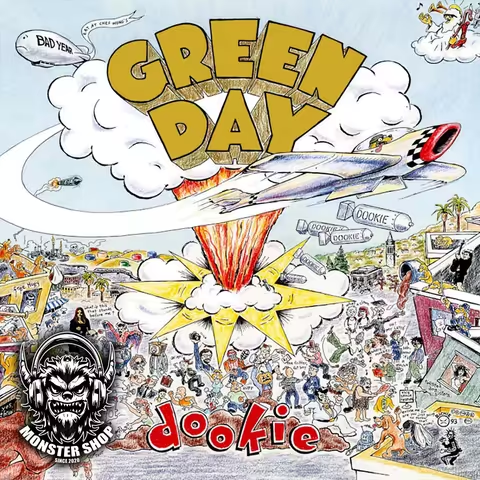
The Reprise marketing department's first proposal for the cover was, predictably, a photograph of three good-looking young men. The band refused on the spot. Cavallo's argument carried the day: that the Telegraph Avenue scene Green Day came out of, where the visual artists were as important as the musicians, would supply something better. The "something better" was Richie Bucher, an East Bay painter and bass player whose 7-inch sleeve for the local band Raooul Armstrong had been carrying around as a reference for months.
Bucher worked off only the title. As a child he had associated faeces with dogs and monkeys, so dogs and monkeys are what he drew. The setting is a near-replica of Berkeley's Telegraph Avenue, with the band's name rising out of a mushroom-cloud explosion in the centre. The Easter eggs are deliberate: Patti Smith in mid-armpit from the cover of her 1978 album Easter; a shootout around Black Panther co-founder Huey P. Newton; the robed woman from the cover of Black Sabbath's 1970 debut, looking exactly like the Mona Lisa; AC/DC's Angus Young; UC Berkeley's Sather Tower; and, in the distance, the oil refineries of Rodeo, the small Contra Costa County town where Armstrong and Dirnt grew up. A bearded man in the foreground is the photographer who used to shoot every band at Gilman every weekend. The graffito reading "Twisted Dog Sisters" refers to two real women from Berkeley. The dog flying the bomber plane is dropping bombs labelled "Dookie".
The back cover is a yellow, orange and sepia-toned crowd shot taken by Ken Schles at the Roseland Ballroom in New York in 1993, when Green Day were opening for Bad Religion. Early pressings have an audience member visible mid-stage-dive who was later airbrushed out at his own request.
Release and reception
The first 9,000 copies pressed by Reprise sold out almost immediately on release day. The initial chart entry was modest: number 127 on the Billboard 200. What changed everything was the moment on 22 February when MTV added the "Longview" video to its rotation. Green Day appeared on Late Night with Conan O'Brien, The Jon Stewart Show and MTV's 120 Minutes within weeks, the album began the climb that would take it to number two on the Billboard 200, and by 14 June it was already RIAA Gold.
Critics, with one or two exceptions, embraced it. Jon Pareles wrote the most-quoted review in The New York Times on 5 January 1995.
"Punk turns into pop in fast, funny, catchy, high-powered songs about whining and channel-surfing; apathy has rarely sounded so passionate."
Jon Pareles, The New York Times, January 1995
Paul Evans in Rolling Stone said the band were "convincing mainly because they've got punk's snotty anti-values down cold: blame, self-pity, arrogant self-hatred, humor, narcissism, fun." NME's Mark Sutherland concluded a 7/10 review with the line that has followed the album around ever since: "Being dumb has never been so much fun." A 2017 retrospective by Marc Hogan at Pitchfork retrospectively scored it 8.7 and identified what most contemporary reviewers had under-rated.
"Buzzing, hook-crammed tracks that acted like they didn't give a shit. But on a compositional and emotional level they were actually gravely serious."
Marc Hogan, Pitchfork, May 2017
The award-season harvest was reasonable rather than dominant. Green Day were nominated in four categories at the 37th Annual Grammy Awards in March 1995: Best Alternative Music Album, Best New Artist, Best Rock Performance by a Duo or Group with Vocal (for "Basket Case") and Best Hard Rock Performance (for "Longview"). They won only the Alternative Album, which was, in retrospect, the only one that mattered.
The pushback came largely from the punk community they had left. New York Times critic Neil Strauss followed Pareles's review with a column arguing the record only "remotely resembled" punk music. The band's response, eighteen months on, was to make Insomniac, lyrically the angriest record of their career.
Singles and music videos
| Single | Released | US Modern Rock peak | UK Singles peak | Other notable peaks | B-sides | Video director |
|---|---|---|---|---|---|---|
| "Longview" | 1 February 1994 (US radio); 23 May 1994 (Australia phys); 6 June 1994 (UK phys) | 1 | 30 (re-issue, March 1995) | 3 US Mainstream Rock; 33 Australia | Live tracks from Jannus Landing, "On the Wagon" | Mark Kohr |
| "Basket Case" | 1 August 1994 (UK and US); 3 October 1994 (Australia) | 1 (five weeks) | 7 | 2 Norway; 3 Sweden; 9 US Mainstream Rock; 16 US Pop Airplay | "On the Wagon", "Tired of Waiting for You", "409 in Your Coffeemaker", Jannus Landing live tracks | Mark Kohr |
| "Welcome to Paradise" | 17 October 1994 (UK 12-inch and CD, exclusive) | 7 | 20 | 17 UK Rock and Metal; 44 Australia | "Chump" (live), "Emenius Sleepus" | Mark Kohr (live performance at Slim's, San Francisco) |
| "When I Come Around" | December 1994 (US radio); 16 January 1995 (Australia phys); 8 May 1995 (UK phys) | 1 (seven weeks) | 27 | 2 Iceland and Netherlands Tipparade; 3 Canada; 4 New Zealand; 6 US Pop Airplay; 7 Australia | "Coming Clean" (live), "She" (live) | Mark Kohr |
| "She" | 5 May 1995 (promo only) | 5 | Not released | 18 US Mainstream Rock | None (promo) | No video |
Mark Kohr, the Bay Area director who had cut his teeth on Primus videos, shot every visual the album spawned. The four-video run is, in retrospect, one of the most consistent single-director music-video sequences of the entire MTV era. The "Basket Case" video, with its over-saturated colour palette and explicit homages to One Flew Over the Cuckoo's Nest and Terry Gilliam's Brazil, was originally shot in monochrome and hand-tinted in post, a technique Kohr did not repeat.
Touring and live
Green Day toured Dookie almost continuously from February 1994 to early 1995. In the United States they travelled between shows in a bookmobile borrowed from Tre Cool's father. They played about forty European dates between late April and early June 1994, including their first UK tour. By July they were the main attraction on the second leg of Lollapalooza.
Three live moments from 1994 became part of the band's mythology:
- Woodstock '94, 14 August. Booked as a punk surprise on a softer line-up, Green Day opened with "Welcome to Paradise" to an audience of around 350,000 who had spent three days in the rain. Within minutes a mud fight had broken out between band and crowd. During the chaos a security guard mistook Mike Dirnt for a stage-invading fan and punched some of his teeth out. The set, broadcast on pay-per-view, made Green Day a household name overnight.
- Hatch Memorial Shell, Boston, 9 September. A free outdoor show that escalated into a riot after seven songs. The Massachusetts State Police pulled the plug; roughly 100 people were injured and dozens arrested, and the band were chased out of the building.
- Z100 Acoustic Christmas, Madison Square Garden, late 1994. An AIDS benefit. Armstrong performed "She" naked, using his guitar to cover himself.
Don Pardo invited the band onto Saturday Night Live in late 1994. Their support acts on the headline legs that followed were chosen pointedly: Pansy Division, an openly gay California queercore band, and Germany's Die Toten Hosen rather than the usual major-label-approved opener options. The band's first European headline tour was followed by a second American leg in early 1995, and by the spring of that year they had been on the road in some form for fifteen straight months.
Two later live moments are worth flagging. In August 2013, Green Day played Dookie in its entirety as the headline set at Reading Festival, twenty years on from the sessions. In October 2023, as part of the run-up to the 30th anniversary, they did it again at a club show at the Fremont Country Club in Las Vegas, where the album was performed in full including the hidden track "All by Myself".
In TV, film and media
Songs from Dookie have soundtracked an unusual number of cultural moments over the last thirty years:
- "Basket Case" appears in Yorgos Lanthimos's 2025 absurdist thriller Bugonia; was covered by Avril Lavigne on her 2003 My World live album; was added to the polka medley "The Alternative Polka" by "Weird Al" Yankovic on Bad Hair Day (1996); and now exists as a playable Fortnite Festival jam track alongside "Welcome to Paradise" and "When I Come Around".
- "When I Come Around" has been sung as a barbershop quartet on South Park, used in the trailer for Blast from the Past, and licensed to NBA 2K26.
- "Longview" appeared on Beavis and Butt-Head in 1994 from an advance copy and remains a Green Day live opener.
- "Welcome to Paradise" features in Reinaldo Marcus Green's 2021 Will Smith vehicle King Richard.
- The full Dookie album, along with American Idiot and 21st Century Breakdown, was playable in Green Day: Rock Band in 2010.
Controversy, censorship and lawsuits
The Gilman ban is the headline controversy and the one that has hung over the record longest. The cooperative that runs 924 Gilman Street has held a no-major-labels rule since the club opened in 1986; Green Day's signing to Reprise tripped it, and the September 1993 farewell under the pseudonym Blair Hess was the band's last show there for twenty-two years. The fallout went beyond the venue. Maximumrocknroll, the East Bay's most influential punk fanzine, refused to cover the band; Armstrong recalled "aggressive glares and furtive whispers" on Berkeley streets through 1994, and the sell-out accusation followed his friends in Jawbreaker into their own major-label deal the following year.
The more material legal controversy came later. On 1 August 2005, Green Day rescinded the master rights to their pre-Dookie catalogue from Lookout! Records, citing a continuing breach of contract over unpaid royalties. The dispute was shared with several other Lookout! bands; Lookout! had stopped paying out as its catalogue dried up, and Green Day's withdrawal of 1,039/Smoothed Out Slappy Hours and Kerplunk from the label's distribution effectively ended Lookout! as a going concern.
The album itself attracted no serious censorship campaigns despite a track listing that included songs about masturbation, mass murder, panic disorder, bisexuality and a male prostitute, and a cover featuring excrement-throwing dogs. Warner did not require a parental advisory sticker. The MTV broadcasts were left intact.
Covers, samples and tributes
For an album of its commercial heft, Dookie has been sampled remarkably little. Where it has cast a long shadow is in covers:
- "Weird Al" Yankovic medleyed "Basket Case" inside "The Alternative Polka" in 1996.
- Avril Lavigne covered "Basket Case" on her 2003 live album Avril Lavigne: My World, citing the album as a reason she picked up an electric guitar.
- Bastille recorded a version of "Basket Case" in 2017 for the Tick reboot, though it ultimately was not used in the show.
- British band As It Is covered "She" for the 2016 tribute album American Superhits!.
- California punk-ska veterans Mad Caddies covered "She" in a reggae arrangement on 2018's Punk Rocksteady.
- Toyah Willcox and Robert Fripp recorded "Basket Case" for their lockdown Sunday Lunch series in March 2022.
Bands who have directly cited the album as a reason they picked up an instrument include Sum 41 (Deryck Whibley has gone on the record several times), Good Charlotte's Billy Martin, Something Corporate's Andrew McMahon, New Found Glory, Fall Out Boy, Joyce Manor, Wavves and FIDLAR. NME's "10 albums that wouldn't exist without Green Day's Dookie" feature from 2019 makes the longer case.
Reissues, remasters and anniversaries
The reissue history is comparatively restrained until very recently:
- Original CD (1994) with the hidden "All by Myself" embedded in track 14.
- 180-gram vinyl reissues through the 2000s and 2010s, including coloured-vinyl Reprise variants.
- 30th Anniversary Color Vinyl Box Set (29 September 2023). Six LPs containing the remastered album, three Fantasy outtakes ("Christie Rd.", "409 in Your Coffeemaker", "On the Wagon") and full live sets from Boston's Hatch Shell (the riot show) and Woodstock '94. Liner notes by Cavallo.
- Dookie Demastered (9 October 2024). A collaboration with Los Angeles art studio BRAIN, with each song on the album re-recorded onto a different "obscure, obsolete, and otherwise inconvenient" format, including a wax cylinder, a Teddy Ruxpin bear, a Game Boy cartridge, a Hello Kitty toothbrush, a doorbell and an answering machine. Distributed by lottery rather than retail.
In April 2024 the album was selected for preservation in the United States National Recording Registry by the Library of Congress, recognising it as "culturally, historically, or aesthetically significant". Dookie sits alongside The Notorious B.I.G.'s Ready to Die and The Chicks's Wide Open Spaces in the 2024 induction class.
Legacy and influence
Stephen Thomas Erlewine, writing for AllMusic, called Dookie "a stellar piece of modern punk that many tried to emulate but nobody bettered". The harder claim, made by NME and the Daily Beast and seconded by most retrospective surveys, is that Green Day and the Offspring's Smash (released two months after Dookie) between them dragged punk rock out of the underground and into the same mall and stadium economy that grunge had owned the previous two years. Rancid's ...And Out Come the Wolves in 1995 capitalised on the opening. So, eventually, did Blink-182, Sum 41, Good Charlotte, New Found Glory, Fall Out Boy, Yellowcard, Simple Plan and Panic! at the Disco.
The list placements are dense. Rolling Stone has placed Dookie on all four iterations of "The 500 Greatest Albums of All Time", at number 375 in the 2020 revision, and at number one on its 2017 list of "The 50 Greatest Pop-Punk Albums". Pitchfork put it at 111 in its "150 Best Albums of the 1990s". Kerrang!, in 2015, placed it at number two on "51 Greatest Pop Punk Albums Ever". Revolver had it at thirteen in "50 Greatest Punk Albums of All Time" in 2018. Loudwire named it the best hard rock album of 1994 in 2014 and again in 2024.
For Green Day themselves the record is both anchor and shadow. Insomniac in 1995 was deliberately darker. Nimrod in 1997 was deliberately broader. Warning in 2000 dipped enough that the band's career was widely declared over. Then American Idiot in 2004 made Green Day arguably the biggest political rock band on the planet, ten years after Dookie had made them the biggest punk band. Saviors, their 2024 album, marked Rob Cavallo's first time producing them in twelve years. The 2024 Saviors Tour, with the Smashing Pumpkins, Rancid and the Linda Lindas in support, was structured as a victory lap for both Dookie at thirty and American Idiot at twenty; both albums were played in full on most dates. The album that got the band thrown out of Gilman Street had become, by then, the album the world toured for half a year to hear in full.
Things you might not know
| Fact | Detail |
|---|---|
| The working title | The album was originally going to be called Liquid Dookie. The reference was to the diarrhoea Armstrong, Dirnt and Cool had suffered eating spoiled food on tour; the title was eventually shortened on what Armstrong has called impulsive "stoner" grounds. |
| The Gilman pseudonym | Green Day's farewell gig at 924 Gilman Street on 3 September 1993, the show that prompted their permanent ban, was billed as "Blair Hess". |
| Tre Cool's age | Tre Cool was seventeen years old when sessions began at Fantasy Studios, which is why Cavallo's first-night trip to a Mexican bar across the street was technically a minor violation. |
| The amp's nickname | The 100-watt Marshall Plexi 1959SLP head that Armstrong used for most of the album's guitar tones was nicknamed "Pete". His Fernandes Stratocaster was called "Blue". |
| Two songs re-cut | "Chump" and "Longview" were re-recorded from scratch at Music Grinder in Los Angeles because the original Fantasy masters were ruined by tape hiss. |
| The Pachelbel debt | The chord progression of "Basket Case" mirrors Pachelbel's Canon in D, transposed and palm-muted, a fact musicologists and pop writers have flagged for years. |
| The acid bass line | Mike Dirnt wrote the "Longview" bass line while on LSD and has admitted on record that it took him some time to be able to play the line again sober. |
| The naked "She" | At the Z100 Acoustic Christmas AIDS benefit at Madison Square Garden in late 1994, Armstrong played "She" naked, covering himself with his guitar. |
| Dirnt's lost teeth | During the band's Woodstock '94 set on 14 August, a security guard mistook Mike Dirnt for a stage-invading fan and punched out some of his teeth. The set went out live on pay-per-view to several million viewers. |
| The crystal-meth demo of "Basket Case" | Armstrong wrote a first draft of the "Basket Case" lyric on crystal meth around 1992 or 1993, convinced it was the greatest song he had ever written. He scrapped that draft sober and rewrote the song from scratch about his panic disorder. |
| The hidden track timing | Tre Cool's hidden track "All by Myself" begins at 4:09 of "F.O.D." after the main song ends at 2:52. On streaming and digital editions it appears as a separate track 15. It is, by his own admission, about masturbation. |
| The cover's Angus Young | If you have ever wondered who the small figure on the cover is gripping a Gibson SG and grinning, that is AC/DC's Angus Young. Patti Smith is also on the cover, mid-armpit, from the cover of Easter. |
| The Roseland back cover | The back-cover photograph by Ken Schles was taken at New York's Roseland Ballroom in 1993, when Green Day were opening for Bad Religion on the Recipe for Hate tour. |
| The label thought modestly | Cavallo's internal sales target for Dookie was 200,000 units. Tre Cool guessed 500,000. The album has now sold over 20 million worldwide, 20 million in the United States alone. |
| The Teddy Ruxpin remaster | For 2024's Dookie Demastered, the album was re-recorded onto fourteen "obsolete and otherwise inconvenient" formats including a wax cylinder, a Game Boy cartridge, a Hello Kitty toothbrush, a doorbell, an answering machine and a Teddy Ruxpin bear. They were distributed by lottery rather than sold at retail. |
The Riffology podcast
For the long version of how Dookie went from Gilman's persona-non-grata pile to the 2024 National Recording Registry, the Riffology podcast episode on the album goes track by track, argues about the sequencing, and spends rather more time than is healthy on the chord progression to "Basket Case". You can find it on Apple Podcasts, Spotify, Pocket Casts and every other major platform, and embedded above this article.
Comments