Grace peaked at number 149 on the Billboard 200, sold roughly 175,000 copies in Jeff Buckley's lifetime, and would not be certified platinum in the United States until 2016, twenty-two years after release and nineteen years after its author drowned, fully clothed, in a Mississippi tributary at the age of thirty. Almost everything most people know about this record happened after the man who made it was dead.
That posthumous arc, the slow climb from quiet commercial disappointment to a fixture on every "greatest debut album" list ever published, is the central fact of Grace and the one most pieces written about it tiptoe around. Released by Columbia on 15 August 1994 in the UK and 23 August in the United States, it was supposed to launch a career and instead became the entire career: ten songs cut over six months at Bearsville Studios in Woodstock, three of them covers, none of them a hit single, all of them now part of how a generation of singers learned to use their voice.
Album Facts
| Field | Detail |
|---|---|
| Artist | Jeff Buckley |
| Album | Grace |
| Release Date | 15 August 1994 (UK/Europe), 23 August 1994 (US) |
| Label | Columbia Records (Sony) |
| Producers | Andy Wallace (album), Jeff Buckley ("So Real") |
| Studios | Bearsville (Woodstock, NY); Quantum Sound (Hackensack, NJ); Soundtrack (New York City) |
| Genre / Subgenre | Alternative rock, folk-rock, jazz-rock |
| Track Count | 10 |
| Total Runtime | 51:48 |
| Billboard 200 Peak | 149 (1994); re-entered as high as 82 |
| UK Albums Chart Peak | 31 |
| Other Notable Chart Peaks | ARIA (Australia) 9; Scottish Albums 12; Irish 14; French 47 |
| Certifications | RIAA Platinum (US); BPI 2x Platinum (UK); ARIA 8x Platinum (Australia); IFPI Europe Platinum |
| Estimated Sales | Over 2 million worldwide (passed 2m by 2011; sales accelerated steadily after 1997) |
| Key Singles | "Grace" (1994), "Last Goodbye" (1995), "So Real" (1995), "Eternal Life" (1995) |
August 1994: what Grace landed into
The month Grace shipped, the American album chart was a holdover from grunge's commercial peak. Kurt Cobain had been dead four months. The Lion King soundtrack was midway through a ten-week run at number one. Boyz II Men's II was about to begin its own three-month run at the top. Pearl Jam's Vitalogy, Hole's Live Through This, Soundgarden's Superunknown, Nine Inch Nails' The Downward Spiral, Weezer's blue album and Green Day's Dookie were all in the racks. Britpop had just declared itself with Oasis's Definitely Maybe and Blur's Parklife. None of those records sounded anything like the one Jeff Buckley had just spent six months making.
The mid-nineties market wanted volume, irony and a riff. Grace had none of those. It had a 28-year-old tenor with a four-octave range, a band he had been playing with for less than a year, three covers including a Benjamin Britten arrangement of a 15th-century English carol, and a song nobody else had thought to revisit by a Canadian poet who had recorded it ten years earlier and watched it sink without trace. The bidding war over Buckley at Columbia in October 1992 had been ferocious, with limos reportedly queueing on St Mark's Place outside the cafe where he played. The album the label got out the other end was not the record any of those executives had been imagining.
The story up to this point
Buckley was born Jeffrey Scott Buckley in Anaheim, California on 17 November 1966, and raised as Scott Moorhead by his mother and stepfather after his biological father, the singer-songwriter Tim Buckley, walked out before he was born. The two Buckleys met exactly once, when Jeff was eight. Tim died of a heroin and morphine overdose in 1975, aged 28. Jeff was nine. The defining feature of his career was a determination to be measured on his own terms, against a father he had spent a few days in a room with and would otherwise be compared to forever.
After a one-year stint at the Musicians Institute in Hollywood and six years of session work in Los Angeles, including a tour with the dancehall reggae artist Shinehead and a stint in a band with future Tool drummer Danny Carey, Buckley moved to New York in February 1990. The thing that pulled him out of obscurity was, of all things, a tribute concert to his father. Hal Willner put on Greetings from Tim Buckley at St Ann's Church in Brooklyn on 26 April 1991. Jeff sang "I Never Asked To Be Your Mountain", a song Tim had written about the infant Jeff and his mother. He later said it was not a career move:
"It wasn't my work, it wasn't my life. But it bothered me that I hadn't been to his funeral, that I'd never been able to tell him anything. I used that show to pay my last respects."
Jeff Buckley, Rolling Stone, October 1994
At St Ann's he met the experimental guitarist Gary Lucas. Over the next year the two of them wrote "Grace" and "Mojo Pin" together, and Buckley briefly joined Lucas's band Gods and Monsters before walking out the day after their first proper gig in March 1992. What followed is the bit of the Buckley story everyone knows. From April 1992 onward he played a Monday-night residency at Sin-e, a tiny Irish cafe on St Mark's Place in the East Village seating roughly 100 people. The sets ran to three and four hours and consisted mostly of covers: Edith Piaf, Nusrat Fateh Ali Khan, Bob Dylan, Led Zeppelin, The Smiths, Bad Brains, Nina Simone, Billie Holiday. Industry maven Clive Davis dropped by. By mid-1992 limos were lining up outside the door.
Columbia signed him in October 1992 to a three-album deal worth close to a million dollars. The first thing the label did was deliberately not put out a studio album. The Live at Sin-e EP, recorded over three days in July and August 1993 at the cafe, came out on 23 November 1993, expressly designed to anchor him as a coffee-house singer with credibility before the band record landed. Buckley spent the rest of 1993 putting that band together.
Pre-production, demos and the songs Columbia almost got
Before Bearsville, in February 1993, Buckley spent three days in a studio with engineer Steve Addabbo and Columbia A&R man Steve Berkowitz cutting much of his solo repertoire: a cappella, with acoustic and electric guitar, Wurlitzer electric piano and harmonium. Most of what was recorded would sit on a shelf for over twenty years until Sony executives, going through the vaults for the 20th anniversary of Grace, found the tapes and released them as You and I in March 2016. Two songs from those sessions, "Lover, You Should've Come Over" in embryonic form and the take on Sly and the Family Stone's "Everyday People", made the case for what Buckley alone could do. The label was, even at that point, still working out what the record was meant to be.
The two earliest band recruits were sourced almost socially. Buckley met bassist Mick Grondahl at a concert at Columbia University and pulled him in after a jam session in his apartment. His then-girlfriend, the artist Rebecca Moore, introduced him to drummer Matt Johnson, and the structure of "Dream Brother" came together at their first rehearsal. Johnson later said:
"It was really scary to go from meeting someone to recording so quickly."
Matt Johnson, quoted in Rolling Stone, 2019
One song that did not make the record is worth pausing on. Near the end of the Bearsville sessions Buckley brought in "Forget Her", and Andy Wallace and the band cut it quickly. Columbia loved it. They thought it had Hot 100 potential. Buckley did not. Early in 1994, after the Live at Sin-e tour, he recruited a second guitarist, Moore's childhood friend Michael Tighe. At a rehearsal Tighe played a descending chord progression that Buckley pulled into a new song, "So Real", recorded as a B-side and then promoted to the album in place of "Forget Her". Tighe later recalled the decision:
"He got really excited and was like, 'Oh, my record is saved because I have this song "So Real" now.' He felt that it tipped the balance of that record to the favorable side of the spectrum, aesthetically."
Michael Tighe, quoted in Rolling Stone, 2019
"Forget Her" was held back. It would not see official release until the Legacy Edition in 2004, by which point a lot of people had spent a decade arguing about whether Buckley had made the right call. The episode tells you more about him than almost anything else in the studio diaries: he passed up a song the label heard as a single on principle, days before mastering, and the song he replaced it with was the one he then handed production credit on to himself.
Creating the album
The Bearsville sessions ran from September 1993 over roughly six weeks of basic tracks, with overdubs and additional work continuing into early 1994 in Manhattan and New Jersey. Total elapsed time, from first session to mastering, was about six months. Buckley had wanted somewhere isolated; Bearsville, built by Albert Grossman in the Catskills in the late sixties for the Band and a long string of Woodstock acts, gave him that.
The producer Columbia put in front of him was Andy Wallace. Wallace's CV at that point already included mixing Nirvana's Nevermind, Slayer's Reign in Blood and Sonic Youth's Dirty. He was an unusual fit on paper, a mixer best known for getting commercial rock records to detonate on radio, walking into a session built around a tenor who wanted strings and harmonium and a 15th-century carol. In a 2001 Tape Op interview Wallace described Buckley as among the most talented musicians he had ever worked with, with an "abundance of ideas", but also "very scattered", chronically unable to focus, and in constant need of someone to point him at the next decision.
That tension shows up in the production. Wallace's signature is everywhere on the record: the wide, three-dimensional stereo image, the drums sitting forward and dry, the vocals pushed up but without compression squashing the dynamic swings. What is absent is anything that smells of a 1994 alternative-rock template. There is no loud-quiet-loud chorus rocket on Grace. The band plays in real time. The dynamic range is closer to a Joni Mitchell record than to a Nirvana one.
The recording was disrupted at one point by a single press notice. Robert Levine, writing in Newsday, savaged the Live at Sin-e EP, comparing Buckley's voice to Michael Bolton and dismissing him as a singer "awkwardly reaching for a balance of emotion and technique, eventually relying on sheer voice of will, oversinging, flaking out". Wallace later said Buckley was "almost apoplectic" and stopped work for two days. It is the only documented break in an otherwise productive run of sessions, and it gives you the temperature gauge on how close to the surface his nerves were.
The standout production-craft story on the album is "Hallelujah". Buckley had known the song from John Cale's piano-and-voice rearrangement on the 1991 Cohen tribute compilation I'm Your Fan, not from Cohen's original 1984 recording on Various Positions. He recorded more than twenty takes, alone with a Telecaster, and the version on the album is edited together from several of them. The single take you hear is not a single take. The intimacy is real, the performance is real, the breath sounds are real, but the seamlessness is an editorial sleight of hand that Wallace's mix completely covers over. Buckley himself talked about the difference between recording and the four-hour Sin-e sets that had made him:
"It's not like a live show where you play it and it just disappears into the air like smoke. It's like painting, sound painting. It's in a crystallised form, so it's very nerve-wracking. Which brain cell do I put down here forever and ever?"
Jeff Buckley, quoted in Rolling Stone, 2019
String arrangements were written by the Woodstock-based jazz composer Karl Berger, who also conducted them on the sessions. Loris Holland came in to play the gospel organ that opens "Lover, You Should've Come Over". Misha Masud added tabla to "Dream Brother", which Buckley had originally hummed into existence at his apartment with Matt Johnson. Howie Weinberg mastered the album at Masterdisk in New York. The credit Lucas got on his two co-writes is the slyest line in the booklet: "Magicalguitarness on Mojo Pin and Grace".
The guitar Buckley used through most of the album, a blonde 1983 Fender Telecaster with a Seymour Duncan Hot Lead Stack in the bridge and a mirror pickguard, is now arguably the most famous instrument of his career. Muse's Matt Bellamy bought it from a Paris dealer in 2020, took it home, and built a song on his Cryosleep mini-album around its sound.
Personnel and credits
| Role | Player | Notes |
|---|---|---|
| Core band | ||
| Vocals, guitars | Jeff Buckley | Also harmonium, organ, dulcimer; additional tabla on "Dream Brother" |
| Bass | Mick Grondahl | Met Buckley at a Columbia University gig, audition was a jam session at Buckley's apartment |
| Drums, percussion | Matt Johnson | Vibraphone on "Dream Brother"; would leave the band on 1 March 1996 |
| Guitar | Michael Tighe | Late addition; plays on "So Real" only |
| Guest musicians | ||
| "Magicalguitarness" | Gary Lucas | Co-wrote and played guitar on "Mojo Pin" and "Grace" |
| Organ | Loris Holland | Opening organ on "Lover, You Should've Come Over" |
| Tabla | Misha Masud | "Dream Brother" |
| String arrangements and conductor | Karl Berger | Woodstock-based jazz musician, longtime Bearsville collaborator |
| Production and engineering | ||
| Producer, engineer, mixer | Andy Wallace | All tracks except "So Real" |
| Producer | Jeff Buckley | "So Real" only |
| Engineer | Clif Norrell | "So Real"; additional engineering on "Corpus Christi Carol" and "Dream Brother" |
| Mastering | Howie Weinberg | Masterdisk, New York |
| Executive producer | Steve Berkowitz | Columbia A&R who had signed Buckley |
| Assistant engineer | Chris Laidlaw | Bearsville |
| Assistant engineer | Steve Sisco | Quantum Sound, Hackensack |
| Assistant engineers | Bryant W. Jackson, Reggie Griffith | Soundtrack, New York City |
| Artwork | ||
| Art direction and design | Nicky Lindeman, Christopher Austopchuk | With design assistant Jennifer Cohen |
| Cover photograph | Merri Cyr | Buckley listening to playback of "Dream Brother" |
| Additional photography | David Gahr | Veteran music photographer, Bearsville sessions |
The songs
The tracklist is unusual for a 1994 major-label rock debut: three covers spaced across the running order, two co-writes with Gary Lucas, one band-credited closer, and four Buckley originals. There is no single-friendly hook track in the first three slots, and the album closes on a six-minute song co-written by the rhythm section.
| # | Title | Writer(s) | Length | Single? | Notes |
|---|---|---|---|---|---|
| 1 | Mojo Pin | Buckley / Lucas | 5:42 | Started life with Gods and Monsters in 1991 | |
| 2 | Grace | Buckley / Lucas | 5:22 | Yes (Aug 1994) | Lyric written about leaving girlfriend Rebecca Moore at the airport |
| 3 | Last Goodbye | Buckley | 4:35 | Yes (May 1995) | The closest thing to a hit; reworked from a Babylon Dungeon Sessions song |
| 4 | Lilac Wine | James Shelton | 4:32 | Cover, based on the Nina Simone reading; written 1950 for the revue Dance Me a Song | |
| 5 | So Real | Buckley / Tighe | 4:43 | Yes (1995, Aus) | Late addition; the only Buckley-produced track; replaced "Forget Her" |
| 6 | Hallelujah | Leonard Cohen | 6:53 | Cover; edited from more than 20 solo Telecaster takes | |
| 7 | Lover, You Should've Come Over | Buckley | 6:43 | Loris Holland gospel organ; widely cited as the album's emotional centre | |
| 8 | Corpus Christi Carol | Trad., arr. Benjamin Britten | 2:56 | Cover; learned in high school from Britten's A Boy Was Born (Op. 3) | |
| 9 | Eternal Life | Buckley | 4:52 | Yes (Aug 1995) | The album's only out-and-out hard rock song |
| 10 | Dream Brother | Buckley / Grondahl / Johnson | 5:26 | Written at Buckley and Johnson's first rehearsal; aimed at a friend on the verge of leaving his pregnant girlfriend, but the parallel to Tim Buckley is impossible to miss | |
| Total length: 51:48 | |||||
"Mojo Pin" is the entry point, four minutes of slow burn followed by a band detonation that lays out the album's whole dynamic vocabulary at once. The "mojo pin" of the title is heroin, but the song is a love song, written by Buckley with Lucas about a recurring sex dream. It is also the song that gives away how unconventional the band's approach is. There is barely a drum hit for the first two minutes. Johnson is playing texture.
"Grace" is the title track and the most Lucas-y song on the record, built around the looping arpeggio Lucas had played the first time Buckley met him backstage at St Ann's. The lyric, about saying goodbye to Rebecca Moore at the airport, fixes the album's tonal centre. The word "grace" never appears in the lyric.
"Last Goodbye" was the song designed for radio, and the one that came closest to performing the job. Reworked from the Babylon Dungeon Sessions demo "Unforgiven", it has a chorus, a riff, and a string arrangement by Karl Berger that lifts the second half without ever tipping into mush. The video, directed by Steve Purcell with Buckley shot in slow-motion against a black backdrop, was nominated for Best New Artist in a Video at the 1995 MTV VMAs.
"Lilac Wine" is a 1950 cabaret song by James Shelton, originally written for Hope Foye and made famous by Eartha Kitt, Helen Merrill and, in the version Buckley actually copied, Nina Simone. He performs it almost a cappella with a brushed acoustic guitar. Stephanie Zacharek's mixed Rolling Stone review of Grace held the song up as the only thing she fully bought:
"His voice seems weighted down with tears that just won't come out the normal way."
Stephanie Zacharek on "Lilac Wine", Rolling Stone, 3 November 1994
"So Real" is the only track on the album that Buckley produced himself, recorded with Clif Norrell at Soundtrack in New York. The song is structurally peculiar, with a long instrumental middle that collapses into white noise and feedback before reassembling into the final chorus. Of all the tracks on Grace, this is the one that points clearest at the second album he never finished making.
"Hallelujah" needs less introduction than any other song on the record and probably deserves more. Cohen's original, on Various Positions (1984), had been ignored by Cohen's own label CBS in the US. John Cale rearranged it for solo piano in 1991 for I'm Your Fan, the Cohen tribute album. Buckley took the Cale arrangement, moved it to fingerpicked Telecaster, and recorded more than twenty takes alone in the live room at Bearsville. The version on Grace is an Andy Wallace edit. It was not a single, was not on the original promo cassette Columbia sent to US radio, and got almost no airplay in Buckley's lifetime. Its current cultural ubiquity is the work of (in chronological order) The West Wing in 2002, the audio Emmy that performance won, the Shrek soundtrack-driven Cohen revival, Jason Castro singing it on the seventh season of American Idol in March 2008 (sending Buckley's version to number one on the iTunes chart on a 178,000-download week), and the Alexandra Burke X Factor Christmas-number-one battle in December 2008. In 2014 the recording was added to the Library of Congress National Recording Registry.
"Lover, You Should've Come Over" is the centrepiece. A funeral he was too young to attend, a girlfriend he loved more than he could say, a gospel organ from Loris Holland, and a vocal that stretches across the better part of his range without ever sounding like it is showing off. It is the song most working singers will tell you privately is the reason they care about Jeff Buckley at all.
"Corpus Christi Carol" is a Benjamin Britten arrangement (from Britten's 1933 choral work A Boy Was Born, Op. 3) of an anonymous 15th-century English hymn. Buckley first encountered it in high school, sang it almost entirely in falsetto, and put it in the running order between "Lover, You Should've Come Over" and "Eternal Life" with no obvious tonal bridge. It works because nothing else on the album would.
"Eternal Life" is the album's loudest song and its most unguarded political statement, a furious attack on hate and on the killing of Martin Luther King ("racist everyman" is the lyric Buckley most often singled out as the one he meant). It also reveals what Buckley grew up listening to: the song is essentially Led Zeppelin played by a band that did not believe in writing riffs.
"Dream Brother" closes the album with five and a half minutes of tabla, dulcimer, bowed bass and Buckley singing a warning to a friend on the verge of walking out on his pregnant girlfriend. The parallel to Tim Buckley, who walked out on Mary Guibert before Jeff was born, is not in the lyric. It does not need to be.
B-sides, outtakes and lost songs
The B-side picture is unusually rich for a four-single album. Highlights:
- "Forget Her": the song Columbia wanted as a single, dropped from the album at Buckley's insistence. Released on the 2004 Legacy Edition.
- "Tongue": a fragment Buckley used to open live shows in 1995, unreleased commercially until the Legacy bonus disc.
- "Dream of You and I": a sketch from the 1994 sessions in New York.
- Live covers of "The Way Young Lovers Do" (Van Morrison), "Kanga-Roo" (Big Star), "Je n'en connais pas la fin" (Edith Piaf) and "I Know It's Over" (The Smiths) all appeared on assorted Grace-era EPs and the Mystery White Boy live album.
- "Yard of Blonde Girls": a Buckley vocal on an Audrey Clark song, recorded for Inger Lorre and later included on Sketches for My Sweetheart the Drunk.
The 2016 archival album You and I, drawn from the February 1993 Steve Addabbo sessions, is effectively the unreleased solo Grace that Columbia had on the shelf the entire time the band record was being made. It includes covers of Bob Dylan's "Just Like a Woman", Led Zeppelin's "Night Flight" and Sly Stone's "Everyday People", plus solo versions of "Grace" and "Dream of You and I".
Album artwork and packaging
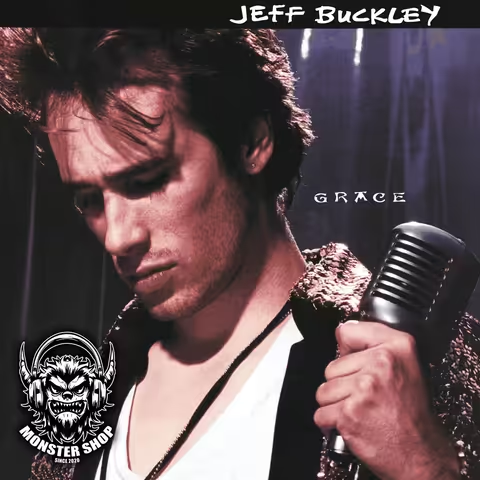
The cover is one of the most recognisable images in nineties rock photography and it nearly did not happen. The photograph was taken by Buckley's friend Merri Cyr in late 1993. He is wearing a women's sequinned jacket he had bought at a thrift store, head tilted back, eyes closed, microphone in one hand. He was listening to a playback of "Dream Brother" at the moment Cyr fired the shutter.
Columbia's executives hated it. Some thought he looked like Adam Ant. Don Ienner, then president of Columbia Records, told the room he looked like a lounge singer. The label put alternatives in front of Buckley. He refused all of them, saying he liked the peaceful expression on his face listening to music. Cyr, in a later interview, was blunter about what the photograph caught: a "split personality" between the boy who wanted media exposure on a major label and the one who wanted to act like he was on an indie label. The art direction, by Nicky Lindeman and Christopher Austopchuk, kept it austere: photograph, title, name, nothing else. David Gahr shot additional photography around Bearsville for the inner booklet.
Release and reception
Grace shipped in three waves: UK and Europe on 15 August 1994, the United States on 23 August, Japan on 1 September, Australia on 19 September. The contemporary review picture was mixed in a way that genuinely surprised Columbia. Some of the press loved it on sight. Some of it heard a major-label tortured-artist record and reached for its critical handgun.
In Entertainment Weekly, Dimitri Ehrlich called the record "dreamy and stunningly original" and described Buckley's voice as "an angel and devil wrapped in one". David Browne, writing the same magazine's year-end list, ranked Grace the sixth-best album of 1994 and wrote that Buckley was "aiming for a higher plane, musically and spiritually, than any other singer-songwriter right now". Mojo named it the number one album of the year. Melody Maker had it at number nine. The Guardian called it a "stunningly accomplished debut". NME gave it 9/10.
Rolling Stone, then the bellwether American magazine, hedged. Stephanie Zacharek's three-star review called him "a man who doesn't yet know what he wants to be" and complained the "meticulous arrangements sound too orchestrated, too ornate". Robert Christgau in The Village Voice was the most quotable hater:
"Beholden to Zeppelin and Nina Simone and Chris Whitley and the Cocteau Twins... Let us pray the force of hype blows him all the way to Uranus."
Robert Christgau, The Village Voice, 29 November 1994
Commercially the record did roughly what the mixed reviews predicted. It spent seven weeks on the Billboard 200, peaking at 149. It reached 31 on the UK Albums Chart and 14 in Ireland. The country it caught on in earliest and hardest was Australia, where it crawled up to number 9 on the ARIA chart in early 1995 and would eventually be certified eight-times platinum. By the time Buckley died in May 1997, Grace had sold about 175,000 copies worldwide.
The trade-magazine list placements got a lot more glowing as the years passed. Rolling Stone has placed Grace on three editions of its 500 Greatest Albums list (303 in 2003, 304 in 2012, 147 in 2020 and again in 2023). Mojo named it the number one Modern Rock Classic of all time in 2006. Q readers voted it the 13th greatest album ever in 2005. In a 2006 Australian television poll of 100,000 people, Grace was voted the second favourite album of all time, behind only Pink Floyd's Dark Side of the Moon.
Singles and music videos
| Single | Release | B-sides | Notable peak | Video / notes |
|---|---|---|---|---|
| "Grace" | August 1994 | "Dream Brother (Nag Champa Mix)", "Mojo Pin (Starsailor Mix)" | Modest college airplay | Performance-style video shot at Bearsville |
| "Last Goodbye" | 8 May 1995 (UK) | Live "Eternal Life", "Kick Out the Jams" cover | Triple J Hottest 100 of 1995: #14 | Steve Purcell black-backdrop video; MTV VMA nom for Best New Artist |
| "So Real" | June 1995 (Australia) | "Lilac Wine" (live), "Dream Brother" (live) | Australian alternative airplay favourite | No standalone video; the song carries the late-album shift on its own |
| "Eternal Life" | August 1995 | Live cuts from the 1995 European tour | UK alternative airplay | Stark Tina Silvey video built around Buckley's eyes |
The promotional video for "Hallelujah", directed by Christine Strand, was filmed in 1994 but barely shown at the time. After American Idol drove the song to the top of the US digital chart in March 2008, MTV2 went back and dug the clip out of the vault. By December 2008 Buckley's version of "Hallelujah" had reached number 2 in the UK singles chart, behind Alexandra Burke's X Factor winner's version, without ever having been re-released in a physical format.
Touring and live
Buckley spent the year and a half after release on the road almost continuously. The first run was the Peyote Radio Theatre Tour, June to August 1994, ending at small American clubs. The first European leg ran 23 August to 22 September 1994 through the UK, Ireland, Scandinavia and Germany, ending in Paris. The North American club tour that followed opened at CBGB in New York on 19 October 1994 and ran to 18 December at Maxwell's in Hoboken. The crowds were small enough that the band could pivot on a per-night basis between solo and full-band sets.
1995 was when the touring stepped up:
- January: first Japan tour, in support of the Japanese single "Last Goodbye".
- February: the Bataclan show in Paris (recorded for the Live from the Bataclan EP) and a much-bootlegged radio session at Nighttown in Rotterdam.
- March to May: US and Canadian dates, including the Chicago Metro show filmed for the Live in Chicago video.
- June and July: European festival run including Glastonbury 1995 and the Meltdown Festival at the Royal Festival Hall in London, where Elvis Costello (the curator) invited him to sing Henry Purcell's "Dido's Lament".
- July: two sold-out nights at the Paris Olympia, the room Edith Piaf had made famous, later released as Live a L'Olympia (2001).
- August to September: the Australia and New Zealand "Mystery White Boy" tour, the dates that pushed Grace to gold in Australia.
By early 1996 the touring had become exhausting. Tensions with Matt Johnson rose through the Hard Luck Tour of Australia and New Zealand. Johnson's last show with the band was on 1 March 1996, in Sydney. The band did not play live again until 12 February 1997, by which point Buckley had left New York for Memphis.
In TV, film and media
"Hallelujah" is the song that has done most of the sync-licensing work, and it has done a great deal of it: The West Wing ("Posse Comitatus", 2002, which won the audio team an Emmy), The OC, ER, House, Scrubs, Cold Case, Without a Trace, Lord of War, the closing montage of multiple sports-broadcast tributes. "Last Goodbye" has appeared in I Am Sam, Pushing Daisies and Vanilla Sky. "Lover, You Should've Come Over" has shown up in House and in countless wedding and funeral playlists. "Lilac Wine" has been licensed for Penny Dreadful and several perfume adverts. "Forget Her", once released, has been a recurring choice for romantic-disappointment montages.
Covers, samples and tributes
The cover-versions list is long: Adele opened many of her 19-era shows by playing "Lover, You Should've Come Over" with just a guitar and her own voice. Rufus Wainwright, Damien Rice, Eddie Vedder, Anna Calvi, Brandi Carlile and Glen Hansard have all recorded versions of Buckley songs at one point or another. Coldplay's Chris Martin has openly described the 2000 single "Shiver" as a Buckley "ripoff". The Foo Fighters' Dave Grohl and his daughter Violet performed "Last Goodbye" and "Grace" at the Taylor Hawkins tribute concert in September 2022.
The most-cited line of inspiration is Radiohead. Thom Yorke has said Buckley gave him the confidence to sing in falsetto; Colin Greenwood has said seeing Buckley at the Garage in Islington made the band write "Fake Plastic Trees" the next day:
"He just had a Telecaster and a pint of Guinness. And it was just fucking amazing, really inspirational."
Colin Greenwood, Radiohead, Uncut, 2016
Matt Bellamy of Muse has said hearing Grace was the moment he realised "a high-pitched, softer voice can work very well" in rock. Jimmy Page told a BBC documentary in 2002 that Grace was "close to being my favourite album of the decade". Bob Dylan called Buckley "one of the great songwriters of this decade" in a 1996 interview, prompting the kind of double-take that only Dylan can produce. David Bowie, asked to name ten albums for a desert island in a 1999 Village Voice interview, included Grace and described it as the best album ever made.
Reissues, remasters and anniversaries
The 10th anniversary reissue, the Grace (Legacy Edition), came out on 23 August 2004 as a 2-CD plus DVD package. The bonus disc included "Forget Her", the cover of Big Star's "Kanga-Roo", a Bob Dylan cover ("Mama, You Been on My Mind"), several unreleased Bearsville session takes and an early studio version of "Eternal Life". The DVD was The Making of Grace, a documentary built around interviews with Wallace, Berkowitz, Lucas, Grondahl, Tighe and Mary Guibert. Pitchfork retroactively scored the original 9.0 in their review of the Legacy edition.
Other Grace-related issues since:
- Grace Around the World (2009): documentary plus live compilation drawn from tours of 1994 to 1996.
- Songs to No One 1991 to 1992 (2002): pre-Grace duo recordings of Buckley and Gary Lucas, including embryonic "Grace" and "Mojo Pin".
- So Real: Songs from Jeff Buckley (2007): single-disc compilation drawn from across the catalogue.
- You and I (2016): the previously unheard February 1993 Steve Addabbo solo sessions for Columbia.
- 30th anniversary (2024): half-speed mastered vinyl pressings and a renewed publicity push, accompanied by Amy Berg's documentary feature It's Never Over, Jeff Buckley, which premiered at Sundance in January 2025 and arrived on HBO in December 2025.
Legacy and influence
The career that was meant to follow Grace never happened. Buckley moved to Memphis in February 1997 to write and demo what would have been the second album, working title My Sweetheart the Drunk. Tom Verlaine of Television was hired to produce, dropped, and Buckley was due to bring in Andy Wallace again. At dusk on 29 May 1997, with his band on a plane from New York to join him in the studio the next morning, he went swimming in the Wolf River Harbor in Memphis, fully dressed, while singing the chorus of Led Zeppelin's "Whole Lotta Love". A passing tugboat's wake swept him under. His body was recovered six days later. He was 30 years old. The autopsy found no drugs or alcohol. The death was ruled an accidental drowning.
The sales curve for Grace pivots cleanly off that date. The album that had sold 175,000 copies in 33 months would, by the end of 2011, have crossed two million. The RIAA finally certified it platinum (a million US units) in 2016. The BPI has it at two-times platinum (600,000 UK units). The ARIA has it at eight-times platinum in Australia.
The critical canonisation followed. Grace is one of a small number of records that have moved up Rolling Stone's 500 Greatest Albums list each time it has been re-issued (303 to 304 to 147), almost always a sign that a record has out-lasted its initial reception. Q named it the 13th greatest album ever in 2005. Mojo placed it first on its 2006 list of "Modern Rock Classics". The Guardian put it in its 1000 Albums to Hear Before You Die. Grace was also added to the Edexcel GCSE music syllabus in England in 2008, which gave it a generation of teenage listeners by force.
The shape of Buckley's influence is unusual. He did not invent a genre, he did not sell out arenas, he did not even get a second album out. What he did instead was give a license to a particular kind of male rock singer to sing high, sing exposed, sing slow, sing covers, and not pretend to be cool about it. Every part of that license is now standard equipment in rock music. The list of singers who have publicly cited Grace (Thom Yorke, Matt Bellamy, Chris Martin, Adele, Lana Del Rey, Anna Calvi, Bat for Lashes, Kiesza, Damien Rice, Glen Hansard) is a roll call of the next twenty years of mainstream singing. He was nominated for the Rock and Roll Hall of Fame in 2026, twenty-nine years after his death.
Things you might not know
| Fact | Detail |
|---|---|
| Born Scott Moorhead | Buckley grew up as Scott Moorhead, his stepfather's surname; he only adopted his birth name and the surname Buckley after Tim's death in 1975. |
| The Wild Blue Yonder | Before moving to New York he played in a band called the Wild Blue Yonder with future Tool drummer Danny Carey, on backing vocals only. |
| Bearsville's pedigree | The Bearsville studio Buckley worked in had been built by Bob Dylan and the Band's manager Albert Grossman in the 1960s. |
| The Michael Bolton review | Recording stopped for two days when a Newsday review of Live at Sin-e likened his voice to Michael Bolton's. Wallace said Buckley was "almost apoplectic". |
| The single Columbia lost | "Forget Her", the song Columbia wanted as the lead single, was held off the album by Buckley personally and would not see release until the 2004 Legacy Edition. |
| The cover photo session | The cover photo was taken while he was listening to a playback of "Dream Brother". Columbia president Don Ienner said he looked like a lounge singer. |
| Hallelujah is a comp | The "Hallelujah" the world knows is an Andy Wallace edit assembled from more than twenty takes. |
| The guitar Bellamy bought | Buckley's blonde 1983 Fender Telecaster was purchased by Matt Bellamy of Muse in 2020 from the Paris guitar dealer Matt's Guitar Shop. |
| The first US number one | "Hallelujah" was added to the Library of Congress National Recording Registry in 2014; the song was Buckley's first US number-one of any kind, on the Billboard Hot Digital Songs chart in March 2008, eleven years after his death. |
| Costello and Purcell at Meltdown | At the 1995 Meltdown Festival in London, Elvis Costello (the curator that year) invited Buckley to perform Henry Purcell's "Dido's Lament" with a chamber orchestra. |
| The unreleased Fraser duet | The duet Buckley recorded with Elizabeth Fraser of the Cocteau Twins, "All Flowers in Time Bend Towards the Sun", has never had a commercial release. |
| Australia's number two | In a 2006 Australian Broadcasting Corporation poll of 100,000 listeners, Grace was voted the second-favourite album of all time, behind only The Dark Side of the Moon. |
| On the GCSE syllabus | Grace was added to the Edexcel GCSE music syllabus in England in 2008, giving a generation of teenagers the album as set text. |
Listen on the Riffology podcast
The Riffology hosts spent the best part of an hour pulling Grace apart from the inside out, working through every track, the production decisions, the Hallelujah arc and the question of what Buckley might have done next. You can find that episode, and the whole back catalogue, on Apple Podcasts, Spotify, Amazon Music, Pocket Casts, Overcast, and anywhere else you listen.
Comments