Steve Albini took $100,000 to record In Utero in two weeks and turned down half a million in royalties on principle. Two months later, while the band were still defending him to the press, Geffen quietly booked Scott Litt to remix the singles for radio. In Utero by Nirvana, the third and final studio album by Kurt Cobain, Krist Novoselic and Dave Grohl, was meant to be the record that undid the smooth corners of Nevermind. By the time it reached the shops on 21 September 1993, it had been argued over by every party with a stake in Nirvana's future, including Cobain himself.
This is the complete story of In Utero: the snow-bound fortnight at Pachyderm Studio, the David Geffen phone call to Newsweek, the Scott Litt remixes that nearly tore the band away from Albini, the Wal-Mart censorship, the kitchen-as-drum-booth, the Transparent Anatomical Manikin on the sleeve, and the small handful of months between number-one debut and the morning of 8 April 1994. It is meant as the definitive companion to the album, written as a Riffology podcast crib sheet and a standalone read.
| Attribute | Detail |
|---|---|
| Artist | Nirvana |
| Album | In Utero |
| Release date | 13 September 1993 (UK); 14 September 1993 (US vinyl); 21 September 1993 (US CD/cassette) |
| Label | DGC Records (a Geffen Records imprint) |
| Producer(s) | Steve Albini (also engineer and mix); Scott Litt remixed two tracks at Bad Animals, Seattle, May 1993 |
| Studio(s) | Pachyderm Studio, Cannon Falls, Minnesota (13–26 February 1993); Bad Animals Studio, Seattle (Litt remixes, May 1993); mastered at Gateway Mastering, Portland, Maine |
| Genre / subgenre | Grunge, noise rock, alternative rock, punk rock |
| Track count | 12 (13 on European/Australian CD, with hidden track) |
| Total runtime | 41:23 |
| Billboard 200 peak | 1 (debut, week of 9 October 1993, 180,000 first-week US sales) |
| UK Albums Chart peak | 1 |
| Other notable peaks | #1 Sweden, #2 Australia, #2 Canada, #2 France, #2 Eurochart, #3 New Zealand, #4 Netherlands, #4 Belgium |
| Certifications | 6× Platinum (US, RIAA, 2024); 3× Platinum (UK, BPI); 2× Platinum (Australia); 6× Platinum (Canada); Gold/Platinum across ~20 territories |
| Estimated sales | ~15 million worldwide (4.26 million SoundScan US to 2013, 6 million RIAA shipments) |
| Key singles | "Heart-Shaped Box" (30 August 1993); "All Apologies" / "Rape Me" double A-side (6 December 1993, UK); "Pennyroyal Tea" (Record Store Day, 19 April 2014) |
Cultural context: the autumn of 1993
September 1993 was the high tide of mainstream alternative rock. The Oslo Accords had just been signed on the White House lawn. Jurassic Park was still chewing through cinema records. Pearl Jam's Vs. would arrive a month after In Utero and demolish first-week sales records of its own. Smashing Pumpkins had released Siamese Dream in July. Tool's Undertow was building word of mouth. Snoop Doggy Dogg's Doggystyle was weeks away. The Cranberries, Counting Crows and Björk were each putting out debut singles that would carry them through the rest of the decade.
What made In Utero so loaded was the gap it had to fill. Nevermind, released two years earlier, had displaced Michael Jackson's Dangerous from the top of the Billboard 200 and would eventually pass 30 million copies worldwide. It was credited, fairly or not, with ending the commercial reign of hair metal in a single season. The follow-up was the most anticipated rock album in years, and Nirvana decided to make it sound like a band recorded in a room in two weeks.
- Pearl Jam, Vs., released 19 October 1993, debuted at #1 with then-record 950,378 first-week US sales.
- Smashing Pumpkins, Siamese Dream, 27 July 1993.
- Tool, Undertow, 6 April 1993.
- The Breeders, Last Splash, 31 August 1993 (Kim Deal was Nirvana's tour-support choice).
- Liz Phair, Exile in Guyville, 22 June 1993.
- Counting Crows, August and Everything After, 14 September 1993, the day after In Utero hit UK shelves.
The band's story up to this point
By the time Nirvana convened to discuss album three, the band was three musicians, two contracts and one runaway juggernaut. Cobain and Novoselic had met at Aberdeen High School in Washington state and bonded around the Melvins. Dave Grohl, recruited from the recently broken-up Washington DC band Scream on Buzz Osborne's recommendation, had joined in September 1990; Novoselic later said, "We knew in two minutes that he was the right drummer." His arrival reframed the rhythm section just in time for the move to DGC, the label they signed to in 1990 on the repeated urging of Sonic Youth's Kim Gordon.
Nevermind, recorded with Butch Vig at Sound City and mixed by Andy Wallace, became the album everyone had to live with. By Christmas 1991 it was selling 400,000 a week in the US. By January 1992 it was number one. The band cancelled an American leg of touring, partly through exhaustion, partly because of an early flare-up of Cobain's heroin use, and partly because the songwriter who had handed Vig a tape of acoustic demos was now widely framed as the voice of a generation he had no interest in speaking for.
By March 1992, royalty arguments were threatening to break the band: Cobain wanted his share of Nevermind's songwriting royalties retroactively raised to 75 percent. Grohl and Novoselic conceded. The bad feeling never fully went away. By the time the trio reconvened in late 1992, Cobain had married Courtney Love, become a father to Frances Bean, suffered through tabloid coverage of his addiction, and put out a stop-gap compilation, Incesticide, instead of the album DGC had hoped for that Christmas. Album three was already overdue and already a referendum.
Pre-production and demos
Some of the songs were old. "Pennyroyal Tea" and "All Apologies" dated to 1990. "Sappy", which gave the album one of its working titles, Verse Chorus Verse, went back even further. Cobain told Spin's Darcey Steinke in October 1993 that the lyrics for In Utero were "more focused, they're almost built on themes". He continued writing them in the studio, sometimes minutes before tracking vocals.
In October 1992 the band booked time at Word of Mouth Productions in Seattle with Jack Endino, who had produced Bleach. They tracked mostly instrumentals, including early versions of songs that would end up on the album. Endino later said he assumed it was a session, not an audition, and the band quietly kept debating whether to use him or Steve Albini for the album proper. In January 1993, during a South American tour leg, Nirvana recorded another set of demos at BMG Ariola Ltda in Rio de Janeiro with their long-time live engineer Craig Montgomery. One of the Brazil tracks, an improvised jam originally titled "I'll Take You Down to the Pavement", a reference to Cobain's row with Axl Rose backstage at the 1992 MTV Video Music Awards, survived to the European pressing as the hidden bonus track "Gallons of Rubbing Alcohol Flow Through the Strip".
Cobain picked Albini specifically because of his work on the Pixies' Surfer Rosa and The Breeders' Pod. Before sessions began, the band sent Albini their Brazil demos. Albini sent back an acetate of the then-unreleased PJ Harvey album Rid of Me, which he had just engineered, so Cobain could hear how the live-in-the-room approach handled vocals. Albini later told Spin, "He really liked the way her singing came across. He was a fan."
"R.E.M. with a fuzzbox. An unremarkable version of the Seattle sound."
Steve Albini's initial assessment of Nirvana, quoted in Michael Azerrad, Come as You Are (1994)
Albini took the gig anyway, partly because he felt sorry for them. He saw them as "the same sort of people as all the small-fry bands I deal with, at the mercy of their record company". To pre-empt any DGC meddling, he proposed Nirvana pay for the sessions out of their own pocket. They did.
Creating the album: two weeks in Cannon Falls
Pachyderm Studio sits in 40 acres of woodland an hour south of Minneapolis, outside the village of Cannon Falls. In February 1993 it was deep in snow. Nirvana flew in but their gear did not; the first three days at the studio were spent waiting for backline to arrive by mail. The band slept in a house on the studio grounds. Novoselic compared the conditions to a gulag, telling Mojo's Keith Cameron, "There was snow outside, we couldn't go anywhere. We just worked."
The deal was simple. Studio fees: $24,000. Albini's flat fee: $100,000, paid up front, no points. By his own reckoning Albini walked away from around $500,000 in royalties, which he considered "immoral and an insult to the artist". Recording started on 13 February. Mixing was finished by 26 February. Total tape time, end to end, was under two weeks.
Albini worked as engineer first and producer second, refusing to argue with takes Cobain accepted. The setup was deliberately unfussy: the band tracked basics live, all three in a room together. Cobain's vocals were cut in a single six-hour session, without double-tracking, sung in a live room rather than a dead booth. For the faster, harsher songs, "Very Ape" and "Tourette's", Grohl's kit was relocated to the studio kitchen for its hard tiled reverb, with around thirty microphones scattered around it. Albini's longtime collaborator Bob Weston handled assistant engineering, credited as "technician" on the sleeve. For most of the two weeks, the only other person in the building was the studio's chef.
"If you take a good drummer and put him in front of a drum kit that sounds good acoustically and just record it, you've done your job."
Steve Albini, quoted in Michael Azerrad, Come as You Are (1994)
When mixes were not coming, the band and Albini knocked off for the day, watched nature documentaries, made prank calls and set things on fire in the snow. Cobain, who had braced for clashes with Albini's reputed bluntness, called the process "the easiest recording we've ever done, hands down". The only real tension came when Courtney Love arrived mid-week because she missed her husband; according to the studio chef she was confrontational with most of the people in the building, and Albini was undiplomatic in return.
One track was left off the album entirely. "I Hate Myself and Want to Die", the song that had originally been on course to be the title cut, was dropped because, in Cobain's words, the album already had "too many noise songs". It surfaced later on The Beavis and Butt-Head Experience compilation in November 1993.
The mixing dispute and the David Geffen phone call
The trouble started the moment unmastered tapes left Cannon Falls. Albini's mixes pushed bass and vocals lower in the picture than DGC and the band's management firm Gold Mountain were used to. According to Michael Azerrad's biography Come as You Are, Cobain told him, "The grown-ups don't like it." Cobain was told his songwriting was "not up to par", the sound was "unlistenable", and radio would not play it.
In April 1993, Albini gave an interview to Chicago Tribune's Greg Kot saying he doubted Geffen would release the album. Two months later a Newsweek piece said the same. Nirvana wrote to Newsweek denying that any pressure had been applied, and reprinted the letter as a full-page ad in Billboard. Label president Ed Rosenblatt put out a press release insisting Geffen would release whatever Nirvana submitted. David Geffen himself made the unusual move of personally telephoning Newsweek to complain.
What actually happened was more nuanced. The band came round to feeling the bass and vocals were too low; Cobain felt "Heart-Shaped Box" and "All Apologies" specifically did not sound right. Bob Ludwig was brought in to master at Gateway in Portland, Maine, with extra clarity dialled in. Then Scott Litt, R.E.M.'s long-time producer, was called to Seattle's Bad Animals Studio in May 1993 to remix those two songs, with Cobain overdubbing extra guitar and backing vocals. Adam Kasper assisted. Albini was furious; he had agreed nothing would be altered without him and at first refused to release the master tapes, relenting after a phone call from Novoselic. The rest of the album was left as Albini had it.
"The record in the stores doesn't sound all that much like the record that was made, though it's still them singing and playing their songs, and the musical quality of it still comes across."
Steve Albini, quoted in Gillian G. Gaar's In Utero (33⅓ series, 2006)
Albini later told Kerrang! that In Utero made him persona non grata at major labels for the next year. He never recanted his version. Twenty years on, Cobain biographer Charles R. Cross argued in Guitar World that the album sounded better than Nevermind and was "a lost pearl" hiding inside a four-million-seller.
Personnel and credits
| Role | Player | Notes |
|---|---|---|
| Core band | ||
| Vocals, guitars | Kurt Cobain | Also credited with art direction, design and photography |
| Bass guitar | Krist Novoselic | Played accordion live during the touring cycle |
| Drums, backing vocals | Dave Grohl | Tracked live; Tourette's / Very Ape drums cut in the studio kitchen |
| Guest musicians (credited) | ||
| Cello | Kera Schaley | On "All Apologies" and "Dumb" |
| Production and engineering | ||
| Producer, engineer, mix | Steve Albini | Flat $100,000 fee; refused royalties; mixed in five days |
| Technician (assistant engineer) | Bob Weston | Listed as "technician" on the sleeve |
| Remix on "Heart-Shaped Box" and "All Apologies" (plus "Pennyroyal Tea" on later deluxe) | Scott Litt | Recorded at Bad Animals Studio, Seattle, May 1993 |
| Second engineer to Scott Litt | Adam Kasper | |
| Mastering | Bob Ludwig | Gateway Mastering, Portland, Maine |
| Artwork and photography | ||
| Art direction, design, photography | Robert Fisher | Designed all Nirvana DGC sleeves |
| Illustrations | Alex Grey | Anatomical illustrations in the booklet |
| Photography | Charles Peterson, Michael Lavine, Karen Mason, Neil Wallace | Peterson shot the back-cover collage in Cobain's living room |
| Touring (not on record but central to the In Utero era) | ||
| Second guitar, backing vocals | Pat Smear | Ex-Germs; joined for the In Utero tour, October 1993 |
| Touring cello | Lori Goldston (1993–94), Melora Creager (1994) | Goldston played the MTV Unplugged set |
Three things are worth pulling out of the table. First, the absence of guests is striking; aside from Schaley's cello there is no expanded cast. Second, Albini's "engineer not producer" billing was a deliberate political statement on his part, he hated the producer cult and refused to be credited as one. Third, Pat Smear was sufficient enough of a presence on tour and in the MTV Unplugged broadcast that many casual listeners assume he plays on the record. He does not. The four-piece line-up only ever existed on stage.
The songs
| # | Title | Writer(s) | Length | Single? | Notes |
|---|---|---|---|---|---|
| 1 | Serve the Servants | Cobain | 3:36 | Opens with "Teenage angst has paid off well"; addresses Cobain's father directly | |
| 2 | Scentless Apprentice | Cobain, Novoselic, Grohl | 3:48 | Built around a riff Grohl had been kicking around; lyric inspired by Patrick Süskind's novel Perfume | |
| 3 | Heart-Shaped Box | Cobain | 4:41 | Yes (30 Aug 1993) | Remixed by Litt; Anton Corbijn video |
| 4 | Rape Me | Cobain | 2:50 | Yes (6 Dec 1993, double A-side) | Written before Nevermind came out; relabelled "Waif Me" on the censored Wal-Mart edition |
| 5 | Frances Farmer Will Have Her Revenge on Seattle | Cobain | 4:09 | Inspired by William Arnold's biography Shadowland | |
| 6 | Dumb | Cobain | 2:32 | One of the album's two cello tracks; written around 1990 | |
| 7 | Very Ape | Cobain | 1:56 | Drums tracked in the kitchen; riff sampled in The Prodigy's "Voodoo People" (1994) | |
| 8 | Milk It | Cobain | 3:55 | Cobain cited as the model for the album's more abrasive direction | |
| 9 | Pennyroyal Tea | Cobain | 3:37 | Yes (cancelled 1994; reissued 2014) | Litt remix on later deluxe editions; original Albini mix on first pressings |
| 10 | Radio Friendly Unit Shifter | Cobain | 4:51 | Title is a sneer at music-industry jargon | |
| 11 | Tourette's | Cobain | 1:35 | Lowercase title on the sleeve; kitchen-drums; under 90 seconds | |
| 12 | All Apologies | Cobain | 3:51 | Yes (6 Dec 1993, double A-side) | Remixed by Litt; cello by Kera Schaley; dedicated to Courtney Love and Frances Bean live at Reading 1992 |
The opener, "Serve the Servants", is the most plainly autobiographical thing Cobain ever recorded. The first line, "Teenage angst has paid off well, now I'm bored and old", is a one-sentence summary of where the band was in early 1993. The chorus dismisses the press's obsession with his parents' splitting up ("That legendary divorce is such a bore") and the final verse is addressed directly to his father: "I tried hard to have a father, but instead I had a dad". Cobain told Azerrad he did not hate his father, but did not particularly want to talk to him either.
"Scentless Apprentice" is the only writing credit on the album shared by the whole band. The opening riff came from Grohl, the lyric, about a perfumer's apprentice who murders virgins to extract their scent, came from Cobain's reading of Patrick Süskind's 1985 novel Perfume. Cobain's vocal performance is, by his own account, the most extreme one on the album: he wanted the closing scream to "overtake the whole band", and Albini left it ragged on the master.
"Heart-Shaped Box" is the album's commercial anchor, written about Cobain's relationship with Courtney Love and obsessed, like much of the record, with imagery of birth, illness and entanglement (the "umbilical noose"). It was the song most aggressively re-touched in the Litt remix, with extra guitar and backing vocals layered on top of the Albini bed. The Anton Corbijn-directed video, crucifix on a sunflower field, KKK-robed old man, foetus dolls in trees, won Best Alternative Video at the 1994 MTV Video Music Awards.
"Rape Me" was written long before In Utero sessions, demoed for Nevermind and famously almost performed at the 1992 MTV VMAs after the network told Nirvana they could not play it (Cobain strummed the opening bars then dropped into "Lithium"). Cobain consistently described it as an anti-rape song, written in part as a response to the misreading of "Polly". He told Azerrad that the song could also be read as being about being torn apart by the press; in that sense the line "rape me again" is addressed to fame itself.
"Frances Farmer Will Have Her Revenge on Seattle" comes from a biography Cobain read at high school: William Arnold's Shadowland, on the actress Frances Farmer, whose treatment by the Seattle establishment Cobain considered emblematic. He named his daughter after her. Cobain favoured deliberately long song titles in 1992–93 as a reaction against the contemporary alt-rock fashion for single-word titles.
"Dumb" and "All Apologies" are the album's two cello tracks, both featuring Kera Schaley, both among the oldest songs Cobain brought to Pachyderm. "All Apologies" had been performed live as early as 1990 and was dedicated to Courtney and Frances Bean at the end of Nirvana's Reading 1992 headline set. The studio version is the closest thing on the album to the pop side of the band Cobain occasionally said he wanted to follow. Azerrad called the album a deliberate refusal to reconcile the two sides: "Dumb happily coexists beside the all-out frenzied punk graffiti of Milk It, while All Apologies is worlds away from the apoplectic Scentless Apprentice. It's as if [Cobain] has given up trying to meld his punk and pop instincts into one harmonious whole. Forget it. This is war."
"Pennyroyal Tea" deserves a paragraph of its own. Pennyroyal is an old herbal abortifacient. The lyric is a litany of cleansings, "give me a Leonard Cohen afterworld so I can sigh eternally", and was meant for radio release as the third single in 1994 with a Litt remix. Test pressings were made. After Cobain's death the launch was scrapped; promo CDs already pressed in the UK are among the most collectable Nirvana artefacts. The song was finally issued commercially for Record Store Day on 19 April 2014, where it topped Billboard's Hot 100 Singles Sales chart.
B-sides, outtakes and lost songs
- "Marigold", Grohl-sung song originally recorded for his Pocketwatch tape; B-side to "Heart-Shaped Box", and the only commercially released Nirvana track with a Grohl lead vocal.
- "Moist Vagina", Pachyderm-era outtake, B-side to "All Apologies".
- "I Hate Myself and Want to Die", recorded at Pachyderm, dropped from the album as one noise song too many; released on The Beavis and Butt-Head Experience in November 1993.
- "Gallons of Rubbing Alcohol Flow Through the Strip", Brazil demo with Craig Montgomery; appended as a hidden bonus track on the European and Australian CD, beginning at 24:00 of the closing track after 20 minutes of silence.
- "Sappy" / "Verse Chorus Verse", recorded multiple times across Nirvana's career; the song that gave the album one of its working titles, released on the No Alternative AIDS compilation in October 1993 as an uncredited hidden track.
Album artwork and packaging
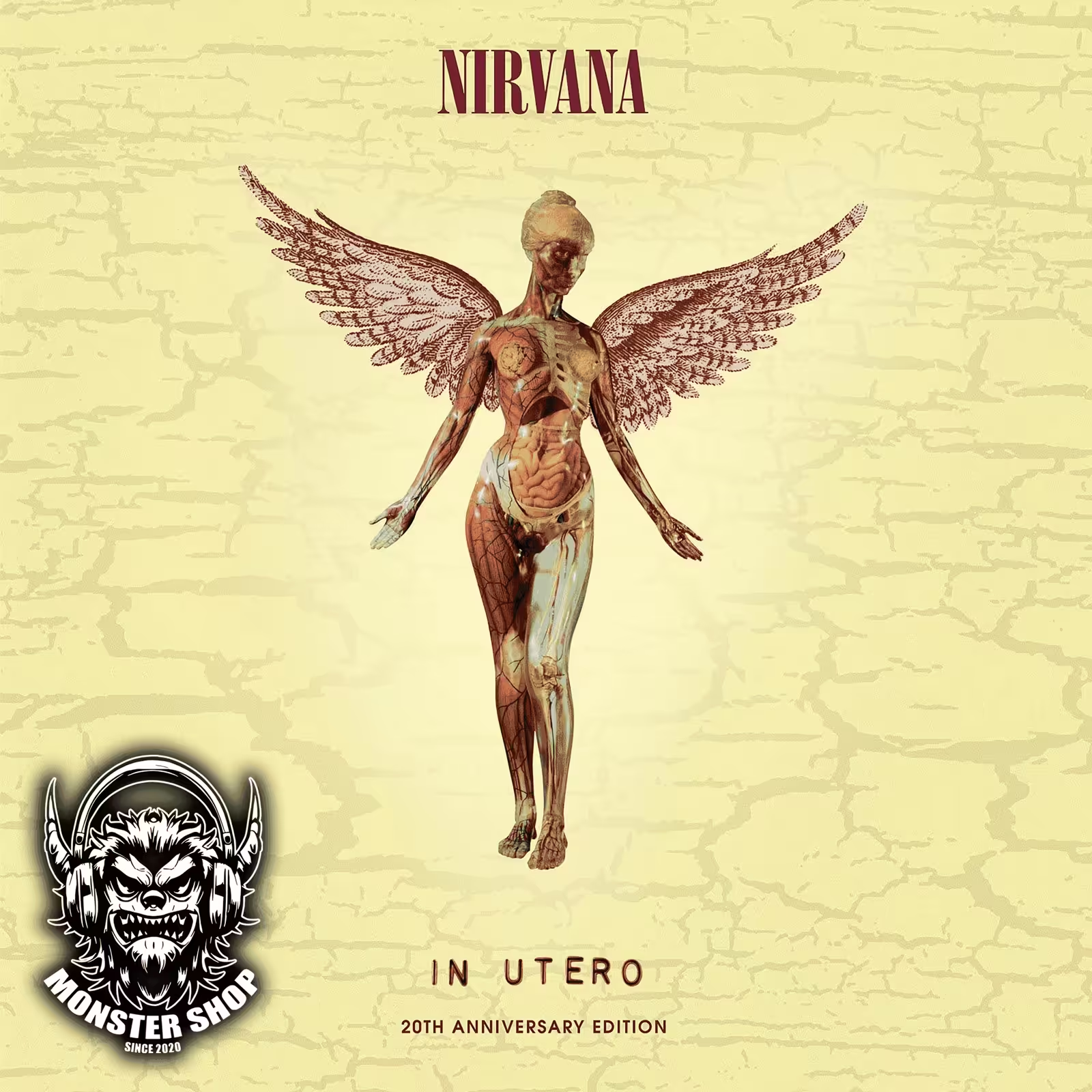
Robert Fisher, who had designed every Nirvana DGC release, was art director. Most of the visual ideas came from Cobain, who handed Fisher "loose odds and ends" and asked him to assemble. The front cover is a photograph of a Transparent Anatomical Manikin, a 1960s medical-teaching figure with visible organs, with angel wings superimposed. The back cover is a collage Cobain made on the floor of his Seattle living room: model foetuses, a turtle shell and toy turtles, body parts, orchids and lilies, photographed by Charles Peterson after an unexpected late-night call from Cobain. The booklet pulls in anatomical illustrations by Alex Grey and re-illustrated symbols from Barbara G. Walker's The Woman's Dictionary of Symbols and Sacred Objects.
That back collage is what got the album banned from Wal-Mart and Kmart shelves. Officially the chains cited lack of demand and merchandise mix; internally they were worried about complaints. In March 1994 DGC issued a censored edition for those retailers: the back-cover collage was modified, "Rape Me" was retitled "Waif Me" on the spine and tray card, and the Litt remix of "Pennyroyal Tea" was swapped in for the Albini mix. A Nirvana spokesperson said the band agreed to the changes because they wanted their music available to "kids who don't have the opportunity to go to mom-and-pop stores".
Mannequins of the winged anatomical figure were carried on the In Utero tour as stage props. One ended up in the "Nirvana: Taking Punk to the Masses" exhibition at Seattle's Experience Music Project (now MoPOP) from April 2011 through 2013.
Release and reception
In Utero went out on CD in the UK on 13 September 1993, on US vinyl on 14 September (a limited 25,000-copy pressing), and on US CD and cassette on 21 September. The album debuted at number one in both the US and the UK, selling 180,000 in its first US week. By late 1993 it had moved a million copies in the US and 1.3 million elsewhere.
Critical reaction was warm but more measured than for Nevermind. Time's Christopher John Farley wrote that "Nirvana hasn't gone mainstream, though this potent new album may once again force the mainstream to go Nirvana." Rolling Stone's David Fricke called it "brilliant, corrosive, enraged and thoughtful, most of them all at once. But more than anything, it's a triumph of the will." NME's John Mulvey was less convinced, giving it 8/10 and concluding, "As a follow-up to one of the best records of the past ten years it just isn't quite there." Entertainment Weekly's David Browne settled on a B+: "The music is often mesmerizing, cathartic rock and roll, but it is rock and roll without release, because the band is suspicious of the old-school rock clichés such a release would evoke."
"A lot of what he has to say is related to a lot of the shit he's gone through. And it's not so much teen angst any more. It's a whole different ball game: rock star angst."
Dave Grohl, quoted in Michael Azerrad, Come as You Are (1994)
Both the Rolling Stone and Village Voice Pazz & Jop year-end critics' polls placed In Utero first or second for the year. The New York Times had it in its top ten of 1993. It was nominated for Best Alternative Music Album at the 1994 Grammys, which it lost to U2's Zooropa. The retrospective Pitchfork verdict on the 20th-anniversary edition in September 2013 was 10/10. Rolling Stone has it 7th on its 90s list and 173 on the most recent revision of the 500 Greatest Albums of All Time.
Singles and music videos
| Single | Released | B-side(s) | Director / notable peaks |
|---|---|---|---|
| "Heart-Shaped Box" | 30 August 1993 (radio promo; commercial elsewhere) | "Marigold", "Milk It" | Video: Anton Corbijn. #1 US Billboard Modern Rock Tracks; #5 UK Singles Chart; #4 Australia. MTV Video Music Award for Best Alternative Video, 1994. |
| "All Apologies" / "Rape Me" | 6 December 1993 (UK double A-side) | "Moist Vagina" | #1 US Modern Rock; #32 UK Singles Chart. No commercial US single release. |
| "Pennyroyal Tea" | Scheduled April 1994; cancelled after Cobain's death; finally issued 19 April 2014 for Record Store Day | "I Hate Myself and Want to Die" (UK promo); "Where Did You Sleep Last Night" (live, RSD release) | Scott Litt remix. Limited UK promo pressings recalled and destroyed; surviving copies among the most valuable Nirvana 7" singles. |
The marketing strategy was deliberately low-key. DGC's head of marketing told Billboard the label intended to "set things up, duck, and get out of the way". No "Heart-Shaped Box" commercial single was issued in the US; promo copies went only to college, modern rock and AOR radio. The band was on record predicting the album would not match Nevermind's sales, Cobain told Jim DeRogatis, "We're certain that we won't sell a quarter as much, and we're totally comfortable with that because we like this record so much."
The "Heart-Shaped Box" video, shot by Dutch photographer Anton Corbijn in early August 1993, is the visual signature of the album: a crucified Christ-figure in a sunflower field, a small girl in a KKK robe reaching for foetuses hanging in a tree, an elderly hospital patient ascending into an angelic costume. Corbijn worked from a treatment Cobain had written himself and had been unhappy with Kevin Kerslake's drafts. It was named one of Time's "30 All-Time Best Music Videos" in 2011.
Touring and live
The In Utero tour proper opened in Phoenix on 18 October 1993 and ran through the autumn US leg. Half Japanese and The Breeders were the support acts. To thicken the live sound and free Cobain from doubling rhythm and lead, the band added Pat Smear of the Germs as second guitarist. Lori Goldston played cello on select dates; Melora Creager replaced her briefly in 1994. The tour included the band's celebrated Aragon Ballroom run in Chicago, and a New Year's Eve show in Oakland.
Two televised performances from this tour passed into rock folklore:
- Saturday Night Live, 25 September 1993, Nirvana's second SNL appearance, playing "Heart-Shaped Box" and "Rape Me" on national US television three days after release.
- MTV Unplugged in New York, 18 November 1993, recorded at Sony Music Studios with Smear and Goldston, deliberately ignoring the hits in favour of Bowie's "The Man Who Sold the World", a Vaselines cover, three Meat Puppets songs with Cris and Curt Kirkwood guesting, and a closing "Where Did You Sleep Last Night" so quietly devastating that the producer initially asked for an encore Cobain refused to perform. The recording, released posthumously in November 1994, would win Best Alternative Music Performance at the 1996 Grammys.
A separate Live and Loud broadcast was taped at the Pier in Seattle on 13 December 1993 and aired on MTV on 31 December. The European leg opened in Cascais, Portugal on 5 February 1994 and was meant to run six weeks. On 4 March, in the Excelsior Hotel in Rome, Courtney Love found Cobain unconscious from a combination of Rohypnol and champagne. The rest of the tour was cancelled. Cobain returned to Seattle, entered rehab on 30 March, escaped on 1 April, and was found dead at his home on 8 April. He was 27.
In TV, film and media
- "All Apologies", closing scene of Six Feet Under's series finale (HBO, 2005); used in Cold Case (S5E1, 2007); central to Kurt Cobain: Montage of Heck (HBO, 2015).
- "Heart-Shaped Box", The Boys (S4E8, Amazon, 2024); Californication (S2E10); recurring needle-drop across MTV, Netflix and HBO documentary content.
- "Very Ape", the riff was directly sampled by The Prodigy on "Voodoo People" (1994), credited to Cobain.
- Several In Utero tracks score Brett Morgen's Kurt Cobain: Montage of Heck (2015) and Nick Broomfield's Kurt & Courtney (1998).
Controversy, censorship and lawsuits
The Wal-Mart and Kmart censorship is the headline story (covered above). The other ongoing dispute around In Utero is the mix itself, Albini stood by his original version for the rest of his life and continued to argue, gently rather than bitterly, that the Litt-remixed singles do not represent the record that was actually made. The 20th and 30th anniversary deluxe editions include the 2013 Albini-supervised remaster of the original mix as a way of letting both versions coexist.
"Rape Me" attracted predictable, mostly American, complaints from the moment the title became known. MTV had refused to let Nirvana play it at the 1992 VMAs. Several US radio stations refused to play the All Apologies / Rape Me double A-side on its own merits, leading to "Rape Me" being dropped from a number of broadcast playlists. There were no successful lawsuits.
Covers, samples and tributes
- Sinéad O'Connor, covered "All Apologies" on her 1994 album Universal Mother, three months after Cobain's death.
- Herbie Hancock, recorded "All Apologies" with Dave Matthews on the 2005 album Possibilities.
- The Bad Plus, released a much-loved jazz-trio reading of "Heart-Shaped Box" on These Are the Vistas (2003).
- The Prodigy, sampled the "Very Ape" riff for "Voodoo People" (1994), with Cobain credited as co-writer.
- In Utero, in Tribute, in Entirety, 2014 track-by-track tribute compilation with covers by Surfer Blood, Telekinesis, Jenny Owen Youngs and others.
Reissues, remasters and anniversaries
| Edition | Released | Notable contents |
|---|---|---|
| Standard CD / LP / cassette | 13–21 September 1993 | Original Albini/Litt hybrid mix; European/Australian CDs include "Gallons of Rubbing Alcohol" as a hidden track |
| Censored Wal-Mart / Kmart edition | March 1994 | Modified back cover; "Rape Me" relabelled "Waif Me"; Litt remix of "Pennyroyal Tea" |
| 20th Anniversary Edition | 23–24 September 2013 | 2013 Albini-supervised remaster of the original mix; B-sides, demos, instrumentals; Live and Loud DVD; super-deluxe includes Bob Ludwig's 1993 master vs. 2013 master comparison |
| "Pennyroyal Tea" Record Store Day single | 19 April 2014 | The originally planned 1994 release, with Litt remix; #1 on Billboard Hot 100 Singles Sales |
| 30th Anniversary Edition | 27 October 2023 | Two complete concerts added: Great Western Forum, Los Angeles, 30 December 1993, and Seattle Centre Arena, 7 January 1994; super-deluxe vinyl box |
Legacy and influence
In Utero turned out to be the last word. Within months of its release Cobain was dead, Nirvana was effectively over, and the band's afterlife passed into the hands of Novoselic, Grohl, Courtney Love and the lawyers. Grohl had recorded a tape of his own songs at Robert Lang Studios in Seattle the week before Cobain died; it became the first Foo Fighters album, released in July 1995. Novoselic moved into political activism, formed Sweet 75, Eyes Adrift and Giants in the Trees, and helped run Nirvana LLC. Pat Smear joined Foo Fighters as touring guitarist and remains a member.
The album itself has been re-evaluated upward over the decades. Where 1993 reviews framed it as "not as good as Nevermind", the post-2000 consensus has shifted; Charles R. Cross's 2003 Guitar World piece arguing that In Utero was the better record is now closer to mainstream than contrarian. Pitchfork ranked it 13th of the 1990s in its original 2003 list. Rolling Stone ranks it 7th of the decade. The band's induction into the Rock and Roll Hall of Fame in 2014 listed both "All Apologies" and "Heart-Shaped Box" as performance highlights, alongside "Smells Like Teen Spirit".
The most lasting legacy is in production rather than songwriting. In Utero validated the live-in-the-room, minimal-overdub, no-double-tracked-vocals approach for a generation of indie and alternative records that followed. PJ Harvey's Rid of Me (1993), Pixies' Surfer Rosa (1988) and In Utero together became Albini's most-cited calling cards and effectively created the playbook that Shellac, Cloud Nothings, METZ, Mclusky and countless others worked from. As Cobain's biographer Charles R. Cross argued in 2003, In Utero is, in its own way, more influential than Nevermind, the album that "only ten years later seems to be an influential seed spreader".
Things you might not know about In Utero
| Fact | Detail |
|---|---|
| The original title | Cobain wanted to call it I Hate Myself and I Want to Die. Novoselic talked him out of it over lawsuit fears. Verse Chorus Verse was the back-up. The final title came from a poem by Courtney Love. |
| Albini's pay | $100,000 flat fee, paid up front. He turned down royalties he later estimated at around $500,000 on principle. |
| The kitchen drums | Drums on "Very Ape" and "Tourette's" were tracked in Pachyderm's tiled kitchen for the natural slap reverb. Grohl was surrounded by roughly 30 microphones. |
| Cobain's vocals | The entire album's lead vocals were tracked in a single six-hour session, sung in a live room, with no double-tracking. |
| PJ Harvey's Rid of Me | Albini sent Cobain an unreleased acetate of PJ Harvey's Rid of Me before the sessions so he could hear how live-room vocals would sound. Cobain became a fan. |
| The David Geffen phone call | After the Newsweek piece claimed DGC was shelving the album, label founder David Geffen personally telephoned the magazine to complain, almost unheard of for an artist who wasn't on his own label imprint. |
| The Brazil bonus track | "Gallons of Rubbing Alcohol Flow Through the Strip" was recorded in Rio de Janeiro with Craig Montgomery and originally titled "I'll Take You Down to the Pavement", a swipe at Axl Rose. |
| The Wal-Mart edit | The censored edition relabelled "Rape Me" as "Waif Me" on the spine, modified the back-cover collage and silently swapped in Scott Litt's remix of "Pennyroyal Tea" for the Albini mix. |
| The Prodigy sample | The "Very Ape" riff is the basis of "Voodoo People" (1994). Cobain is credited as co-writer. |
| The Beavis and Butt-Head connection | "I Hate Myself and Want to Die" was cut from the album for being one noise song too many; it appeared instead on the November 1993 The Beavis and Butt-Head Experience compilation, sharing a tracklist with Cher. |
| The "Pennyroyal Tea" single nearly happened | UK promo pressings of the cancelled 1994 single were destroyed after Cobain's death. Surviving copies sell for four-figure sums; the song eventually came out commercially for Record Store Day 2014, twenty years after it was meant to. |
| Bob Weston | Albini's long-time collaborator and Shellac bassist was the album's "technician", what most albums would call an assistant engineer. He went on to mix records for The Breeders, Mission of Burma and dozens more. |
| The Grammy it lost | In Utero's sole 1994 Grammy nomination, Best Alternative Music Album, was beaten by U2's Zooropa. |
| The Sappy / No Alternative trick | "Sappy", a song Cobain had been recording in different forms since 1990, was released the same autumn on the AIDS benefit compilation No Alternative as an uncredited hidden track. It is sometimes catalogued as "Verse Chorus Verse", the working title for the album itself. |
Conclusion: the riff in your pocket
If you only have time for one Riffology podcast on Nirvana, this is the one we keep coming back to. In Utero is the album where every choice was reactive, to Nevermind's polish, to MTV, to the label, to fame itself, and yet the record that came out the other end sounds completely deliberate. Two weeks at Pachyderm, $100,000 flat to Steve Albini, drums in the kitchen, vocals in a live room, and an artwork that got it pulled from Wal-Mart. We dig into all of it on the podcast, including the bits the Wikipedia summary glosses over: the Andy Wallace conversation that nearly happened, the Litt remix war, the Bob Weston angle, and whose mix the 2013 anniversary edition actually presents. Riffology is on Apple Podcasts, Spotify, Pocket Casts and every other major platform, listen above or subscribe wherever you get your shows.
Comments