Two hundred copies. That was the original print run for the album that would, twelve months later, be nominated for a Grammy in the same category as the posthumous Nirvana record that beat it. One hundred cassettes ran off a Seattle duplication lab; one hundred LPs pressed and given to friends. Dave Grohl had recorded everything himself in six days at Robert Lang Studios in October 1994, played every instrument, sang every word, and walked out the door not entirely sure he wanted any of it released at all.
Foo Fighters is the self-titled debut album by the American rock band Foo Fighters, issued on Grohl's new Capitol imprint Roswell Records on 26 June 1995 in the UK and 4 July 1995 in the US. It exists because, in the months after Kurt Cobain's suicide in April 1994, Grohl could not sit at a drum kit without grieving, could not work as a sideman without remembering, and could not face going back to the bands he had grown up with. So he booked one week of studio time at his local recording space in Shoreline, Washington, ran from one room to the next still sweating from the drums to pick up a guitar, and made an album in the order it would later appear on tape. The only musician other than Grohl who plays a note on the record is Greg Dulli, who wandered in from another session, was handed a guitar, and overdubbed a part on "X-Static" before lunch.
Album Facts
| Field | Detail |
|---|---|
| Artist | Foo Fighters (Dave Grohl, solo project at time of recording) |
| Album | Foo Fighters |
| Release date | 26 June 1995 (UK); 4 July 1995 (US) |
| Recorded | 17–23 October 1994 (six days) |
| Label | Roswell Records (Capitol Records imprint) |
| Producers | Dave Grohl & Barrett Jones |
| Studio | Robert Lang Studios (Shoreline, Washington) |
| Mixing | Tom Rothrock & Rob Schnapf at The Shop (Arcata, California) on a 32-channel API DeMedio console |
| Mastering | Stephen Marcussen |
| Genre / Subgenre | Alternative rock; post-grunge; punk rock; grunge; melodic hardcore |
| Track count | 12 (Japanese edition: 14; 2003 reissue restored 14-track listing in some markets) |
| Total runtime | 44:04 |
| US Billboard 200 peak | 23 (debut, 40,000 first-week units) |
| UK Albums Chart peak | 3 (highest new entry of the week) |
| Other notable chart peaks | New Zealand 2; Australia 5; Canada 5; Scotland 8; Netherlands 22; Sweden 18; Germany 33 |
| Certifications | Platinum (RIAA, 1 million); Platinum (BPI, 374,187); Platinum (Music Canada); Platinum (Malaysia); Gold (ARIA Australia); Gold (RMNZ New Zealand) |
| Estimated sales | 2 million worldwide by end of 1995; over 1.4 million in North America alone by 2011 |
| Key singles | This Is a Call; I'll Stick Around; For All the Cows; Big Me |
| Awards / nominations | Grammy nomination Best Alternative Music Album 1996 (lost to Nirvana's MTV Unplugged in New York); Kerrang! Album of the Year 1995; Rolling Stone #2 album of 1995; #6 Village Voice Pazz & Jop critics' poll 1995 |
Cultural Context
The record industry that Foo Fighters landed into in summer 1995 was visibly grieving and quietly opportunistic at the same time. Kurt Cobain had been dead fourteen months. Alice in Chains had just released their self-titled tripod album of trauma and were already cancelling tours. Soundgarden's Superunknown had stretched well into its second year on the chart. Pearl Jam were embroiled in a public war with Ticketmaster that kept them out of arenas. The Cobain-shaped hole at the centre of grunge was being filled in real time by acts the major labels had signed in the gold rush of 1992 and 1993: Bush released Sixteen Stone in November 1994 and were already platinum; Live's Throwing Copper had been the soundtrack to spring 1995; Silverchair's debut Frogstomp arrived two weeks after the Foo Fighters debut. The phrase "post-grunge" had not yet entered general use, but its commercial outline was already legible.
British guitar music was looking elsewhere. The summer of 1995 was the summer of the great Britpop chart battle: Blur's "Country House" took the UK number one slot off Oasis's "Roll With It" on 14 August, three weeks after Foo Fighters had peaked in the UK at number three. Pulp's Different Class would arrive in October. The US alternative rock universe and the UK guitar-pop universe were briefly running on separate tracks, and Grohl's debut, half punk-rock racket and half massive radio-friendly chorus, was one of very few records that played comfortably to both audiences. Other notable albums from the same eight-week window:
- Alanis Morissette — Jagged Little Pill (13 June, the album that would dominate the next twelve months)
- Silverchair — Frogstomp (4 July, US release)
- Bjork — Post (12 June)
- Mike Watt — Ball-Hog or Tugboat? (Grohl drummed on two tracks; the album that pulled him back to music)
- Smoking Popes — Born to Quit (also Capitol, also breaking through)
- Filter — Short Bus (8 May; Reznor's protege act, another act selling on grunge afterglow)
The cultural significance of a Dave Grohl solo record in this moment was outsized. Grohl was 26 years old. He had been the drummer of the most important rock band of the previous five years. The wider music press genuinely did not know whether he had anything to offer beyond his Nirvana credentials. The album answered that question in 44 minutes and 4 seconds.
The Band's Story Up to This Point
There was no band yet, of course. There was Dave Grohl, born David Eric Grohl in Warren, Ohio in January 1969, raised by his mother in Springfield, Virginia, self-taught on guitar from age 12, on drums from his mid-teens. The teenage cousin who took him to a Naked Raygun show in Chicago in 1982 had effectively rerouted his life into the Washington DC hardcore scene. He had played in Freak Baby, Mission Impossible, Dain Bramage, and from 1986, the DC hardcore band Scream, with whom he toured the world (twice) and recorded two studio albums (No More Censorship in 1988, Fumble in 1993) before the band collapsed mid-tour in 1990 when their bassist quit.
That collapse was the door into Nirvana. Buzz Osborne of the Melvins gave Grohl the phone numbers of Kurt Cobain and Krist Novoselic, who flew him to Seattle to audition. He was their fifth (or sixth, depending on how you count) drummer. By the time Nevermind came out in September 1991, Grohl was the drummer in the band whose record was about to change the shape of the American music industry overnight. Across the four years that followed he played on Nevermind, In Utero, and the In Utero B-sides; co-wrote "Scentless Apprentice"; released a cassette of his own songs as Late! titled Pocketwatch in 1992 on the Simple Machines label; played drums for Iggy Pop one night in Toronto; played in the Backbeat Band (the fictional Beatles supergroup assembled for the Stuart Sutcliffe biopic); drummed on two tracks for Mike Watt; and quietly amassed a stockpile of songs of his own that he was too intimidated to show to Cobain.
Then on 5 April 1994, Cobain died. Grohl, in a 2022 interview, described what came next:
"I was still in Seattle, and I just felt, 'I gotta get out.' I [had to] go somewhere where I could just disappear and sort through my life, and try to figure out what to do next... I was winding around these country roads, and I was finding peace... and I come upon this hitchhiker, and I was considering picking him up, and I saw that he had a Kurt Cobain T-shirt. And to me that meant: 'You can't outrun this thing, so it's time to push through and find some sort of continuation.' So I flew home and I immediately started recording those Foo Fighters songs."
Dave Grohl on his retreat to County Kerry, Ireland in mid-1994, interview reproduced by Bob Alexa, 2022
Tom Petty had asked him to drum permanently for the Heartbreakers after a Saturday Night Live performance. Eddie Vedder briefly considered him as Pearl Jam's replacement for Dave Abbruzzese; Grohl sat in for a song or two at three shows on the band's Australian tour in March 1995 before Pearl Jam settled on Jack Irons. Danzig wanted him. Petty wanted him. Anyone with an open drum stool wanted him. Instead, he booked his local studio.
Pre-production and Demos
There was effectively no pre-production. Grohl wrote songs on the road through the Nevermind and In Utero tours, captured them on a home eight-track in Seattle, played them once or twice through with Krist Novoselic, and let them sit. Nine of the twelve tracks that would end up on Foo Fighters had been written before Cobain's death and existed already in rough multi-track form. Some of them dated back to 1990 or earlier and had been considered for Late!'s Pocketwatch cassette. The four songs composed specifically for the album in 1994 were "This Is a Call", "I'll Stick Around", "X-Static" and "Wattershed".
The most significant pre-existing demo session was the one Nirvana booked at Robert Lang Studios in late January 1994, before the European tour. Cobain was absent for most of the three days. Novoselic and Grohl spent the time tracking demos of Grohl's own songs. They completed working versions of "Exhausted", "Big Me", "February Stars" and "Butterflies", all of which would later appear (the first two on this debut, the second two on The Colour and the Shape). On the third day Cobain arrived and the band recorded "You Know You're Right". It was the last studio recording Nirvana ever made.
So when Grohl walked back into Robert Lang Studios in October 1994 with Barrett Jones, he was returning to the same room where he had cut "Exhausted" and "Big Me" with Cobain and Novoselic nine months earlier. He did not say so at the time. He just plugged in.
The wider demo trail: most B-sides and extras released through the album's singles campaign also date from this period. "Winnebago" (co-written with Geoff Turner of Grohl's pre-Scream band Dain Bramage), "Podunk", "How I Miss You" and "Ozone" (an Ace Frehley cover from Kiss's first solo records in 1978) had been kicking around for years. Several of these would surface as Japanese bonus tracks or single-only B-sides.
Creating the Album
The session ran for six days, from 17 to 23 October 1994. Robert Lang Studios is built into a hillside in Shoreline, Washington, a few miles north of Seattle's city limits. The owner, Robert Lang, had hand-dug much of the facility himself over a decade. Grohl had a house nearby. Barrett Jones, who had been Grohl's collaborator since the Pocketwatch sessions and had recorded most of the Scream-era demos, came up from out of state to engineer. The two had a working method already established: Grohl plays, Jones rolls tape.
They arrived in the morning. Set up by noon. Tracked four songs a day. The compositions were laid down in the same order in which they would eventually appear on the released album. Each song took roughly 45 minutes. Only "I'll Stick Around" needed two run-throughs.
"I would run from room to room, still sweating and shaking from playing drums and [then] pick up the guitar and put down a track, do the bass, maybe another guitar part, have a sip of coffee and then go in and do the next song."
Dave Grohl on the Robert Lang sessions, Classic Rock, July 2005
The drums went down first, played live to a click. Then bass. Then rhythm guitars. Then lead guitar overdubs. Then vocals, which Grohl quadruple-tracked on most songs because he did not yet trust his own voice as a frontman. "I added effects to my voice on 'Floaty'", he later admitted, "because I was insecure about my singing." The phrase he uses repeatedly in interviews about the album is "fucking around". The only outside contribution to any session was Greg Dulli of The Afghan Whigs, who walked in to watch, was offered a guitar, and laid down a part on "X-Static" in a single take.
The lyrics were, by Grohl's own admission, "nonsensical lines written by Grohl in the 20 minutes before recording began". Some words were genuinely improvised at the mic. He saw this less as a failing than as a deliberate decision to keep "too much to say" about Cobain from collapsing the project into a memorial.
"The first Foo Fighters record was not meant to be an album, it was an experiment and for fun. I was just fucking around. Some of the lyrics weren't even real words."
Dave Grohl on the album's origins, Classic Rock, May 2011
The initial mix was done at Robert Lang Studios and used for the 100 cassettes Grohl handed out to friends. When the album was picked up by Capitol, those mixes were discarded and the multi-tracks were shipped down to The Shop in Arcata, California, a small studio run by Tom Rothrock and Rob Schnapf. Their console was a 32-channel API DeMedio originally built in 1972 by Frank DeMedio for Wally Heider Recording's Studio 4 in Hollywood (the room where the Grateful Dead's American Beauty and Crosby Stills Nash & Young's Déjà Vu had been tracked). Playback was a Stephen's 24-track 2-inch tape machine. The processing chain included an Eventide Omnipressor compressor used on vocals and guitar solos, an Alan Smart stereo compressor for parallel-squashing the drums and printing across the mix bus, UREI 1176 and LA3A compressors, an Echoplex tape delay, and what Schnapf later called "a crappy digital reverb". The session was unhurried for some tracks and brutally fast for others: Schnapf has cheerfully admitted that "Big Me" was mixed in 20 minutes. Mastering was handled by Stephen Marcussen.
The album cost almost nothing to make. Grohl paid for the Robert Lang sessions himself out of Nirvana royalty money. The mixing budget was real but modest. There was no string section, no orchestra, no guest producer, no industry-standard Hollywood polish.
Personnel and Credits
| Role | Player | Notes |
|---|---|---|
| Album musician (one) | ||
| Lead and backing vocals; electric and acoustic guitar; bass guitar; drums | Dave Grohl | Every instrument on every track; lead vocal quadruple-tracked on most songs |
| Guest musician (one) | ||
| Additional guitar on "X-Static" | Greg Dulli | Singer/guitarist of The Afghan Whigs; was in the studio watching; tracked in a single take |
| Touring band added for the live shows after recording | ||
| Drums | William Goldsmith | Formerly of Sunny Day Real Estate; would be replaced by Taylor Hawkins in 1997 |
| Bass guitar | Nate Mendel | Formerly of Sunny Day Real Estate; the only original line-up Foo Fighter besides Grohl still in the band in 2026 |
| Rhythm guitar | Pat Smear | Formerly of The Germs; touring guitarist with Nirvana from 1993; would leave in 1997, return in 2005 |
| Production & engineering | ||
| Production | Dave Grohl & Barrett Jones | Barrett Jones had produced Grohl's 1992 Pocketwatch demos as Late! |
| Engineering | Barrett Jones; Steve Culp | At Robert Lang Studios |
| Mixing | Tom Rothrock & Rob Schnapf | At The Shop, Arcata, California; on a 32-channel API DeMedio console |
| Mastering | Stephen Marcussen | One of the most prolific US mastering engineers of the era |
| Artwork | ||
| Cover photograph; sleeve photography | Jennifer Youngblood | Grohl's then-wife, a professional photographer from Grosse Pointe, Michigan |
| Jacket artwork | Jaq Chartier | |
| Art direction; album design | Tim Gabor | |
| Additional photography | Charles Peterson, Jeff Ross, Curt Doughty | Charles Peterson was Sub Pop's house photographer through the early 1990s and had shot most of Nirvana's defining images |
The single most important credit on the sleeve is the one that isn't there: there is no formal producer credit for any of the other "band members" because the album was finished before the band existed. Capitol insisted on a band photograph in the liner notes for marketing reasons. Grohl assembled the trio of Smear, Mendel and Goldsmith for the photo session and the subsequent tour. None of them played a note on the record.
The Songs
| # | Title | Writer | Length | Single? | Notes |
|---|---|---|---|---|---|
| 1 | This Is a Call | Dave Grohl | 3:53 | Yes (Jun 1995) | Lead single; UK #5; written after Cobain's death; Grohl describes it as "a 'hello' and a 'thank you' to everyone that had played a key role in my life" |
| 2 | I'll Stick Around | Dave Grohl | 3:52 | Yes (Sep 1995) | Second single; only song that needed two takes; video directed by Gerald Casale of Devo; Grohl has called it "the strongest song I've ever written" |
| 3 | Big Me | Dave Grohl | 2:12 | Yes (Mar 1996) | Fourth single; UK #19, US Modern Rock #3; love song to Grohl's then-wife Jennifer Youngblood; mixed in 20 minutes by Rob Schnapf; video parodies Mentos commercials |
| 4 | Alone + Easy Target | Dave Grohl | 4:06 | Promo only (1996) | Song Cobain reportedly kissed Grohl after first hearing as a Pocketwatch-era demo |
| 5 | Good Grief | Dave Grohl | 4:01 | No | Lyrically the closest the album gets to acknowledging post-Cobain depression; title borrowed from Peanuts |
| 6 | Floaty | Dave Grohl | 4:30 | No | The vocal track Grohl added the heaviest effects to because he was uncertain of his singing |
| 7 | Weenie Beenie | Dave Grohl | 2:46 | No | Lyrically nonsensical, named after a hot-dog stand near Grohl's childhood home in Virginia; one of the album's punkiest tracks |
| 8 | Oh, George | Dave Grohl | 3:00 | No | A song reportedly written in response to George H.W. Bush's first term; lyrics finalised at the microphone |
| 9 | For All the Cows | Dave Grohl | 3:30 | Yes (Nov 1995) | Third single, UK-only; UK #28; mid-tempo art-pop departure with horn-like jangly arpeggios; pre-dates Nirvana years |
| 10 | X-Static | Dave Grohl | 4:14 | No | Only track with a non-Grohl performer: Greg Dulli (The Afghan Whigs) plays additional guitar |
| 11 | Wattershed | Dave Grohl | 2:15 | No | Title is a pun on Mike Watt of Minutemen / fIREHOSE; Grohl's most explicit nod to the DC and SST hardcore scenes that raised him |
| 12 | Exhausted | Dave Grohl | 5:45 | Promo only (1995) | The album's six-minute closer; demoed in January 1994 at Robert Lang with Cobain and Novoselic in the room; Grohl describes it as "sad but makes you feel good" |
"This Is a Call" sets the entire mood. It opens with a guitar lick that sounds, by design, like a less precise version of "Smells Like Teen Spirit"'s arpeggio, then explodes into a chorus built on three open chords and a vocal that, when Grohl quadruple-tracks it in the bridge, becomes a wall. The lyric ("This is a call to all my past resignations") is, by Grohl's own gloss, a deliberate "hello and thank you" to every musician he had worked with up to that point: Mike Watt, Krist Novoselic, the Scream guys, even Cobain by implication. It was the first song Foo Fighters released as a single (19 June 1995) and the song they made their network television debut with on the Late Show with David Letterman on 14 August 1995.
"I'll Stick Around" sits at track two and is the song most often read as a Cobain-Courtney Love post-mortem, though Grohl has consistently insisted it is about no specific person.
"It's a very negative song about feeling you were violated or deprived. I consider it the strongest song I've ever written, because it was the one song that I actually meant and felt emotionally."
Dave Grohl on "I'll Stick Around", Rolling Stone interview by Chris Mundy, October 1995
"Big Me", at two minutes and twelve seconds, is the album's pop heart. Written for Grohl's first wife Jennifer Youngblood (whose photograph adorns the cover), mixed in 20 minutes, released as a single in March 1996 and accompanied by Jesse Peretz's parody video of the long-running Mentos commercials. The video was so successful that the band were pelted with Mentos by fans at gigs for the rest of the decade; Grohl eventually banned the song from setlists at festivals just to escape the candy. The Beatles harmonies on the chorus are double-tracked Grohl singing against Grohl.
"Alone + Easy Target", at track four, has the most direct Nirvana lineage. It was demoed years earlier on Pocketwatch and survives, in modified form, on the In Utero outtakes box. Cobain, on first hearing the Pocketwatch demo, is reported to have walked across the room and kissed Grohl on the forehead.
"Floaty", "Weenie Beenie" and "Oh, George" form the album's punk middle: 12 minutes of Black Flag / Bad Brains / Husker Du worship played as if Grohl were trying to remind himself which scene had raised him before Cobain phoned. "Weenie Beenie" in particular is the closest the record gets to outright hardcore. Grohl's lyric in "Oh, George" is among the album's most opaque; he later said he was writing about George H.W. Bush, but the words at the mic became something else.
"For All the Cows" is the album's stylistic outlier. Released as a UK-only third single in November 1995, it pivots on a finger-picked guitar figure that Grohl had been carrying since his Scream days and a chorus melody that owes more to Tom Petty than to anyone from Seattle. It charted respectably (UK #28) and remains the gentlest moment on the record.
"X-Static" is the song with the only outside player. Greg Dulli, in town to do something else, sat in on the session, was handed a guitar, and tracked his part on the spot. The two had become friends through the Backbeat Band that Grohl had played in for the 1994 Stuart Sutcliffe biopic of the same name; Dulli, Don Fleming, Mike Mills (R.E.M.) and Thurston Moore (Sonic Youth) had all played in that supergroup recreating the Beatles' Hamburg-era covers. The X-Static guitar part is doubled, panned hard left, and just slightly out of tune.
"Wattershed", the album's shortest song at 2:15, takes its name from Mike Watt and reads, in less than two minutes, as Grohl's love letter to the SST scene. Watt's solo album Ball-Hog or Tugboat? released in February 1995 was the record Grohl drummed on in late 1994 between the Robert Lang sessions and the album's release; Watt's Ring Spiel Tour the following spring would be Foo Fighters' first US tour.
"Exhausted" is the album's emotional closer. The version on the album is a re-recording of the take Grohl had laid down in January 1994 with Cobain and Novoselic, in the same room, on the same console, eleven months earlier. Grohl never explained the decision to revisit it explicitly; he didn't need to.
The Foo Fighters' first commercial music video, for "I'll Stick Around", was directed by Devo's Gerald Casale and features the band performing in front of a giant inflatable hostile entity. Foo Fighters' Late Show with David Letterman debut, performing "This Is a Call" on 14 August 1995, is widely available and is the clearest piece of evidence for how good the live four-piece had become inside three months of rehearsal.
B-sides, Outtakes and Lost Songs
The album's singles campaign generated a small but well-loved trove of B-sides, most of them also recorded during or just before the Robert Lang week. The Japanese pressing of the album added two extra tracks (1 and 14 below), and a four-track bonus EP was paired with selected European pressings:
- "Winnebago" (Grohl / Geoff Turner) — the oldest credited co-write on the project; Turner had been Grohl's bandmate in the DC pre-Scream act Dain Bramage
- "Podunk" — instrumental-leaning B-side; a punk-rock fragment that pre-dates Nevermind
- "How I Miss You" — a slower, melodic B-side often singled out by fans as one of the great forgotten Foo Fighters tracks
- "Ozone" — a cover of Ace Frehley's 1978 solo Kiss-era track, the most direct hardware-store-rock moment in the project
- "For All the Cows" (live at Reading Festival, 26 August 1995) — B-side to the studio version
- "Wattershed" (live at Reading Festival, 26 August 1995) — the second of the Reading B-sides
- "Down in the Park" — a cover of Gary Numan's 1979 single, recorded during a break in the album's first touring cycle (one of the few full-band recordings from this era)
- "Butterflies" and "February Stars" — tracked at the January 1994 Robert Lang demo session with Cobain in the room; held back from the debut and finished for The Colour and the Shape in 1997
The most-discussed unreleased recording from this period is the Big Bird Sessions: a cassette of Grohl-only home recordings from 1992 to 1994 that includes early demos of "Big Me", "Floaty" and a handful of songs that never made any official release. The bulk of this material was later folded into the Foo Files compilation in 2022, but parts of it still circulate among collectors as a fan-traded artefact.
Album Artwork and Packaging
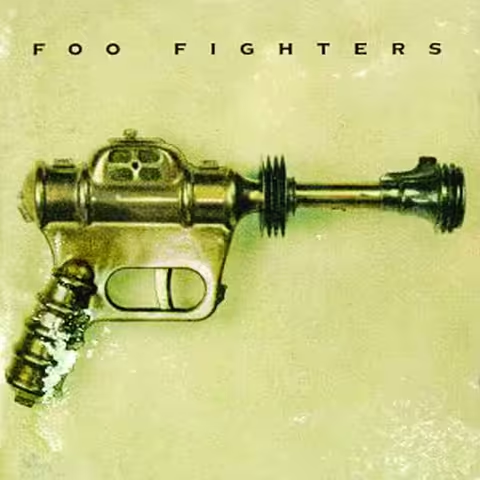
The cover is a photograph by Jennifer Youngblood, Grohl's then-wife, of a Buck Rogers XZ-38 Disintegrator Pistol toy ray gun against a beige background. The composition is severe and product-shot-formal: the gun is dead-centre, lit from above, slightly tilted, with the typeset band name in plain sans-serif above it. Tim Gabor handled the layout. Jaq Chartier did the jacket artwork that wraps round the spine.
The choice of a Buck Rogers ray gun was an extension of the project's "Foo Fighters" sci-fi pun. Grohl had taken the band name from a chapter in Timothy Good's ufology book Above Top Secret describing the "foo fighter" phenomenon: balls of light that World War II Allied pilots reported seeing alongside their aircraft, presumed at the time to be German experimental weapons but never explained. Roswell Records, the Capitol Records imprint that Grohl was given as part of his deal, took its name from the 1947 Roswell UFO incident. The ray gun rounded the bit out.
It also caused immediate friction. Several reviewers and online commentators (including writers at Billboard) pointed out that a debut album by an artist whose former bandmate had killed himself with a firearm should perhaps not have led with a gun on the cover, even a sci-fi toy gun. Grohl's response was the same line he gave Goldsmith when he asked him about it: that he had picked it for the Foo Fighters / Roswell / sci-fi visual joke and had not thought about Cobain. Goldsmith later said it was "really a completely separate thing. Dave wasn't even conscious of that."
Inside the gatefold, the photography is a mixture of Youngblood's personal shots, Charles Peterson's professional Seattle work and a band photo of the Smear / Mendel / Goldsmith / Grohl line-up that did not in fact play on the record. Capitol had insisted on including a "band" image for marketing reasons; the four had spent a single afternoon together at this point.
The first commercial vinyl pressing (Capitol C1-34027) is now collectible, particularly the UK Roswell / Capitol pressing. A limited initial UK run was issued in a special embossed jacket. The 2011 vinyl reissue used the standard track listing. There is a Japanese CD (Toshiba EMI TOCP-8590) that includes the bonus tracks "Winnebago" and "Podunk", and a Japanese promo CD (PCD-5119) with sleeve translations and a four-page lyric insert that is one of the most-collected items from the entire Foo Fighters catalogue.
Release and Reception
The album was released on 26 June 1995 in the UK and on 4 July 1995 in the US, on Roswell Records through Capitol. It debuted at number 23 on the US Billboard 200 with first-week sales of 40,000 copies, an unusually strong opening for an unknown band on a new imprint. It debuted at number 3 in the UK (the highest new entry of that week's chart), 2 in New Zealand, 3 in Australia, 5 in Canada, 8 in Scotland, and somewhere between 10 and 30 across most European territories. By December 1995 it had passed 900,000 copies in the US and 2 million worldwide. RIAA Gold arrived in September 1995, Platinum in January 1996.
Critical reception was warm and divided in equal measure, with most reviewers reaching reflexively for the Nirvana comparison.
"[Grohl's] songs pack the riffy wallop of unpolished Nirvana demos, and his voice has Kurt Cobain's lunging, over-the-top passion."
David Browne, reviewing Foo Fighters for Entertainment Weekly, 14 July 1995 (graded B+)
"Since he recorded the album by himself, they aren't as powerful as most band's primal sonic workouts, but the results are damn impressive for a solo musician."
Stephen Thomas Erlewine, AllMusic, retrospective review (four stars out of five)
Rolling Stone's Alec Foege called it "a remarkable yet coolly understated solo debut" and gave it four stars, though he noted that "the album's only disappointment is that despite its home-studio feel, it ultimately reveals little about its creator." Spin's Terri Sutton compared it directly to Nevermind. NME gave it 9 out of 10. The Guardian's Caroline Sullivan made it the paper's CD of the week. Kerrang!'s Paul Rees admitted the album "cannot fail to evoke Kurt Cobain's memory" but considered it "more than strong enough to stand or fall on its own merits".
Year-end recognition was emphatic. Kerrang! named it Album of the Year for 1995. Rolling Stone placed it at number 2 on their critics' albums-of-the-year list, behind PJ Harvey's To Bring You My Love. Spin's 20 Best Albums of '95 included it. The Village Voice's Pazz & Jop critics' poll ranked it 6th. In January 1996 it was nominated for the Best Alternative Music Album Grammy. It lost to MTV Unplugged in New York by Nirvana.
Singles and Music Videos
| Single | UK release | UK chart peak | US Modern Rock peak | Notable B-sides | Video director / concept |
|---|---|---|---|---|---|
| This Is a Call | 19 June 1995 | 5 | 2 | "Winnebago"; "Podunk"; "Exhausted" | Performance and conceptual; budget shoot |
| I'll Stick Around | 4 September 1995 | 18 | 11 | "How I Miss You"; "Ozone" (Ace Frehley cover) | Gerald Casale (Devo) directed; band performs in front of a large inflatable hostile creature |
| For All the Cows | 20 November 1995 | 28 | — | "Wattershed" (live, Reading); "For All the Cows" (live, Reading); "Podunk" | UK-only release; budget conceptual video |
| Big Me | 25 March 1996 | 19 | 3 | "Floaty" (Radio 1 live session); "Gas Chamber" | Jesse Peretz directed; parody of the long-running Mentos television commercials; one of the most-recognised rock videos of the mid-1990s |
| Alone + Easy Target | 1996 (US promo) | — | 34 | (promo only) | No commercial video |
| Exhausted | 1995 (US promo) | — | — | (promo only) | No commercial video; the first song sent to US alternative radio |
The cultural impact of the "Big Me" video, in retrospect, was outsized. Mentos' "The Freshmaker" commercials had been a global advertising fixture since 1991: insanely cheerful young Europeans solving small social problems by chewing a mint while a chorus sang "It doesn't matter what comes / Fresh goes better / In life with Mentos". Jesse Peretz's parody took the exact visual grammar (jump cuts, cheerful slow motion, the can-do attitude) and weaponised it. The video runs less than three minutes. Audiences understood the joke immediately. The band paid for it in trauma. By the time the Foo Fighters were headlining UK festivals in 1996, audiences were throwing Mentos at them on stage. Grohl dropped "Big Me" from setlists for years.
Touring and Live
The Foo Fighters' first US tour was as the support act on Mike Watt's Ring Spiel Tour in spring 1995. It was an unusual tour: the headline act was Watt promoting Ball-Hog or Tugboat?, the supports were Foo Fighters and Hovercraft (whose drummer was Eddie Vedder's then-wife Beth Liebling, with Vedder also briefly in the band). Both Grohl and Vedder also moonlighted as members of Watt's own backing band, meaning that on most nights of the tour, audiences would see Vedder play three or four sets in different roles. Hovercraft and the Foo Fighters opened, Vedder and Grohl joined Watt's set, then Watt's main set ran. It was rock theatre as cross-generational mentorship: the elder of the SST scene paying his debt to the younger generation by putting them in front of his audience.
The album's main touring cycle ran for over a year:
- Spring 1995, US: Mike Watt's Ring Spiel Tour, the band's debut US dates
- Summer 1995, US: a 25-date headline run with Wool and Shudder to Think
- 14 August 1995: network television debut on Late Show with David Letterman, performing "This Is a Call"
- Late summer 1995, Europe: festival debut with Pukkelpop (Belgium), Reading Festival (UK), Lowlands (Netherlands)
- 26 August 1995: Reading Festival main stage; live recordings of "For All the Cows" and "Wattershed" became B-sides
- Autumn 1995, Europe: full European tour with Built to Spill
- Late 1995 / early 1996: Japan, Australia, New Zealand dates
- 20 July 1996: tour wrap at the Phoenix Festival, UK
Grohl logged close to 100 shows in 1995 and over 70 in 1996. Mendel and Smear adapted to the band's punk-rock pace immediately. Goldsmith, the drummer, struggled to read Grohl's drumming choices on songs Grohl himself had originally played; the tension would erupt during The Colour and the Shape sessions in 1996 when Grohl secretly re-recorded most of Goldsmith's drum tracks himself. Goldsmith left in early 1997 and was replaced by Taylor Hawkins. Pat Smear announced his departure on stage at the 1997 MTV Video Music Awards.
In TV, Film and Media
"Big Me" became the album's lasting commercial second life, largely through the Mentos parody video which ran into heavy rotation on MTV and became one of the most-played clips of 1996. "This Is a Call" was used as the opening music for an episode of The X-Files season 3 in February 1996 ("Pusher"), an episode in which Grohl and Youngblood made a brief uncredited cameo walking down a hospital hallway. "I'll Stick Around" featured in episodes of Buffy the Vampire Slayer. "Big Me" later appeared in the 2014 Tom Cruise film Edge of Tomorrow. "Exhausted" closes Reginald Hudlin's 1996 horror film The Great White Hype. Grohl himself made the late-1990s talkshow rounds extensively, appearing on every major US late-night programme and on Top of the Pops in the UK.
Controversy, Censorship and Lawsuits
The album was almost entirely free of controversy in the usual sense. The cover-art ray gun debate (firearms on a post-Cobain debut sleeve) produced a few editorial comment pieces but no formal complaints. The album was not parental-advisory stickered in any major market. There were no plagiarism suits. There was no Westboro-style picketing. Even the "I'll Stick Around" lyric, widely (mis)read at the time as an attack on Courtney Love, attracted no legal action; Grohl publicly insisted the song was not about anyone specific.
The one moment of genuine industry friction was a brief cease-and-desist from Capitol in May 1995 to the LA station KROQ-FM and Seattle's KNDD after both stations began playing tracks from the album before its official release. The promo tapes Grohl had given out as friend-gifts had circulated wider than intended, with copies eventually reaching radio programmers who chose not to wait for the official campaign. Capitol resolved the situation by sending "Exhausted" to college and modern rock radio in June and "This Is a Call" a week later as the first commercial single.
Covers, Samples and Tributes
The album's songs have been covered widely. "Big Me" has become a pop-punk standard and was covered by NOFX, Me First and the Gimme Gimmes (whose Foo Fighters cover featured Fat Mike from NOFX, Spike from Me First, and the Foo Fighters' own Pat Smear on guitar) and dozens of acoustic YouTube channels. "This Is a Call" has been covered by Tenacious D as a tongue-in-cheek tribute. "For All the Cows" has been covered as both straight performance and country-style rearrangement by US singer-songwriters. None of these songs has been sampled in the hip-hop or electronic-music sense.
The album itself contains no sampling. It does interpolate three or four obvious influences: the verse arrangement of "This Is a Call" echoes the verse of "Smells Like Teen Spirit" deliberately (Grohl has acknowledged this in multiple interviews); "Big Me" carries a Beatles harmony structure straight out of Rubber Soul; "Floaty" leans on a Husker Du-style melodic-hardcore arpeggio. The Ace Frehley B-side "Ozone" is the album campaign's only formal cover.
Foo Fighters were inducted into the Rock and Roll Hall of Fame in 2021, with Grohl having already been inducted in 2014 as part of Nirvana. The 1995 debut album was directly cited in the induction speech.
Reissues, Remasters and Anniversaries
The album has been remarkably stable across reissues. The original 12-track 1995 CD pressing remains the definitive version. A 2003 CD reissue restored the 14-track Japanese edition listing for some territories ("Winnebago" and "Podunk" as tracks 13 and 14). A 2011 vinyl-only and download reissue used the original 12-track configuration. The original 1995 master by Stephen Marcussen remains the version of record on every streaming service; there has been no official remaster.
There has been no formal anniversary reissue. A 20th-anniversary box was rumoured in 2015 but never materialised. A 25th-anniversary expansion was talked about during the 2020 COVID-19 lull but Capitol's catalogue arm has not yet committed to a release. The band's own Roswell Records has stayed proprietary about the catalogue, partly because Grohl is uncomfortable with revisiting the album's specific psychic context. The Foo Files compilation in 2022 collected some of the most-requested unreleased material from the era but stopped well short of a full deluxe edition.
Live full-album performances of Foo Fighters have been rare: the band have never played the record in full on a UK or US tour. Individual songs ("This Is a Call", "Big Me", "I'll Stick Around" and occasionally "For All the Cows") remain staples of the live show 30 years after the album's release.
Legacy and Influence
Foo Fighters did three things at once. It established Dave Grohl, the drummer everyone knew, as a guitarist, singer, songwriter and producer credible enough to carry a band that bore his fingerprint on every track. It established the commercial possibility of post-grunge: traditional rock songcraft, big choruses, recognisable verse-chorus-bridge structures, the soft-loud dynamic borrowed from Nevermind but applied to songs that did not need Cobain's particular pain to function. And it established a working method for the Foo Fighters as a band that would persist for thirty years: Grohl writes, Grohl records, Grohl plays as many parts as he wants, the rest of the band rounds out the arrangement.
Within the wider 1995–2000 rock landscape, the album sits next to Bush's Sixteen Stone, Live's Throwing Copper and Silverchair's Frogstomp as the records that defined what post-grunge would look like on US alternative radio and MTV. It also influenced the next decade's worth of melodic punk and emo-adjacent acts: Jimmy Eat World, Weezer (whose Pinkerton followed a year later and shares some of the same studio-as-bedroom intimacy), Sum 41 in their more sincere moments, the early Death Cab for Cutie. The album's "anyone can do this, you just need a week" implication helped make home-recording credible at exactly the moment Pro Tools was becoming affordable for project studios. Grohl would later make his Sound City documentary (2013) and Sonic Highways TV series (2014) partly as a way of teaching that the studio is just a room.
For Foo Fighters the band, the album launched the steady ascent. The Colour and the Shape in 1997 added Taylor Hawkins, produced "Everlong" and "My Hero", and went triple-platinum. The next nine studio albums took the band from clubs to theatres to arenas to stadiums. By the time Wasting Light topped the US Billboard 200 in 2011, the Foo Fighters were a US household name. By the time Taylor Hawkins died in March 2022, the band were one of the last working bands of their generation on a continuous album-tour cycle. The 1995 debut, the album Grohl had not intended to release at all, was retrospectively their foundation document.
Stephen Hyden, writing for the A.V. Club twenty years on, called the record "a bridge between Nirvana and mid-'90s alt-rock". That, ultimately, is its place in the canon: not the best Foo Fighters album, not the most beloved, but the one that exists precisely because Grohl could not let go and could not stand still.
Things You Might Not Know
| Fact | Detail |
|---|---|
| The 200-copy print run | Grohl's original release plan was 100 cassettes (duplicated at a Seattle lab) and 100 LPs, handed out to friends. The tapes reached radio programmers, who started playing them. Capitol then made the offer. |
| One band member | Foo Fighters is, in practice, a Dave Grohl solo album credited to a fictional band. Greg Dulli's guitar part on "X-Static" is the only contribution by any other musician on the entire record. |
| Six days | The album was tracked across exactly six days, from 17 to 23 October 1994, four songs a day, about 45 minutes per song. |
| The console with a pedigree | The 32-channel API DeMedio mixing console at Tom Rothrock and Rob Schnapf's "The Shop" in Arcata, California was originally built in 1972 by Frank DeMedio for Wally Heider Recording's Studio 4 in Hollywood, where the Grateful Dead's American Beauty and CSN&Y's Déjà Vu had been tracked. |
| "Big Me" was mixed in 20 minutes | Mixing engineer Rob Schnapf later admitted on the Gearslutz forum that the future US Modern Rock #3 single was mixed in roughly twenty minutes. |
| Roswell Records | The Capitol Records imprint Grohl was given as part of his deal was named after the 1947 Roswell UFO incident, extending the band's "foo fighter" sci-fi pun (the term itself was World War II aviator slang for unexplained aerial lights). |
| The cover model | The pistol on the sleeve is a Buck Rogers XZ-38 Disintegrator Pistol toy ray gun, photographed by Grohl's then-wife Jennifer Youngblood. Several reviewers objected to a gun on a post-Cobain debut; Grohl denied any reference. |
| The book that named the band | Grohl took the band name from a chapter on the "foo fighter" phenomenon in Timothy Good's ufology book Above Top Secret, which he was reading at the time. |
| The Pearl Jam audition that never was | Eddie Vedder briefly considered Grohl as Pearl Jam's drummer after Dave Abbruzzese's exit. Grohl sat in for a song or two at three Pearl Jam shows on the Australian tour in March 1995 before Pearl Jam settled on Jack Irons. |
| The Tom Petty job offer | Tom Petty asked Grohl to drum permanently for the Heartbreakers after Grohl played one Saturday Night Live with them in November 1994. When Petty learned about the Foo Fighters demo, he instead urged Grohl to commit to his solo project. |
| Eddie Vedder leaked it on his radio show | On 8 January 1995, six months before the official release, Eddie Vedder premiered two unreleased songs from the Foo Fighters demo on his Self-Pollution Radio broadcast. |
| The Grammy they lost | At the 1996 Grammy Awards, Foo Fighters was nominated for Best Alternative Music Album. The award went to MTV Unplugged in New York by Nirvana, Grohl's own former band. |
| The Mentos consequence | The "Big Me" video parodied Mentos commercials. For years afterwards, fans threw Mentos sweets at the band on stage. Grohl dropped "Big Me" from festival setlists just to escape the candy. |
| "X-Static" was a wander-in | Greg Dulli was not booked for the session. He was in the studio for an unrelated reason, watched Grohl record, was handed a guitar, and laid the X-Static part down in one take. |
| The supergroup before the band | Grohl's other 1993–94 musical activity was the Backbeat Band, the supergroup that recreated the Beatles' Hamburg-era material for the 1994 Stuart Sutcliffe biopic Backbeat. His Backbeat bandmates were Greg Dulli (X-Static guest), Don Fleming, Mike Mills (R.E.M.), Thurston Moore (Sonic Youth) and Dave Pirner (Soul Asylum). Grohl met Dulli on that project. |
The Riffology Podcast
Riffology covers Foo Fighters as a full deep-dive episode of the podcast, with extended discussion of the six-day Robert Lang sessions, the cover-art row, the Mentos video and how the album sits in the post-Cobain rock canon. Riffology is available on Apple Podcasts, Spotify, Amazon Music, Pocket Casts, Overcast and every other major podcast platform. Stream the episode above or search "Riffology" on the app you already use.
Comments