The credit hidden in the back-sleeve small print is the most quietly defiant thing on the album. "No samples, keyboards or synthesizers were used in the making of this record." In November 1992, with Public Enemy''s Bomb Squad in full flight and Dr. Dre''s G-funk weeks away from rewiring American radio, four men from Los Angeles released a record that sounded like turntables, sirens and dub bass and contained none of the above. One guitar, one bass, one drum kit and a rapper. The sleeve put the disclaimer there because nobody listening would otherwise believe it.
The other quiet defiance was an absence. Open the booklet, scan the lyric sheets, and the second song''s page is blank, just "2. KILLING IN THE NAME" and a jump to the next track. The most repeated chorus on rock radio for the next decade was the only one Epic''s lawyers and the band agreed should never be printed. Everything you need to know about Rage Against the Machine is in those two omissions.
Album Facts
| Field | Detail |
|---|---|
| Artist | Rage Against the Machine |
| Album | Rage Against the Machine |
| Release Date | 6 November 1992 |
| Label | Epic |
| Producer(s) | Garth "GGGarth" Richardson; Rage Against the Machine |
| Studio(s) | Sound City (Van Nuys, CA); Industrial Recording (North Hollywood, CA); Scream (Studio City, CA) |
| Genre / Subgenre | Rap metal, funk metal, alternative metal, rap rock |
| Track Count | 10 |
| Total Runtime | 52:55 |
| Billboard 200 Peak | No. 45 (No. 1 on Heatseekers; No. 4 Hard Rock; No. 10 Alternative; No. 21 Rock) |
| UK Albums Chart Peak | No. 17 (No. 2 UK Rock and Metal; No. 1 UK Album Downloads, Dec 2009) |
| Other Notable Chart Peaks | Australia 12; Netherlands 5; New Zealand 9; France 8; Switzerland 16; Germany 22; Sweden 22 |
| Certifications | US 3x Platinum; UK 3x Platinum; Australia 5x Platinum; Denmark 5x Platinum; New Zealand 3x Platinum; France Platinum; Canada Platinum; Netherlands Platinum; Italy Platinum; Germany Gold; Japan Gold; Switzerland Gold; Austria Gold; Belgium Gold |
| Estimated Sales | Reports vary; the RIAA certification implies at least three million US shipments and combined global sales are widely reported above six million. |
| Key Singles | "Killing in the Name" (Nov 1992); "Bullet in the Head" (Apr 1993); "Bombtrack" (Aug 1993); "Freedom" (Dec 1993) |
Cultural Context
The album was tracked in April and May 1992. The Los Angeles riots, set off by the not-guilty verdicts in the Rodney King beating trial, started on 29 April. Sound City sits in Van Nuys, fifteen miles north of where the National Guard was being deployed. The four men in the live room were watching the city burn from the studio television and writing the kind of record that would still feel topical thirty years later. Take the Power Back, Killing in the Name and Wake Up were already written, but they were tracked into a city under curfew.
1992 was also the year mainstream rock had to negotiate with hip hop in earnest. Public Enemy''s Apocalypse 91 had landed the previous October. Cypress Hill''s debut had gone platinum. Body Count had released its self-titled record in March, lit a fire under the Cop Killer controversy, and watched its parent label Time Warner pull the song from the album that summer. By the time RATM''s debut arrived in November, the question of whether a rock label would sign and release a record about a black man telling police officers to step off was no longer hypothetical. Epic had answered it.
- Body Count, Body Count, March 1992. Cop Killer pulled by July.
- Dirt, Alice in Chains, September 1992. Released two months before RATM''s debut.
- Angel Dust, Faith No More, June 1992. Mr. Bungle''s Mike Patton on the same Epic shelf.
- Core, Stone Temple Pilots, September 1992. The Atlantic Records counterweight.
- Countdown to Extinction, Megadeth, July 1992. The mainstream metal benchmark of the year.
- The Chronic, Dr. Dre, December 1992. Released six weeks after RATM and changed everything.
The Band''s Story Up to This Point
Rage Against the Machine assembled in Los Angeles in 1991 from four people who had each almost made it elsewhere. Tom Morello, Harvard graduate and former office assistant to Senator Alan Cranston, had been the guitarist in the LA glam-leaning band Lock Up, who released one album on Geffen and were dropped. Brad Wilk had auditioned for Lock Up. Tim Commerford had been Zack de la Rocha''s schoolfriend in the punk and hardcore scene around Irvine and Long Beach. De la Rocha had fronted Inside Out, a melodic hardcore band on Revelation, and at one stage had been pursued as a solo lyricist.
The four met properly when de la Rocha was rapping at a Hollywood club and Morello recognised the lyrical density. They convened, played one song together (Morello''s instrumental sketch that would become Bombtrack), and came out of the room with a band. Their first public show was a backyard birthday party for Commerford''s friend in Orange County in October 1991. Within months they had recorded the twelve-song Rage Against the Machine demo cassette, dubbed it themselves, and started selling it for five dollars at gigs. Seven of those twelve demo tracks would carry over directly to the studio album.
The label situation moved quickly. Major labels circled after a string of incendiary live shows on the Sunset Strip and the Whisky a Go Go circuit. The band insisted on contractual protection of editorial control. They signed to Epic in late 1991 with terms that reportedly gave each member individual veto on band decisions and gave the band itself final say on artwork, lyrics and song selection. The contract is the unsung architect of the record that followed: it is why the cover was allowed to be a burning monk and why the inner sleeve could carry an unprintable chorus.
Pre-production and Demos
The 1991 demo cassette is effectively the album''s pre-production document. It contained twelve songs, hand-numbered and dubbed at home, and is now bootlegged everywhere as the Black Demo or simply The Original Demos. Seven of its tracks made the studio album in revised form: Bombtrack, Take the Power Back, Bullet in the Head, Know Your Enemy, Township Rebellion, Killing in the Name and Freedom. The remaining demo tracks, including Darkness of Greed, Clear the Lane, Auto Logic, Mindset''s a Threat and The Narrows, were quietly retired and resurfaced two decades later as bonus material on the XX 20th anniversary box set in 2012.
The arrangements that arrived at Sound City in April 1992 had therefore been roadtested for the better part of a year. Songs had been sequenced for the live set, choruses had been tested in clubs, and the stop-start dynamic that defines the record (Wilk and Commerford locked, Morello''s guitar dropping out, de la Rocha left in space) had been built in front of audiences. Killing in the Name, the song that would still be filling stadium chants thirty years on, had reportedly grown out of a drop-D guitar warm-up Morello had been using when teaching guitar lessons; he has retold versions of that story in interviews for years, though specific dates and venues are inconsistent across retellings.
Two songs on the finished record, Settle for Nothing and Wake Up, were arrangements the band finalised closer to the studio date, with Wake Up in particular borrowing its main riff from Led Zeppelin''s Kashmir in a way Morello has openly acknowledged in subsequent interviews.
Creating the Album
The studio team was assembled around producer Garth "GGGarth" Richardson, a Vancouver-raised engineer whose CV at the time included work on the Red Hot Chili Peppers and the early stages of L7''s career. Sound City''s Studio A was the principal tracking room, chosen for its Neve 8028 console, its history with Fleetwood Mac and Tom Petty, and its famously dry, dead-feeling drum room which made for tight close-mic''d kits without the early-1990s reverb wash. Industrial Recording in North Hollywood and Scream in Studio City handled overdub and additional sessions.
Richardson and engineer Stan Katayama tracked the band largely live as a rhythm section. Wilk''s drums and Commerford''s bass went down together, with Morello playing through to feel; rhythm guitars and overdubs were rebuilt afterwards. De la Rocha''s vocals were tracked in dedicated sessions, often multiple takes spliced together. The "no samples, keyboards or synthesizers" credit was not boast: every effect on the record, including the sweeping siren-like wails and the turntable scratch on Bullet in the Head, came from Morello''s rig.
Morello''s rig is the secret weapon. The core was a Performance double-cutaway guitar, locally built and nicknamed Arm the Homeless, fitted with Seymour Duncan pickups, an Ibanez Edge tremolo and a kill-switch toggle wired between the pickups. He ran through a Marshall JCM800 2205 50-watt head into a Peavey 4x12 cabinet, with a DOD FX40B equaliser, an Ibanez DFL flanger, a DigiTech Whammy WH-1, a Boss DD-2 digital delay, a Cry Baby wah and a Boss TR-2 tremolo. The Whammy pedal, sequenced through with the kill-switch flicked on and off, is what produces the DJ-scratch effect on Bullet in the Head. The wah and tremolo, run together, produce the helicopter-like swirl on Wake Up.
- Sound City Neve 8028 console; Sound City''s notoriously dead drum room.
- Morello: Arm the Homeless guitar; Marshall JCM800 2205; Peavey 4x12; DigiTech WH-1 Whammy; DOD FX40B EQ; Ibanez DFL; Cry Baby; Boss DD-2; Boss TR-2.
- Commerford: Music Man StingRay bass; Ampeg SVT.
- Wilk: Pearl drums; Zildjian cymbals; tracked dry into the room.
- Mixed at Soundtrack New York by Andy Wallace, fresh off mixing Nirvana''s Nevermind.
- Mastered by Bob Ludwig at Masterdisk.
The engineer''s eye was on dynamic range. Wallace, who had mixed Nevermind a year earlier, brought the same loud-quiet-loud philosophy: tight low end, drums forward, vocals dry, and a deliberate refusal to compress the verses. The verse-drop on Killing in the Name (Wilk''s ride and Commerford''s repeated octave figure, with Morello''s scratch licks and de la Rocha barely above a whisper) is loud only because Wallace let it be quiet first. The 1992 mix has aged better than almost anything else on rock radio that year for the same reason.
Two outside guests appear on a single track. Maynard James Keenan, then about to release Tool''s debut Opiate EP, was friends with de la Rocha and was invited down to add the chanted vocal in the bridge of Know Your Enemy. Stephen Perkins of Jane''s Addiction added the percussive shaker and tom flourishes on the same song. Both are credited but no other guests appear on the record. Reports of Maynard sitting in on other tracks in early sessions are anecdotal and unconfirmed.
Personnel and Credits
| Role | Player | Notes |
|---|---|---|
| Core band | ||
| Vocals; production; art direction | Zack de la Rocha | All lead vocals; lyric writing |
| Guitar; production; art direction | Tom Morello | All guitar; whammy and kill-switch effects |
| Bass; backing vocals; production; art direction | Tim Commerford | Credited on the sleeve as "Timmy C." |
| Drums; percussion; production; art direction | Brad Wilk | Tracked live with Commerford |
| Guest and session musicians | ||
| Additional vocals | Maynard James Keenan | Bridge of "Know Your Enemy" |
| Additional percussion | Stephen Perkins | "Know Your Enemy"; Jane''s Addiction drummer |
| Production and engineering | ||
| Producer | Garth "GGGarth" Richardson | Also engineering; Vancouver-based |
| Co-production | Rage Against the Machine | Self-credited as "Guilty Parties" |
| Engineer | Stan Katayama | Sound City |
| Assistant engineers | Craig Doubet; Jeff Sheehan | |
| Mixing | Andy Wallace | Soundtrack New York |
| Mixing assistant | Steve Sisco | |
| Mastering | Bob Ludwig | Masterdisk, New York |
| 2012 remaster | Vlado Meller | For the XX 20th anniversary |
| 2016 SACD remaster | Steve Hoffman | Hybrid SACD edition |
| Artwork and packaging | ||
| Cover photograph | Malcolm Browne | 1963; Pulitzer Prize-winning Saigon image |
| Art direction | Nicky Lindeman with Rage Against the Machine | All four band members credited |
The Songs
| # | Title | Length | Single | Notes |
|---|---|---|---|---|
| 1 | Bombtrack | 4:02 | Yes (3rd, Aug 1993) | The first song the four ever played together; Morello''s riff opens the record |
| 2 | Killing in the Name | 5:14 | Yes (1st, Nov 1992) | Drop-D; lyrics omitted from the album booklet |
| 3 | Take the Power Back | 5:36 | Commerford''s slap-bass intro; school-curriculum critique | |
| 4 | Settle for Nothing | 4:49 | The album''s slow burn; written closer to the sessions | |
| 5 | Bullet in the Head | 5:08 | Yes (2nd, Apr 1993) | Whammy/kill-switch DJ-scratch effect; about TV-induced compliance |
| 6 | Know Your Enemy | 4:57 | Maynard James Keenan and Stephen Perkins guest | |
| 7 | Wake Up | 6:06 | Riff openly modelled on Led Zeppelin''s "Kashmir"; FBI COINTELPRO subject matter | |
| 8 | Fistful of Steel | 5:32 | Rolling guitar drone; not on the original demo | |
| 9 | Township Rebellion | 5:22 | Anti-apartheid; live set staple | |
| 10 | Freedom | 6:06 | Yes (4th, Dec 1993) | Closing manifesto; written for Leonard Peltier |
Bombtrack opens the record with Morello''s recurring four-bar figure, the riff that defined the band''s first proper jam in 1991. Wilk drops the kit in halfway through the first bar; Commerford locks on; de la Rocha enters with the slow rolling boil that becomes the album''s signature pacing. Used as the third single in August 1993, it carried two live B-sides and reached the UK top 40, but its real role is as the door the album walks through.
Killing in the Name is the song everybody knows and the song the band were most reluctant to release as a single. Drop-D tuning, six notes, four-bar phrase, and the now-canonical chorus that Epic''s lawyers permitted on disc but not on the lyric sheet. The track was also the only song on the record where Morello recorded the rhythm guitar twice, once with the Marshall and once with a clean signal, and Wallace stacked them in the mix. The repeated chorus at the end is widely cited as the section most responsible for the song''s 2009 UK Christmas Number One, when an organised online campaign pushed it past the year''s X Factor winner.
Take the Power Back opens with one of the great opening salvos in rock-bass history: Commerford slap-thumbing through a phrase that lasts long enough to become the song''s signature, before Morello and Wilk arrive for the chorus. De la Rocha spends the verses arguing that American school curricula systematically ignore non-European history, then hands the song over to a long instrumental run-out where Commerford keeps slapping and Morello does almost nothing.
"What makes RATM more than just another bunch of prodigiously capable genre-benders is their total lack of pretension or contrivance. The results burn with an undeniable conviction."
NME, February 1993
"Metal for rap-lovers, and opera-haters."
Robert Christgau, The Village Voice, 9 March 1993
Bullet in the Head is the song that proves the no-samples credit is true. The DJ-scratch effects in the intro and breaks are entirely Morello: pick attack, kill-switch toggle, Whammy pedal sweep. The lyric, about media-induced compliance and the way television becomes the bullet, is one of the most directly Public Enemy-indebted on the record. Released as the second single in April 1993, it reached number 16 in the UK and spent the band''s first European tour as a centrepiece.
Know Your Enemy is the album''s only song with non-band guests. Maynard James Keenan, then on the cusp of releasing Tool''s Opiate, sings the descending bridge ("All of which are American dreams"). Stephen Perkins of Jane''s Addiction adds the shaken percussion. The song''s lyrical machine is the catalogue of institutions to oppose, called over a Morello riff that switches between Sabbath drone and a clean staccato bridge.
Wake Up closes side one of the vinyl on a six-minute Zeppelin reference: the riff is, by Morello''s own subsequent admission, a direct cousin of Kashmir. The lyric reaches into FBI COINTELPRO documentation and the murders of Fred Hampton and Malcolm X, and the closing minute, where the band drops back to a single guitar note while de la Rocha reads from declassified files, is the album''s most cinematic moment. Seven years later, the Wachowskis would use the song over the closing credits of The Matrix.
Fistful of Steel, Township Rebellion and Freedom close the record. Township Rebellion, a live staple from before the album was even tracked, kept the South Africa anti-apartheid theme in the album''s second half. Freedom, released as the fourth and final single in December 1993, was written about and dedicated to imprisoned Native American activist Leonard Peltier; its video, shot the following year, would carry the same dedication.
B-sides, Outtakes and Lost Songs
The album''s B-side history is unusually rich for a debut, mostly because the band had a fully formed live set by the time of release. The four singles between November 1992 and December 1993 carried live performances of songs from the record itself rather than studio outtakes, which is partly why the demo-era leftovers (Darkness of Greed, Clear the Lane, Auto Logic, Mindset''s a Threat, The Narrows) sat unreleased for two decades.
- Killing in the Name single (Nov 1992): the album version, with no B-side on most pressings; some 12-inch promos paired it with the demo of Bullet in the Head.
- Bullet in the Head single (Apr 1993): live B-side of Bombtrack; some European pressings added live Bullet in the Head from the same set.
- Bombtrack single (Aug 1993): backed with the live Bombtrack and live Take the Power Back; included a remix of Bullet in the Head.
- Freedom single (Dec 1993): live Freedom, live Take the Power Back, and a remix of Freedom.
- Australian 1995 tour edition added Darkness, Year of the Boomerang (later re-recorded for Evil Empire), a remix of Freedom and a live Take the Power Back.
The original twelve-track demo was finally given an official release on the XX 20th anniversary box set in 2012, twenty-one years after the band first dubbed it on cassette. Five of the demo''s songs (Darkness of Greed, Clear the Lane, Auto Logic, Mindset''s a Threat, The Narrows) had been bootlegged for years on the cassettes the band gave away at gigs in 1991 and 1992, but never officially issued before that point.
Album Artwork and Packaging
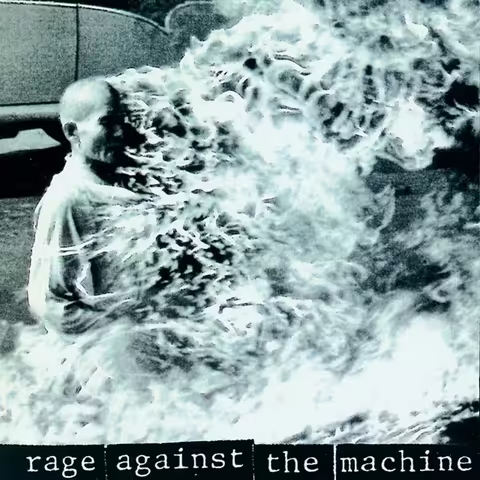
The cover image is a crop of Malcolm Browne''s photograph of Vietnamese Buddhist monk Thich Quang Duc burning to death on Phan Dinh Phung Boulevard in Saigon on 11 June 1963, as protest against the persecution of Buddhists by the South Vietnamese regime of Ngo Dinh Diem. Browne, an Associated Press correspondent, won a Pulitzer Prize and a World Press Photo of the Year for the image, which was published in newspapers worldwide within twenty-four hours and was famously displayed on John F. Kennedy''s desk. The version on the album cover is cropped tight on the seated figure, with the saloon-car sedan that idled behind him also cropped out.
The art direction was credited to Nicky Lindeman, working with all four band members. The lowercase Helvetica title set along the lower edge, the deliberate absence of any band photo on the front, and the choice to leave the back sleeve unornamented except for the disclaimer about samples were all decisions made by the band themselves, exercising the contractual control they had insisted on at signing. The booklet inside contains lyrics, the long list of "Thanks for Inspiration" (which names Bobby Sands, Huey P. Newton, Ian and Alec MacKaye, and many more), and the missing-lyrics joke at track two.
"It was the first album to successfully merge the seemingly disparate sounds of rap and heavy metal, with meaningful rhymes and emotionally charged conviction. Essential."
Eduardo Rivadavia, AllMusic, retrospective review
Release and Reception
The album was released on 6 November 1992, four days after the lead single, with a modest initial Epic press push. Initial UK and US chart performance was respectable rather than spectacular: number 45 on the Billboard 200, number 17 in the UK, number one on the US Heatseekers chart that tracked debut releases. The album''s real commercial story is its long tail. By the end of 1993, after a year of touring, it had reached gold in the US; platinum followed in 1994; double platinum in 1996; triple platinum by the early 2000s. In the UK it eventually reached triple platinum (900,000 units) on a long, slow climb that included a number one on the UK Album Downloads chart in December 2009 driven by the Killing in the Name Christmas single campaign.
Critical reception was almost uniformly positive. Q magazine made it one of its 50 Heaviest Albums of All Time in 2001. Rolling Stone slotted it at number 368 on the 2003 500 Greatest Albums of All Time, moved it up to 365 in 2012, and then jumped it dramatically to number 221 in the 2020 reboot, an unusual upward revision that reflected reappraisal in the wake of Black Lives Matter and the album''s evergreen relevance. The same magazine''s 2017 100 Greatest Metal Albums of All Time placed it at number 24. Guitar World ranked it the fifth-best guitar album of 1992. Zane Lowe added it to his BBC Radio 1 Masterpieces series in 2008.
| Publication | Score | Notable line |
|---|---|---|
| Pitchfork (retrospective, 2017) | 9.1/10 | Grayson Haver Currin called it a "pivotal and classic" 1990s release. |
| AllMusic (retrospective) | 5/5 | Eduardo Rivadavia: "essential". |
| Rolling Stone | 4.5/5 | Praised de la Rocha''s vocal delivery and the band''s political clarity. |
| Mojo (Jan 2013) | 4/5 | Coverage of the XX 20th anniversary edition. |
| Q (Mar 1993) | 4/5 | "A record of real attitude and energy." |
| NME (Feb 1993) | 7/10 | "Their total lack of pretension or contrivance." |
| Los Angeles Times (Robert Hilburn) | 3.5/4 | "A striking, politically conscious debut." |
| Select (Mar 1993, Steve Lamacq) | 4/5 | Contemporary UK rave. |
| Record Collector | 5/5 | Joel McIver, on the XX edition. |
| The Village Voice (Christgau) | B+ | "Metal for rap-lovers, and opera-haters." |
| Encyclopedia of Popular Music (Larkin) | 4/5 | Standard reference rating. |
One contemporary review stood slightly aside. Robert Christgau, writing in the Village Voice in March 1993, gave it a B+ and characterised the record as "metal for rap-lovers, and opera-haters", picking out Know Your Enemy and Wake Up as standouts. The Christgau line is the most-quoted single sentence of the album''s critical reception, partly because it captured the genre uneasiness even sympathetic critics felt at the time.
Singles and Music Videos
| Single | Released | UK / US peaks | B-sides | Video |
|---|---|---|---|---|
| Killing in the Name | 2 November 1992 | UK 25 (1992), UK 1 (Dec 2009 reissue), US Modern Rock 38 | Promo only on most pressings | Performance edit; banned by MTV in early rotations for the chorus |
| Bullet in the Head | 26 April 1993 | UK 16 | Live Bombtrack; live Bullet in the Head | Director Peter Christopherson; live-show edit |
| Bombtrack | 23 August 1993 | UK 31 | Live Bombtrack; live Take the Power Back; remix of Bullet in the Head | Live-cut edit; minimal narrative |
| Freedom | 6 December 1993 | UK 41 | Live Freedom; live Take the Power Back; Freedom remix | Director Peter Christopherson; dedicated to Leonard Peltier; ends with the campaign address card |
The Killing in the Name video was a tightly edited live performance shot, with no narrative, intercut with archival material. MTV''s standards-and-practices team flagged the chorus from initial rotations, eventually programming an edit and pushing it to late-night programming. The Freedom video, directed by industrial-music figure Peter Christopherson (Throbbing Gristle, Coil), closed with a dedication card to Leonard Peltier, the Native American activist serving two life sentences for the killing of two FBI agents at Pine Ridge in 1975. The card included an address fans could write to in support of Peltier''s appeal.
Touring and Live
The Rage Against the Machine Tour ran from 15 January 1993 in Chicago through to 31 December 1993 in Detroit. Opening acts on different legs included Cypress Hill, House of Pain, Suicidal Tendencies and a young Tool, who toured as direct support after Maynard James Keenan''s contribution to Know Your Enemy. The tour also took in major European festival appearances at Pinkpop, Reading, Glastonbury and Rock am Ring, and a long American summer leg supporting their own headline shows.
Notable televised performances from the album cycle:
- Saturday Night Live, 13 April 1996, with the band hanging upside-down American flags from their amps. The flags were torn down by stagehands moments before the broadcast began.
- Pinkpop Festival, 23 May 1994, a televised set across Dutch and German broadcasters that became one of the most-bootlegged shows of the album cycle.
- The MTV Movie Awards, June 1993, performing Bombtrack with the band stripping to the waist with letters spelling out PMRC across their chests.
- Lollapalooza 1993, on a bill with Alice in Chains, Primus, Dinosaur Jr., Fishbone, Arrested Development, Front 242 and Babes in Toyland.
The 1996 protest at Woodstock ''99 (when the band burned an American flag during Killing in the Name) is often misremembered as belonging to this tour cycle; it does not. By 1999 the band were two albums deeper into their career.
In TV, Film and Media
The album''s songs have had unusually heavy film and television placement for an unapologetically political record. Wake Up closed the credits of The Matrix (1999), giving an entire generation of teenagers an unexpected entry point. Bombtrack and Take the Power Back appeared on Oliver Stone''s Natural Born Killers soundtrack in 1994. Killing in the Name appeared in Dave Grohl''s 2013 documentary Sound City as the showcase track for the studio''s Neve console, and on the soundtrack to the BBC drama Industry. Sports broadcasters in both the US and UK have used Killing in the Name as a stadium walk-on track for fight sports and football in particular for over two decades.
Controversy, Censorship and Lawsuits
The most consequential censorship moment was MTV''s programming of an edit of Killing in the Name; the chorus was a non-starter for daytime rotation in 1992. Radio in the US largely treated the song as album-cut only until clean edits emerged. The cover art drew complaints from US religious groups, but no significant retail chain refused to stock the album. Wal-Mart, which famously refused to stock Nirvana''s In Utero the following year, carried the record without modification.
The 2009 Killing in the Name UK Christmas Number One campaign, organised by music journalists Jon and Tracy Morter on Facebook to dethrone the X Factor winner, raised over £100,000 for Shelter (the band donated their proceeds; Sony, who owned the recording through its acquisition of Epic, also donated; Simon Cowell publicly objected and then climbed down). The song hit number one on Christmas Day 2009 with sales of around 502,000 in the UK, more than its 1992 release had managed in fifteen years on the chart.
The riff to Wake Up shares enough DNA with Led Zeppelin''s Kashmir that the question of acknowledgement has been raised in print interviews repeatedly. Morello has openly characterised it as a knowing homage rather than a sampled or quoted lift; no legal claim was ever pursued by the Zeppelin camp.
Covers, Samples and Tributes
The album''s songs have been covered by artists ranging from Denver-based bluegrass collective Iron Horse (a full bluegrass Killing in the Name) to Jerry C. (a guitar-orchestra rendition), Dropkick Murphys (a punk Killing in the Name) and Bad Wolves. The only major sample known to use a RATM track is the Killing in the Name chorus chant, which has been cleared and used in adverts and trailer beds, though the band have repeatedly refused commercial sync placements where the song''s political message would be inverted.
The record itself contains no commercial samples (per the back-sleeve credit), though Morello''s rhythm-guitar line on Take the Power Back sits in the same key and tempo as a small section of N.W.A''s Express Yourself; nothing has ever been formally claimed.
Reissues, Remasters and Anniversaries
The album has had two principal remasters and one major anniversary reissue:
- 2012 XX 20th anniversary edition, released 27 November 2012. Vlado Meller remaster. Three formats: a deluxe box (two CDs, two DVDs, 12-inch 180gm vinyl LP, 40-page booklet, two-sided poster); a special edition (two CDs and a bonus DVD with six tracks); and a single CD with three bonus tracks. The set included the previously unreleased original 1991 demo on disc for the first time, plus the band''s 2010 Live at Finsbury Park performance and B-sides from the 1992 to 1996 period.
- 2016 Hybrid SACD remaster, mastered by Steve Hoffman. Audiophile reissue with no additional tracks but a new high-resolution master.
- 2018 vinyl reissue, on Epic''s standard-weight black 12-inch.
- 2022 30th anniversary was acknowledged by the band in interviews but no new remaster or box was released, in part because of de la Rocha''s leg injury and the cancellation of the 2022-2023 tour.
Legacy and Influence
The album''s commercial achievement is the long tail. The 2009 UK Christmas Number One campaign turned a seventeen-year-old song into a UK chart-topper and added several hundred thousand units to certifications already in motion. The Wake Up placement on The Matrix in 1999 made the album an entry point for a generation that was eight years old when it came out. The 2012 XX reissue gave it a second commercial wave and brought the long-bootlegged demo into the legitimate catalogue.
Its musical legacy is wider. Nu-metal, often correctly attributed to Korn''s Korn a year later, also drew openly on the RATM template: down-tuned guitar, slap bass, rapped or shouted vocals, drum-led grooves. Linkin Park''s Hybrid Theory, Limp Bizkit''s Three Dollar Bill, Y''all$, System of a Down''s Toxicity, and the entire mid-1990s rap-rock crossover scene followed RATM''s commercial proof point. The band''s direct influence on activist musicians (Anti-Flag, Rise Against, Run the Jewels, Bambu, IDLES) is even more direct.
"De la Rocha is a bona fide star who combines on stage a Bob Marley-like charisma and a Chuck D.-style rap command, and the music itself is as tough and relentless as his raps."
Robert Hilburn, Los Angeles Times, 1 December 2002
The band followed the debut with three studio albums in eight years (Evil Empire, 1996; The Battle of Los Angeles, 1999; Renegades, 2000), the third of which arrived a month before de la Rocha''s departure and the band''s subsequent split into Audioslave (Morello, Wilk and Commerford with Chris Cornell, see Audioslave) and de la Rocha''s solo work. The band reunited in 2007, toured intermittently through to 2010 and again in 2022, and remain a working but rarely touring concern.
Things You Might Not Know
| Fact | Detail |
|---|---|
| The first jam | The first song the four ever played together was an early version of Bombtrack; they came out of the rehearsal as a band the same afternoon. |
| The first show | Their public debut was a backyard birthday party in Orange County in October 1991, several months before the demo was even dubbed. |
| The five-dollar demo | The 1991 self-titled twelve-track demo cassette was hand-dubbed by the band and sold for $5 at gigs; copies still circulate on Discogs at four-figure prices. |
| The veto pact | The Epic deal reportedly granted each band member individual veto power on band decisions; the contract is the reason no compromise was ever made on artwork or song selection. |
| The missing lyric sheet | The album booklet omits the lyrics to Killing in the Name; the page reads "2. KILLING IN THE NAME" and skips to track three. |
| The disclaimer | The "no samples, keyboards or synthesizers" credit on the back sleeve was kept for every subsequent RATM studio album as a running disclaimer. |
| Maynard before Tool | Maynard James Keenan recorded his vocal cameo on Know Your Enemy while Tool''s Opiate EP was still on the way to mastering. |
| The Cranston connection | Tom Morello had been a scheduling secretary for US Senator Alan Cranston (Democrat, California) before forming Lock Up; the senator''s office was reportedly told only that Morello was leaving for "a music project". |
| Wallace''s Nevermind crossover | Mixer Andy Wallace went straight from mixing Nirvana''s Nevermind to mixing this record, applying the same dry, dynamic-range-respecting approach to both. |
| The Sound City Neve | The Neve 8028 console used to track the album was the same console Fleetwood Mac''s Rumours had used in 1976; it was later bought by Dave Grohl in 2011 and installed at his Studio 606. |
| The Christmas Number One | In December 2009, an organised online campaign pushed Killing in the Name to UK Christmas Number One with around 502,000 sales in the chart week, dethroning the X Factor winner Joe McElderry; the band donated their proceeds to Shelter. |
| Wake Up in The Matrix | The Wachowskis paid for the closing-credits sync of Wake Up on The Matrix; the Lana Wachowski commentary on the film''s 1999 DVD describes it as a non-negotiable choice. |
| The COINTELPRO read-out | The closing minute of Wake Up, in which de la Rocha reads from declassified FBI memos about the surveillance and assassination of black activists, was performed in a single take in the vocal booth at Sound City. |
| Stephen Perkins'' shaker | The percussion on Know Your Enemy was added by Jane''s Addiction drummer Stephen Perkins, who tracked his parts in a single afternoon at Sound City and was paid in dinner. |
| The Pulitzer cover | The cover photograph by Malcolm Browne won the 1963 World Press Photo of the Year and contributed to Browne''s 1964 Pulitzer Prize for International Reporting; the band paid for the licence and credited Browne in the booklet. |
Listen to the Riffology Podcast
Riffology is the companion podcast to this site. The episode dedicated to Rage Against the Machine by Rage Against the Machine sits in the player above, and every other episode (covering everything from Rumours to Toxicity) is available wherever you listen to podcasts. Subscribe and the next album deep dive will land on whichever app you use.
Comments