Rage Against the Machine spent eight years refusing to sound like anyone but themselves, and then signed off with an album made entirely of other people's songs. Renegades, released on 5 December 2000, is the band's fourth and final studio record, twelve covers stretched across five decades of protest, funk, punk and hip hop. It is also the only Rage album that arrived after the band had already ceased to exist.
By the time the record reached shops, singer Zack de la Rocha had been gone for seven weeks. The most combustible band in American rock had finally combusted, leaving Tom Morello, Tim Commerford and Brad Wilk holding a finished album they could no longer tour and a singer who had walked out the door. What should have been a victory lap after two consecutive number one albums became, almost by accident, one of the most curious farewells in rock: defiant, generous, and quietly heartbroken all at once.
Album Facts
Renegades is the strangest entry in a discography built on originality, a covers album from a band whose whole identity was self-authored fury. The numbers tell part of the story; the timing tells the rest.
| Field | Detail |
|---|---|
| Artist | Rage Against the Machine |
| Album | Renegades |
| Release Date | 5 December 2000 |
| Label | Epic Records |
| Producer(s) | Rick Rubin; Brendan O'Brien ("The Ghost of Tom Joad"); Rage Against the Machine (co-production) |
| Studio(s) | Cello Studios, Hollywood; The Village, Los Angeles |
| Genre / Subgenre | Rap rock, rap metal, nu metal |
| Track Count | 12 |
| Total Runtime | 51:14 |
| Billboard 200 Peak | 14 |
| UK Albums Chart Peak | 71 |
| Other Notable Chart Peaks | Australia 10, Canada 13, Finland 25 |
| Certifications | Platinum (US, RIAA); Gold (UK, BPI); Platinum (Australia, ARIA) |
| Estimated Sales | Over 1 million (US shipments) |
| Key Singles | "Renegades of Funk" |
Cultural Context
Late 2000 was the moment heavy music had wrestled its way back to the centre of the mainstream, and it had largely done so in Rage's image. The rap-rock template the band had forged on their 1992 debut was now everywhere, often stripped of the politics and kept for the volume. Limp Bizkit's Chocolate Starfish and the Hot Dog Flavored Water had just become one of the fastest-selling rock albums in history. Linkin Park's Hybrid Theory was on its way to becoming the best-selling record of the new decade. Papa Roach, Disturbed and Godsmack were all over rock radio.
Into this crowded, riff-heavy marketplace Rage dropped a record of cover versions, the least commercial gesture a band at their commercial peak could make. The wider world was distracted anyway. The United States was in the middle of the deadlocked Bush versus Gore election, the result of which would not be settled for weeks. Napster had turned the record industry upside down. The dot-com bubble was deflating. For a band whose entire catalogue was an argument about power, money and who holds it, the backdrop could hardly have been more fitting.
- Limp Bizkit, Linkin Park and Papa Roach had taken the rap-rock sound Rage pioneered into the pop charts.
- The 2000 US presidential election was still unresolved when the album landed.
- Napster and file sharing were rewriting how a record even reached its audience.
- Nu metal was the dominant rock currency, and Rage were widely seen as its founding fathers.
The Band's Story Up to This Point
Rage Against the Machine had formed in Los Angeles in 1991 from the wreckage of other bands. Guitarist Tom Morello had played in Lock Up; drummer Brad Wilk had failed an audition for a young Seattle group called Pearl Jam; bassist Tim Commerford and singer Zack de la Rocha were childhood friends. The name came from a song de la Rocha had written for his earlier hardcore band, Inside Out. From the start the formula was singular: Morello's guitar conjuring scratches, sirens and dub effects with no samples or keyboards, de la Rocha rapping and screaming Marxist polemic over the top, Commerford and Wilk locking into one of the heaviest rhythm sections in rock.
The 1992 self-titled debut, with its cover photograph of the monk Thich Quang Duc burning himself alive on a Saigon street, sold over three million copies in the United States and gave the world "Killing in the Name". Evil Empire followed in 1996, entering the Billboard 200 at number one. The Battle of Los Angeles arrived in 1999, also at number one, shifting 450,000 copies in its first week and later winning the band a Grammy for "Guerrilla Radio". They were, against every expectation for a band this radical, one of the biggest rock acts on the planet.
They were also coming apart. Years of friction over money, politics, control and creative direction had worn the four men down. Morello later put the absurdity of it bluntly.
"There was so much squabbling over everything, and I mean everything. We would even have fist fights over whether our T-shirts should be mauve or camouflaged. It was ridiculous. We were patently political, internally combustible. It was ugly for a long time."
Tom Morello, Q, 2003
Why a Covers Album
The covers concept was both an artistic statement and a practical truce. For a band that struggled to agree on almost anything, other people's songs offered rare common ground. Many of the tracks had been live staples or soundcheck jams for years. Rage had been opening shows with MC5's "Kick Out the Jams" and had performed Springsteen's "The Ghost of Tom Joad" in concert since 1997. The idea of formally recording the music that ran through their collective DNA, the hip hop, hardcore punk, funk and protest folk that had made them, had been circling for a long time.
There was also a thesis buried in the track listing. By placing Afrika Bambaataa next to Minor Threat, EPMD next to The Rolling Stones, and Cypress Hill next to Bob Dylan, Rage were drawing a single line through decades of dissident American music. The message was that rebellion did not belong to one genre or one generation. It was a family tree, and Rage were claiming their place on it.
What none of them could fix was the band itself. The recording and release of Renegades unfolded against a backdrop of escalating crisis that would, before the album even reached shops, bring the whole thing to an end.
Creating the Album
For Renegades the band turned to Rick Rubin, the famously hands-off producer who had built Def Jam, resurrected Johnny Cash and produced everyone from the Beastie Boys to Slayer. Recording took place at Cello Studios in Hollywood and The Village in Los Angeles. It was the band's first studio album not produced by Brendan O'Brien, who had overseen both Evil Empire and The Battle of Los Angeles, although O'Brien did return to produce one track, the cover of Springsteen's "The Ghost of Tom Joad".
Rubin's reputation rested on capturing a band as it actually sounded in a room rather than layering it into something slicker. That suited Rage, whose power had always been four people playing live and loud. The sessions were engineered by Jim Scott and David Schiffman, with mixing handled by Rich Costey, while Dave Sardy mixed "The Ghost of Tom Joad" and "Street Fighting Man". A small army of assistant engineers, including Katie Teasdale, Darren Mora and Matt Marin, kept the tapes rolling.
The trouble was that the four people in the room were barely speaking. Two events during 2000 turned long-running tension into open warfare. The first was the filming of the video for "Sleep Now in the Fire", a leftover single from The Battle of Los Angeles, directed by the documentary maker Michael Moore. On 26 January 2000 the band attempted to film on the steps of the New York Stock Exchange, then pushed toward the doors. The Exchange responded by closing the titanium security doors and briefly halting trading.
"Michael basically gave us one directorial instruction. No matter what happens, don't stop playing."
Tom Morello, on the New York Stock Exchange shoot, 2000
The second event was the 2000 MTV Video Music Awards on 7 September. After the band performed "Testify", and after Limp Bizkit beat them to the Best Rock Video award, Commerford climbed the stage scaffolding in protest and spent the night in jail. De la Rocha, by several accounts, left the ceremony in disgust. Six weeks later, on 18 October 2000, he announced he was leaving the band for good.
"I feel that it is now necessary to leave Rage because our decision-making process has completely failed. It is no longer meeting the aspirations of all four of us collectively as a band, and from my perspective, has undermined our artistic and political ideal."
Zack de la Rocha, departure statement, 18 October 2000
The album was finished. The band was not. Renegades went out into the world a little under two months later, its maker already dissolved.
Personnel & Credits
The core of Renegades is the same four musicians who had defined every Rage record, captured doing what they did best. The most notable guests appear not on the album proper but on a live bonus recording of "How I Could Just Kill a Man", where Cypress Hill's own Sen Dog and B-Real joined the band, a neat closing of the circle on a song they wrote.
| Role | Player | Notes |
|---|---|---|
| Core band | ||
| Lead vocals | Zack de la Rocha | Had left the band before release |
| Guitars | Tom Morello | All effects produced without samples or synths |
| Bass, backing vocals | Tim Commerford | |
| Drums | Brad Wilk | |
| Guest musicians | ||
| Guest vocals | Sen Dog, B-Real | Cypress Hill; on the live version of "How I Could Just Kill a Man" |
| Production & engineering | ||
| Producer | Rick Rubin | Full album except one track |
| Producer | Brendan O'Brien | "The Ghost of Tom Joad" only |
| Co-production | Rage Against the Machine | |
| Engineers | Jim Scott, David Schiffman | |
| Mixing | Rich Costey | Most tracks |
| Mixing | Dave Sardy | "The Ghost of Tom Joad", "Street Fighting Man" |
| Digital editing | Greg Fidelman, Mark Moreau | |
| Artwork | ||
| Art direction | Aimee Macauley with the band | Cover styled after Robert Indiana's LOVE image |
| Booklet | Jake Koppell | Inside booklet |
The Songs
Renegades works because Rage understood the difference between a cover and a karaoke. They did not simply replay these songs louder; they translated them into their own dialect, dragging hip hop tracks into the world of live guitar and rewiring rock standards with hip hop's swagger. The album moves through twelve songs and at least four genres without ever sounding like a compilation.
| # | Title | Writer(s) | Original Artist (Year) | Length |
|---|---|---|---|---|
| 1 | Microphone Fiend | Eric Barrier, Rakim Allah | Eric B. & Rakim (1988) | 5:01 |
| 2 | Pistol Grip Pump | R. Troutman, D. Hawkins, A. Miller, E. Vidal, N. Vidal | Volume 10 (1994) | 3:18 |
| 3 | Kick Out the Jams | Kramer, Smith, Tyner, Davis, Thompson | MC5 (1969) | 3:11 |
| 4 | Renegades of Funk | Bambaataa, Baker, Miller, Robie | Afrika Bambaataa (1983) | 4:35 |
| 5 | Beautiful World | Mark Mothersbaugh, Gerald Casale | Devo (1981) | 2:35 |
| 6 | I'm Housin' | Erick Sermon, Parrish Smith | EPMD (1988) | 4:56 |
| 7 | In My Eyes | MacKaye, Nelson, Baker, Preslar | Minor Threat (1981) | 2:54 |
| 8 | How I Could Just Kill a Man | Freese, Reyes, Muggerud | Cypress Hill (1991) | 4:04 |
| 9 | The Ghost of Tom Joad | Bruce Springsteen | Bruce Springsteen (1995) | 5:38 |
| 10 | Down on the Street | Pop, R. Asheton, S. Asheton, Alexander | The Stooges (1970) | 3:38 |
| 11 | Street Fighting Man | Mick Jagger, Keith Richards | The Rolling Stones (1968) | 4:42 |
| 12 | Maggie's Farm | Bob Dylan | Bob Dylan (1965) | 6:34 |
The album opens with "Microphone Fiend", Eric B. & Rakim's 1988 hip hop landmark reborn as a riff monster, Morello translating Rakim's flow into a slithering guitar line. It is a statement of intent: this is a rock band that has always understood itself as a hip hop group with guitars. "Pistol Grip Pump", a cover of an obscure Volume 10 track, and a thunderous reading of EPMD's "I'm Housin'" extend the same idea, proving Rage could make underground rap sound like stadium metal without losing the menace.
The rock covers cut the other way. MC5's "Kick Out the Jams" and The Stooges' "Down on the Street" are proto-punk anthems that Rage simply turbo-charge, while The Rolling Stones' "Street Fighting Man" gains a political edge that the original only flirted with. The two folk covers are the emotional core. Springsteen's "The Ghost of Tom Joad", a hushed acoustic lament in its original form, becomes a slow-building electric epic, and Bob Dylan's "Maggie's Farm" closes the record as a six-and-a-half-minute storm of refusal, the perfect last word from a band that built a career out of saying no.
B-sides & the Live Cypress Hill Reunion
The most rewarding non-album moment in the Renegades sessions was a live recording of "How I Could Just Kill a Man" featuring Sen Dog and B-Real of Cypress Hill, the men who wrote it. Released as a bonus on certain editions and single formats, it turned a cover into a collaboration and a tribute into a genuine passing of the torch. For a band whose studio version of the song already sat on the album, having the original authors join them on stage was a fitting full circle.
- The studio cover of "How I Could Just Kill a Man" sits on the album proper.
- A live version with Cypress Hill's Sen Dog and B-Real circulated as a bonus and single track.
- Various international editions carried different bonus configurations of the covers.
Album Artwork & Packaging
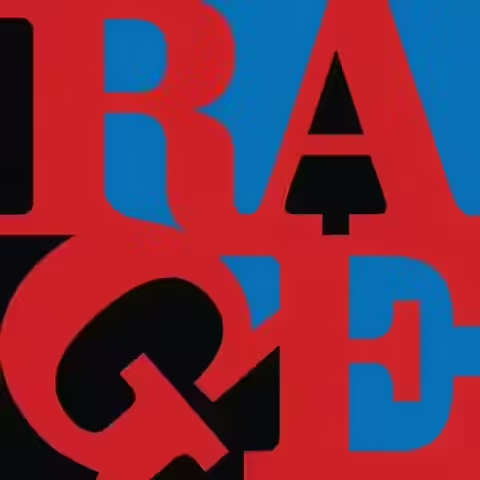
The Renegades sleeve is one of the most recognisable in the band's catalogue, and one of its wittiest. The cover takes Robert Indiana's famous 1960s LOVE image, the stacked, tilted letters reproduced on everything from US postage stamps to public sculpture, and rewrites it as RAGE, the four red capitals set against a black and blue field. The pun is perfect for the band: the most ubiquitous symbol of pop-art sentiment turned into a fist.
Art direction was credited to Aimee Macauley working with the band, with the inside booklet handled by Jake Koppell. The choice underlined what Renegades was really about, taking something familiar from the culture and repurposing it as protest. It was the same trick the music played, performed in a single image.
Release & Reception
Renegades was released on 5 December 2000 to strong reviews, holding a score of 78 out of 100 on Metacritic from 26 critics. For a covers album from a band in the act of breaking up, the reception was remarkably warm, with most critics impressed by how thoroughly Rage had made the songs their own.
"The album works well with just a bare few exceptions, in part because Rage Against the Machine is both smart enough to change very little and talented enough to make the songs its own."
John Bush, AllMusic, 2000
Entertainment Weekly's Rob Brunner gave it an A minus, calling it "a remarkably diverse, if not exactly surprising, mix of heavy rock, hip hop and protest music" that "would still be a raging success even if this disc does nothing but introduce a new generation to the joys of Bob Dylan and Minor Threat". NME awarded it eight out of ten and described it as "a brilliant archaeology", while Alternative Press called it "a tour through three decades of sonic recalcitrance" and "the genome map of seditious sound". Rolling Stone's Tom Moon praised the band for tackling the material with "the roaring, fearless spirit that's been missing in action since these songs were new".
Commercially, the album told a more bittersweet story. After two consecutive number one records, Renegades stalled at number 14 on the Billboard 200, the first Rage studio album since their 1992 debut to miss the top of the chart. With no band left to promote it, that was perhaps inevitable. It still went platinum in the United States within roughly a month, reached the top ten in Australia and number 13 in Canada, and earned gold and platinum certifications around the world.
| Territory | Chart | Peak |
|---|---|---|
| United States | Billboard 200 | 14 |
| Australia | ARIA | 10 |
| Canada | Canadian Albums | 13 |
| Finland | Suomen virallinen lista | 25 |
| Germany | Offizielle Top 100 | 47 |
| Switzerland | Schweizer Hitparade | 49 |
| United Kingdom | UK Albums | 71 |
Singles & Music Videos
Only one single was lifted from Renegades, and it arrived after the band had already ceased to exist. "Renegades of Funk", the band's electrified take on Afrika Bambaataa's 1983 electro-funk classic, was released on 20 February 2001, complete with a music video. It was an inspired choice for a swansong: a song about rebels through history, from "the renegades of the atomic age" onward, repurposed by a band that had spent a decade casting itself in exactly that role.
The track later earned the band a Grammy nomination for Best Hard Rock Performance at the 2002 ceremony, a final piece of mainstream recognition for a group that had always claimed to despise it. There was no second single and no campaign behind the record beyond that. The promotional machine that usually drives a platinum album was simply absent, because the band that would have powered it had walked away.
Touring & Live
There was no Renegades tour. The album was released into a vacuum, its creators already scattered, and so a record full of songs born on stages and in soundchecks never got a stage of its own. It remains the only Rage Against the Machine album never supported by a single concert in its own name.
The songs did not vanish, though. Several had been live fixtures long before they were recorded, and several returned to the setlist when the classic line-up reunited later in the decade. "Kick Out the Jams" and "Renegades of Funk" in particular found their way back into Rage shows, and on occasion the band shared a stage with the originals, including MC5 guitarist Wayne Kramer. The covers, it turned out, outlived the band that recorded them, exactly as a good cover should.
In TV, Film & Media
Renegades occupies an unusual place in the band's screen legacy. The Rage songs that became cultural shorthand, "Killing in the Name", "Wake Up" from The Matrix, "Guerrilla Radio" on video game soundtracks, are all originals, not covers. The Renegades versions live a quieter life, surfacing mainly through the "Renegades of Funk" video and the album's enduring presence on streaming playlists devoted to protest music and rock covers.
That said, the record introduced a generation of guitar-leaning listeners to songs they might never otherwise have heard. For many young fans in 2000, Rage's versions were the first contact they ever had with Minor Threat, EPMD or Devo, an act of musical evangelism that Entertainment Weekly singled out as the album's quiet triumph.
Controversy & Aftermath
The drama around Renegades was less about the music than the circumstances that surrounded it. The New York Stock Exchange shoot for "Sleep Now in the Fire", which briefly halted trading at the heart of global capitalism, became one of the defining acts of guerrilla film-making in rock, and a fitting symbol for a band whose final studio statement was a meditation on rebellion.
Less than a year later the wider context turned darker. In the aftermath of the 11 September 2001 attacks, the broadcasting giant Clear Channel circulated an internal memorandum of songs considered "lyrically questionable" for airplay. Rage Against the Machine held the grim distinction of being the only act to have their entire catalogue listed. For a band that had just released an album arguing that protest music was an unbroken American tradition, it was an oddly perfect coda.
Covers, Samples & the Source Artists
Because Renegades is itself a covers album, its most interesting relationships run backwards, to the artists it drew from. The track list is a deliberate map of influence, and reading it as one reveals exactly how Rage saw their own lineage.
- Hip hop roots: Eric B. & Rakim, EPMD, Cypress Hill, Afrika Bambaataa and Volume 10.
- Hardcore and proto-punk: Minor Threat, MC5 and The Stooges.
- Classic rock and folk protest: The Rolling Stones, Bob Dylan, Bruce Springsteen and Devo.
The selection makes an argument that few other bands could credibly make: that Rakim and Bob Dylan, Iggy Pop and Ian MacKaye, are all part of the same dissident tradition. By covering them side by side, Rage placed themselves at the confluence of all three streams, which is exactly where their own music had always sat.
Legacy & Influence
Renegades closed one of the most influential chapters in modern rock. The rap-metal and nu-metal explosion that dominated the early 2000s owed an enormous debt to the template Rage had built, even when the bands who profited from it stripped out the politics. As an end point, a covers album was a strange but oddly honest one: a band acknowledging the music that made them on the way out the door.
What happened next is almost as famous as the band itself. Morello, Commerford and Wilk stayed together and, on Rick Rubin's suggestion, joined forces with former Soundgarden singer Chris Cornell to form Audioslave, whose self-titled debut arrived in 2002. Morello was characteristically dry about the split that made it possible.
"We informed Epic that losing our singer was actually a blessing in disguise, and that we had bigger ambitions than being somebody's hired musicians."
Tom Morello, Q, 2003
De la Rocha pursued a quieter, more sporadic path, collaborating with DJ Shadow and Trent Reznor and later forming the duo One Day as a Lion. The story did not end there either. The classic line-up reunited at Coachella in 2007 and toured on and off for years, sent "Killing in the Name" to the UK Christmas number one in 2009 through a grassroots campaign, and was inducted into the Rock and Roll Hall of Fame in 2023. Through all of it, Renegades stood as the full stop on their studio career, a defiant, generous farewell that nobody, least of all the band, set out to make.
Things You Might Not Know
| Fact | Detail |
|---|---|
| A posthumous album | Zack de la Rocha had announced his departure on 18 October 2000, nearly seven weeks before Renegades was released, making it the only Rage album issued after the band had already split. |
| All twelve are covers | It is the band's only album with no original compositions, spanning hip hop, punk, funk, folk and classic rock across five decades. |
| The chart slip | After Evil Empire and The Battle of Los Angeles both entered at number one, Renegades stalled at number 14, the first Rage studio album since their debut to miss the top. |
| Rubin's first Rage record | Renegades was the only Rage album not produced by Brendan O'Brien, though he returned to produce a single track, the cover of "The Ghost of Tom Joad". |
| A LOVE letter | The cover restyles Robert Indiana's famous LOVE pop-art image as RAGE, the four red capitals set against a black and blue background. |
| Cypress Hill came back | A live recording of "How I Could Just Kill a Man" featured the song's original authors, Sen Dog and B-Real of Cypress Hill, joining the band. |
| One single, after the end | "Renegades of Funk" was released as the album's only single on 20 February 2001, months after the band had ceased to exist, and earned a Grammy nomination. |
| The blessing in disguise | Three quarters of the band became Audioslave with Chris Cornell after Rick Rubin suggested the pairing; Morello later joked there had been talk of becoming Ozzy Osbourne's or Macy Gray's backing band. |
| Listed in full | After 11 September 2001, Clear Channel's internal memo of "lyrically questionable" songs listed Rage Against the Machine's entire catalogue, the only act so flagged. |
| No tour, ever | Renegades is the only Rage Against the Machine album never supported by a concert tour, because the band had dissolved before its release. |
The Riffology Podcast
Renegades is the kind of record that rewards a long conversation: a covers album that doubles as a manifesto, a farewell nobody planned, and a snapshot of one of the most important bands in rock at the exact moment it tore itself apart. If you want to dig deeper into the stories behind the songs, the band that made them and the music that made the band, the Riffology podcast is available on all major platforms. Pull up a chair, turn it up, and join us.
Comments